Dairy Compounders Ignore Macro Noises: Bega Cheese +130%, PT Ultrajaya Milk +230% YTD (Bamboo Innovator Insight)

The following article is extracted from the Bamboo Innovator Insight weekly column blog related to the context and thought leadership behind the stock idea generation process of Asian wide-moat businesses that are featured in the monthly entitled The Moat Report Asia. Fellow value investors get to go behind the scene to learn thought-provoking timely insights on key macro and industry trends in Asia, as well as benefit from the occasional discussion of potential red flags, misgovernance or fraud-detection trails ahead of time to enhance the critical-thinking skill about the myriad pitfalls of investing in Asia at the microstructure- and firm-level.

The weekly Bamboo Innovator Insight series brings to you:

Cheese

Dear Friends and All,

Dairy Compounders Ignore Macro QE Noises: Bega Cheese +130%, PT Ultrajaya Milk +230% YTD

At the Singapore Cricket Club last Thursday, the Bamboo Innovator had lunch with one of our subscribers, Mr Hemant Amin, a highly accomplished and astute Indian value investor who runs a global industrial raw material procurement house and his own multi-million family office with concentrated bets in stocks such as Infosys which delivered over 60 times in handsome returns. Hemant also heads a value investor group called BRKets (www.brkets.com) with 11 other members. The name BRKets (pronounced as ‘brickets’) is a fusion of Berkshire Hathaway’s ticker code BRK and the Cricket Club where they meet. 6 of the BRKets members joined us for an interesting lunch discussion on value investing in Asia where we share our investment outlook, wide-moat business model analysis and stock ideas.

When Hemant ordered cheese platter for his desert, it triggered me to think about the inspiring stories of another outstanding Indian entrepreneur Devendra Shah and Barry Irvin of Bega Cheese. Shah turned the smallish Pune-based Parag Milk Foods into a high value dairy powerhouse with his bold decision in early 2008 to invest in the untapped opportunity in processed cheese in India, doubling by end 2008 the entire country’s cheese-making capacity from 40 tonnes to 80 tonnes. Interestingly, while the world is fixated on the QE tapering macro challenges, Warrnambool Cheese & Butter Factory (ASX: WCB AU, MV A$467m) is up 90% in less than three months since Sept. This was despite WCB posting its lowest profit since 2009 with FY13 (year end Jun) net profit down over 50% as it was the subject of a three-way bidding war by Canadian giant Saputo (TSX: SAP, MV C$9.6bn), Japan’s Kirin, and Bega Cheese (ASX: BGA AU, MV A$704m). Bega is a wide-moat company in our Bamboo Innovator Index since its listing in Aug 2011 with a market value of A$240m. NZ dairy giant Fonterra (FCG NZ, MV NZ$10.9bn), after its own contamination scare in Aug, joined in the industry consolidation battle by acquiring a 6% stake in Bega on Nov 2, adding on to Bega’s spectacular share price returns of 130% year-to-date. Ongoing competition in the raw milk market with supply affected by droughts in NZ and Australia and unseasonably cold weather conditions in Europe has kept upward pressure in prices paid to milk suppliers; the surge in the GDT (global dairy trade) price index from 800 to over 1,400 in the last year-and-a-half has hurt the profitability of processor such as WCB. Yet, despite both WCB and Bega being cheese processor companies, Bega has been able to achieve FY13 EBITDA and net profit growth of 13% and 25% respectively as compared to the FY13 decline of 28% and 51% for WCB. Meanwhile, the share price performance of dairy giants Saputo and Fonterra are flat YTD.

So why are Parag and Bega outperforming Bamboo Innovators in a cyclical commodity industry, especially when they are supposedly price-taking minnows in the midst of oligopolistic giants Fonterra, Murray Goulburn, Saputo, Amul (India), Royal Friesland Campina, Arla etc? What are the lessons for value investors when investing in companies related to the volatile commodities cycle? I admit that I was also surprised by the sharp jump in share price of well-managed boring consumer food companies such as Bega. But it once again proves the wisdom of one of our subscribers, Mr K, an intelligent value investor who has nearly doubled his returns from his investment since Mar this year in DKSH Malaysia (DKSH MK) after it was highlighted as a Bamboo Innovator; his thoughtful comments:

“I’d love money making ideas, but I also very excited about education, and understanding/ navigating Asian markets. If I can avoid stupid (frauds) mistakes, I think the upside will work out.”

By avoiding the “set-up” fraudulent companies which are promoted with that alluring sexy growth theme by a whole gamut of syndicates, insiders and brokers/dealmakers, and by staying long-term in undervalued wide-moat businesses – even if they are boring like cheese! – the short-term returns may be unexciting or even frustrating but the longer-term upside will eventually work out for the value investor.

How did Barry Irvin grow Bega Cheese from a single-site regional dairy processor in southern New South Wales (NSW) town of Bega, with 80 employees and selling only into the domestic market, to its position today as the southern hemisphere’s largest cheese-packing and processing business, with sales nudging to over A$1 billion a year, exporting to more than 40 countries and employing over 1,600 people? What caught the Bamboo Innovator’s attention in Bega before its Aug 2011 listing was an article in May 2011 in Sydney Morning Herald about how Irvin was the parent and caregiver of his autistic child Matthew, now 22. For two decades, the 51-year-old Irvin has juggled the responsibilities of caring for a disabled child, running the family farm and steering the ambitious former dairy co-operative through deregulation, acquisition, a public float..

helpLead-420x0Barry Irvin pictured with his son Matthew.

The role of a caregiver is special: they need to have that intangible quality of inner courage at its “core” to give strength to its “periphery”, much like the empty hollow center of a bamboo in which the nutrients and moisture that would have been exhausted making and maintaining this empty center can be utilized for growth of the periphery bamboo culm/stem. The architecture of the bamboo culm presents a powerful configuration: fibers of greatest strength occur in increasing concentration toward the periphery of the plant. With Irvin helming Bega, it is likely that the company will invest in the intangibles, in people and building long-term relationships..

Also, what are the lessons for value investors from the story of Indonesia’s PT Ultrajaya Milk (+230% YTD), controlled by the family of the late Ahmad Prawirawidjaja who established the business in 1958 from his house in Bandung? What are the 4 key Bamboo Innovator takeaways?

The Inner Light of Asian Compounders: The Reborn of India’s Hero Motocorp (Bamboo Innovator Insight)

The following article is extracted from the Bamboo Innovator Insight weekly column blog related to the context and thought leadership behind the stock idea generation process of Asian wide-moat businesses that are featured in the monthly entitled The Moat Report Asia. Fellow value investors get to go behind the scene to learn thought-provoking timely insights on key macro and industry trends in Asia, as well as benefit from the occasional discussion of potential red flags, misgovernance or fraud-detection trails ahead of time to enhance the critical-thinking skill about the myriad pitfalls of investing in Asia at the microstructure- and firm-level.

The weekly Bamboo Innovator Insight series brings to you:

  • The Inner Light of Asian Compounders: The Reborn of India’s Hero Motocorp, Nov 4, 2013 (Moat Report Asia, BeyondProxy)

Hero

Dear Friends and All,

The Inner Light of Asian Compounders: The Reborn of India’s Hero Motocorp

A Hero lights up this Diwali festival: Hero Motocorp (HMCL IN, MV $6.8 billion), the world’s largest two-wheeler manufacturer (by volume), announced on Nov 1, the first day of Diwali, that they achieved the highest-ever retail sales (625,420 units, +18.2% yoy) for any month in October in India. This is also the first time that any two-wheeler manufacturer has exceeded the landmark 6 lakh (600,000) unit sales in a month. Hero sold 6.23 million units in the year ended March 31, and has a capacity to produce 7 million annually. Hero’s performance stood in contrast to the four-wheeler market in which the automakers from Maruti Suzuki, Tata Motor and Mahindra & Mahindra reported lower or nearly flat sales with the Indian economy growing at its slowest pace in a decade and accelerating inflation (onion prices has surged from Rs 16 a kg in Jun to Rs 100) leading the central bank to raise its lending rate twice in as many months. Interestingly, just three years ago on Dec 21, 2010, Hero hit a crisis and was thought to have problems surviving in India. Yet, Hero has emerged stronger from the crisis because of its “Inner Light”, just like the spiritual significance of Diwali.

Diwali, also called Deepavali or the “festival of lights”, is a five-day Hindu festival to celebrate the slaying of the evil demon Narakasura by Lord Krishna, the incarnation of Vishnu (the supreme god of Hinduism), signifying the victory of good over evil and light over darkness. The deeper spiritual meaning of Diwali celebrates the belief that there is something beyond the physical body and mind which is pure, infinite, and eternal, called the Atman or the Inner Light. With this awakening of the Inner Light comes compassion and the awareness of the oneness of higher knowledge which brings ananda (joy or peace).

Hero Motocorp is an incarnation of Hero Honda, the JV formed between founder Brijmohan Lall Munjal and Japan’s Honda Motor (7267 JP) in 1984 in a country that did not think beyond scooters back then. By 2001, Hero Honda beat Bajaj Auto (BJAUT IN) to become India’s largest two-wheeler manufacturer – and also the world’s largest for 12 consecutive years. In the years between March 2000 and March 2011, Hero Honda’s revenue grew from Rs 2,118 crore to Rs 20,787 crore ($3.4 billion); profits increased from Rs 192 crore to Rs 1,927 crore ($314 million).

On Dec 21, 2010, Honda announced a bitter split up and Hero bought over their 26% stake for Rs 3,842 crore ($622 million), ending the 26 year-old JV which started with equity of Rs 16 crore, of which Honda contributed Rs 4 crore. Worse, Honda will be competing with Hero in India and Hero has to drop the Honda name from its brands, products, and distribution outlets after March 2014. How would customers know that the Hero bike is not Honda nad that the quality has not gone down? Dealers are thought to be stampeding out of Hero to join Honda. Prior to the termination of the joint venture, Honda supplies technology for products which Hero marketed in India and Hero’s right to use Honda’s new technology for Hero’s new products will end in 2017, though they can continue to use the existing technology. The 90 year-old Munjal commented, “They didn’t tell us that they want to leave. We told them that if they, themselves, are here to make motorcycles, then they become competitors. How can a competitor and principal be the same?” Since the split, Honda, the world’s biggest motorcycle maker, overtook Bajaj Auto to become India’s second biggest two-wheeler seller with around a 20% market share and vowed to overtake former partner Hero’s 43% leadership by 2020.

So how did Hero survive the crisis? What are the lessons for value investors in assessing stocks in Asia beyond the quantitative financial numbers? What are the five key Bamboo Innovator takeaways?

Warren Buffett and Charlie Munger’s best advice: “The big secret is that we’re good at lifelong learning. If you keep learning all the time, you have a wonderful advantage.”

Warren Buffett and Charlie Munger’s best advice

By Patricia Sellers October 31, 2013: 11:50 AM ET

The world’s greatest investing duo talk about how they’ve helped each other exceed at investing–and life.

Warren Buffett and his lifelong investing partner Charlie Munger are rarely interviewed together except in front of 30,000-plus shareholders at the Berkshire Hathaway (BRKA) annual meeting in Omaha each spring. So, my recent sit-down with the two investing legends was a special event. The new issue of Fortune features Buffett, 83, and Munger, 89 and other super-successful duos who have thrived by sharing advice with one another over the years. Here’s an expanded piece of my interview that didn’t make it into the magazine. You don’t have to be a billionaire to understand that following  this advice can lead to a truly successful life. Read more of this post

Tired Asian Businessmen, Assessing Management Quality and the $15 Billion Oshin Retail Stock in China (Bamboo Innovator Insight)

The following article is extracted from the Bamboo Innovator Insight weekly column blog related to the context and thought leadership behind the stock idea generation process of Asian wide-moat businesses that are featured in the monthly entitled The Moat Report Asia. Fellow value investors get to go behind the scene to learn thought-provoking timely insights on key macro and industry trends in Asia, as well as benefit from the occasional discussion of potential red flags, misgovernance or fraud-detection trails ahead of time to enhance the critical-thinking skill about the myriad pitfalls of investing in Asia at the microstructure- and firm-level.

  • Tired Asian Businessmen, Assessing Management Quality and the $15 Billion Oshin Retail Stock in China, Oct 28, 2013 (Moat Report AsiaBeyondProxy)

Oshin

Dear Friends and All,

Tired Asian Businessmen, Assessing Management Quality and the $15 Billion Oshin Retail Stock in China

“A tired businessman is one whose business is usually not a successful one.” – Joseph R. Grundy (1863-1961), Quaker businessman and US senator

“For many CEOs the hours are relentless; you’re working around the clock seven days of the week. I need a break. I think three-and-a-half years in the department store is a long time and if you think about our restructuring post the global financial crisis [and] us not being ready for the digital world, it has taken its toll and I’m just simply tired. The past three-and-a-half years as a CEO … weren’t normal, let’s face it. It was tough going and I am signalling my intention to resign ….” – Paul Zahra, CEO of David Jones, on Oct 22, 2013

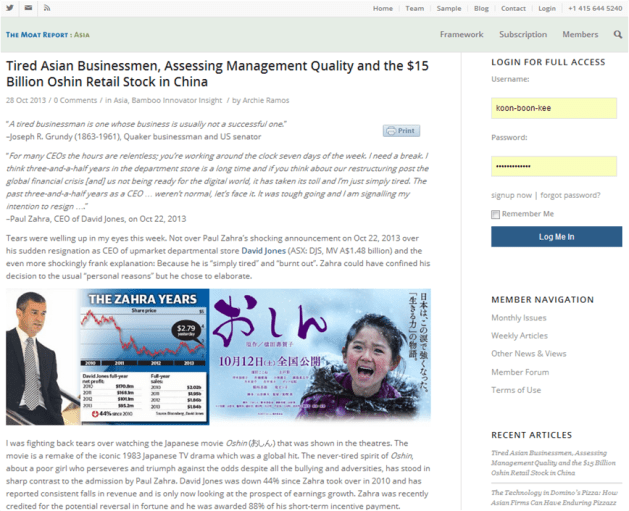
Tears were welling up in my eyes this week. Not over Paul Zahra’s shocking announcement on Oct 22, 2013 over his sudden resignation as CEO of Australian upmarket departmental store David Jones (ASX: DJS, MV A$1.48 billion) and the even more shockingly frank explanation: Because he is “simply tired” and “burnt out”. Zahra could have confined his decision to the usual “personal reasons” but he chose to elaborate.

I was fighting back tears over watching the Japanese movie Oshin (おしん) that was shown in the theatres. The movie is a remake of the iconic 1983 Japanese TV drama which was a global hit. The never-tired spirit of Oshin, about a poor girl who perseveres and triumph against the odds despite all the bullying and adversities, has stood in sharp contrast to the admission by Paul Zahra. David Jones was down 44% since Zahra took over in 2010 and has reported consistent falls in revenue and is only now looking at the prospect of earnings growth. Zahra was recently credited for the potential reversal in fortune and he was awarded 88% of his short-term incentive payment.

Oshin is inspired by the touching story of the late Katsu Wada, the indefatigable entrepreneur who founded the once-successful Japanese departmental chain Yaohan in 1930. The film-maker explained that the 30-year lag for the movie version of the series was to celebrate the 30th anniversary of Oshin and that even after 30 years, “there are some things that never change, like the inspirational story of perseverance”. Even though I have watched the TV series like most older-generation Asians and am familiar with the story, I still cried in one particular scene. Before Oshin’s beloved grandmother died, she had a mouthful of the rice porridge – wages that were earned by Oshin when she was taken in by the kind and wise matriarch Mrs Yashiro in exchange for her labor at the Kagawa-family rice dealer shop. Oshin’s grandmother’s touching parting words: “The rice is very tasty.”

The death of her grandmother steels Oshin’s resolve to make something good out of her life. The story of Oshin is to remind people to cherish those around them and to keep going no matter what happens. Perhaps I was also a little emotional because building up The Moat Report Asia has its unique challenges and what kept me going was the sense of duty to value-add to our subscribers and readers with authentic and refreshing views about resilient compounders in Asia as accounting frauds of companies with attractive quant financials and net-net numbers break out systematically and syndicates manipulating share prices and volumes run rampant. Like Oshin who treasure the people around her, I cherish every one of our subscribers and they come from North America, the Nordic, Europe, the Oceania and Asia, including value investors with over $20 billion in asset under management in equities.

Quaker entrepreneur Joseph Grundy (1863-1961) illuminated a useful way to assess management quality with his penetrating quote: “A tired businessman is one whose business is usually not a successful one.” The story of Paul Zahra and Oshin highlighted two interesting questions:

  • Avoiding stocks whose companies are run by managers who are tired appear to be a sound method to lower downside risks. If so, is it possible to know in advance why managers get tired and burn out?
  • Why then do others not get tired like Oshin? How to identify and invest in stocks whose management and culture that have such Oshin-like quality?

To answer these questions, let’s explore the case of the $94-billiion retail grocery market in China:

  • Why is there one Oshin-like company in China, with a market value of $15 billion, who is growing sustainably when everyone else, from Tesco, Wal-Mart to Asia’s richest businessman Li Ka-Shing’s Park N’Shop and Thai billionaire tycoon’s CP Lotus, are “tired” with faltering growth and losses?
  • Also, what are the 3Ms that resulted in entrepreneurs and managers to not become tired? The 3Ms is also a simple and practical way to help value investors assess management quality.
  • How can companies avoid the fate of a Yaohan and investors to detect the downfall ahead of time?

“In business, I look for economic castles protected by unbreachable ‘moats’.”

– Warren Buffett

The Moat Report Asia is a research service focused exclusively on competitively advantaged, attractively priced public companies in Asia. Together with our European partners BeyondProxy and The Manual of Ideas, the idea-oriented acclaimed monthly research publication for institutional and private investors, we scour Asia to produce The Moat Report Asia, a monthly in-depth presentation report highlighting an undervalued wide-moat business in Asia with an innovative and resilient business model to compound value in uncertain times.

Learn more about membership benefits here: http://www.moatreport.com/subscription/

Our latest upcoming monthly issue for the month of October examines a Northeast Asia-listed company with global #1 market share leadership in 4 different products, including making the components for an innovative consumer product whose sales have climbed from $90 million to $526 million in the recent three years. The company is a hidden global consolidator with underappreciated growth. The stock is trading at PE 11.5x, EV/EBITDA 9x and generates a sustainable dividend yield 5.75%.

Our past monthly issues in August and September investigate a Taiwan and Southeast-Asian-listed entrepreneurial company, both with a dominant 80% domestic market share and have innovative business models to generate substantial cashflow to support both expansion and a 4-5% dividend yield. There is also a behind-the-scene conversation with the CEO of the two companies to understand their thinking process in building up the business.

The Moat Report Asia Members’ Forum has been getting penetrating quality dialogues from our existing institutional subscribers from North America, the Nordic, Europe, the Oceania and Asia, including professional value investors with over $20 billion in asset under management in equities. Questions range from:

  • The nuances of internal dealings in Asia, including the case discussion of the recent deal in which HK billionaire’s Lee Shau-kee Henderson Land acquiring Towngas or Hong Kong & China Gas (3 HK) from his family holdings, seemingly déjà vu from the early Oct 2007 transaction when the market peak.
  • The case of F&N Singapore spinning out its property unit FCL Trust and getting “free” special dividend-in-specie and the potential risk in asset swap restructuring to deleverage the hidden debt in the entire Group balance sheet.
  • The dilemma of whether to invest in a Southeast Asian-listed company and hidden champion with a domestic market share of 60% due to family squabbles and a legal suit over the company’s ownership.
  • Discussion of the wise and thoughtful 107-year-old Irving Kahn’s investment into a US-listed but Hong Kong-based electronics company with development property project in Shenzhen’s Qianhai zone and the possible corporate governance risks that could be underestimated or overlooked, as well as their history of listing some assets in HK in 2004.. This is also a case study of “buy one get one free” in John’s highly-acclaimed book The Manual of Ideas in which the “free” property is lumped together with the (eroding) core business to make the combined entity look cheap and undervalued. What are the potential areas that value investors need to watch out for when adapting the SOTP (sum-of-the-parts) valuation method in Asia?
  • And many more intriguing questions.

Do find out more in how you can benefit from authentic and candid on-the-ground insights that sell-side analysts and brokers, with their inherent conflict-of-interests, inevitable focus on conventional stock coverage and different clientele priorities, are unwilling or unable to share. Think of this as pressing the Bloomberg “Help Help” button to navigate the Asian capital jungle. Institutional subscribers also get access to the Bamboo Innovator Index of 200+ companies and Watchlist of 500+ companies in Asia and the Database has eliminated companies with a higher probability of accounting frauds and  misgovernance as well as the alluring value traps.

The Technology in Domino’s Pizza: How Asian Firms Can Have Enduring Pizzazz (Bamboo Innovator Insight)

The following article is extracted from the Bamboo Innovator Insight weekly column blog related to the context and thought leadership behind the stock idea generation process of Asian wide-moat businesses that are featured in the monthly entitled The Moat Report Asia. Fellow value investors get to go behind the scene to learn thought-provoking timely insights on key macro and industry trends in Asia, as well as benefit from the occasional discussion of potential red flags, misgovernance or fraud-detection trails ahead of time to enhance the critical-thinking skill about the myriad pitfalls of investing in Asia at the microstructure- and firm-level.

  • The Technology in Domino’s Pizza: How Asian Firms Can Have Enduring Pizzazz, Oct 21, 2013 (Moat Report Asia, BeyondProxy)

Pizzazz

Dear Friends and All,

The Technology in Domino’s Pizza: How Asian Firms Can Have Enduring Pizzazz

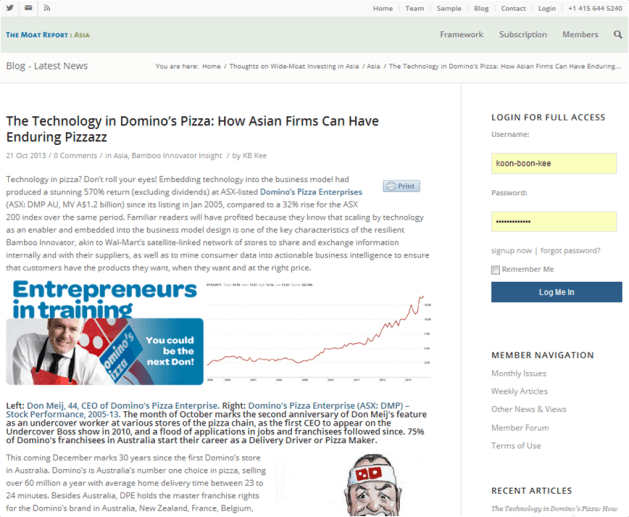
Technology in pizza? Don’t roll your eyes! Embedding technology into the business model had produced a stunning 570% return (excluding dividends) at ASX-listed Domino’s Pizza Enterprises (ASX: DMP AU, MV A$1.2 billion) since its listing in Jan 2005, compared to a 32% rise for the ASX 200 index over the same period. Familiar readers will have profited because they know that scaling by technology as an enabler and embedded into the business model design is one of the key characteristics of the resilient Bamboo Innovator, akin to Wal-Mart’s satellite-linked network of stores to share and exchange information internally and with their suppliers, as well as to mine consumer data into actionable business intelligence to ensure that customers have the products they want, when they want and at the right price.

This coming December marks 30 years since the first Domino’s store in Australia. Domino’s is Australia’s number one choice in pizza, selling over 60 million a year with average home delivery time between 23 to 24 minutes. Besides Australia, DPE holds the master franchise rights for the Domino’s brand in Australia, New Zealand, France, Belgium, Monaco and The Netherlands, and is the largest franchisee for the brand in the world. DPE also recently acquired 75% of Domino’s Japan from Bain Capital in Aug/Sep 2013 for A$128 million, plus agreeing to supply new debt funding of another A$96.4 million for a total of about A$225 million, adding 259 Japanese stores (216 corporate and 43 franchise) to increase DPE’s total store network to over 1,200 stores. Thus, for value investors seeking exposure to Japan but are wary of the governance risks of the domestic stocks, DPE provides an interesting alternative with significantly lower governance risk. Stocks listed outside of Japan with exposure to Japan could be an interesting topic of discussion in the highly insightful Japan Investing Summit on Nov 5-6. Long-time value investors in Japan are cognizant that stocks with high net cash or net current asset as a percentage of their market cap are potential value traps since the cash and liquid assets are “borrowed” by their powerful bank shareholders as part of the keiretsu network, a phenomenon documented empirically as the “keiretsu” valuation discount and investor activism pushing for change usually becomes an act of kicking the hornet’s nest. Empirical fans would find the research of Takeo Hoshi (Stanford University), Anil Kashyap and Douglas Skinner (Chicago Booth School of Business), and Suraj Srinivasan (Harvard Business School) to be particularly useful in understanding governance risks in Japan.

Back to pizza. What did Domino’s Pizza do to embed technology into its business model? What are the 5 Key Bamboo Innovator Takeaways?

The Moat Report Asia Members’ Forum has been getting penetrating quality dialogues from our existing institutional subscribers from North America, the Nordic, Europe, the Oceania and Asia, including professional value investors with over $20 billion in asset under management in equities. Questions range from:

  • The nuances of internal dealings in Asia, including the case discussion of the recent deal in which HK billionaire’s Lee Shau-kee Henderson Land acquiring Towngas or Hong Kong & China Gas (3 HK) from his family holdings, seemingly déjà vu from the early Oct 2007 transaction when the market peak.
  • The case of F&N Singapore spinning out its property unit FCL Trust and getting “free” special dividend-in-specie and the potential risk in asset swap restructuring to deleverage the hidden debt in the entire Group balance sheet.
  • The dilemma of whether to invest in a Southeast Asian-listed company and hidden champion with a domestic market share of 60% due to family squabbles.
  • Discussion of the wise and thoughtful 107-year-old Irving Kahn’s investment into a US-listed but Hong Kong-based electronics company with development property project in Shenzhen’s Qianhai zone and the possible corporate governance risks that could be underestimated or overlooked, as well as their history of listing some assets in HK in 2004.. This is also a case study of “buy one get one free” in John’s highly-acclaimed book The Manual of Ideas in which the “free” property is lumped together with the (eroding) core business to make the combined entity look cheap and undervalued. What are the potential areas that value investors need to watch out for when adapting the SOTP (sum-of-the-parts) method in Asia?
  • And many more intriguing questions.

Do find out more in how you can benefit from authentic and candid on-the-ground insights that sell-side analysts and brokers, with their inherent conflict-of-interests, inevitable focus on conventional stock coverage and different clientele priorities, are unwilling or unable to share. Think of this as pressing the Bloomberg “Help Help” button to navigate the Asian capital jungle. Institutional subscribers also get access to the Bamboo Innovator Index of 200+ companies and Watchlist of 500+ companies in Asia and the Database has eliminated companies with a higher probability of accounting frauds and  misgovernance as well as the alluring value traps.

Can Asia Produce a Precision Castparts (PCP), a 1,000X Compounder? (Bamboo Innovator Insight)

The following article is extracted from the Bamboo Innovator Insight weekly column blog related to the context and thought leadership behind the stock idea generation process of Asian wide-moat businesses that are featured in the monthly entitled The Moat Report Asia. Fellow value investors get to go behind the scene to learn thought-provoking timely insights on key macro and industry trends in Asia, as well as benefit from the occasional discussion of potential red flags, misgovernance or fraud-detection trails ahead of time to enhance the critical-thinking skill about the myriad pitfalls of investing in Asia at the microstructure- and firm-level.

Asia PCPDear Friends and All,

Can Asia produce a Precision Castparts Corp (PCP)? PCP grew from a small metal casting workshop to become one of the best compounders in American capital history, up over 1,700x in three decades plus to a global giant with a market cap of $34.7 billion. In other words, an initial investment of $100,000 compounds to over $170 million.

This is one of the questions that I asked rhetorically in our recent Members’ Forum dialogue with one of our thoughtful Institutional Subscribers, who come from various continents spanning from North America, the Nordic, Europe and Asia, including professional value investors with over $20 billion in asset under management. This is not a trivial question since the median market cap of Asian companies is below $100 million, which is PCP’s market value before 1980. Even Buffett’s Berkshire Hathaway was attracted to the wide moat of PCP and initiated the purchase of 1.248 million shares in 3Q2012, a stake subsequently increased to 1.977 million shares that’s now worth over $450 million in its latest 13F filing; the astute capital allocators also overcome this major psychological barrier faced by many value investors: buying a stock that has already gone up multiple-folds. It is common for value investors to run screens for “cyclically cheap” stocks trading at 52-weeks low or 3-5 years low and “overlook” stocks like PCP or Fastenal who are long-term industry consolidators with their business models overcoming short-term cyclicality.

In the Forum, our institutional subscriber was initially asking about how the net cash position of a steel and aluminum stockist-cum-fabricator family business listed in Southeast Asia can be nearly two-third of its market cap which is below $100 million. The stock appears cheap, trading at a price-to-book of 0.68x. So a natural counter question: Could the high net cash be misleading and the stock is a value trap? How about tunneling opportunities of the cash via related party transactions? Is the listed company a front to act as a loan guarantor for its unlisted companies in the business group so that the high net cash mask the massive hidden off-balance-sheet debt at the group level? All these are prevalent situations in Asia that value investors using quant screens neglect to investigate, especially when share prices and volume of the illiquid stocks are manipulated.

And what similarities do PCP and the below chart of a Northeast Asian-listed stock, a family business which has 25% domestic market share in a relatively stable-demand product and run by the Seul family for 58 years, appear to have in common? What are the important differences that resulted in PCP becoming a resilient Bamboo Innovator but not the Asian company below?

Taihan Electric Wire Co. Ltd. (001440.KS) – Stock Price Performance, 1983-2013

BII_Oct2013_841

The Moat Report Asia Members’ Forum has been getting penetrating quality dialogues from our existing institutional subscribers from North America, the Nordic, Europe and Asia. Questions range from:

  • The nuances of internal dealings in Asia, including the case discussion of the recent deal in which HK billionaire’s Lee Shau-kee Henderson Land acquiring Towngas or Hong Kong & China Gas (3 HK) from his family holdings, seemingly déjà vu from the early Oct 2007 transaction when the market peak.
  • The case of F&N Singapore spinning out its property unit FCL Trust and getting “free” special dividend-in-specie and the potential risk in asset swap restructuring to deleverage the hidden debt in the entire Group balance sheet.
  • Discussion of the wise and thoughtful 107-year-old Irving Kahn’s investment into a US-listed but Hong Kong-based electronics company with development property project in Shenzhen’s Qianhai zone and the possible corporate governance risks that could be underestimated or overlooked, as well as their history of listing some assets in HK in 2004.. This is also a case study of “buy one get one free” in John’s highly-acclaimed book The Manual of Ideas in which the “free” property is lumped together with the (eroding) core business to make the combined entity look cheap and undervalued. What are the potential areas that value investors need to watch out for when adapting the SOTP (sum-of-the-parts) method in Asia?
  • And many more intriguing questions.

Do find out more in how you can benefit from authentic and candid on-the-ground insights that sell-side analysts and brokers, with their inherent conflict-of-interests, inevitable focus on conventional stock coverage and different clientele priorities, are unwilling or unable to share. Think of this as pressing the Bloomberg “Help Help” button to navigate the Asian capital jungle. Institutional subscribers also get access to the Bamboo Innovator Index of 200+ companies and Watchlist of 500+ companies in Asia and the Database has eliminated companies with a higher probability of accounting frauds and  misgovernance as well as the alluring value traps.

Value Investing and the Two Wolves in Asia: The Case of the Collapse of Singapore’s Speculative Stocks (Bamboo Innovator Insight)

The following article is extracted from the Bamboo Innovator Insight weekly column blog related to the context and thought leadership behind the stock idea generation process of Asian wide-moat businesses that are featured in the monthly entitled The Moat Report Asia. Fellow value investors get to go behind the scene to learn thought-provoking timely insights on key macro and industry trends in Asia, as well as benefit from the occasional discussion of potential red flags, misgovernance or fraud-detection trails ahead of time to enhance the critical-thinking skill about the myriad pitfalls of investing in Asia at the microstructure- and firm-level.

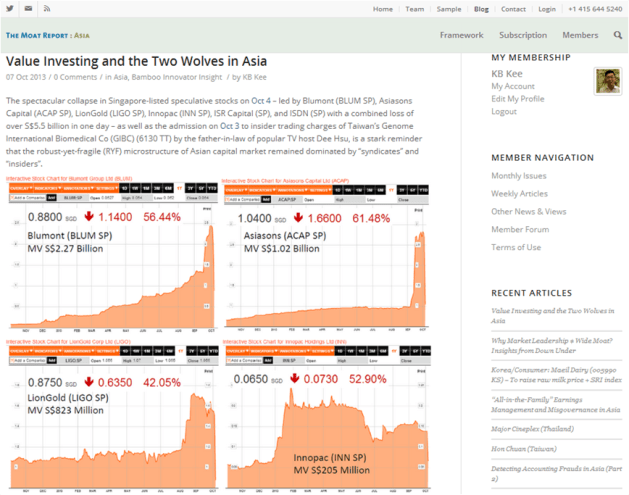
Spore Syndicate

Why Market Leadership ≠ Wide Moat? Insights from Down Under (Bamboo Innovator Insight)

The following article is extracted from the Bamboo Innovator Insight weekly column blog related to the context and thought leadership behind the stock idea generation process of Asian wide-moat businesses that are featured in the monthly entitled The Moat Report Asia. Fellow value investors get to go behind the scene to learn thought-provoking timely insights on key macro and industry trends in Asia, as well as benefit from the occasional discussion of potential red flags, misgovernance or fraud-detection trails ahead of time to enhance the critical-thinking skill about the myriad pitfalls of investing in Asia at the microstructure- and firm-level.

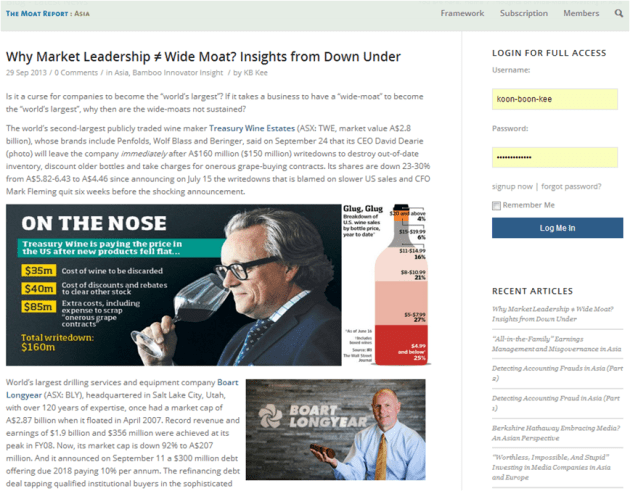
Makret Leadership Down Under


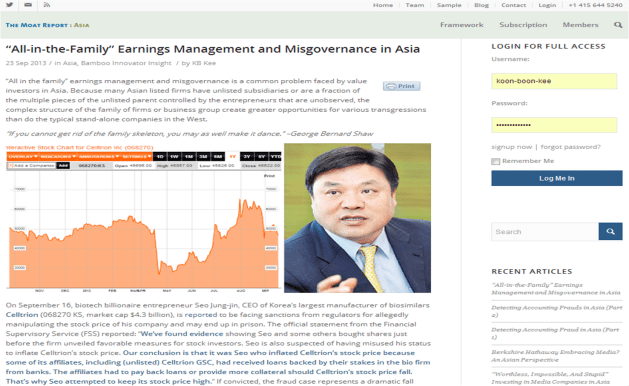
“All-in-the-Family” Earnings Management and Misgovernance in Asia (Bamboo Innovator Insight)

The following article is extracted from the Bamboo Innovator Insight weekly column blog related to the context and thought leadership behind the stock idea generation process of Asian wide-moat businesses that are featured in the monthly entitled The Moat Report Asia. Fellow value investors get to go behind the scene to learn thought-provoking timely insights on key macro and industry trends in Asia, as well as benefit from the occasional discussion of potential red flags, misgovernance or fraud-detection trails ahead of time to enhance the critical-thinking skill about the myriad pitfalls of investing in Asia at the microstructure- and firm-level.

Celltrion

Detecting Accounting Frauds in Asia (Part 2) (Bamboo Innovator Insight)

The following article is extracted from the Bamboo Innovator Insight weekly column blog related to the context and thought leadership behind the stock idea generation process of Asian wide-moat businesses that are featured in the upcoming monthly entitled Moat Report Asia. Fellow value investors get to go behind the scene to learn thought-provoking timely insights on key macro and industry trends in Asia as well as benefit from the occasional discussion of potential red flags, misgovernance or fraud-detection trails ahead of time to enhance the critical-thinking skill about the myriad pitfalls of investing in Asia at the microstructure- and firm-level.

Detecting Accounting Frauds in Asia Part 2

Detecting Accounting Frauds in Asia (Part 1) (Bamboo Innovator Insight)

The following article is extracted from the Bamboo Innovator Insight weekly column blog related to the context and thought leadership behind the stock idea generation process of Asian wide-moat businesses that are featured in the upcoming monthly Moat Report Asia. Fellow value investors get to go behind the scene to learn thought-provoking timely insights on key macro and industry trends in Asia as well as benefit from the occasional discussion of potential red flags, misgovernance or fraud-detection trails ahead of time to enhance the critical-thinking skill about the myriad pitfalls of investing in Asia at the microstructure- and firm-level.

  • Detecting Accounting Frauds in Asia (Part 1), Sep 11, 2013 (BeyondProxy)

DetectingFrauds1


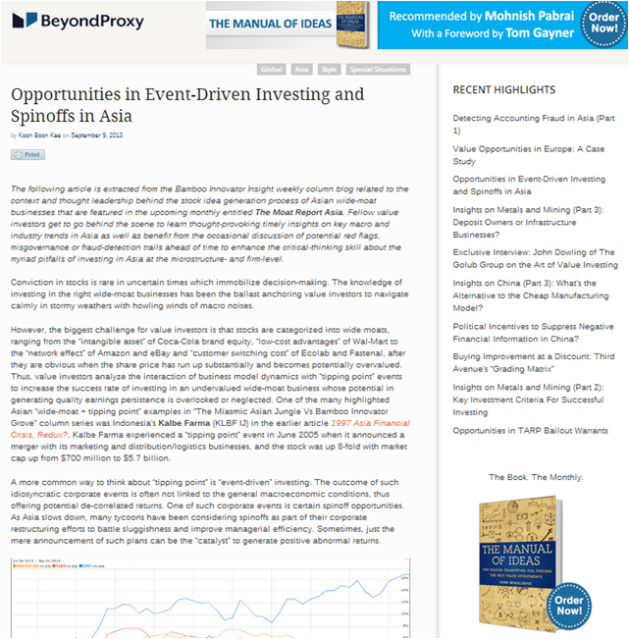
Opportunities in Event-Driven Investing and Spinoffs in Asia (Bamboo Innovator Insight)

The following article is extracted from the Bamboo Innovator Insight weekly column blog related to the context and thought leadership behind the stock idea generation process of Asian wide-moat businesses that are featured in the upcoming monthly Moat Report Asia. Fellow value investors get to go behind the scene to learn thought-provoking timely insights on key macro and industry trends in Asia as well as benefit from the occasional discussion of potential red flags, misgovernance or fraud-detection trails ahead of time to enhance the critical-thinking skill about the myriad pitfalls of investing in Asia at the microstructure- and firm-level.

  • Opportunities in Event-Driven Investing and Spinoffs in Asia, Sep 9, 2013 (BeyondProxy)

Spinoff


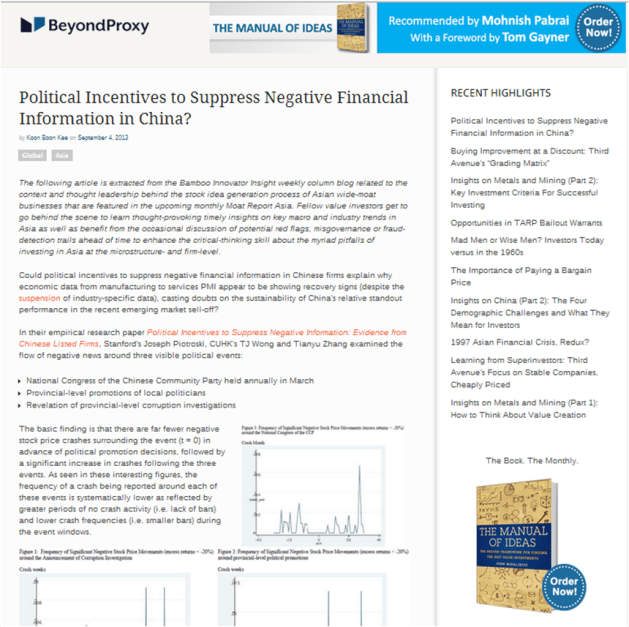
Political Incentives to Suppress Negative Financial Information in China? Moat Report Asia: Bamboo Innovator Insight

The following article is extracted from the Bamboo Innovator Insight weekly column blog related to the context and thought leadership behind the stock idea generation process of Asian wide-moat businesses that are featured in the upcoming monthly Moat Report Asia. Fellow value investors get to go behind the scene to learn thought-provoking timely insights on key macro and industry trends in Asia as well as benefit from the occasional discussion of potential red flags, misgovernance or fraud-detection trails ahead of time to enhance the critical-thinking skill about the myriad pitfalls of investing in Asia at the microstructure- and firm-level.

  • Political Incentives to Suppress Negative Financial Information in China? Sep 4, 2013 (BeyondProxy, Moat Report Asia)

Political Incentives to Suppress Negative Financial News

1997 Asian Financial Crisis, Redux? Bamboo Innovator is featured in BeyondProxy.com, where value investing lives

Bamboo Innovator is featured in BeyondProxy.com, where value investing lives:

  • 1997 Asian Financial Crisis, Redux? Aug 28, 2013 (BeyondProxy)

AFC

Berkshire Hathaway Embracing Media? An Asian Perspective. Bamboo Innovator is featured in BeyondProxy.com, where value investing lives

Bamboo Innovator is featured in BeyondProxy.com, where value investing lives:

  • Berkshire Hathaway Embracing Media? An Asian Perspective, Aug 21, 2013 (BeyondProxy)

Berkshire Media


“Worthless, Impossible, And Stupid” Investing in Media Companies in Asia and Europe. Bamboo Innovator is featured in BeyondProxy.com, where value investing lives

Bamboo Innovator is featured in BeyondProxy.com, where value investing lives:

  • “Worthless, Impossible, And Stupid” Investing in Media Companies in Asia and Europe, Aug 14, 2013 (BeyondProxy)

Media

Berkshire’s Fruit of the Loom vs. Gildan, or How to Avoid Value Traps in Low-Cost Businesses; Bamboo Innovator is featured in BeyondProxy.com, where value investing lives

Bamboo Innovator is featured in BeyondProxy.com, where value investing lives:

  • Fruit of the Loom vs. Gildan, or How to Avoid Value Traps in Low-Cost Businesses, Aug 7, 2013 (BeyondProxy)

Fruit

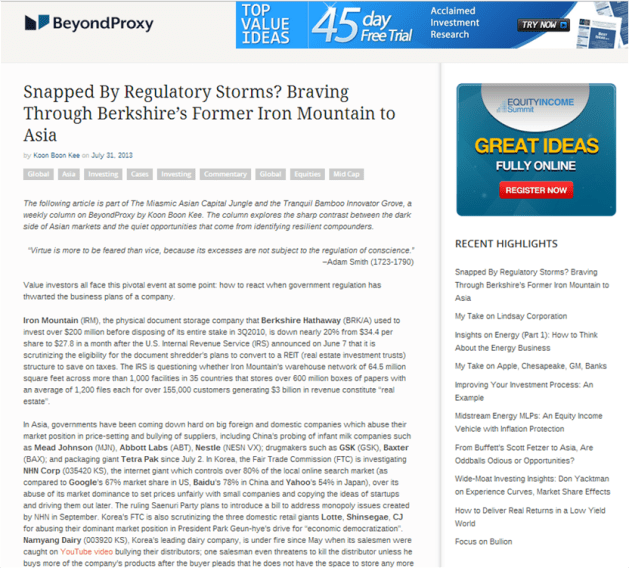
Snapped By Regulatory Storms? Braving Through Berkshire’s Former Iron Mountain to Asia. Bamboo Innovator is featured in BeyondProxy.com, where value investing lives

Bamboo Innovator is featured in BeyondProxy.com, where value investing lives:

  • Snapped By Regulatory Storms? Braving Through Berkshire’s Former Iron Mountain to Asia, July 31, 2013 (BeyondProxy)

RegulatoryStorm


From Buffett’s Scott Fetzer to Asia, Are Oddballs Odious or Opportunities? Bamboo Innovator is featured in BeyondProxy.com, where value investing lives

Bamboo Innovator is featured in BeyondProxy.com, where value investing lives:

  • From Buffett’s Scott Fetzer to Asia, Are Oddballs Odious or Opportunities? July 24, 2013 (BeyondProxy)

Oddballs


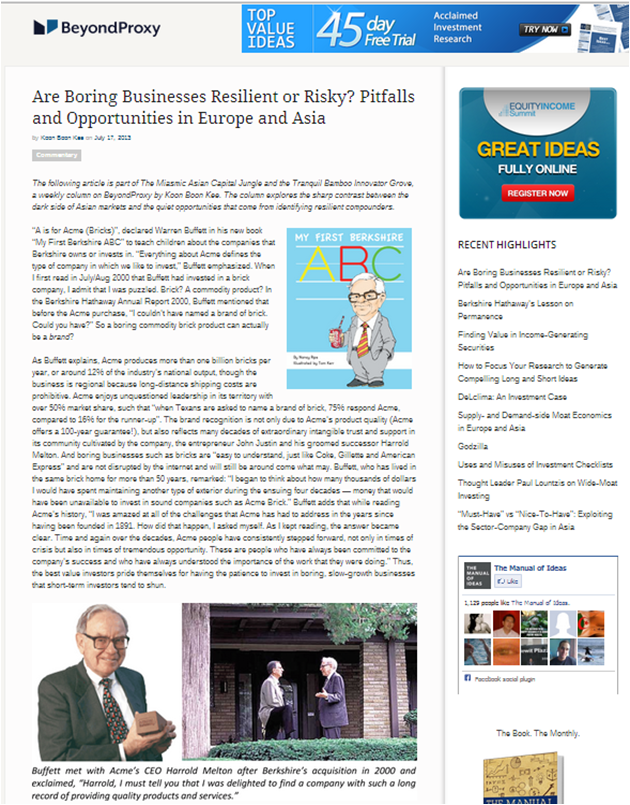
Are Boring Businesses Resilient or Risky? Pitfalls and Opportunities in Europe and Asia. Bamboo Innovator is featured in BeyondProxy.com, where value investing lives

Bamboo Innovator is featured in BeyondProxy.com, where value investing lives:

  • Are Boring Businesses Resilient or Risky? Pitfalls and Opportunities in Europe and Asia, July 17, 2013 (BeyondProxy)

BoringBusiness

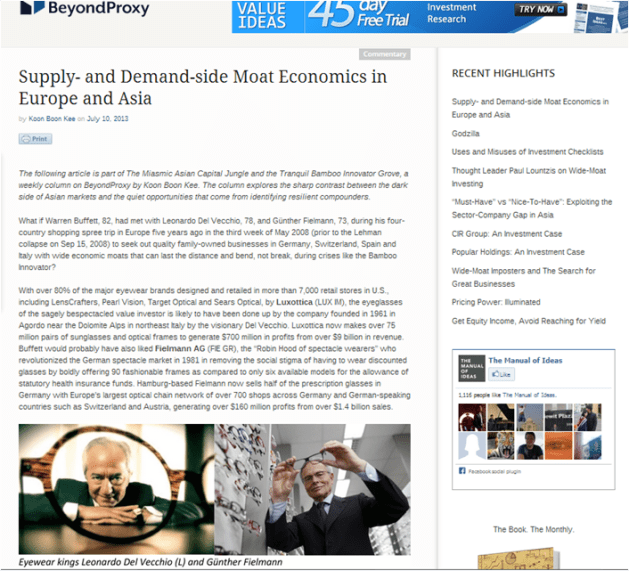
Supply- and Demand-side Moat Economics in Europe and Asia. Bamboo Innovator is featured in BeyondProxy.com, where value investing lives

Bamboo Innovator is featured in BeyondProxy.com, where value investing lives:

  • Supply- and Demand-side Moat Economics in Europe and Asia, July 10, 2013 (BeyondProxy)

Moat Economics

Wide Moat Investing Summit 2013 (July 9-10): Bamboo Innovator presents “Wouldn’t it be nice if we can invest BEFORE the economic moat is obvious?”

“Must-Have” vs “Nice-To-Have”: Exploiting the Sector-Company Gap in Asia. Bamboo Innovator is featured in BeyondProxy.com, where value investing lives

Bamboo Innovator is featured in BeyondProxy.com, where value investing lives:

  • “Must-Have” vs “Nice-To-Have”: Exploiting the Sector-Company Gap in Asia, July 3, 2013 (BeyondProxy)

SectorCoGap

From the Fund Management Jungles: Value Investing Exposed and Explored (Public Workshop Series) (Preview Slides)

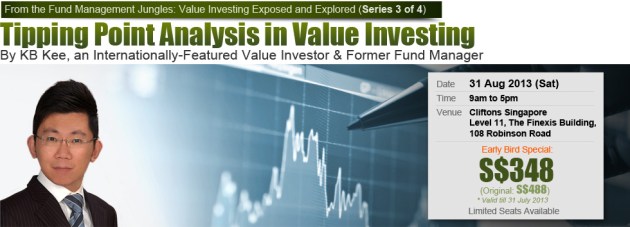
Bamboo Innovator Workshop Series (#3 of 4): Tipping Point Analysis in Value Investing

Tipping Point Analysis in Value Investing
Saturday, 31 August 2013 from 09:00 to 17:00 (SGT)

jph7p5

Waiting is the main drawback in value investing. Investors often lose patience with their stocks when they don’t perform in the short-term to produce a feel-good comfort that we are right in our stock calls. That’s why fund managers under pressure to deliver short-term results always ask, “Any upcoming catalysts?” This cannot be more misleading when there is an insufficient understanding in the scalability and resilience of the underlying business model.

When iPod was introduced on November 10, 2001, Apple’s share price was US$9.40 per share and had jumped to US$12 by year end. Those who had loaded up on the “iPod effect” or “new product” catalyst suffered for the next year-and-a-half as the shares plunged to US$6.70 in April 2003. Disappointed, momentum traders cloaked under the label of fund managers sell the stock. Then a “tipping point” moment happened in April 2003 to bring about the extraordinary 60-fold returns in the next decade to US$428 per share, or US$400 billion in market cap. What was this “tipping point” event? One such “tipping point” event is the launch of the iTunes Store on April 28, 2003.

Serious institutional investors spend most of their time not in looking at stock price screens or gaining “insider” knowledge of “catalysts” to generate alpha or excess returns, but in analyzing the interaction of business model dynamics with “tipping point” events so that they literally hear and see the “clicking” sound when they occur to produce a resilient compounder. It is our task to have a systematic framework to understand and identify “tipping point” events when they occur to stay ahead of the momentum traders and colluding insiders (庄家) on the investing curve.

Course Highlights:

– Mr Kee, one of the few Asian fund manager being invited to speak at a number of top banking & finance conferences around the world alongside with renowned speakers such as Praveen Kadle, Chief Executive Officer of Tata Capital & Lauren Templeton, President of Lauren Templeton Capital Management

– Learn from an experienced & qualified instructor who has taught in local Universities

Program Outline and Key Learning Points:

  • UNDERSTAND the stock market reactions to a wide-range of “catalysts”:

–          “Post-earnings announcement drift (PEAD)”,

–          “Capital management programs” (e.g. dividends, capital reduction, share buybacks, bonus issue, rights, splits, share/debt placement) and “Financial structure changes”,

–          “Analyst coverage and recommendations”,

–          and many more.

  • GAIN the surprising insight to why certain positive catalyst signals can be      misleading noise, for instance, insider purchase can be negative. And also      why overreaction to certain negative catalyst signals can be an opportunity.
  • DEVELOP the ability to distinguish between “catalysts” with unsustainable short-term      effects and “tipping point” with long-term value relevance.
  • LEARN where M&A pays and where it strays and the pitfalls.
  • DISSECT a wide range of real-world cases of Asian and global Bamboo Innovators in various industries and understand the tipping point in their business models.
  • UNIFY at the end of the day all the previously disparate loose-hanging concepts,      descriptive facts and “checklists” you have learnt from various sources into the practical Bamboo Innovator mental model when it comes to real investment decision-making.

Understand more about the Instructor’s investment approach with the following published articles:

About the Instructor:

Koon Boon is the founder and managing director of the Singapore-based Bamboo Innovator Institute to establish the thought leadership of resilient value creators around the world. KB has been rooted in the principles of value investing for over a decade as a fund manager and analyst in the Asian capital markets. He was a fund manager and head of research/analyst at a Singapore-based investment management organization dedicated to the craft of value investing in Asia. He had been with the firm since 2002 and was also part of the core investment committee in significantly outperforming the index in the 10-year-plus flagship Asian fund. He was previously the portfolio manager for Asia-Pacific equities at Korea’s largest mutual fund company. He received his Masters in Finance (magna cum laude) and double degree in Accountancy and Business Management (both summa cum laude) from the Singapore Management University (SMU). He had taught accounting at his alma mater in SMU and at SIM University. He had published research in the Special Issue of Istanbul Stock Exchange 25th Year Anniversary of the Boğaziçi Journal, Review of Social and Economic Studies, as well as wrote articles about value investing and corporate governance in the media. He had also presented in top banking and finance conferences in Sydney, Cape Town, HK, Beijing and in the recent Emerging Value Summit 2013. He had trained CEOs, entrepreneurs, CFOs, management executives in business strategy, macroeconomic and industry trends in Singapore, HK and China.

Institutional Imperative and Differentiating Between the Tech Innovators, the Imitators and the Swarming Incompetents in Asia. Bamboo Innovator is featured in BeyondProxy.com, where value investing lives

Bamboo Innovator is featured in BeyondProxy.com, where value investing lives:

  • Institutional Imperative and Differentiating Between the Tech Innovators, the Imitators and the Swarming Incompetents in Asia, June 27, 2013 (BeyondProxy)

Institutional Imperative

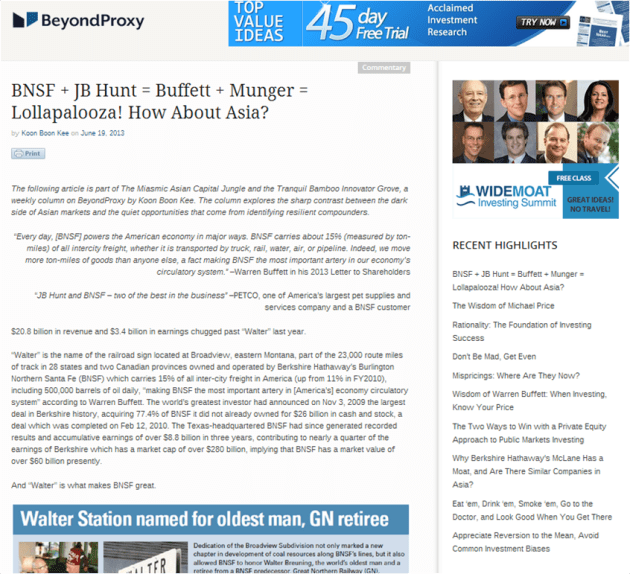
BNSF + JB Hunt = Buffett + Munger = Lollapalooza! How About Asia? Bamboo Innovator is featured in BeyondProxy.com, where value investing lives

Bamboo Innovator is featured in BeyondProxy.com, where value investing lives:

  • BNSF + JB Hunt = Buffett + Munger = Lollapalooza! How About Asia? (BeyondProxy)

BNSF

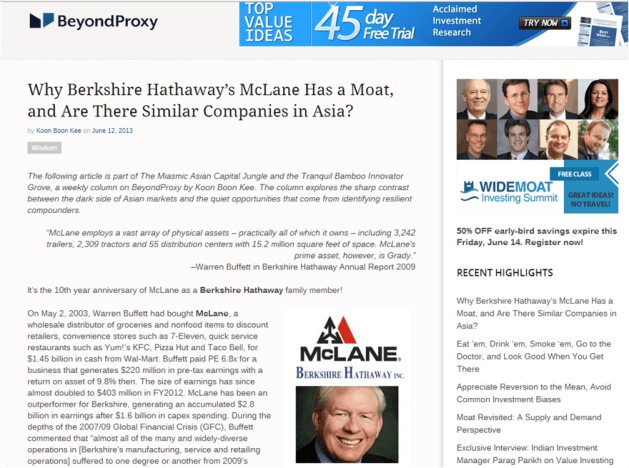
Why Berkshire Hathaway’s McLanee Has a Moat, and Are There Similar Companies In Asia? Bamboo Innovator is featured in BeyondProxy.com, where value investing lives

Bamboo Innovator is featured in BeyondProxy.com, where value investing lives:

Why Berkshire Hathaway’s McLanee Has a Moat, and Are There Similar Companies In Asia? (BeyondProxy)

McLane

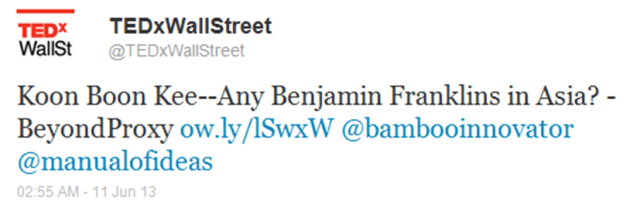
Bamboo Innovator mentioned on TEDxWallStreet

TEDxWallStreet

Investing in Korea: Staying Rational Despite Samsung’s Halo Effect. Bamboo Innovator is featured in BeyondProxy.com, where value investing lives

Bamboo Innovator is featured in BeyondProxy.com, where value investing lives:

Investing in Korea: Staying Rational Despite Samsung’s Halo Effect, June 5, 2013 (Weblink: BeyondProxy.com)

Korea