Wide Moat Investing Summit 2013, July 9-10, 2013 (Presentation by Bamboo Innovator on Jul 10, 8.30am EST)
June 4, 2013 Leave a comment

R.E.S.-ilience in Value Creation 《竹经:经商经世离不得立根创新》
June 4, 2013 Leave a comment
Frauds. Warren Buffett commented in the recent Berkshire Hathaway AGM 2013 that when he’s reading through financial statements, he’d find companies he was virtually certain are frauds. In response to a shareholder’s question on what did he find that made him so certain, both Buffett and Munger replied that “there isn’t a 40-point checklist” and that value investors need to understand the interaction between the underlying business model dynamics and the people running the enterprise when examining the numbers.
In Asia, with outbreaks of accounting frauds and corporate governance lapse erupting on a systematic basis at the firm level, how does a value investor go about generating sustainable outsized returns? To paraphrase Sherlock Holmes, to murder (to engage in earnings management) is easy, but to dispose the murdered body (to expropriate or tunnel out the cash and assets out of the company) is harder as it is detectable by the serious institutional investor with his or her keen observation of the various information signals and clues.
It would be premature to speak of “fundamental” analysis using possibly rigged accounting numbers due to propping and tunneling to fashion elaborate but “garbage-in-garbage-out” quant valuation models. Even “technical” analysis can be misleading given prices and volumes are often manipulated by the “insiders” (庄家) who establish the stock inventory (老鼠仓), luring investors in and then offloading in a pump-and-dump cycle. Such exploits by insiders is made easy as most stocks in Asia are still relatively small-cap and illiquid, given that the median market cap of the listed universe of 23,000 stocks in Asia is around $80 million and over 80% are under a billion dollar in market cap.
Thus, the use of “fundamental” or “technical” analysis, or its combination – without a Mungerian I-O accounting framework using the Bamboo Innovator way – can lead to a false sense of confidence that clever insiders exploit at your expense.
Course Highlights:
– Mr Kee Koon Boon, one of the few Asian fund managers being invited to speak at a number of top banking & finance conferences around the world alongside with renowned speakers such asPraveen Kadle, Chief Executive Officer of Tata Capital & Lauren Templeton, President of Lauren Templeton Capital Management
– Learn from an experienced & qualified instructor who has also taught in local Universities
Program Outline and Key Learning Points:
Understand more about the Instructor’s investment approach with the following published articles:
About the Instructor:
Koon Boon is the founder and managing director of the Singapore-based Bamboo Innovator Institute to establish the thought leadership of resilient value creators around the world. KB has been rooted in the principles of value investing for over a decade as a fund manager and analyst in the Asian capital markets. He was a fund manager and head of research/analyst at a Singapore-based investment management organization dedicated to the craft of value investing in Asia. He had been with the firm since 2002 and was also part of the core investment committee in significantly outperforming the index in the 10-year-plus flagship Asian fund. He was previously the portfolio manager for Asia-Pacific equities at Korea’s largest mutual fund company. He received his Masters in Finance (magna cum laude) and double degree in Accountancy and Business Management (both summa cum laude) from the Singapore Management University (SMU). He had taught accounting at his alma mater in SMU and at SIM University. He had published research in the Special Issue of Istanbul Stock Exchange 25th Year Anniversary of the Boğaziçi Journal, Review of Social and Economic Studies, as well as wrote articles about value investing and corporate governance in the media. He had also presented in top banking and finance conferences in Sydney, Cape Town, HK, Beijing and in the recent Emerging Value Summit 2013. He had trained CEOs, entrepreneurs, CFOs, management executives in business strategy, macroeconomic and industry trends in Singapore, HK and China.
May 20, 2013 Leave a comment
http://valueinvesting-series1.eventbrite.sg/
From the Fund Management Jungles: Value Investing Exposed and Explored (Workshop Series)
In Search of Compounding Stocks in Uncertain Times (Series #1 of 4)
Saturday, 13 July 2013 from 09:00 to 17:00 (SGT)
Singapore, Singapore
Event Details
“In business, I look for economic castles protected by unbreachable ‘moats’.”
– Warren Buffett
With unresolved crises on the horizon, investors are often immobilized in making investment decision. “Wait for the clouds to clear” is the mantra. Value investing appears to provide a way out to see opportunities in cloudy weather by using the “cheap” price signal to identify “out-of-favor” neglected stocks and invest in them for “reversion back to mean”. Hence, pick stocks with “cheap” valuations based on conventional metrics and ratios – how much lower can they go anyway? – and they will bounce back up to their historical average levels. Or simply wait for a market dip, or a crash, before declaring some magical list of top ten stock tips to invest in. This is NOT value investing.
When Li Ning, the “Nike of China”, announced that its founder is going into industrial park and property development in September 2010, the stock has been a darling, having a competitive “moat” with brand recognition and it has recovered strongly since its bottom in March 2009 by climbing 140% to HK$24 per share. Oh, it is already expected that the market will react negatively to the property news, now it is down 20% to HK$19, value stock, be contrarian, BUY! Down another 20% to HK$15, getting cheaper and it’s out-of-favor, it will bounce back up, BUY! And the value investor catches the falling knife until below HK$5 now; while Nike hits an all-time high.
How do value investors distinguish whether “cheap” stocks are value traps or opportunity?Without an understanding of the underlying business model dynamics and analyzing the durability of the economic moat, an investment decision based on price and macro signals and historical valuation metrics can be misleading and costly. Without an understanding of business model, one would also have sold Wal-mart after it was listed in 1972 as the stock crashed over 60% in the next three years. Wal-mart went on to compound 1,200-fold since 1972 to over US$250 billion in market cap – a $100,000 investment in Wal-Mart becomes a $120 million treasure trove. So why is Wal-mart able to bounce back to scale new heights but the same cannot be said for the “Nike of China”?
Can resilient business models – Bamboo Innovators – outperform even in stormy periods? When Shanghai Composite Index crashed 70% from its peak of 6,000 in October 2007 to below 2,000 at the bottom in March 2009, Yunnan Baiyao was UP around 8%. As the index bounce to 2,200, still down 60% from its peak, Baiyao is up over 220% during the same period. Increasingly, such resilient business models are outperforming in Asia and globally; while the “cheap” stocks get cheaper and they become the fertile ground for “insiders” (庄家) who manipulate prices and volumes and inject “action” via exciting corporate news announcement of “sexy” projects or M&As, luring investors in and then offloading to them in a pump-and-dump cycle. Sophisticated value investors can overcome poor and uncertain macro conditions by investing in resilient compounders because they have their own internal rhythm to create value, like the bamboo, which bend, not break even in the wildest of storm that would have snapped the once-mighty oak tree.
Course Highlights:
– Mr Kee, one of the few Asian fund manager being invited to speak at a number of top banking & finance conferences around the world alongside with renowned speakers such as Praveen Kadle, Chief Executive Officer of Tata Capital & Lauren Templeton, President of Lauren Templeton Capital Management
– Learn from an experienced & qualified instructor who has taught in local Universities
Program Outline and Key Learning Points:
Understand more about the Instructor’s investment approach with the following published articles:
About the Instructor:
Koon Boon is the founder and managing director of the Singapore-based Bamboo Innovator Institute to establish the thought leadership of resilient value creators around the world. KB has been rooted in the principles of value investing for over a decade as a fund manager and analyst in the Asian capital markets. He was a fund manager and head of research/analyst at a Singapore-based investment management organization dedicated to the craft of value investing in Asia. He had been with the firm since 2002 and was also part of the core investment committee in significantly outperforming the index in the 10-year-plus flagship Asian fund. He was previously the portfolio manager for Asia-Pacific equities at Korea’s largest mutual fund company. He received his Masters in Finance (magna cum laude) and double degree in Accountancy and Business Management (both summa cum laude) from the Singapore Management University (SMU). He had taught accounting at his alma mater in SMU and lectures at SIM University for working professionals. He had published cutting-edge empirical research in the Special Issue of Istanbul Stock Exchange 25th Year Anniversary of the Boğaziçi Journal, Review of Social and Economic Studies, as well as wrote articles about value investing and corporate governance in the media. He had also presented in top banking and finance conferences in Sydney, Cape Town, HK, Beijing and in the recent Emerging Value Summit 2013. He is also an internationally-featured value investor in Greatinvestors.TV and BeyondProxy.com. He had trained CEOs, entrepreneurs, CFOs, management executives in business strategy, macroeconomic and industry trends in Singapore, HK and China.
May 17, 2013 Leave a comment
Dear Friends and All,
“What use is an esoteric academic theory like Einstein’s theory of relativity?” Answering this question with the Bamboo Innovator framework can surprisingly lead to the uncovering of resilient compounders: the Indonesian-listed bread company Indosari, the largest mass-market producer of bread in Indonesia under the “Sari Roti” brand, and Mexican-listed Grupo Bimbo, the largest bread manufacturer in the world. Interestingly, Indosari’s market value of US$750 million (now over US$900 million) is almost 20-times smaller as compared to Mexico’s Grupo Bimbo’s US$15 billion, even though both Indonesia and Mexico have gross domestic product (GDP) of US$1 trillion. What is so unique about the business models at Indosari and Grupo Bimbo? Why are they Bamboo Innovators? I like to share the article that was published in Jakarta Post, the oldest and largest-circulated English newspaper (one of the few dailies who survived the 1997/98 Asian Financial Crisis): “Education 2.0 in Indonesia: Inspiring Bamboo Innovators”.
Education 2.0 In Indonesia: Inspiring Bamboo Innovators, May 11, 2013 (Weblink: Jakarta Post)
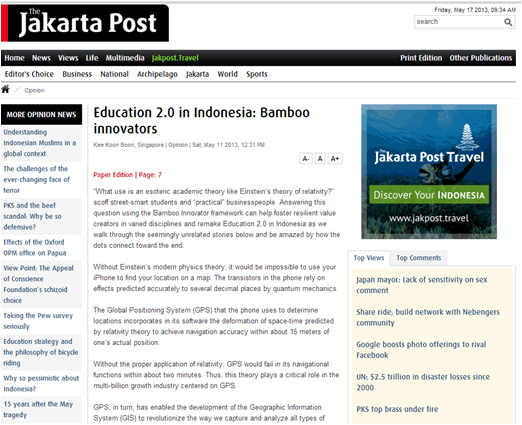
Below is the unedited version:
Education 2.0 in Indonesia: Inspiring Bamboo Innovators
April 2013
“What use is an esoteric academic theory like Einstein’s Theory of Relativity?” scoffed the “street-smart” students and “practical” businesspeople. Answering this question using the Bamboo Innovator framework can help foster resilient value creators in varied disciplines and remake Education 2.0 in Indonesia as we walk through the seemingly unrelated stories below and be amazed by how the dots connect towards the end.
Without Einstein’s modern physics theory, it would be impossible to use your iPhone to find your location on a map. The transistors in the phone rely on effects predicted accurately to several decimal places by quantum mechanics. The Global Positioning Satellites (GPS) that the phone uses to locate us incorporate in their software the deformation of space-time predicted by relativity theory to achieve navigation accuracy within about 15 meters of our actual position. Without the proper application of relativity, GPS would fail in its navigational functions within about 2 minutes. Thus, this theory plays a critical role in the multi-billion growth industry centered around the GPS.
GPS, in turn, has enabled the development of the GIS (Geographic Information System) to revolutionize the way we capture and analyze all types of geographical data for multiple applications from urban planning, disaster response, epidemic planning, mining and oil exploration to location-based services. ESRI is the GIS software pioneer, founded by Jack Dangermond in 1969. ESRI has an installed base of more than one million users in more than 350,000 organizations with over a billion in annual revenue achieved by 3,000 employees. ESRI grew by focusing on its users and employees, eschewing incentives such as sales commissions. “People want to do the right thing; they want to be purposeful in their life,” Jack said. “Throwing financial thresholds and goals — my experience in running at least my kind of organization is that it robs people of the culture of doing great things.”
ESRI, in turn, is linked to Singapore entrepreneur Wong Fong Fui who runs the conglomerate Boustead, which has exclusive country license to ESRI GIS software in South East Asia and Australia. Mr Wong is known as a turnaround specialist, having helped the loss-making unfocused QAF with a market cap of $15 million then in 1988 to build the Gardenia bakery brand in Singapore into a $500 million food business when it was sold, and now Boustead, which he bought for $14 million in 1996 and has a current market value of $580 million.
Interestingly, this $500 million market value has been exceeded by Wendy Yap who helped focus her family business Nippon Indosari to become a Gardenia 2.0 and the largest mass-market producer of bread in Indonesia under the “Sari Roti” brand with a market value of $750 million. Around the same time FF Wong got into Boustead, Wendy started Indosari in 1995 with her father Piet Yap, one of the Salim Group executive who co-founded Bogasari Flour Mills. The typical businessman might shrug and point out that for Indosari to be bigger than Gardenia is an obvious observation, since Indonesia is a far larger market than Singapore. However, many companies and MNC giants such as SaraLee had tried to expand in Indonesia earlier but all retreated with heavy losses. So why was Wendy Yap able to scale up while others with abundant tangible resources failed?
Indosari has adopted an open innovation business model in collaborating with Japan’s Shikishima Baking who helped Indosari in its technological processes in introducing Japanese-style soft breads that won over the Indonesian palate. Importantly, Indosari has built trust with retailers and customers to overcome the logistics nightmare that doomed its better-capitalized rivals through its strong distribution network for its highly-perishable products of more than 2 million pieces of bread daily, resulting in a dominant 90% market share. It sells its products through modern distribution channels and an innovative system of around 3,000 mobile tricycle carts to penetrate over 17,000 small traditional shops in the rural parts of Indonesia.
Yet, Indosari’s market value at $750 million pales in comparison to Mexico’s Grupo Bimbo’s $15 billion even though both Indonesia and Mexico have a GDP of $1 trillion. Bimbo is also the world’s largest bread manufacturing with over $13 billion in sales. So why is this “small white teddy bear”, Bimbo’s corporate image, which “began with great limitations” in 1945 from Mexico, a country where half the population lived below the poverty line, able to become the largest in the world and compound 24-fold in market value since 1994?
Given that over 80% of bread is sold in mom-and-pop stores in Mexico scattered miles from one another over poor roads, cultivating trust and support amongst its community of customers, suppliers and employees is critical to overcome the geographical limitations in scaling up. Small store owners tend to ask for credit which was provided informally by Bimbo. Its partnership with community bank FinComún leveraged upon the bank’s pioneering expertise in providing micro-loans to extend credit yet reduce bad debt and improve working capital position to free up more cash to carry out expansion. In a country known for the exploitation of workers, Bimbo has built an unusually people-oriented culture with its well-known policy of avoiding layoffs even in times of crisis and sponsoring its employees’ education which helped foster loyalty and committment. As a result, Bimbo was able to resist the 1991 threat from the arrival on the Mexican market of giant PepsiCo. While Bimbo innovated in integrating production-delivery-finance, none of it would amount to much if Bimbo had not offered the country affordable, edible aspiration, spreading this dream to nearly every remote corner of Mexico.
There is a common thread running through these stories: the resilient Bamboo Innovator. The vitality of the bamboo revolves around its empty hollow center in the same way as the “emptiness” of the Bamboo Innovator with its “indestructible intangibles” that derive its strength from “know-how” and “trust and support in the community”. The “emptiness” is why bamboo bend but not break in the wildest storms that snapped the mighty resisting oak tree. The intangible know-how in relativity theory has led to the multi-billion GPS industry which enabled the development of the GIS pioneered by Jack Dangermond’s ESRI whose leadership nurtured a culture of empowerment and innovations. FF Wong is attracted by this intangible know-how of ESRI, having built the “intangible” Gardenia brand. At the same time when FF Wong is building Boustead, Wendy Yap has scaled up a bigger, more focused Gardenia 2.0 at Indosari by cultivating trust and support in the company’s community of customers, suppliers, partners and employees, in the same way this “emptiness” worked wonders at Grupo Bimbo.
In the landscape of Education 2.0 in Indonesia, students can search for facts on Google, but Google and Facebook cannot tell them how to connect the dots in alignment with their talent and personality to pursue what they can excel in. With the Bamboo Innovator in their hearts, they will experience the uncanny: the raw sensual data reaching their eyes before and after are the same, but with this pertinent framework of meaning, the chaotic features and anomalies in the marketplace are visible. Instead of producing “grades”, “checklist-based holistic CV” and “high graduation salary”, the education system inspires students to be the Jack Dangermond inventor, the FF Wong and Wendy Yap entrepreneur, the quantum mechanics engineer and physics expert, the geography-based business and trade specialist, the teacher and the value investor, and so on. Their fate all intertwined as Bamboo Innovators to forge their own larger-than-self path to create value for Indonesia and the world.
May 9, 2013 Leave a comment
Bamboo Innovator is featured in BeyondProxy.com, where value investing lives:
Any Benjamin Franklins in Asia? May 9, 2013 (Weblink: BeyondProxy.com)
May 7, 2013 Leave a comment
Bamboo Innovator is featured in BeyondProxy.com, where value investing lives:
Berkshire Hathaway 2013: Takeaways and Impressions from the Annual Meeting, May 7, 2013 (Weblink: BeyondProxy.com) – Scroll down till the end of the article.

May 2, 2013 Leave a comment
Bamboo Innovator is featured in BeyondProxy.com, where value investing lives:
Pilgrimage to Omaha + Entrepreneurship, Asian-style! May 1, 2013 (Weblink: BeyondProxy.com)
April 26, 2013 Leave a comment
 Bamboo Innovator is featured in BeyondProxy.com, where value investing lives:
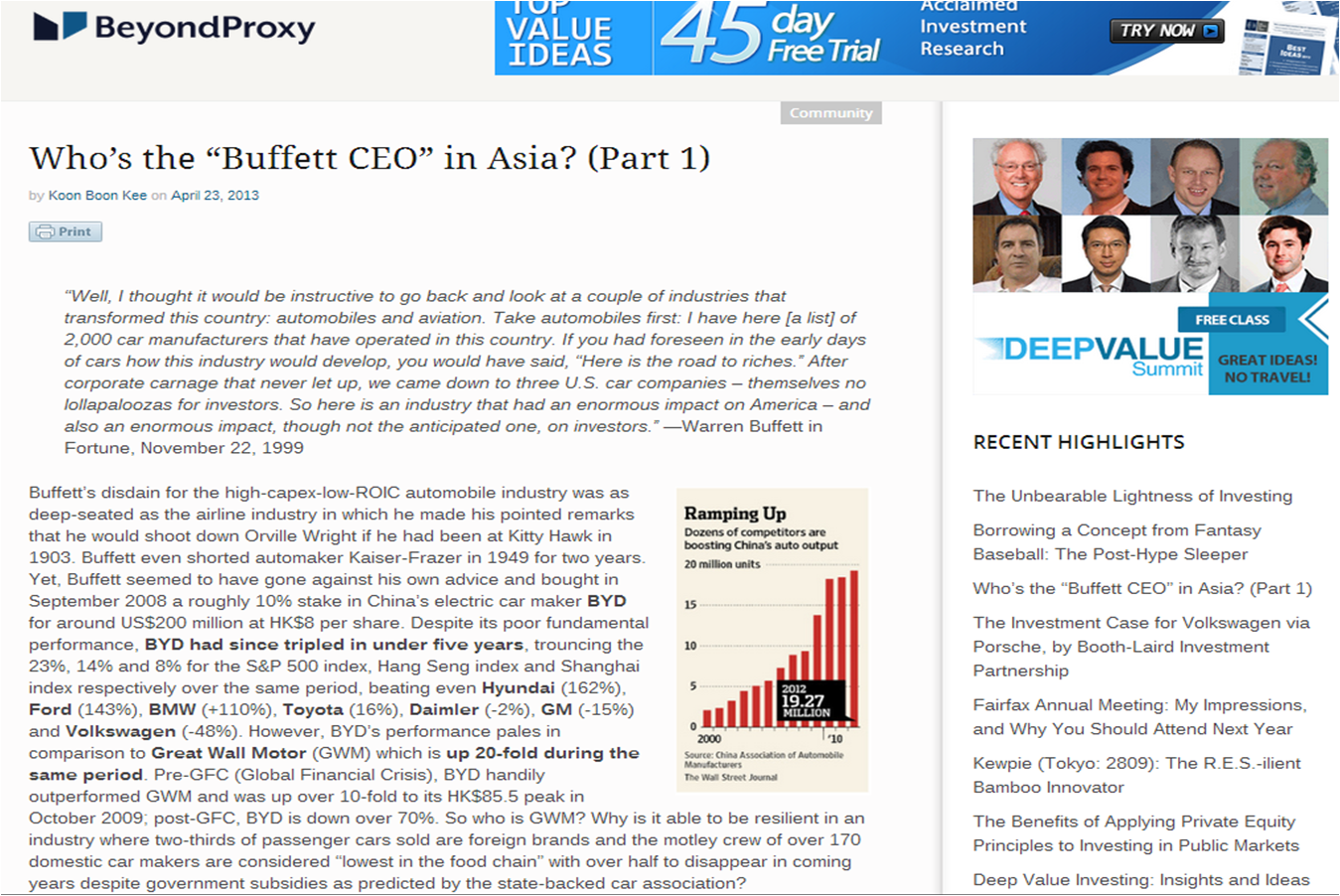
Who’s the Buffett CEO in Asia? Part 1 on China’s Great Wall Motor, April 23, 2016 (Weblink: BeyondProxy.com)
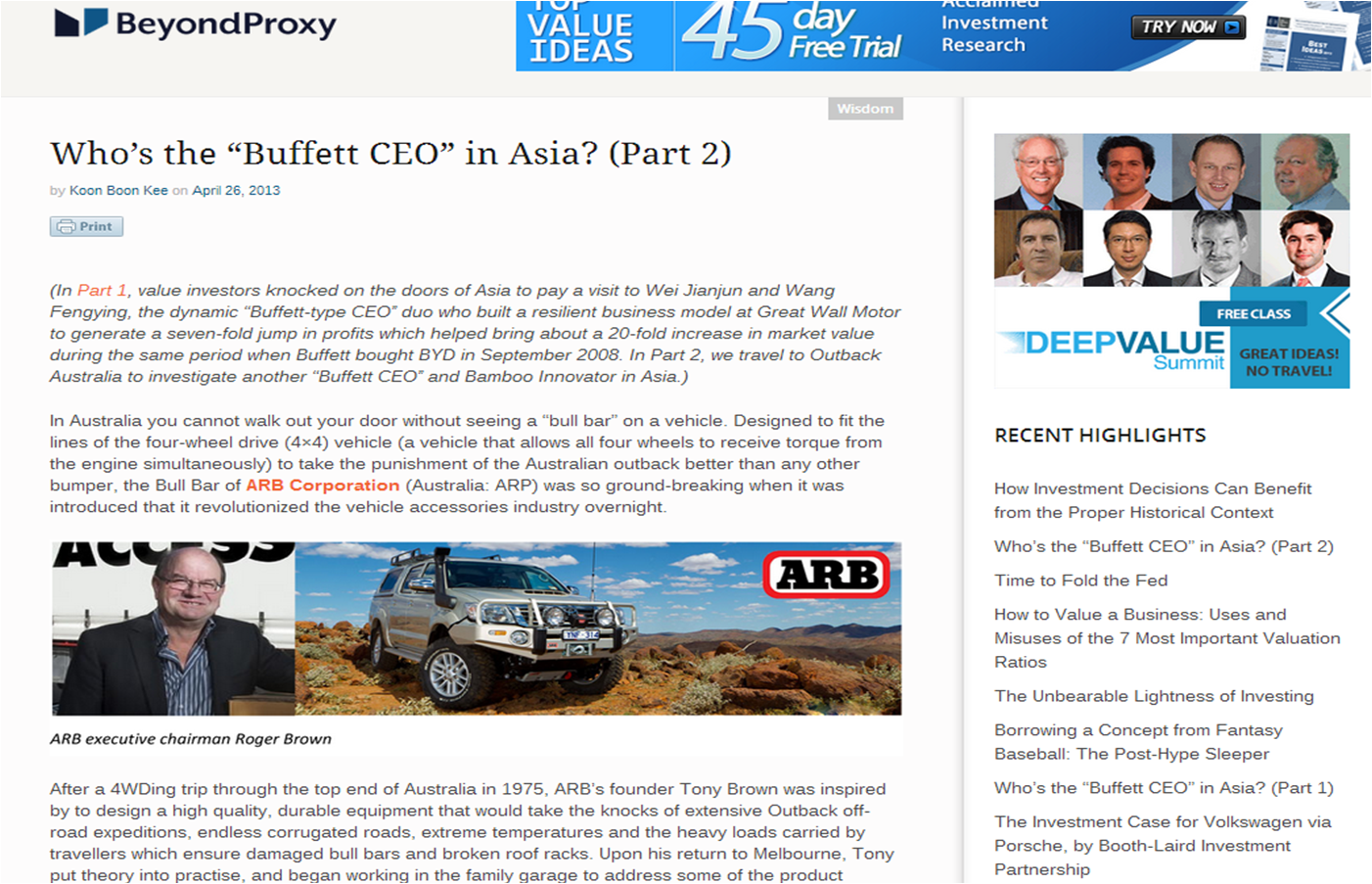
Who’s the Buffett CEO in Asia? Part 2 on Australia’s ARB Corporation, April 26, 2013 (Weblink: BeyondProxy.com)
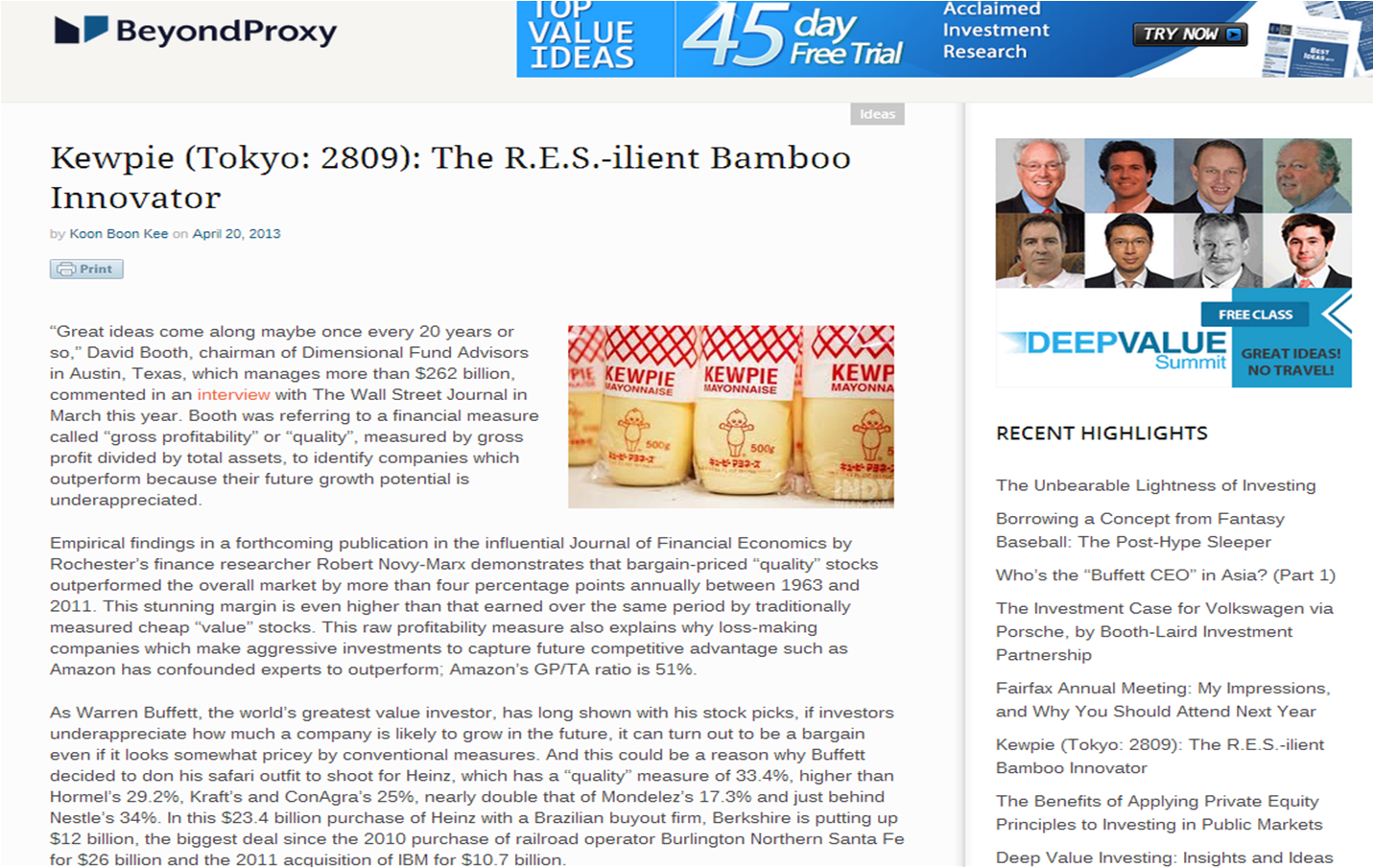
Kewpie: Japan’s Heinz and R.E.S.-ilient Bamboo Innovator, April 20, 2013 (Weblink: BeyondProxy.com)
Value Investors in Asia: Making Sense of the Micro Vs. Macro Dilemma, April 16, 2013 (Weblink: BeyondProxy.com)
April 13, 2013 Leave a comment
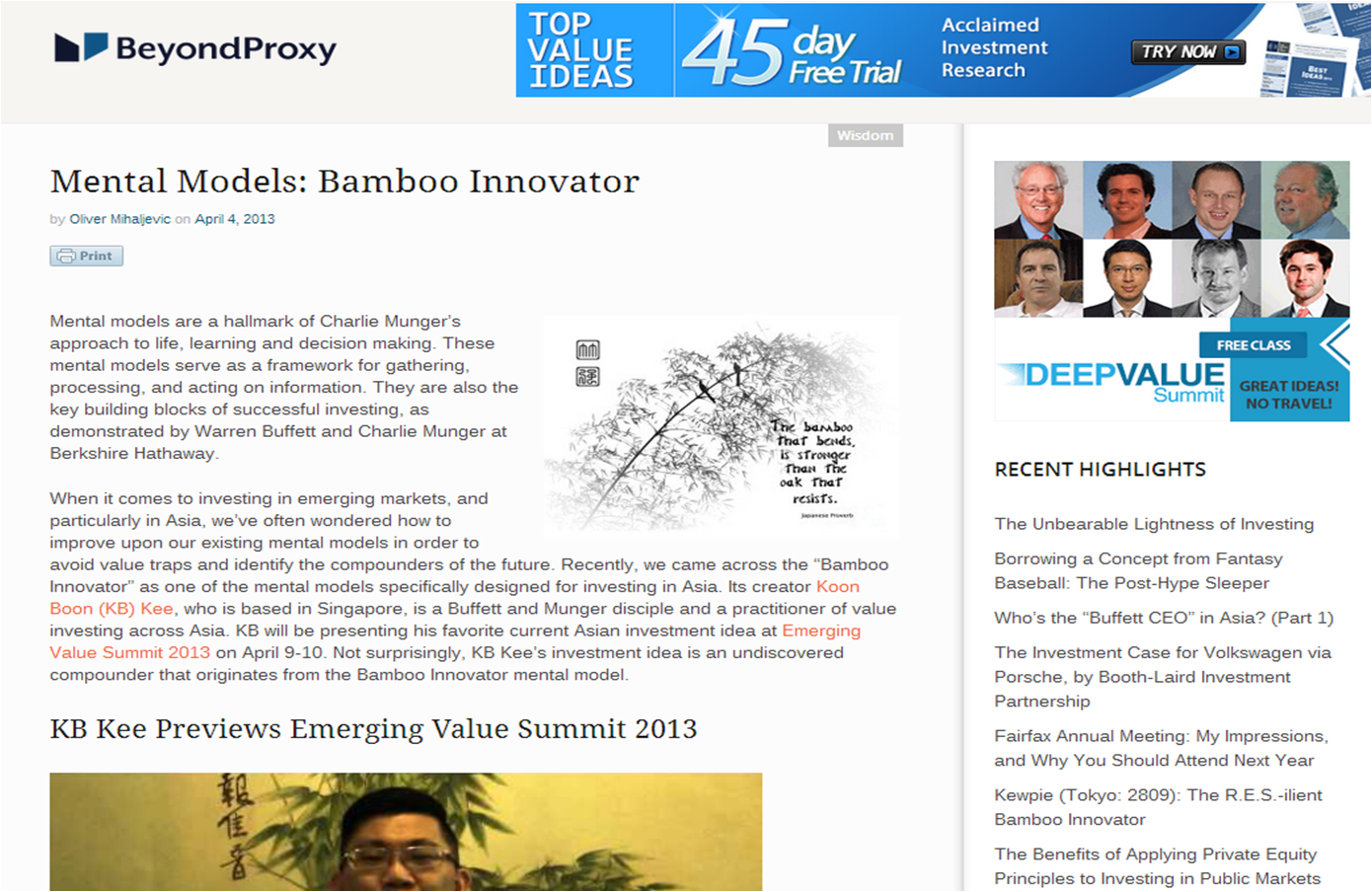
http://www.beyondproxy.com/mental-models/
http://www.beyondproxy.com/detecting-fraud/
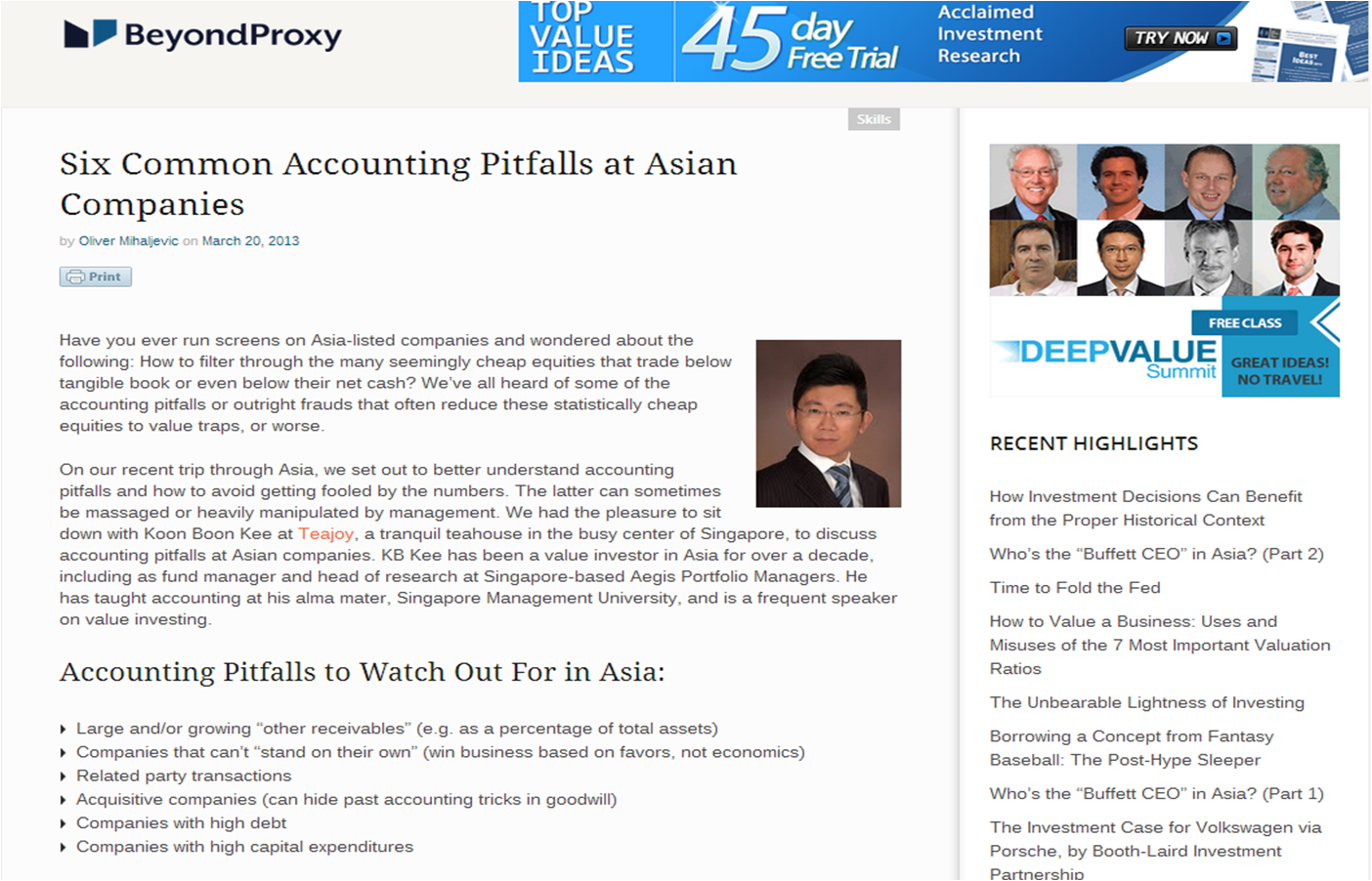
http://www.beyondproxy.com/accounting-pitfalls-at-asian-companies/
http://greatinvestors.tv/video/insights-into-accounting-pitfalls-at-asian-companies-with-si.html
http://greatinvestors.tv/video/beware-of-other-receivables-accounting-at-asian-companies-wi.html
http://www.frequency.com/video/insights-into-accounting-pitfalls-at/85354333/-/5-1707

April 8, 2013 Leave a comment
“Singapore is too small and its talent pool is too small to produce a world-class manufacturing giant of the Fortune 500 class,” Singapore’s founding Prime Minister Lee Kuan Yew once said. A cryptic remark, indeed, because it does not imply that he thinks Singapore cannot produce knowledge-based giants, or resilient “bamboo innovators”.
Why bamboo innovators? Bamboos bend, not break, even in the most terrifying storm or devastating earthquake that would snap the mighty oak tree. It survives, therefore it conquers.
Disruptive industry trends and black-swan crises have become a permanent fixture in today’s marketplace. How wonderful it would be if countries, companies and individuals can stay resilient amid such upheavals and unorthodox challenges.
The study of bamboo innovators could inspire companies to be productive innovators in order to surpass stall-points in their business models during tumultuous periods, particularly for small and medium enterprises aspiring to scale up to become global champions.
But why is it that Asian companies are predominantly product manufacturers in the first place? This could ironically be a result of the Asian values of hard work and sacrifice.
It is far easier for the Asian entrepreneur to be the middleman taking orders from a few important anchor multinational corporation customers with access to the end-customers, take capital risk investing in tangible assets and work hard to produce the required products with quality and efficiency — than to attempt to build business models that have direct ownership of the hundreds and thousands of end-customers.
As a result, these entrepreneurs are unwilling to share the rewards with their “undeserving” staff who took neither risk nor sacrifice. They treat employees as expenses and not intangible assets, make most or all of the decisions and hoard most resources and information, running the firm as a “one-man show”. Eventually, they may face the challenge of business continuity arising from succession woes.
NEW IDEAS
Keyence is an example of the unconventional Asian firm. Founder Takemitsu Takizaki liberated the firm from manufacturing conventions and built a knowledge-based enterprise in laser sensors for factory automation, serving more than 100,000 customers in 70 countries.
Despite having less than 1 per cent global market share in a commodity-like product and only around 3,000 employees, Keyence commands a US$17-billion (S$21.1 billion) market value — approximately similar to Singapore’s Keppel Corp, a global leader in offshore oil rig design and building.
Mr Takizaki understood keenly that Keyence cannot improve on Japan’s legendary manufacturing efficiency. So, unlike its manufacturing-based competitors who leave sales to distributors, wholesalers and agents, it deliberately avoids making products, except for manufacturing steps that involve trade secrets kept in-house.
Most of its employees are either “sales” or “research” staff. In their direct contact with the customers, Keyence’s in-house “sales” team picks up new product ideas on frequent factory visits. For instance, its front-liners observed from the production lines at instant noodle factories that the noodle quality was compromised because the noodles were manufactured at variable thicknesses. Laser sensors that could measure noodles to 1/100th of a millimetre were developed to ensure consistency.
A quarter of sales at Keyence is generated from such new products every year, more than what 3M achieves. To excel in these areas, Keyence had to cultivate a meritocratic culture, and it is known for having some of the highest-paid employees in corporate Japan.
Bright young people from rival firms are attracted to Keyence by the performance-based pay. The average salary there is US$100,000. Engineers also get to do their own research, rather than labouring for years under grey-haired supervisors.
THE EMPTY CORE
Keeping the front line or the “periphery” resilient and innovative, and the centre or the “core” diffused, and enforcing meritocratic values at all levels have compounded immense value at Keyence. This “core-periphery” growth pattern is also that of the bamboo: The vitality of its growth revolves around its “empty” centre.
Instead of constructing itself inch by solid inch, like a tree, the nutrients and moisture that would have been exhausted making and maintaining its empty centre can be utilised for growth of its periphery in the stem. From a builder’s viewpoint, the architecture of the bamboo presents a powerful configuration: Fibres of greatest strength occur in increasing concentration towards the periphery.
Manufacturing and project-based companies often tout the size of their order book and their idea of “team” is about having high-profile dealmakers who can bring in the sales orders; the job of “everyone else” is to execute efficiently and “productively”.
The well-connected dealmakers may be able to pull in high-dollar projects, but because of the difficulties in coordinating and executing large-scale complex projects, these deals cannot be repeated and the hype associated with a big order book starts to fade, particularly when cost overruns and delivery delays rear their ugly heads. Bigger becomes riskier.
Even in manufacturing, the only way to perform and execute large-scale complex projects repeatedly is to create a culture of excellence where the interests of emotionally engaged front-liners matter in the innovation and value creation process.
Customers are attracted to this contagious performance culture rather than to the dealmakers on a relationship basis, resulting in a valuation breakthrough beyond the billion-dollar market value barrier that many Asian companies find difficult to break.
“Fortune 500”? With “emptiness” in business model design, Singapore can instead aim for its own resilient “Bamboo Innovator 500” powerhouse with a US$10-trillion value.
ABOUT THE AUTHOR:
Kee Koon Boon, a former lecturer of accounting at the Singapore Management University, has been an investment professional for the past decade. He is a presenter at the Emerging Value Summit 2013 on April 9-10.
April 8, 2013 Leave a comment
Resilient Growth In Crisis? Bamboo Innovators CSL and Keppel Show How
By KEE Koon Boon
8 April 2013
“Sometimes to be reborn, you must first die,” Dr. Victor Fung, group chairman of the multi-billion Li & Fung group of companies, cites pensively this old Chinese proverb in order to ask an open-ended question, “In a world that’s speeding up, how will companies change enough without crisis?”
We cannot avoid, or even choose, a crisis in order to engender the change that is required to overcome stall points in growth and to stay relevant in today’s marketplace where disruptive industry trends and black-swan crises have become a permanent fixture. When the inevitable traumatic upheavals and unorthodox challenges do come, innovators craft their business models to stay resilient like the bamboo, which bend, not break, even in the most terrifying storm that would snap the might resisting oak tree.
Australia’s CSL and Singapore’s Keppel are two such companies who have experienced near-deaths in daring greatly to scale and globalize their once domestic SME operations right under the noses of powerful incumbent global giant rivals – and they were renewed and reborned to be resilient Bamboo Innovators.
In its remarkable transformation from a sleepy government outfit providing snakebite antivenin since its privatization and listing in 1994 with a market value of A$500 million to a A$29 billion global biotech champion, CSL had experienced a near-death crisis in 2002. Similarly, Keppel, the global leader in offshore oil rig design and building, had hit a crisis in 1973, 1983 and 1990. Both were able to bounce back higher to scale greater heights. Why? Both companies have dedicated leaders cultivating a culture rooted in trust, cooperation and empowerment to contend with and heal creative dissent to handle large-scale complex projects repeatedly with excellence.
Brian McNamee was plucked from relative obscurity at the age of 33 to head CSL at the recommendation of then Industry Minister John Button. Similarly, the late Hon Sui Sen, founding Chairman of Singapore’s Economic Development Board (EDB), picked Chua Chor Teck to be Keppel’s first managing director in May 1972 and to take over and “Singaporeanize” Keppel from the hands of British managers of the Swan Hunter Group, then one of the best known shipbuilding companies in the world that has now disappeared.
During the era when America was dubbed the OPEC (Organization of Plasma Exporting Companies) of the global plasma industry, CSL broke the dominance of America’s grip by buying Swiss plasma fractionation pioneer ZLB for A$1 billion in 2000 and Germany’s Aventis Behring for US$925 million in 2004. Today, domestic earnings account for 10 percent of the group earnings at CSL with the bulk provided by its global businesses. Similarly, Keppel got its design and technology in oil rig from acquiring rig builder Far East Livingstone Shipbuilding (FELS), which Keppel took majority control in 1973 during the oil crisis. Subsequently, the late Sim Kee Boon, Chairman of Keppel Corp from 1984 to 1999, continued to lead the globalization push of Keppel, subsequently continued by the capable leaders Mr. Lim Chee Oon, Mr. Choo Chiau Beng, Mr. Tong Chong Heong, Mr. Loh Wing Siew and so on. Mr. Sim outlined the basic strategy of avoiding “green-field” or start-from-scratch projects and to invest in yards that are already there. For instance, Keppel acquired Allison-McDermid in America, AHI in Middle East, PEM Setal in Brazil, and Verolme Botlek in Europe. Mr. Sim’s dream was to see Keppel become like a Nestle with a very significant global presence.
The big-picture “plan” to globalize is seen obvious but managing the unseen risks and creating adaptive advantages along the way are more important. For the first two years, ZLB lived up to its promise, resulting in solid earnings growth for CSL, and its market value more than doubled. But the wheels came off in 2002 when the industry went into oversupply and a combination of sharply falling product prices and disadvantageous currency mismatch nearly crippled CSL. Back in 1983, Keppel’s cash purchase of Straits Steamship saddled it with a debt of S$845 million. Furthermore, the shipbuilding industry during that period was pronounced a sunset industry by the pundits as the industry went into oversupply with more than 80 shipyards capable of building rigs. Keppel survived the crisis and was the only surviving rig-builder in the world in 1986 then. Subsequently, another crisis hit shortly after Keppel’s acquisition of Texas-based jackup yard Allison-McDermid in 1990 when an American firm brought a US$565 million litigation case against Keppel for alleged breach of contract and damages involving the building of jackup offshore drilling rigs. CSL turned risk into opportunity by acquiring Aventis Behring to consolidate its position as the industry recovers. Keppel eventually won the suit. Keppel saw the need for control and bought out its partner, renaming the entity AmFELS which became a wholly-owned subsidiary of Keppel. It grew to become one of the best-equipped offshore yards in the Gulf of Mexico.
Growth through acquisitions has proven to be the graveyard for many companies in general. Warren Buffett, the world’s greatest investor, likened growing via acquisitions to kissing unresponsive corporate toads who croaked and the tempting but value-destroying toy that executives must have because their peers have one too. Post-acquisition efforts in integrating the companies into the parent company to compete as a coherent whole prove crucial to successfully scale to greater heights and not blow up. Both CSL and Keppel are able to do so because of the foundation laid down in the culture carefully nurtured by Mr. McNamee and Mr. Chua.
“We respected them greatly for their skills and their capabilities, so we weren’t cultural imperialists. We greatly respect our Swiss and German colleagues and so there was no notion that they were being taken over and that they were going to work to our method,” McNamee articulated how their culture of trust and respect provided both parties a common ground to work together towards a global vision for the group. The culture of empowerment at CSL is embedded into its business model to foster open innovation and extensive collaboration with its acquired companies and a network of high-quality academics, scientists and physicians across the world. CSL minimises a silo formation by giving people personal responsibility and by running R&D using a matrix structure. This intangible culture has delivered powerful tangible results, including how CSL beat competitors to be the first to market with an effective vaccine against the global swine flu epidemic and in developing the anti-cervical cancer drug Gardasil. The dedication of McNamee is also touching. He was diagnosed to have cancer and kidney problems when he was planning to buy ZLB. Swiss giant Novartis also offered more money and fanned the patriotism flame that ZLB should remain in Swiss hands. Due to the persistence of McNamee who flew to Switzerland against medical advice to personally negotiate the deal, CSL acquired ZLB despite paying 20 percent less than its rival bidder.
In his touching eulogy for Mr. Chua, “the much-loved leader among his men” who passed away from cancer in 1986 when he was 47, Keppel’s influential long-time US representative Mr. John Bajor commented, “Yes there’s complete dedication expected but the return in caring for each employee is the spirit he so carefully nurtured and left behind. It has become the Keppel way.” Mr. Sim also paid tributes to Mr. Chua who “tried exceedingly hard to inculcate in the organisation the ‘Keppel culture’ of loyalty, thrift and hard work.” Mr. Chua’s dedication and his “genuine interest in helping junior officers overcome difficulties in order to advance their career” has laid the foundation to the “Can Do” spirit of excellence at all levels in Keppel for many years to come.
The story at Bamboo Innovators CSL and Keppel highlighted the intangible culture of kindness, caring and empowerment is akin to the invisible intricate underground root structure that makes the ground around a bamboo grove very stable – and make possible the adaptability of the bamboo to bend, not break, with storms and crisis, and to remain relevant and evergreen no matter how the world around us speeds up and changes.
April 4, 2013 Leave a comment
Now on AsiaOne: http://www.asiaone.com/News/Latest%2BNews/Singapore/Story/A1Story20130402-413040.html
Creating ‘bamboo innovators’ in S’pore

Uncertain conditions can breed innovative businesses, where risk-taking educators nurture flexible students. -ST
Kee Koon Boon
Wed, Apr 03, 2013
The Straits Times
Gil Shwed, CEO & Founder of Check Point Sofware.
SINGAPORE – “Can my kid watch how you milk cows?”
“Can my kid see how you print the newspaper?”
These were questions asked by Israeli inventor and entrepreneur Gil Shwed’s mother when she took him on educational “adventure trips” when he was young, exposing him to a dairy farm, a printing house, and his father’s office in 1972, where at age five he saw a computer for the first time.
He soon signed up for computer classes at age nine, a summer coding job at 12, and took computer science classes at the Hebrew University while still in high school.
Unlike his career-minded peers, Mr Shwed persisted with an idea first cooked up during his military conscription: building a type of computer security software that links up computer networks in a way that would allow some users access to confidential materials while denying access to others. He embarked upon the project with two friends after army conscription and without the security of “proper” jobs.
By 1994, the trio’s Firewall product won the best software award at a computer show, vindicating a venture capital firm’s faith in Mr Shwed’s vision. Check Point Software Technologies listed on Nasdaq in 1996. Its market value today has jumped 12-fold to US$10 billion (S$12.4 billion).
Binding the trio together was a pioneering ethos where “education” with a “bitzu’ism” quality was at its heart. A bitzu’ist is a Hebrew word that loosely translates to “pragmatist” with a resilient quality, like bamboo that bends but does not break in the wildest storms when even oak trees snap. The bitzu’ist is the “builder, the irrigator, the pilot, the gun-runner, the settler all rolled into one”.
Mr Shwed thinks of his home country Israel as a “start-up nation”. “We managed to create a country from zero. We’ve had an entrepreneurial spirit for over 100 years. One thing that really helps us here is that we don’t have a local market.”
Surrounded by hostile neighbours and with few natural resources, Israel has the highest density of start-ups in the world, with one for every 1,800 Israelis. With a population of 7.7 million with 70 different nationalities, Israelis think globally when creating products and innovative firms.
Developing human capital is the key to growing the Israeli economy. Its education system is not about chasing after instrumental achievements such as “grades” or a “checklist-based holistic curriculum vitae” or “high graduation salary”.
The education system in Israel is made market-relevant when plugged into an unique ecosystem that constantly searches for and supports innovative ideas and new products to help build “bamboo innovator” companies such as Check Point.
In “Singapore version 1.0’s” growth since independence, the education system is meritocratic, highly competitive and “standardised”, lifting the technical competence and social mobility of Singaporeans to fit multinational companies (MNCs) with their export-oriented strategies.
This is augmented by higher valued-added services from logistics, shipping and maritime support to legal, finance and accounting, generating high wages to beat inflationary pressures. “Education 1.0” is about meeting the needs of capable MNCs which connect Singapore’s small, open economy to the real marketplace.
Yet the highly skilled workforce is not able to translate its “intangibles” in know-how into building and even owning “bamboo innovators”. The “earnings” accrued from this know-how remain with the MNCs.
In investing lingo, a high-salaried MNC worker has a price earnings (PE) ratio of one while a MNC can have a PE value of 20 times. A productive “bamboo” worker is one who, when a wind blows away his MNC title and position, can still remain a resilient innovator to create value because he has that intangible quality that is indestructible.
MNCs are concerned about the Singapore workforce lacking the initiative and innovativeness desired by knowledge-based industries, thus creating a barrier to a breakthrough in wages and productivity. It is the hollow “emptiness” in its centre – the intangibles – that gives bamboo great strength and flexibility in a raging storm.
The Singapore workforce’s accumulation of wealth and tangible assets for their own sake has evolved into a sense of entitlement, a dangerous liability that erodes character, moral values and social cohesion.
Reform attempts through character education and creative thinking alone are not only difficult but also decidedly off-track. As economist David Landes puts it, nothing dilutes drive and ambition more than a sense of entitlement. This kind of distortion makes an economy inherently uncompetitive.
Instead of the diminishing marginal returns from repeating “Education 1.0”, where school results are instrumental, these complex uncertain times require an education system that enables students to grope and reach directly into the global marketplace, to be sensitive and alert to existing anomalies and paradigms, and to how things ought to function and behave.
Educators must connect and sensitise students to the chaotic global marketplace. It is this sensitivity and alertness that leads to creating “bamboo innovators”.
Reflecting former deputy prime minister Goh Keng Swee’s view about the spirit of education as both “a search for truth” and “the way to a better life”, Singapore’s “Education 2.0” system should centre on how and why resilient firms continue to create value in uncertain and difficult times.
The system should also educate students who dare to become “bamboo innovators” like Mr Shwed, and who will build enduring creations.
As former Israeli president Shimon Peres said, “the most careful thing is to dare”.
April 1, 2013 Leave a comment
Dear Friends and All,
It has been a month since “Bamboo Innovator” was created in late February and I am grateful that there are some kindred spirits who find the ideas value-adding and resonate in your hearts. There is an article “Creating ‘bamboo innovators’ in S’pore” in Singapore’s Straits Times today that goes beyond the accounting numbers and uses Check Point/Gil Shwed as an actionable example of Bamboo Innovator at work: with the recent recovery in the S&P 500 back to its previous 2007 peak, Check Point is up over 80% in the same period; when the index plunged 50% from its peak to bottom in March 2009, Check Point was resilient, down around 15%. Overall, Check Point is up 12-fold since its 1996 listing to $10 billion, a rare feat in the hyped-up “startup culture” that has resulted in “entrepreneurs” with a get-rich-quick mentality by flipping and selling businesses rather than building business models to last the distance. There is also an upcoming article in Today Singapore possibly on next Monday and I am working towards a possible monthly Monday column about Bamboo Innovator. The wonderfully informative websites BeyondProxy.com and Greatinvestors.TV have also featured another Bamboo Innovator article on detecting accounting frauds and some videos about my thoughts on value investing in Asia (weblinks below). I also look forward to presenting at the upcoming Emerging Value Summit on April 9-10 on the topic “R.E.S.-ilient Compounders in (the Next) Crisis: Buffett + Bosch + Baiyao = Bamboo Innovator” to a group of like-minded value investors around the world. Great value investors including Tata Capital CEO, FCA Corp founder and CEO Mr Robert Scharar are speakers at the Emerging Value Summit which is still open for registration.
Why “Bamboo Innovators”? Bamboos bend, not break, even in the most terrifying storm or devastating earthquake that would snap the mighty resisting oak tree. It survives, therefore it conquers. Disruptive industry trends and black-swan crises have become a permanent fixture in today’s marketplace. How wonderful it would be if countries, companies and individuals can stay resilient amidst the disruptive upheavals and unorthodox challenges – like the bamboo. The study of Bamboo Innovators can hopefully inspire companies to be productive innovators in order to surpass stall points in their business models during tumultuous periods, particularly SMEs aspiring to scale up to become global champions.
Asian Research Product (Subscription Bundle)
Thought Leadership about Bamboo Innovator in Articles, Presentations and Videos
Seminars/Workshops/Speaking
Life
I was at the SMU-Vitol Industry Speakers’ Series on March 15 presented by Dr Brene Brown when she was in Singapore. Brene is the author of “Daring Greatly: How the Courage to be Vulnerable Transforms the Way We Live, Love and Lead” and the message was inspiring: Vulnerability is the birthplace of innovation and the authentic wholehearted person dare to show up and be seen in the arena, to take the hits and punches; totally different from what we are taught that vulnerability is displaying weakness and a lack of confidence and optimism. Click on these two links to see my favorite quotes from the Oprah Winfrey’s “Super Soul Sunday” interview with Brene and the videos: fav quotes and video. Perhaps I am naïve or idealistic, but it is a fact that vulnerability is still a big no-no in Asian culture, yet unless we appreciate one another to carry the Big V, we cannot embrace resilient innovation.
I like to end off by sharing a story about Dwight Eisenhower and the power of vulnerability and authentic leadership. Professor L, Professors T and Professor C, Mr A and Mr B, and to my friends, thank you for your kind encouragement. Really grateful.
During World War II, General Dwight D. Eisenhower would routinely walk among the troops. One day, as the soldiers were preparing for battle, Eisenhower noticed a young man who seemed silent and depressed.
“How are you feeling, son?” he asked.
“General,” he said. “I’m awfully nervous. I was wounded two months ago and just got back from the hospital yesterday. I don’t feel so good.”
Many generals would have tried to buck up the frightened soldier’s spirits, saying, “You don’t need to be scared. You’ve got the best damn army in the world behind you.”
Instead, Eisenhower said, “Well, you and I are a great pair then, because I’m nervous too… Maybe if we just walk along together to the river we’ll be good for each other.”
Eisenhower revealed himself in the most humble way, and that’s one of the reasons his troops were so devoted to him. He became a great leader not by being rigid and fearsome, but by being honest and human.
“His grin, his mannerisms, his approach to life all exuded sincerity. He wore his heart on his sleeve. There was nothing devious about him. It is perhaps a paradox that it was for this reason that he was an outstanding diplomat, a profession in which the guarded truth and the half-truth are supposed to count for much,” historian Stephen Ambrose writes in The Supreme Commander: The War Years of Dwight D. Eisenhower.
Warm regards,
KB Kee
31 March 2013
April 1, 2013 Leave a comment
http://www.stasiareport.com/premium/opinion/story/creating-bamboo-innovators-spore-20130401
Creating ‘bamboo innovators’ in S’pore
Uncertain conditions can breed innovative businesses, where risk-taking educators nurture flexible students.

March 13, 2013 Leave a comment
Fortune 500? Singapore’s Bamboo Innovator 500!
By KEE Koon Boon
13 March 2013
“Singapore is too small and its talent pool is too small to produce a world-class manufacturing giant of the Fortune 500 class”, Singapore’s former Minister Mentor Lee Kuan Yew once said. A cryptic remark indeed because it does not imply that the venerable founder of modern Singapore thinks Singapore cannot produce knowledge-based giants, or resilient “Bamboo Innovators”.
Why “Bamboo Innovators”? Bamboos bend, not break, even in the most terrifying storm or devastating earthquake that would snap the mighty resisting oak tree. It survives, therefore it conquers. Disruptive industry trends and black-swan crises have become a permanent fixture in today’s marketplace. How wonderful it would be if countries, companies and individuals can stay resilient amidst the disruptive upheavals and unorthodox challenges – like the bamboo. The study of Bamboo Innovators can hopefully inspire companies to be productive innovators in order to surpass stall points in their business models during tumultuous periods, particularly SMEs aspiring to scale up to become global champions.
But why is it that Asian companies are predominantly product manufacturers in the first place? This could ironically be a result of the Asian values of hardwork and sacrifice. It is far easier for the Asian entrepreneur to be the middleman in getting orders from a few important anchor MNC customers who have access to the end customers, take capital risk in investing in tangible assets, and work hard in producing the required products with quality and efficiency, rather than attempt to build business models that have direct ownership of the hundreds and thousands of end customers. To do the latter would require interacting intensively with the end customers, a task which is beyond that of a lone powerful entrepreneur. As a result, Asian entrepreneurs are unwilling to share the rewards with their “undeserving” staff who did not take risk or sacrifice, thus treating employees as expenses, making most or all of the decisions and hoarding most of the resources and information themselves, running the firms as a “one-man-show”, and facing potential business continuity challenges from succession woes.
Keyence, established in 1974, is an illustration of the unconventional Asian firm. Takemitsu Takizaki, the 67-year-old founder, liberated the firm from manufacturing conventions and built a knowledge-based enterprise in laser sensors for use on automated factory assembly lines serving over 100,000 customers in 70 countries. Despite having only less than 1 percent global market share in a commodity-like product and only around 3,000 employees, Keyence commands a US$17 billion market value, approximately similar to Singapore’s Keppel Corp, a global leader in offshore oil rig design and building. It is also double the value of Nidec, another outstanding Japanese company which has more than 80 percent global market share in miniaturized motor and 100,000 employees.
Takizaki-san, who stepped down from the CEO role to be the Chairman in 2000, understood keenly that Keyence cannot improve on Japan’s legendary manufacturing efficiency. So, unlike its manufacturing-based competitors which focus on manufacturing and leave sales to distributors, wholesalers and agents, it deliberately avoids making products, except for manufacturing steps that involve trade secrets which are kept in-house. Most of its 3,000 employees are either “sales” or “research” staff. In their direct contact with the customers, Keyence’s in-house “sales” team pick up new product ideas on frequent factory visits. They would report back to the research department on what new machines their customers would find useful. They also tell the production department about demand for existing products, helping Keyence to regulate its output and reduce inventories. For instance, Keyence’s frontline solution providers observed from the production lines at instant noodle factories that the noodle quality was compromised because they were manufactured at variable thicknesses. Laser sensors that could measure noodles to 1/100th of a millimetre were develop and used by giants such as Nissin to keep noodle thickness consistent. 25 percent of sales at Keyence are generated from such new products, even higher than 3M.
To excel in these areas, Keyence had to cultivate a meritocratic culture and it is “notorious” for having one of the highest-paid salaries in corporate Japan for its employees. Bright young people from rival firms are attracted to Keyence by the performance-based pay. The engineers also get the chance to do their own research, rather than labouring for years under grey-haired supervisors. The average pay of the employees at Keyence is US$100,000.
“Ownership” of customer by decentralizing and empowering frontline employees also helped IBM to stave off a near-death experience in the early 1990s. When Lou Gerstner took over as CEO in April 1993, IBM had three consecutive years of financial losses, including losing a record $8 billion in 1993, and was about to be broken up. Lou reduced the Big Blue’s dependency in mainframe manufacturing, which was supplanted by personal computers and servers, and built the global platform for services to provide higher value to customers, a core business which today accounts for over 40 percent of its overall profits. Lou had multiplied the market cap 10-folds to $100 billion by the time he passed over the leadership baton in 2002 to Sam Palmisano, who quadrupled earnings and created an additional $130 billion in shareholders’ value in 10 years as he positioned IBM in software and analytics, a task now continued by the new CEO Virginia Rometty.
Keeping the frontline, or the “periphery”, to be resilient and innovative, and the center, or the “core”, to diffuse and enforce meritocratic values to all levels, has compounded immense value at both Keyence and IBM. This core-periphery growth pattern is also that of the bamboo whereby the vitality of its growth revolves around its “empty” center. Instead of sanely constructing itself inch by solid inch like trees, soberly climbing into the contested forest air, the nutrients and moisture that would have been exhausted making and maintaining its empty center can be utilized for growth of its periphery in the other culms (stem). From a builder’s viewpoint, the architecture of the bamboo culm presents a powerful configuration: fibers of greatest strength occur in increasing concentration toward the periphery of the plant.
Manufacturing and project-based companies often tout the size of their “orderbook” and their idea of “teamwork” is about hiring high-profile rainmakers or dealmakers who can bring in the sales orders and the job of everyone else is to execute efficiently and “productively”. The well-connected dealmaker may be able to pull in high-dollar projects but because of the difficulties in coordinating and executing large-scale complex projects, these projects or deals cannot be repeated and the hype associated with big orderbook starts to fade, particularly when cost overruns and delivery delays start to rear their ugly heads. Bigger becomes riskier. Even in manufacturing, the only way to perform and execute large-scale complex projects repeatedly is to create an intangible culture and environment of excellence where the interests of the mid-level and frontline individuals matter by aligning their interests and empower them to become. Customers are attracted to this contagious performance culture rather than to the dealmakers on a relationship basis, or even to the core “team”, resulting in a valuation breakthrough beyond the billion-dollar market value barrier that many Asian companies find hard to break.
A service-based economy does not emanate from taking a broad sector or industry approach, such as identifying “hot” services such as healthcare, education, media and so on. Such a headlong approach can only get the growth engine going only so far. Services sustainability has to stem from equitizing customer ownership based upon performance and interaction, trust, mutual respect and interdependency. This inevitably requires “emptiness” in the business model design like the bamboo with a core-periphery growth structure in order to scale up in a sustainable way. A powerful lone entrepreneur at the center who believes that he has work so hard and sacrificed so much, or a “I-did-it-all-by-myself” mentality, often does not believe in sharing with other “undeserving periphery” people if he does not cultivate a culture rooted in kindness, trust and cooperation.
Culture is like the invisible intricate underground root structure that makes the ground around a bamboo grove very stable – and make possible the flexibility and adaptability of the bamboo to bend, not break, with the wind. Kindness is like water nourishing the powerful roots of bamboo. A culture rooted in kindness definitely seems incompatible in a harsh, competitive business world. But kindness is trusting and ready to risk in new innovations. Kindness is an inner revolution; as is innovation. We become more fluid, more willing to risk. Kindness is about putting less in our possession and more in people. The boundaries between us and others begin to merge, so that we feel engaged and committed as part of a whole in which it is possible to share resources, emotions and innovations.
Rootedness in a culture of kindness and trust triggers the intense instinct, emotional focus and commitment with regard to actively planning for the enterprise’s future as one cohesive singular enterprise, to accept and embrace those who want to contribute, and to engender love amongst the members despite differential rewards and efforts as all work towards the objective of creating a resilient structure as a true compounder, the evergreen Bamboo Innovator.
Fortune 500? With “emptiness” in business model design and “rootedness” in a kindness culture, just like Keyence and Keppel which have almost US$20 billion in value, Singapore can have its own unique Bamboo Innovator 500 powerhouse with a US$10 trillion value.
March 12, 2013 Leave a comment
Education 2.0 in Singapore: The Bitzu’istic Bamboo Innovator
By KEE Koon Boon
12 March 2013
“Can my kid watch how you milk cows?”
“Can my kid see how you print the newspaper?”
As a young boy, Gil Shwed was taken on learning adventure trips by his loving mother – to dairy farm, to printing house, including to his father’s office in 1972 where he saw a computer for the first time when he was five years old. Enlivened, and grounded in the values of sacrificial love since young, Gil pursued excellence in an “education” in computer skills by signing himself up for an afternoon computer class in a religious community center at nine, embarking on a summer job coding for a language-translation software company at twelve, and taking computer science classes at the Hebrew University while in high school.
While his high-profiled peers boisterously chased fashionable dollar-seeking career strategies with their well-endowed grades and holistic CV, Gil diligently and silently persisted in building a computer security software, an idea that he had cooked up during his four-year mandatory military conscript in which he strung together military computer networks in a way that would allow some users access to confidential materials while denying access to others. After leaving the army service, Gil, together with his two friends, Shlomo Kramer and Marius Nacht, would work together on borrowed computers in the cramped and hot apartment that belongs to Kramer’s grandmother without much extrinsic reward, and without the psychological security of a “proper” real job, until 1 a.m., then comforted themselves with companionship and Japanese food or went for a drink on the beach.
Gil’s “education” was made market-relevant when plugged into the unique self-organized ecosystem that constantly searches for and supports innovative ideas and new products. A VC fim shared in Gil’s vision and gave him technical and business assistance. The trio unveiled their product at a computer show in Las Vegas in 1994 and won the best software award. That product was called FireWall and their flagship product has never been breached. Their company, Check Point Software Technologies, went on to list in NASDAQ in 1996 and its market capitalization had since multiplied 12-folds to around US$10 billion presently.
“Education” with that bitzu’ism quality was at the heart of the pioneering ethos that connected not only the trio together but also into the global marketplace, adding on to the social capital that higher “education” brings to society when resilient “Bamboo Innovators” are created. A bitzu’ist is a Hebrew word that loosely translates to “pragmatist” with a resilient quality, like the bamboo that bend but not break in the wildest storms that snapped the mighty resisting oak trees. The bitzu’ist is “the builder, the irrigator, the pilot, the gunrunner, the settler” – all rolled together into one.
Gil thinks of his home country Israel as a “startup nation”: “We managed to create a country from zero. We’ve had an entrepreneurial spirit for over 100 years. Brought in immigrants. Fed them. Created a legal system. Built cities. Set up farms in the desert. Invented techniques like drip irrigation. One thing that really helps us here is that we don’t have a local market. We are thinking of customers who are 6,000+ miles away from home.” Adversity, like necessity, breeds inventiveness. Surrounded by hostile neighbors that makes regional trade impossible and endowed with little natural resources, Israel has the highest density of start-ups in the world with one for every 1,800 Israelis from its population base of 7.4 million with seventy different nationalities as Israelis think globally to create international products. These physical constraints ironically positioned Israel for the global turn toward knowledge- and innovation-based economies and companies. After the US, Israel has more companies listed on the NASDAQ than any other country in the world, including the entire European continent, as well as India, China, Korea, Singapore combined. These agile startups darting between the legs of multinational monsters are hungry global champions, with some long-term entrepreneurs who looked not for the tempting quick flips but stayed the painful course to build and last for the long-term, such as Gil’s Check Point, scaling up to become world leaders, brick by brick.
Warren Buffett, the world’s greatest investor and the apostle of risk aversion, broke his decades-long record of not buying any foreign company with the purchase of an 80 percent stake in Iscar Metalworking, the world’s second largest maker of cutting tools which is founded in 1952 in a wooden garage, for US$4 billion in May 2006 – seemingly vulnerable assets in war-torn Israel. Buffett’s view is that if Iscar’s facilities are bombed, it can go build another plant. The plant does not represent the value of the company. It is the “intangible” – the talent of the management, the international base of loyal customers, and the brand – that constitute Iscar’s value. As Iscar’s founder Stef Wertheimer puts it firmly, “We do not miss a single shipment. For our customers around the world, there was no war.” By responding to threats this way, Wertheimer and his team have transformed the very dangers that may make Israel seem risky into evidence of Israel’s inviolable assets. Israelis, by making their economy and their business reputation both a matter of national pride and a measure of national steadfastness, have created for foreign investors a confidence in Israel’s ability to honor, or even surpass, its commitments.
What is striking about Israel is that the development of human capital is the key to growing the economy. Its “education” was made relevant because it was plugged into the unique ecosystem such that the combination of sacrifices and competence has a performance-based outlet to be converted into longer-term relevance for the global marketplace in building a “Bamboo Innovator” company such as Check Point.
In the growth of Singapore 1.0 since its self-governance, the system in education is rightly about forging a meritocratic and highly-competitive “standardized” education system to lift the technical competence and social mobility of the masses to the plateau where they will be able to get the rays of the sun emitted by the multinational companies in its export-oriented economic strategies. This is augmented by higher valued-added services from logistics, shipping and maritime support to legal, finance and accounting, generating high-wages to beat inflationary pressures. This was masterful strategic grand-positioning amidst the geopolitical forces of power in the “hard times” era to meet the exigencies of the global forces in order for the population to stay employed and survive.
In other words, Education 1.0 is about plugging in to the needs of capable MNCs, who, in turn, connect the small, open economy of Singapore to the real marketplace. Along the way, short-term transactional-based tangible wealth was collected amongst the individuals through industriousness in work, and passed on when invested in private assets that have the potential for long-term capital appreciation, such as property, to foster a sense of ownership and stability. As the late Dr Goh Keng Swee, the indefatigable economic architect of Singapore, elucidated: “The way to better life was through hard work, first in schools… and then on the job in the work place. Diligence, education and skills will create wealth.”
Yet, the highly-skilled workforce is not able to house whatever of their “intangibles” in know-how into building and even owning “Bamboo Innovators”. The capitalization of tangible “profits” that accrue from these intangible know-how are housed in and owned by the MNCs vehicles. In investing lingo terms, a high-salaried worker in MNC has a “Price-Earnings” (PE) ratio of one while a MNC can have a PE value of 20 times. A productive “Bamboo” worker is one who, when a wind blows away his or her MNC title and position, can still remain resilient innovators to create value because they have that indestructible “intangible” quality. Interestingly, it is the hollow “emptiness” in its center – the “intangibles” – that gives the bamboo great strength and flexibility in a raging storm. In addition, there are growing concerns expressed by the MNCs that the Singapore workforce lacks the initiative and innovativeness that the knowledge-based industries desire, imposing a barrier to a breakthrough in wages and productivity.
Making further economic and social advancements from this blockage by putting guile ahead of industriousness, their “retained earnings” are deployed into scalping, speculative and hedonic activities which can be socially destabilizing. Their accumulated wealth and assets for its own sake evolve to a sense of entitlement, festering into a dangerous liability that erodes character, moral values, and social cohesion. And healing attempts or reform through efforts in “character education” and “creative thinking” alone is not only difficult but also decidedly off-track. As economist David Landes puts it aptly, nothing is more dilutive to drive and ambition than a sense of entitlement, ingraining in the minds of the elites and the population that they are superior, which reduces their “need to learn and do”. This kind of distortion makes an economy inherently uncompetitive.
Thus, even though America consistently ranked far below Singapore and the East Asian nations in educational metrics such as standardized test scores or prizes won in math and science competitions, the U.S. “education ecosystem” with that bitzu’ism quality continuously enabled the emergence of long-term entrepreneurs with a sense of mission, such as Sam Walton (Wal-Mart), Warren Buffett and Charlie Munger (Berkshire Hathaway), Bill Gates (Microsoft), Steve Jobs (Apple), Ray Kroc (McDonald’s), Jim Sinegal (Costco), Howard Schultz (Starbucks), Jeff Bezos (Amazon), the “Google guys”, and so on.
Instead of getting diminishing marginal returns from repeating the strategy of Education 1.0 that treats educational achievements as instrumental, the education system in this “complex uncertain times” era requires enabling the population to grope and reach directly into the global marketplace, to be sensitive and alert to existing anomalies and paradigms of how things ought to function and behave in the marketplace. It is this sensitiveness and alertness that lead to their discovery through their strong conviction and belief that they can do it significantly better by creating “Bamboo Innovators”. A nation of long-term entrepreneurs who are able to burst asunder the limits of existing knowledge to find and exploit the niches of relative advantage when they introduced their new innovations to positively create value for the customers and society.
At the heart of the educational curricula in any discipline and subject is for the educators and teachers to connect and sensitive the students to the chaotic global marketplace. The disengaged students, upon seeing the reflection of their foggy and incompatible images in this grand mirror, would see inside themselves, embarking on a self-discovery and self-learning journey or Work to equip themselves with both the knowledge and character to once again see themselves more clearly in this mirror. They will experience the uncanny: the raw sensual data reaching their eyes before and after are the same, but with the pertinent framework of meaning, the chaotic features and anomalies in the marketplace are visible. Visible for them to experience the burning sense of mission to sacrifice in undertaking the lifelong Work of building durable enterprises with compulsion, persistence and a sense of urgency. The sacrifices and, at times, pain, can break the heart, but doing anything else would be unimaginable. There will be no idle time to waste for every moment has a strategic importance. Sensitized students will be constantly attentive to the possibility that they may be mistaken, and they will be enlivened by a sense of responsibility towards the Work, internalizing the well-working of the Work as an object of passionate concern and personal committment. This is an ethical virtue.
And being rich or poor is irrelevant in the bitzu’istic education ecosystem without that delusive and destructive chase towards instrumental educational achievements, such as creating “input” in “grades” or “output” in “checklist-based holistic CV” or “high graduation salary”, for it is now plugged into the marketplace. This experience of the uncanny does not reveal itself to idle spectators; to “get it” is an ethical virtue. The poor can beat the rich because they can be more virtuous. Both the poor and the rich can rise through the marketplace by staying productive as diligent builders of enduring enterprises, “Bamboo Innovators” such as Check Point which remain relevant no matter how the uncertain world around us changes as they hold fast to the resilient principles in value creation.
In a rendition of Dr Goh’s view on the spirit of education as both “a search for truth” and “the way to better life”, the mother of purpose and progress in Education 2.0 is to center around the understanding of how and why resilient companies continue to create value in uncertain and difficult times – and educating students to dare greatly to become “Bamboo Innovators” at an individual level like Gil Shwed in building enduring creations can originate that “indestructible intangible” quality which they carry within themselves as an inner compass to navigate the world. After all, as former Israeli President Shimon Peres puts it, “the most careful thing is to dare”, which also articulates the pioneering definition of the Singaporean trait of kiasuism to scale new heights, just like the expression “the bamboo blossoms at ever higher nodes”.
March 5, 2013 Leave a comment
Dear Friends and All,
Value investors focused on emerging markets will gather at the “Emerging Value Summit 2013” (http://www.valueconferences.com/reg/emerging13/) on April 9-10 to share their insights and ideas. Some of the speakers include Tata Capital CEO Mr Praveen Kadle, FCA Corp Founder & CEO Mr Robert Scharar, Ms Lauren Templeton etc. The Emerging Value Summit 2013 is organized by The Manual of Ideas, the definite source of value investing ideas (http://www.manualofideas.com/).
I am honored to be invited by Oliver from The Manual of Ideas to be one of the speakers to share with you the topic:
“R.E.S.-ilient Compounders in (the Next) Crisis: Buffett + Bosch + Baiyao = Bamboo Innovators”. Thank you Oliver.
Further updates will be uploaded on the Emerging Value Summit 2013 website from next week.
Thank you for your kind feedback and encouragement all along. Hope you will enjoy this latest upcoming presentation about Bamboo Innovators, a research series to establish thought leadership on resilient and innovative value creators in Asia and around the world.
Kind regards,
Koon Boon (KB)
February 26, 2013 Leave a comment
I was just discussing this afternoon about how can one “measure/quantify” the criteria of “kindness”. This is in relation to Yahoo’s Marissa Mayer scrapping the “work-from-home” policy which would affect several working mothers and the policy does not seem aligned with a culture of kindness and trust to foster productivity and innovations. And there are reports that Marissa Mayer paid to have a nursery built in her office; “not all Yahoos have that kind of money and clout” was the feedback gathered by journalist Nicholas Carson from some Yahoo staff. In the R.E.S.-ilience framework of Bamboo Innovators, R stands for Rootedness in a Kindness culture. Perhaps the lack of Kindness can be “quantified” by the disproportionate size of the office and size of perks to the top executives and managers. In a positive way, Kindness can be “measured” by the “number of jokes/humor” in annual reports and company publications, just like Warren Buffett’s folky humor in his widely-followed Berkshire Hathaway’s Letter to Shareholders. Words can reveal kindness and there is growing awareness of how linguistic/textual analysis can be used to highlight the intentions of managers and leaders. Talk about using unorthodox “data”. Below is a brief article “The Accounting of Words and Value Investing” that I wrote in September 2010 which also has relevance to investigating Bamboo Innovators.
Koon Boon
26 Feb 2013
Singapore
27 September 2010 (Updated 22 March 2013)
The Accounting of Words and Value Investing for Bamboo Innovators
By KEE Koon Boon
Have taken down this article as i am submitting this for a posting at a media outlet for a 1-month exclusivity period. Will update accordingly. Thank you.
February 25, 2013 Leave a comment
This verse from the Bible is shared to me by a kind friend and investment veteran this morning after reading my “Bamboo Innovator” article, saying he particularly “like the statement : ‘To trust is to be kind to others – & making ourselves vulnerable’.” Thank you for your kind encouragement.
1 Corinthian 13:4: “Love is patient, love is kind. It does not envy, it does not boast, it is not proud. it does not dishonor others, it is not self-seeking, it is not easily angered, it keeps no record of wrongs. Love does not delight in evil but rejoices with the truth. It always protects, always trusts, always hopes, always perseveres.”

February 23, 2013 Leave a comment
Bamboo Innovators: R.E.S.-ilience in Value Creation
24 February 2013
KEE Koon Boon (bambooinnovator@gmail.com)
If only stock price behavior and the firm value creation process was resilient like the bamboo. In emergencies such as a storm, typhoon, or earthquake, the wise ones would head for the bamboo grove. The ground is held firm by the dense mass of interlocking “rhizomes”, or the intricate underground root structure of a bamboo. Bamboos bend but not break in the wildest storms that snapped the mighty resisting oak trees, its leaves blow in the wind but do not fall; it survives and therefore it conquers.
Resilience is rare in companies, even among successful ones. During the 2007/08 Global Financial Crisis (GFC), the S&P 500 Index and Morgan Stanley Asia Pacific ex-Japan Index (MXAPJ) were down 52 percent and two-thirds respectively over a period of 15-16 months from their peaks in November 2007 to their lowest points in March 2009. Despite the strong market rebound since, while the S&P has recovered to its pre-GFC peak level, the MXAPJ is still down around 20 percent. An intriguing unexamined question remains: during the worst of storm, is there a group of companies whose stock prices have fallen far less than the index or even rose – resilient just like the bamboo – and why? And for those who went on to surpass their previous pre-GFC peaks significantly, what are the underlying business fundamentals that enable them to grow and scale up?
These resilient growth firms are “Bamboo Innovators”, outperforming primarily because of their innovative business models and proactive corporate culture. Studies rife with survivorship-bias abound in examining – and extrapolating – the multiple factors behind the “long-term” performance of firms. Just as character is ultimately tested in periods of crisis and in the inevitable traumatic knocks of life, past contributing success factors may prove fragile and fleeting especially in disruptive upheavals and previously successful firms are unable to bounce back to scale greater heights. Instead, they remain in a state of protracted consolidation or even decline, whereby the very optimization that made it so successful is now maladaptive, confounding conventional rigorous analysis. There is much more to resilience than simplistic oak-like strength, which is achieved typically by efficiency in the hardening of assets of a system.
The study of these Bamboo Innovators globally and in Asia can bring fresh thinking and redefinition about firm innovation, its underlying sources and dynamics, in the face of dramatically changed circumstances and punctuated crises. The key objectives are three-fold: one is to propagate the core ideas in the findings in companies to enable them to be productive innovators in order to surpass stall points in tumultuous periods, particularly among SMEs aspiring to scale up to be regional or global champions; the other is to use this powerful lens to view the value creation process afresh and make predictions to continually find emerging evergreen Bamboo Innovators; the third is to adapt the timeless principles in us all to become a more emotionally engaged innovator-leader, Bamboo-style.
R.E.S.-ilience framework in value creation
A checklist approach in examining “successful” companies might overlook the resilient Bamboo Innovators. After all, there are much larger impressive trees in the forest. By comparison a bamboo looks smaller, thinner, and fragile. The list of Bamboo Innovators is a surprising one; many of them are not the typical ones that one would come across. While the details are always different, certain features of the Bamboo Innovators are remarkably similar to those that resulted in the astonishing vitality in bamboo: the R.E.S.-ilience factors in value creation.
“Rootedness”
A culture rooted in kindness definitely seems incompatible in a harsh, competitive business world. But kindness is trusting and ready to risk in new innovations. Without kindness, Google’s web-based email Gmail would have been an aborted project and died. Gmail was a surprisingly result of insubordination, initial widespread dislike amongst the vast majority of “team” members – and a triumphant culture rooted in kindness towards the iterative experimentation with ideas. Created by Paul Buchheit, Google’s Employee No. 23 and the one who famously came up with the “Don’t Be Evil” motto for Google, Gmail “innovated” with a concept which was in existence at the time but not believed viable by most companies: linking ads to the content of an email to bring about monetization and commercialization. When Buchheit told his supervisor of his idea, the VP of Search Products and User Experience shot it down and asked him not to proceed. Buchheit, convinced of the potential of this new product, ignored his supervisor’s orders, stayed up all night (until 7.am) to finish the ad integration component. The Gmail work also subsequently led to the multi-billion-profit AdSense content targeted ad product for Google.
Buchheit was handsomely rewarded for the innovation and “retired” from Google at age 30. Gmail, along with Google News, Orkut, Google Finance and AdSense, were all originated from Google’s “Innovation Time Off” intrapreneurship program whereby engineers can spend 20% of their time working on personal projects unrelated to their primary assignments, “a license to pursue dreams”. It is unusual for companies to trust employees to use their free time productively; in fact, any free time should be soaked up to be “productive”. Google knows that the 20% time is a costly program that is difficult to monitor and they trust the employees to use their time wisely. To trust is to be kind to others – and making ourselves vulnerable. When someone or a place has more faith in us than we have in ourselves, we feel uplifted, because that faith helps us discover in ourselves a trait or ability we perhaps did not know we had. While there are some outstanding successes, a large proportion of such time may well be unproductive. This “failure” is the cost for a few successful innovations. Empathy and tolerance towards failures, frustrations and sufferings are rooted in kindness. A true test of kindness, which is harder than empathy towards failures, is joy at other people’s success – a rare virtue that Buddhists call mudita. A typical response to innovation is that once the “leaders” understood that midlevel functionaries in an obscure initiative were going to become the highest-paid executives in the corporation, their enthusiasm for the project could disappear overnight.
Kindness is like water nourishing the powerful roots of bamboo. Bamboos are found most abundantly along the waterways, among the rice paddies, in coastal regions where they can be bathed by sea mists, but rarely in dry places. And it is the invisible intricate underground root structure that makes the ground around a bamboo grove very stable – and make possible the flexibility and adaptability of the bamboo to bend, not break, with the wind. Just like innovators with their ideas and experiments bending with resistance. Adaptability to the present reality means accepting the frustrations and failures that come from innovative experimentations. We can then open to the new, to paradox and the absurd. Kindness is an inner revolution; as is innovation. We become more fluid, more willing to risk. We are able to let go of old models and the beliefs we are most fond of, and we become humble enough to start and learn all over again. We also put less in our possession and more in people. The boundaries between us and others begin to merge, so that we feel engaged and committed as part of a whole in which it is possible to share resources, emotions and innovations.
“Emptiness”
“Emptiness” in business model is perhaps the most misunderstood and underrated virtue in resilient growth and value creation. Bamboos are among the fastest-growing plants in the world. And there is nothing quite like the sight of emerging bamboo shoots breaking through the earth’s crust to reach for the sun. Remaining underground for the first several years, bamboo has been clocked surging skywards as fast as 47.6 inches in a 24-hour period. The vitality of its growth revolves around its “emptiness”. Instead of sanely constructing itself inch by solid inch like trees, soberly climbing into the contested forest air, bamboo sprints sunward to complete stature in about two months. After this initial vertical burst, bamboo unfolds branches and uncoils leaves to capture the sunlight it leapt up to get. The nutrients and moisture that would have been exhausted making and maintaining this empty center can be utilized for growth of other culms (stem). As a survival tactic among many plant species reaching up to compete for available light, the growth pattern of bamboo is shrewdly designed. From a builder’s viewpoint, the architecture of the bamboo culm presents a powerful configuration: fibers of greatest strength occur in increasing concentration toward the periphery of the plant.
Consider the case of Japan’s Ohsho Food Services (Ticker: 9936 JP), which displayed resiliency by rising 6% during the 2007/09 GFC period when Nikkei index was down from the peak in July 2007 by 61% to March 2009. The “Gyoza Dumpling King” with more than 600 restaurants nationwide in Japan went on to exceed its pre-GFC peak by over 90% to a market value of $620 million while the Nikkei is still down 38%. Ohsho innovated and created value from “emptiness” in a core/periphery business model during difficult times. In the restaurant chain industry, most of the menu development, promotions and event planning take place at the headquarters rather than at the store. At Ohsho, it has been left in the hands of the store manager who firmly grasps the market needs of the region. Instead of scaling up by developing the center to “manage” the individual standardized stores, Ohsho believe in the store managers and employees to build up a store of their own wisdom with the “one-shop, one-of-a-kind” philosophy to assimilate into the local community of consumers and for that unique shop to “be loved forever.”
Employees of each store are required to think for themselves how to delight customers in exploring and implementing innovations in terms of cooking techniques, devising menu, taste of food, in-store atmosphere and planning events. To enhance flexible response and agility, information about the successful and failed innovations and operations at each store is shared by an online network to all stores in a transparent environment that encourages validated learning. Whilst store individuality and institutional independence of employees are embedded into the business model, what does not change at the “core” for its “periphery” is the “creed of the three kings”: food that is delicious, cheap and quick, reinforced by a fresh handmade dumplings policy. Since the founding of the first store in Kyoto in 1967, Ohsho stressed its signature dumplings are to be handmade wholeheartedly in front of the customers’ eyes without resorting to frozen food which creates “waste”. In Japan, children grow up eating homemade food cooked by their loving mother and they wish to create this feeling at each Ohsho store. Ohsho has its own logistics system to deliver fresh and semi-processed ingredients to ensure quality as it scales up its geographical footprint. A proactive human resource support is also developed to help franchisees and store managers grow. New employees are required to go through a controversial five-day Sparta-like training at the Ashigara facility located in the mountains of Kanagawa Prefecture where employees have to scream a three-minute speech about “My Ambition” – to be the store manager in one year. Employees were seen crying and hugging each other in the end, like a motivational seminar.
The same “emptiness” in a “core/periphery” business model has transformed Japan’s convenience store operator Lawson (Ticker: 2651 JP), which was heading towards bankruptcy in 2002, into one of the most innovative companies in Japan with a market value of over $7.3 billion. Like Ohsho, Lawson was up during the GFC storm when Nikkei plunged 61% and it went on to double its pre-GFC peak. Upon taking over in 2002, CEO Takeshi Niinami found out that overly strong headquarter-centric management led to low motivation of the rank and file. Isao Nakuchi, the original founder of Daiei Group who brought the American Ohio-origin Lawson chain to Osaka in 1975, was such a charismatic leader that most of the people under him were used to being given orders from the top. Yet, the Tokyo-HQ management had a hard time understanding the specific needs of local customers. The 1,900 miles of land and sea that separated the northern and southern tip of Japan resulted in geographic, climatic and cultural diversities that only local management could capture. Niinami-san discovered that his people knew how to better solve problems using their local knowledge than the standardized operational know-how directed from HQ. So he delegated decision-making authority on day-to-day functions, such as merchandising, sourcing, store development and local marketing, to “energize” the front-line and changed the corporate philosophy into “Happiness and Harmony in our Community” to stress the importance of front-line staff in serving the customer. Importantly, store managers and supervisors are given a free hand to source 30% of merchandise locally while 70% continue to be nationally sourced by HQ. By empowering people with the “you’ve gotta decide” mentality, the “periphery” started to sense their own state and became more motivated and productive. As a result, new innovative store formats and new product categories, such as fresh fruits and vegetables, pour forth to target new demographics beyond teenagers and middle-aged men by attracting the elderly and female consumers to meet the changing socio-economic trends. Half of the 10,000 Lawson stores nationwide now sell a range of fresh vegetables and fruit, compared with around only 1,200 in fiscal 2009. New format stores, such as Natural Lawson, which offers healthy deli items and organic products targeting health and beauty conscious customers, and Pharmacy Lawson with a dispensing pharmacy to serve the aging population by providing them healthy food items, now account for over half of the stores. A closer connection to the consumer base was forged and Lawson gained greater recognition as a neighbourhood store who knew their needs intimately.
At the “core”, Niinami-san also abolished the seniority system and implemented total meritocracy in the HR management system. Keenly aware that “innovation occurs at the boundary” and that “diversity is one of the most important elements for innovation”, Niinami-san created a culture to actively recruit women as well as foreign nationals from 2006 onwards and half of their new hirers are women and nearly one-third are non-Japanese. The “Lawson University” was also set up with training programs focusing not only on operational skills for store managers and supervisors but also leadership development and strategic thinking. By 2011, leadership programs had grown to include franchise owners, who run 80% of the 10,000 Lawson stores, and crew members. Lawson HQ also played the role of venture capitalist, providing various supports to entrepreneurs-franchise owners with a desire to expand their business with innovative service and new business models in the “Management Owner System” launched in 2009. One of the most successful Management Owners is only 29 years old, running 31 stores with annual sales of about $70 million and preparing to list his company on the JASDAQ stock exchange. Lawson also seeks to become the world’s first double “O2O” (online to offline and offline to online) enterprise in retail industry by fully utilizing their deep customer knowledge from our real store operations with loyal consumers. Bamboo Innovator Lawson achieved 10 consecutive years of operating profit growth with compound annual growth rate of over 7% and ROE over 15%, far higher than the Japanese average.
The alternating pattern of intangible (hollow emptiness) internodes and tangible (solid) nodes gives the bamboo culm great strength, light weight and flexibility in a raging storm. The upward climb of the bamboo is attained by throwing a horizontal truss across at distances carefully determined by stress levels in the ascending culm, hence the expression “the bamboo blossoms at ever higher nodes”. In the same way, Japan’s mayonnaise king Kewpie (Ticker: 2809 JP, $2 billion market value) leveraged upon its deep intangible knowledge about eggs, the main ingredient of mayonnaise, from handling over 10% (250,000 tonnes) of eggs in Japan over two decades, to pursue the full use of eggs to expand into new product categories and new customer segments without breaking the stress levels of the business model. Through fusing the proprietary technologies, products, information and marketing channels of the group akin to the alternating pattern of bamboo internodes and nodes, the resilient growth at Kewpie came from creating related table-top dressing and kitchen-use products in salad condiments, salads and cut vegetables, ready-made delicatessen, and cultivating latent demands such as nursing care food products for the elderly and baby food. In its fine chemical products business, Kewpie develops medicine stabilization technology using egg-yolk lecithin capsules and extracts hyaluronic acid from eggs that is used in cosmetics and in the medical treatment to strengthen functions in joints, such as knee osteoarthritis, and dry eye.
There is a similar resilient growth pattern at other Bamboo Innovators such as online price-comparison site Kakaku.com (Ticker: 2371 JP, $2.2 billion market value) or online medical information service provider M3 Inc (Ticker: 2413 JP, $2.8 billion market value). Kakaku.com was started in 1997 by Mitsuaki Makino as a website which lists the retail prices of Akihabara, the Japanese electric market. Building upon its intangible quality – its trustworthiness and reliability amongst the Japanese community of consumers, wholesalers and retailers as an informative site which shows the best deals of electrical products – Kakaku.com is able to grow into new areas such as insurance, forex currency trade and finance site, restaurant ranking gourmet site tabelog, word-of-mouth travel site 4travel, last minute hotel reservation site yoyaQ.com, real estate and housing information sites Summaity and Mansion DB and so on. M3 started out with its core MR-kun service, which is like a Google for medical professionals, used as a marketing tool by pharmaceutical companies to provide consistent, repeated delivery of information on products and diseases. MR-kun also provides a channel for companies to receive questions and feedback from doctors, strengthening company/doctor relations. Pharmaceutical companies signed up for MR-kun pay a basic annual fee of ¥70 to ¥100 million ($0.75 to 1 million) per electronic “e-detailing message,” which is the online equivalent of a sales visit by a MR (medical representative) to a physician’s clinic. In the pharmaceutical industry a sales visit by an MR to a doctor’s clinic is called a detail. M3 also charges fees for the production of promotional content and receives fees for other services such as facilitating the exchange of messages between pharma company MRs and their physician clients. A dominant platform used by 80% of Japan’s physicians, MR-kun is rated by over 92% of its users who said its usage “deepened their knowledge of diseases”. With this intangible trust built up amongst the community of users, M3 is able to leverage this relationship with its members to develop new online tools. These include online tools in clinical trials to determine the feasibility of trials and help with patient recruitment, market research and survey panels, and online job search and career information site for member doctors and pharmacists. M3 even expanded from B2B to B2C by providing a range of services for consumers including AskDoctors.jp, a subscription service that gives patients a chance to ask doctors questions about their ailments, and iTicket, whose more than 500,000 members use the service to make reservations at clinics. Both Kakaku.com and M3 Inc are up 370% and 200% respectively from their pre-GFC peaks even when Nikkei is still down 38%.
“Sheath”
Sheaths are not the most obvious structures on a bamboo plant, but they are, perhaps, the most complicated. As the bamboo shoot breaks through the earth’s surface and reaches for the sun, it is covered and protected by a set of distinctive sheaths. Every soft and vulnerable emerging node of rhizome (root), culm, or branch bears a sheath that protects it during growth until it hardens. The outer surface of the culm sheath is usually tough while the inner surface is always smooth and glossy which allows the internode to rise rapidly through its casing. Similarly, upon crafting the culture and creating the context for resilient growth, sheath leaders play the role of protecting emerging nodes of innovation at the periphery from harm. An illuminating example would be how Singapore’s founding Prime Minister Lee Kuan Yew cleared the political obstacles and laid the ground to allow for the innovations devised by his key economic architect Dr. Goh Keng Swee to be implemented, as commented by Lee himself in his eulogy for Goh on 23 May 2010: “He [Goh Keng Swee] was my trouble-shooter. I settled the political conditions so that his tough policies we together formulated could be executed.”
Like its tough outer surface, sheath leaders are brutally honest in recognizing a problem rather than to pretend there is none. In a conservative Japanese culture, Niinami-san was unusually candid by using the word “failed to” repeatedly in highlighting Lawson’s performance, such as failure in rolling out initiatives to boost franchise owners’ motivation, in his presentation to investors during fiscal years 2003 to 2006 and discussed extensively about the improvement measures. Without gratitude, honesty cannot be brought out meaningfully, since gratitude is the ability to see value even in humble, unremarkable and problematic situations as areas to improve through providing his or her service. Gratitude is antiheroic. It does not depend on courage or strength or talent. It is based on our incompleteness and born only where solidarity and the awareness of problems are present. If we are honest and do not hide it from ourselves, we can proactively work to receive the goodness and opportunities that life offers us and we can be grateful.
With its smooth inner surface, sheath leaders are able to weave diverse networks and groups who might otherwise be excluded into a coherent whole, quite unlike the typical command-and-control “position/title-based” leadership Most people regard individual bamboo culms as trees, each a separate, living whole. In fact, the stems are airy branches of a single life whose structural foundation is underground, invisible. Apparent individuals are members of a system of inter-survival, a tuft of giant grasses: sharing, cooperative, striving for the common good of the grove, gathering and storing resources in rhizomes, to be sent then to the most active centers of new growth in the grove, the “bamboo kids” or takenoko, as the new shoots are affectionately known in Japanese. Consider the case of P&G’s Olay Vitamin brand. This innovative product was a result of P&G alumni Brent Bailey facilitating a licensing deal between Pharmavite (part of Japanese pharmaceutical giant Otsuka), which he then served as the president and COO, and P&G in 2003. Historically, when people left P&G, they were shunned and ostracized as “traitors”. But when A.G. Lafley became CEO, he planned for former employees to officially participate in reunions as he realized that they were “extremely valuable allies” to weave into P&G’s network, as was the case for Bailey in the Olay Vitamin innovation. Sheath leaders are able to give voice to the unpopular, unconventional, unorthodox views to foster innovation.
Bamboo is an ancient resident of earth, here before people by some 100 to 200 million years. Its “root-like” rhizome and “hollow” culm is perhaps the hardiest and effective natural structure to evolve in millions of years of restless experiment in cellular life on earth, and the most efficient laboratory that has yet appeared for braiding sunlight, water, and soil into forms which have for centuries proved immensely useful for human needs. Bamboos bend, not break, and remain evergreen even with the onslaught of the atomic bomb. The world’s first atomic bomb over the city of Hiroshima on August 6, 1945, has destroyed streets and houses, charred trees and grasses to bits. Yet, one living thing stood out. In the very epicenter, a thicket of bamboo stood through the blast, suffering only one side to be scorched. The sight was an immeasurable encouragement to the war-shattered citizens. A portion of the bamboo plant is now housed in the Memorial Museum for Peace.
A series of articles will investigate and highlight the top Bamboo Innovators around the world in why and how they are able to create massive value during periods of disruptive upheavals and unorthodox challenges. While the specific application and context changes, the enduring R.E.S.-ilence principles in value creation at these Bamboo Innovators remain relevant and evergreen no matter how the world around us changes. The sage Confucius was reputedly so absorbed in his investigation of bamboos that he forgot to taste meat for three months. He remarked to a friend, “People get thin without meat, but without bamboo they get vulgar”! As with all serious quests, the sought turns out to be the seeker. I hope that the ideas in Bamboo Innovators will come alive not when we “taste” them but when we feel them from inside of us and discover contextually-relevant forms for ourselves. “Give me a lever long enough and a place to stand and I’ll move the world,” says Aristotle. The long lever we choose to innovate in the world is hopefully the Bamboo; the place where we stand is Emptiness – when we empty our heart of prejudices, pride and fear, we become open to the possibilities to innovate – and Emptiness is rooted in Kindness and Trust.

咬定青山不放松,立根原在破岩中。 千磨万击还坚劲,任尔东西南北风。
 Bamboo Innovator