Meet 2014’s Blockbuster Drugs

Meet 2014’s Blockbuster Drugs

November 14, 2013

These five medicines are predicted to be big moneymakers:

GA101
Roche’s (RHHBY) experimental leukemia drug beat the company’s top seller, Rituxan, in a trial that may position it as the older treatment’s heir. Annual revenue is forecast to reach $1.4 billion in 2018, based on a Bloomberg survey of six analysts. Read more of this post

Medical Device Makers Look East

Medical Device Makers Look East

By Bruce Einhorn November 14, 2013

Like a lot of people in the medical-device business, Larry Jasinski built his career in Massachusetts. Now he spends much of his time in Israel. Last year the former Boston Scientific (BSX) exec became chief executive officer of Argo Medical Technologies, a 42-person startup in Yokneam Illit, Israel. Argo’s main product is the ReWalk, an exoskeleton for helping paraplegics walk again. The company’s research facility is at a Yokneam industrial park, which Jasinski says has become a center for health-care innovation. “Everybody here is a medical-device company,” he says. In Israel, “we are on the cusp of a golden age of medical-device investment,” says Jonathan Medved, founder and CEO of Jerusalem-based OurCrowd, a crowdfunding site that has invested in Argo. “People sense this is where the money is.” Read more of this post
Kidney Artery Stents Fail to Provide Greater Heart Help

Kidney Artery Stents Fail to Provide Greater Heart Help

A procedure to clear and prop open clogged kidney arteries didn’t offer a cardiovascular benefit to patients more than drug therapy, researchers said, underscoring the need to use medicines first to reduce heart disease. The study released today builds on two previous trials that also found the procedure known as renal stenting was no better than aggressive drug therapy. Doctors cited flaws in the original research and continued to perform the procedures since clogged renal arteries have been linked to high blood pressure, kidney damage and long-term complications. Read more of this post

Hospitals Try Yogurt to Prevent Infections in Patients; For people on antibiotics, probiotics can stymie a common, virulent bug

Hospitals Try Yogurt to Prevent Infections in Patients

For people on antibiotics, probiotics can stymie a common, virulent bug

LAURA LANDRO

Nov. 17, 2013 4:07 p.m. ET

At Holy Redeemer Hospital in Meadowbrook, Pa., a worrisome trend emerged in 2011: an uptick in cases of one of the most virulent hospital infections, despite measures to battle the bug by scrubbing surfaces with bleach and isolating affected patients. But the hospital was able to drive down cases last year after adding a new weapon to its arsenal: probiotics, the small organisms that help maintain the natural balance of bacteria in the intestines. Read more of this post

Here’s What Your Operation Will Really Cost; Intermountain Healthcare extends data-driven approach to reducing costs

Here’s What Your Operation Will Really Cost

Intermountain Healthcare extends data-driven approach to reducing costs

MELINDA BECK

Nov. 17, 2013 4:07 p.m. ET

IV-AA518D_RECOR_G_20131113160022

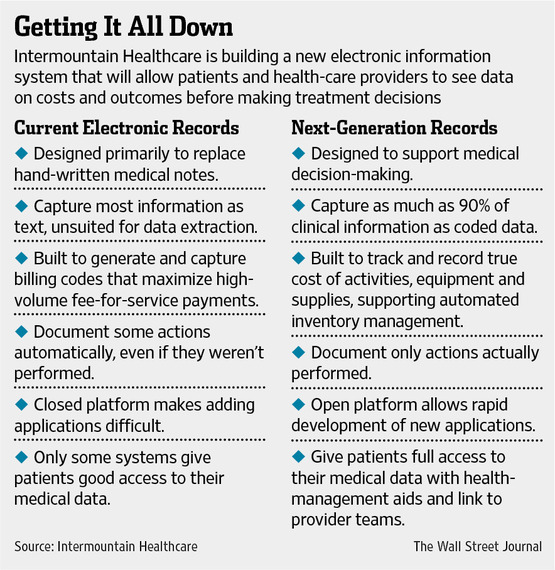
Brent C. James may be starting another medical revolution. As chief quality officer for Intermountain Healthcare, a Salt Lake City-based network of 22 hospitals and 185 clinics in Utah and Idaho, Dr. James has been using electronic records to improve care and cut costs since the 1980s. Read more of this post

Drug companies in Japan invest in curing diseases of the poor

Drug companies in Japan invest in curing diseases of the poor

Nov 16th 2013 |From the print edition

JAPAN’s pharmaceutical firms are an inventive bunch: only the American and British drugs industries produced more new medicines between 2005 and 2008. But their record on healing the diseases of the poor is not so good. The Access to Medicine Foundation, a non-profit group, tracks drug firms’ efforts to serve patients in developing countries; and in its ranking of the 20 biggest ones, Japanese firms occupy four of the bottom six rungs. Read more of this post

Biotech Bubble Watch 2014

Biotech Bubble Watch 2014

November 14, 2013

With valuations at historic highs, the industry’s bull run is looking frothy. Investors should brace for a correction, though not a 2000-like bust.

health_biotechgraphic47_970b

Big Pharma’s Patent Cliff

Big Pharma’s Patent Cliff

November 14, 2013

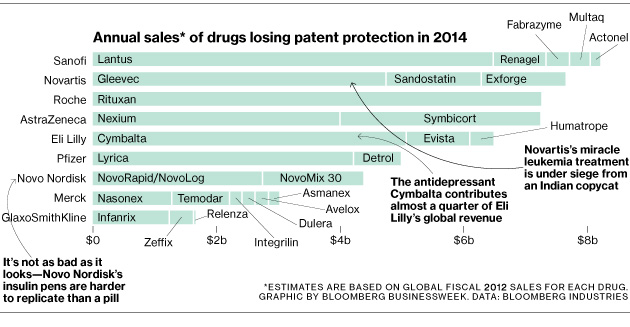
Drugs going off-patent in 2014 contribute just under $50 billion in pharmaceutical industry revenue. Not all products losing protection face imminent competition from generics; biological products and drugs delivered by devices are best poised to extend their money-spinning streak.

health_drugpatentchart447_630

Electronic Health Records’ ‘Make-or-Break Year’

Electronic Health Records’ ‘Make-or-Break Year’

By Suzanne Allard Levingston November 14, 2013

Lelia Straw uses her home computer to help manage her type 2 diabetes. To track her blood work and stay in touch with her doctors, she logs on to HealthConnect, an online system operated by Kaiser Permanente, the Oakland (Calif.)-based health plan that covers 9.1 million Americans. “When you have the tools, you have sort of an internal motivation to use them and to pay attention to what’s going on,” Straw says. For years, the 63-year-old carried a paper record of her medical history, but she has come to realize that all her doctors now have access to even her most recent test results. Read more of this post

Thought-Controlled Computer Hands May Aid Stroke Recovery

Thought-Controlled Computer Hands May Aid Stroke Recovery

Virtual reality hands controlled by thought may help stroke patients recover the use of their limbs, according to a study testing whether the brain-computer system could be a new rehabilitation tool. Six stroke patients had as much as 81 percent accuracy in reaching virtual hands to a glass of tea or water viewed on a computer screen, and they improved their skills in as few as three two-hour sessions, according to a report today at the American Heart Association’s Scientific Sessions in Dallas. Read more of this post

Europe’s Last Resort Antibiotics Can No Longer Kill Disease ‘Superbugs’

Europe’s Last Resort Antibiotics Can No Longer Kill Disease ‘Superbugs’

BEN HIRSCHLERREUTERS NOV. 15, 2013, 10:00 AM 1,504 8

CRE bacteria, sometimes called “nightmare bacteria,” is blamed for 600 deaths each year and can withstand treatment from virtually every type of antibiotic.

LONDON (Reuters) – Europe faces a growing threat from superbugs that are resistant to a powerful, last-resort class of antibiotics known as carbapenems, the EU’s disease monitoring agency said on Friday. It is the latest in a series of warnings about antibiotic resistance from healthcare authorities around the world who fear that in future simple infections may no longer respond to medical treatment. Read more of this post

Addiction Treatment With a Dark Side; High hopes for buprenorphine, an effective treatment for opioid addiction, have been tempered by a messy reality: health complications and deaths, unscrupulous doctors and a reputation as a street drug

November 16, 2013

Addiction Treatment With a Dark Side

By DEBORAH SONTAG

For Shawn Schneider, a carpenter and rock musician, the descent into addiction began one Wisconsin winter with a fall from a rooftop construction site onto the frozen ground below. As the potent pain pills prescribed for his injuries became his obsessive focus, he lost everything: his band, his job, his wife, his will to live. Mr. Schneider was staying in his parents’ basement when he washed down 40 sleeping pills with NyQuil and beer. His father heard him gasping and intervened, a reprieve that led Mr. Schneider into rehab, not his first program, but the one where he discovered buprenorphine, a substitute opioid used to treat opioid addiction. Read more of this post

Addiction Specialists Wary of New Painkiller

November 15, 2013

Addiction Specialists Wary of New Painkiller

By BARRY MEIER

Addiction experts protested loudly when the Food and Drug Administration approved a powerful new opioid painkiller last month, saying that it would set off a wave of abuse much as OxyContin did when it first appeared. An F.D.A. panel had earlier voted, 11 to 2, against approval of the drug, Zohydro, in part because unlike current versions of OxyContin, it is not made in a formulation designed to deter abuse. Read more of this post

Diabetes Kills One Person Every Six Seconds; Diabetes battle “being lost” as cases hit record 382 million

Diabetes Kills One Person Every Six Seconds, Estimates Show

pdfnews

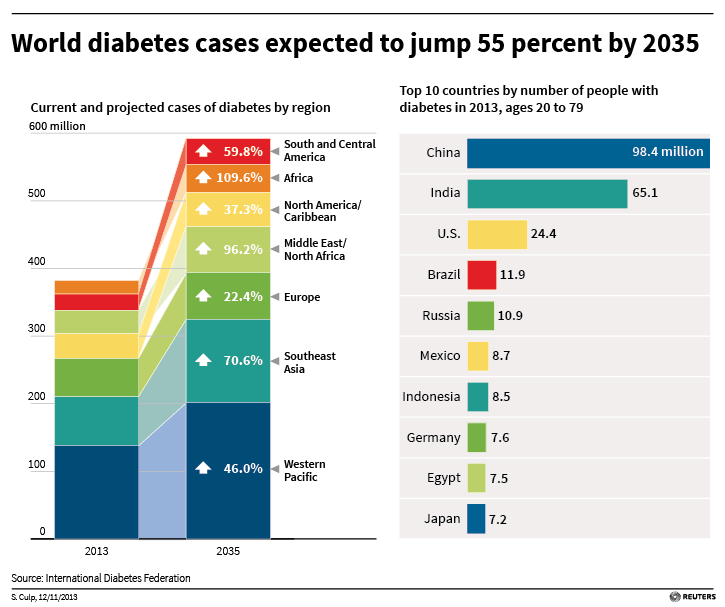
Diabetes kills one person every six seconds and afflicts 382 million people worldwide, according to the International Diabetes Federation, which has been canvassing the help of people ranging from celebrity chef Jamie Oliver to Bob Marley’s nephew to raise awareness about the problem. The number of diabetes cases has climbed 4.4 percent over the past two years and is more than 5 percent of the world’s population, according to new figures the Brussels-based federation released today. The number of people affected by the disease is expected to climb 55 percent to 592 million by 2035 as factors including poor diet, a more sedentary lifestyle, increases in obesity and life expectancy fuel an epidemic, it said. There were only 285 million sufferers worldwide in 2009. Read more of this post

What You Need to Know About New Heart-Care Guidelines

What You Need to Know About New Heart-Care Guidelines

Some Answers to New Clinical Recommendations

RON WINSLOW

Nov. 13, 2013 9:20 a.m. ET

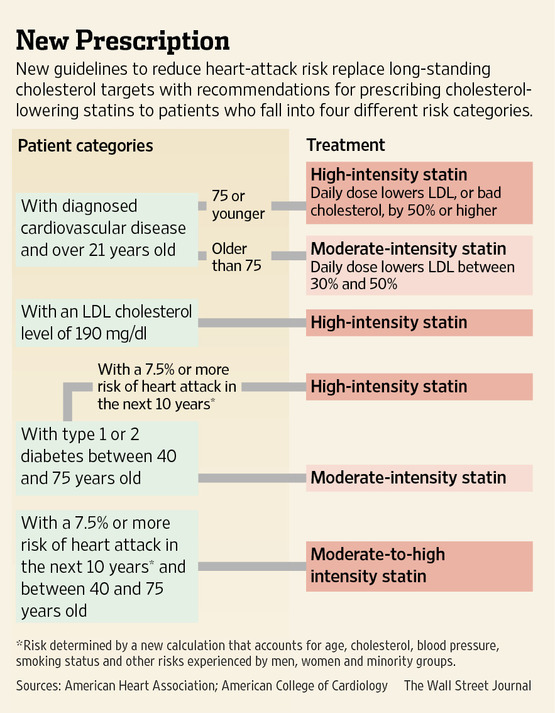
For nearly a decade, the mantra for targeting LDL, or bad cholesterol, to reduce the risk of heart attacks and strokes was “the lower the better.” Now, new guidelines issued Tuesdayby two leading cardiology groups back away from that idea and scrap the long-standing goal of getting LDL to below 100—or below 70 for people at especially high risk. The new tack recommended by the American Heart Association and the American College of Cardiology is to prescribe moderate to high doses of cholesterol-lowering drugs called statins to patients who fall into one of four risk groups regardless of their LDL status. Here is a look at the implications: Read more of this post

Profit bonanza eludes companies chasing obesity business

Profit bonanza eludes companies chasing obesity business

Thu, Nov 14 2013

By Ben Hirschler and Martinne Geller

KALUNDBORG, Denmark (Reuters) – Steam rises from pipes at a giant industrial complex on the edge of the Baltic Sea whose success is a testament to the world’s diabetes and obesity epidemic. Novo Nordisk’s Kalundborg factory, 100 km west of Copenhagen, makes half the planet’s insulin for diabetics, putting it on a list of global sites the United States sees as vital to its interests, according to a WikiLeaks cable in 2010. Read more of this post

Taiwan doctors urge vigilance after a flu virus that commonly circulates among chickens was found for the first time in a human being

Taiwan doctors urge vigilance over new bird flu virus

POSTED: 14 Nov 2013 09:29
Researchers in Taiwan on Thursday called on watchdogs to keep up their guard after a flu virus that commonly circulates among chickens was found for the first time in a human being. PARIS: Researchers in Taiwan on Thursday called on watchdogs to keep up their guard after a flu virus that commonly circulates among chickens was found for the first time in a human being. Read more of this post

Alzheimer’s Clues Sought Studying Link to Down Syndrome

Alzheimer’s Clues Sought Studying Link to Down Syndrome

Research to unravel for the first time the complex genetic mechanisms shared by Alzheimer’s disease and Down syndrome is gaining momentum in studies by Johnson & Johnson and patient advocacy groups. By age 40, almost everyone with Down syndrome has beta amyloid deposits in their brains reflective of the protein clumps seen in Alzheimer’s in the general population, autopsy and imaging studies show. By age 50, half have dementia. Read more of this post

Panel Unveils Shake-up in Strategy to Cut Heart Risk

Panel Unveils Shake-up in Strategy to Cut Heart Risk

Long-standing strategy jettisoned under new guidelines

RON WINSLOW

Updated Nov. 12, 2013 7:48 p.m. ET

NA-BY872A_HEART_G_20131112182404

The current strategy of reducing a person’s heart-attack risk by lowering cholesterol to specific targets is being jettisoned under new clinical guidelines unveiled Tuesday that mark the biggest shift in cardiovascular-disease prevention in nearly three decades. The change could more than double the number of Americans who qualify for treatment with the cholesterol-cutting drugs known as statins. Read more of this post

Resistance to anti-malarial drugs spreads in SE Asia

Resistance to anti-malarial drugs spreads in SE Asia

WASHINGTON — Experts in the United States are raising the alarm over the spread of drug-resistant malaria in several South-east Asian countries, endangering major global gains in fighting the mosquito-borne disease that kills more than 600,000 people annually.

3 HOURS 27 MIN AGO

WASHINGTON — Experts in the United States are raising the alarm over the spread of drug-resistant malaria in several South-east Asian countries, endangering major global gains in fighting the mosquito-borne disease that kills more than 600,000 people annually. Read more of this post

Report Raises Concerns on Robotic Surgery Device

Report Raises Concerns on Robotic Surgery Device

THOMAS M. BURTON

Updated Nov. 8, 2013 8:06 p.m. ET

BF-AG180_ROBOTS_G_20131108195314

Surgeons in Paris using the da Vinci Surgical System in March 2012. A new analysis raised safety concerns. ABK/BSIP/Corbis

A robotic-surgery device called the da Vinci Surgical System is linked to “an overall increasing trend in the rate of injury and death reports” since 2004, according to a draft analysis of such events reported to the Food and Drug Administration. The draft analysis, by the chief of adult cardiac surgery at Rush University Medical Center and co-authors from the University of Illinois and Massachusetts Institute of Technology, focused on all adverse-event reports made to the FDA from January 2000 through last December. The da Vinci device is made by Intuitive Surgical Inc., ISRG +2.70% of Sunnyvale, Calif. Read more of this post

A Cure for the Allergy Epidemic? When we left farming life, we lost the microbes that kept our immune systems in check

November 9, 2013

A Cure for the Allergy Epidemic?

By MOISES VELASQUEZ-MANOFF

WILL the cure for allergies come from the cowshed? Allergies are often seen as an accident. Your immune system misinterprets a harmless protein like dust or peanuts as a threat, and when you encounter it, you pay the price with sneezingwheezing, and in the worst cases, death. What prompts some immune systems to err like this, while others never do? Some of the vulnerability is surely genetic. But comparative studies highlight the importance of environment, beginning, it seems, in the womb. Microbes are one intriguing protective factor. Certain ones seem to stimulate a mother’s immune system during pregnancy, preventing allergic disease in children. Read more of this post

Intuitive Surgical Robot Incident Reports Double in Year

Intuitive Surgical Robot Incident Reports Double in Year

The number of adverse incident reports involving Intuitive Surgical Inc.’s (ISRG) robots more than doubled this year, according to U.S. regulators who also released a physician survey showing no consistent training exists for the complex machines. The Food and Drug Administration received 3,697 adverse reports through Nov. 3, compared with 1,595 in 2012. The surge, though, doesn’t necessarily mean the rate has changed, said William Maisel, with the FDA’s device unit. Rising robot use and recent media reports and recalls may have spurred public attention, he said. The reports, from the company and medical professionals, are largely unverified by the agency. Read more of this post

Ms Lei Jufang, billionaire founder of Shenzhen-listed Cheezheng has ridden the stunning success of her traditional Chinese medicine (TCM) firm

LEI JUFANG: Tycoon’s Traditional Recipe For Riches

Written by Andrew Vanburen (China Correspondent)

lei_montage

Saturday, 09 November 2013 09:01Cheezheng Tibetan Medicine Chairperson Ms. Lei Jufang has a net worth of over one billion usd.Photos: imageschina, richonline
MS. LEI JUFANG, chairperson of Shenzhen-listed Cheezheng, has ridden the stunning success of her traditional Chinese medicine (TCM) firm to the tune of a net worth of over one billion usd.
Born in 1955 in the northwestern Chinese province of Gansu, one of the PRC’s poorest, Ms. Lei nevertheless has gradually risen to become one of the country’s wealthiest women. Gansu Province is renowned as a source for wild medicinal herbs used in traditional Chinese medicine – a geographic factor which influenced the billionaire’s business direction later in life. In 1995, she founded Cheezheng Tibetan Medicine (SZA: 002287) in Linzhi, Tibet and currently serves as the TCM firm’s chairperson, owning 81% of its issued shares. Read more of this post

Harvard Zebrafish Research Yields Possible Treatments for Muscle Diseases

Harvard Zebrafish Research Yields Possible Treatments for Muscle Diseases

Zebrafish experiments by Harvard University researchers yielded new chemicals that prod stem cells to make muscle tissue, an advance that may lead to treatments for muscular dystrophy and related disorders. The chemicals, found to coax fish embryo cells to form muscle, also had the same effect on human stem cells that were transplanted into mice with a muscle-wasting disease. The researchers’ findings were published today in the journal Cell. Read more of this post

FDA Wants To Ban Trans Fat From All Processed Food

FDA Wants To Ban Trans Fat From All Processed Food

by Paul SheaNovember 7, 2013

Big changes may be afoot in the food industry. The Food and Drug Administration (FDA) has revealed that it wants to ban the use of trans fats in all processed foods. The move is not set in stone just yet, but there are indications that it could become a concrete regulation in the coming months. According to the FDA the consumption of trans fats has declined drastically in recent years as awareness about the dangers they pose pervaded consumer and producer mentalities. The cultural change has not been big enough to prevent the deaths of millions, and the agency is now looking to ban the substances by law. Read more of this post

Enabling diabetes patients to sleep soundly; Excess insulin levels can be fatal when they occur at night. NightSense aims to remove the fear

Enabling diabetes patients to sleep soundly

Excess insulin levels can be fatal when they occur at night. NightSense aims to remove the fear.

5 November 13 13:14, Gali Weinreb

Gadi Kan-Tor, Yoav Kan-Tor and Shy Hefetz have developed a number of medical devices in the past, most of which are related to diabetes treatment. Gadi Kan-Tor, who himself suffers from diabetes, served as a volunteer guinea pig for product trials. NightSense, a product that aims to immediately detect sudden drops in blood-sugar levels (hypoglycemia) during the night may be their first product to break through the technological barrier and reach the market. Read more of this post

Autistic babies reduced their eye contact with people by 6 months of age, a finding that may lead to ways to identify the disorder earlier in life

Autistic Babies Reduce Eye Contact in Early Months

Babies later diagnosed with autism reduced their eye contact with people by 6 months of age, a finding that may lead to ways to identify the disorder earlier in life, researchers said. Almost 60 babies who were thought to be at high risk of autism were examined in the study, as were 51 babies considered at low risk, according to the report released today by the journal Nature. Later, 13 children were diagnosed with autism. While a lack of eye contact has been a hallmark of autism since the disease was first described, it’s not known exactly when it begins to occur, wrote study authors Warren Jones and Ami Klin, both of Emory University in Atlanta. Today’s report suggests that while newborns don’t initially show any difference in looking directly at people’s eyes, changes occur from 2 months to 6 months of age. Babies who had the steepest declines in eye contact tended to have the most severe autism. Read more of this post

Merck Seen Unlocking $13 Billion With Breakup: Real M&A

Merck Seen Unlocking $13 Billion With Breakup: Real M&A

Merck & Co. (MRK), the second-biggest U.S. drugmaker, may be coming around to the idea of separating its businesses after the breakup of larger rival Pfizer Inc. (PFE) boosted shareholder value by $50 billion. Merck Chairman and Chief Executive Officer Ken Frazier said last week that he’s evaluating whether the animal-health unit and consumer products would be better off outside the $134 billion company. Slimming down to focus on human medicines would follow in the footsteps of Pfizer, which spun off its animal-health unit and sold its baby formula business. Novartis (NOVN) AG also has identified its animal-health division as a top candidate to sell, Bloomberg News reported yesterday. Read more of this post

Attention-Deficit Expansion Merits Monitoring: Analysis

Attention-Deficit Expansion Merits Monitoring: Analysis

Expanding the criteria used to diagnose attention-deficit hyperactivity disorder led to a surge in drug prescriptions that may be “unnecessary and possibly harmful” for some children, researchers said. The broadening of diagnostic criteria in The American Psychiatric Association’s Diagnostic and Statistical Manual of Mental Disorders, known as the DSM, has been an “important contributor” to the growing prevalence of ADHD, according to an analysis led by Rae Thomas, a senior research fellow at Bond University in Australia and a psychologist who has worked with children and families for more than 20 years. Read more of this post