Genetic oncology: Cancer cartography: Mapping the DNA of thousands of tumours will help understand them

Genetic oncology: Cancer cartography: Mapping the DNA of thousands of tumours will help understand them

Sep 28th 2013 |From the print edition

A CANCER, put simply, is a gang of rogue cells multiplying out of control. But each gang is different, so “cancer” is actually a term that embraces hundreds of specific ailments propelled by an even larger number of genetic and epigenetic traits. The old ways of characterising it, by the anatomical site of its debut (kidney, for example, or prostate gland) and the histology of its cells, seem increasingly out of date. Instead, thanks to genomics, researchers have unprecedented information on the molecular changes which propel it. The challenge is making sense of those data and putting them to use. Read more of this post

Medical-Device Makers See EU Rules Slowing U.S. Approvals

Medical-Device Makers See EU Rules Slowing U.S. Approvals

U.S. medical-device manufacturers are looking anxiously across the Atlantic as the European Union prepares to tighten the process to approve new products, a step companies say will crimp their lifeline to funding and patients. The EU’s overhaul is meant to close loopholes that allowed breast implants made with industrial-grade silicone to be implanted in thousands of women. Yet device makers say the new rules will delay approvals without increasing safety. The European Parliament is scheduled to vote on new regulations over the next couple of weeks. The draft, once approved, will be the basis for negotiating with member states on final rules. Read more of this post

A new system called Sedasys, made by Johnson & Johnson, would automate the sedation of many patients undergoing colonoscopies. That could eliminate a big source of income for anesthesiologists

September 25, 2013, 7:12 p.m. ET

Robots vs. Anesthesiologists

J&J’s New Sedation Machine Promises Cheaper Colonoscopies; Doctors Fight Back

JONATHAN D. ROCKOFF

Anesthesiologists, who are among the highest-paid physicians, have long fought people in health care who target their specialty to curb costs. Now the doctors are confronting a different kind of foe: machines. A new system called Sedasys, made byJohnson & JohnsonJNJ -1.29% would automate the sedation of many patients undergoing colon-cancer screenings called colonoscopies. That could take anesthesiologists out of the room, eliminating a big source of income for the doctors. More than $1 billion is spent each year sedating patients undergoing otherwise painful colonoscopies, according to a RAND Corp. study that J&J sponsored. Read more of this post

Scientists are finding that maintaining stability and balance with each step we take requires complex coordination. The research could someday help athletes and prevent falls among the elderly

September 23, 2013, 7:06 p.m. ET

From Athletes to the Elderly: The Science of Trips and Falls

New research into how we maintain our balance could help athletes and prevent falls among the elderly

SHIRLEY S. WANG

New research into how we maintain our balance could help athletes and prevent falls among the elderly. Scientists are finding that maintaining stability and balance with each step we take requires complex coordination of foot placement, arm movement, trunk angle and neck and head motion. That’s because every step is different from the one before it. There are slight variations in stride length and width and the angle at which the foot hits the ground, as well as small shifts of weight in the torso. People’s bodies when walking must constantly make minuscule adjustments to accommodate these variations. Read more of this post

Google has launched a healthcare company to attack some of the most difficult scientific problems in diseases related to ageing, marking the biggest step yet beyond its core internet business

September 18, 2013 7:05 pm

Google launches healthcare company

By Richard Waters in San Francisco

Google has launched a healthcare company to attack some of the most difficult scientific problems in diseases related to ageing, marking the biggest step yet beyond its core internet business. Larry Page, chief executive, unveiled the venture, called Calico, with a characteristically ambitious and vague claim that “with some longer term, moonshot thinking around healthcare and biotechnology, I believe we can improve millions of lives”. Read more of this post

F.D.A. to Regulate Some Health Apps

September 23, 2013

F.D.A. to Regulate Some Health Apps

By SABRINA TAVERNISE

The Food and Drug Administration said Monday that it would regulate only a small portion of the rapidly expanding universe of mobile health applications, software programs that run on smartphones and tablets and perform the same functions as medical devices. Agency officials said their goal is to oversee apps that function like medical devices, performing ultrasounds, for example, and that could potentially pose risks to patients. Tens of thousands of health apps have sprung up in recent years, including apps that count steps or calories for fitness and weight loss, but agency officials said they would not regulate those types of apps. Read more of this post

Novartis CEO Writes a Prescription for the Swiss Drug Giant’s Success

SATURDAY, SEPTEMBER 21, 2013

Novartis CEO Writes a Prescription for the Swiss Drug Giant’s Success

By JONATHAN BUCK | MORE ARTICLES BY AUTHOR

Joseph Jimenez has steered the Swiss drug giant deftly through the patent expiration on its top-selling drug. Up next: record earnings.

ON-BC203_SPOTLI_G_20130921005026 BA-BC985_ceospt_G_20130920222310

Novartis CEO Joseph Jimenez isn’t a medical doctor like his predecessor, Daniel Vasella. Nonetheless, since becoming boss in February 2010, Jimenez has written the right prescription for the Swiss drug giant’s success. His appointment coincided with a critical moment in Novartis’ history: the patent expiration on Diovan, a treatment for hypertension that had been the company’s best-selling drug for more than a decade. As generic substitutes entered the market, Novartis’ revenue and profit slipped. But the company is poised to post record results again in 2015, powered by rising sales of new medications. Read more of this post

Nonagenarian Valley Produces Next Big Thing for Elders

Nonagenarian Valley Produces Next Big Thing for Elders

Silicon Valley entrepreneurs are finding their next big idea in the elderly capital of America.

While the world’s biggest firms have struggled to develop products targeted at older consumers, a group led by former Apple Inc. (AAPL), Microsoft (MSFT) Corp. and EBay Inc. employees yesterday unveiled Lively. The system of tiny sensors helps the elderly maintain their independence, letting far-flung relatives know whether they take their pills on time or exit the house. Read more of this post

Veggie-Heavy Stress Reduction Regimen Shown to Modify Cell Aging

Veggie-Heavy Stress Reduction Regimen Shown to Modify Cell Aging

The fountain of youth may simply be a healthy diet and reduced stress after all, not a magic pill or expensive cosmetics. Comprehensive lifestyle changes, including more fruit and vegetables as well as meditation and yoga, were shown to reverse signs of aging at the cellular level for the first time in a study published today. Adopting a diet rich in unprocessed foods combined with moderate exercise and stress management over five years increased the length of telomeres, the ends of chromosomes linked to aging, according to a study of 35 men published in the Lancet medical journal. No previous study has shown the effect of lifestyle changes on telomere length, the authors said. Read more of this post

Scans of people’s knees are less likely to reveal a problem when the referring doctor has a financial stake in the imaging center or the equipment used, suggesting some tests may be unnecessary

Doc financial interest may influence MRI referrals

3:53pm EDT

By Andrew M. Seaman

NEW YORK (Reuters Health) – Scans of people’s knees are less likely to reveal a problem when the referring doctor has a financial stake in the imaging center or the equipment used, suggesting some tests may be unnecessary, according to a new study. When doctors have a financial interest in the imaging facility, their patients are 33 percent more likely to get a test result that shows nothing wrong, compared to patients of doctors with no financial interest, U.S. researchers found. Read more of this post

There is no real secret about how to win the war on cancer

There is no real secret about how to win the war on cancer

Sep 14th 2013 |From the print edition

The Cancer Chronicles: Unlocking Medicine’s Biggest Mystery. By George Johnson. Knopf; 304 pages; $27.95. Bodley Head; £18.99. Buy fromAmazon.comAmazon.co.uk

The Truth in Small Doses: Why We’re Losing the War on Cancer—and How to Win It. By Clifton Leaf. Simon & Schuster; 499 pages; $27. Buy fromAmazon.com

NOW that AIDS is treatable, and only poor people die from it, cancer has resumed its role as the health bugaboo of the rich world. The headlines shout daily about what does, or does not cause it, with the same things often appearing in both lists. Magazines are full of tales of celebrities who have had the disease—or rather, “battled” with it. And the science columns discourse learnedly on this or that new drug which might prove (though always five to ten years hence) a crucial breakthrough in the war against it. Read more of this post

Are Insomnia’s Effects on the Brain as Bad As They Feel? Researchers are intrigued by how insomnia patients perform cognitive tasks despite feeling sleepy and unable to concentrate

September 16, 2013, 6:47 p.m. ET

Are Insomnia’s Effects on the Brain as Bad As They Feel?

Researchers are intrigued by how insomnia patients perform cognitive tasks despite feeling sleepy and unable to concentrate

SUMATHI REDDY

Insomniacs don’t just suffer at night. During the day, they often feel sleepy, have trouble concentrating and report greater difficulty with work or school performance than individuals who get adequate sleep. But researchers are intrigued by an apparent discrepancy: Despite what insomnia patients experience subjectively, they often seem able to perform cognitive tasks as well as people getting adequate sleep. One possibility is that insomnia doesn’t lead to inferior performance after all—maybe it just feels that way. Read more of this post

Steps to Better Foot Health; Foot pain can signal big and small problems. Even how you get out of bed matters.

September 16, 2013, 7:04 p.m. ET

Steps to Better Foot Health

Foot pain can signal big and small problems. Even how you get out of bed matters.

ANGELA CHEN

PJ-BQ514_FEET_G_20130916172239

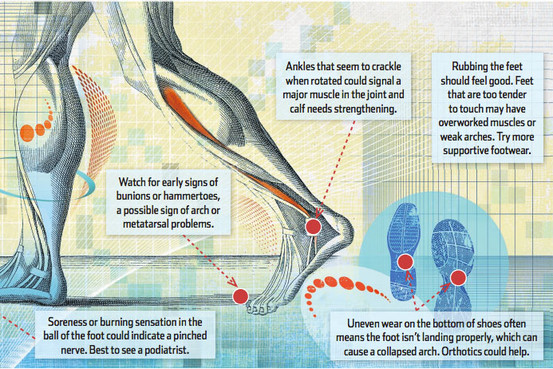
Are your feet healthy? Even people who try to cover all the bases—avoiding fattening foods, hitting the gym and wearing sunscreen—may not be able to answer yes. Doctors say people often ignore persistent but minor foot complaints, which can later develop into bigger problems, like lower back pain. Some common foot problems can mask underlying issues that are correctable if addressed early. Tender feet might be a sign of a pinched nerve, for example, or bunions might stem from weak arches. Other foot ailments, such as sores that don’t heal, can point to a more serious condition, such as diabetes. Read more of this post

Patients Share DNA for Cures

September 16, 2013, 9:45 p.m. ET

Patients Share DNA for Cures

RON WINSLOW

Patients with rare and deadly diseases are getting a powerful new boost. Cancer foundations and other nonprofit patient groups are investing tens of millions of dollars to build genetic databases in an effort to speed drug development and jumpstart clinical trials. The databases are designed to collect DNA and other information from patients with hard-to-treat diseases. The material can be analyzed for certain genetic mutations and made available to scholars and pharmaceutical companies. The databases could also help patients familiar with their own genetic mutations to find information about clinical trials. Read more of this post

Drugs for Inherited Cancers Get Fresh Push

September 15, 2013, 9:37 p.m. ET

Drugs for Inherited Cancers Get Fresh Push

After Earlier Disappointments, Treatments Are Seen Helping Patients With Breast-Gene Mutation

JOSEPH WALKER

OB-YX587_DRUGS0_G_20130915220303

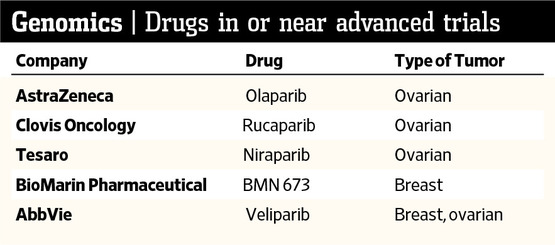
Drug makers are rallying to a class of drugs that, if they succeed, could be the first treatments to target breast and ovarian cancers tied to the genetic mutations known as BRCA 1 and BRCA 2. Two years ago, the drugs were all but written off after a string of clinical study failures in broader cancer-patient populations. But later research and a closer examination of existing data showed the drugs, known as PARP inhibitors, had a pronounced effect in BRCA patients. Read more of this post

Antibiotics Losing Battle Against Bugs; More than two million people in the U.S. develop infections every year that are resistant to antibiotics, and at least 23,000 of them die as a result

Updated September 16, 2013, 7:32 p.m. ET

Antibiotics Losing Battle Against Bugs: Report

BETSY MCKAY

NA-BY086_ANTIBI_G_20130916151206

More than two million people in the U.S. develop infections every year that are resistant to antibiotics, and at least 23,000 of them die as a result, according to a government report Monday that called for aggressive steps to counter a worsening public health problem. Another 250,000 people annually develop a bacterial infection, clostridium difficile, and about 14,000 of those cases prove fatal, the Centers for Disease Control and Prevention said in its first report to give an overview of the threat and toll of antibiotic-resistant bugs that cause most infections. Read more of this post

Looking for lessons in cancer’s ‘miracle’ responders

Looking for lessons in cancer’s ‘miracle’ responders

8:03am EDT

By Ransdell Pierson

NEW YORK (Reuters) – Nearly every oncologist can tell the story of cancer patients who beat the odds, responding so well to treatment that they continued to live many years disease-free, while most of their peers worsened and eventually died. Dr. David Solit decided to find out why. Solit, an oncologist at Memorial Sloan-Kettering Cancer Center in New York City, delved into the case of a woman with advanced bladder cancer who volunteered for a 45-patient study of the Novartis drug Afinitor. He discovered that a combination of two gene mutations made her particularly receptive to the treatment. “Every other patient died, but she’s without evidence of disease for more than three years now,” said Solit. Over the past century, such patients – sometimes called “outliers” or “super responders” – have stood out by staging remarkable recoveries, or long-term benefit, from cancer drugs that provide little or no help to others. Little heed has been paid to them because there was no way to know why they fared so well. In most cases, the drugs that helped them were abandoned because they helped too few patients. Read more of this post

How the bacteria in your gut may be shaping your waistline

How the bacteria in your gut may be shaping your waistline

Sep 14th 2013 | NEW YORK |From the print edition

A CALORIE is a calorie. Eat too many and spend too few, and you will become obese and sickly. This is the conventional wisdom. But increasingly, it looks too simplistic. All calories do not seem to be created equal, and the way the body processes the same calories may vary dramatically from one person to the next. This is the intriguing suggestion from the latest research into metabolic syndrome, the nasty clique that includes high blood pressure, high blood sugar, unbalanced cholesterol and, of course, obesity. This uniquely modern scourge has swept across America, where obesity rates are notoriously high. But it is also doing damage from Mexico to South Africa and India, raising levels of disease and pushing up health costs. Read more of this post

Global Fund seeks $15 billion to control three big killers

Global Fund seeks $15 billion to control three big killers

Thu, Sep 12 2013

By Kate Kelland

LONDON (Reuters) – The world’s biggest funder of the fight against AIDS, tuberculosis (TB) and malaria said on Thursday it needs $15 billion over the next three years to begin bringing “the three big global pandemics” under control. In a report released ahead of a pledging conference later this year, the Global Fund to Fight AIDS, TB and Malaria said timely investments could avert $47 billion in extra treatment costs and save millions of lives, but warned that acting too late would mean missing important opportunities. Read more of this post

MIT’s Williams Decodes Economics of Gene Sequencing

MIT’s Williams Decodes Economics of Gene Sequencing

Heidi Williams’s dad helped with her high school science-fair projects by driving her two hours from their North Dakota town to get books on World War II German cryptography. After studying up, she would present new ways to crack the cipher. These days, Williams is trying to help scientists as they unlock the secrets of a different code: the human genome. The 32-year-old Massachusetts Institute of Technology economist is examining health-care innovation with a $430,000 National Science Foundation CAREER grant, an award given to “exceptionally promising” junior faculty who excel as educators and researchers. Read more of this post

Scientists create reprogrammable mouse in stem cell breakthrough, opening a new way to regenerate failing tissues in patients with diseases ranging from heart failure to diabetes

September 11, 2013 6:04 pm

Scientists create reprogrammable mouse in stem cell breakthrough

By Clive Cookson, Science Editor

Scientists in Spain have produced the world’s first embryonic stem cells within a live animal rather than in a laboratory dish. The experiment with mice at the National Cancer Research Centre in Madrid could open a new way to regenerate failing tissues in patients with diseases ranging from heart failure to diabetes. Therapeutic applications – for example to repair damaged spinal cord or make new insulin-producing cells – are distant. Even on the most optimistic assumptions clinical trials in people are unlikely to start in less in than five years, according to Dr Serrano. Read more of this post

Rampant IV use leads to 390,000 deaths a year in China

Rampant IV use leads to 390,000 deaths a year in China: report

Staff Reporter

2013-09-12

CC08X0350H_2012資料照片_N71_copy1

Sick children with intravenous drips in a hospital in Beijing. (Photo/Xinhua)

Over 390,000 deaths in China are caused by unsafe intravenous therapy each year, with 200,000 of them being caused by fatal reactions to drugs delivered, the China Alliance for Safe Injection estimated. At least 100,000 persons died in the country each year after receiving IV fluid infusion, they added. Read more of this post

Diabetes Ailing 114 Million Chinese may consume $22 billion, or more than half of China’s annual health budget, if all those afflicted with the condition get routine, state-funded care

Diabetes Ailing 114 Million Chinese Risks Ravaging Health Budget

Diabetes may consume $22 billion, or more than half of China’s annual health budget, if all those afflicted with the condition get routine, state-funded care. The disease is putting an “overwhelming burden” on the country, according to the International Diabetes Federation, which says China spent $17 billion, or about $194 a patient, on diabetes last year. A study released last week found China has 114 million diabetics or 21.6 million more than the Brussels-based federation estimated in November. Read more of this post

Cancer treatment has grown so complex, many U.S. doctors can’t keep up with new information and are offering incorrect treatment, failing to explain options and leaving patients to coordinate their own care

U.S. cancer-care delivery is ‘in crisis’: report

Tue, Sep 10 2013

By Sharon Begley

NEW YORK (Reuters) – Cancer treatment has grown so complex, many U.S. doctors can’t keep up with new information and are offering incorrect treatment, failing to explain options and leaving patients to coordinate their own care, according to a report released on Tuesday by the Institute of Medicine, part of the National Academy of Sciences. The 315-page report, “Delivering High-Quality Cancer Care: Charting a New Course for a System in Crisis,” identifies a long list of reasons for the crisis, including a growing demand for cancer care as more people receive a diagnosis and a shrinking oncology workforce. Read more of this post

How US biotechnology bull run will affect Australia

How US biotechnology bull run will affect Australia

PUBLISHED: 15 HOURS 2 MINUTES AGO | UPDATE: 6 HOURS 46 MINUTES AGO

The Australian Financial Review

JESSICA GARDNER

The lower Aussie dollar, a well regarded local clinical trials industry, and a frothy US biotechnology industry, are combining to make early stage Australian life science companies attract­ive. Although the right qualities are falling into place, not all industry watchers expect a spate of takeovers. A partner at early stage investment fund GBS Ventures, Brigitte Smith, said in comparison to the US, where the biotechnology sector was “on fire”, Australian life science companies do appear cheaper. “It has been a really big, long sustained bull run on biotech IPOs, for the best part of a year,” she said. “Because of that, the biotech sector in the US is looking pricey.” Read more of this post

Workers Nudged to Health Exchanges Seen Costing Taxpayers

Workers Nudged to Health Exchanges Seen Costing Taxpayers

U.S. retirees being pushed out of company-sponsored health plans may prove a harbinger for existing employees as well. About $6.7 billion in taxpayer money may be at risk if companies raise premiums by as little as $100 a month. That may spur as many as 2.25 million people to drop company coverage and enroll in plans under the Affordable Care Act, Stanford University researchers said. Read more of this post

Research renaissance offers new ways out of depression

Research renaissance offers new ways out of depression

6:53am EDT

By Kate KellandHealth and Science Correspondent

LONDON (Reuters)- As Susan sits chatting to a nurse in a London clinic, a light tapping sound by her head signals that parts of her brain are being zapped by thousands of tiny electro-magnetic pulses from a machine plugged into the wall. The 50 year-old doctor is among growing ranks of people with so-called treatment-resistant depression, and after 21 years fighting a disorder that destroyed her ability to work and at times made her want to “opt out of life”, this is a last resort. Read more of this post

A Common Test to Screen for Stroke Risk Is Under Review; Health panel takes a new look at carotid-artery ultrasounds, which can produce false positive results

September 8, 2013, 5:22 p.m. ET

A Common Test to Screen for Stroke Risk Is Under Review

Health panel takes a new look at carotid-artery ultrasounds, which can produce false positive results.

LAURA LANDRO

After a career driving custom buses for touring rock bands, Ken Goins felt like he was in good shape to enjoy retirement, having lost weight and quit smoking years earlier following a bypass operation at age 50. But on his 69th birthday, an ultrasound test showed an 85% blockage in his left carotid artery, one of the two large blood vessels in the neck that supply blood to the brain and can become clogged with cholesterol. A vascular surgeon performed a carotid endarterectomy—a procedure to remove plaque and restore normal blood flow—to lower the risk of stroke from a blood clot or piece of plaque that can get stuck in a smaller artery in the brain. Read more of this post

Store-Bought Baby Food Offers Little Benefit to Milk Diet

Store-Bought Baby Food Offers Little Benefit to Milk Diet

Commercial baby foods offer little nutritional benefit over breast milk and infants would get more from homemade purees than from a jar when transitioning to a solid food diet, a study found. Researchers looked at more than 450 products for infants being weaned off breast milk made by Danone SA’s (BN) Cow & Gate, H.J. Heinz Co., Boots, Hipp Organic, Ella’s Kitchen and Organix Brands Ltd. Fifty grams of homemade baby food would probably have the same energy and protein as 100 grams of the commercial food, they wrote in the Archives of Disease in Childhood, which is published by the British Medical Association. Read more of this post

Death Every 10 Seconds Spurs Novartis, Glaxo Lung Contest

Death Every 10 Seconds Spurs Novartis, Glaxo Lung Contest

There’s a new competition brewing in the $10 billion market for drugs to treat deadly lung diseases as the growing number of smokers in emerging markets drives demand. Novartis AG (NOVN) aims to convince doctors that its new Ultibro medicine for chronic obstructive pulmonary disease is better than GlaxoSmithKline Plc (GSK)’s blockbuster Advair, which is also used to treat asthma. Glaxo, meanwhile, has developed new products in anticipation of the day that Advair faces competition from generic copies. Read more of this post