Extra Food Means Nothing to Stunted Kids With Bad Water: Health

Extra Food Means Nothing to Stunted Kids With Bad Water: Health

Aameena Mohammed gives her 20-month-old daughter Daslim Banu plenty to eat. The girl’s mother supplements breast milk with eggs, soup and rice to help her grow. The extra food doesn’t help. Daslim still weighs only as much as a healthy infant half her age.

Mohammed’s home, in one of the poorest districts of the south Indian city of Vellore, is among the 65 percent of India’s homes without running water and safe sewage disposal. Feces and urine collect next to the doorway in an open drain — the source of odor permeating the tin-roofed shack and of the microbes likely retarding the toddler’s growth. Read more of this post

Human Genome Project Spurred $966 Billion Sciences Boom

Human Genome Project Spurred $966 Billion Sciences Boom

The $14.5 billion investment by the U.S. in the Human Genome Project, completed a decade ago, has paid off more than 60-fold in new jobs, drugs and a rapidly expanding genetics industry, an analysis has found.

The endeavor to map human DNA in its entirety created $966 billion in economic impact and $59 billion in federal tax revenue, according to the study released today by United for Medical Research and Battelle, two research advocacy groups.

Dozens of companies have started with the knowledge gained from the project, leading to new diagnostic tests and development of medicines that can be matched with gene variants linked to disease. The project triggered a new era in the life sciences, with new oncology drugs and screenings among the early developments in the field, said Greg Lucier, chief executive officer of Life Technologies Corp. (LIFE) Read more of this post

Fake Fake Drugs From China: What’s Stopping a Cure for Malaria in Africa?

Fake Fake Drugs From China: What’s Stopping a Cure for Malaria in Africa?

By Kathleen McLaughlin

In 1967, as the United States sank into war in the jungles of Vietnam and China descended into the cataclysm of the Cultural Revolution, Chinese soldiers secretly fighting alongside the North Vietnamese also battled swarms of malarial mosquitoes. Showing remarkable foresight, Chinese Communist Party Chairman Mao Zedong amassed a secret team of top scientists with one mission: find a cure for malaria.

As China — then a poor country, barely recovered from a devastating famine — added insult to injury by dismantling its scientific, medical, and educational institutions under Mao’s misguided program of political cleansing, the scientists labored on with clear purpose. Within a decade, some 500 researchers, many of whom were persecuted politically along the way, developed an ingenious drug called artemisinin, pulling off a medical marvel against the odds. Read more of this post

GSK fires China research head over ‘misrepresented’ data

GSK fires China research head over ‘misrepresented’ data

Tue, Jun 11 2013

LONDON (Reuters) – British drugmaker GlaxoSmithKline (GSK.L: QuoteProfileResearchStock Buzz) has fired its head of research and development in China after discovering that a study by some of its Chinese scientists contained misrepresentation of data. A company spokesman said on Tuesday that Jiangwu Zang had been dismissed and three other individuals had been placed on administrative leave, while a further employee had resigned. The decision follows an investigation into concerns about a scientific paper published in the journal Nature Medicine in 2010 involving pre-clinical research into multiple sclerosis. Zang was one of the authors of the paper. “Regretfully, our investigation has established that certain data in the paper were indeed misrepresented,” Britain’s biggest drugs group said in a statement. Read more of this post

Fears of coronavirus mount as pilgrimage to Mecca nears; The deadly Middle East respiratory syndrome coronavirus (MERS) has potential to cause pandemic: WHO

June 11, 2013 1:34 pm

Fears of coronavirus mount as pilgrimage to Mecca nears

By Michael Peel and Abeer Allam in Abu Dhabi and Andrew Jack in London

Global health experts have stepped up warnings to the more than a million foreign pilgrims on their way to Saudi Arabia of the risks there from a deadly Sars-like virusthat has killed more than 30 people worldwide.

As vast numbers of Saudi and non-Saudi Muslims prepare to travel to Mecca next month for the peak of the Umrah pilgrimage, public health officials fear the virus may be circulating more widely than thought.

The influx of visitors to Saudi Arabia increases the chances of both domestic and international transmission of the coronavirus dubbed Middle East Respiratory Syndrome, which has killed more than 20 people in the kingdom. Read more of this post

CT Scans in Children May Trigger 5,000 Cancers in U.S.

CT Scans in Children May Trigger 5,000 Cancers in U.S.

The radiation from 4 million annual computerized tomography scans in U.S. children younger than 15 may lead to almost 5,000 cancers each year in the future, a study found.

The use of CT scans of the head, abdomen or pelvis, chest or spine in children 14 years and younger more than doubled from 1996 to 2007 before beginning to decline through 2010, according to research released today by JAMA Pediatrics. Those at greater risk for cancer were younger patients, girls, and those who underwent CT scans of the abdomen/pelvis or the spine rather than other areas of the body, the researchers said. Read more of this post

Alzheimer Research Cuts Show Folly of Sequestration: Albert Hunt

Alzheimer Research Cuts Show Folly of Sequestration: Albert Hunt

Many Republicans, and Democrats, never thought the automatic across-the-board spending cuts known as sequestration would take effect. After all, they might produce dangerous, if unintended, consequences such as potentially bankrupting the U.S. health-care system, along with millions of families. Typical Washington hyperbole, right? It actually is happening under sequestration, which kicked in three months ago, a product of America’s political dysfunction. Because the cuts only affect the margins of a wide array of defense and domestic discretionary programs, there mostly hasn’t been an immediate pinch; the public backlash has been minimal. The long-term consequences, in more than a few cases, are ominous. There’s no better case study than Alzheimer’s disease. With the sequestration-enforced cuts at the National Institutes of Health, research to find a cure or better treatment is slowing. Alzheimer’s, the most common form of dementia, is the sixth leading cause of death in the U.S. Five million Americans are afflicted with the disease. It costs about $200 billion a year, creating a severe strain for public health care and many families. Then there’s the emotional toll: The Alzheimer’s Association estimates that caregivers had an additional $9 billion of health-care costs last year. Read more of this post

Lab-Grown Blood Vessel Used for First Time in the U.S.

Lab-Grown Blood Vessel Used for First Time in the U.S.

A 62-year-old Virginia man with kidney failure received the first genetically engineered blood vessel in the U.S., a vein that may improve his dialysis treatments and pave the way for future tissue transplants.

The operation at Duke University Hospital in Durham, North Carolina, yesterday marked the first time doctors have implanted an “off-the-shelf” tissue graft in the U.S. The vessel, grown with human cells on a mesh tube, has the potential to be widely used since it was cleansed of any lingering cells that may trigger an immune reaction, said the doctors who performed the surgery. Read more of this post

Cancer therapy: Checkpoint Charlie; A new class of drugs is being deployed in the struggle against cancer

Cancer therapy: Checkpoint Charlie; A new class of drugs is being deployed in the struggle against cancer

Jun 8th 2013 |From the print edition

THE lexicon of oncology is filled with military metaphors: the war on cancer, aggressive tumours, magic bullets. And although these are indeed only metaphors, they do reflect an underlying attitude—that it is the clinician’s job to attack and destroy his patient’s tumour directly, with whatever weapons are to hand. As in real warfare, those weapons may be conventional (surgery), chemical (cancer-killing drugs) or nuclear (radiation therapy). There is even talk of biological agents, in the form of viruses specifically tailored to seek out and eliminate their tumorous targets.

Which is all well and good as strategies go. But as Sun Tzu observed, the wisest general is not one who wins one hundred victories in one hundred battles, but rather one who overcomes the armies of his enemies without having to fight them himself. And one way to do that is to get someone else to do your fighting for you. Read more of this post

$24.6 billion of the global biotech industry’s turnover of $120 billion is based on products that originated in Israeli research

Israeli inventions underpin 20% of global biotech revenue

Pitango general partner Ruth Alon: $24.6 billion of the global biotech industry’s turnover of $120 billion is based on products that originated in Israeli research.

6 June 13 21:10, Gali Weinreb

Israel’s life sciences industry is manic-depressive. One moment, it’s preparing for catastrophe and pending collapse, and the next, it’s celebrating the industry’s hoped-for breakthrough. There is no argument that Israel’s science and medicine are outstanding, and there is the feeling that the growth of a thriving pharmaceutical industry is only a matter of time. But it is not easy to translate the vision into reality.

“If we examine how many products in the world are based on Israeli technology, we discover that the vision has already been partly realized,” saysPitango Venture Capital general partner Ruth Alon, who handles the firm’s life sciences business, and is chairwoman of the IATA BioMed 2013 Conference. Read more of this post

Shortages of Drugs Threaten TB Fight

June 5, 2013, 10:35 p.m. ET

Shortages of Drugs Threaten TB Fight

By GEETA ANANDSHREYA SHAH and BETSY MCKAY

The U.S., India and other nations are facing shortages of tuberculosis drugs—threatening to reverse decades of progress against a deadly disease that is becoming increasingly untreatable.

In India, some clinics are turning away sick children due to short supplies of pediatric doses, and in a risky move, adult pills are sometimes being split to approximate children’s dosages. In the U.S., some patients who are infected, but not yet suffering symptoms, have lacked access to the most commonly used drug for that form of TB, leaving them instead to wait for the supply to improve or take another drug that doctors fear could worsen drug resistant TB if not properly used. The U.S. has also had repeated shortages of medicines that work against drug-resistant TB strains. Read more of this post

Accord Aims to Create Trove of Genetic Data; The goal is to put the vast collection of data on genetic variations and health into databases open to researchers and doctors all over the world

June 5, 2013

Accord Aims to Create Trove of Genetic Data

By GINA KOLATA

06gene-articleLarge

A storage robot deposits samples in the world’s largest blood and urine freezer at Biobank in Manchester, England.

More than 70 medical, research and advocacy organizations active in 41 countries and including the National Institutes of Health announced Wednesday that they had agreed to create an organized way to share genetic and clinical information. Their aim is to put the vast and growing trove of data on genetic variations and health into databases — with the consent of the study subjects — that would be open to researchers and doctors all over the world, not just to those who created them.

Millions more people are expected to get their genes decoded in coming years, and the fear is that this avalanche of genetic and clinical data about people and how they respond to treatments will be hopelessly fragmented and impede the advance of medical science. This ambitious effort hopes to standardize the data and make them widely availabl e. Read more of this post

Snake Gall Bladders Ditched for Drugs by Balding Chinese

Snake Gall Bladders Ditched for Drugs by Balding Chinese

(Corrects year of warning requirement in seventh paragraph.)

After raw-ginger scalp rubs and walnut snacks failed to counter Shi Yang’s receding hairline, the 26-year-old Shanghai engineer says he’s ready to ditch his mother’s advice and give Western drugs a go.

Traditional herbal remedies for male pattern baldness are losing ground to treatments such as Merck & Co. (MRK)’s Propecia and Johnson & Johnson (JNJ)’s Rogaine in China, where a full head of black hair on a man is a sign of health and virility. Shi, a slim, bespectacled college graduate, has a better chance of landing a girlfriend with a thick thatch of hair like President Xi Jinping or Premier Li Keqiang, both of whom are in their 50s, he said. Read more of this post

Cancer No Longer Death Sentence Brings Care Gap: Health

Cancer No Longer Death Sentence Brings Care Gap: Health

After Teresa Levitch underwent successful chemotherapy and radiation for the cancer attacking her immune system, she believed her health problems were over.

Now she knows better. For more than 10 years after her treatment, she felt pain and muscle fatigue in her upper body, and her range of motion was limited. She went to several doctors, but none helped her. Then she found the cancer survivor program at Memorial Sloan-Kettering Cancer Center in New York, which identified her illness as radiation fibrosis syndrome and began treatments that have made her feel better.

The Sloan-Kettering program is one of seven in the U.S. exclusively focused on long-term cancer survivors, a growing group that is facing a treatment gap between the successful end of cancer care by their oncologist and adequate follow-up by other doctors, according to reports this weekend at the American Society for Clinical Oncology annual meeting. Read more of this post

Diabetes Is the Price Vietnam Pays for Progress

June 4, 2013

Diabetes Is the Price Vietnam Pays for Progress

By THOMAS FULLER

HO CHI MINH CITY — He survived the deprivation of the Vietnamese countryside and decades of war, but Pham Van Dang, 70, lay dazed in his hospital bed, the stump of his freshly amputated leg sewn up like the seams of a leather bag. Mr. Dang and many younger patients in the diabetes ward here at Nguyen Tri Phuong Hospital are casualties of rising affluence, his doctor says. “I see more and more patients with diabetes,” said Dr. Tran Quang Khanh, who is chief of the endocrinology department, whose ward receives 20 new patients a day. The precise reasons for a spike in diabetes cases are hard to pin down — people are living longer, for one — but doctors in Vietnam say the prime culprits are “Westernization and urbanization.” “Now we have KFC and many fast-food restaurants,” Dr. Khanh said.

Read more of this post

In the Pursuit of Longevity; Two new books offer insights on trying to bend mind and matter to stop or reverse the ravages of time

June 3, 2013

In the Pursuit of Longevity

By ABIGAIL ZUGER, M.D.

At some point between George Washington and Colonel Sanders, white hair and a cane turned from symbols of elegance to suggestions of decrepitude, and an industry was born. Not that the fountain of youth wasn’t always sought after. But to look young, think young, feel young — those are distinctly modern goals.

A giant how-to literature now attends them: As Lauren Kessler estimates in “Counterclockwise,” at the rate of a book a week it would take almost 160 years to read them all. That didn’t stop her from writing one more, of course. Still, she has a point. The field suffers from a dearth of intelligent consumer review.

Ms. Kessler, a no longer young but not quite old journalist who sneakily never does mention her chronological age, decided to test a host of popular techniques on herself. “I did everything,” she tells her readers, “so you don’t have to.” Read more of this post

What Makes a Breakthrough Cancer Drug?

June 3, 2013, 3:43 p.m. ET

What Makes a Breakthrough Cancer Drug?

By PETER LOFTUS

CHICAGO—In the eyes of Richard Pazdur, a breakthrough cancer drug should be “transformative.”

His view is important because Dr. Pazdur is the head of the U.S. Food and Drug Administration’s office of hematology and oncology products, which helps decide whether experimental cancer drugs are sufficiently safe and effective to go on the market.

Under a new law that took effect last year, the agency has been designating certain drugs in development as “breakthroughs,” based on preliminary clinical evidence that suggests the drug could be a substantial improvement in treating serious or life-threatening diseases. Read more of this post

Pressure Grows to Create Drugs for ‘Superbugs’

June 2, 2013

Pressure Grows to Create Drugs for ‘Superbugs’

By BARRY MEIER

Government officials, drug companies and medical experts, faced with outbreaks of antibiotic-resistant “superbugs,” are pushing to speed up the approval of new antibiotics, a move that is raising safety concerns among some critics.

The need for new antibiotics is so urgent, supporters of an overhaul say, that lengthy studies involving hundreds or thousands of patients should be waived in favor of directly testing such drugs in very sick patients. Influential lawmakers have said they are prepared to support legislation that allows for faster testing.

The Health and Human Services Department last month announced an agreement under which it will pay $40 million to a major drug maker, GlaxoSmithKline, to help it develop medications to combat antibiotic resistance and biological agents that terrorists might use. Under the plan, the federal government could give the drug company as much as $200 million over the next five years. Read more of this post

The $2.7 Trillion Medical Bill: Colonoscopies Explain Why U.S. Leads the World in Health Expenditures

The $2.7 Trillion Medical Bill

Colonoscopies Explain Why U.S. Leads the World in Health Expenditures

By ELISABETH ROSENTHAL | Published: June 1, 2013

Healthcare cost

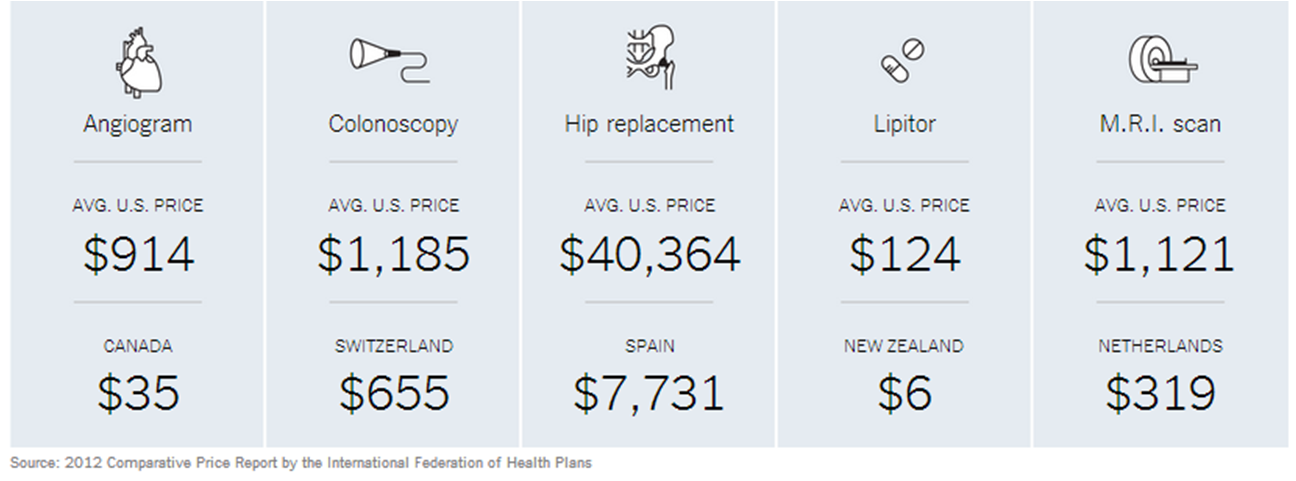
MERRICK, N.Y. — Deirdre Yapalater’s recent colonoscopy at a surgical center near her home here on Long Island went smoothly: she was whisked from pre-op to an operating room where a gastroenterologist, assisted by an anesthesiologist and a nurse, performed the routine cancer screening procedure in less than an hour. The test, which found nothing worrisome, racked up what is likely her most expensive medical bill of the year: $6,385.

That is fairly typical: in Keene, N.H., Matt Meyer’s colonoscopy was billed at $7,563.56. Maggie Christ of Chappaqua, N.Y., received $9,142.84 in bills for the procedure. In Durham, N.C., the charges for Curtiss Devereux came to $19,438, which included a polyp removal. While their insurers negotiated down the price, the final tab for each test was more than $3,500. Read more of this post

Artificial kidneys are getting closer to becoming a clinical reality, thanks to a range of advances

Medical technology: Artificial kidneys are getting closer to becoming a clinical reality, thanks to a range of advances

Jun 1st 2013 |From the print edition

AN ARTIFICIAL kidney these days still means a refrigerator-sized dialysis machine. Such devices mimic the way real kidneys cleanse blood and eject impurities and surplus water as urine. But they are nothing like as efficient, and can cause bleeding, clotting and infection—not to mention inconvenience for patients, who typically need to be hooked up to one three times a week for hours at a time. Still, for 2m people around the world who suffer from chronic kidney failure, dialysis is the best option—unless they qualify for one of the 76,000 or so kidney transplants performed each year. Even those lucky few endure a lifetime on drugs to stop their bodies rejecting the foreign tissue.

A world in which new kidneys are grown using a patient’s own cells remains some way off. In the meantime, human patients are likely to be offered tiny versions of the dialysis machine. None is available yet, but last year America’s Food and Drug Administration (FDA) picked a couple of candidates to participate in a fast-track process called Innovation Pathway 2.0, which aims to bring promising medical gizmos to market more promptly. Read more of this post

A new technique aims to prevent blood loss and save lives by using a rapidly expanding foam

A new technique aims to prevent blood loss and save lives by using a rapidly expanding foam

Jun 1st 2013 |From the print edition

ON OBSERVING that most injured soldiers died before receiving medical attention, Dominique-Jean Larrey, a young surgeon in Napoleon’s army, proposed installing surgical teams near the front lines. Horse-drawn carriages would whisk the wounded from the battlefield to the closest field hospital, dramatically reducing casualties. Today the whisking is done by helicopter or ambulance and the treatment on arrival is incomparably better.

But whereas clever bandages help deal with external injuries, little progress has been made in helping soldiers with innards ravaged by bullets or shrapnel survive the trip to the operating table. Upma Sharma and her colleagues at Arsenal Medical, a start-up based in Massachusetts, hope to change that. They are developing a way to help a field medic stanch blood loss from punctured organs. Read more of this post

A Lone Voice Raises Alarms on Lucrative Diabetes Drugs; “We have all these people out there taking these drugs,” Dr. Butler said, “and the problem is: What is happening to their pancreases?”

A Lone Voice Raises Alarms on Lucrative Diabetes Drugs

Dr. Peter C. Butler heads endocrinology at U.C.L.A. and is a former editor of Diabetes, the American Diabetes Association journal.

By ANDREW POLLACK

Published: May 30, 2013 100 Comments

LOS ANGELES — Dr. Peter C. Butler initially declined a request by the drug maker Merck to test whether its new diabetes drug, Januvia, could help stave off the disease in rats. “I said, I’m not interested in your money, go away,” Dr. Butler recalled.

Merck no doubt now wishes it had. When Dr. Butler finally agreed to do the study, he found worrisome changes in the pancreases of the rats that could lead to pancreatic cancer. The discovery, in early 2008, turned Dr. Butler into a crusader whose follow-up studies now threaten the future of not only Januvia but all the drugs in its class, which have sales of more than $9 billion annually and are used by hundreds of thousands of people with Type 2 diabetes. Read more of this post

The drive to develop cancer drugs that harness the immune system looks like the next big thing for Bristol-Myers, Merck and Roche

THURSDAY, MAY 30, 2013

Invest for the Cure

By JOHANNA BENNETT | MORE ARTICLES BY AUTHOR

The drive to develop cancer drugs that harness the immune system looks like the next big thing for Bristol-Myers, Merck and Roche.

Scientists have been laboring for years to develop treatments that harness the body’s immune system to destroy cancer. All that effort may finally be about to pay off for patients and drug makers, not to mention investors. The race to develop so-called immunotherapies takes center stage at this year’s meeting of the American Society of Clinical Oncology, which begins May 31 in Chicago. Preliminary data from early-stage studies unveiled ahead of the conference have fueled convictions that these drugs are the new front in the war on cancer. It has also fueled stock prices.

Read more of this post

Gene Therapy Shields Against Deadly Flu

Updated May 29, 2013, 6:53 p.m. ET

Gene Therapy Shields Against Deadly Flu

By RON WINSLOW

Researchers said Wednesday they have developed a gene-therapy technique that in animal studies provided broad protection against flu viruses linked to deadly human pandemics.

If verified in people, the approach could become an important tool in the effort to ward off viral infections such as H5N1 that originate in animals and aren’t affected by human vaccines.

Outbreaks of H5N1, a bird flu, have caused 374 deaths around the globe in the past decade, according to the World Health Organization, and provoked concern among public-health officials about the potential for far deadlier pandemics. Read more of this post

Intensive-Care Patients Need Treatment to Stop Deadly Bug

Intensive-Care Patients Need Treatment to Stop Deadly Bug

Disinfecting all intensive-care patients to remove potentially deadly bacteria can prevent infections better than testing for a superbug and targeting only those who carry it, researchers said.

Patients in hospital intensive-care units are particularly vulnerable, weakened so that normally harmless microbes can make them ill and sensitive to acquiring infections from others. Hospitals in the U.S. typically test for bacteria like methicillin-resistant Staphylococcus aureus when patients are admitted and isolate those who show signs of harboring it to stop the spread. Read more of this post

Africa’s Malaria Battle: Fake Drug Pipeline Undercuts Progress

May 28, 2013, 10:39 p.m. ET

Africa’s Malaria Battle: Fake Drug Pipeline Undercuts Progress

By BENOÎT FAUCON in Luanda, Angola, COLUM MURPHY in Guangzhou, China, and JEANNE WHALEN in London

P1-BL700_ANGOLA_G_20130528184816

When customs officials in Luanda, Angola, searched a cargo container from China, they found something hidden inside a shipment of loudspeakers: 1.4 million packets of counterfeit Coartem, a malaria drug made by Swiss pharmaceutical giant NovartisNOVN.VX +0.56% AG.

The discovery, last June, led to one of the largest seizures of phony medicines ever. The fakes—enough to treat more than half the country’s annual malaria cases, had they been genuine—are part of a proliferation of bogus malaria drugs in Africa that threatens to undermine years of progress in tackling the disease. Read more of this post

With $30 Billion and 100,000 Patient Deaths Annually at Risk, Hospitals Push Staff to Wash Hands; “People learn to game the system.. there are people who will swipe their badges and turn on the water, but not wash their hands. It’s just amazing.”

May 28, 2013

With Money at Risk, Hospitals Push Staff to Wash Hands

By ANEMONA HARTOCOLLIS

At North Shore University Hospital on Long Island, motion sensors, like those used for burglar alarms, go off every time someone enters an intensive care room. The sensor triggers a video camera, which transmits its images halfway around the world to India, where workers are checking to see if doctors and nurses are performing a critical procedure: washing their hands.

This Big Brother-ish approach is one of a panoply of efforts to promote a basic tenet of infection prevention, hand-washing, or as it is more clinically known in the hospital industry, hand-hygiene. With drug-resistant superbugs on the rise, according to a recent report by the federal Centers for Disease Control and Prevention, and with hospital-acquired infections costing $30 billion and leading to nearly 100,000 patient deaths a year, hospitals are willing to try almost anything to reduce the risk of transmission. Read more of this post

Pork industry hunts for deadly pig virus

Insight: Pork industry hunts for deadly pig virus

3:11pm EDT

By P.J. Huffstutter

Chicago (Reuters) – The sudden and widespread appearance of a swine virus deadly to young pigs – one never before seen in North America – is raising questions about the bio-security shield designed to protect the U.S. food supply.

The swine-only virus, the Porcine Epidemic Diarrhea Virus (PEDV), poses no danger to humans or other animals, and the meat from infected pigs is safe for people to eat.

Though previously seen in parts of Asia and Europe, the virus now has spread into five leading hog-raising U.S. states. How it arrived in the United States remains a mystery.

While the U.S. imports millions of pigs each year from Canada, it imports pigs from virtually no other country, and no Canadian cases of PEDV have been confirmed. Veterinarians and epidemiologists say pigs are infected through oral means, and that the virus is not airborne and does it not occur spontaneously in nature. Read more of this post

Beijing reports 2nd H7N9 infection; Drug resistance in new China bird flu raises concern

Beijing reports 2nd H7N9 infection

English.news.cn   2013-05-2

BEIJING, May 28 (Xinhua) — Health authorities in Beijing Tuesday reported a second human infection of the H7N9 strain of bird flu in the Chinese capital.

A six-year-old boy who lives in the Haidian district was confirmed to have been infected with the H7N9 strain Tuesday afternoon, the Beijing municipal health bureau said in a statement.

The child developed symptoms including fever and headache on May 21 and he was sent to a hospital for medical treatment on the same day. His body temperature returned to normal on May 23 and he returned to kindergarten the next day, according to the statement.

The boy was sent to the Beijing Ditan Hospital for further medical observation after being confirmed of the H7N9 infection Tuesday. Read more of this post

Do Shilajit, Other Rock Extracts Boost the Immune System?

May 27, 2013, 5:21 p.m. ET

Do Shilajit, Other Rock Extracts Boost the Immune System?

By LAURA JOHANNES

The Claim: Minerals and acids taken from rocks, including shale in the U.S. and tar from India, are good for your health. Rock ingredients vary, but can include fulvic and humic acids, and dozens of metals and minerals including iron, zinc, gold and silver, scientists say. Proponents say these ingredients soothe inflammation, boost the immune system and act as an antioxidant. A well-known rock-based treatment is shilajit, (pronounced shil-a-jeet), a tar-like substance scraped from rocks in the Himalayas.

The Verdict: “There is no known benefit of shilajit or other rock extracts” and they haven’t been adequately tested for safety in humans, says Philip J. Gregory, a pharmacist at ConsumerLab.com., which does independent testing on dietary supplements. Composition of rock-based therapies may vary from sample to sample, so it’s hard to be sure exactly what you’re getting, he adds.

PJ-BO502_ACHES_DV_20130527170737

Blk Enterprises’s Blk mineral-infused water sells for $2.49 for a 16.9-oz. bottle, while Pure Shilajit, a Himalaya tar-like resin which can be mixed in a liquid, sells for $380 for 90 grams.

The idea of consuming the nutrients in rocks for health benefits goes back thousands of years, says Dhaval Dhru, acting chairman of the department of Ayurvedic Sciences at Bastyr University in Kenmore, Wash. In ayurveda, or traditional Indian medicine, a small amount of shilajit is taken in warm milk, he says, to improve libido and treat a range of health problems such as diabetes and anemia. Read more of this post