Death toll hits 16 in China bird flu outbreak; Online pictures of dead birds spur China flu openness

Online pictures of dead birds spur China flu openness

POSTED: 16 Apr 2013 4:21 PM

a-photo-from-weibo-user-mao-lanlanlan-on-april-15-shows-dead-sparrows-on-the-ground-in-nanjing-eastern-china-4
Photos of 10 dead sparrows on a Chinese pavement that went viral on social media and drew a swift official response show how hard covering up a bird flu outbreak would be in the Internet age.

SHANGHAI – Photos of 10 dead sparrows on a Chinese pavement that went viral on social media and drew a swift official response show how hard covering up a bird flu outbreak would be in the Internet age.

China has won international praise for its transparency on the H7N9 strain, which has killed 14 people so far, in sharp contrast to criticism for trying to conceal the 2003 Severe Acute Respiratory Syndrome (SARS) epidemic.

But analysts say the government has little choice, as technological change over the past decade and the proliferation of Twitter-like “weibo” microblogs help drive greater official openness.

The images of the dead sparrows by weibo user Mao Xiaojiong (who also uses the weibo name Mao Lanlanlan), shot beneath a magnolia tree near her home in the city of Nanjing — which banned live poultry trading and culled birds after confirming H7N9 in people — were a case in point.

When she posted them on her weibo account earlier this month, asking authorities to investigate, they were reposted 20,000 times, racked up hundreds of thousands of views, and became a top topic on Internet portal Sina. Read more of this post


Bird Flu Fears Mount in China as Herbal Remedies Run Out

Bird Flu Fears Mount in China as Herbal Remedies Run Out

A popular herb called ban lan gen, or blue root, has been flying off pharmacy shelves across China as local governments encourage people to consider traditional remedies to ward off the latest bird flu virus.

With scientists so far unable to pinpoint the H7N9 influenza virus’ animal host, locals are preparing for a possible pandemic by stocking up on popular plant remedies as well as face masks and hand sanitizers and other over-the- counter remedies.

“Chinese people associate ban lan gen with anti-virus,” said Shen Jiangang, assistant director for research at the University of Hong Kong’s school of Chinese medicine. “So when they hear about bird flu, they immediately think it might be effective to protect themselves although there is no experimental evidence.”

Ayurvedic and Chinese medicines have used the remedy for centuries. Scientists have proved it can relieve bacterial conjunctivitis in eye drops and found it has an antiviral effect in test tubes. There is no test to show it works against influenza.

That hasn’t stopped buyers. Chinese consumers, especially older ones, tend to believe in traditional formulations especially when it comes to cold and flu remedies, said Iwona Mamczur, an analyst at Mintel International Group Ltd. The market for over-the-counter medicines was worth 77.5 billion yuan ($12.5 billion) in 2011, according to a report from the London-based researcher. Read more of this post

Chasing that elusive dengue vaccine

Chasing that elusive dengue vaccine

The scourge of dengue extends throughout the tropical world and now encroaches on subtropical areas, even as in Singapore last week, the number of cases (492) hit a high for this year.

4 HOURS 14 MIN AGO

The scourge of dengue extends throughout the tropical world and now encroaches on subtropical areas, even as in Singapore last week, the number of cases (492) hit a high for this year.

A recent study estimated that nearly 400 million people are infected each year; another three billion are at risk of infection. Yet, there is neither a vaccine that can prevent infection nor a specific antiviral drug for a severe case of the disease.

The lack of an effective vaccine is not for want of effort. Interestingly, the call for a global effort to develop a dengue vaccine was made here in Singapore in 1977. Read more of this post

Gene swapping makes new China bird flu a moving target; Influenza experts say the H7N9 strain is still swapping genes with other strains, seeking to select ones that might make it fitter. If it succeeds, the world could be facing the threat of a deadly flu pandemic; bird flu death toll rises to 14

Analysis: Gene swapping makes new China bird flu a moving target

5:47am EDT

By Kate KellandHealth and Science Correspondent

LONDON (Reuters) – A new bird flu virus that has killed 13 people in China is still evolving, making it hard for scientists to predict how dangerous it might become.

Influenza experts say the H7N9 strain is probably still swapping genes with other strains, seeking to select ones that might make it fitter.

If it succeeds, the world could be facing the threat of a deadly flu pandemic. But it may also fail and just fizzle out. Read more of this post

Amazon Goes After Older Adults & Seniors With New Store

Amazon Goes After Older Adults & Seniors With New Store

SARAH PEREZ

posted 11 mins ago

50-active-healthy-living-amazon-com

Amazon has launched a new store catering to mature adults and seniors, the company announced today. But while “Amazon Seniors” would have a nice ring to it, Amazon went with a more polite, if wordy, branding: “50+ Active and Healthy Living Store.” As the name implies, the new store will be focused on a variety of “healthy living” needs, including nutritional products, wellness, exercise, fitness, medical, personal care, beauty and entertainment items and more.

The site also serves as another smart extension of one of Amazon’s lesser-known features: subscription-based ordering. Today’s its “Subscribe & Save” program allows Amazon customers to schedule automatic deliveries of household products (cleansers, paper towels, etc.) and other replenishable goods, including baby products (diapers, wipes, etc.), personal care items (deodorant, lotions, etc.), and more. Read more of this post

Bird Flu Surge in China Spurs H7N9 Pandemic Vaccine Preparations; “The risk of this becoming a pandemic is increasing. This is a much more serious outbreak than H5N1, which from 2003 until now only infected 43 people in China”

Bird Flu Surge in China Spurs H7N9 Pandemic Vaccine Preparations

A surge in bird flu cases in China increases the pandemic potential of the H7N9 strain, according to a Beijing-based supplier of influenza vaccines to the Chinese government.

Sinovac Biotech Ltd. (SVA), the first company to win regulatory approval for a swine flu shot in 2009, is preparing to make immunizations against the new virus that’s infected dozens of people in China and killed 13. The Nasdaq-traded company will hold off producing the shots until it’s received an order from the state, said Chief Executive Officer Yin Weidong. Flu labs around the world are developing vaccine seed strains to serve as a template for bulk immunization production, should it be required. While there is no evidence that H7N9 is spreading easily among people, it hasn’t been detected in humans before, so they have no natural immunity. That raises global public health concerns, researchers at the Centers for Disease Control and Prevention in Atlanta said last week.

“The risk of this becoming a pandemic is increasing,” Yin said in an interview at the company’s headquarters in the Chinese capital, where a second H7N9 infection was reported today. Over the past two months, 61 H7N9 cases and 13 deaths have been reported by health authorities, mostly in China’s eastern provinces. About half the infections occurred this month, suggesting the pace of transmission is increasing. The H5N1 bird flu strain, which killed at least 371 people in Asia and Africa over the past decade, hasn’t acquired the ability to spread easily among people. In 2009, a novel swine flu virus, known as H1N1, touched off the first influenza pandemic in 41 years, showing how diseases of livestock can spill over into human populations, causing a contagion.

Bigger Threat

“This is a much more serious outbreak than H5N1, which from 2003 until now only infected 43 people in China,” Yin said. Read more of this post

Symptom-Free Bird Flu Case Suggests more people may be catching the H7N9 influenza virus than reported. “…the virus may have been going around as a normal cold.”

Symptom-Free Bird Flu Case Suggests Wider H7N9 Spread

Bird flu was found in a 4-year-old Beijing boy who has no symptoms of the infection, health authorities said, suggesting more people may be catching the H7N9 influenza virus than reported.

The first asymptomatic H7N9 case was discovered by health care workers searching for possible cases, the Beijing Municipal Health Bureau said in a statement on its website today. The boy’s parents are poultry and fish sellers, and their neighbors across the street had bought chicken sold by the family of a 7- year-old girl whose H7N9 infection was reported two days ago.

The boy, who is under medical observation, suggests that some H7N9 infections may be going unrecorded because of a lack of obvious symptoms. Almost all the 60 previous cases in eastern China were extremely unwell, with complications extending to brain damage, multi organ failure and muscle breakdown.

“With asymptomatic cases around, I think everything changes,” said Ian Mackay, an associate professor of clinical virology at the University of Queensland in Brisbane, in a telephone interview today. “There has been a spike in pneumonia cases that have drawn the health officials’ attention, but the virus may have been going around as a normal cold.” Read more of this post

The first patent on OxyContin expires Tuesday, a milestone in the history of one of the most powerful and abused painkillers on the market

Updated April 14, 2013, 8:15 p.m. ET

Generic OxyContin Pains the FDA

Patent Expiration Brings Debate Over Abuse Deterrents

By TIMOTHY W. MARTIN

The first patent on OxyContin expires Tuesday, a milestone in the history of one of the most powerful and abused painkillers on the market.

But it could be quite some time before generic versions of the drug are available.

Read more of this post

In lab, “bio-kidney” offers hope for renal patients

In lab, “bio-kidney” offers hope for renal patients

POSTED: 15 Apr 2013 9:29 AM
Researchers in the United States said they had bio-engineered a kidney and transplanted it into rats, marking a step forward in a quest to help patients suffering from kidney failure.

PARIS: Researchers in the United States on Sunday said they had bio-engineered a kidney and transplanted it into rats, marking a step forward in a quest to help patients suffering from kidney failure.

The prototype proves that a “bio-kidney” can work, emulating breakthroughs elsewhere to build replacement structures for livers, hearts and lungs, they said.

Described in the journal Nature Medicine, the work entailed taking a rat kidney and stripping out its living cells using a detergent solution, leaving behind a shell made of collagen.

The next step was to repopulate this empty structure with living cells, comprising human endothelial cells, which line the walls of blood vessels in the kidney, and kidney cells taken from newborn rats.

The trick was then to “seed” these cells in the correct part of the kidney, using a muscle duct called the ureter as a tube. Read more of this post

Shanghai Chicken Served With Blood Shunned as Bird Flu Spreads

Shanghai Chicken Served With Blood Shunned as Bird Flu Spreads

By Bloomberg News  Apr 14, 2013

Wu Liangui left Shanghai’s Xiao Shaoxing restaurant with a delicacy his daughter wants him to avoid. Inside a plastic box were slices of white-cut chicken, traditionally served rare so that blood seeps from the bones.

“My daughter says I am committing suicide,” the gray- haired 65-year-old said. “But I really enjoy a dinner of chicken and rice wine and I won’t be giving it up easily.”

Wu was one of a few customers still buying Xiao Shaoxing’s specialty after the H7N9 strain of bird flu killed 13 people in China, including nine in Shanghai. Sales of white-cut chicken at the seven-decade old eatery have dropped to about 100 servings a day from as many as 600 before the outbreak, according to deputy General Manager Chen Zhiqiang, who said that in his 30 years at the restaurant he’s never seen demand fall as much.

“I fully understand,” Chen said. “I wouldn’t dare eat chicken either if I didn’t work here.” Read more of this post

China says new bird flu cases found in central province Henan, the first cases found in the region and bringing the total number nationwide to 51

China says new bird flu cases found in central China

BEIJING — Two people in the central Chinese province of Henan have been infected by a new strain of avian influenza, the first cases found in the region and bringing the total number nationwide to 51, Xinhua state news agency said today.

4 HOURS 28 MIN AGO

BEIJING — Two people in the central Chinese province of Henan have been infected by a new strain of avian influenza, the first cases found in the region and bringing the total number nationwide to 51, Xinhua state news agency said today. Read more of this post

Beijing reports first human case of H7N9 bird flu

Beijing reports first human case of H7N9 bird flu

POSTED: 13 Apr 2013 10:12 AM
A seven-year-old girl was confirmed as Beijing’s first human case of H7N9 bird flu on Saturday, local authorities said, as China’s outbreak of the disease spread to the capital.

BEIJING: A seven-year-old girl was confirmed as Beijing’s first human case of H7N9 bird flu on Saturday, local authorities said, as China’s outbreak of the disease spread to the capital.

The girl, whose parents are poultry traders, was in a stable condition in hospital, the Beijing health bureau said. Her mother and father had been quarantined for observation but had shown no symptoms so far, it added.

She developed a fever, sore throat and headache on Thursday, it said, and her parents took her to hospital. Samples from her tested positive H7N9 the following day, and the national disease control centre confirmed the results on Saturday.

Chinese officials announced nearly two weeks ago that they had found the H7N9 strain in humans for the first time, and the girl brought the number of confirmed infections in the outbreak to 44, 11 of whom have died.

All previous cases had been confined to eastern China. Experts fear the prospect of such viruses mutating into a form easily transmissible between humans has the potential to trigger a pandemic. Read more of this post

Can Cancer Cells Solve the Puzzle of Junk DNA?

April 12, 2013, 7:47 p.m. ET

Can Cancer Cells Solve the Puzzle of Junk DNA?

By MATT RIDLEY

RV-AK222_RIDLEY_G_20130412183752

The usually placid world of molecular biology has been riven with two fierce disputes recently. Although apparently separate, the two conflagrations are converging.

The first row concerns the phrase “junk DNA.” Coined in 1972 by the geneticist Susumu Ohno, it is an attempt to explain why vast stretches of animal genomes, far more in some species than in others, seem to serve no purpose. Genes of all kinds and their control sequences make up maybe 9% of the human genome at the very most. The rest may be nonfunctional “junk,” mainly there because it is good at getting itself duplicated. Yet the phrase has always caused a surprising amount of offense. Reports of the discrediting of junk-DNA theory have been frequent.

Why does it matter? Partly because scientists want to know if they are right to focus on part of the genome, ignoring the rest, but mainly because the issue tests an evolutionary theory about how DNA sequences can proliferate even if they do not benefit the body. Read more of this post

For a Sick Friend: First, Do No Harm; Conversing with the ill can be awkward, but keeping a few simple commandments makes a huge difference. Don’t pressure them to practice ‘positive thinking.’

April 12, 2013, 7:12 p.m. ET

For a Sick Friend: First, Do No Harm

Conversing with the ill can be awkward, but keeping a few simple commandments makes a huge difference

By LETTY COTTIN POGREBIN

‘A closed mouth gathers no feet.” It’s a charming axiom, but silence isn’t always an option when we’re dealing with a friend who’s sick or in despair. The natural human reaction is to feel awkward and upset in the face of illness, but unless we control those feelings and come up with an appropriate response, there’s a good chance that we’ll blurt out some cringe-worthy cliché, craven remark or blunt question that, in retrospect, we’ll regret.

Take this real-life exchange. If ever the tone deaf needed a poster child, Fred is their man.

“How’d it go?” he asked his friend, Pete, who’d just had cancer surgery.

“Great!” said Pete. “They got it all.”

“Really?” said Fred. “How do they know?”

Later, when Pete told him how demoralizing his remark had been, Fred’s excuse was, “I was nervous. I just said what popped into my head.”

We’re all nervous around illness and mortality, but whatever pops into our heads should not necessarily plop out of our mouths. Yet, in my own experience as a breast-cancer patient, and for many of the people I have interviewed, friends do make hurtful remarks. Marion Fontana, who was diagnosed with breast cancer eight years after her husband, a New York City firefighter, died in the collapse of the World Trade Center, was told that she must have really bad karma to attract so much bad luck. In another case, upon hearing a man’s leukemia diagnosis, his friend shrieked, “Wow! A girl in my office just died of that!”

You can’t make this stuff up.

If we’re not unwittingly insulting our sick friends, we’re spouting clichés like “Everything happens for a reason.” Though our intent is to comfort the patient, we also say such things to comfort ourselves and tamp down our own feelings of vulnerability. From now on, rather than sound like a Hallmark card, you might want to heed the following 10 Commandments for Conversing With a Sick Friend. Read more of this post

Will Google’s Ray Kurzweil Live Forever? In 15 years, the famous inventor expects medical technology will add a year of life expectancy every year.

Updated April 12, 2013, 6:44 p.m. ET

Will Google’s Ray Kurzweil Live Forever?

In 15 years, the famous inventor expects medical technology will add a year of life expectancy every year.

By HOLMAN W. JENKINS, JR.

Ray Kurzweil must encounter his share of interviewers whose first question is: What do you hope your obituary will say?

This is a trick question. Mr. Kurzweil famously hopes an obituary won’t be necessary. And in the event of his unexpected demise, he is widely reported to have signed a deal to have himself frozen so his intelligence can be revived when technology is equipped for the job.

Mr. Kurzweil is the closest thing to a Thomas Edison of our time, an inventor known for inventing. He first came to public attention in 1965, at age 17, appearing on Steve Allen’s TV show “I’ve Got a Secret” to demonstrate a homemade computer he built to compose original music in the style of the great masters.

In the five decades since, he has invented technologies that permeate our world. To give one example, the Web would hardly be the store of human intelligence it has become without the flatbed scanner and optical character recognition, allowing printed materials from the pre-digital age to be scanned and made searchable. Read more of this post

Beijing Brambling, Zhejiang Duck Spawn Deadly Flu, Study Finds

Beijing Brambling, Zhejiang Duck Spawn Deadly Flu, Study Finds

A brambling from Beijing, a wild bird from Korea and a duck from China’s Zhejiang province probably helped spawn the new flu variant that’s killed 10 people, a study in the New England Journal of Medicine found.

The birds were infected with avian flu strains that most resemble the H7N9 virus circulating in eastern China, according to yesterday’s study by researchers at the Chinese Center for Disease Control and Prevention in Beijing and Fudan University in Shanghai.

Thirty-eight people have been sickened with H7N9 flu, which the authors said causes brain damage, muscles to break down and vital organs to fail in its most extreme form. Different mutations in samples taken from patients suggest the virus entered human populations at least twice, the study found.

“We are concerned by the sudden emergence of these infections and the potential threat to the human population,” Rongbao Gao and colleagues wrote. “An understanding of the source and mode of transmission of these infections, further surveillance, and appropriate counter measures are urgently required.” The new strain, which hasn’t been detected in humans or animals before, raises “many urgent questions and global public health concerns,” Timothy Uyeki and Nancy Cox, flu scientists at the Centers for Disease Control and Prevention in Atlanta, said in an accompanying editorial in the journal. Read more of this post

Boomers Push Doctor-Assisted Dying in End-of-Life Revolt

Boomers Push Doctor-Assisted Dying in End-of-Life Revolt

Claudia Burzichelli doesn’t want to die like her dad. Nine years ago, her father, already afflicted with Parkinson’s, killed himself with a gunshot to the head days after his release from a hospital where he had been treated for a heart attack.

Burzichelli, 54, now suffering from kidney and lung cancer, is haunted by her father’s violent death, even more so as she contemplates her own mortality. She hopes to find a more peaceful way to end her life, if it comes to that.

“On those days when I’ve struggled to breathe, when I think about the stresses on my family, I would hope that I might have more options than starving myself or taking my life in a violent way,” she told a panel of New Jersey lawmakers during a hearing in February on a bill to legalize assisted dying. “It comforts me to think there could be a process, a way to offer options that would not hurt my family.”

Baby boomers, like Burzichelli, a former eduction manager at Rutgers University, are at the forefront of a new movement. They brought on the sexual revolution, demanded natural childbirth, fought for legalized abortion and turned the mid- life crisis into a force for self-improvement. Now they’re engaged in transforming how Americans experience death. Read more of this post

Orphan Drugs Could Lose Their Government Subsidies; The $86 billion market for drugs that treat diseases affecting relatively few patients faces pressure from cost-conscious governments.

Orphan Drugs Could Lose Their Government Subsidies

By Simeon Bennett on April 11, 2013

comp_orphangraphic16_405

Treatments for rare diseases are hot properties for drugmakers, who covet the medicines for their tax breaks, through-the-roof prices, and the exclusive marketing rights granted by government regulators. Lately, though, those orphan drugs—so named because they treat rare conditions for which there are no other approved treatments—are being slammed by an unlikely culprit: the European economic slump. As more medicines win approval to treat such diseases, affecting no more than 5 in 10,000 people, Europe’s austerity-conscious governments are applying the same pricing scrutiny to orphan drugs that they do to widely prescribed medicines for heart disease and diabetes. That’s putting the brakes on an $86 billion sector of the pharmaceutical industry that’s been growing twice as fast as the market as a whole.

“We have seen countries which were providing good access to orphan medicinal products now questioning the continuation of reimbursement,” says Yann Le Cam, chief executive officer of Eurordis, a Paris-based group that represents patients with rare diseases. Read more of this post

Vaccine to Fight New Bird Flu Strain Could Be Elusive

April 11, 2013, 8:09 p.m. ET

Vaccine to Fight New Bird Flu Strain Could Be Elusive

By BETSY MCKAY

Developing a vaccine to protect people from the new H7N9 flu virus that recently emerged in eastern China could prove to be especially difficult, flu experts from the U.S. Centers for Disease Control and Prevention reported in a paper Thursday.

As with many new flu viruses, it isn’t clear yet whether the new flu will create only “sporadic human infections from an animal source” or whether it will “signal the start of an influenza pandemic,” CDC flu scientists Timothy Uyeki and Nancy Cox wrote in an article published online in the New England Journal of Medicine.

In addition, they wrote, “there are many challenges to making H7N9 vaccines available.” Vaccines against H7 avian flu viruses that have already been studied haven’t produced a strong immune response in humans, they wrote. And like any new vaccine, it would likely take many months to produce and distribute, they wrote, adding “extensive efforts” to develop vaccines are under way. Read more of this post

UN fears bird flu virus may spread

UN fears bird flu virus may spread

BEIJING — Another person died from a new strain of bird flu in China yesterday, state media said, bringing to 10 the number of deaths from the H7N9 virus, as a United Nations body said it was concerned the virus could spread across borders in poultry.

5 HOURS 52 MIN AGO

BEIJING — Another person died from a new strain of bird flu in China yesterday, state media said, bringing to 10 the number of deaths from the H7N9 virus, as a United Nations body said it was concerned the virus could spread across borders in poultry.

The latest victim was in the commercial hub of Shanghai, the official Xinhua news agency reported, where several of the 38 cases to date have been found. All of the cases so far have been found in eastern China. Read more of this post

Bird Flu Causing Suffocation Shows Severe Spectrum of New Virus; Bird flu turned fatal for a 52- year-old Shanghai woman whose lungs became so damaged that she began to suffocate, causing her vital organs to rapidly shut down; “The big question here is, are these severe cases the tip of a very big iceberg or do most cases get really ill like this?’

Bird Flu Causing Suffocation Shows Severe Spectrum of New Virus

Bird flu turned fatal for a 52- year-old Shanghai woman whose lungs became so damaged that she began to suffocate, causing her vital organs to rapidly shut down, doctors in China said.

The retiree became ill March 27, with a fever that soared as high as 40.6 degrees Celsius (105.1 Fahrenheit), doctors at Huashan Hospital in Shanghai wrote in a report on the case in the journal Emerging Microbes & Infections. Treatment with intravenous antibiotics, steroids, antibody therapy, and mechanical ventilation failed to help, and she died April 3.

Her illness, the first H7N9 avian influenza case to be described in a medical journal, highlights the seriousness of the new strain, which has sickened at least 35 people in eastern China, killing 10, in the past two months. Hospital doctors didn’t know the cause of the woman’s illness when she was admitted. Tests identified the H7N9 virus after she died.

“What they had here was a seriously ill patient and they didn’t know what was going on,” said Dominic Dwyer, director of the Institute of Clinical Pathology and Medical Research at Sydney’s Westmead Hospital, who reviewed the case report. “This person was so ill, they just threw everything” at her. Read more of this post

A gene mutation known to help influenza resist Tamiflu and Relenza was found in the first of three H7N9 bird-flu patient specimens in China

Tamiflu-Resistance Gene in H7N9 Bird Flu Spurs Drug Tests

A gene mutation known to help influenza resist Tamiflu was found in the first of three H7N9 bird-flu patient specimens in China, sequence data show.

The flu virus from the patient in Shanghai has a mutation known as R292K that causes high-level resistance to the Roche Holding AG (ROG) pill and reduced sensitivity to a related drug from GlaxoSmithKline Plc (GSK) called Relenza, genetic sequence information posted on the website of the Global Initiative on Sharing Avian Influenza Data show. Subsequent H7N9 specimens from a patient in Shanghai and one in Anhui province don’t show the mutation.

The finding of the mutation warrants further analysis, said Masato Tashiro, a director at Japan’s National Institute of Infectious Diseases in Tokyo. Preliminary tests so far show no evidence that the new flu strain, which has sickened at least 33 people, killing nine, in eastern China, has developed resistance to the neuraminidase inhibitor drugs Tamiflu and Relenza, the World Health Organization said in a statement yesterday. Read more of this post

WHO is looking into two suspected “family clusters” of people in China who may be infected, potentially the first evidence of human-to-human spread. “In general, no matter what their exposure, this virus so far has produced overwhelmingly severe cases”

H7N9 death toll rises as ‘family clusters’ probed

Created: 2013-4-10 1:06:39

TWO more deaths from the H7N9 bird flu virus took China’s toll from the new strain to nine yesterday.

One was an 83-year-old man in Jiangsu Province who was admitted to hospital with a fever on March 20 and confirmed as having H7N9 on April 2, Xinhua news agency reported.

The other victim was a patient in Anhui Province. No further details have been released so far.

The strain has now infected 28 people, all of them in eastern China. They include another four infections confirmed yesterday, two in Shanghai and two in Zhejiang Province, one of whom was said to be dangerously ill.

The World Health Organization said yesterday that it was looking into two suspected “family clusters” of people in China who may be infected, potentially the first evidence of human-to-human spread.

The new virus is severe in most humans, leading to fears that if it becomes easily transmissible, it could cause a deadly influenza pandemic.

“At this point there is no evidence of sustained human-to-human transmission,” WHO spokesman Gregory Hartl told a news briefing in Geneva. “There are some suspected but not yet confirmed cases of perhaps very limited transmission between close family members. Those are still being investigated.

“In general, no matter what their exposure, this virus so far has produced overwhelmingly severe cases,” he said. Read more of this post

China Bird-Flu Deaths Rise to Nine

April 9, 2013, 12:19 p.m. ET

China Bird-Flu Deaths Rise to Nine

By CARLOS TEJADA and LAURIE BURKITT

AI-CA221_CFLU_NS_20130409122706

BEIJING—China reported two more fatalities from a new strain of avian flu on Tuesday, bringing the death toll to nine, and raised the total number of infections by four to 28 as the government renewed efforts to combat the spread of the disease.

Government officials said an 83-year-old man in the eastern Chinese province of Jiangsu died of the H7N9 bird flu on Tuesday. He went to a local hospital on March 20 with flulike symptoms and was diagnosed with the disease on April 2, according to the official Xinhua news agency.

Late Tuesday, authorities reported a second death for the day. A report by China Central Television said a 35-year-old woman in Anhui province died of the H7N9 bird flu Tuesday afternoon. She was diagnosed with the disease March 31, according to CCTV.

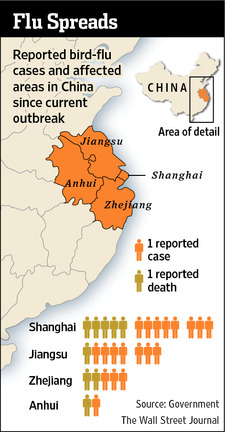
Also on Tuesday, local authorities reported two new cases in Shanghai and two more in eastern Zhejiang province. The cases remain confined to the eastern region around Shanghai, with 13 cases confirmed in China’s financial capital, eight in Jiangsu province, five in Zhejiang province, and two in Anhui province since the disease was identified on March 31. Read more of this post

China Bird Flu Outbreak May Stem From Numerous Sources; WHO’s Richard Webby: “This virus might be getting more infectious to humans”

China Bird Flu Outbreak May Stem From Numerous Sources

China’s deadly avian flu outbreak is being driven by at least two closely-related viruses, a situation that may make it more difficult to contain in humans and birds, researchers said.

The H7N9 flu has shown signs of genetic diversity since the first three patients were diagnosed, said Richard Webby, director of a World Health Organization collaborating center for the virus at St. Jude Children’s Research Hospital in Memphis. It already appears more infectious than the H5N1 strain of bird flu that has been circulating since 2003, infecting 600 people and killing 60 percent of them, he said.

Scientists from around the world are working together to understand the virus because of the potential devastation caused by novel infections. The pandemics of the past century include the 1918 Spanish flu that killed as many as 50 million people and the 2003 SARS outbreak that killed 774.

“This virus might be getting more infectious to humans,” Webby said in a telephone interview. “If this is let spread from where it is now, it will evolve further. That’s what viruses do. If it isn’t contained now, that will almost certainly happen.” Read more of this post

Adults Skipping Medicines to Save Money, Research Finds

Adults Skipping Medicines to Save Money, Research Finds

Adults who haven’t reached retirement age were twice as likely as those who have to skip their prescribed medications to save money, a U.S. study found.

About 20 percent of adults regardless of age have asked their doctors for a lower cost treatment, according to the study released today by the Atlanta-based Centers for Disease Control and Prevention. Spending on drugs is expected to increase an average of 6.6 percent a year from 2015 through 2021, the Kaiser Family Foundation has reported.

Americans spent $45 billion out-of-pocket on retail prescription drugs in 2011, the CDC said. The Affordable Care Act is expected to expand access in 2014 when medication coverage is considered an essential benefit of any health plan offered in new insurance marketplaces called exchanges.

“If you’re not insured or you face high co-payments, you’re going to stretch your prescriptions,” said Steve Morgan, an associate professor at the University of British Columbia’s School of Population and Public Health in Vancouver. “Even among insured populations, there is this invincibility mindset among the very young. Older people are more likely to adhere to chronic therapies over a longer period of time than younger.”

Today’s study found 13 percent of those ages 18 to 64 reported not taking their medications as prescribed to reduce costs compared with 5.8 percent of those 65 and older. The 2011 data came from the National Health Interview Survey. Most U.S. adults are eligible at age 65 for Medicare, the federal government’s health program. Read more of this post

Cambodia fights surge in bird flu deaths; Vietnam reports first bird flu death in 14 months

Cambodia fights surge in bird flu deaths

Bird flu killed 8 people so far this year in Cambodia, including 6 children, while more than 13,000 chickens have been culled or died from the highly contagious illness.- AFP
Suy Se

Tue, Apr 09, 2013
AFP

PHNOM PENH – As China scrambles to contain a deadly new strain of bird flu, Cambodia is battling a spike in the better known H5N1 strain that is baffling experts a decade after a major outbreak began in Asia. Bird flu has killed eight people so far this year in Cambodia, including six children, while more than 13,000 chickens have been culled or died from the highly contagious illness. The impoverished kingdom is also nervously watching the spread in China of a new H7N9 strain that had not previously been transmitted from birds to humans, but has now killed seven people in China since February.

Read more of this post

New cancer case diagnosed every six minutes in China

New cancer case diagnosed every six minutes in China

Staff Reporter, 2013-04-09

China’s cancer rate has climbed to alarming new heights, with at least one person being diagnosed with a form of cancer every six minutes, according to the country’s National Cancer Registration Center. There are 3.12 million new cancer cases reported in China annually, an average of 8,550 people per day, according to a report published by the center earlier this year. At present, one in eight people diagnosed with cancer will die from it, a mortality rate of about 13%. Chen Wanqing, deputy director of the center, said China will have 6 million new cancer patients and 3 million cancer-related deaths every year by 2020. Experts note that cancer incidence will only continue to rise over the next decade, and have attributed the trend to the country’s serious air and water pollution.

Wei Kuangrong, director of the Cancer Research Institute at Zhongshan People’s Hospital in Guangdong province, said that 8.34 people were diagnosed and 5.27 people died from cancer in Zhongshan every day in 2009. In the 1970s, the rate for both was only 0.78. Wei said that nasopharyngeal carcinoma, a form of cancer that originates in the upper region behind the nose, has become extremely prevalent in the city. Other areas across the country have also reported high incidences of specific forms of cancer. The city of Qidong in Jiangsu province has reported unusually high rates of liver cancer. Experts have speculated that the geographical distribution of cancer across the country may be linked to local eating customs, environmental conditions or other factors, though no theory is regarded as conclusive. Wang Ning, the deputy director of the Beijing Cancer Institute and Hospital, predicts that China’s cancer rate will not drop over the next 10 years and the nation will be lucky if the rate remains steady.

3-D Printing Is Ready for Surgery; Surgeons Practice With Replicas of Patients’ Organs Before Surgery

Updated April 8, 2013, 9:31 p.m. ET

3-D Printing Is Ready for Surgery

Surgeons Practice With Replicas of Patients’ Organs Before Surgery

By JURO OSAWA

MK-CC250_3DPRIN_G_20130408181531

Japanese surgeon Maki Sugimoto holds a 3-D replica of a patient’s liver built by printers using acrylic resin.

Surgeons at a hospital in Japan recently faced a dilemma before transplanting a parent’s liver into a child: How exactly to trim the organ to fit the space in the child’s smaller cavity while preserving its functions.

So they took a knife to a three-dimensional replica of the donor’s liver built by a machine that resembles an office printer. The model helped the doctors figure out where to carve it, leading to a successful transplant last month.

Surgeons are finding industrial 3-D printers to be a lifesaver on the operating table. This technology, also known as additive manufacturing, has long produced prototypes of jewelry, electronics and car parts. But now these industrial printers are able to construct personalized copies of livers and kidneys, one ultrathin layer at a time. Read more of this post

Western drugmakers may have to give hefty subsidies and forgo some profit on expensive cancer drugs if they want access to China’s “huge market,” the country’s former health minister said.

China Drugmaker Access May Require Profit Cut, Chen Says

Western drugmakers may have to give hefty subsidies and forgo some profit on expensive cancer drugs if they want access to China’s “huge market,” the country’s former health minister said.

With the cost of some oncology drugs topping $100,000 a year, Chinese officials may increasingly push for deals like one reached last year with Novartis AG (NOVN), in which the company agreed to donate three doses of its leukemia drug Gleevec for every one sold to the government, the former minister, Chen Zhu, said during an interview in Washington, D.C.

“If the cost is too high, maybe only a few percent of patients can benefit,” said Chen, who stepped down last month after seven years as China’s top health official. “If we can arrange an appropriate, acceptable, affordable price, then you can have a huge market.” Read more of this post