From street stalls to bourses, South East Asia’s traditional medicine makers promise panacea

From street stalls to bourses, South East Asia’s traditional medicine makers promise panacea

7:36am EST

By Eveline Danubrata and Anshuman Daga

JAKARTA/SINGAPORE (Reuters) – On rainy days in Jakarta, a canny street merchant like Emi can sell two dozen sachets of herbal cold cure Tolak Angin to office workers and labourers sniffling by her roadside stall. Read more of this post

3-Year-Old Left Brain Damaged After Dentist Allegedly Gave Her Too Much Anesthesia

3-Year-Old Left Brain Damaged After Dentist Allegedly Gave Her Too Much Anesthesia

PAMELA ENGEL0DEC 14, 2013, 12.41 AM

The parents of a 3-year-old girl plan to sue a dentist who allegedly gave their daughter excessive anesthesia and sedatives that caused irreparable brain damage, KFVE in Hawaii reports. Read more of this post

The Selling of Attention Deficit Disorder

December 14, 2013

The Selling of Attention Deficit Disorder

By ALAN SCHWARZ

The Number of Diagnoses Soared Amid a 20-Year Drug Marketing Campaign

After more than 50 years leading the fight to legitimize attention deficit hyperactivity disorder, Keith Conners could be celebrating. Severely hyperactive and impulsive children, once shunned as bad seeds, are now recognized as having a real neurological problem. Doctors and parents have largely accepted drugs like Adderall and Concerta to temper the traits of classic A.D.H.D., helping youngsters succeed in school and beyond. Read more of this post

Surprise! Generic-Drug Prices Spike

Surprise! Generic-Drug Prices Spike

By Alan Katz December 12, 2013

comp_genericschart51_315

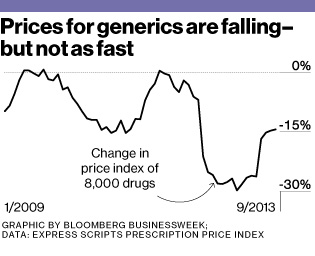
Bill Drilling, an owner of a pharmacy in Sioux City, Iowa, apologizes as he rings up a customer’s three-month supply of the heart medicine digoxin. The total is $113.12—almost 10 times the cost for the same prescription in August. Digoxin isn’t a new miracle drug. It’s a plant-derived medicine that’s been in use since the 18th century and one of nearly 100 generics that have at least doubled in price over the past year, an unprecedented number, according to pharmacists and industry consultants. “I’ve been doing this since 1985, and the only direction that generics-drug prices have gone is down,” Drilling says. Read more of this post

New Medicines Emerge, but Few Blockbusters; Drug Makers Find It Hard to Elbow Aside Established, Often Cheaper, Products

New Medicines Emerge, but Few Blockbusters

Drug Makers Find It Hard to Elbow Aside Established, Often Cheaper, Products

JONATHAN D. ROCKOFF and RON WINSLOW

Dec. 15, 2013 8:19 p.m. ET

P1-BO396_DRUGSE_G_20131215180903

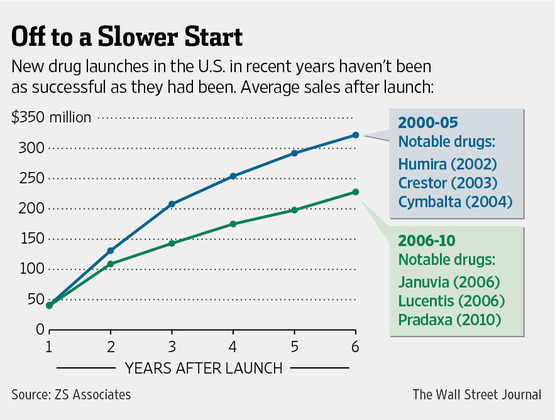
After years of anemic productivity, pharmaceutical companies are launching new drugs at the fastest pace since the 1990s, including 39 last year alone. But there is a problem: selling the new drugs. Read more of this post

Investment risks of fast-tracking biotech drugs become apparent

Investment risks of fast-tracking biotech drugs become apparent

1:02am EST

By Deena Beasley

(Reuters) – With biotech’s bull run nearing its third year, some savvy investors believe it is time to seek safety in size. The promise of drugs reaching the market at a faster pace has overshadowed rising risk in the sector. But signs in the past few months that a booming IPO market may be peaking and reversals for some fast-tracked drugs, are starting to give investors second thoughts about expensive smaller-cap biotechs. Read more of this post

GlaxoSmithKline will stop paying doctors for promoting its drugs and scrap prescription targets for its marketing staff – a first for an industry battling scandals over its sales practices, and a challenge for its peers to follow

GSK to stop paying doctors in major marketing overhaul

9:34am EST

By Ben Hirschler

LONDON (Reuters) – GlaxoSmithKline will stop paying doctors for promoting its drugs and scrap prescription targets for its marketing staff – a first for an industry battling scandals over its sales practices, and a challenge for its peers to follow suit. Read more of this post

Antibiotics of the Future; Scientists hunt for new antibiotics amid a rise in resistant germs

Antibiotics of the Future

Scientists hunt for new antibiotics amid a rise in resistant germs

SHIRLEY S. WANG

Dec. 16, 2013 7:06 p.m. ET

As bacteria continue to develop resistance to existing antibiotics, scientists are working on new strategies to combat bug-borne infections and diseases, Shirley Wang reports. Photo: AP.

Scientists are working to develop new strategies to combat the growing threat of germs that current antibiotics can’t fight. Read more of this post

An Epidemic of Attention Deficit Disorder

December 18, 2013

An Epidemic of Attention Deficit Disorder

By THE EDITORIAL BOARD

The hard-sell campaign by drug companies to drive up diagnoses of attention deficit hyperactivity disorder, or A.D.H.D., and sales of drugs to treat it is disturbing. The campaign focused initially on children but is now turning toward adults, who provide a potentially larger market. Read more of this post

Antibacterial soaps would have one year to prove they’re safe to remain in U.S. stores, part of a proposal by regulators to address 40 years of debate on overuse of germ-killing chemicals

Antibacterial Soaps Given 1 Year to Prove Safety by FDA

Antibacterial washes would have one year to prove they’re safe to remain in U.S. stores, part of a proposal by regulators to address 40 years of debate on overuse of germ-killing chemicals. Antibacterial soap has gained “widespread consumer use” despite a lack of data showing added health benefits, the Food and Drug Administration said today. The common active ingredient, triclosan or triclocarban, also may be linked to hormone imbalances and antibiotic resistance, the FDA said. Read more of this post

Woman in China first to die from bird flu strain: WHO

Woman in China first to die from bird flu strain: WHO

7:37am EST

BEIJING (Reuters) – A woman in China has died of the H10N8 strain of bird flu, the first ever reported human case of the virus, the World Health Organisation (WHO) said on Wednesday. Read more of this post

Antibiotic Use on Farm Animals to Be Phased Out in U.S

Antibiotic Use on Farm Animals to Be Phased Out in U.S

Use of antibiotics to fatten cattle, hogs and chickens for human consumption will be phased out by 2017, as U.S. regulators seek to curb a rise in more deadly forms of foodborne pathogens. Farmers would no longer be able to purchase the medicines without a veterinarian’s approval under a plan announced yesterday by the Food and Drug Administration. Drugmakers will be asked to agree to increased controls over three months, then will have three years to change labels to remove production uses of antibiotics, including for weight gain and accelerated growth. Read more of this post

Alzheimer’s Theory That’s Been Drug Graveyard Facing Test

Alzheimer’s Theory That’s Been Drug Graveyard Facing Test

Merck & Co. (MRK) is putting the prevailing theory on the cause of Alzheimer’s to a test with two studies in thousands of people that may, once and for all, determine whether the amyloid tangles that grow in the brain spur the disease or are simply an outgrowth. Read more of this post

FDA looks again at Boston Scientific anti-stroke device

FDA looks again at Boston Scientific anti-stroke device

Mon, Dec 9 2013

By Susan Kelly

(Reuters) – U.S. Food and Drug Administration staff reviewing data on Boston Scientific Corp’s novel anti-stroke device highlighted the implant’s failure to meet a key goal for effectiveness in a recent study but said on Monday that other data must be weighed in deciding whether it should be approved. Read more of this post

Why the ‘Electronic Nose’ Is Set to Revolutionize Health Care

Why the ‘Electronic Nose’ Is Set to Revolutionize Health Care

Dec 06, 2013

Samuel M. Khamis, the CEO of a new tech start-up, is building a chip that can be embedded in your smartphone and will be able to smell your breath. With just a whiff, the “electric nose” sensor, which Khamis is developing at Adamant Technologies, can provide information about a person’s current metabolic state and detail how many calories he or she is burning in real time. For those looking to lose weight, this would be potentially invaluable. The invention is also being refined to warn users well in advance if they’re about to have an asthma attack. Khamis expects his new sensor technology will eventually be used for many other real-time health care applications, with developers testing all different kinds of possibilities around breath analysis. Adamant has been growing quickly, securing venture capital financing along the way, and Khamis is hopeful his product will be available to the masses within the next few years. The ultimate goal is to help people manage their health more effectively and give doctors and health care professionals in-depth information about their patients. Knowledge@Wharton sat down with Khamis to discuss the technology and its growth prospects. The interview was conducted jointly with Hoag Levins, editor of LDI Health Economist Magazine.

An edited version of the transcript appears below.

Hoag Levins: Sam, how did you get interested in this subject in the first place?

Samuel M. Khamis: I’ve always been interested in the idea of using advanced technology to help the general population, and it became a personal mission of mine before I went to grad school. When I went to grad school at UPenn back in 2004, I started working on novel nanotechnology. Read more of this post
Vitamins’ Old, Old Edge

December 9, 2013

Vitamins’ Old, Old Edge

By CARL ZIMMER

In 1602, a Spanish fleet was sailing up the Pacific coast of Mexico when the crew became deathly ill. “The first symptom is pain in the whole body that makes it sensitive to touch,” wrote Antonio de la Ascensión, a priest on the expedition. “Purple spots begin to cover the body, especially from the waist down; then the gums become so swollen that the teeth cannot be brought together, and they can only drink, and finally they die all of a sudden, while talking.” Read more of this post

The Next Front in Cancer Care; As More Patients Survive, Cancer Centers Handle Disease’s Knock-On Effects

The Next Front in Cancer Care

As More Patients Survive, Cancer Centers Handle Disease’s Knock-On Effects

LAURA LANDRO

Dec. 9, 2013 7:34 p.m. ET

OG-AA483_Cancer_G_20131209214510

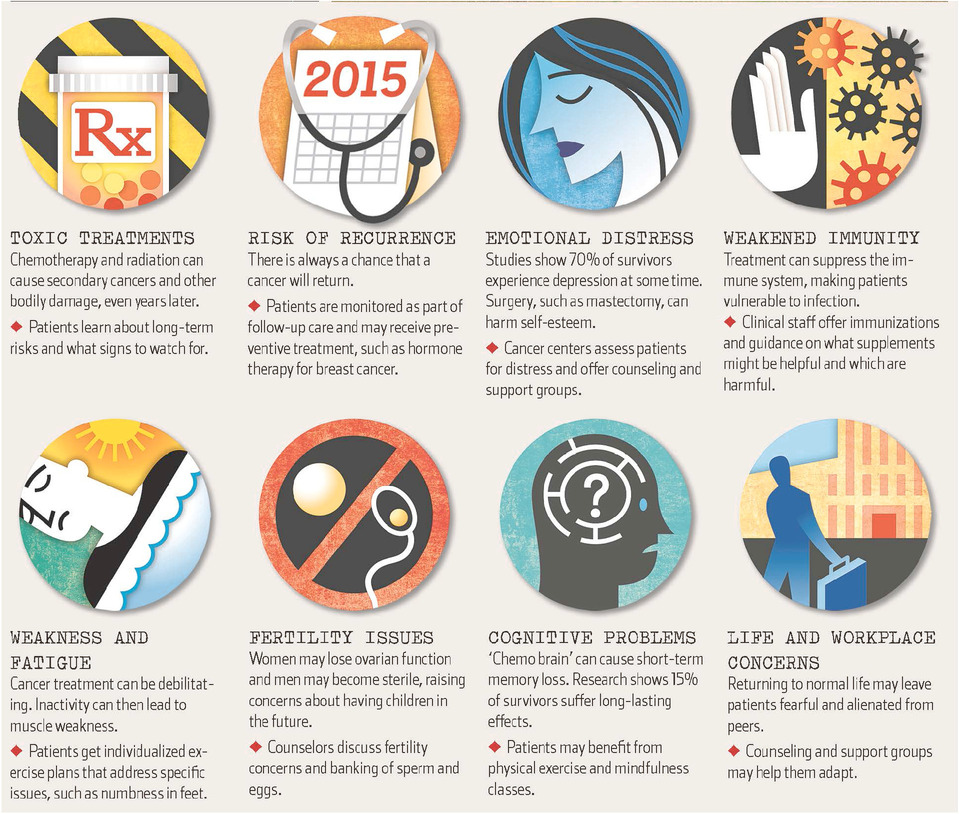
For cancer patients, getting through the rigors of treatment is the first hurdle. Then, life as a cancer survivor poses its own daunting physical and emotional challenges. A growing number of hospitals and community cancer centers, which treat the majority of the nation’s cancer patients, are launching survivorship-care programs. These include treatment follow-up plans, physical rehabilitation and emotional assistance, such as counseling and support groups. They resemble programs currently offered by big urban cancer centers like MD Anderson in Houston and Memorial Sloan-Kettering in New York. Read more of this post

Surgical robots’ awkward adolescence

Surgical robots’ awkward adolescence

December 9, 2013: 1:31 PM ET

Studies call their effectiveness into question; now an FDA recall looms

By Ryan Bradley, senior editor

131206113219-intuitive-surgical-620xa

FORTUNE — It has not been the best year for Intuitive Surgical (ISRG), the maker of the most popular robot in the world for general surgery, the da Vinci. First, a study published in the Journal of the American Medical Association found little added benefit to hysterectomies performed with a robot, and yet the procedure cost on average one-third more when using the $1.5-$2.3 million machine. Then the Food and Drug Administration launched a probe on the company, sending out a survey for doctors that asked what sort of surgeries the robot is least suited for, and questioned the rigor of their training on the da Vinci. Finally, last week, the FDAposted a Class II recall on the machines after Intuitive sent out a warning for customers that the instruments can momentarily stall during procedures. The robots aren’t being pulled from the operating room, but they are undergoing plenty of inspections. Shares of Intuitive have fallen nearly 25% this year. Read more of this post

PillCam Maker Given Imaging to Be Bought by Covidien for $860M

PillCam Maker Given Imaging to Be Bought by Covidien

Hospital Equipment Maker to Pay $860 Million

JOSEPH WALKER

CONNECT

Dec. 8, 2013 7:20 p.m. ET

Given Imaging Ltd. GIVN +0.81% , a maker of ingestible pills that take photos inside patients’ bodies, agreed Sunday to be acquired by Covidien  COV +0.86% PLC for $860 million. Covidien will pay $30 a share, a nearly 27% premium to Given Imaging’s share price of $23.65 in 4 p.m. Nasdaq trading Friday. Read more of this post

Can we avoid an antibiotic apocalypse? ‘Today’s adults want the drugs but it is future generations who will suffer most from overuse’

December 6, 2013 12:09 pm

Can we avoid an antibiotic apocalypse?

By Gillian Tett

‘Today’s adults want the drugs but it is future generations who will suffer most from overuse’

What are the biggest future dangers faced by the western world? If asked that question, most people might mumble “terrorism”, “climate change”, “debt crisis” or “cybercrime”. But if Professor Dame Sally Davies, Chief Medical Officer for England, is correct, there is another terrifying issue looming over all of us: the growth of antibiotic resistance. Read more of this post

Narayana Health: Providing World-class Treatment to the Poor

Narayana Health: Providing World-class Treatment to the Poor

by Rohin Dharmakumar | Dec 6, 2013

Narayan Health, founded by leading cardiac surgeon Dr Devi Shetty, could easily be mistaken for just another ‘corporate’ hospital chain. But by ensuring that the poor get equal access to world-class health care, they have proved that they are so much more Read more of this post

Treating Allergies With Pills or Drops Instead of Shots

December 5, 2013

Treating Allergies With Pills or Drops Instead of Shots

By ANDREW POLLACK

Jennifer Maiolo’s allergy is treated with a liquid allergen extract, instead of an injection, as Dr. David P. Skoner watches. Dr. Skoner is excited about the allergen tablets that allergy sufferers can now take, replacing injections and decreasing office visits.

For much of her adult life, Shirley Hickey received two injections a week in an effort to tame severe allergies that caused frequent sore throats and sinus infections. Now she uses a less painful method. “One drop under the tongue every morning, and that’s it,” said Ms. Hickey, 65, who lives in Beaver Falls, Pa. She is free of symptoms and sinus infections from her allergies to ragweed and tree pollens, she said. Read more of this post

Dementia epidemic looms with 135 million sufferers seen by 2050

Dementia epidemic looms with 135 million sufferers seen by 2050

7:04pm EST

By Kate Kelland

LONDON (Reuters) – Many governments are woefully unprepared for an epidemic of dementia currently affecting 44 million people worldwide and set to more than treble to 135 million people by 2050, health experts and campaigners said on Thursday. Read more of this post

Ditching Big Drugmakers for Biotech Brings Leukemia Boon

Ditching Big Drugmakers for Biotech Brings Leukemia Boon

Fifty-five, pensionless and assuming he’d have to work until he died, Roger Ulrich had a decision to make. After two decades in the pharmaceutical industry, his position at Merck & Co. (MRK) had been phased out. Instead of joining another big drug company, where he could expect a steady income and relative job security, Ulrich took a leap. He teamed with two partners, raised seed funding and founded a biotechnology company, making a bet on an industry characterized by risk. Read more of this post

Intuitive Robots May Stall in Surgery, Company Warns

Intuitive Robots May Stall in Surgery, Company Warns

Intuitive Surgical Inc. (ISRG), the maker of a $1.5 million robot surgery system, told doctors that friction in the arms of some devices may cause the units to stall, the second warning issued about the company’s products in a month. The company sent an “urgent medical device recall” Nov. 11 alerting customers of the issue, which affects 1,386 of the systems worldwide, the U.S. Food and Drug Administration said in a Dec. 3 notice on its website. The stalling may result in a sudden “catch-up” if the surgeon pushes through the resistance, the agency said. Read more of this post

As Hospital Prices Soar, a Single Stitch Tops $500

December 2, 2013

As Hospital Prices Soar, a Single Stitch Tops $500

By ELISABETH ROSENTHAL

SAN FRANCISCO — With blood oozing from deep lacerations, the two patients arrived at California Pacific Medical Center’s tidy emergency room. Deepika Singh, 26, had gashed her knee at a backyard barbecue. Orla Roche, a rambunctious toddler on vacation with her family, had tumbled from a couch, splitting open her forehead on a table. Read more of this post

The Secrets Inside Us: The human body is less well understood than we think

December 3, 2013

The Secrets Inside Us

By BILL HAYES

WHEN the news broke recently that a team of Belgian scientists had “discovered” a new body part — a ligament located just outside the knee — the first place my mind went was to Padua. Padua is the small city in northern Italy where the 16th-century Brussels-born scientist Andreas Vesalius taught anatomy and created his history-making masterpiece, “De Humani Corporis Fabrica” (“On the Fabric of the Human Body”), published in 1543. The old man would have been delighted by the news, I couldn’t help thinking. Read more of this post

Copycat biotech drugs slow to take off in Europe

Copycat biotech drugs slow to take off in Europe

1:00am EST

By Ben Hirschler

LONDON (Reuters) – Despite austerity-driven cuts across European healthcare systems, most countries have been slow to embrace a new class of medicines that could save them billions of euros – copies of biotech treatments. These cheaper versions of expensive biotech drugs, known as biosimilars, could slash the cost of treating diseases like cancer and rheumatoid arthritis in the same way that generics have curbed spending on traditional medicines. Read more of this post

Japan’s drugs companies open up to western treatment

December 1, 2013 5:26 pm

Japan’s drugs companies open up to western treatment

By Andrew Jack

The decision by one of Japan’s largest pharmaceutical groups to name a European as its chief executive designate reflects growing international openness in the world’s second-largest medicines market at a time of intensifying competition. Christophe Weber, who trained in France and worked for most of his career atGlaxoSmithKline, is set to take over as chief executive of Takeda from Yasuchika Hasegawa, who will become chairman of the Osaka-based group next summer. Read more of this post

Statins by Numbers; The problem with numerically driven guidelines for cardiovascular disease

November 29, 2013

Statins by Numbers

By JASON KARLAWISH

PHILADELPHIA — MEDICINE is having its moneyball moment.

In his book “Moneyball,” Michael Lewis chronicled how the Oakland A’s, in order to identify the best predictors of a winning baseball team, used a highly formulaic, statistics-driven approach in place of the traditional assessments of coaches and managers. This month, in a similar spirit, the American Heart Association and the American College of Cardiology issued new, numerically driven guidelines for the treatment of cardiovascular disease. Read more of this post