Three Reasons Chipotle Is Destroying McDonald’s

Three Reasons Chipotle Is Destroying McDonald’s

ASHLEY LUTZ RETAIL  FEB. 14, 2014, 3:57 AM

Chipotle is thriving.

The fast-casual chain posted a 9.3% sales gain in 2013. Meanwhile, former parent company McDonald’s saw sales fall by 1.4%.

The companies employ completely opposite strategies, Brian Sozzi at Belus Capital Advisors wrote in a recent note to clients.

Sozzi shares a few reasons why Chipotle is dominating McDonald’s.

1. Sticking to a classic menu. While McDonald’s tacks on new menu items to entice customers, Chipotle has stuck to the same menu since it opened. The menu at McDonald’s has grown 70% since 2007, Bloomberg reported last year. Chipotle does a few things really well, making it easier to execute and reduce customer wait times.

2. Making lines faster. Chipotle has aggressively worked to reduce wait times during peak periods. Meanwhile, McDonald’s is struggling with the longest drive-thru wait times in decades. McDonald’s is attempting to fix wait times by cutting some menu items and adding employees to assist at check-out. But the overloaded menu makes it difficult for operations to run smoothly, Sozzi says.

3. Emphasizing an ethical menu. Chipotle is in the process of eliminating GMOs from its menu, and has long boasted about its antibiotic-free meats. As a result, “people feel better about eating at Chipotle and share with others, personally or on social media, that positive experience,” Sozzi writes. Meanwhile, McDonald’s has struggled to shake its reputation as an unhealthy restaurant.


How The Global Beer Industry Has Consolidated Over The Last 10 Years In Two Charts

How The Global Beer Industry Has Consolidated Over The Last 10 Years In Two Charts

MATTHEW BOESLER MARKETS  FEB. 14, 2014, 6:56 PM

image001-2

Euromonitor, Goldman Sachs Global Investment Research

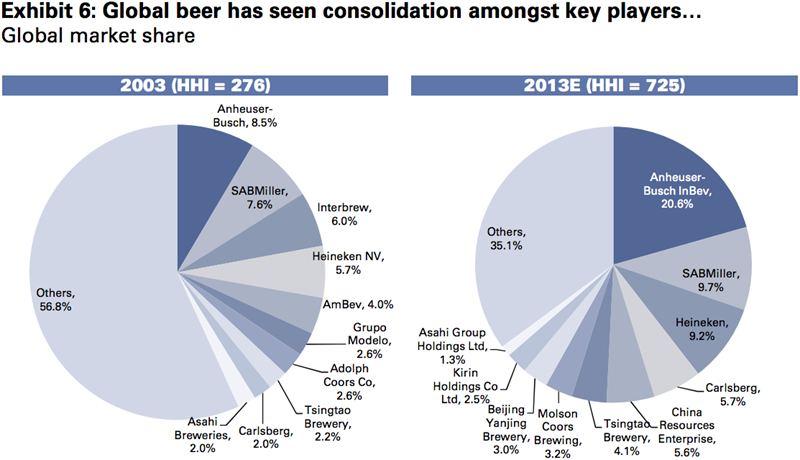
In a note to clients this week, Goldman Sachs analysts led by Robert D. Boroujerdi look at merger trends in various industries.

One that has gone through substantial consolidation in the last 10 years is the global beer industry.

Here’s Goldman:

The global beer industry has undergone a steady process of consolidation. Ten years ago the global beer industry was highly fragmented with Anheuser-Busch’s 8.5% market share enough to make it the global leader. Since then, a steady process of consolidation via M&A has taken place – often focused around cost-cutting opportunities (e.g. the $60 bn merger of Anheuser-Busch and InBev completed in 2008) or geared towards acquiring attractive emerging market assets (e.g. Heineken’s $24 bn acquisition of Asia Pacific Breweries completed in 2012).

Today’s AB InBev, with an estimated 21% market share, has been the driving force behind much of this consolidation. Interbrew’s acquisition of AmBev in 2004 created a new global leader, InBev, with 11% share and the subsequent Anheuser-Busch/InBev merger in 2008 again created a global leader, AB InBev, with 20% market share. Today’s top 5 companies represent more than 50% of the global market (versus 32% for the top 5 players in 2003), and the industry’s HHI has risen to 725 in 2013E from just 276 in 2003.

“HHI” stands for Herfindahl-Hirshman Index, a common measure of industry concentration.

“The U.S. Department of Justice generally considers HHI levels of 1,500-2,500 to be consistent with moderately concentrated markets, and levels above 2,500 signifying high concentration,” explain the Goldman analysts.

“The score is calculated as the sum of the squares of the market shares of an industry’s competitors.”

In 2013, the global beer industry’s HHI was 725 — almost three times what it was 10 years ago, but still well below the levels cited above.

“Global Beer measures as considerably more fragmented than the other industries in our study,” say the Goldman analysts.

“The market for beer brands more often tends to be local than global, making it not directly comparable with the HHI scores of other truly global or purely local markets in this study. In the case of our beer study, the direction of the HHI is much more pertinent than the absolute level.”

World’s Sweet Tooth Heats Up Cocoa; Growing Demand From Emerging Markets Is Pushing Up Prices for Key Ingredient in Chocolate

World’s Sweet Tooth Heats Up Cocoa

Growing Demand From Emerging Markets Is Pushing Up Prices for Key Ingredient in Chocolate

ALEXANDRA WEXLER

Updated Feb. 13, 2014 7:06 p.m. ET

Hoard that Valentine’s Day candy now, because chocolate prices are poised to head higher.

Demand for the treat is soaring, especially in emerging markets where customers are getting wealthier. And farmers around the world are struggling to produce enough cocoa to keep the chocolate flowing. Read more of this post

Gartner’s head of research, Peter Sondergaard, talks about the pressure on IT to be more agile, and how the cloud is helping CIOs achieve that

The Cloud Grows Up

Gartner’s Peter Sondergaard on the cloud’s role in helping CIOs achieve agility

Feb. 10, 2014 4:47 p.m. ET

The business applications of the future will be moving onto the cloud to improve their agility, says Gartner Inc. Senior Vice President and Global Head of Research Peter Sondergaard. He speaks at The Wall StreetJournal’s CIO Network conference in San Diego. Read more of this post

The name game: New web domain names hit the market

The name game: New web domain names hit the market

Feb 8th 2014 | From the print edition

AFTER the dotcom boom of the 1990s, the world is about to experience a boom in dots. Over 1,000 new generic top-level domain names (gTLDs) are set to join the 22 existing ones, such as .com and .org, and the 280 country-specific ones, such as .uk, that now grace the end of web addresses. The Internet Corporation for Assigned Names and Numbers (ICANN), the non-profit organisation that manages the web’s address book, reckons this will boost competition and innovation. It will also increase the cost to businesses of protecting their brands.

Some of the new gTLDs, such as .guru and .sexy, will flatter owners’ egos. Others, such as .clothing and .photography, will be used by firms to tout their wares. Among the first to go live, on February 4th, was “.web” written in Arabic script. That made history: until now all generic top-level domains have been written in Latin lettering, meaning internet users with Arabic keyboards had to wrestle with ALT, CTRL and the like to type the last few letters of most websites’ names. Other gTLDs in scripts such as Chinese and Russian will follow in the coming months.

Firms including Apple, Ford and IWC, a watchmaker, have already applied to register their names as gTLDs. That will allow them to ensure they are not used by crooks or cybersquatters. Google, Amazon and others have applied for numerous gTLDs, including .app and .kindle, presumably because they want to use them and think they can make money by selling the right to use “second-level” domains (for example, economist.app), typically for $10-50 a year. Firms may also be keen to buy certain second-level domains to stop them falling into the wrong hands. Donuts, a company that has lodged hundreds of applications for gTLDs, has .wtf and .sucks on its list.

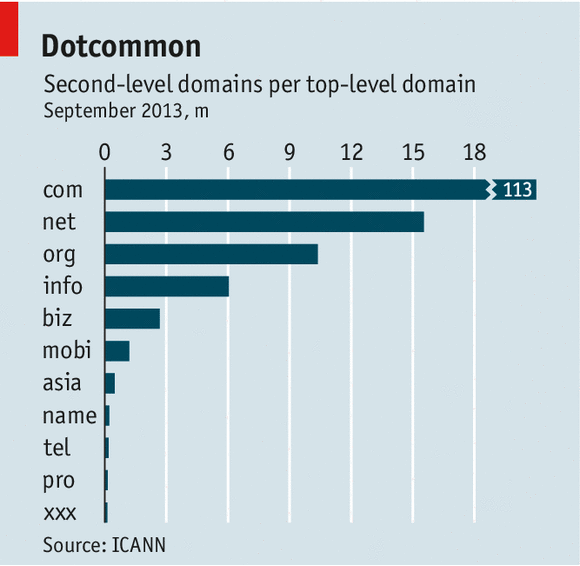
But there are costs to owning a gTLD. Firms must pay $185,000 to ICANN when applying for one, plus $25,000 for each year they use it. Deciding which ones to splash out on is tricky. New domains including .biz and .mobi have been added in the past, but have failed to put a dent in the wildly popular .com (see chart).

image001-10

The avalanche of new domains may also confuse web users, who often get to their destinations via search engines rather than by typing web addresses into browsers. Greater choice and competition should eventually bring them benefits. But the transition may be .complicated.


Uber, the hot start-up whose software allows anyone with a smartphone to get a cab ride, is suddenly facing trouble about its business practices, including liability in accidents.

Rough Patch for Uber Service’s Challenge to Taxis

By DAVID STREITFELDJAN. 26, 2014

Uber, the mobile phone ride-hailing service, now operates in 26 countries. But as the San Francisco firm expands, it faces questions about its business practices, including liability in accidents.

SAN FRANCISCO — It’s Travis Kalanick versus the world, and recently the world seems to be winning.

Mr. Kalanick, who is brash and aggressive even by the standards of Silicon Valley, created Uber four years ago to blow up the traditional taxi business. In more than 60 cities, from San Francisco to Berlin, it is doing just that.

Anyone with a smartphone can use Uber’s software to get a ride. No more standing on the corner in the rain, trying desperately to conjure up something that is not there. For that achievement, Uber is valued at $4 billion.

Suddenly, however, Mr. Kalanick is a bit besieged. Uber is being sued by its drivers, who say it is stealing their tips. Competitors are pressing it from all sides. Celebrity riders likeSalman Rushdie

and Jessica Seinfeld have had gripes too, usually about pricing.

Much worse, there have been questions about the quality of the drivers, made more urgent after one here in San Francisco hit an immigrant family in a crosswalk on New Year’s Eve, killing a 6-year-old. Her death has provoked the first wrongful-death lawsuit against Uber, which is expected to be filed on Monday.

Uber and its abundance of imitators represent a new stage for technology companies. These businesses directly insert themselves into the physical world, arranging on-demand transportation, meals or even clean laundry in exchange for a sweet commission. Unlike Facebook or Twitter, which thrive in the safe confines of cyberspace, these start-ups live on the streets.

That is a much messier place. Regulators, courts and city halls are struggling to define Uber. Is it a taxi company or a technology platform? Are the drivers, who often use their own vehicles, employees, as some are arguing in court, or “partners” — that is, freelancers — as Uber maintains?

Uber compares itself to the auction site eBay, connecting a buyer and seller but not liable for what happens between them. Regulating Uber, the company told the California Public Utilities Commission, would stifle innovation.

The commission, which oversees limousine companies, called Uber’s arguments “creative” but decided in September that it was a transportation company after all, subject to regulation. Uber is appealing. A spokesman for Uber said the company’s system of asking passengers for feedback meant Uber was self-regulating.

The issue is pressing because, as the company rapidly expands and Uber drivers flood the streets, the possibility of accidents increases. Who is responsible when something goes wrong?

The Uber driver who hit 6-year-old Sofia Liu and injured her mother and brother was arrested on suspicion of vehicular manslaughter.

“We have deactivated his Uber account,” Uber said in a statement. But the company pointedly said the driver, Syed Muzaffar, did not have a passenger in his Honda Pilot at the time of the accident, and thus the accident had nothing to do with Uber.

Mr. Muzaffar’s lawyer said that was false and self-serving. “He was working for Uber,” said the lawyer, Graham Archer. “He was waiting for a fare.”

In a testy interview at Uber’s offices here, Mr. Kalanick declined to discuss the accident except in the most general terms.

“We work our butts off to go above and beyond what is expected even by the regulators, including insurance, background checks,” he said. “And so it always comes back to, did Uber do something wrong?”

Some say the answer is yes.

The San Francisco Cab Drivers Association, which is losing drivers to Uber, prominently offered condolences to Sofia’s family on its website.

“Uber may be the next Amazon, but Amazon doesn’t have the same potential capability to leave a trail of bodies in the street,” Trevor Johnson, a director of the association and a driver himself, wrote in an email.

Sofia was buried Thursday. Christopher Dolan, a personal injury lawyer representing the Liu family, spoke at the service with a message from the girl’s father, Ang Jiang Liu: “I intend to get justice for my daughter and hold Uber accountable.”

Uber by its very nature distracts its drivers, the lawyer said in an interview.

“Cabdrivers who are looking for fares are scanning the streets,” he said. “Uber drivers looking for fares are looking at their phones.”

Uber’s safety and reliability was also called into question after a driver and a passenger here got into a verbal and physical altercation late one night in November. The police were called, but no arrests were made.

The tech website PandoDaily reported that the driver, Daveea Whitmire, had a history of clashes with the law, including a misdemeanor for resisting a public officer last spring. In October, his probation officer recommended revoking his probation. Mr. Whitmire, who had good reviews from his Uber passengers, could not be reached for comment.

Mr. Kalanick declined to comment about this episode, and shortly afterward, ended the interview. Last week, Uber told drivers here that they had to undergo new background checks.

Drivers who use their own cars are in an uncertain insurance position, said Kara Cross, general counsel for the Personal Insurance Federation of California. Many personal insurance policies do not cover commercial activity. Even the insurance that the California commission is requiring Uber to carry — a $1 million per accident liability policy — would take effect only if the Uber driver were legally at fault.

“If another driver is liable, the passenger would have to rely on that other driver’s insurance, assuming there is any,” Ms. Cross said.

Peter Ashlock drove a cab in San Francisco for 10 years in the 1970s and early ’80s, bringing home about $500 a week. For a few years, he even got health insurance. Two years ago he started driving for Uber. After gas and the company’s commission — usually 20 percent — he makes about $1,000 a week. Factor in inflation, and he has lost ground.

“I have freedom and flexibility now,” said Mr. Ashlock, 65. “If I want to take a vacation I just take it. But there’s no union. There’s no community of drivers. And the only people getting rich are the investors and the executives.”

David Krane, who last summer led a $258 million investment in Uber by Google Ventures, was full of admiration for Mr. Kalanick and what he called his “superpowers,” including his attention to detail.

“I know very few chief executives that on New Year’s Day would answer 100 customer service inquiries in public,” Mr. Krane said.

Those inquiries, on Twitter, were often about surge pricing, the much-discussed Uber feature that increases prices by multiples of three, four or more times normal on holidays, or during bad weather or rush hour. Surge pricing, Uber says, gets more vehicles on the road, but many riders do not seem to understand it.

Mr. Kalanick, 37, was his usual combative self on New Year’s in response to complaints about surge pricing. “2 confirmations and typing in surge price.. should ppl not take responsibility for their actions when drunk?” he posted on Twitter.

Drivers filed suit against Uber in August, saying the company told riders that the tip was included in the fare but that it was never remitted to the driver. Uber says there is no merit to the case, but a San Francisco judge ruled last month that it could go forward.

More drivers are constantly being solicited. Last week, Uber apologized for ordering a hundred cars from a New York competitor and then canceling. Uber’s goal was to get the drivers’ numbers and persuade them to work for Uber. “Too aggressive,” the company conceded.


JANUARY 27, 2014, 7:00 AM  6 Comments

Uber and a Child’s Death

By DAVID STREITFELD

image001-2Sofia Liu, 6, was was struck and killed by a car in San Francisco on New Year’s Eve. Christopher Dolan, a lawyer for the Liu family who provided the image, is expected to file suit against the driver of the vehicle and Uber.

Travis Kalanick, chief executive of the on-demand transportation service Uber, originally used “The Fountainhead” as his Twitter icon. It was viewed by many as a proclamation: Ayn Rand’s novel is beloved by Silicon Valley’s regulation-is-useless crowd, and Uber is in too much of a hurry to want anyone slowing it down with questions about safety and responsibility.

Uber is a big success. It and the apartment rental site Airbnb have successfully popularized the notion of the sharing economy, where the driver who picks you up at the airport and the fellow who rents you a room for the night are in business for themselves. The sharing economy will bring more income to some, and probably cause unemployment for others. The upheaval in the larger economy could be considerable.

Taxes and regulation are the two big issues. The question of how much Uber should be regulated and by whom is under discussion in all sorts of ways, asmy article

on Monday in The Times indicates. But the fate of its first wrongful-death lawsuit might be central.

The suit, set to be filed on Monday, seeks damages against Uber in the death of Sofia Liu, 6, on New Year’s Eve in San Francisco. Sofia was hit by an Uber driver who was waiting for a fare. Her mother and brother were injured.

Uber asserts that Uber drivers without fares are not Uber cars. The suit, filed by Chris Dolan, a San Francisco lawyer, directly challenges this effort by the company to detach itself from its own users. It says Uber needs the vehicles to be logged into the Uber app — that’s the only way potential riders know there is a car in the vicinity. So even when there is no fare in the car, the drivers are in essence on the clock, working for Uber.

When drivers accept a call, furthermore, they need to interface with the app. The suit goes on to note that under California law, it is illegal to use a “wireless telephone” while driving unless it is specifically configured to be hands-free — which the app is not. In essence, the suit argues that Uber was negligent in the “development, implementation and use of the app” so as to cause the driver to be distracted and inattentive.

Mr. Kalanick, in an interview, refused to discuss the case or even to confirm that the driver, Syed Muzaffar, had been carrying passengers earlier that evening. Mr. Muzaffar, who cooperated with the police after the accident, had been driving for Uber about a month, his lawyer said. It was a full-time job, using his own car, to support four kids. In the new sharing economy, he takes the fall.

Mr. Dolan, according to his website, has a fistful of awards: Statewide Trial Lawyer of the Year by the Consumer Attorneys of California, Trial Lawyer of the Year by the San Francisco Trial Lawyers Association and California Lawyer Attorney of the Year award.

“Uber’s claims that they are not responsible for injuries caused by Uber drivers who are logged on to the system but not carrying a fare flies in the face of hundreds of years of law,” he said. “New technology does not eliminate well-established legal principles.”

As for Mr. Kalanick, he recently ditched Ms. Rand as his Twitter icon for the considerably more pro-government figure of Alexander Hamilton.

“People think I’m a crazy libertarian,” he said. “I’m a little crazy, but I’m not a libertarian.”
When Mao praised the beauty of Japan; while reformers and revolutionaries alike resented Japan’s defeat of their country, they could respect Japan’s economic and social achievements. Chen Duxiu and Li Dazhao both studied in Japan

When Mao praised the beauty of Japan

Sunday, January 26, 2014 – 09:00

John Gee For The Straits Times

The Straits Times

image001

A HUNDRED years ago, Japan was, to many Chinese intellectuals, a source of inspiration, a place of educational opportunities and a political refuge.

In the current climate of Sino-Japanese relations, that is easy to forget.

Japan’s victory in the Sino-Japanese war of 1894-5 emphasised to many Chinese how their country’s failure to modernise had weakened its ability to defend itself. China had been defeated and bullied by Western powers since the Opium Wars, but this was the first case in modern times that it had suffered defeat at the hands of another Asian country, long assumed to be no match for China.

The lesson drawn by many was that China needed to learn from how Japan had built itself into a powerful country. Within the Qing Court, there were modernisers who saw a need for administrative reform and a re-equipped, re-trained armed forces.

And they continued to hold this view even after the imperial army, then in the process of modernisation, was defeated by better trained foreign troops during the Boxer Rebellion of 1899-1901.

Elsewhere, there were those, such as Sun Yat Sen, who concluded that the Qing dynasty and the imperial institutions that upheld its rule were a fundamental obstacle to China’s modernisation. But while reformers and revolutionaries alike resented Japan’s defeat of their country, they could respect Japan’s economic and social achievements.

Attitudes towards Japan became much less ambivalent as a result of the Russo-Japanese War of 1904-05. It was largely fought on Chinese territory, in Manchuria, and Chinese civilians were inevitably killed and maimed during the conflict. Chinese property was one of the prizes at stake in the war: Japan aimed to wrest Port Arthur (Dalian) from Russia, as well as assert its interests in the resources of Manchuria.

Yet what mattered to most patriotic Chinese at the time was that an Asian country had defeated a European power. They could therefore overlook China’s own losses in the war, as well as the defeat of 1895.

Japan admitted a stream of Chinese students to its universities at this time. One of them was Lu Xun, later to become well-known as a writer. In 1902, he was given a government scholarship to study in Japan. He learnt Japanese, and much of his early acquaintance with European literature was made through books translated into Japanese.

He returned to China after eight years in Japan.

Years later, in 1926, he recalled with affection Mr Fujino, who taught anatomy in the medical college at Sendai. Lu Xun was the only Chinese student at the college. Mr Fujino asked to see Lu Xun’s notes of his lectures, and then patiently corrected them, which helped ensure that he passed the annual examination.

Lu Xun described him as, of all his teachers, “the one to whom I feel most grateful and who gave me the most encouragement”. He thought that Mr Fujino wanted China to have modern medical knowledge.

Chen Duxiu and Li Dazhao, founders of the Communist Party of China, both studied in Japan. Chen was there from 1900 to 1902, at Tokyo Normal School and then at Waseda University. This was where he first became involved in politics, joining the Chinese Youth Society, a group founded by one of Sun Yat Sen’s associates.

Chen returned to Japan briefly in 1906 and then again from 1913 to 1915, following the dissolution of China’s first Parliament by the ambitious former Qing general, Yuan Shih-kai.

Li studied political economy at Waseda University from 1913 to 1916 before returning to China.

Zhou Enlai also studied in Japan, though only for 18 months. He arrived in 1917 and went to classes at Waseda University, in Tokyo, and at Kyoto University. In 1936, he told American journalist Edgar Snow that he had met other “revolution-minded” Chinese students while there.

Another Chinese who studied in Japan taught Mao Zedong. Interviewed by Edgar Snow in his book, Red Star Over China, Mao recalled going to a new school when he was 16 years old. One of the teachers there was derided as the “False Foreign Devil” by students, who could see that his queue was false. He had studied in Japan, and Mao liked to hear him talk about what the country was like.

The teacher taught English and music. One of his songs was called The Battle Of The Yellow Sea. It celebrated Japan’s victory over Russia in 1905, and made such an impression on Mao that he could still remember part of it in 1936, when he spoke to Snow.

Mao said: “At that time I knew and felt the beauty of Japan, and felt something of her pride and might, in this song of her victory over Russia. I did not think there was also a barbarous Japan – the Japan we know today”.

Among the Chinese who went to Japan in the early 20th century were political dissidents who did not arrive, first of all, as students. The best known was Sun Yat Sen, who lived there for much of the period between the First Guangzhou Uprising in 1895 and the 1911 Revolution.

It was in Tokyo that the Tongmenghui (United League), forerunner of the Kuomintang, was formed, though it soon relocated its headquarters to Singapore.

If Chinese reformers and revolutionaries had a positive impression of Japan in the early years of the 20th century, it changed fairly quickly during World War I.

Japan’s leaders agreed that their country needed guaranteed access to Chinese resources.

But they disagreed over the best way to secure it – whether through cooperation with a Chinese government, albeit on terms favourable to Japan, or through more direct control. The issue was settled by World War I, when the European powers that had previously checked Japan’s ambitions in China were thoroughly preoccupied with fighting each other.

As an ally of Britain, Japan occupied the German base of Tsingtao (Qingdao) in 1914 and sought to retain it, as well as German economic interests in Shandong province.

In December 1914, Japan’s ambassador to China presented Yuan Shih-kai’s government with the Twenty-One Demands, which called for extensive economic concessions to Japan, including rights over a number of railways.

The government felt forced to agree to most of the demands, but the episode reflected badly on both Japan and Yuan Shih-kai in the eyes of patriotic Chinese. When Japan tried to solidify its gains in China at the Versailles Peace Conference in 1919, it provoked the May Fourth Movement. Sino-Japanese relations went from bad to worse, reaching their nadir with the war of 1937-45.

Today, it is all too easy for nationalists in China and Japan to incite hostility between their peoples and portray their modern histories in terms of unending conflict. That interpretation, however, is simply untrue.

The two nations grated against each other, and fought, as neighbours often do.

But there were also episodes when state-to-state relations were better, and, even more, when there were ties of friendship, respect and cooperation between citizens of the two countries.

stopinion@sph.com.sg

The writer is a freelance journalist who writes regularly on Asian affairs.

Asian demand fuels Triotech’s growth in amusement park, attractions business

Asian demand fuels Triotech’s growth in amusement park, attractions business

Quentin Casey | January 8, 2014 | Last Updated: Jan 20 1:06 PM ET
image001

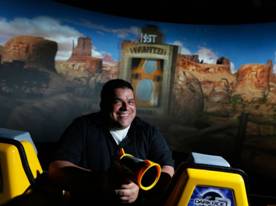
Ernest Yale’s story is familiar. In his youth, he spent hours tinkering with the computers at his school and reprogramming Atari games. So founding a business that made arcade games in 1999 was a natural progression. Montreal-based Triotech, soon found it was unable to compete on price with giants such as Sega, so it pivoted to creating original technology. Today, the company makes “interactive attractions” using large screens, 3D animation, moving seats, lasers, and wind machines, to make traditional amusement park attractions more interactive. Triotech is producing a major attraction for Canada’s Wonderland called Wonder Mountain’s Guardian, which features a digital dragon and lasers that visitors will fire at animated characters. Growth has been happening quickly, particularly in Asia where a growing middle class is clamouring for entertainment. As well, the 100-person company is using revenue-sharing partnerships with its clients to expand faster. Mr. Yale, chief executive of Triotech, recently discussed his company’s growth strategy with Quentin Casey. The following is an edited transcript of their conversation.

Q You’re headed off to Asia. Is the trip business-related?

A I travel about six months a year. On this trip I’m technically on vacation, but we’re in the attraction business so we always visit amusement parks. Even when I’m on vacation I go to every amusement park and I try the rides. There’s a thin line between work and play in my line of business. Actually, most people I know think I don’t work.

Q You have installations in more than 40 countries. Can you give me a sense of your recent growth?

A In the past four years, we’ve grown by an average 20% to 25%. We’ve been doing very well because we offer a new type of attraction — something interactive. When times are hard, people are looking for something that’s new and different to attract customers. We’re also in new markets like China.

Q You’ve opened a small office in Beijing. Does Asia represent the biggest market for further growth?

A Yes. It’s a bit of an expensive product for the Chinese market, but we’re seeing a lot of triple-A theme parks being built in China. They want to replicate the Disneys and Universal Studios of the world, so they’re buying foreign rides, including ours.

Q You’re trying to push your technology into bigger amusement parks. How will your project at Canada’s Wonderland aid that effort?

A Canada’s Wonderland is owned by Cedar Fair, a U.S. company. They own 11 amusement parks in North America. We’re targeting all their parks. Same thing in China. We’ve been working with theme park companies including the OCT Group and Happy Valley. If you do one ride, and it’s successful, then the park operators want to replicate that ride in a lot of their parks. That is our strategy.

Q You’ve also started partnering on revenue-sharing deals. Why?

A Our customers have been very successful with our attractions. A lot of them had a return on investment in less than a year. We’re partners in about 20 attractions, including one in the West Edmonton Mall. One of our goals is to establish these attractions all over the world, and have local partners manage them. It’s an important focus for the future.

Q Why is that important?

A It ensures long-term, steady revenue every month. And it’s actually much more profitable than manufacturing a product. Our operations division accounts for less than 10% of revenue. Eventually, it could drive the majority of our revenue. Just imagine you have 50 or 100 locations and they generate revenue every month. Every time someone steps on a ride we get a portion of that revenue. And some countries have 12-month seasons. In Singapore, for example, there’s no winter. Imagine the revenue.

Q Have you made any mistakes in growing the company?

A We’ve made a lot. For instance, we wanted to become a co-owner at some venues but we lacked expertise in operations. We initially placed some of our locations in far away places. We learned that we have to partner with someone who is local. In the U.S. we have local partners now. They know the market, and they know how to advertise there. We made a few mistakes. But we’re a small company so we’re able to turn it around quickly.

Q What’s your prediction for future growth?

A Last year was a record year. It was our best so far — by far. This year will be even bigger based on the contracts we have already. I see an acceleration of our growth in 2015 and 2016 — more than 25% a year. A lot of amusement parks are looking for something new. That’s where interactive attractions come in. It’s a virgin market.

The 2014 Global Risk Matrix

The 2014 Global Risk Matrix

By Mark Glassman January 23, 2014

Even the scariest scenarios are worth sweating over only if they’re likely to happen. (Really, how often do you worry about a tornado full of sharks?) With that in mind, the World Economic Forum’s latest annual report on global risks sizes up the impact of some all-too-real threats in the year ahead.

risk001

The Good News About Slow-Motion Money

The Good News About Slow-Motion Money

By Matthew Philips January 17, 2014

money1

One of the more obscure indicators economists use to gauge the strength of the economy is money velocity. In essence, this is the speed at which a dollar moves from one transaction to another. The more times a dollar is used to buy something, the greater its velocity, and the quicker the economy grows.

More than four years after the recession ended, you’d think money would be cycling through the economy at a faster rate than a few years ago. But you’d be wrong. Dating to 1959, money has never moved through the U.S. economy at a more glacial pace than it has over the past year. As of the third quarter of 2013, the velocity of the M2 money supply—cash and checking deposits, plus “near money,” which includes savings accounts, retail money market mutual funds, and CDs—was 1.5, according to data tracked by the Federal Reserve. This means that of the $11 trillion in bank accounts (not to mention all the cash stuffed under mattresses), each dollar was spent just 1.5 times over the past year. That’s down from 2 times in 2006 and a high of 2.2 times in 1997.

Because money velocity is roughly the ratio of the size of the economy (gross domestic product) to the size of the money supply, it’s no wonder money is moving so slowly. In 2008 the Fed began its aggressive quantitative-easing program of monetary stimulus that included buying bonds and flooding banks with capital in hopes of spurring lending and investment. Since then, the money supply has grown about 46 percent. GDP has averaged only 2.3 percent annual growth since the recession ended in June 2009.

With all the money the Fed has pumped into the economy, GDP would have to grow almost 10 percent annually for money velocity to keep pace with the money supply. And since this isn’t China, that type of growth isn’t remotely plausible. This also explains why all that new money hasn’t triggered inflation: If it’s not getting spent, it’s not raising prices. “We’re simply not going to get inflation until velocity gets back to something normal,” says Austan Goolsbee, a former chairman of President Obama’s White House Council of Economic Advisers.

Money tends to slow down in the early stages of an economic recovery as people reduce spending, pay down debt, and increase their savings rate, and it doesn’t pick up speed until about four years into a turnaround. During the economic boom of the 1960s, annual GDP growth averaged more than 5 percent from 1961 to 1965, but money velocity fell during much of the first half of the decade and didn’t bottom until the end of 1964, at about 1.6 percent—not far from where we are today. Afterward, the economy ticked off another five years of solid growth, as the money speed indicator started rising. Twenty years later, something similar happened. After a deep recession in the early 1980s, the economy went through almost a decade of growth. And yet money velocity fell during much of that recovery, bottoming in 1987 and then racing up through the late ’90s. “To me, this is totally normal,” says James Paulsen, chief investment strategist at Wells Capital Management, who has studied the variations in money velocity through the years.

Based on these historical examples and improving economic data, we may be on the verge of money finally speeding up again, especially as the Fed tapers its bond purchases and mops up excess liquidity, slowing the expansion of the money supply. This would in theory lead to stronger growth, but it could also unleash some moderate inflation. That’s not entirely a bad thing if rising prices boost spending. Some economists think the Fed wouldn’t mind a small inflation jolt. “This is not your father’s Fed,” says David Rosenberg, chief economist at Canadian investment firm Gluskin Sheff + Associates (GS:CN). “When it comes to inflation, this is a Fed that will say, ‘Bring it on.’ ”

The bottom line: The money supply has grown 46 percent since 2008, pushing the money velocity reading to record lows.


Chinese CDS Worsens As Post-Year-End Liquidity Needs Spike

Tyler Durden on 01/23/2014 21:43 -0500

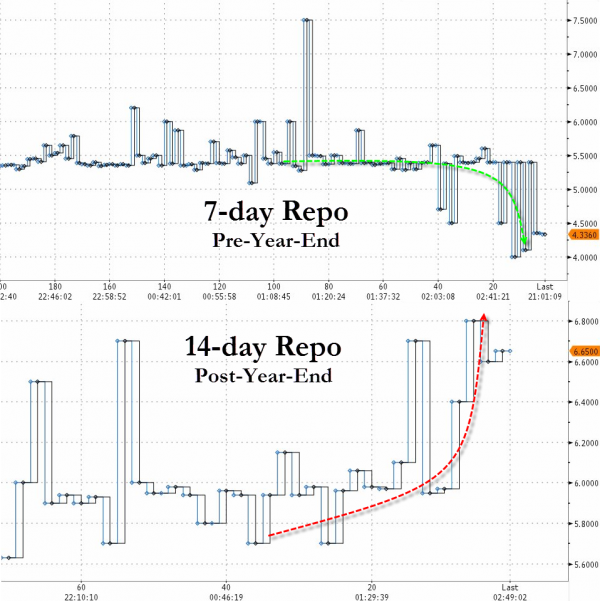
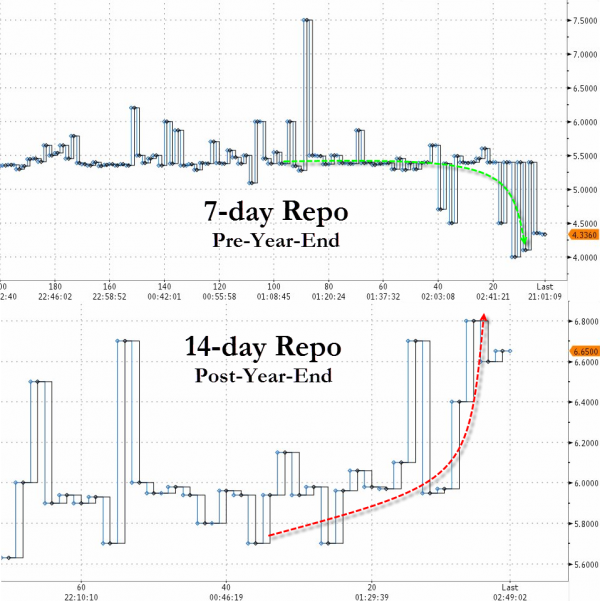
The PBOC has injected around CNY 400 billion into China’s banking system in the last week focused in the 7-day reverse-repo maturity. While this has been greeted with moderation of the spiking trend in ultra-short-dated funding costs, there is a problem still. With the CEG#1 Trust maturing on 12/31 coinciding with the farce that is the ‘confess all mismatched sins’ debacle that occurs every Chinese Lunar New Year, the need for liquidity through that maturity is becoming extreme (while shorter-dated not so much). 14-day repo is now at 7.2% – almost 300bps above 7-day repo (which matures before year-end). In fact, it seems those concerned about possible Chinese contagion effects are buying protection aggressively as 5Y CDS jumped over 5bps to 102bps – the widest in 7 months (since the credit crunch in the Summer). This is far from over…

7-day repo in less demand (or over-supplied for now) as 14-day repo (which will see banks through the year-end) are seeing rates spike… at its widest today banks were willing to pay almost 250bps to extend the reverse-repo from 7 to 14 days – quite a curve!!!


imageb imagea

And Chinese CDS are blowing wider still…

Given our earlier note on the depositor problems at some banks, we though Nomura’s comment very apt:

Media reports that some farmers’ financial cooperatives are failing to pay depositors may be another sign of rising financial stress in China as interest rates rise and economy slows, Zhiwei Zhang, China chief economist at Nomura, wrote in note yesterday.

Continues to see credit defaults to occur in corporate, LGFV and shadow banking sectors in 2014

The fact that CNR, a major official news agency in China, reported on co-ops may suggest govt stance on financial risks is to acknowledge problem, strengthen regulations

The Asian Superlative Horse for Value Investors: The Tale of Cosmax Vs L’Oreal

Dear Friends and All,

The Asian Superlative Horse for Value Investors: The Tale of Cosmax Vs L’Oreal

The Three Apples was on my mind in August 2007 when the Bamboo Innovator was in Seoul presenting to a group of about 50 Korean SME CEOs and the commerce minister at the KITIA-PwC conference. The first, “Eve’s apple,” the apple of morality. The second, the “Apple of Beauty,” the one which was given to Aphrodite by the Trojan prince. The third, “Newton’s apple of science”, the one that inspired Newton for the development of his theory of universal gravitation. The Three Apples is the corporate symbol of Korea’s Cosmax (Kospi: 044820 KS, MV $720 million), an ugly-duckling cosmetics company that the Bamboo Innovator decided to pay a visit amongst the over two thousand companies listed in Korea after the conference.

Cosmax was shunned by both foreign and local investors then because it doesn’t have its own brand – it does the contract manufacturing (ODM/OEM) for L’Oreal, Shu Uemura, Maybelline, J&J, Mary Kay, Amorepacific and so on. Companies with brands are the ones who command valuation premium, the veterans would sneer. The financial numbers of Cosmax was also ugly as it was undertaking a capex exercise to expand in China, depressing its profit margins while the plants are being constructed. KS (Kyung-soo) Lee (photo), founder and chairman of Cosmax, explained: “These three symbols hinged on the apple, explain the leaders, reflect exactly our industrial philosophy based on honesty, on our mission to contribute to a life more beautiful and finally on our goal for R&D.”

The Bamboo Innovator remembered the management sharing how Cosmax/KS were often advised by investors to go with the trend and venture downstream to building their own brand. Cosmax will not compete with its clients and adds value with new ODM products that are developed only after analyzing trends, KS Lee emphasized, stamping his integrity to stay independent to innovate with its own business model. The company highlighted its ability to create “formulas” and boasts that nearly all of its products are manufactured from them. One of the company’s most popular products is a gel eyeliner it devised for L’Oreal. KS had worked at Dong-A Pharmaceutical and Daewoong Pharmaceutical before starting Cosmax in 1992, then called Miroto Korea. President and CEO CH (Chul-hun) Song rose through the ranks of LG Household & Health Care’s cosmetics manufacturing division before joining Cosmax in 2004. At Cosmax’s R&D center, many heads of departments have joined Cosmax from Amorepacific, including company director Kim Joo-ho and directors Park Myeong-sam and Moon Seong-joon. Since August 2007 as the company expanded with a new factory in Shanghai (constructed in 2006 and the tipping point of commercialization in 2008) and Guangzhou, Cosmax has rose over 13-fold to a market value of $720 million from around W4,000 to W56,000, but not before enduring a gut-wrenching plunge to W1,410 in Oct 2008 during the Global Financial Crisis.

The recent exit of L’Oreal’s Garnier brand and Revlon from China and the continued success of Cosmax in China goes to highlight that beauty in Asia should not be judged skin-deep in chasing brands and pretty financial numbers. The porcelain beauty of Chinese women takes $35 billion to upkeep so exiting from such a seemingly attractive market speaks volume about the increasing difficulties faced by established western brands in China and emerging markets. L’Oreal made the surprising announcement less than two weeks ago that it is pulling its successful Garnier brand from the rapidly evolving Chinese market, which made up a little over 1% of L’Oreal’s $2 billion sales in China. The positioning of the Garnier line with relatively mass-market pricing has seen an initial promising start as the #1-selling brand in China since launching in 2006 with superstar Zhang Ziyi but it failed to gain traction as consumer grew wary of mass-market products and they no longer believe mass-market products are good for them. Revlon also said it was cutting its ailing operations in China, which account for about 2% of its total sales, and slashing more than 15% of its workforce, or 1,100 jobs, including those of 940 beauty advisers.

As hockey legend Waynes Gretzsky would say, skate to where the puck is going to be, not where it has been. The Bamboo Innovator was of the view that the profits and valuation premium in the value chain is possibly shifting to manufacturers with R&D/ODM capabilities to handle large batch orders as product lifecycle shortens and speed-to-market is crucial and there will only be a few of these companies, including Cosmax, who have the capability and capacity to handle these orders. Cosmax is capable of…

<Article snipped>

The story of Cosmax also reminded the Bamboo Innovator of an old Taoist tale of the Superlative Horse on how to find the neglected, the misunderstood opportunities, and its age-old wisdom is particularly apt as we approach the Chinese Lunar Year of the Horse at the month end of January:

Duke Mu of Chin said to Po Lo: ‘You are now advanced in years. Is there any member of your family whom I could employ to look for horses in your stead?’

Po Lo replied: ‘A good horse can be picked out by its general build and appearance. But the superlative horse – one that raises no dust and leaves no track – it is something evanescent and fleeting, elusive as thin air. The talents of my sons lie on a lower plane altogether; they can tell a good horse when they see one, but they cannot tell a Superlative Horse. I have a friend, however, one Chiu-fang Kao, a hawker of fuel and vegetables, who in things appertaining to horses is nowise my inferior. Pray see him.’

Duke Mu did so, and subsequently dispatched him on a quest for a steed. Three months later, he returned with the news that he had found one. ‘It is now in Shach’iu,’ he said.

‘What kind of a horse is it?’ asked the Duke.

‘Oh, it is a dun-coloured mare,’ was the reply.

However, the animal turned out to be a coal-black stallion. Much displeased, the Duke sent for Po Lo. ‘That friend of yours,’ he said, ‘whom I commissioned to look for a horse, has made a fine mess of it. Why, he cannot even distinguish a beast’s colour or sex. What on earth can he know about horses?’

Po Lo heaved a sigh of satisfaction. ‘Has he really got as far as that?’ he cried. ‘Ah, then he is worth ten thousand of me put together. There is no comparison between us. What Kao keeps in view is the spiritual mechanism. In making sure of the essential, he forgets the homely details; intent on the inward qualities, he loses sight of the external. ‘He sees what he wants to see, and not what he does not want to see. He looks at things he ought to look at, and neglects those that need not be looked at. So clever a judge of horses is Kao that he has it in him to judge something better than horses.’

And when the horse finally arrived, it turned out, indeed, to be a superlative animal.

his is a fabulous tale of Superlative Horses and of men who have the patience and the uncanny instinct to identify horses that raise no dust and leave no track. One cannot escape noticing the relationship among the three men – the underlying trust, the sense of self-worth, the respect for one another’s views and, of course, the obvious loyalty. In value investing, the payoff/returns might not be immediate, as in the case of Cosmax and Duke Mu’s judgment of Kao’s assessment of the Superlative Horse, and usually result in fray nerves, anxiety and unhappiness. Trust and support of one another is critical. At the Moat Report Asia and Bamboo Innovator community, which recently saw the addition of clients who raise no dust and leave no track – a secretive Singapore-based billionaire who’s a highly successful super value investor and a European-based multi-billion family office – we believe our value-add is in the authentic and independent sharing of investment opinions and views in order to get closer to the Truth – and this means that we need to take the social and business risk of being disagreeable at times. For value investing to be productive, there has to be a candid dialogue with a group of people who genuinely care for one another.

The more over-powering message, one that is relevant in our search for the resilient compounder, is that we should go beyond the external – the nice financial numbers, the certificates, the accolades, the family links and the PR – and seek out the intrinsic leadership qualities in individuals and the wide-moat of the companies.

To read the exclusive article in full to find out more about the story of Cosmax and Sa Sa (HKSE: 178 HK) and the value investing lessons from the old Taoist tale of the Superlative Horse, please visit:

Cosmax

The Chinese Emperor and His Number Two: Xi-Li Power Shift, What It Means for Value Investors and the Story of Hangzhou Robam

The following article is extracted from the Bamboo Innovator Insight weekly column blog related to the context and thought leadership behind the stock idea generation process of Asian wide-moat businesses that are featured in the monthly entitled The Moat Report Asia. Fellow value investors get to go behind the scene to learn thought-provoking timely insights on key macro and industry trends in Asia, as well as benefit from the occasional discussion of potential red flags, misgovernance or fraud-detection trails ahead of time to enhance the critical-thinking skill about the myriad pitfalls of investing in Asia at the microstructure- and firm-level.

Dear Friends and All,

The Chinese Emperor and His Number Two: Xi-Li Power Shift, What It Means for Value Investors and the Story of Hangzhou Robam

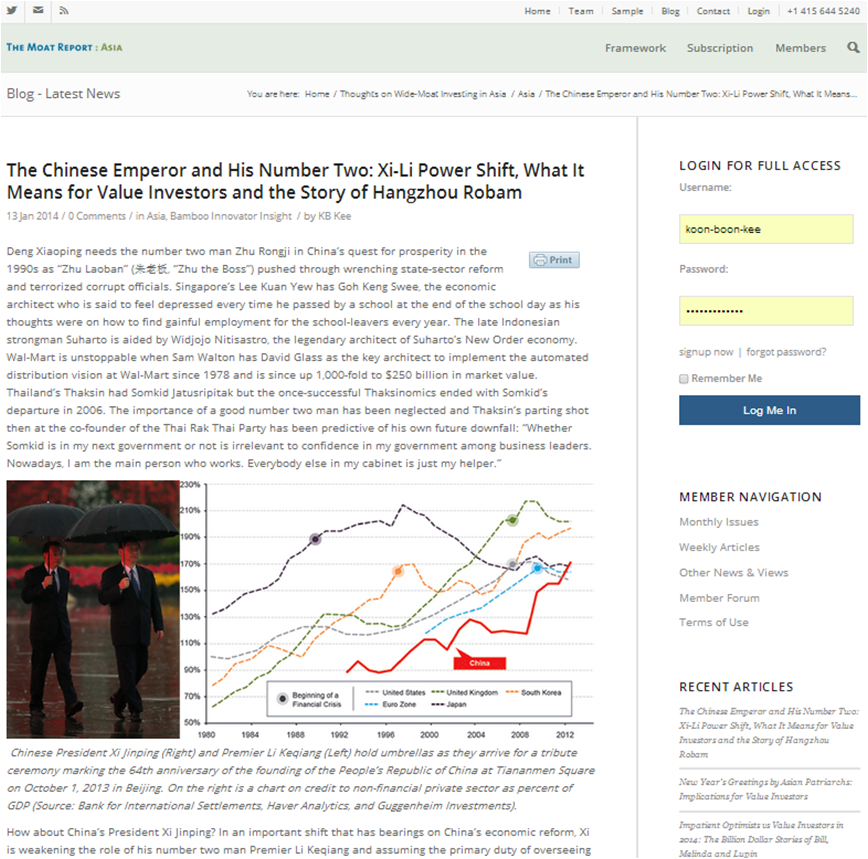
Deng Xiaoping needs the number two man Zhu Rongji in China’s quest for prosperity in the 1990s as “Zhu Laoban” (朱老板, “Zhu the Boss”) pushed through wrenching state-sector reform and terrorized corrupt officials. Singapore’s Lee Kuan Yew has Goh Keng Swee, the economic architect who is said to feel depressed every time he passed by a school at the end of the school day as his thoughts were on how to find gainful employment for the school-leavers every year. The late Indonesian strongman Suharto is aided by Widjojo Nitisastro, the legendary architect of Suharto’s New Order economy. Wal-Mart is unstoppable when Sam Walton has David Glass as the key architect to implement the automated distribution vision at Wal-Mart since 1978 and is since up 1,000-fold to $250 billion in market value. Thailand’s Thaksin had Somkid Jatusripitak but the once-successful Thaksinomics ended with Somkid’s departure in 2006. The importance of a good number two man has been neglected and Thaksin’s parting shot then at the co-founder of the Thai Rak Thai Party has been predictive of his own future downfall: “Whether Somkid is in my next government or not is irrelevant to confidence in my government among business leaders. Nowadays, I am the main person who works. Everybody else in my cabinet is just my helper.”

15-1024x450

Chinese President Xi Jinping (Right) and Premier Li Keqiang (Left) hold umbrellas as they arrive for a tribute ceremony marking the 64th anniversary of the founding of the People’s Republic of China at Tiananmen Square on October 1, 2013 in Beijing. On the right is a chart on credit to non-financial private sector as percent of GDP (Source: Bank for International Settlements, Haver Analytics, and Guggenheim Investments). 

How about China’s President Xi Jinping? In an important shift that has bearings on China’s economic reform, Xi is weakening the role of his number two man Premier Li Keqiang and assuming the primary duty of overseeing economic reforms, particularly after the Plenum in November 2013. “Likonomics” is replaced by “Jinpingnomics”. Xi had personally led the drafting of the Plenum economic reform plan – the first time a party chief had done so since 2000. Xi is subverting a nearly two-decade-old division of power whereby the president, who is also party chief, handles politics, diplomacy and security, while the premier manages the economy. Xi’s predecessor Hu Jintao had played a negligible role in the economy and shared power evenly with former premier Wen Jiabao who was in charge of the massive RMB4 trillion ($660 billion) stimulus plan to respond to the 2008-09 global financial crisis which led to over RMB20 trillion ($3.3 trillion) of local government debt and concerns by investors such as George Soros who wrote recently what is perceived as a prediction of an economic crash in China: “There is an unresolved self-contradiction in China’s current policies: restarting the furnaces also reignites exponential debt growth, which cannot be sustained for much longer than a couple of years.” After rapidly consolidating power over the party and the military in his first year, Xi is now stepping in on the economy, making him the most individually powerful leader since Deng who launched China’s economic liberalization in 1978. Xi is also said to want to avoid the mistake of Hu who was outshined by Wen during the ten-year Hu-Wen administration from 2002.

Interestingly, in the February and May 2011 monthly editions of On the Ground in Asia, the predecessor of the Bamboo Innovator Insight and the Moat Report Asia, we had highlighted how the weak emperors in China and Asia would attempt to consolidate and take back power from the powerful local warlords:

“Local provinces now have greater autonomy and real power and the local warlords strive to create political dynasties capable of controlling or influencing a wide range of government projects to entrench themselves. A key risk for Asia that has not been particularly publicly highlighted is that the weakened central authority, unhappy at how his power and money base is eroded by so many different local factions, attempts to first attract all the FDI and investment flows into the regions with buzz transformational projects and privatization or PPP plans, and then, after getting a critical pool of funds, “shuts down” the place partially to reallocate power and money back to the central authority. This is a potential macro risk in Asia that investors have to keep in mind.. leverage is flattened, particularly at the LGFVs (local government financing vehicles), so as to weaken the elitist grip in local provinces through controlling the finances, resulting in China taking a “big bath writedown”, contrary to market expectations of a relatively smooth economic condition.. The new (benign elitist) leader Xi Jinping can also start to quickly produce fruits on the burnt-and-fallowed grounds when he takes over to demonstrate his competence and authority.”

The Bamboo Innovator recalled when we wrote about the above opinion in early 2011, we were derided both by some external parties and even internally for being an unnecessary alarmist, especially when Asia had rebounded strongly for almost two years from the bottom in March 2009 and everyone was minting money from property, gold, commodities and so on. The local government debt risk is not something new or unexpected and is already a known risk factored into the markets, some commented. If the information is out there, someone is already worrying about it and the risk will be impounded into the prices, they added. Shanghai Composite index is down 30% since then, Hang Seng index is still slightly down, gold down 11%, while the S&P index is up nearly 40% over the same period. Yes, while the local debt risk is not new, it definitely isn’t weighted enough by the market….

<Article snipped>

… Asian patriarchs and matriarchs add value in ways that do not appear on balance-sheets through their relationship-based deal-making capabilities. These strengths and tacit knowledge are difficult to bequeath or transfer to one’s children, and these specialized and intangible assets cannot be capitalized easily in the markets. This is why some Asian empires struggle to outlive their founders and succession tended to coincide with tremendous destruction of value. Because most Asian companies are “one-man-shop” operations with the founder making all the decisions, one of our favorite due diligence questions for Asian entrepreneurs and managers: the willingness to build a culture of decentralization/ empowerment and invest in a system to cascade decision rights throughout the organization is an important signal that the founder desires and cares to scale up the company in a sustainable manner by not hoarding knowledge.

That is why the Bamboo Innovator likes to see whether the company or country has a David Glass, a Zhu Rongji. Often, in our interaction with the Asian management, we can sense whether the emperor is playing mind games on the people around him or her so as to ascertain the worthiness of the “successor”. True Asian compounders and Bamboo Innovators have no time to waste – they build an idea or a vehicle that is larger than them so that others can be co-creators and involved in the value creation process, rather than having to fight for favors and permission and engaging in time-wasting posturing acts to be perceived in a good light by the emperor. There is a palpable sense of urgency in wanting to get things done, to realize the intangible ideas and Purpose, to keep the flames burning..

To read the exclusive article in full to find out more about the implications of the Xi-Li power shift and the story of Hangzhou Robam, please visit:

  • The Chinese Emperor and His Number Two: Xi-Li Power Shift, What It Means for Value Investors and the Story of Hangzhou Robam, Jan 13, 2014 (Moat Report AsiaBeyondProxy)

Emperor

New Year’s Greetings by Asian Patriarchs: Implications for Value Investors (Bamboo Innovator Insight)

Updates:

  • One of our recent new subscribers last month is a Singapore-based billionaire who’s a secretive low-profile super value investor with his own multi-billion family office and we have another European-based multi-billion family office signing up too.
  • The Bamboo Innovator also met up with one of our Institutional Subscribers over  Saturday at the Detecting Accounting Frauds Ahead of the Investment Curve workshop (our 6th run of the workshop series) and he commented that while he has been cautious on the macro front, he finds the investment philosophy, the thinking process and the stock ideas highlighted in the monthly reports to be carefully researched and useful for his professional and personal growth as a value investor in taking high-conviction bets of wide-moat business models with peace of mind in an uncertain macro environment.
  • We are grateful to have the support of our subscribers and readers, an unusual and exceptional group who are not traders seeking short-term momentum, get-rich-quick, syndicates-driven ideas. We are especially grateful to our initial subscribers including the astute private investors Mr K (whose investments in Malaysia’s wide-moat innovator DKSH is up nearly 200% since March 2013) and Mr W. This reminds the Bamboo Innovator of what Harvard’s Michael Porter remarked in a recent interview last month:

“The concern is that it seems like the vast majority of energy and effort in investing has become about other things. It’s about momentum. It’s about program trading to capitalize on tiny movements in share prices. It’s about locating your servers closer to the exchange so you can trade in and out a little faster. I’m all for price discovery and liquidity, but improvements here have diminishing returns for fundamental wealth creation. One investor’s gain is often another investor’s loss.. I believe that the fundamental purpose of investing is to deploy capital to productive uses in the real economy. It’s the ability of businesses to use capital well to meet needs at a profit and grow that creates all the wealth in society. Directing capital to companies that can use it productively to create economic value, and thus wealth, is ultimately the most profound benefit investors can have on society.”

With knowledge, we have a choice to invest in the hardworking Asian entrepreneurs and capital allocators who are serious in building a wide-moat business. And we are intrinsically motivated to keep the flames burning to highlight these exceptional innovators for our subscribers who are just as unique!

The following article is extracted from the Bamboo Innovator Insight weekly column blog related to the context and thought leadership behind the stock idea generation process of Asian wide-moat businesses that are featured in the monthly entitled The Moat Report Asia. Fellow value investors get to go behind the scene to learn thought-provoking timely insights on key macro and industry trends in Asia, as well as benefit from the occasional discussion of potential red flags, misgovernance or fraud-detection trails ahead of time to enhance the critical-thinking skill about the myriad pitfalls of investing in Asia at the microstructure- and firm-level.

Dear Friends and All,

New Year’s Greetings by Asian Patriarchs: Implications for Value Investors

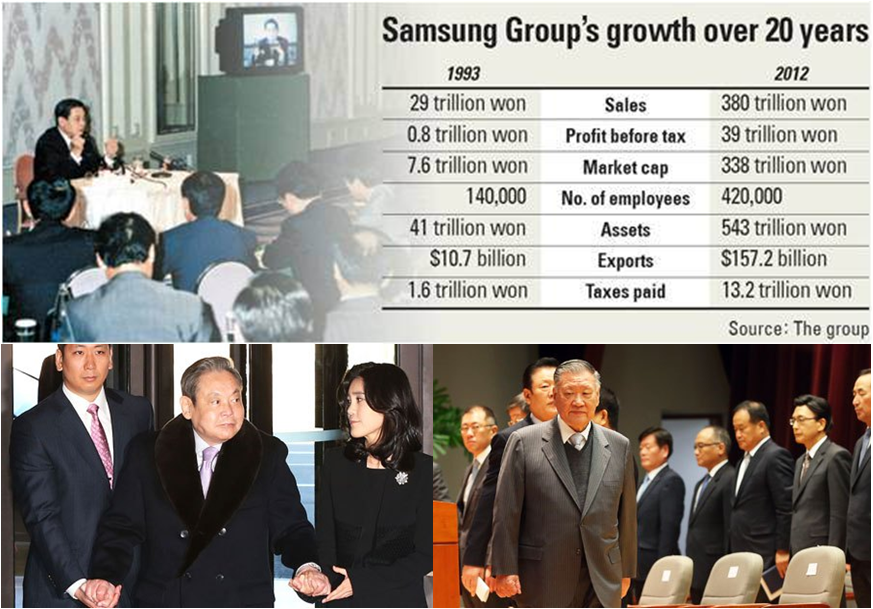
“Let us boldly throw away the business models and strategies of the past five and ten years,” said the 71-year-old Lee Kun-hee in a New Year message to Samsung Group’s 420,000 employees around the world. More than 60% of the profits of Samsung come from the flagship vehicle Samsung Electronics (005930 KS, MV $180bn), and 60% of Samsung Electronics’ profits come from mobile phones. “Let us move beyond our hardware-oriented processes and corporate culture. “Our leading businesses are constantly being challenged by competitors, while time is running out for our less dynamic businesses. It is therefore time to change once again. Economic slowdowns can present opportunities too. Let us see farther from a higher vantage point and create new technologies and markets. We must push ourselves to improve our business structure so that we can lead industry trends. We must innovate technologies that can help us compete in an uncertain future. And we must invest in systems to enhance our global management capabilities. As we move forward, we must resist complacency and thoughts of being good enough, as these will prevent us from becoming better. We should not be complacent and be armed again with a sense of crisis. We need to be a management that thrives on innovation, autonomy and creativity, that accepts challenge and is not afraid of failure. We must create an environment of ingenuity, where autonomy and creativity abound. There are social expectations on us. We will take another first step toward becoming an eternal, super first-class corporation that can’t be shaken by any obstacle. Once again, we will move strongly.” Like Nokia and Blackberry, Samsung was also disrupted by Apple but it managed to accomplish something the others did not — it bounced back, stronger than ever; to bend, and not break, like the bamboo.

New Year_Samsung

Top: On June 7, 1993, at an emergency executives meeting in Frankfurt, Germany, he told his assembled managers: “Change everything except your wife and children.” Bottom left: Samsung Electronics Chairman Lee Kun-hee walks into the Hotel Shilla in Seoul, holding hands with the hotel’s CEO and his daughter Boo-jin, to attend the 2014 New Year’s greeting ceremony; Bottom right: Hyundai Motor Group Chairman Chung Mong-koo walks into a hall to attend a New Year’s greeting ceremony at the group’s headquarters in Yangje-dong, Seoul.

“The economic condition is still difficult, especially with the strengthening of the won and the dragging out of the economic recovery,” said Koo Bon-moo, chairman of LG Group, as he asked each employee to be ready for the challenge of difficult times ahead. “We are in a crisis,” he said. “A leading firm could collapse due to a careless mistake.” LG Electronics (066570 KS, MV $10bn) has since lagged far behind Samsung Electronics. Hyundai Motor (005380 KS, MV $46bn) Chairman Chung Mong-koo, 75, also called for innovative approaches to tackle challenges. “The global economy has entered the era of low growth, which has led to a fiercer competition. Uncertainty has grown, due to technological conversions,” Chung said. “It is necessary to innovate the management system of global networks to obtain efficiency to cope with challenges.” Hyundai Group Chairwoman Hyun Jeong-eun said 2014 will be a turning point for the group. “We are in a time we can’t survive with old sales strategies, business models and management measures,” she said. “We should be reborn to carry out innovative strategies.” Hyundai Group has recently decided to sell all three of its financial affiliates – Hyundai Securities, Hyundai Savings Bank and Hyundai Asset Management – for $3.1 billion in a bid to avoid a liquidity crisis and lower its high debt ratio from nearly 500% to less than 300%. It also expects to raise $320 million by selling the Banyan Tree Hotel in Seoul which it acquired for $155 million in 2012. Hyundai Group is a conglomerate with businesses ranging from shipping and logistics to finance and machinery, but it does not include Hyundai Motor or Hyundai Heavy Industries (009540 KS, MV $18bn), which were spun off following the 1997/98 Asian Financial Crisis. Creditors have piled pressure on cash-strapped industrial conglomerates to accelerate restructuring, following a string of bankruptcies including STX, Tongyang and Woongjin.

The New Year message by these successful and crisis-aware Asian patriarchs and entrepreneurs has been sober. What are the implications for value investors? The increasing pace of business disruptive changes will accelerate the restructuring efforts of many Asian business groups to spin-off, divest, merge and acquire the different business parts to stay relevant and competitive, to make decisions and execute faster on business opportunities, and to aim for the highest valuation with an improved governance structure. Take for instance Korea’s internet giant NHN which announced the spin-off of its games division (Hangame, renamed NHN Entertainment) on 8 March 2013 from its search and mobile chatapp LINE business (Naver) with the actual split date on August 29. The rationale is for the separate entities to respond to challenges and opportunities more nimbly and quickly. Naver Corp (035420 KS, MV $21.8bn) is up 57% since the split as shown in the price chart, compared to a flat Kospi index over the same corresponding period. Understanding the company’s motivations for restructuring is critical to provide clues to the future values of new and existing entities.

Naver

To read the exclusive article in full to find out more about how restructuring aimed at improving corporate governance will be a major investment theme in Korea and Asia in 2014, please visit:

New Year


Impatient Optimists Vs Value Investors in the New Year 2014: The Billion Dollar Stories of Bill-Melinda and Lupin (Bamboo Innovator Insight)

The following article is extracted from the Bamboo Innovator Insight weekly column blog related to the context and thought leadership behind the stock idea generation process of Asian wide-moat businesses that are featured in the monthly entitled The Moat Report Asia. Fellow value investors get to go behind the scene to learn thought-provoking timely insights on key macro and industry trends in Asia, as well as benefit from the occasional discussion of potential red flags, misgovernance or fraud-detection trails ahead of time to enhance the critical-thinking skill about the myriad pitfalls of investing in Asia at the microstructure- and firm-level.

Dear Friends and All,

Nearly ten years ago, the Bamboo Innovator had met with the founder of a Chinese drugmaker who was seeking to list his firm in Singapore. As this Chinese entrepreneur hails from the northeastern Shandong province and Shandong men are generally stocky like rugby players, this particular entrepreneur stood out for being unusually small-build. So the Bamboo Innovator asked him and found out that he had been afflicted with polio when he was young and he managed to recover from the disease. The gritty entrepreneur remarked that I am the only fund manager who observed this condition and made an effort to ask; he is usually bombarded by questions about profit margins and guidance on sales figures. The Bamboo Innovator is positive on people who have overcome personal adversities in life as they tend to be resilient in creating value for others. We invested in the shares of this Chinese pharmaceutical company and not only did the market value climbed four-fold from around $75 million to $300 million, but importantly it was also possibly the only Chinese S-Chip firm whose accounting was clean and did not suffer when the wave of accounting fraud revelation swept across the statistically-cheap Singapore-listed Chinese firms during the 2007/09 Global Financial Crisis.

******

As we step forward into the New Year 2014, the Bamboo Innovator was captivated by a WSJ article “What I Learned in the Fight Against Polio” written by Bill Gates on Nov 10. It talks about how the Bill and Melinda Gates Foundation has helped India stayed polio-free for more than two years and the lessons for solving other human welfare issues worldwide. Impatient Optimists is the name of the blog (www.impatientoptimists.org) of the influential Bill & Melinda Gates Foundation featuring the work and stories of the people working every day to help alleviate suffering, poverty, diseases, promote health, and to help students realize his or her full potential. These are all urgent problems requiring innovative solutions that have long-term investment implications which we will discuss shortly with the story of the Indian compounder Lupin (NSE: Lupin, MV $6.5 billion) and how its focus in the neglected niche of anti-TB drugs transformed the firm into India’s third-most valuable listed pharmaceutical firm, compounding shareholders’ wealth by over 138-fold. Bill Gates wrote in a blog post on Dec 23 about a summary of “Good News You Might Have Missed in 2013” that include how we got smarter and faster at fighting polio and that funding commitment to the Global Fund to fight TB and malaria was renewed. Gates also shared a tweet expressing his excitement on what he is looking forward to seeing in 2014: a new vaccine called pentavalent that can prevent five diseases.

Gates

Lupin

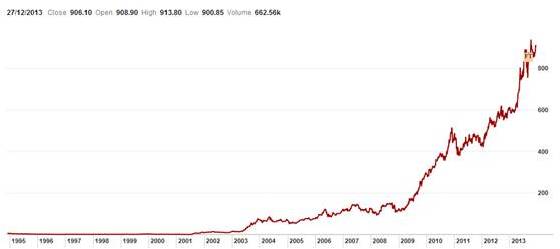
Lupin (NSE: LUPIN) – Stock Price Performance, 1995-2013

To read the exclusive article to find out more about the story of Lupin, of Australia’s CSL which is up 85-fold to $29 billion and how value investors can potentially gaze at the next Lupin/CSL, please visit:

  • Impatient Optimists Vs Value Investors in the New Year 2014: The Billion Dollar Stories of Bill-Melinda and Lupin, Dec 27, 2013 (Moat Report AsiaBeyondProxy)

Impatient Optimists


Keepers of the Flame: Revisit into the Origins of Compounders in India and Asia (Bamboo Innovator Insight)

The following article is extracted from the Bamboo Innovator Insight weekly column blog related to the context and thought leadership behind the stock idea generation process of Asian wide-moat businesses that are featured in the monthly entitled The Moat Report Asia. Fellow value investors get to go behind the scene to learn thought-provoking timely insights on key macro and industry trends in Asia, as well as benefit from the occasional discussion of potential red flags, misgovernance or fraud-detection trails ahead of time to enhance the critical-thinking skill about the myriad pitfalls of investing in Asia at the microstructure- and firm-level.

Dear Friends and All,

Keepers of the Flame: Revisit into the Origins of Compounders in India and Asia

“A person or an organization may be down temporarily due to circumstances beyond himself or herself. But he or she may rise up from the values they held fast as keepers of the flame”, a Tata executive shared with me this belief over lunch during our business trip to India from 7-17 Dec and he handed us the Keepers of the Flame: A Century of Trust, a limited-copy DVD film on the life and times of the three great Tata stalwarts: Jamsetji, JRD and Naval.

Tata Group, with a total revenue of over $100 billion, is special among all MNCs in the world. Its mission is more than just economic. What makes Tata different is that its societal purpose powered its economic progress. Like Korea’s Samsung Group with Samsung Electronics as the flagship cashcow vehicle accounting for 70% of the market value of the sprawling conglomerate, the flagship Tata company is Tata Consultancy Services (TCS IN) which has a market value of $67 billion. Other major listed companies include Tata Motors (TTMT IN, MV $17.7bn), Tata Steel (TATA IN, MV $6.5bn), Tata Power (TPWR IN, MV $3.5bn), Titan Industries (TTAN IN, MV $3.2 billion), Tata Global Beverages (TGBL IN, MV $1.5bn), Tata Communications (TCOM IN, MV $1.3bn), Tata Chemicals (TTCH IN, MV $1.1bn), Taj Hotels (IH IN, MV $750m), Voltas (VOLT IN, MV $610M), Tata Teleservices (TTLS IN, MV $222M) and Tata Elxsi (TELX IN, MV $182m). The increasing criticism for these mega Asian giants is that they have grown too diverse and unwieldy to manage and potential internal family conflicts fighting over the economic ownership of the flagship cashcow vehicle has distracted the management in neglecting the value creation of the other multiple smaller pieces in the entire group.

As I buy a Titan Edge watch as a gift for my dad, the Bamboo Innovator pondered upon how Tata demonstrated their commitment to the idea that local society can develop local talent in the most adverse of circumstances. In 1987, the Tata Group formed a JV with the Tamil Nadu government (TIDCO) to open a watch-making factory in the remote south Indian city of Hosur, training the locals to be world-class horologists instead of taking the “efficient” short-cut way of staffing the place with professional engineers from elsewhere. Today, Titan Industries is the world’s fifth largest wrist watch manufacturer with more than 60% domestic market share and exports watches to 32 countries around the world, with their core expertise in precision engineering powering innovations such as the world’s slimmest wrist watch branded as Titan Edge. The Tata Group talks not of conquering markets but of serving people. As JRD always say, “What comes from the people must go back to the people, many times over.” The Tata experience suggests that the most resilient value companies are those created by action, by doing things, by engaging with people, by revealing and making explicit the firm’s values and then living by them, consistently, day after day after day.

What was shared by the Tata executive echoed the lifelong research work of the Bamboo Innovator: Why is it that some companies or people are able to bounce back from a crisis or challenge to scale greater heights, while others, particularly previously successful ones, remain in a state of protracted consolidation or even decline? Answering this question will illuminate the path for value investors to identify and invest in the emerging compounders and undervalued wide-moat innovators in Asia in the next five years.

Having spent the past decade plus in the miasmic Asian capital jungles interacting with the top management of Asian companies in various countries and sectors, we started to see how the mental model of the Bamboo can help to explain the underlying sources of moat creation and sustainability in outperforming value creators. We coined these compounders Bamboo Innovators, compounders who bend, not break even in the wildest of storms that would snap the mighty resisting oak tree. Due to their unique business models, the Bamboo Innovators are often overlooked, neglected, misunderstood and underappreciated, presenting mispricing opportunities for the value investors. The usual statistically cheap stocks in Asia are Extractors, either value traps with misgovernance issues with the controlling share owners extracting wealth from minority investors or fraudulent companies with the syndicates-insiders lying in wait.

As we head towards 2014, it is worthwhile for value investors to pause and relook into the wealth creation and destruction process of Compounders Vs Extractors. Value investors need to look beyond the aggregate market PE figures since the widening valuation chasm between the Compounders and the Extractors has distorted the “average” overall PE number; the quality wealth creators are rather pricey while most of the “cheap” companies are Extractors. In one of the figures extracted from Motilal Oswal’s 18th Annual Wealth Creation Study (2008-2013) forwarded to me by the accomplished and thoughtful value investor Hemant Amin (Part 1, Part 2), also head of the BRKets (www.brkets.com), we can see that the wealth destroyed in the Indian market during 2008-13 is at an unprecedented high of INR 17 trillion ($276 billion), nearly the equivalent of the total wealth created by the top 100 companies!

Wealth DestroyedSource: Motilal Oswal 18th Annual Wealth Creation Study (2008-2013)

Value investors in Asia cannot look purely at quant “valuation” metrics since many business models and moats are “permanently impaired” and these stocks are the fertile ground for momentum traders and nefarious insiders who have the incentive and power to manipulate prices and volumes. Value investors who attempted to invest in these statistically cheap stocks in Asia have found themselves facing deadweight losses in their portfolio. We observed firsthand how these compounders grew from strength to strength, especially in difficult times during the 2007-09 Global Financial Crisis, while others, such as some Singapore SME business owners, grew to become either contented with what they have achieved or disillusioned with their core business, straying to seek “growth” for their private interests such as property development, or simply numbing/”exciting” their senses with destructive lifestyle at the MBS/RWS casinos while treating both their listed business vehicles as a personal ATM and their employees as disposable expenses rather than as valuable intangible assets. The listed companies belonging to the latter group become dangerous value traps; some even slipped into conniving with “syndicates”. Financial numbers were “propped up” artificially with the prospects of sexy growth projects to lure in funds from investors and the studiously-assessed asset value has already been “tunnelled out” or expropriated. Western-based accounting fraud detection tools and techniques have not been adapted to the Asian context to avoid these traps. And the Bamboo Innovator has seen how the perpetrators go away scot-free and live a life of super luxury on minority investors’ hard-earned money. Of course, it is often said that if one’s hands are kept clean in the front-office of financial services industry in Asia, one cannot be wealthy. When investors have knowledge in their hands, we have a choice to stay away from these people and away from temptations and do the things that we think are right. With knowledge, we have a choice to invest in the hardworking Asian entrepreneurs and capital allocators who are serious in building a wide-moat business.

Note also that the percentage of wealth created by the top 100 wealth creators during 2008-2013 is also at an all-time high of 93%, as compared to merely 2% from the start of the Asian bull market during 2005-2010 when the Sensex index was 6,000 (now 21,000), while the Shanghai index is up from 1,200 to around 2,100 over the same period. The situation in India is a reflection of the broader Asian market: Shareholder wealth gain is increasingly concentrated amongst a core group of compounders whose management have been focused on building up scalable business models quietly to last the distance and were consolidating the industry to make market share gains or introduce new innovative products and services to fulfill unmet needs of the customers.

The Godrej Group is part of this core group of around 200-plus Asian Compounders which have the “highest order of competitive advantage” that is beyond fitting them into the usual Porter-style matrix of “low-cost” or “differentiation” strategy, as shared with us by Mr G Sunderraman, the Head of Innovation and EVP at Godrej & Boyce, the holding company of the reputable Godrej family at their corporate headquarters at Vikhroli in northeast Mumbai…

To read the exclusive article about the inner workings of the Indian and Asian compounders in full, please visit:

Keepers of the Flame

How to innovate? Google exec explains; The best type of innovation is disruptive innovation. Who better to teach it than a star Google exec who ran the Pentagon’s R&D arm?

How to innovate? Google exec explains

By Patricia Sellers December 17, 2013: 8:51 AM ET

The best type of innovation is disruptive innovation. Who better to teach it than a star Google exec who ran the Pentagon’s R&D arm?

dugan

FORTUNE — Disruptive innovation is the kind that unhinges old ways of operating, juices competition and creates new growth. One of the world’s leading experts on the subject is Regina Dugan, Motorola Mobility’s SVP in charge of Advanced Technology and Projects, a skunkworks-inspired unit devoted to delivering breakthrough innovations. Dugan joined Motorola Mobility, part of Google (GOOG), last year after heading the Defense Advanced Research Projects Agency (DARPA), the Pentagon’s R&D unit where scientific inflection points and critical applications–the essence of disruptive innovation, she says–have often intersected. DARPA’s legacy of radical innovation includes RISC computing, the Internet, miniaturized GPS, and those unmanned aerial vehicles popularly known as drones. Read more of this post

How to Live In a Grey World with Black-and-White Values? Musings on the Indian Accounting Standards 18, “Willful Defaulters”, Frugal Innovations and Avalokiteśvara

The following article is extracted from the Bamboo Innovator Insight weekly column blog related to the context and thought leadership behind the stock idea generation process of Asian wide-moat businesses that are featured in the monthly entitled The Moat Report Asia. Fellow value investors get to go behind the scene to learn thought-provoking timely insights on key macro and industry trends in Asia, as well as benefit from the occasional discussion of potential red flags, misgovernance or fraud-detection trails ahead of time to enhance the critical-thinking skill about the myriad pitfalls of investing in Asia at the microstructure- and firm-level.

The weekly Bamboo Innovator Insight series brings to you:

  • How to Live In a Grey World with Black-and-White Values? Musings on the Indian Accounting Standards 18, “Willful Defaulters”, Frugal Innovations and Avalokiteśvara, Dec 2, 2013 (Moat Report AsiaBeyondProxy)

Grey World

How to Live In a Grey World with Black-and-White Values? Musings on the Indian Accounting Standards 18, “Willful Defaulters”, Frugal Innovations and Avalokiteśvara

“Mr Murthy, if we have black-and-white values like yourself, how can we live in the real world that is grey?” This brilliant question to Infosys Chairman Narayana Murthy was posed by Hemant Amin, the Singapore-based value investor who compounded his investment in Infosys by 60-folds, amongst his other concentrated portfolio holdings in his multi-million single family office. Last Thursday was the second time that the Bamboo Innovator has met over lunch with Hemant, also the head of the BRKets (www.brkets.com), after our rendezvous at the Singapore Cricket Club on 7 Nov. We also wanted to catch up before the Bamboo Innovator flies over to India on a work trip from 7 to 17 December.

The Bamboo Innovator is grateful to have the experience to have met with people from all walks of life during the past decade plus in the Asian capital jungles. They range from competent pioneering intra-preneurs such as Tong Chong Heong who nurtured Singapore’s Keppel FELS (KEP SP, MV $16.3B); gritty entrepreneurs such as Lim Hock Chee who built Singapore’s supermarket chain Sheng Siong (SSG SP, MV $672M) against the odds of competing with the Davids of state-owned FairPrice and giant Jardine Group’s Dairy Farm, China’s natural gas pipeline and equipment baron Wang Yusuo of ENN Energy (2688 HK, $7.6B) and spinoff Enric (3899 HK, MV $3.2B) and many more; kind and wise professors from the School of Accounting at Singapore Management University; to exposing the accounting frauds of billionaire imposters such as Eddy Groves of Australia’s ABC Learning and the “extractor” CEOs of S-chips and P-chips. Perhaps the Bamboo has acquired some sensitivity in differentiating between the “Compounders” and the “Extractors” in a harsh and cruel world over the years. Hence, we are always excited to meet with a super value investor or/and outstanding entrepreneur with upright values and Hemant is amongst them.

The answer by Narayana Murthy was equally brilliant and profound. “You have to be able to live with the consequences of your values system. You have to be comfortable under your own skin.” An example would be how Murthy would rather acquire plots of land to expand his business at three times the price than he would otherwise pay for if he had gone through the “grey market” of middlemen who would most probably bully and rape the rural poor residents and force them into “illegal” eviction.

Besides Infosys, another concentrated compounding bets that returned multiple-fold for Hemant include HDFC (HDFC IN, MV $20.6B) and its subsidiary spinoff GRUH Finance (GRHF IN, MV $671M). As Asia slows down, many tycoons have been considering spinoffs as part of their corporate restructuring efforts to battle sluggishness and improve managerial efficiency. As explained in our earlier articles, not all spinoffs are value-creating opportunities. Heavily-indebted firms are in deleveraging mode to dispose highly-geared businesses to investors in spinoffs. The upcoming spinoff events in Asia need to be examined carefully for their business fundamentals (whether they have a wide moat and a unique scalable business model) and their motivation. In India, one of the more useful accounting clues to separate the Compounders vs the Extractors in India has been the Indian Accounting Standards 18 (IAS 18), which we will elaborate after understanding the (hidden) debt problem in India and Asia.

Despite the entrenched problems in India, both Hemant and the Bamboo Innovator share the same investment insight that India is a unique vibrant and versatile hub for “frugal innovations”: cost-effective and affordable solutions of various varieties that cater to price-sensitive consumers. Like the three sources of wide-moat in Bamboo Innovators to separate the resilient compounders vs the extractors, India’s Frugal Innovators are those with the:

1)       Indestructible intangible know-how in proprietary know-how in the system to scale up or know-how in unique products or trust and support in the community of customers and suppliers, such as Tata Consultancy Services TCS; NBFCs such as HDFC and its subsidiary GRUH with their accumulated knowledge base in assessing the credit quality of its borrowers which cultivates and snowballs trust and support from its customer base; the “unique” products of Bosch India, Pidilite Industries, Britannia, Jyothy, Eicher, Emami;

2)       Core-periphery network with the strong touch-points and periphery network eg Asian Paints, Godrej Consumer, Mahindra & Mahindra;

3)       Open innovation in co-creating value with external partners, such as the MNCs Nestle India etc, Amara Raja vs Exide, Hero Motocorp.

One prominent Buddhist story according to Mahāyāna doctrine tells of Avalokiteśvara (Sanskrit: अवलोकितेश्वर lit. “Lord who looks down”), the bodhisattva vowing never to rest until he had freed all sentient beings from samsara. Despite strenuous effort, he realizes that still many unhappy beings were yet to be saved. After struggling to comprehend the needs of so many, his head splits into eleven pieces. Amitabha Buddha, seeing his plight, gives him eleven heads with which to hear the cries of the suffering. Upon hearing these cries and comprehending them, Avalokiteśvara attempts to reach out to all those who needed aid, but found that his two arms shattered into pieces. Once more, Amitabha Buddha comes to his aid and invests him with a thousand arms with which to aid the suffering multitudes. The Chinese name of Avalokiteśvara is Guanyin (观音菩萨), which means “Observing the Sounds or Cries of the World”. The Goddess of Mercy goes all out to hear and see the pains and sorrows and negative things to help with her thousand hands and eyes (“即发誓言,若我当来堪能利益安乐一切众生者,令我即时身千手千眼具足.” 《千手千眼观世音菩萨广大圆满无碍大悲心陀罗尼经》). In their own ways, Frugal Innovators attempt to design cost-effective, “good enough” solutions that can reach out to meet the aspirations and solve the problems of millions of consumers with the indestructible intangible asset in the form of their first-hand knowledge of the ground situation of targeted customer group. Seeking to hear and see the negative things and acknowledging sadness and failures is perhaps the first step to becoming a Bamboo Innovator and resilient compounder.

The Bamboo Innovator will be away to India on a work trip from 7 to 17 December and will resume the weekly Bamboo Innovator Insight article in the last week of December. We are grateful for your support and understanding all this while.

Mockingjay and IFRS 10/FRS 110 in Asia 2014: Changing Balance Sheet and The Rebellion Year for Accounting Frauds?

The following article is extracted from the Bamboo Innovator Insight weekly column blog related to the context and thought leadership behind the stock idea generation process of Asian wide-moat businesses that are featured in the monthly entitled The Moat Report Asia. Fellow value investors get to go behind the scene to learn thought-provoking timely insights on key macro and industry trends in Asia, as well as benefit from the occasional discussion of potential red flags, misgovernance or fraud-detection trails ahead of time to enhance the critical-thinking skill about the myriad pitfalls of investing in Asia at the microstructure- and firm-level.

The weekly Bamboo Innovator Insight series brings to you:

  • Mockingjay and IFRS 10/FRS 110 in Asia 2014: Changing Balance Sheet and The Rebellion Year for Accounting Frauds? Nov 25, 2013 (Moat Report Asia, BeyondProxy)

Rebellion

Dear Friends and All,

Mockingjay and IFRS 10/FRS 110 in Asia 2014: Changing Balance Sheet and The Rebellion Year for Accounting Frauds? 

“Fire is catching! And if we burn, you burn with us!” 
― Katniss Everdeen in Mockingjay, series #3 of The Hunger Games

When you’re in the arena … you just remember who the enemy is.”

– Haymitch in Catching Fire, series #2 of The Hunger Games

Audit firms that show up year after year to express their “true and fair” opinion on the financial statements to be free of material misstatements run the risk of getting complacent and, worse still, in cahoots with their clients in their chemical dependence on the comfortable audit fees, like the victors of previous Hunger Games who show up annually at the event and spend the rest of their time in the relative comfort of the Victor’s Village in each district. Last week on Nov 19, an arrow struck into the client-auditor nexus that perpetuates frauds in Asia: The Seoul Central District Court ordered Samil-PwC, the largest auditor in Korea, to pay a $13 million fine to a group of 137 shareholders for failing to conduct its audit in Kosdaq-delisted software firm Forhuman with due care. The shareholders filed the lawsuit to claim compensation for their losses after the company was delisted from the Kosdaq exchange over embezzlement and accounting fraud scandals. Lee Yong-hee, the company’s CEO, was ordered to pay more than $23 million on charges of embezzling $9.4 million. Forhuman was listed on the Kosdaq market in 2002. From 2008 to 2010 it recorded $15.5 million of net losses. However, the software developer forged its accounting records, recording $39 million of net profit instead. During that period, Samil-PwC consistently gave Forhuman high evaluation scores.

This is the first time that a court has ruled to hold big accounting firms such as Samil-PwC responsible for poor auditing, whether in Korea or in Asia. And this ruling came despite the financial regulator defending Samil-PwC, arguing that it would be wrong if an auditor should assume responsibility for what was perpetrated by a client company. Both retail and institutional investors in Asia have frequently fallen prey to the negligence of auditors in terms of their duties or collusion with companies, as has been seen in the savings banks and Tongyang Group scandals which prompted the unprecedented ruling in Korea. Over the last three years in Korea, accounting firms had to pay a total of only $3.2 million for partial responsibility and settlements in accounting scandal cases. Incorporated accounting companies also came up with clever ways to escape responsibility over charged of negligence. The ruling against Samil PricewaterhouseCoopers was the second decision made by the same court in the same month that an accounting firm is responsible for negligence. The Seoul Central District Court ruled on Nov 9 that BDO-Daejoo is partially responsible for compensating investors of the failed Samhwa Mutual Savings Bank.

Accounting fraud has long been a prevalent and deep-seated problem. There had been various measures to tackle it, but fraudulent practices continue. In Hunger Games, the mockingjay bird becomes a symbol of rebellion in the second series Catching Fire. Hopefully, the Forhuman is the “mockingjay” symbol that can spread throughout Asia to unravel more accounting frauds with the various colluders from auditors to financial advisors/dealmakers with the company’s insiders. The S-chip (or Singapore-listed Chinese companies) scandals have also cases of auditor partners directly or indirectly involved, such as Ziwo in which the Deloitte Singapore audit partner was advertised to have invested in the company as one of the largest shareholders. As explained in our series on Detecting Accounting Frauds (Part 1 and Part 2), Ziwo is a typical case in employing the capex inflation (“Grand Capex”) and consolidation trick in accounting by using balance-sheet items in the “Subsidiary”, “Amount Due from Subsidiary” and “Prepayment/Advances” accounts (“Roll-Away Loans or Advances”) to generate artificial sales and mask possible acts of tunneling and expropriation of cash and assets. Since the media blitz which includes the audit partner’s investment, the all-expense-paid IR trip and bullish sell-side research piece, share price of Ziwo is down nearly 90% from S$0.42 to S$0.05.

Like Ziwo, the fraudulent accounts of Korea’s Forhuman are detected via their affiliate overseas business partners in Japan. These are all part of the related-party transactions atypical of Asian firms. Noteworthy for Forhuman, Ziwo and Prince Frog is that if their hidden “related-party” entities (subsidiaries, associates, SPEs/VIEs (special purpose entities/ variable interest entities), JVs, pool arrangements, financial assets/instruments) are consolidated into the balance sheet as they ought to be, a far clearer picture on the financial health, particularly the hidden liabilities and debt, of the group (of companies) can be analyzed and evaluated. Value investors would be able to observe the explosion in the hidden debt and liabilities for Korea’s Forhuman at the group level once the Japanese affiliated entities are consolidated into their balance sheet and not be misled by the nice quant numbers of just the listed vehicle at the company level.

IFRS10

What are the implications of the new IFRS 10 Consolidated Financial Statements (the outgoing IAS 27), effective for annual periods beginning on or after Jan 1, 2013 but delayed in Singapore to allow more time for implementation. In Singapore, the FRS 110 will be effective for annual periods beginning on or after Jan 1, 2014. The power of control is one of the most difficult questions to answer in accounting since it involves subjective judgment, leading to diversity in practice related to consolidation. What is the impact on family business groups such as Jindal, Jaypee/Jaiprakash, Essar, Adani, JSW, GMR, Lanco, Videocon, and GVK? Or the chaebols in Korea such as Doosan, Dongbu, Hanjin and Kolon? Or to the REIT/real estate/construction industry and shipping industry? Yet, all these accounting standard changes are not impactful if the auditors are not held accountable for any material misstatements and fraud revelation. Hence the importance of the mockingjay symbolized by the court ruling case for delisted Kosdaq tech firm Forhuman last week. The auditors are now in the fire. What are the 4 key Bamboo Innovator takeaways?

Are You Crafty Enough? Yellen’s Non-Bubble, Henry Ford’s Art Book Present and Korea’s Com2Us-Gamevil (Bamboo Innovator Insight)

The following article is extracted from the Bamboo Innovator Insight weekly column blog related to the context and thought leadership behind the stock idea generation process of Asian wide-moat businesses that are featured in the monthly entitled The Moat Report Asia. Fellow value investors get to go behind the scene to learn thought-provoking timely insights on key macro and industry trends in Asia, as well as benefit from the occasional discussion of potential red flags, misgovernance or fraud-detection trails ahead of time to enhance the critical-thinking skill about the myriad pitfalls of investing in Asia at the microstructure- and firm-level.

The weekly Bamboo Innovator Insight series brings to you:

  • Are You Crafty Enough? Yellen’s Non-Bubble, Henry Ford’s Art Book Present and Korea’s Com2Us-Gamevil, Nov 18, 2013 (Moat Report AsiaBeyondProxy)

Bubble

Dear Friends and All,

Are You Crafty Enough? Yellen’s Non-Bubble, Henry Ford’s Art Book Present and Korea’s Com2Us-Gamevil

“Mirror, mirror on the wall, who’s the bubble of them all?”

Checking the various Fed quant valuation models that attempt to mirror the actual world’s fundamentals and prospects, Fed chair Janet Yellen replied at her confirmation hearing before the Senate Banking Committee on Thursday 14 Nov asking about bubbles: “Stock prices have risen pretty robustly, but I think that if you look at traditional valuation measures, you would not see stock prices in territory that suggests bubble-like conditions.” Yet, the very action of artificially driving down interest rates is what’s making stocks look cheap. When pressed further by the senators, Yellen reassured them that she does not see the era of low interest rates and quantitative easing continuing indefinitely. “This program cannot continue forever,” Yellen said. The FOMC “is focused on a variety of risks and recognizes that the longer this program continues, the more we will need to worry about those risks,” she said.

Yellen’s non-bubble proclamation reminded me of a closed-door presentation two-plus years ago that the Bamboo Innovator did to the CEO and top management team of an Asean-listed tech company that had a market value of over S$500 million then. I deliberately asked rhetorically a difficult question that would embarrass myself in front of the group of tech veterans: “Is there a bubble in tech stocks? What’s the difference between now and the Internet bubble that burst in 2000/01?”

Legs shuffle, some murmurings, people look uncomfortably at one another before settling their piercing eyes on me, waiting to shred apart my comments since everyone knows firmly that no one has the clear answer to this question. Before I made my remarks, the word regret did flash quickly through my brain but I believe in asking the authentic and uncomfortable questions to bring forth a meaningful dialogue, even if it makes me look painfully stupid. “Do you observe that this time round, there’re more large sophisticated giant buyers such as the likes of Tencent, Baidu, Alibaba holding sway the valuation – and overvaluation – of the off-market new assets created whose present fundamentals may still be awkward? In the previous round, it’s the mom-and-pop retail investors and fund managers driving the craze in the public market. Now, there’s an active private market for trade sellers with spillovers to the public market. These mega trade buyers believe they can integrate these smaller companies into their own business model as an offensive strategy to create bigger value for their customers. The mom-and-pop and fund managers hold paper; the trade buyers wring value – hopefully.” This is an important but less-visible fringe activity around the visible “bubble” that they have also observed but did not articulate it out to one another. The palpable tension in the room eased and positive energy ensued in our interesting discussion on wide-moat business models in Asia’s tech sector.

Observing the less-visible fringe activities that are not and cannot be captured in the traditional valuation measures has yielded interesting insights on the evolution of bubbles. Now, (too) many smaller private investors seek access to the party, lured by the explosion of VCs, PEs and dealmakers promising multibaggers. They want to be part of the thrill and become the conversational life of the party: “Oh, I have invested in that Unicorn”. Partly blinded by the “social returns” of investing in promising growth companies, the blasé attitude of private investors to the investment risks, believing that they are clever and crafty enough to discern the right VC, PE and dealmaker and right investments reminds me of the thought-provoking story of Henry Ford’s art book present and Joseph Duveen:

The year of 1920 had been a particularly bad one for American art dealers. Big buyers – the robber-baron generation of the previous century – were getting to an age where they were dying off like flies, and no new millionaires had emerged to take their place. Things were so bad that a number of the major dealers decided to pool their resources, an unheard-of-event, since art dealers usually get along like cats and dogs.

Joseph Duveen, art dealer to the richest tycoons of America, was suffering more than the others that year, so he decided to go along with this alliance. The group now consisted of the five biggest dealers in the country. Looking around for a new client, they decided that their last best hope was Henry Ford, then the wealthiest man in America. Ford had yet to venture into the art market, and he was such a big target that it made sense for them to work together.

The dealers decided to assemble a list, “The 100 Greatest Paintings in the World” (all of which they happened to have in stock), and to offer the lot of them to Ford. With one purchase, he could make himself the world’s greatest collector. The consortium worked for weeks to produce a magnificent object: a three-volume set of books containing beautiful reproductions of the paintings, as well as scholarly texts accompanying each picture. Next they made a personal visit to Ford at his home in Dearborn, Michigan. There they were surprised by the simplicity of his house: Mr Ford was obviously an extremely unaffected man.

Ford received them in his study. Looking through the book, he expressed astonishment and delight. The excited dealers began imaging the millions of dollars that would shortly flow into their coffers. Finally, however, Ford looked up from the book and said, “Gentlemen, beautiful books like these, with beautiful coloured pictures like these, must cost an awful lot!” “But Mr Ford!” exclaimed Duveen, “we don’t expect you to buy these books. We got them up especially for you, to show you the pictures. These books are a present to you.” Ford seemed puzzled. “Gentlemen,” he said, “it is extremely nice of you, but I really don’t see how I can accept a beautiful, expensive present like this from strangers.” Duveen explained that the reproductions in the books showed paintings they had hoped to sell to him. Ford finally understood. “But gentlemen,” he exclaimed, “what would I want with the original pictures when the ones right here in these books are so beautiful?”

Duveen prided himself on studying his victims and clients in advance, figuring out their weaknesses and the peculiarities of their tastes before he ever met them. He was driven by desperation to drop this tactic just once, in his assault on Henry Ford. It took him months to recover from his misjudgement, both mentally and monetarily. Ford was the unassuming, plain-man type who just isn’t worth the bother. He was the incarnation of those literal-minded folks who do not possess enough imagination to be deceived. From then on, Duveen saved his energies for the Mellons and Morgans of the world – men crafty enough for him to entrap in his snares.

The tone of the fringe activities in the past two-plus years in Asia has changed from one of healthy doubt to that of “craftiness”. Most of every private investors and high-net-worth entrepreneurs these days believe that they are “crafty enough” to invest in the right “art piece”, the right lottery-like multibagger company and exit at the right time and avoid losses during this evolution of the muddle-through bubble period. After all, the negative news and expectations are supposed to be already all out there in the market and prices have already impounded these informational content. In some sense, they resemble the sophisticated investors whom art dealer Joseph Duveen – the VCs, PEs, dealmakers – sought to court: “the Mellons and Morgans of the world – men crafty enough for him to entrap in his snares.” Sometimes, we ourselves determine the kind of people whom we attract and value investors who are lifelong learners are never crafty enough – we are simple-minded folks who appreciate the value of having a authentic dialogue with a group of like-minded people who genuinely care about one another.

Also, what are the implications of the recent merger of Korea’s top mobile gaming operators Com2Us and Gamevil? What are the 4 key Bamboo Innovator takeaways?

Q&A: China Mobile Aims to Challenge Skype With Jego

Nov 19, 2013

Q&A: China Mobile Aims to Challenge Skype With Jego

LORRAINE LUK

China Mobile Ltd.0941.HK -0.72% is expanding beyond its traditional voice and text services, betting on a  new mobile application to tap into growing communications traffic between China and the rest of the world.  This week, its unit China Mobile International Ltd. launched Jego, a Voice Over Internet Protocol application similar to MicrosoftCorp.MSFT -1.72%’s Skype. Read more of this post

Dairy Compounders Ignore Macro Noises: Bega Cheese +130%, PT Ultrajaya Milk +230% YTD (Bamboo Innovator Insight)

The following article is extracted from the Bamboo Innovator Insight weekly column blog related to the context and thought leadership behind the stock idea generation process of Asian wide-moat businesses that are featured in the monthly entitled The Moat Report Asia. Fellow value investors get to go behind the scene to learn thought-provoking timely insights on key macro and industry trends in Asia, as well as benefit from the occasional discussion of potential red flags, misgovernance or fraud-detection trails ahead of time to enhance the critical-thinking skill about the myriad pitfalls of investing in Asia at the microstructure- and firm-level.

The weekly Bamboo Innovator Insight series brings to you:

Cheese

Dear Friends and All,

Dairy Compounders Ignore Macro QE Noises: Bega Cheese +130%, PT Ultrajaya Milk +230% YTD

At the Singapore Cricket Club last Thursday, the Bamboo Innovator had lunch with one of our subscribers, Mr Hemant Amin, a highly accomplished and astute Indian value investor who runs a global industrial raw material procurement house and his own multi-million family office with concentrated bets in stocks such as Infosys which delivered over 60 times in handsome returns. Hemant also heads a value investor group called BRKets (www.brkets.com) with 11 other members. The name BRKets (pronounced as ‘brickets’) is a fusion of Berkshire Hathaway’s ticker code BRK and the Cricket Club where they meet. 6 of the BRKets members joined us for an interesting lunch discussion on value investing in Asia where we share our investment outlook, wide-moat business model analysis and stock ideas.

When Hemant ordered cheese platter for his desert, it triggered me to think about the inspiring stories of another outstanding Indian entrepreneur Devendra Shah and Barry Irvin of Bega Cheese. Shah turned the smallish Pune-based Parag Milk Foods into a high value dairy powerhouse with his bold decision in early 2008 to invest in the untapped opportunity in processed cheese in India, doubling by end 2008 the entire country’s cheese-making capacity from 40 tonnes to 80 tonnes. Interestingly, while the world is fixated on the QE tapering macro challenges, Warrnambool Cheese & Butter Factory (ASX: WCB AU, MV A$467m) is up 90% in less than three months since Sept. This was despite WCB posting its lowest profit since 2009 with FY13 (year end Jun) net profit down over 50% as it was the subject of a three-way bidding war by Canadian giant Saputo (TSX: SAP, MV C$9.6bn), Japan’s Kirin, and Bega Cheese (ASX: BGA AU, MV A$704m). Bega is a wide-moat company in our Bamboo Innovator Index since its listing in Aug 2011 with a market value of A$240m. NZ dairy giant Fonterra (FCG NZ, MV NZ$10.9bn), after its own contamination scare in Aug, joined in the industry consolidation battle by acquiring a 6% stake in Bega on Nov 2, adding on to Bega’s spectacular share price returns of 130% year-to-date. Ongoing competition in the raw milk market with supply affected by droughts in NZ and Australia and unseasonably cold weather conditions in Europe has kept upward pressure in prices paid to milk suppliers; the surge in the GDT (global dairy trade) price index from 800 to over 1,400 in the last year-and-a-half has hurt the profitability of processor such as WCB. Yet, despite both WCB and Bega being cheese processor companies, Bega has been able to achieve FY13 EBITDA and net profit growth of 13% and 25% respectively as compared to the FY13 decline of 28% and 51% for WCB. Meanwhile, the share price performance of dairy giants Saputo and Fonterra are flat YTD.

So why are Parag and Bega outperforming Bamboo Innovators in a cyclical commodity industry, especially when they are supposedly price-taking minnows in the midst of oligopolistic giants Fonterra, Murray Goulburn, Saputo, Amul (India), Royal Friesland Campina, Arla etc? What are the lessons for value investors when investing in companies related to the volatile commodities cycle? I admit that I was also surprised by the sharp jump in share price of well-managed boring consumer food companies such as Bega. But it once again proves the wisdom of one of our subscribers, Mr K, an intelligent value investor who has nearly doubled his returns from his investment since Mar this year in DKSH Malaysia (DKSH MK) after it was highlighted as a Bamboo Innovator; his thoughtful comments:

“I’d love money making ideas, but I also very excited about education, and understanding/ navigating Asian markets. If I can avoid stupid (frauds) mistakes, I think the upside will work out.”

By avoiding the “set-up” fraudulent companies which are promoted with that alluring sexy growth theme by a whole gamut of syndicates, insiders and brokers/dealmakers, and by staying long-term in undervalued wide-moat businesses – even if they are boring like cheese! – the short-term returns may be unexciting or even frustrating but the longer-term upside will eventually work out for the value investor.

How did Barry Irvin grow Bega Cheese from a single-site regional dairy processor in southern New South Wales (NSW) town of Bega, with 80 employees and selling only into the domestic market, to its position today as the southern hemisphere’s largest cheese-packing and processing business, with sales nudging to over A$1 billion a year, exporting to more than 40 countries and employing over 1,600 people? What caught the Bamboo Innovator’s attention in Bega before its Aug 2011 listing was an article in May 2011 in Sydney Morning Herald about how Irvin was the parent and caregiver of his autistic child Matthew, now 22. For two decades, the 51-year-old Irvin has juggled the responsibilities of caring for a disabled child, running the family farm and steering the ambitious former dairy co-operative through deregulation, acquisition, a public float..

helpLead-420x0Barry Irvin pictured with his son Matthew.

The role of a caregiver is special: they need to have that intangible quality of inner courage at its “core” to give strength to its “periphery”, much like the empty hollow center of a bamboo in which the nutrients and moisture that would have been exhausted making and maintaining this empty center can be utilized for growth of the periphery bamboo culm/stem. The architecture of the bamboo culm presents a powerful configuration: fibers of greatest strength occur in increasing concentration toward the periphery of the plant. With Irvin helming Bega, it is likely that the company will invest in the intangibles, in people and building long-term relationships..

Also, what are the lessons for value investors from the story of Indonesia’s PT Ultrajaya Milk (+230% YTD), controlled by the family of the late Ahmad Prawirawidjaja who established the business in 1958 from his house in Bandung? What are the 4 key Bamboo Innovator takeaways?

The Inner Light of Asian Compounders: The Reborn of India’s Hero Motocorp (Bamboo Innovator Insight)

The following article is extracted from the Bamboo Innovator Insight weekly column blog related to the context and thought leadership behind the stock idea generation process of Asian wide-moat businesses that are featured in the monthly entitled The Moat Report Asia. Fellow value investors get to go behind the scene to learn thought-provoking timely insights on key macro and industry trends in Asia, as well as benefit from the occasional discussion of potential red flags, misgovernance or fraud-detection trails ahead of time to enhance the critical-thinking skill about the myriad pitfalls of investing in Asia at the microstructure- and firm-level.

The weekly Bamboo Innovator Insight series brings to you:

  • The Inner Light of Asian Compounders: The Reborn of India’s Hero Motocorp, Nov 4, 2013 (Moat Report Asia, BeyondProxy)

Hero

Dear Friends and All,

The Inner Light of Asian Compounders: The Reborn of India’s Hero Motocorp

A Hero lights up this Diwali festival: Hero Motocorp (HMCL IN, MV $6.8 billion), the world’s largest two-wheeler manufacturer (by volume), announced on Nov 1, the first day of Diwali, that they achieved the highest-ever retail sales (625,420 units, +18.2% yoy) for any month in October in India. This is also the first time that any two-wheeler manufacturer has exceeded the landmark 6 lakh (600,000) unit sales in a month. Hero sold 6.23 million units in the year ended March 31, and has a capacity to produce 7 million annually. Hero’s performance stood in contrast to the four-wheeler market in which the automakers from Maruti Suzuki, Tata Motor and Mahindra & Mahindra reported lower or nearly flat sales with the Indian economy growing at its slowest pace in a decade and accelerating inflation (onion prices has surged from Rs 16 a kg in Jun to Rs 100) leading the central bank to raise its lending rate twice in as many months. Interestingly, just three years ago on Dec 21, 2010, Hero hit a crisis and was thought to have problems surviving in India. Yet, Hero has emerged stronger from the crisis because of its “Inner Light”, just like the spiritual significance of Diwali.

Diwali, also called Deepavali or the “festival of lights”, is a five-day Hindu festival to celebrate the slaying of the evil demon Narakasura by Lord Krishna, the incarnation of Vishnu (the supreme god of Hinduism), signifying the victory of good over evil and light over darkness. The deeper spiritual meaning of Diwali celebrates the belief that there is something beyond the physical body and mind which is pure, infinite, and eternal, called the Atman or the Inner Light. With this awakening of the Inner Light comes compassion and the awareness of the oneness of higher knowledge which brings ananda (joy or peace).

Hero Motocorp is an incarnation of Hero Honda, the JV formed between founder Brijmohan Lall Munjal and Japan’s Honda Motor (7267 JP) in 1984 in a country that did not think beyond scooters back then. By 2001, Hero Honda beat Bajaj Auto (BJAUT IN) to become India’s largest two-wheeler manufacturer – and also the world’s largest for 12 consecutive years. In the years between March 2000 and March 2011, Hero Honda’s revenue grew from Rs 2,118 crore to Rs 20,787 crore ($3.4 billion); profits increased from Rs 192 crore to Rs 1,927 crore ($314 million).

On Dec 21, 2010, Honda announced a bitter split up and Hero bought over their 26% stake for Rs 3,842 crore ($622 million), ending the 26 year-old JV which started with equity of Rs 16 crore, of which Honda contributed Rs 4 crore. Worse, Honda will be competing with Hero in India and Hero has to drop the Honda name from its brands, products, and distribution outlets after March 2014. How would customers know that the Hero bike is not Honda nad that the quality has not gone down? Dealers are thought to be stampeding out of Hero to join Honda. Prior to the termination of the joint venture, Honda supplies technology for products which Hero marketed in India and Hero’s right to use Honda’s new technology for Hero’s new products will end in 2017, though they can continue to use the existing technology. The 90 year-old Munjal commented, “They didn’t tell us that they want to leave. We told them that if they, themselves, are here to make motorcycles, then they become competitors. How can a competitor and principal be the same?” Since the split, Honda, the world’s biggest motorcycle maker, overtook Bajaj Auto to become India’s second biggest two-wheeler seller with around a 20% market share and vowed to overtake former partner Hero’s 43% leadership by 2020.

So how did Hero survive the crisis? What are the lessons for value investors in assessing stocks in Asia beyond the quantitative financial numbers? What are the five key Bamboo Innovator takeaways?

Warren Buffett and Charlie Munger’s best advice: “The big secret is that we’re good at lifelong learning. If you keep learning all the time, you have a wonderful advantage.”

Warren Buffett and Charlie Munger’s best advice

By Patricia Sellers October 31, 2013: 11:50 AM ET

The world’s greatest investing duo talk about how they’ve helped each other exceed at investing–and life.

Warren Buffett and his lifelong investing partner Charlie Munger are rarely interviewed together except in front of 30,000-plus shareholders at the Berkshire Hathaway (BRKA) annual meeting in Omaha each spring. So, my recent sit-down with the two investing legends was a special event. The new issue of Fortune features Buffett, 83, and Munger, 89 and other super-successful duos who have thrived by sharing advice with one another over the years. Here’s an expanded piece of my interview that didn’t make it into the magazine. You don’t have to be a billionaire to understand that following  this advice can lead to a truly successful life. Read more of this post

Tired Asian Businessmen, Assessing Management Quality and the $15 Billion Oshin Retail Stock in China (Bamboo Innovator Insight)

The following article is extracted from the Bamboo Innovator Insight weekly column blog related to the context and thought leadership behind the stock idea generation process of Asian wide-moat businesses that are featured in the monthly entitled The Moat Report Asia. Fellow value investors get to go behind the scene to learn thought-provoking timely insights on key macro and industry trends in Asia, as well as benefit from the occasional discussion of potential red flags, misgovernance or fraud-detection trails ahead of time to enhance the critical-thinking skill about the myriad pitfalls of investing in Asia at the microstructure- and firm-level.

  • Tired Asian Businessmen, Assessing Management Quality and the $15 Billion Oshin Retail Stock in China, Oct 28, 2013 (Moat Report AsiaBeyondProxy)

Oshin

Dear Friends and All,

Tired Asian Businessmen, Assessing Management Quality and the $15 Billion Oshin Retail Stock in China

“A tired businessman is one whose business is usually not a successful one.” – Joseph R. Grundy (1863-1961), Quaker businessman and US senator

“For many CEOs the hours are relentless; you’re working around the clock seven days of the week. I need a break. I think three-and-a-half years in the department store is a long time and if you think about our restructuring post the global financial crisis [and] us not being ready for the digital world, it has taken its toll and I’m just simply tired. The past three-and-a-half years as a CEO … weren’t normal, let’s face it. It was tough going and I am signalling my intention to resign ….” – Paul Zahra, CEO of David Jones, on Oct 22, 2013

Tears were welling up in my eyes this week. Not over Paul Zahra’s shocking announcement on Oct 22, 2013 over his sudden resignation as CEO of Australian upmarket departmental store David Jones (ASX: DJS, MV A$1.48 billion) and the even more shockingly frank explanation: Because he is “simply tired” and “burnt out”. Zahra could have confined his decision to the usual “personal reasons” but he chose to elaborate.

I was fighting back tears over watching the Japanese movie Oshin (おしん) that was shown in the theatres. The movie is a remake of the iconic 1983 Japanese TV drama which was a global hit. The never-tired spirit of Oshin, about a poor girl who perseveres and triumph against the odds despite all the bullying and adversities, has stood in sharp contrast to the admission by Paul Zahra. David Jones was down 44% since Zahra took over in 2010 and has reported consistent falls in revenue and is only now looking at the prospect of earnings growth. Zahra was recently credited for the potential reversal in fortune and he was awarded 88% of his short-term incentive payment.

Oshin is inspired by the touching story of the late Katsu Wada, the indefatigable entrepreneur who founded the once-successful Japanese departmental chain Yaohan in 1930. The film-maker explained that the 30-year lag for the movie version of the series was to celebrate the 30th anniversary of Oshin and that even after 30 years, “there are some things that never change, like the inspirational story of perseverance”. Even though I have watched the TV series like most older-generation Asians and am familiar with the story, I still cried in one particular scene. Before Oshin’s beloved grandmother died, she had a mouthful of the rice porridge – wages that were earned by Oshin when she was taken in by the kind and wise matriarch Mrs Yashiro in exchange for her labor at the Kagawa-family rice dealer shop. Oshin’s grandmother’s touching parting words: “The rice is very tasty.”

The death of her grandmother steels Oshin’s resolve to make something good out of her life. The story of Oshin is to remind people to cherish those around them and to keep going no matter what happens. Perhaps I was also a little emotional because building up The Moat Report Asia has its unique challenges and what kept me going was the sense of duty to value-add to our subscribers and readers with authentic and refreshing views about resilient compounders in Asia as accounting frauds of companies with attractive quant financials and net-net numbers break out systematically and syndicates manipulating share prices and volumes run rampant. Like Oshin who treasure the people around her, I cherish every one of our subscribers and they come from North America, the Nordic, Europe, the Oceania and Asia, including value investors with over $20 billion in asset under management in equities.

Quaker entrepreneur Joseph Grundy (1863-1961) illuminated a useful way to assess management quality with his penetrating quote: “A tired businessman is one whose business is usually not a successful one.” The story of Paul Zahra and Oshin highlighted two interesting questions:

  • Avoiding stocks whose companies are run by managers who are tired appear to be a sound method to lower downside risks. If so, is it possible to know in advance why managers get tired and burn out?
  • Why then do others not get tired like Oshin? How to identify and invest in stocks whose management and culture that have such Oshin-like quality?

To answer these questions, let’s explore the case of the $94-billiion retail grocery market in China:

  • Why is there one Oshin-like company in China, with a market value of $15 billion, who is growing sustainably when everyone else, from Tesco, Wal-Mart to Asia’s richest businessman Li Ka-Shing’s Park N’Shop and Thai billionaire tycoon’s CP Lotus, are “tired” with faltering growth and losses?
  • Also, what are the 3Ms that resulted in entrepreneurs and managers to not become tired? The 3Ms is also a simple and practical way to help value investors assess management quality.
  • How can companies avoid the fate of a Yaohan and investors to detect the downfall ahead of time?

“In business, I look for economic castles protected by unbreachable ‘moats’.”

– Warren Buffett

The Moat Report Asia is a research service focused exclusively on competitively advantaged, attractively priced public companies in Asia. Together with our European partners BeyondProxy and The Manual of Ideas, the idea-oriented acclaimed monthly research publication for institutional and private investors, we scour Asia to produce The Moat Report Asia, a monthly in-depth presentation report highlighting an undervalued wide-moat business in Asia with an innovative and resilient business model to compound value in uncertain times.

Learn more about membership benefits here: http://www.moatreport.com/subscription/

Our latest upcoming monthly issue for the month of October examines a Northeast Asia-listed company with global #1 market share leadership in 4 different products, including making the components for an innovative consumer product whose sales have climbed from $90 million to $526 million in the recent three years. The company is a hidden global consolidator with underappreciated growth. The stock is trading at PE 11.5x, EV/EBITDA 9x and generates a sustainable dividend yield 5.75%.

Our past monthly issues in August and September investigate a Taiwan and Southeast-Asian-listed entrepreneurial company, both with a dominant 80% domestic market share and have innovative business models to generate substantial cashflow to support both expansion and a 4-5% dividend yield. There is also a behind-the-scene conversation with the CEO of the two companies to understand their thinking process in building up the business.

The Moat Report Asia Members’ Forum has been getting penetrating quality dialogues from our existing institutional subscribers from North America, the Nordic, Europe, the Oceania and Asia, including professional value investors with over $20 billion in asset under management in equities. Questions range from:

  • The nuances of internal dealings in Asia, including the case discussion of the recent deal in which HK billionaire’s Lee Shau-kee Henderson Land acquiring Towngas or Hong Kong & China Gas (3 HK) from his family holdings, seemingly déjà vu from the early Oct 2007 transaction when the market peak.
  • The case of F&N Singapore spinning out its property unit FCL Trust and getting “free” special dividend-in-specie and the potential risk in asset swap restructuring to deleverage the hidden debt in the entire Group balance sheet.
  • The dilemma of whether to invest in a Southeast Asian-listed company and hidden champion with a domestic market share of 60% due to family squabbles and a legal suit over the company’s ownership.
  • Discussion of the wise and thoughtful 107-year-old Irving Kahn’s investment into a US-listed but Hong Kong-based electronics company with development property project in Shenzhen’s Qianhai zone and the possible corporate governance risks that could be underestimated or overlooked, as well as their history of listing some assets in HK in 2004.. This is also a case study of “buy one get one free” in John’s highly-acclaimed book The Manual of Ideas in which the “free” property is lumped together with the (eroding) core business to make the combined entity look cheap and undervalued. What are the potential areas that value investors need to watch out for when adapting the SOTP (sum-of-the-parts) valuation method in Asia?
  • And many more intriguing questions.

Do find out more in how you can benefit from authentic and candid on-the-ground insights that sell-side analysts and brokers, with their inherent conflict-of-interests, inevitable focus on conventional stock coverage and different clientele priorities, are unwilling or unable to share. Think of this as pressing the Bloomberg “Help Help” button to navigate the Asian capital jungle. Institutional subscribers also get access to the Bamboo Innovator Index of 200+ companies and Watchlist of 500+ companies in Asia and the Database has eliminated companies with a higher probability of accounting frauds and  misgovernance as well as the alluring value traps.

Indonesia Needs to Invest in Research

Indonesia Needs to Invest in Research

By Jakarta Globe on 12:48 pm October 25, 2013.
As Indonesia’s economy matures and moves higher up the value chain, it will no longer be able to rely on its rich natural resources and robust domestic consumption. If the country wants to realize its ambition of being a top 10 global economy by 2050, it will have to innovate and create its own technology. For this to happen, the country needs researchers and scientists who can carry out cutting-edge research in medicine, pharmaceuticals, consumer products and social trends. We need only look at Japan and South Korea to see how far they have advanced due to investments in research. Read more of this post

Nigeria Bourse Wants More of $22 Billion Pension Cash

Nigeria Bourse Wants More of $22 Billion Pension Cash

The Nigerian Stock Exchange (NGSEINDX) is seeking to have rules on pension-fund investing relaxed to attract funds and boost Africa’s third-best performing gauge this year, Chief Executive Officer Oscar Onyema said. Nigeria has more than 3.5 trillion naira ($22 billion) in invested retirement savings, according to the National Pension Commission, known as Pencom. Investors should be able to put that money into companies with at least three years of financial statements, less than the five required now, he said in an interview in the commercial capital, Lagos, on Oct. 23. Read more of this post

Ideo’s David Kelley: How Did I Get Here? The design guru on his contribution to Boeing’s 747, collaborating on the artistic Enorme phone, and other high points of his career

Ideo’s David Kelley: How Did I Get Here?

October 24, 2013

The design guru on his contribution to Boeing’s 747, collaborating on the artistic Enorme phone, and other high points of his career.

etc_backpage44_970


Three Things that Actually Motivate: (1) Mastery: Help people develop deep skills; (2) Membership: Create community by honoring individuality; (3) Meaning: Repeat and reinforce a larger purpose

Three Things that Actually Motivate Employees

by Rosabeth Moss Kanter  |   10:00 AM October 23, 2013

The most motivated and productive people I’ve seen recently work in an older company on the American East Coast deploying innovative technology products to transform a traditional industry. To a person, they look astonished when I ask whether their dedication comes from anticipation of the money they could make in the event of an IPO. Newcomers and veterans alike say they are working harder than ever before. Their products are early stage, which means daily frustrations as they run through successive iterations. Getting them to market demands more than corporate systems can handle, so they must beg for IT upgrades, recruit and budget themselves, and even take on sales responsibilities to explain innovations to customers — which adds to the workload. So much pressure, yet they don’t seem to care about the money? Read more of this post

Top China Banks Triple Debt Write-Offs as Defaults Loom

Top China Banks Triple Debt Write-Offs as Defaults Loom

China’s biggest banks tripled the amount of bad loans written off in the first half, cleaning up their books ahead of what may be a fresh wave of defaults. Industrial & Commercial Bank of China Ltd., the world’s most profitable lender, and its four largest rivals expunged in the first six months 22.1 billion yuan ($3.65 billion) of debt that couldn’t be collected, up from 7.65 billion yuan a year earlier, filings showed. That didn’t pare first-half profits, which climbed to a record $76 billion, as provisions were set aside in earlier periods when the loans began souring. Read more of this post