Detecting Accounting Frauds in Asia (Part 1) (Bamboo Innovator Insight)

The following article is extracted from the Bamboo Innovator Insight weekly column blog related to the context and thought leadership behind the stock idea generation process of Asian wide-moat businesses that are featured in the upcoming monthly Moat Report Asia. Fellow value investors get to go behind the scene to learn thought-provoking timely insights on key macro and industry trends in Asia as well as benefit from the occasional discussion of potential red flags, misgovernance or fraud-detection trails ahead of time to enhance the critical-thinking skill about the myriad pitfalls of investing in Asia at the microstructure- and firm-level.

  • Detecting Accounting Frauds in Asia (Part 1), Sep 11, 2013 (BeyondProxy)

DetectingFrauds1


Opportunities in Event-Driven Investing and Spinoffs in Asia (Bamboo Innovator Insight)

The following article is extracted from the Bamboo Innovator Insight weekly column blog related to the context and thought leadership behind the stock idea generation process of Asian wide-moat businesses that are featured in the upcoming monthly Moat Report Asia. Fellow value investors get to go behind the scene to learn thought-provoking timely insights on key macro and industry trends in Asia as well as benefit from the occasional discussion of potential red flags, misgovernance or fraud-detection trails ahead of time to enhance the critical-thinking skill about the myriad pitfalls of investing in Asia at the microstructure- and firm-level.

  • Opportunities in Event-Driven Investing and Spinoffs in Asia, Sep 9, 2013 (BeyondProxy)

Spinoff


Apple is no longer an innovative company, says the man who helped Steve Jobs design the Mac

Apple is no longer an innovative company, says the man who helped Steve Jobs design the Mac

By Christopher Mims @mims September 12, 2013

Hartmut Esslinger knows a thing or two about industrial design and what it’s done for Apple. He worked directly with Steve Jobs to establish a “design language” that was used on the Macintosh line of computers for over a decade. Esslinger’s iconoclastic firm had already designed over 100 products for Sony when he signed an exclusive, $1-million-a-year contract with Apple in 1982. But that Apple is mostly gone, says Esslinger in an interview with Quartz. The Apple of today resembles Sony of the 1980′s, says Esslinger, who witnessed the succession process at Sony first-hand: The visionary founder has been replaced by leaders who aren’t thinking beyond refinement and increasing profit. “Steve Jobs was a man who didn’t care for any rational argument why something should not be tried,” says Esslinger. “He said a lot of ‘no,’ but he also said a lot of ‘yes’ to things and he stubbornly insisted on trying new things.” Read more of this post

Bond investors face annual losses for only third time in 33 years

Bond investors face annual losses for only third time in 33 years

Only a “highly unlikely” fall in interest rates can prevent bond investors losing money over the course of 2013, BlackRock executive says.

The US Federal Reserve, chaired by Ben Bernanke, wants to stop buying bonds Photo: AP

By Richard Evans, Investment Editor

3:59PM BST 11 Sep 2013

Investors face losses on their bond holdings this year for only the third time in more than three decades, a senior expert in the field has said. Jeffrey Rosenberg, who is the chief investment strategist for fixed income at BlackRock, which manages bond investments worth $1.2 trillion or £750bn, said bond investors had lost 3.65pc so far this year and that “avoiding an annual loss will require a major shift lower in interest rates, something we do not expect”. Read more of this post

PBOC’s Zhou Says LGFV Reliance on Land Sales Is ‘Problem’

PBOC’s Zhou Says LGFV Reliance on Land Sales Is ‘Problem’

Chinese local government financing vehicles’ reliance on land sales and rising land prices to repay debt creates “problems,” People’s Bank of China Governor Zhou Xiaochuan wrote in a commentary. LGFVs are similar to municipal bonds in more mature markets, with both relying on future income to fund repayments, Zhou said in comments published on the central bank’s website yesterday. The difference is that Chinese financing platforms rely on land sales and not tax revenue for income, he wrote. Read more of this post

Professor Who Helped Pop Junk Bubble Says Trace Slows Trade

Professor Who Helped Pop Junk Bubble Says Trace Slows Trade

The decade-old system of publicly reporting U.S. corporate bond transactions reduced trading while cutting price volatility in the $4.2 trillion-a-year market, according to the Massachusetts Institute of Technology and Harvard University. High-yield bonds were affected the most, according to the study using data from the Financial Industry Regulatory Authority’s Trace bond-reporting system, which was introduced in four stages beginning in 2002. In the 90 days after the final three phases started, trading fell 15.2 percent and price dispersion shrank 8.5 percent, the study dated Sept. 4 found. Read more of this post

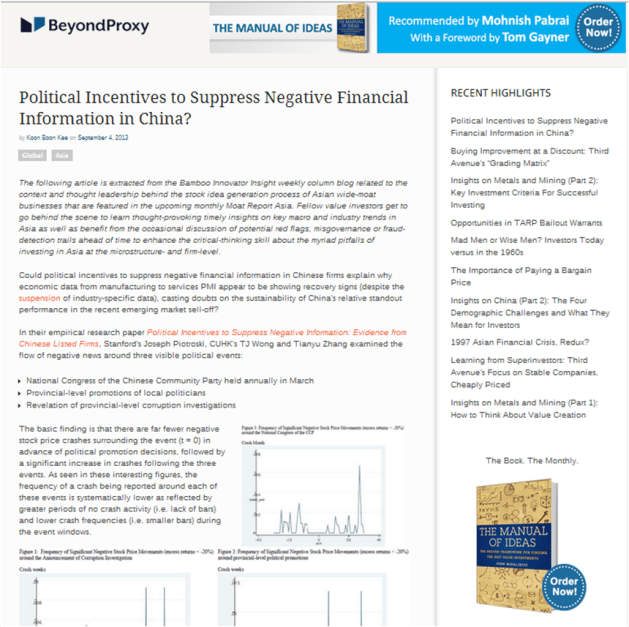
Political Incentives to Suppress Negative Financial Information in China? Moat Report Asia: Bamboo Innovator Insight

The following article is extracted from the Bamboo Innovator Insight weekly column blog related to the context and thought leadership behind the stock idea generation process of Asian wide-moat businesses that are featured in the upcoming monthly Moat Report Asia. Fellow value investors get to go behind the scene to learn thought-provoking timely insights on key macro and industry trends in Asia as well as benefit from the occasional discussion of potential red flags, misgovernance or fraud-detection trails ahead of time to enhance the critical-thinking skill about the myriad pitfalls of investing in Asia at the microstructure- and firm-level.

  • Political Incentives to Suppress Negative Financial Information in China? Sep 4, 2013 (BeyondProxy, Moat Report Asia)

Political Incentives to Suppress Negative Financial News

Rampant bridge lending posing threat to China’s financial market

Rampant bridge lending posing threat to China’s financial market

Staff Reporter

2013-09-05

The increasingly popular bridge lending business, which involves providing capital to individuals or companies in acute need of funds to repay bank loans, is posing a threat to China’s financial market, Shanghai’s First Financial Daily reports. The lending practice is typically used by private lenders, who mainly provide bridge loans, or short-term loans, to small and medium enterprises in urgent need of cash by charging them extremely high interest rates. Under the practice, borrowers usually repay their debt after securing new bank loans, the paper said. Read more of this post

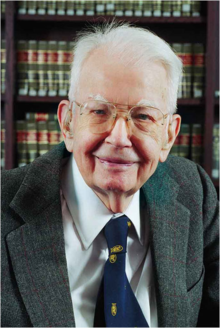
Ronald Coase, Nobel Winner Who Studied Corporations, Dies at 102

Ronald Coase, Nobel Winner Who Studied Corporations, Dies at 102

By Laurence Arnold September 02, 2013

220px-Coase

Ronald Coase, the British-born University of Chicago economist whose Nobel Prize-winning work on the role of corporations stemmed from visits in the early 1930s to American companies including Ford Motor Co. and Union Carbide, has died. He was 102. He died yesterday at St. Joseph Hospital in Chicago, according to a news release from the University of Chicago. No cause was given. The Royal Swedish Academy of Science awarded Coase the 1991 Nobel in economics “for his discovery and clarification of the significance of transaction costs and property rights for the institutional structure and functioning of the economy.” Read more of this post

From humble beginnings in a father’s living room, Ng Cheong Choon’s Rainbow Loom, a kit to make bracelets out of rubber bands, has skyrocketed in popularity; 600 retailers carry Rainbow Loom, and just over one million units have been sold at a retail price of $15-17

August 31, 2013

Rainbow Loom’s Success, From 2,000 Pounds of Rubber Bands

By CLAIRE MARTIN

01-PROTO-JP3-articleLarge

Cheong Choon Ng, above, designed Rainbow Loom, a suddenly popular crafts kit that turns rubber bands into bracelets. The key to selling the kits, it turned out, was educating buyers about how to use them.

LAST weekend in Fair Harbor, N.Y., on Fire Island, a few dozen children gathered on the boardwalk for the local tradition of selling lemonade, baked goods and painted seashells to passers-by at sunset. Among the children was Julia Colen, a 12-year-old vacationer from New Jersey, who in addition to hawking cupcakes and drinks was presiding over a stand overflowing with brightly colored bracelets. Julia and a friend had made the jewelry out of tiny rubber bands, using a crafts kit called Rainbow Loom. “We had a lot, at least 100,” Julia estimated of their inventory, which they priced at $1 to $2 apiece. Sales were impressive that night — “we made like $68,” she said. Read more of this post

Nike Patents Golf Shirt Design That Could Double as Coach; The clothing will have tighter material in areas key to a repetitive movement, like a golf swing. The snugger fit increases muscle stimulation, giving a better feel that will improve form, help a coach normally would provide by watching the golfer perform

Nike Patents Golf Shirt Design That Could Double as Coach

Nike Inc. (NKE) says it can make a golf shirt that could replicate what a coach does. The world’s largest maker of sporting goods obtained about a dozen patents on Aug. 27, including one invention with the potential to irk golf pros. “A coach or trainer can greatly improve an athlete’s form or body positioning, which can result in improved athletic performances,” Nike said in a patent filed with the U.S. Patent and Trademark Office. “For most people, however, a coach or trainer is not always available” and there isn’t an easy way to check positioning on your own, Nike said. Enter what the sponsor of Tiger Woods describes as “articles of apparel providing enhanced body position feedback.” The clothing will have tighter material in areas key to a repetitive movement, like a golf swing. The snugger fit increases muscle stimulation, giving a better feel that will improve form, help a coach normally would provide by watching the golfer perform, the document said. Nike has prospered even in hard times with a sustained focus on innovation, from air-pocket sneaker soles in the 1980s to last year’s Flyknit shoe, whose upper is woven like a sock. While these aren’t always the company’s best-sellers, they give its brand credibility — as does paying the world’s most famous athletes to wear them on television. Read more of this post

Innovation: Kite Mosquito Patch renders a person invisible to mosquitoes for up to 48 hours

Innovation: Kite Mosquito Patch

By Olga Kharif August 29, 2013

Innovators: Michelle Brown, Anandasankar Ray
Ages: 41, 39
Brown is chief scientist and Ray co-founder of Riverside (Calif.)-based Olfactor Laboratories.
Form and function: Kite Mosquito Patch, a nontoxic 1.5-inch-square sticker, renders a person invisible to mosquitoes for up to 48 hours.

tech_innovator36_970

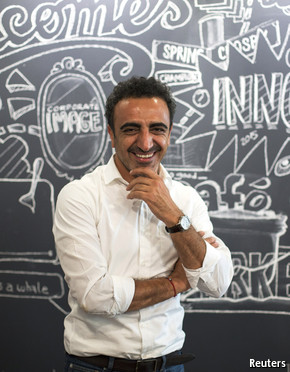
Food companies and innovation: The Greek-yogurt phenomenon in America left big food firms feeling sour. They are trying to get better at innovation

Food companies and innovation: The Greek-yogurt phenomenon in America left big food firms feeling sour. They are trying to get better at innovation

Aug 31st 2013 |From the print edition

A Kurd and his whey-free way to success

20130831_WBP002_0

FEW business careers have been as spectacular as Hamdi Ulukaya’s. He bought an 85-year-old yogurt factory in upstate New York in 2005 and sold his first pot of Chobani “Greek” yogurt 18 months later. This year he expects to sell more than $1 billion-worth of it. Greek-style yogurt’s share of America’s $6.1 billion market has risen from negligible when Chobani started to nearly half. “No category changed faster,” boasts Mr Ulukaya, the sole owner of the firm that makes Chobani. Read more of this post

China Minzhong Food has dismissed claims of fraud against it by a shortseller as a misunderstanding of its business and said that it would issue a response by the end of the week

PUBLISHED AUGUST 30, 2013

Now Minzhong says it was misunderstood

It dismisses fraud claims but will respond only later; analysts seek strong response

KENNETH LIM KENLIM@SPH.COM.SG

[SINGAPORE] China Minzhong Food Corp has dismissed claims of fraud against it by a shortseller as a misunderstanding of its business and said that it would issue a response by the end of the week. The company delayed reporting its full-year results from yesterday morning to yesterday evening to address some of the issues raised by shortseller Glaucus Research Group, but those numbers would mean little until Minzhong gives its response, observers said. Read more of this post

Unhappy ending for Indonesia growth story; Indonesia bows to investor pressure to raise rates

August 29, 2013 3:40 pm

Unhappy ending for Indonesia growth story

By Ben Bland in Jakarta

Indonesia’s decision to follow Brazil’s lead by raising interest rates at an extraordinary central bank meeting on Thursday temporarily took the sting out of the recent market slide, with the rupiah appreciating against the dollar and the stock market closing in the black. But the global emerging market turbulence, which has also hit Brazil, India, South Africa and Turkey, is unlikely to abate until the US Federal Reserve clarifies its plans to curb its quantitative easing programme. Read more of this post

Innovation isn’t an idea problem, but rather a biased recognition problem

Innovation Isn’t an Idea Problem

by David Burkus  |   8:00 AM July 23, 2013

When most organizations try to increase their innovation efforts, they always seem to start from the same assumption: “we need more ideas.” They’ll start talking about the need to “think outside the box” or “blue sky” thinking in order to find a few ideas that can turn into viable new products or systems. However, in most organizations, innovation isn’t hampered by a lack of ideas, but rather a lack of noticing the good ideas already there. It’s not an idea problem; it’s a recognition problem. Read more of this post

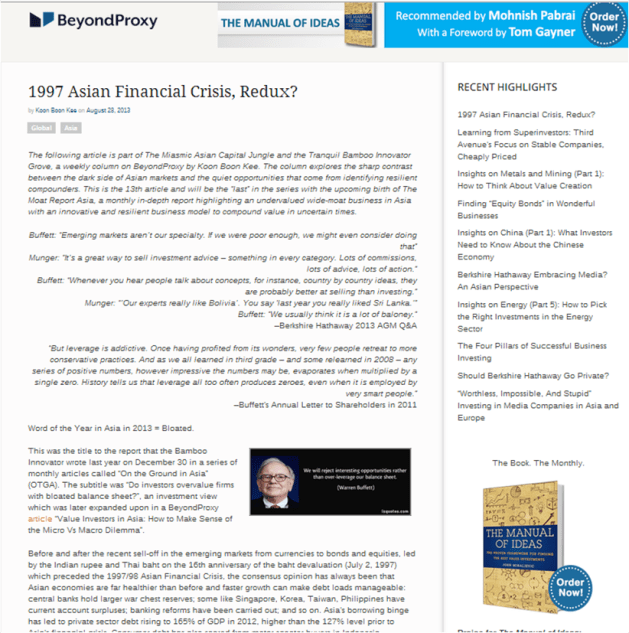
1997 Asian Financial Crisis, Redux? Bamboo Innovator is featured in BeyondProxy.com, where value investing lives

Bamboo Innovator is featured in BeyondProxy.com, where value investing lives:

  • 1997 Asian Financial Crisis, Redux? Aug 28, 2013 (BeyondProxy)

AFC

The New, Improved Keiretsu

The New, Improved Keiretsu

by Katsuki Aoki and Thomas Taro Lennerfors

Some of Japan’s most dominant companies owe their success not only to technology and process expertise but also to an often-overlooked factor: During the past decade, they’ve been quietly turning their supplier relationships into a tool for innovating faster while radically cutting costs. Welcome to the new keiretsu—a modern version of the country’s traditional supply system. During its heyday, in the 1980s, the traditional keiretsu system—an arrangement in which buyers formed close associations with suppliers—was the darling of business schools and the envy of manufacturers everywhere. Although there was some tentative movement in the West toward keiretsu-like supplier partnerships at the time, the rise of manufacturing in low-wage countries soon made cost the preeminent concern. Most Western companies today wouldn’t dream of investing in supplier relationships that would require significant care and feeding. Indeed, many people probably assume that keiretsu died when Japanese manufacturers initiated Western-style cost-cutting tactics.

Read more of this post

The Picasso Effect: What The Success of Cubism Teaches Us About Radical Innovation

The Picasso Effect: What The Success of Cubism Teaches Us About Radical Innovation

ian leslie, August 6, 2013

Paris, 1907. In a ramshackle studio in Montmartre, a twenty-six year-old Spanish artist presented the painting he had been working on day and night for the best part of a year to a small group of fellow artists, dealers and friends. They were visibly aghast. One considered the work “a veritable cataclysm”. Another concluded that its creator must be on the brink of suicide. None could foresee that it would one day be considered the most influential artwork of the twentieth century. The painting, then untitled, was later to become known as Les Demoiselles d’Avignon. It is credited as the first work of Cubism, and the catalyst for a revolution in Western art and culture. Read more of this post

MIT’s Innovators List

August 22, 2013, 3:45 PM

MIT’s Innovators List

By WSJ Staff

The MIT Technology Review, a Massachusetts-based technology publication has come out with its annual list of 35 innovators aged under 35. This year it features two men of south Asian origin. Balaji Srinivasan and Vijay Balasubramaniyan, both 33, made it to the coveted list, which celebrates young entrepreneurs and inventors, who have done exceptional work in the field of technology globally. People of south Asian origin and Indian-Americans have regularly featured on  MIT’s innovators list. This year, however their number has gone down. In 2012, five innovators on the list were of south Asian origin. The winners are selected by a panel of judges evaluate the candidates based on current trends in technology and the diversity of innovation. The list is divided into five sections: inventors, entrepreneurs, visionaries, humanitarians and pioneers. MIT selected Mr. Srinivasan as one of the top entrepreneurs. He is the founder of Counsyl Inc., a Silicon Valley startup that conducts low-cost, genetic tests on prospective parents that can identify if they are carrying genes capable of causing hereditary diseases in their children. Counsyl also won bronze in the The Wall Street Journal’s Innovation Awards in 2010. Mr. Srinivasan founded Counsyl in 2007 with his brother Ramji Srinivasan. Before that, he taught data mining, statistics, and computational biology in the department of statistics at Stanford University in California. The Srinivasan brothers’ father, however, didn’t want them to get into medicine and was keen for them to study computer science instead, notes the MIT Technology review. A Stanford alum, Mr. Srinivasan holds graduate, post-graduate and doctoral degrees in electrical engineering. He also holds a Master’s degree in chemical engineering from Stanford. The other south Asian on the list, Vijay Balasubramaniyan is the co-founder of Pindrop Security. an Atlanta based company that tracks fraudulent phone calls. The list recognizes him as one of the top inventors. Mr. Balasubramaniyan completed his undergraduate studies in engineering from R. V. College of Engineering in the southern Indian city of Bangalore and doctoral studies from Georgia Institute of Technology in the U.S. Prior to Pindrop, he worked at some of the top technology firms such as Google Inc.GOOG +0.45%, Intel Corp. and IBM Research. He is also a regular speaker at technology conferences on the subject of phone fraud. In the past the MIT list has included Google founders Sergey Brin and Larry Page,Mark Zuckerberg of Facebook Inc.FB -0.23%, Spotify’s founder Daniel Ek and AppleIncAAPL +0.26%’s Jonathan Ive. Read more of this post

“I doubt any great entrepreneur in history got up in the morning and said I think I’ve got a good plan on how to make money. I think Wilbur and Orville [Wright] wanted to fly, I think [Thomas] Edison wanted to make light without candles.”

August 21, 2013, 7:50 p.m. ET

Inventing With an Eye on the Future

Even with an exceptional idea, budding entrepreneurs can struggle to move past the brainstorming stages. They face challenges in execution like building a cohesive team, coming up with a business plan and even understanding how to present their product or service. This week mentors on “WSJ Startup of the Year,” a documentary on wsj.com, offered some words of inspiration for all entrepreneurs. Here’s what some science and technology innovators had to say. Edited excerpts:

Ray Kurzweil, director of engineering at Google Inc. GOOG +0.45% : “Ninety-five percent of the innovators I meet would actually do exactly what they say if given the resources, but most of those projects would fail because the timing is wrong. A lot of business and technology plans assume the world three or four years from now will be kind of like it is today, and that’s not the world you need to aim at. That’s going to be a completely different world. The world is completely changed in just a few years time, and it will change at an even faster pace in the future. So a key harbinger of success is to actually understand this exponential pace of change and make your project relevant for the future world and meet the train when you get there.”

Peter Diamandis, chairman and founder of XPRIZE Foundation: “What I’m interested in seeing is someone who’s passionate about what they’re doing; that they love it; that they’re excited about it. Because a business plan isn’t worth much of anything. What really is worth something is a set of entrepreneurs whose mission this is to make happen beyond anything. That at 3 o’clock in the morning when they hit another brick wall, they’re going to wake up and take a different direction. Ultimately a business plan is going to be out-of-date as soon as you begin writing it. And it is really that internal dimension of passion, of commitment that will carry through all the hurdles along the way.”

Bob Hariri, founder and CEO of Celgene Cellular Therapeutics: “It’s the mission and the man. You establish a clear mission, what you want to do and then you go and find really great people. You have to have the kind of outgoing, engaging personalities that let [you] pull the best and the brightest. You’ve got to be evangelical about your mission. And then when you get them to sign on and you can inject some of that passion in them, then you can build a remarkably successful business.”

Dean Kamen, Segway inventor and health-care innovator: “If you believe that what drives a person to be an entrepreneur is money or not wanting to risk money, I’d say that’s an early sign that this is not an entrepreneur. Every entrepreneur I’ve ever seen is driven by the passion to do something, believing that if it’s as good as they think it is, of course somebody will make money. And probably if they stay with it, they’ll make some of it, maybe most of it or maybe all of it. But I doubt any great entrepreneur in history got up in the morning and said I think I’ve got a good plan on how to make money. I think Wilbur and Orville [Wright] wanted to fly, I think [Thomas] Edison wanted to make light without candles.”

Sunset For Hong Kong Real Estate Run? Property prices in Hong Kong are now 40% higher than 1997 values – a time just before the devastating Asian Financial Tsunami hit the regional real estate market particularly hard

Sunset For Hong Kong Real Estate Run?

Written by Andrew Vanburen (China Correspondent)

Thursday, 22 August 2013 07:00

PROPERTY PRICES in Hong Kong are now 40% higher than 1997 values – a time just before the devastating Asian Financial Tsunami hit the regional real estate market particularly hard.

This is prompting market watchers to ask: Are prices sustainable?
Most of us can clearly remember the haunting images of half-finished luxury housing projects on pristineThai beaches and pitch darkoffice towers from Seoul to Hong Kong during the asset bubble burst that seemed to hit every Asian country but China a decade-and-a-half ago.
At the time, Hong Kong was awash with not only an overblown property market, but excitement mixed with a bit of nervousness as the Special Administrative Region reverted to Beijing rule in mid-1997. Read more of this post

Berkshire Hathaway Embracing Media? An Asian Perspective. Bamboo Innovator is featured in BeyondProxy.com, where value investing lives

Bamboo Innovator is featured in BeyondProxy.com, where value investing lives:

  • Berkshire Hathaway Embracing Media? An Asian Perspective, Aug 21, 2013 (BeyondProxy)

Berkshire Media


The Vulnerability of Asian Markets Then (1997) and Now (2013)

Aug 20, 2013

The Vulnerability of Asian Markets Then (1997) and Now (2013)

By Vincent Cignarella

It was a toxic combination that sparked the Asian financial crisis in 1997. The bad news is that same combination–of Federal Reserve monetary tightening and Japanese fiscal tightening–is looming once again. Rewind to March 1997. Then, the Fed’s communications policy bore little resemblance to the current era of transparency, so inevitably some investors were taken aback when the central bank raised the discount rate, the rate at which the Fed lends money to commercial banks, to 5.5% from 5.25% after two years of trimming rates. (Remember, this was before fed funds targeting was in vogue.) Read more of this post

In college, Meredith Perry wondered why wireless devices needed wires for recharging. That question has led to her work on a way to transmit electrical power via sound waves

August 17, 2013

An Inventor Wants One Less Wire to Worry About

By JACK HITT

18-IDEA2-popup

Meredith Perry with a covered prototype of uBeam’s wireless charger, which is under wraps until its release date

SOMETIMES, there is an actual eureka moment. For Meredith Perry, it was in late 2010, during her senior year studying astrobiology at the University of Pennsylvania. She was searching for an idea to enter into the college’s innovation competition. “It was my last year to do it,” she told me, “so I literally would just carry around a notebook and write down any annoyances, because that would be an opportunity to solve a problem and have an invention.” An admitted “professional Googler,” she’d been researching all day on her computer when she decided to pack it in for the night. “I was just standing in my room,” she said, “wrapping up my laptop charger and trying to fit it into my bag and suddenly it occurred to me: Wow, this is so archaic. Why are we using these 20-foot wires to plug in our quote-unquote wireless devices?” “See past old paradigms” is one of those cheesy riffs one might hear from an innovation expert working the business speakers’ circuit. Yet here it was, a question that inched just past what was simply accepted: Why, in a wireless age, do we still have electrical wires? Read more of this post

In All Flavors, Cigars Draw In Young Smokers

August 17, 2013

In All Flavors, Cigars Draw In Young Smokers

By SABRINA TAVERNISE

CIGARS-articleLarge

BALTIMORE — At Everest Greenish Grocery, a brightly lit store on a faded corner of this city, nothing is more popular than a chocolate-flavored little cigar. They are displayed just above the Hershey bars along with their colorful cigarillo cousins — white grape, strawberry, pineapple and Da Bomb Blueberry. And they were completely sold out by 9 one recent evening, snapped up by young people dropping by for a snack or stopping in during a night of bar hopping. Read more of this post

“Voice is going to places it hasn’t gone before, with people developing applications to post conversations to Facebook, or games that prove you are a good son because you call Mom every week”

AUGUST 17, 2013, 9:00 AM

What’s Lost When Everything Is Recorded

By QUENTIN HARDY

While we fret about losing privacy and other dangers of the digital revolution, one sad change is happening with little notice: Our technology is stealing the romance of old conversations, that quaint notion that some things are best forgotten.

Remember the get-to-know-me chat of a first date or that final (good or bad) conversation with someone you knew for years? Chances are, as time has passed, your memory of those moments has changed. Did you nervously twitch and inarticulately explain your love when you asked your spouse to marry you? Or, as you recall it, did you gracefully ask for her hand, as charming as Cary Grant? Read more of this post

Johnson Matthey has come far from its roots as a gold assayer in London’s Hatton Garden to become the world’s largest supplier of vehicle catalytic converters by volume

August 15, 2013 4:55 pm

Johnson Matthey looks to Brussels to drive up sales

By Mark Wembridge

Although devoid of links with famous historical figures that encourage such monuments in London, the British chemical engineering company believes that an event in 1974 at its plant is worthy of such note – it is the location where the world’s first catalytic converter was manufactured. Nearly four decades on, Johnson Matthey has grown to become the world’s largest supplier of vehicle catalytic converters by volume, with sales of devices that alter environmentally damaging car and truck emissions comprising more than half of the FTSE 100 company’s £2.7bn annual turnover. The group has come far from its roots as a gold assayer in London’s Hatton Garden, where it regularly burnt the floorboards and carpet in shops located in the London jewellery district to extract any leftover precious metals. Read more of this post

“Worthless, Impossible, And Stupid” Investing in Media Companies in Asia and Europe. Bamboo Innovator is featured in BeyondProxy.com, where value investing lives

Bamboo Innovator is featured in BeyondProxy.com, where value investing lives:

  • “Worthless, Impossible, And Stupid” Investing in Media Companies in Asia and Europe, Aug 14, 2013 (BeyondProxy)

Media

The Best Of Jeff Bezos’ Lessons In Innovation From His Amazon Shareholder Letters

The Best Of Jeff Bezos’ Lessons In Innovation From His Amazon Shareholder Letters

TIM KASTELLEINNOVATION FOR GROWTH AUG. 12, 2013, 6:53 AM 4,653 2

With Jeff Bezos in a news a fair bit right now, I thought it would a good time to look at some of the important innovation lessons that we can draw from his annual letters to Amazon shareholders.  It’s worthwhile to read them all, but here are some highlights:

 It’s All About the Long Term

The first letter is from 1997, and Bezos has included it as an appendix to every other annual letter that Amazon has sent out because it includes a summary of the firm’s long-run view. Here are a couple of the key parts of that:

We will continue to make investment decisions in light of long-term market leadership considerations rather than short-term profitability considerations or short-term Wall Street reactions.

We will continue to measure our programs and the effectiveness of our investments analytically, to jettison those that do not provide acceptable returns, and to step up our investment in those that work best. We will continue to learn from both our successes and our failures. Read more of this post