Orchid entrepreneur Koh Keng Hoe makes failure a blooming success, mastering the full cycle of orchid growing through trial and error.

He makes failure a blooming success

Sunday, Aug 11, 2013

Judith Tan, The New Paper

20130809_Kohkenghoe_tnp

SINGAPORE – Life had thrown Mr Koh Keng Hoe lemons and instead of wallowing, he grew orchids. He has gone from an unemployed man in his 20s with a bleak future to one of the top growers worldwide. The Kovan boy, whose nursery did not even have a proper road, is now living in a bungalow in Dunearn Road. But back in 1954, life was tough as he had just been sacked from his job in The Straits Times after taking part in a Singapore Printing Employees’ Union strike. “I only had that one skill, nothing else,” he said of his $160-a-month job as a linotype operator. So he sold his BSA motorcycle for $100 to buy a Vanda merrillii, a red jungle orchid with a distinctive scent, from a Simon Road grower. “I had no money. I had to ride a bicycle there,” he said. “I knew nothing (then) about growing orchids. I was told that they grow well on coconut husks. People throw out the husks, making that a zero investment for me,” he added. Mr Koh applied whatever little knowledge of vegetable farming he had and his plants blossomed. That was the start of his six-decade love affair with the flower. He even mastered the full cycle of orchid growing – from cultivation and pollination, to the preparation and perfecting of nurturing seedlings – through trial and error. Read more of this post

Michael Hayman, co-founder of StartUp Britain, draws inspiration from six innovators who show what entrepreneurs can achieve

Meet the innovators changing our world

Michael Hayman, co-founder of StartUp Britain, draws inspiration from six remarkable people who show what entrepreneurs can achieve .

By Michael Hayman

6:00AM BST 07 Aug 2013

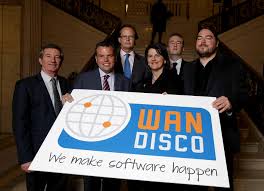
wandisco

“The people who are crazy enough to think they can change the world, are the ones who do.” That was the clarion call of the campaign that relaunched one of the 21st century’s best-loved brands: Think Different was the defining moment for Apple and Steve Jobs. It saved a corporation and, for me, captured the essence of the entrepreneur. It can be hard to define the attributes of an entrepreneur, but you certainly know when you’ve met one. They are an impatient tribe who constantly challenge the status quo – fuelled by a driving intensity to invent or invest, to build or conquer. To get the job done. If you work for an entrepreneur, you might very well see them in extremes, perhaps as a saviour, perhaps a sociopath, very possibly both. One thing is for sure: they are far from ordinary. Steve Jobs caught the swashbuckling characteristics of the breed perfectly when he said: “It’s better to be a pirate than join the navy.” And in these turbulent times, where technology and trade make for a combustible mix, those who have hoisted the Jolly Roger rather than opting for corporate conformity are winning the battle of ideas. You don’t have to look far to find the evidence that entrepreneurs are building the titans of tomorrow. It is estimated that two thirds of the companies that will make up the S&P 500 in 10 years’ time haven’t even been created yet. Or take the Fortune 500 – almost 87pc of the companies that made up the original list in 1955 no longer feature. The lifespan of a S&P 500 company has declined from 67 years in the 1920s to just 15 years today. And it is entrepreneurs who are filling the void. As Carl Schramm, former president and chief executive of the Kauffman Foundation points out, big business has not created one net job in the US during the past 40 years. Not one. For the last four years, I have enjoyed an unparalleled vantage point from which to observe the influence entrepreneurs have on our everyday lives. The firm I co-founded, Seven Hills, is one of the fastest growing in its sector; I helped to create StartUp Britain, the national campaign for early-stage businesses; and I’ve been behind two of the biggest festivals for entrepreneurs in the UK – MADE and Accelerate. My work gives me the chance to meet some of the most exciting and innovative founders in the world. Here are six of them who have most inspired me over the past year. One you will almost certainly have heard of, the rest quite possibly not. They do not cover every sector or innovation that is changing how people across the world live and work. But they each illustrate how entrepreneurship is making a difference, and why it matters. They are the “crazy ones” who change lives. Read more of this post

With wearable technology, a new measure of independence for people with disabilities

With wearable technology, a new measure of independence for people with disabilities

By Hayley Tsukayama, Published: August 6

It’s been 18 years since Tammie Lou Van Sant held a camera. But nearly two decades after a car accident left her paralyzed from the chest down, Van Sant is shooting again — thanks to a device that could be part of technology’s next big trend. Google’s Glass headset, which connects to users’ smartphones and displays information on a screen that hovers above one eye, is the first of what analysts say may be a new trend of wearable technology — headsets, watches, fitness trackers and other devices that are worn, rather than slipped into a pocket. Analysts say growing interest in wearable tech could translate into big money for technology firms, with projected sales of up to 9.6 million of such devices worldwide by the end of 2016. Read more of this post

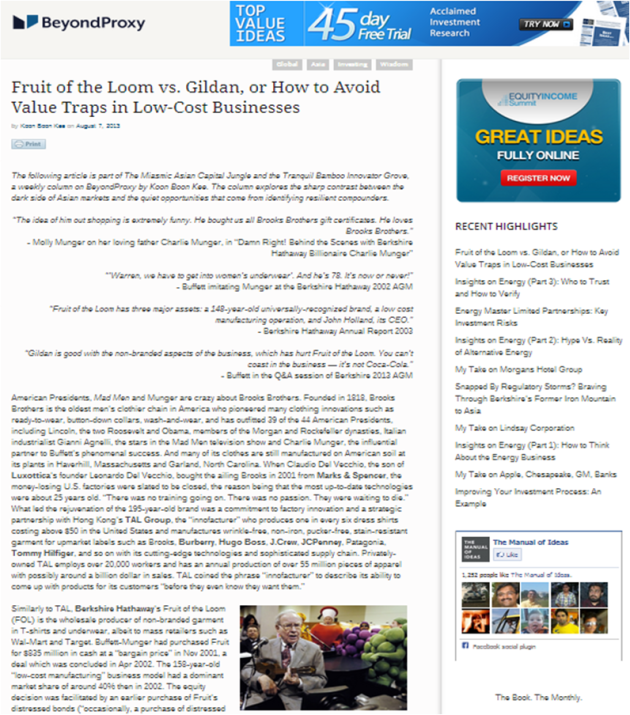
Berkshire’s Fruit of the Loom vs. Gildan, or How to Avoid Value Traps in Low-Cost Businesses; Bamboo Innovator is featured in BeyondProxy.com, where value investing lives

Bamboo Innovator is featured in BeyondProxy.com, where value investing lives:

  • Fruit of the Loom vs. Gildan, or How to Avoid Value Traps in Low-Cost Businesses, Aug 7, 2013 (BeyondProxy)

Fruit

What every company can learn from Lego; Lego has built an open community of robotics enthusiasts who have helped make the company’s products better

What every company can learn from Lego

August 6, 2013: 11:28 AM ET

Lego has built an open community of robotics enthusiasts who have helped make the company’s products better.

By John Hagel and John Seely Brown

FORTUNE — By now, many businesses are aware of the benefits of ecosystems — communities of suppliers, partners, vendors, and customers — and the idea that there’s value to connecting participants with each other. One fax machine alone, for example, has no value. Connect that fax machine to another, however, and suddenly the machine has value even though nothing about it has changed. The value grows with each additional machine connected. Now imagine that the fax machines can learn from each other, gaining additional capabilities and getting better at what they do with each interaction. The more fax machines connected, the greater potential for interactions and the greater the rate of learning. That is the fundamental power of a dynamic ecosystem: Participants interact with each other with the goal of learning faster, getting better, and increasing the capabilities of each participant and the value of the entire community. Read more of this post

The Innovation Mindset in Action: 3M Corporation

The Innovation Mindset in Action: 3M Corporation

by Vijay Govindarajan and Srikanth Srinivas  |  12:00 PM August 6, 2013

In three recent blog posts we looked at the innovation mindset in individuals, profiling game changersJerry Buss

Peter Jackson, and Shantha Ragunathan. These three innovators share common qualities, which we call the innovation mindset, a robust framework which can be applied at the micro (individual) as well as macro (organizational) levels: they see and act on opportunities, use“and” thinking to resolve tough dilemmas and break through compromises, and employ theirresourcefulness to power through obstacles. Innovators maintain a laser focus on outcomes, avoid getting caught in the activity trap, and proactively “expand the pie” to make an impact. Regardless of where they start, innovators and innovative companies persist till they successfully change the game. Read more of this post

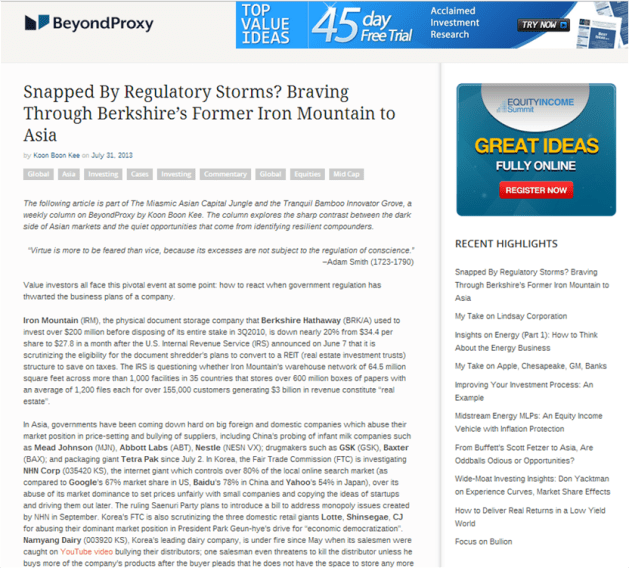
Snapped By Regulatory Storms? Braving Through Berkshire’s Former Iron Mountain to Asia. Bamboo Innovator is featured in BeyondProxy.com, where value investing lives

Bamboo Innovator is featured in BeyondProxy.com, where value investing lives:

  • Snapped By Regulatory Storms? Braving Through Berkshire’s Former Iron Mountain to Asia, July 31, 2013 (BeyondProxy)

RegulatoryStorm


James Dyson: Big invention does not happen overnight — or in 5 years

Big invention does not happen overnight — or in 5 years

BY JAMES DYSON

6 HOURS 20 MIN AGO

In 2010, Singapore committed S$16.1 billion to fund research, innovation and enterprise over five years. A smart move providing the foundation and fuel for Singapore’s long-term growth.

In 2010, Singapore committed S$16.1 billion to fund research, innovation and enterprise over five years. A smart move providing the foundation and fuel for Singapore’s long-term growth. But for research, is five years really long term? It took me five years and more than 5,000 prototypes to perfect my design for a bagless vacuum cleaner. It was a gamble; I flirted with bankruptcy on a number of occasions, had to re-mortgage my house and borrow hundreds of thousands of pounds. I (and thankfully, my wife too!) believed in my idea, but even once I had got it working, success did not happen overnight. And that was a vacuum cleaner — one single product. Big invention needs big — and long-term — investment. Read more of this post

Good Strategy, Bad Strategy by Richard Rumelt

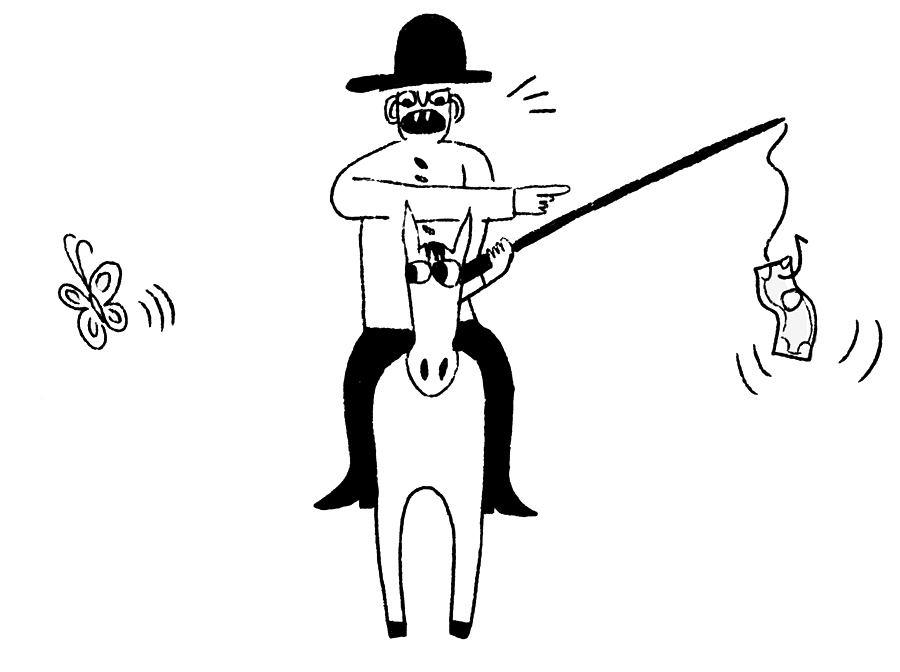
From Buffett’s Scott Fetzer to Asia, Are Oddballs Odious or Opportunities? Bamboo Innovator is featured in BeyondProxy.com, where value investing lives

Bamboo Innovator is featured in BeyondProxy.com, where value investing lives:

  • From Buffett’s Scott Fetzer to Asia, Are Oddballs Odious or Opportunities? July 24, 2013 (BeyondProxy)

Oddballs


Innovation Isn’t an Idea Problem

Innovation Isn’t an Idea Problem

by David Burkus  |   8:00 AM July 23, 2013

When most organizations try to increase their innovation efforts, they always seem to start from the same assumption: “we need more ideas.” They’ll start talking about the need to “think outside the box” or “blue sky” thinking in order to find a few ideas that can turn into viable new products or systems. However, in most organizations, innovation isn’t hampered by a lack of ideas, but rather a lack of noticing the good ideas already there.

It’s not an idea problem; it’s a recognition problem. Read more of this post

Zig Zag: The Surprising Path to Greater Creativity

The One Thing All Creative Geniuses Have In Common

ERIC BARKERBARKING UP THE WRONG TREE 38 MINUTES AGO 186

ZigZag

Keith Sawyer tells an interesting story about breakthrough ideas in his book, Zig Zag: The Surprising Path to Greater Creativity. Researcher Vera John-Steiner wanted to know What nourishes sustained productivity in the lives of creative individuals?“ She interviewed over 70 living creative geniuses and analyzed the notebooks of 50 dead ones (including Tolstoy, Einstein, etc.) to look at their work habits. She assumed this was going to end up as a review of Eureka! moments in the greatest creative minds. She even planned to title her book “The Leap” because it would be about those giant flashes of inspiration that led to breakthrough ideas. But she was completely wrong. Eureka! moments turned out to be a myth. There was no inspiration moment where a fully formed answer arrived. Strokes of genius happened over time. A great idea comes into the world by drips and drabs, false starts, and rough sketches.

Via Zig Zag: The Surprising Path to Greater Creativity:

Creativity started with the notebooks’ sketches and jottings, and only later resulted in a pure, powerful idea. The one characteristic that all of these creatives shared— whether they were painters, actors, or scientists— was how often they put their early thoughts and inklings out into the world, in sketches, dashed-off phrases and observations, bits of dialogue, and quick prototypes. Instead of arriving in one giant leap, great creations emerged by zigs and zags as their creators engaged over and over again with these externalized images. Read more of this post

The Innovation Mindset in Action: Sir Peter Jackson who has transformed much more than the movie industry in New Zealand—he has also transformed filmmaking globally.

The Innovation Mindset in Action: Sir Peter Jackson

by Vijay Govindarajan and Srikanth Srinivas  |   1:00 PM July 22, 2013

Pater Jackson

Peter Jackson is a game changer who transformed the practice of filmmaking. Like Jerry Buss, who revolutionized basketball, Jackson and other effective innovators share a common set of qualities that we call the innovation mindset: they see and act on opportunities, use “and” thinking andresourcefulness, focus on outcomes, and act to “expand the pie.” Regardless of where they start, innovators persist till they successfully change the game. As an only child, Jackson was often left to entertain himself. His parents bought him an 8-mm movie camera when he was 8 years old. At 16, he left school to work as a full time photo-engraver, saving as much money as he could for film equipment. He began making short films with his friends. These were amateurish horror movies, but they won awards and had a cult following. Read more of this post

How Criticism Creates Innovative Teams

How Criticism Creates Innovative Teams

by David Burkus  |   9:00 AM July 22, 2013

It’s tough to find examples of successfully challenging the boss, even tougher to find stories of leaders who specifically ask to be challenged. The most common is a tale of Alfred P. Sloan at General Motors. During a meeting in which GM’s top management team was considering a weighty decision, Sloan closed the meeting by asking.” “Gentlemen, I take it we are all in complete agreement on the decision here?” Sloan then waited as each member of the assembled committee nodded in agreement. Sloan continued, “Then, I propose we postpone further discussion of this matter until our next meeting to give ourselves time to develop disagreement and perhaps gain some understanding of what this decision is about.” Read more of this post

Profiting from adversity: Maria Xynias’s brilliant start-up idea Ladies Running Errands, the “extra helping hand for people who need an extra pair of hands”

Profiting from adversity: Maria Xynias’s brilliant start-up idea

PUBLISHED: 1 HOUR 9 MINUTES AGO | UPDATE: 1 HOUR 9 MINUTES AGO

009e01ac-ed19-11e2-8b13-fa19f3af555d_749190184--646x363

Entrepreneur Maria Xynias’s clients range from the elderly and people living alone to young parents: “I get a lot of baby-boomer clients who are working or time-poor and need someone to take their elderly parent to the doctor”.

ANNE FULWOOD

When Maria Xynias suffered a serious illness which left her unable to work for two years, she relied on her network of family for support, transport and sustenance. Time in convalescence gave her pause for thought: “I have a big Greek family network and lots of support but I wonder what happens to ­people who aren’t as lucky as me.” Therein lies the genesis of her start-up business, Ladies Running Errands , which is what Xynias calls the “extra helping hand for people who need an extra pair of hands”. – rather like a trusted family member without being a member of the family. She is one of the growing number of Australian women who take a break from long-term employment for a range of reasons, then work for themselves as sole traders. Xynias had worked her way up through store manager ranks at Target for 15 years, followed by a stint in a duty-free store at ­Sydney Airport. She launched Ladies Running Errands in January 2011. “It’s a very personal service and covers anything to make people’s daily lives easier. I take my responsibility very seriously.” Read more of this post

The biggest decision most of us leave to chance

The biggest decision most of us leave to chance

BY FRANCISCO DAO 
ON JULY 18, 2013
mponeydoney_bw1

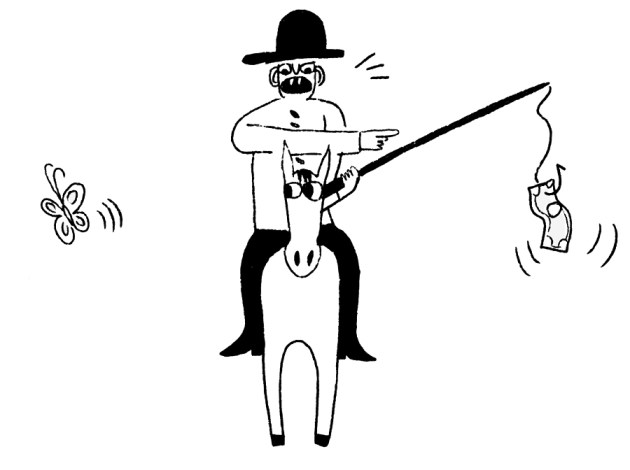
Recently, a friend of mine told me his goal was to make some “fuck you money.” This was a new development for him, as he had never before prioritized a big score. As we talked about his options, he described several promising opportunities that he decided not to pursue, because they weren’t interesting to him. Despite his proclamation that making money was his new priority, he couldn’t change the fact that he wasn’t strictly wired to be financially motivated. I’ve seen many people try to convince themselves that making money was their primary goal even when it wasn’t. I’ve been guilty of doing it myself. Truthfully, I think life would be much simpler if I were coin operated, but I’m not. And despite what others like my friend might claim, the vast majority of people aren’t either. Most people don’t realize it, but the pull of non-financial motivations creates one of the biggest decisions many of us face in life. Unless you’re one of the lucky ones whose interests are naturally lucrative, here is the choice you face. Do you do something you care about which might be more difficult, or even impossible, to make financially lucrative? Or do you set aside your personal motivations and pursue whatever provides the best opportunity for making the most money with the fewest obstacles? I’m sure you’ve thought about this question before, but you probably did so only as a philosophical exercise. Did you really think about it when you accepted your last job? For the entrepreneurs reading this, do you really love your startup? Or did a random opportunity present itself, and you just went along with it while you convinced yourself that mailing stuff in a box is your dream company?

The decision often seems one-sided because there’s no external measure of our internal motivations. Only you know how much they matter to you. In contrast, we’re bombarded with messages that correlate financial success with absolute success. We end up losing sight of the decision because one side of the equation is screaming at us with big houses, fancy cars, and the respect of our peers, while the other side offers nothing that the rest of the world can even measure. Considered this way, there hardly seems to be a decision at all. But just because one side speaks more quietly than the other doesn’t mean it carries any less weight. Despite the fact that this decision determines the course of our lives, very few of us really take it seriously. We hypocritically quote Confucius and tell people to, “Choose a job you love, and you will never have to work a day in your life,” while we spend our own days at jobs we honestly don’t care for that much. Somehow, when it came time to make this decision for ourselves, we probably didn’t really think about it. Most likely, we let circumstance or convenience make the choice for us and ended up with whatever was put in front of us instead of choosing our own path.

Unless my friend gets lucky with a really fast score, I don’t think he’ll be able to follow through on his goal of making, “fuck you money.” He just isn’t built that way and I don’t think he can force himself to pursue the cash if his heart isn’t in it. For me, it took a string of choices that left me wondering, “Why the hell am I doing this?” before I decided all of my work decisions would be guided solely by my personal interests and nothing more. It’s a decision that has made me happy, but without question I’ve left a lot of financial opportunities on the table. How about you? Have you made the choice for yourself? Or have you let the decision fall to chance?

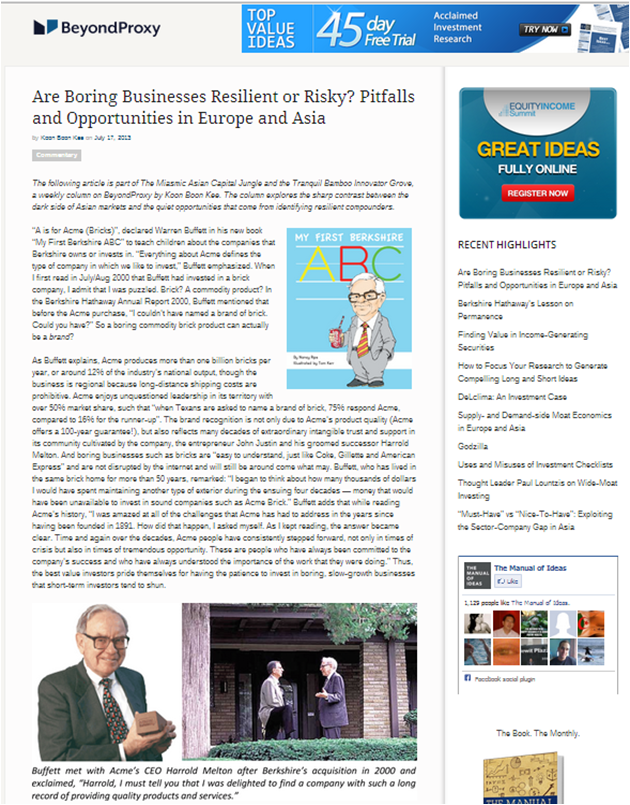
Are Boring Businesses Resilient or Risky? Pitfalls and Opportunities in Europe and Asia. Bamboo Innovator is featured in BeyondProxy.com, where value investing lives

Bamboo Innovator is featured in BeyondProxy.com, where value investing lives:

  • Are Boring Businesses Resilient or Risky? Pitfalls and Opportunities in Europe and Asia, July 17, 2013 (BeyondProxy)

BoringBusiness

NEC to exit smartphone business after failed deal with Lenovo: Nikkei

NEC to exit smartphone business after failed deal with Lenovo: Nikkei

2:28pm EDT

(Reuters) – Japan’s NEC Corp plans to exit its loss-making smartphone business after a deal with Chinese PC maker Lenovo Group Ltd failed to materialize, the Nikkei reported. The two companies have a partnership in the personal computers business and NEC was in talks with Lenovo for a deal for its smartphones operations since late 2012, the Japanese daily reported. The Japanese electronics company had offered Lenovo a majority stake in NEC Casio Mobile Communications Ltd, its subsidiary that makes smartphones. Casio Computer Co and Hitachi Ltd are among NEC Casio’s current investors. NEC, once a market leader in the smartphones business in Japan, currently has a market share of about 5 percent, the business daily said. The Japanese company will now focus on conventional handsets and plans to sell some of its mobile phone-related patents, according to the Nikkei. NEC will reassign majority of NEC Casio employees to other group firms, the paper said.


Amar G. Bose, the visionary acoustic engineer, inventor and billionaire entrepreneur, dies at 83; “I would have been fired a hundred times at a company run by M.B.A.’s. But I never went into business to make money. I went into business so that I could do interesting things that hadn’t been done before.”

July 12, 2013

Amar G. Bose, Acoustic Engineer and Inventor, Dies at 83

By GLENN RIFKIN

sub-Bose-obit-popup

Amar G. Bose, chairman of Bose, with a Wave radio in 1993.

Amar G. Bose, the visionary engineer, inventor and billionaire entrepreneur whose namesake company, the Bose Corporation, became synonymous with high-quality audio systems and speakers for home users, auditoriums and automobiles, died on Friday at his home in Wayland, Mass. He was 83. His death was confirmed by his son, Dr. Vanu G. Bose. As founder and chairman of the privately held company, Dr. Bose focused relentlessly on acoustic engineering innovation. His speakers, though expensive, earned a reputation for bringing concert-hall-quality audio into the home. And by refusing to offer stock to the public, Dr. Bose was able to pursue risky long-term research, such as noise-canceling headphones and an innovative suspension system for cars, without the pressures of quarterly earnings announcements. In a 2004 interview in Popular Science magazine, he said: “I would have been fired a hundred times at a company run by M.B.A.’s. But I never went into business to make money. I went into business so that I could do interesting things that hadn’t been done before.” Read more of this post

Abenomics Leaves Japan’s Hinterland Behind as Budget Cuts Bite

Abenomics Leaves Japan’s Hinterland Behind as Budget Cuts Bite

Japanese Prime Minister Shinzo Abe’s cuts to local-government subsidies are like trying to “wring water from an old rag that’s been squeezed dry,” says Kazuya Yoshida, a 27-year veteran of Shijonawate City’s municipal staff.

Abe pared payments to local authorities by 392 billion yen ($3.9 billion), or 2.3 percent, deepening decade-long cutbacks for city and prefectural budgets hurt by falling populations and dwindling revenues. While Abe has deployed fiscal stimulus at the national level to revive Japan’s economy, a drop in wages for provincial civil servants risks prolonging deflation. Read more of this post

Avoid the Deadly Temptations that Derail Innovators

Avoid the Deadly Temptations that Derail Innovators

by Rosabeth Moss Kanter  |   9:00 AM July 11, 2013

Any promising new initiative — a stand-alone business venture or an innovation in an established organization — hits roadblocks and unexpected obstacles. Recently I’ve advised entrepreneurs and innovators about a different, seemingly better, dilemma: pop-up opportunities that look like short cuts to success. Too often, these turn out to be deadly temptations.

Consider these cases (with names disguised to protect confidentiality):

Bill’s venture capital-backed business concept was to operate a new revenue-producing service for large U.S. professional organizations. In its first year, the venture landed two almost-committed pilot sites and a prospect pipeline for a multi-billion-dollar market. But almost at the same time, Bill was offered a lucrative deal to build a similar service for an English-speaking country outside the U.S. Feeling that the money was good and the chance to show credibility to U.S. customers even better, Bill took the deal, brushing aside numerous challenging differences and departures from his model. Then he was offered an even bigger international site in a developing country eager for American know-how, in partnership with a U.S. organization that could also be a customer. His financial backers urged him to take it — it would mean more revenue, fast. Suddenly Bill was in a different, less appealing business, jeopardizing building the U.S. business. Read more of this post

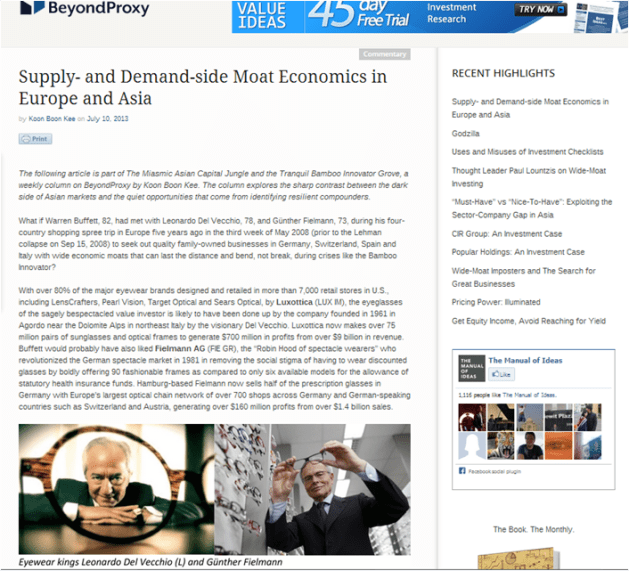
Supply- and Demand-side Moat Economics in Europe and Asia. Bamboo Innovator is featured in BeyondProxy.com, where value investing lives

Bamboo Innovator is featured in BeyondProxy.com, where value investing lives:

  • Supply- and Demand-side Moat Economics in Europe and Asia, July 10, 2013 (BeyondProxy)

Moat Economics

Wide Moat Investing Summit 2013 (July 9-10): Bamboo Innovator presents “Wouldn’t it be nice if we can invest BEFORE the economic moat is obvious?”

Shaping Innovation Processes Through Humor

Shaping Innovation Processes Through Humor

Marcel Bogers University of Southern Denmark

Trine Heinemann University of Helsinki

June 18, 2013
Proceedings of the Participatory Innovation Conference; June 18-20, 2013; Lahti, Finland; pp. 325-329

Abstract: 
In this paper we present a case study of how humor is employed at the micro-level of collaborative innovation processes. Based on data from workshops in which participants work together to construct new business models for a particular company, we employ the method of Conversation Analysis to find that humor (laughter) may be an important condition for the acceptance of proposals at the interactional micro-level of innovation processes. A particular finding is that company-internal representatives’ use of humor differs from company-external participants in terms of their orientation to having different rights and responsibilities in the innovation process.

Widespread delisting of Chinese companies has investors rethinking due diligence and looking harder for subtle clues that something is amiss

Due diligence in China: Art, science, and self-defense

Widespread delisting of Chinese companies has investors rethinking due diligence and looking harder for subtle clues that something is amiss.

July 2013 | byDavid Cogman

Image_Web_ChinaDiligence_ex

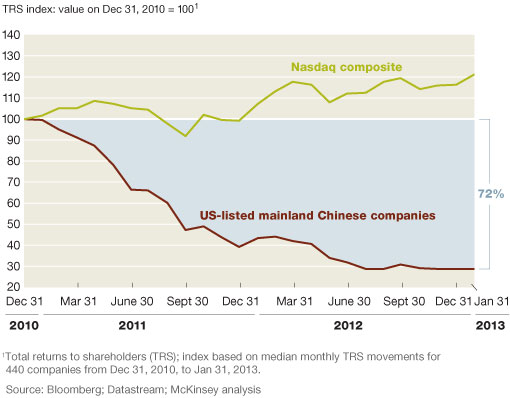
It’s not often that the credibility of an entire class of companies is called into question at once. The aggregate market capitalization of US-listed Chinese companies1 fell in 2011 and 2012 by 72 percent—and around one in five was delisted2 —even as the Nasdaq rose by 12 percent (exhibit). Nor is delisting of Chinese companies purely a US phenomenon: since 2008, around one in ten Chinese companies listed in Singapore has also been delisted or suspended. In recent years, the aggregate market capitalization of US-listed Chinese companies has fallen dramatically. Read more of this post

Douglas Engelbart, Computer Mouse Creator, Visionary, Dies at 88

July 3, 2013

Computer Visionary Who Invented the Mouse

By JOHN MARKOFF

engelbart-web-popup

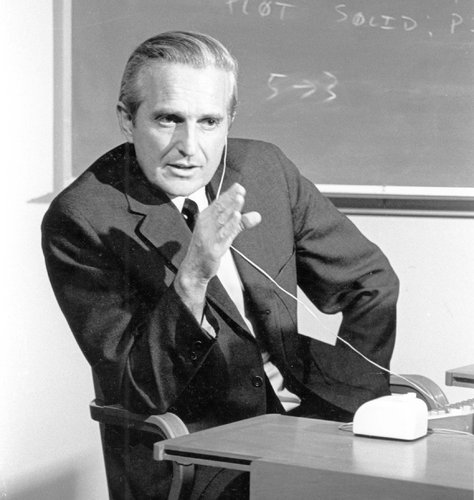
Douglas C. Engelbart with an early computer mouse in 1968, the year it was unveiled

Douglas C. Engelbart was 25, just engaged to be married and thinking about his future when he had an epiphany in 1950 that would change the world.

He had a good job working at a government aerospace laboratory in California, but he wanted to do something more with his life, something of value that might last, even outlive him. Then it came to him. In a single stroke he had what might be safely called a complete vision of the information age.

The epiphany spoke to him of technology’s potential to expand human intelligence, and from it he spun out a career that indeed had lasting impact. It led to a host of inventions that became the basis for the Internet and the modern personal computer. Read more of this post

“Must-Have” vs “Nice-To-Have”: Exploiting the Sector-Company Gap in Asia. Bamboo Innovator is featured in BeyondProxy.com, where value investing lives

Bamboo Innovator is featured in BeyondProxy.com, where value investing lives:

  • “Must-Have” vs “Nice-To-Have”: Exploiting the Sector-Company Gap in Asia, July 3, 2013 (BeyondProxy)

SectorCoGap

Your Brand Is the Exhaust Fume of the Engine of Your Life; The truth is this: The brand follows the work. In a world of “personal brand” and “leadership brand” and “personal reinvention” and so forth, we should not forget: the real signal is the work itself, and the social signaling is just its echo

Your Brand Is the Exhaust Fume of the Engine of Your Life

by Nilofer Merchant  |   8:00 AM July 1, 2013

“How do you manage your brand?” I get asked that question really often, especially at public-venue speaking events. Typically, I sigh. It is not that the question is silly, or the questioner shallow, but because this question itself represents so much of what is stopping all of us from doing work that matters.

We talk about “reinventing your brand” when in reality the goal is to reinvent what you work on. We talk about the “brand called you” when we talk about being able to do more of the work you love to do. We talk about ways to “deliver on the impact equation” without asking first, “what is it you want to impact?” We are told by marketing gurus that “everyone now owns a media company!” — as if somehow this is, itself, the goal — rather than a means to an end. Marketing has become the default language — the lingua franca of the day — that we use to describe work, and it is distorting how we evaluate what matters. Read more of this post

‘Innovation Prowess’: George S. Day on What Distinguishes Growth Leaders

‘Innovation Prowess’: George S. Day on What Distinguishes Growth Leaders

Published : July 01, 2013 in Knowledge@Wharton

How did IBM, General Electric and other companies become growth leaders? Why is it that some companies lag behind — and stay behind? Those are the questions that Wharton marketing professor George S. Day explores in his book, Innovation Prowess: A Leadership Strategy to Accelerate Growth. Recently, Day spoke with David Heckman, practice leader, senior management at the Wharton School’s Aresty Institute of Executive Education, about why innovation prowess is the key to growth leadership. An edited transcript of the conversation follows.

David Heckman: I’m here with professor George Day to interview him about his new book, Innovation Prowess. George, welcome to Knowledge@Wharton.

George S. Day: Thank you, Dave. I’m very excited about sharing my thinking on my new book,Innovation Prowess. I’ve been working for over 25 years to understand what distinguishes consistent growth leaders — that is, companies that grow organically with their own resources — from growth laggards. I’m looking at growth leaders like IBM, Samsung, LEGO and companies of that caliber to try to discern over many, many years, what sets them apart. The answer comes in two parts. Firstly, they have what I call growth-seeking discipline. This resonates with Peter Drucker’s notion that innovation is a skill, just like learning the piano, that you build when you practice and invest a lot of time. It’s a replicable and disciplined skill. Read more of this post

Brent-WTI Oil Spread Shrinks to $5 for First Time in 2 1/2 Years

Brent-WTI Oil Spread Shrinks to $5 for First Time in 2 1/2 Years

The difference between the world’s two most-traded crude oil grades shrank to less than $5 a barrel for the first time in about 2 1/2 years, underlining the easing of a supply bottleneck in the U.S.

North Sea Brent crude was $4.99 a barrel more than West Texas Intermediate today. It’s the first time the spread between the two grades has been at $5 or less since Jan. 18, 2011, on an intraday basis, according to data compiled by Bloomberg. WTI, the main U.S. crude grade, had been typically the more expensive grade until mid-2010. Read more of this post