Idea Entrepreneur: The New 21st Century Career

Idea Entrepreneur: The New 21st Century Career

by John Butman  |  10:00 AM May 27, 2013

There is a new player emerging on the cultural and business scene today: the idea entrepreneur. Perhaps you are one yourself — or would like to be. The idea entrepreneur is an individual, usually a content expert and often a maverick, whose main goal is to influence how other people think and behave in relation to their cherished topic. These people don’t seek power over others and they’re not motivated by the prospect of achieving great wealth. Their goal is to make a difference, to change the world in some way.

Idea entrepreneurs are popping up everywhere. They’re people like Sheryl Sandberg (Facebook COO and author of Lean In), who is advocating a big new idea from within an organization. And like Atul Gawande (the checklist doctor), who is working to transform a professional discipline. Or like Blake Mycoskie (founder of TOMS shoes), who has created an unconventional business model. In my research into this phenomenon (which forms the basis of my book, Breaking Out), I have been amazed at how many different kinds of people aspire to be idea entrepreneurs. I have met with, interviewed, emailed or tweeted with librarians, salespeople, educators, thirteen-year-old kids, marketers, technologists, consultants, business leaders, social entrepreneurs — from countries all over the world — who have an idea, want to go public with it, and, in some cases, build a sustainable enterprise around it.

Read more of this post

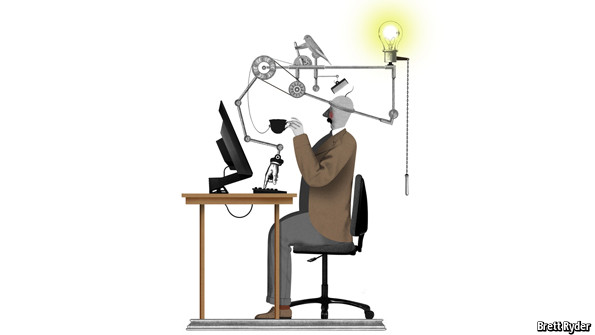
The age of smart machines: Brain work may be going the way of manual work

The age of smart machines: Brain work may be going the way of manual work

May 25th 2013 |From the print edition

20130525_WBD000_0

IN HIS first novel, “Player Piano” (1952), Kurt Vonnegut foresaw that industry might one day resemble a “stupendous Rube Goldberg machine” (or as Brits would say, a Heath Robinson contraption). His story describes a dystopia in which machines have taken over brain work as well as manual work, and a giant computer, EPICAC XIV, makes all the decisions. A few managers and engineers are still employed to tend their new masters. But most people live in homesteads where they spend their time doing make-work jobs, watching television and “breeding like rabbits”.

It is impossible to read “Player Piano” today without wondering whether Vonnegut’s stupendous machine is being assembled before our eyes. Google has designed self-driving cars. America’s military-security complex has pioneered self-flying killing machines. Educational entrepreneurs are putting enlightenment online. Are we increasingly living in Vonnegut’s dystopia? Or are the techno-enthusiasts right to argue that life is about to get a lot better? Read more of this post

Keeping the Faith: The Mathematician Who Could Be a Movie Star; Yitang Zhang, a onetime accountant and part-time lecturer at the University of New Hampshire who used to make sandwiches in a Subway shop, solves one of the great math puzzles

The Mathematician Who Could Be a Movie Star

In the distraction of the scandal-fever swirling through Washington and the news media, you might have missed the announcement the other day that one of the great puzzles of number theory had been solved.

What makes the news most fascinating is that the solver isn’t on the faculty of a top university and wasn’t known until this month to others who work in the field. He is a Chinese immigrant in his 50s named Yitang Zhang, a onetime accountant and part-time lecturer at the University of New Hampshire who used to make sandwiches in a Subway shop. Said one leading number theorist: “Basically, no one knows him.”

Cue the agents and film producers.

Because the story gets better. Zhang’s accomplishment tracks our romantic vision of the dedicated genius working alone in his garage. The truth is even more unlikely.

Zhang hit upon the crucial idea not in his garage but at a friend’s house in Colorado, where he had gone to clear his head. He was sitting in the backyard, waiting to leave for a concert. (Imagine it cinematically: Zhang skips the concert, ignoring the entreaties of his skeptical hosts, and refuses to budge from the yard, where he sits all through the frigid Rocky Mountain night, feverishly scratching equations into tree bark.) Read more of this post

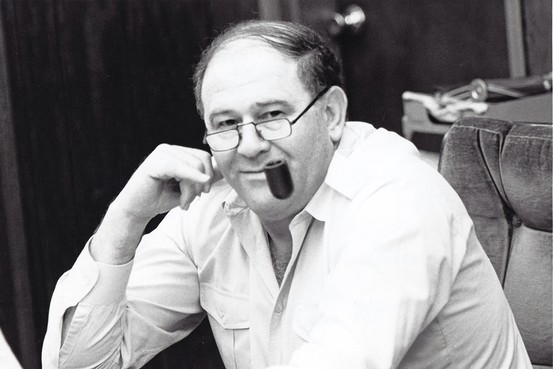
Snapple Guy’s Overnight Success Took Decades; Leonard Marsh transformed a tiny fruit-juice supplier into Snapple, a national brand of fruit-flavored beverages and iced tea powered by quirky marketing and bold flavors

May 22, 2013, 7:41 p.m. ET

Snapple Guy’s Overnight Success Took Decades

By STEPHEN MILLER

MK-CD460_REM_MA_G_20130522182400

Leonard Marsh transformed a tiny fruit-juice supplier into Snapple, a national brand of fruit-flavored beverages and iced tea powered by quirky marketing and bold flavors.

Leonard Marsh launched Snapple with two friends in the early 1970s. So successful was the brand that Snapple inspired dozens of imitators and prompted major soft-drink companies to introduce their own fruit and tea beverages to compete. Mr. Marsh, who died Tuesday at age 80, launched Snapple in New York with two friends in the early 1970s to supply natural fruit juices to health-food stores. After introducing lemonade and fruit-flavored ice tea in distinctive wide-mouth bottles, the company went public in a much-ballyhooed initial public offering in 1992. Snapple became a “New Age” beverage, touted by the company as “Made from the best stuff on earth.” Read more of this post

How Email App Mailbox Turned A Desperate Situation Into An ~$100 Million Exit 37 Days After It Launched

How Email App Mailbox Turned A Desperate Situation Into An ~$100 Million Exit 37 Days After It Launched

Alyson Shontell | May 22, 2013, 5:09 PM | 2,593 | 1

8551241646_ec6ceb9795_b

Gentry Underwood, co-founder of Mailbox

In January, an email organization app called Mailbox launched, and it promised to help users reach inbox zero. Thirty-seven days later, cloud storage company Dropbox acquired it for a reported $100 million. We sat down with the app’s founder, Gentry Underwood, who told us how he was able to flip the app so quickly and what it is like working for $4 billion Silicon Valley company, Dropbox. To summarize:

Underwood isn’t sure if his app is actually worth $100 million. He also wouldn’t confirm if that was the actual sale price.

Underwood says the quick sale was the result of Underwood’s team being able to determine product-market fit.

Mailbox went viral before the app even launched. Here’s how he drummed up attention for it: Read more of this post

Forget to Take Medicine? An IDEO concept for a medicine bottle that would show spots like a rotting banana when past expiration date.

May 20, 2013, 8:07 p.m. ET

Forget to Take Medicine? These Pills Will Tell Your Doctor

Startups Devise Ways to Help Patients Stick to Their Pill-Taking Schedule

By TIMOTHY HAY

MK-CD365_PILL_S_DV_20130520183345MK-CD389_PILLS__G_20130520182723

AdhereTech pill bottle. It glows blue during the optimal dosage time and it flashes red when the dosage is missed. An IDEO concept for a medicine bottle that would show spots like a rotting banana when past expiration date.

Startups are coming up with new technologies, such as “digital pills,” aimed at getting people to take medicine only as directed. Timothy Hay joins The News Hub. Photo: AdhereTech. Startup companies are coming up with new technologies aimed at getting people to take medicine only as directed. Taking medication haphazardly—skipping doses, lapsing between refills or taking pills beyond their expiration date—has been linked to health complications and hundreds of millions of wasted dollars for insurers and hospitals. “After six months’ time, only half of people taking prescription medicines are taking them as directed,” said Troyen Brennan, chief medical officer of drug retailer CVS Caremark Corp.CVS -0.77% Health insurers and pharmacy-benefits managers like CVS have long relied on robo-calls, mailers and face-to-face meetings with pharmacists to keep patients on their dosing schedule. Now they are evaluating a range of more cost-effective technologies, from pills and bottles with digital sensors, to data analytics software and social games that offer patients rewards. Read more of this post

Why Low-Risk Innovation Is Costly

Why Low-Risk Innovation Is Costly

Companies are finding it hard to churn out “the next big thing”. Instead of the disruptive products, services and business models of yesteryears, innovations coming to market today are typically line extensions.

An Accenture survey of more than 500 executives has found that while one in five (18 percent) respondents rate innovation as their top strategic priority and two-thirds depend strongly on innovation for their long-term strategy success, and more than half feel they have a sluggish innovation process. Companies are seeking to innovate but are increasingly less satisfied with the results. The respondents also have an answer to why this is happening. They are aware that a cautious approach and reduced investment by companies to generate renovation or, at best, incremental innovation is a potentially perilous strategy. By putting formal systems in place to manage innovation, companies can protect themselves from such risks. Enterprises able to successfully innovate at a breakthrough level are far more likely to dominate and prosper in the new markets they create. They can also position themselves to master change.

Last updated: May 17, 2013 10:26 pm

Companies see innovation without results

By Paul Taylor

The vast bulk of corporate innovation initiatives are failing to deliver the results that senior executives expected. Despite increased investment in innovation, only 18 per cent of executives believe their company’s innovation efforts deliver a competitive advantage, according to a survey conducted by Accenture and published this week. Read more of this post

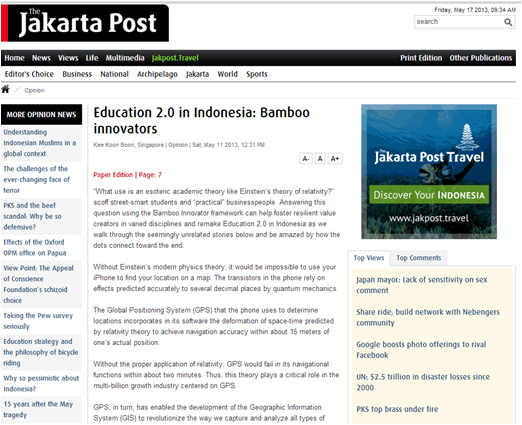
Education 2.0 In Indonesia: Inspiring Bamboo Innovators (Jakarta Post)

Dear Friends and All,

“What use is an esoteric academic theory like Einstein’s theory of relativity?” Answering this question with the Bamboo Innovator framework can surprisingly lead to the uncovering of resilient compounders: the Indonesian-listed bread company Indosari, the largest mass-market producer of bread in Indonesia under the “Sari Roti” brand, and Mexican-listed Grupo Bimbo, the largest bread manufacturer in the world. Interestingly, Indosari’s market value of US$750 million (now over US$900 million) is almost 20-times smaller as compared to Mexico’s Grupo Bimbo’s US$15 billion, even though both Indonesia and Mexico have gross domestic product (GDP) of US$1 trillion. What is so unique about the business models at Indosari and Grupo Bimbo? Why are they Bamboo Innovators? I like to share the article that was published in Jakarta Post, the oldest and largest-circulated English newspaper (one of the few dailies who survived the 1997/98 Asian Financial Crisis): “Education 2.0 in Indonesia: Inspiring Bamboo Innovators”.

Education 2.0 In Indonesia: Inspiring Bamboo Innovators, May 11, 2013 (Weblink: Jakarta Post)

Jakarta Post_Bamboo Innovators

Below is the unedited version:

Education 2.0 in Indonesia: Inspiring Bamboo Innovators

April 2013

“What use is an esoteric academic theory like Einstein’s Theory of Relativity?” scoffed the “street-smart” students and “practical” businesspeople. Answering this question using the Bamboo Innovator framework can help foster resilient value creators in varied disciplines and remake Education 2.0 in Indonesia as we walk through the seemingly unrelated stories below and be amazed by how the dots connect towards the end.

Without Einstein’s modern physics theory, it would be impossible to use your iPhone to find your location on a map. The transistors in the phone rely on effects predicted accurately to several decimal places by quantum mechanics. The Global Positioning Satellites (GPS) that the phone uses to locate us incorporate in their software the deformation of space-time predicted by relativity theory to achieve navigation accuracy within about 15 meters of our actual position. Without the proper application of relativity, GPS would fail in its navigational functions within about 2 minutes. Thus, this theory plays a critical role in the multi-billion growth industry centered around the GPS.

GPS, in turn, has enabled the development of the GIS (Geographic Information System) to revolutionize the way we capture and analyze all types of geographical data for multiple applications from urban planning, disaster response, epidemic planning, mining and oil exploration to location-based services. ESRI is the GIS software pioneer, founded by Jack Dangermond in 1969. ESRI has an installed base of more than one million users in more than 350,000 organizations with over a billion in annual revenue achieved by 3,000 employees. ESRI grew by focusing on its users and employees, eschewing incentives such as sales commissions. “People want to do the right thing; they want to be purposeful in their life,” Jack said. “Throwing financial thresholds and goals — my experience in running at least my kind of organization is that it robs people of the culture of doing great things.”

ESRI, in turn, is linked to Singapore entrepreneur Wong Fong Fui who runs the conglomerate Boustead, which has exclusive country license to ESRI GIS software in South East Asia and Australia. Mr Wong is known as a turnaround specialist, having helped the loss-making unfocused QAF with a market cap of $15 million then in 1988 to build the Gardenia bakery brand in Singapore into a $500 million food business when it was sold, and now Boustead, which he bought for $14 million in 1996 and has a current market value of $580 million.

Interestingly, this $500 million market value has been exceeded by Wendy Yap who helped focus her family business Nippon Indosari to become a Gardenia 2.0 and the largest mass-market producer of bread in Indonesia under the “Sari Roti” brand with a market value of $750 million. Around the same time FF Wong got into Boustead, Wendy started Indosari in 1995 with her father Piet Yap, one of the Salim Group executive who co-founded Bogasari Flour Mills. The typical businessman might shrug and point out that for Indosari to be bigger than Gardenia is an obvious observation, since Indonesia is a far larger market than Singapore. However, many companies and MNC giants such as SaraLee had tried to expand in Indonesia earlier but all retreated with heavy losses. So why was Wendy Yap able to scale up while others with abundant tangible resources failed?

Indosari has adopted an open innovation business model in collaborating with Japan’s Shikishima Baking who helped Indosari in its technological processes in introducing Japanese-style soft breads that won over the Indonesian palate. Importantly, Indosari has built trust with retailers and customers to overcome the logistics nightmare that doomed its better-capitalized rivals through its strong distribution network for its highly-perishable products of more than 2 million pieces of bread daily, resulting in a dominant 90% market share. It sells its products through modern distribution channels and an innovative system of around 3,000 mobile tricycle carts to penetrate over 17,000 small traditional shops in the rural parts of Indonesia.

Yet, Indosari’s market value at $750 million pales in comparison to Mexico’s Grupo Bimbo’s $15 billion even though both Indonesia and Mexico have a GDP of $1 trillion. Bimbo is also the world’s largest bread manufacturing with over $13 billion in sales. So why is this “small white teddy bear”, Bimbo’s corporate image, which “began with great limitations” in 1945 from Mexico, a country where half the population lived below the poverty line, able to become the largest in the world and compound 24-fold in market value since 1994?

Given that over 80% of bread is sold in mom-and-pop stores in Mexico scattered miles from one another over poor roads, cultivating trust and support amongst its community of customers, suppliers and employees is critical to overcome the geographical limitations in scaling up. Small store owners tend to ask for credit which was provided informally by Bimbo. Its partnership with community bank FinComún leveraged upon the bank’s pioneering expertise in providing micro-loans to extend credit yet reduce bad debt and improve working capital position to free up more cash to carry out expansion. In a country known for the exploitation of workers, Bimbo has built an unusually people-oriented culture with its well-known policy of avoiding layoffs even in times of crisis and sponsoring its employees’ education which helped foster loyalty and committment. As a result, Bimbo was able to resist the 1991 threat from the arrival on the Mexican market of giant PepsiCo. While Bimbo innovated in integrating production-delivery-finance, none of it would amount to much if Bimbo had not offered the country affordable, edible aspiration, spreading this dream to nearly every remote corner of Mexico.

There is a common thread running through these stories: the resilient Bamboo Innovator. The vitality of the bamboo revolves around its empty hollow center in the same way as the “emptiness” of the Bamboo Innovator with its “indestructible intangibles” that derive its strength from “know-how” and “trust and support in the community”. The “emptiness” is why bamboo bend but not break in the wildest storms that snapped the mighty resisting oak tree. The intangible know-how in relativity theory has led to the multi-billion GPS industry which enabled the development of the GIS pioneered by Jack Dangermond’s ESRI whose leadership nurtured a culture of empowerment and innovations. FF Wong is attracted by this intangible know-how of ESRI, having built the “intangible” Gardenia brand. At the same time when FF Wong is building Boustead, Wendy Yap has scaled up a bigger, more focused Gardenia 2.0 at Indosari by cultivating trust and support in the company’s community of customers, suppliers, partners and employees, in the same way this “emptiness” worked wonders at Grupo Bimbo.

In the landscape of Education 2.0 in Indonesia, students can search for facts on Google, but Google and Facebook cannot tell them how to connect the dots in alignment with their talent and personality to pursue what they can excel in. With the Bamboo Innovator in their hearts, they will experience the uncanny: the raw sensual data reaching their eyes before and after are the same, but with this pertinent framework of meaning, the chaotic features and anomalies in the marketplace are visible. Instead of producing “grades”, “checklist-based holistic CV” and “high graduation salary”, the education system inspires students to be the Jack Dangermond inventor, the FF Wong and Wendy Yap entrepreneur, the quantum mechanics engineer and physics expert, the geography-based business and trade specialist, the teacher and the value investor, and so on. Their fate all intertwined as Bamboo Innovators to forge their own larger-than-self path to create value for Indonesia and the world.

The Buffett Formula — How To Get Smarter

The Buffett Formula — How To Get Smarter

by SHANE PARRISH on MAY 15, 2013

“The best thing a human being can do is to help another human being know more.” — Charlie Munger

“Go to bed smarter than when you woke up.” — Charlie Munger

Most people go though life not really getting any smarter. Why? They simply won’t do the work required. It’s easy to come home, sit on the couch, watch TV and zone out until bed time rolls around. But that’s not really going to help you get smarter. Sure you can go into the office the next day and discuss the details of last night’s episode of Mad Men or Game of Thrones. Sure you know what happened on Survivor. But that’s not knowledge accumulation, it’s a mind-numbing sedative. You can acquire knowledge if you want it. In fact there is a simple formula, which if followed is almost certain to make you smarter over time. Simple but not easy. It involves a lot of hard work. We’ll call it the Buffett formula, named after Warren Buffett and his longtime business partner at Berkshire Hathaway, Charlie Munger. These two are an extraordinary combination of minds. They are also learning machines. Read more of this post

Why companies need inventors, not just their ideas

Why companies need inventors, not just their ideas

By Peter Gwynne May 13, 2013

Peter Gwynne is a former science editor of Newsweek and a freelance writer who covers science, technology and business.

According to an early and frequently quoted aerodynamic model, bumblebees cannot possibly fly. Of course, any entomologist or gardener knows that the fuzzy insects make it into the air with great success; the model simply had it wrong.

As with bees, so it is with business. Researchers have long held the conceit that innovative entrepreneurship is impossible. “They assert that ‘entrepreneurs can’t do anything new in the economy,’” says Daniel Spulber, a professor of management and strategy at the Kellogg School.

This is because established firms have several advantages when it comes to taking inventions to the market. “They have all kinds of assets that are complementary to innovation,” Spulber says, including established corporate structures, marketing channels, an existing customer base, and access to capital. To go it alone, on the other hand, the inventor must undertake the cumbersome effort of setting up a new firm and dealing with the uncertainty that any new invention faces in the market. Even Joseph Schumpeter, perhaps the greatest advocate of entrepreneurs, suggested in his classic book Capitalism, Socialism, and Democracy that only large companies have the resources and market power necessary for innovation. Read more of this post

What Is Organizational Culture? And Why Should We Care?

What Is Organizational Culture? And Why Should We Care?

by Michael Watkins  |   2:00 PM May 15, 2013

If you want to provoke a vigorous debate, start a conversation on organizational culture. While there is universal agreement that (1) it exists, and (2) that it plays a crucial role in shaping behavior in organizations, there is little consensus on what organizational culture actually is, never mind how it influences behavior and whether it is something leaders can change.

This is a problem, because without a reasonable definition (or definitions) of culture, we cannot hope to understand its connections to other key elements of the organization, such as structure and incentive systems. Nor can we develop good approaches to analyzing, preserving and transforming cultures. If we can define what organizational culture is, it gives us a handle on how to diagnose problems and even to design and develop better cultures.

Beginning May 1, 2013, I facilitated a discussion around this question on LinkedIn. The more than 300 responses included rich and varied perspectives and opinions on organizational culture, its meaning and importance. I include several distinctive views below, illustrated by direct quotes from the LinkedIn discussion thread — and then I offer my own synthesis of these views. (There often were multiple postings with similar themes, so these are simply early selections; unfortunately it was not possible to acknowledge everyone who made helpful contributions.) Read more of this post

Don’t Let Predictability Become the Enemy of Innovation

Don’t Let Predictability Become the Enemy of Innovation

by Michael Schrage  |   1:00 PM May 15, 2013

Unhappily shocked by Sputnik’s unexpected 1957 success, President Eisenhower quickly pushed the Pentagon to establish the Defense Advanced Research Projects Agency (DARPA). Its ostensible mission: “to prevent technological surprise to the U.S. military, and to create surprises of its own.”

Anticipating and enabling “technological surprise” has become even more challenging, DARPA director Arati Prabhakar recently told an MIT audience, because more people in more places have more access to more technology that ever before. Surprises can come from anywhere. In an era of greater global trade, knowledge transfer and transparency, Prabhakar unsurprisingly reports DARPA’s core value proposition demands disproportionately greater imagination and ingenuity. Predictability breeds complacency. Predictability is DARPA’s cultural, technical and organizational enemy. Read more of this post

U.S. 2 Percenters Trade Down With Post-Recession Angst

U.S. 2 Percenters Trade Down With Post-Recession Angst

Jennifer Prentice, a medical-equipment saleswoman in Minneapolis, once had no qualms about dropping $600 or more for Gucci purses. Now she spends $300 for Coach Inc. (COH) bags and is filling in her Burberry wardrobe with pieces from J. Crew.

“The things we went through over the last couple of years definitely have an impact on what I am doing,” Prentice, 45, said in an interview. “I tend to be less frivolous now.”

While good times keep rolling for the super-wealthy, many Americans at the bottom end of the privileged group with incomes of $250,000 or more are thinking twice. These “two-percenters,” unnerved by the most recent recession, are trading down to less-expensive offerings from Coach Inc. and Ralph Lauren Corp. (RL) rather than pricier goods from Prada SpA (1913) and Giorgio Armani SpA. Even with the stock and real estate markets rebounding, they’re not draining their wealth again, and the shift may prove challenging for the highest-priced brands that can no longer lean on credit card-fueled aspirational customers.

“The rich have lost their exuberance,” said Pam Danziger, president of Unity Marketing, a luxury research firm. “They do not feel as wealthy. They increasingly feel that their wealth is threatened, real or not.”

An increasing share of America’s “ultra-affluent” consumers view themselves as middle-class and are spending like “Henrys,” which stands for High Earner Not Rich Yet, Danziger said. People in the latter category earn $100,000 to $249,999 a year, putting them in the top 20 percent by income, Danziger said. Read more of this post

5 Habits Of The Most Creative People

5 HABITS OF THE MOST CREATIVE PEOPLE

HOW DO THE MOST CREATIVE PEOPLE WORK? BRYAN CRANSTON, KENDRICK LAMAR, MAX LEVCHIN, AND OTHER CREATIVELY SUPERCHARGED FOLKS SHARE THEIR METHODS.

BY: DRAKE BAER

What do a startup king, a social network innovator, a hip hop prince, perhaps the best actor on television, and two absolutely hilarious dudes have in common? They’re all among the Most Creative People–and we can learn quite a bit from the way they work.

Max Levchin: Always be asking questions

We talked to PayPal founder Max Levchin about how he keeps snagging startup ideas. Turns out it’s a lot about controlling chaos in ways we’ve discussed about why ideas come at random and why you need to document everything.

Levchin’s method is like this: He talks to tons of random creative people, asks them questions about their craft, takes extensive notes of their quandaries, and then compiles–and reviews–all of his research. What comes out of it? Companies–like his new mobile payment solution Affirm–and loads of paper. Dude has a crate of 200 legal pads sitting in his garage.

Kirthiga Reddy: Go flat

The director of online operations for Facebook India, Kirthiga Reddy has helped growthe social network’s user base from 8 to 71 million users over two years. What did it? A little California import: the flat culture of Silicon Valley, so different than the hierarchical norm in India.

“You’re not here to do just what you’re told,” she says. “You’re here to see gaps and to act upon them.” Read more of this post

Designing the Corporate Center: How to Turn Strategy into Structure

Designing the Corporate Center: How to Turn Strategy into Structure

by Fabrice Roghé, Ulrich Pidun, Sebastian Stange, and Matthias Krühler

MAY 13, 2013

DesigningCorporateCenter_Ex1_lg_tcm80-134014DesigningCorporateCenter_Ex2_lg_tcm80-134017DesigningCorporateCenter_Ex3_lg_tcm80-134020

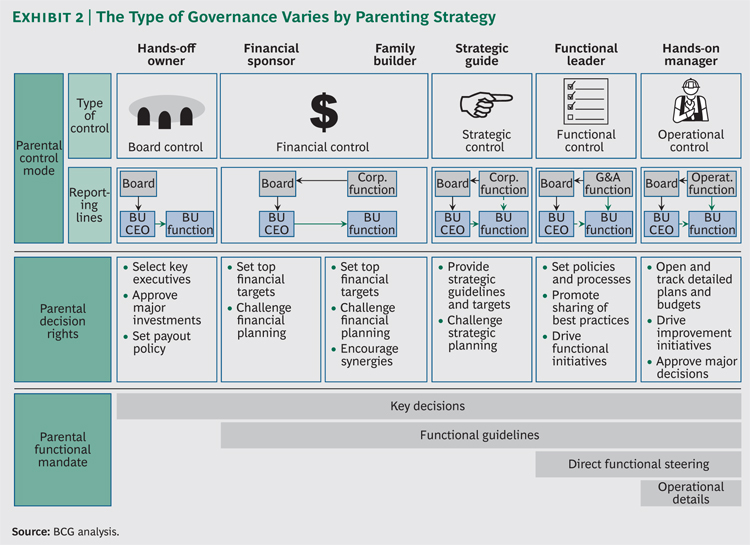
If there is one overriding imperative for CEOs, it is to add value to the portfolio of businesses so that the whole is worth more than the sum of its parts. Such value creation requires steering by the corporate center—whether across businesses, across regions, or across functions. But whatever form that steering takes, the corporate center must not only choose its optimal parenting strategy but also design an organization that translates that strategy’s value-creation logic into practice. Many CEOs, however, struggle to translate strategic logic into action, and as a result, many corporate centers still fall short of their full value-creation potential. The pressure to improve the center’s value creation is unrelenting and comes from all quarters. The capital market demands constant value creation and is quick to penalize corporate shares—and CEOs—if they fail to deliver. Analysts and shareholders pay close attention to valuation discounts. They are also quick to sound the alarm when overhead cost controls appear to be weakening. They compare the corporation against competitors that demonstrate excellence and ask why the corporation can’t keep up. Just as intense are the internal demands for constant value creation. Boards look for quick results from mergers and acquisitions (M&A) and press for corporate strategies that add value to the combined enterprise. Business units complain that the center insists that they engage in activities that impose costs and operating constraints without seeming to provide offsetting benefits. In the worst cases, these conflicts can paralyze the whole organization. In their own ways, the markets, boards, and business units are all asking the same urgent question: What is the corporate parent doing to add value to the business units? It is no longer sufficient to assemble a corporate portfolio of good businesses. Corporate stakeholders have shifted their focus from the specific competitive advantages of individual units—such as market share, technology, or brands—to the competitive advantage at the corporate level; that is, to the parenting advantage. Effective parenting strategies add value in many different ways. Some promote excellence in key business functions through clear guidelines; some share competencies among business units. Others improve decision quality, attract game-changing talent, or build a high-performance culture in each unit. Read more of this post

Creators are so caught up in the pursuit of their work mission that they sacrificed all, especially the possibility of a rounded personal existence

How to be a Creator

by Eric Barker

1) Be curious and driven

For his book Creativity, noted professor Mihaly Csikszentmihalyi did interviews with 91 groundbreaking individuals across a number of disciplines, including 14 Nobel Prize winners. In 50 Psychology Classics Tom Butler-Bowdon summed up many of Csikszentmihalyi’s findings including this one: Successful creative people tend to have two things in abundance, curiosity and drive. They are absolutely fascinated by their subject, and while others may be more brilliant, their sheer desire for accomplishment is the decisive factor.

2) It’s not about formal education. It’s about hours at your craft.

Do you need a sky-high IQ? Do great geniuses all have PhD’s? Nope. Most had about a college-dropout level of education.

Via Talent Is Overrated: What Really Separates World-Class Performers from Everybody Else:

Dean Keith Simonton, a professor at the University of California at Davis, conducted a large-scale study of more than three hundred creative high achievers born between 1450 and 1850—Leonardo da Vinci, Galileo, Beethoven, Rembrandt, for example. He determined the amount of formal education each had received and measured each one’s level of eminence by the spaces devoted to them in an array of reference works. He found that the relation between education and eminence, when plotted on a graph, looked like an inverted U: The most eminent creators were those who had received a moderate amount of education, equal to about the middle of college. Less education than that—or more—corresponded to reduced eminence for creativity.

But they all work their ass off in their field of expertise. That’s how to be a genius. Those interested in the 10,000 hour theory of deliberate practice won’t be surprised. As detailed in Daily Rituals: How Artists Work, the vast majority of them are workaholics.

Via Daily Rituals: How Artists Work

“Sooner or later,” Pritchett writes, “the great men turn out to be all alike. They never stop working. They never lose a minute. It is very depressing.”

In fact, you really can’t work too much.

Via Talent Is Overrated: What Really Separates World-Class Performers from Everybody Else:

If we’re looking for evidence that too much knowledge of the domain or familiarity with its problems might be a hindrance in creative achievement, we have not found it in the research. Instead, all evidence seems to point in the opposite direction. The most eminent creators are consistently those who have immersed themselves utterly in their chosen field, have devoted their lives to it, amassed tremendous knowledge of it, and continually pushed themselves to the front of it.

3) Test Your Ideas

Howard Gardner studied geniuses like Picasso, Freud and Stravinsky and found a similar pattern of analyzing, testing and feedback used by all of them:

Via Creating Minds: An Anatomy of Creativity Seen Through the Lives of Freud, Einstein, Picasso, Stravinsky, Eliot, Graham, and Ghandi:

Creative individuals spend a considerable amount of time reflecting on what they are trying to accomplish, whether or not they are achieving success (and, if not, what they might do differently).

Does testing sound like something scientific and uncreative? Wrong. The more creative an artist is the more likely they are to use this method:

Via Little Bets: How Breakthrough Ideas Emerge from Small Discoveries

In a study of thirty-five artists, Getzels and Csikszentmihalyi found that the most creative in their sample were more open to experimentation and to reformulating their ideas for projects than their less creative counterparts.

4) You Must Sacrifice

10,000 hours is a hell of a lot of hours. It means many other things (some important) will need to be ignored. In fact, geniuses are notably less likely to be popular in high school. Why? The deliberate practice that will one day make them famous alienates them from their peers in adolesence.

Via Quiet: The Power of Introverts in a World That Can’t Stop Talking:

…the single-minded focus on what would turn out to be a lifelong passion, is typical for highly creative people. According to the psychologist Mihaly Csikszentmihalyi, who between 1990 and 1995 studied the lives of ninety-one exceptionally creative people in the arts, sciences, business, and government, many of his subjects were on the social margins during adolescence, partly because “intense curiosity or focused interest seems odd to their peers.” Teens who are too gregarious to spend time alone often fail to cultivate their talents “because practicing music or studying math requires a solitude they dread.”

At the extremes, the amount of practice and devotion required can pass into the realm of the pathological. If hours alone determine genius then it is inevitable that reaching the greatest heights will require, quite literally, obsession.

Via Creating Minds: An Anatomy of Creativity Seen Through the Lives of Freud, Einstein, Picasso, Stravinsky, Eliot, Graham, and Ghandi:

My study reveals that, in one way or another, each of the creators became embedded in some kind of a bargain, deal, or Faustian arrangement, executed as a means of ensuring the preservation of his or her unusual gifts. In general, the creators were so caught up in the pursuit of their work mission that they sacrificed all, especially the possibility of a rounded personal existence. The nature of this arrangement differs: In some cases (Freud, Eliot, Gandhi), it involves the decision to undertake an ascetic existence; in some cases, it involves a self-imposed isolation from other individuals (Einstein, Graham); in Picasso’s case, as a consequence of a bargain that was rejected, it involves an outrageous exploitation of other individuals; and in the case of Stravinsky, it involves a constant combative relationship with others, even at the cost of fairness. What pervades these unusual arrangements is the conviction that unless this bargain has been compulsively adhered to, the talent may be compromised or even irretrievably lost. And, indeed, at times when the bargain is relaxed, there may well be negative consequences for the individual’s creative output.

5) Work because of passion, not money

Passion produces better art than desire for financial gain — and that leads to more success in the long run.

Via Dan Pink’s Drive: The Surprising Truth About What Motivates Us:

“Those artists who pursued their painting and sculpture more for the pleasure of the activity itself than for extrinsic rewards have produced art that has been socially recognized as superior,” the study said. “It is those who are least motivated to pursue extrinsic rewards who eventually receive them.”
Fed Maps Exit From Stimulus

Updated May 10, 2013, 7:19 p.m. ET

Fed Maps Exit From Stimulus

Timing of Wind-Down Is Uncertain, but Focus Is on Managing Unpredictable Market Expectations

By JON HILSENRATH

P1-BL500_FED_on_G_20130510184805

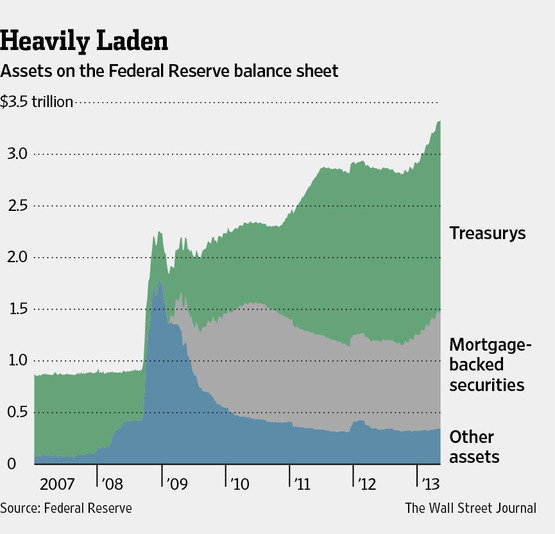
Federal Reserve officials have mapped out a strategy for winding down an unprecedented $85 billion-a-month bond-buying program meant to spur the economy—an effort to preserve flexibility and manage highly unpredictable market expectations. Officials say they plan to reduce the amount of bonds they buy in careful and potentially halting steps, varying their purchases as their confidence about the job market and inflation evolves. The timing on when to start is still being debated. The Fed’s strategy for how and when to wind down the program is of intense interest in financial markets. While the strategy being debated leaves the Fed plenty of flexibility, it might not be the clear and steady path markets expect based on past experience. Officials are focusing on clarifying the strategy so markets don’t overreact about their next moves. For example, officials want to avoid creating expectations that their retreat will be a steady, uniform process like their approach from 2003 to 2006, when they raised short-term interest rates in a series of quarter-percentage-point increments over 17 straight policy meetings. Read more of this post

A Brief History of LinkedIn

A Brief History of LinkedIn
by  on May 05, 2013

From a handful of guys in a living room to 225 million members around the world. Join us for a look back at where we’ve been over the last decade. Thanks to our amazing members for being a part of our journey.

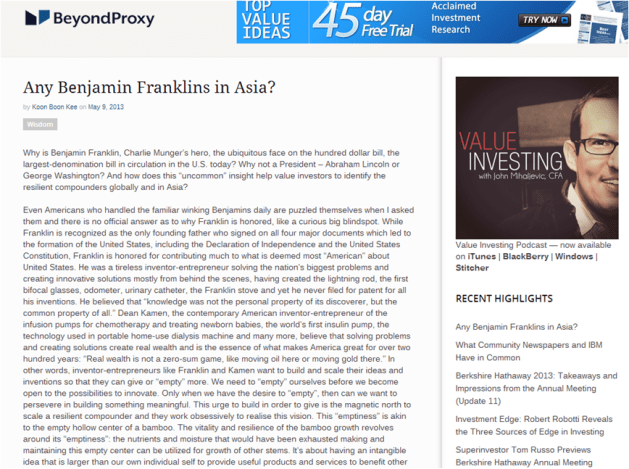
Any Benjamin Franklins in Asia? Bamboo Innovator is featured in BeyondProxy.com, where value investing lives

Bamboo Innovator is featured in BeyondProxy.com, where value investing lives:

Any Benjamin Franklins in Asia? May 9, 2013 (Weblink: BeyondProxy.com)

BenFranklinAsia

Berkshire Hathaway 2013: Takeaways from the Annual Meeting using the Bamboo Innovator mental model (Go to BeyondProxy.com, where value investing lives)

Bamboo Innovator is featured in BeyondProxy.com, where value investing lives:

Berkshire Hathaway 2013: Takeaways and Impressions from the Annual Meeting, May 7, 2013 (Weblink: BeyondProxy.com) – Scroll down till the end of the article.

Berkshire_Bamboo

Steve Case: When Attackers Become Defenders, Innovation Is Lost

May 4, 2013

When Attackers Become Defenders, Innovation Is Lost

By ADAM BRYANT

This interview with Steve Case, chief executive of Revolution, an investment firm, was conducted and condensed by Adam Bryant. Mr. Case was also a founder of America Online.

Q. What were some early leadership lessons for you?

A. The earliest ones probably related to just understanding that everybody is wired a little bit differently. Just because you think a certain way or are inclined to react a certain way doesn’t mean everybody thinks and reacts the same way. I think people just naturally presume that they look at a problem in a certain way and frame the issue in a certain way and that everybody else would look at it the same way.

I learned in my 20s that there are a lot of different ways to look at things, a lot of different filters that people put on, partly based on how they analyze the circumstance but also based on their own history and perspectives and biases and instincts and so forth. You have to be open-minded about that and listen to what’s being said — but also to what’s not said sometimes. Those discussions can lead you to different places. Read more of this post

Van Gogh: “Today again from seven o’clock in the morning till six in the evening I worked without stirring except to take some food a step or two away”

What does nearly every genius have in common when it comes to work habits?

by eric barker

A very interesting new book, Daily Rituals: How Artists Work, examines the work habits of over 150 of the greatest writers, artists and scientists. What does nearly every genius have in common? Those interested in the 10,000 hour theory of deliberate practice won’t be surprised — the vast majority of them were complete and unapologetic workaholics.

Via Daily Rituals: How Artists Work:

William Faulkner:

During his most fertile years, from the late 1920s through the early ’40s, Faulkner worked at an astonishing pace, often completing three thousand words a day and occasionally twice that amount. (He once wrote to his mother that he had managed ten thousand words in one day, working between 10: 00 A.M. and midnight— a personal record.) “I write when the spirit moves me,” Faulkner said, “and the spirit moves me every day.”

Maya Angelou:

Sometimes the intensity of the work brings on strange physical reactions— her back goes out, her knees swell, and her eyelids once swelled completely shut. Still, she enjoys pushing herself to the limits of her ability. “I have always got to be the best,” she has said. “I’m absolutely compulsive, I admit it. I don’t see that’s a negative.”

H.L. Mencken:

His compulsiveness meant that he was astonishingly productive throughout his life— and yet, at age sixty-four, he could nevertheless write, “Looking back over a life of hard work  …   my only regret is that I didn’t work even harder.”

Musician Glenn Gould:

From the time he retired from public performances in 1961, when he was thirty-one years old, Gould devoted himself completely to his work, spending the vast majority of his time thinking about music at home or recording music in the studio. He had no hobbies and only a few close friends and collaborators, with whom he communicated mostly by telephone. “I don’t think that my life style is like most other people’s and I’m rather glad for that,” Gould told an interviewer in 1980. “[ T] he two things, life style and work, have become one. Now if that’s eccentricity, then I’m eccentric.”

Alexander Graham Bell:

As a young man, Bell tended to work around the clock, allowing himself only three or four hours of sleep a night… When in the throes of a new idea, he pleaded with his wife to let him be free of family obligations; sometimes, in these states, he would work for up to twenty-two hours straight without sleep.

Van Gogh:

“Today again from seven o’clock in the morning till six in the evening I worked without stirring except to take some food a step or two away,” van Gogh wrote in an 1888 letter to his brother, Theo, adding, “I have no thought of fatigue, I shall do another picture this very night, and I shall bring it off.”

Artist Chuck Close:

“Inspiration is for amateurs,” Close says. “The rest of us just show up and get to work.” Read more of this post

Regulators Focus on ‘Nontraded’ REITs

May 3, 2013, 6:03 p.m. ET

Regulators Focus on ‘Nontraded’ REITs

By CAITLIN NISH

Wall Street’s leading self-regulator has been watching how brokerages market “nontraded” real-estate investment trusts to customers, and it doesn’t like what it sees.

Brokers too often offer misleading information about the potential benefits and incomplete explanations of the risks of nontraded REITs, the Financial Industry Regulatory Authority said in guidance it issued to firms Thursday. Sales materials often stress the income the investments generate in distributions but can fail to make sufficiently clear that these may actually tap the investor’s principal, the regulator said.

“The notice provides clear standards that can be applied consistently by firms,” said Thomas A. Pappas, Finra’s vice president for advertising regulation, in an email. When firms follow the guidance, “investors will have a better understanding of the products and their features.”

REITs give investors an equity interest in a pool of assets such as land, shopping centers or hotels, or in mortgages secured by real estate. REITs don’t pay income taxes if they distribute at least 90% of their earnings to investors, and they often attract investors seeking higher payouts than other investments offer. Read more of this post

Chobani CEO: Our Success Has Nothing To Do With Yogurt; the company’s now infamous Greek yogurt is netting more than $1 billion in annual sales — and it only went to market five years ago.

Chobani CEO: Our Success Has Nothing To Do With Yogurt

Megan Durisin | May 3, 2013, 11:19 AM | 2,559 | 3

Chobani Yogurt has been one of the most explosive food start-ups to ever hit the market.

The company’s now infamous Greek yogurt is netting more than $1 billion in annual sales — and it only went to market five years ago.

But Chobani’s CEO and founder, Hamdi Ulukaya said the company’s instant success wasn’t all about the product.

“Chobani is not a yogurt story,” he said. “It’s a manufacturing story.”

Ulukaya gave a presentation earlier this week to a packed audience at New York University‘s Stern School of Business, sponsored by the Berkley Center for Entrepreneurship & Innovation. In it, he outlined the story of the company’s rapid growth.

Ulukaya scraped together funding to buy an old yogurt plant in upstate New York in 2005, with help from a Small Business Administration Loan. He didn’t have any concrete plans, and the place wasn’t in good shape — with water dripping from the ceiling and paint peeling for the walls. But when he got the idea to start making Greek yogurt in the U.S., the company fixed the factory up and ran with it, and Ulukaya said he practially lived in the plant for five years to get Chobani off the ground.

“I knew that something could be done with yogurt because growing up in Turkey, we knew what to expect from yogurt,” he said at NYU.

Chobani was an instant success when it hit shelves in 2007, with orders consistently increasing. Ulukaya soon had big yogurt companies, like Dannon, knocking at his door, asking him to sell. He also could have turned to private equity companies for funding. Those strategies are typically the most appealing to food start-ups, Ulukaya said, because if they don’t, the larger companies imitate it and use their large manufacturing bases to get it to the masses.

But he decided not to sell, and that’s when Chobani’s focus turned to expansion — and fast.

“No start-up has done it any other way, so I wanted to do it in another way,” Ulukaya said. “I bet on these guys being lazy, that they’re not going to wake up that fast, and I said, ‘I’m going to be fast.'”

And fast it was. Ulukaya didn’t outsource anything — keeping control of the yogurt from its production in the factories to the time it hit shelves. The company built a big warehouse across the street from the plant in two months, and soon after built another huge plant in Idaho, which went up in just a year.

He also bet on the product being successful and priced it based on what it would cost in the future if sales increased, instead of factoring in the high input costs that the company had to face at the onset. (The yogurt goes for about $1 per cup.)

“This was not going to be about selling,” Ulukaya said. “This was going to be about making.”

The strategy worked. The company now produces 2.2 million cases of yogurt a week, Ulukaya said, and has passed $1 billion in sales. When they started, Greek yogurt made up 0.2% of the yogurt market in the U.S. Now it makes up 50%, and Chobani has at least half of that market share, he said.

It’s been a huge shock to the yogurt sector, which had been dominated by two or three big companies for decades prior and mostly pumped out products that were high in sugar, coloring and preservatives, Ulukaya said. And the majority of the money to fund Chobani’s new plants, employees and warehouses was internally generated.

Ulukaya also prides the company’s success on its small-town roots and dedicated employees, who he said didn’t have a holiday off for the first five years.

“Never has a food aisle been challenged like this and changed so quickly by a startup ever,” Chobani said. “Some say we’re the fastest growing startup ever, including technology.”

Marc Andreessen and Peter Thiel debate whether we’re still innovating

Andreessen and Thiel debate whether we’re still innovating

BY SARAH LACY 
ON MAY 2, 2013

Marc Andreessen and Peter Thiel will pretty much debate anyone, anytime, anywhere about most anything. They’re both frighteningly good at it. It’s not fun to be on the other side of the barrage of obscure facts and rhetorical tricks both can easily employ.

So, The Milken Institute decided to sick them on one another. At an event earlier this week, the two debated whether innovation has stalled, with Thiel taking the pro and Andreessen taking the con position.

This issue is obviously a major one for the startup world, and one we’ve debated quite a bit as well. I’m typically more aligned with Andreessen’s view of the world. Yes, we could be doing more. But let’s not underestimate the impact of things like Twitter and smartphones on the world. As Andreessen says in this video, “The whole basis of civilization is communication.” It’s the catalyst for multi-cultural understanding and, ultimately, innovation itself. Massive advances in globally available free communication aren’t exactly trivial. Read more of this post

The Generosity Strategies that Help Companies Grow

The Generosity Strategies that Help Companies Grow

by Eddie Yoon  |   2:00 PM May 2, 2013

Netflix reported another great quarter last month, with big subscriber and stock growth. It’s hard to believe it was just two years ago that the company and its CEO were widely ridiculed — and even subject to a Saturday Night Live parody.

Certainly much credit is due to adding new tricks to its tool kit by creating new content like House of Cards, a programming success that’s highlighted how it is using its analytic power to find news ways to satisfy customers.

I’ve written three HBR posts on Netflix since its difficult 2011. All were bullish on its future. I had many left-brain reasons why to be bullish — the quantified upside of digital streaming, its leadership, distribution and analytics advantages, etc. But I think there was emotional ‘data’ that I’ve acquired as a 10 year subscriber that stitches all the rational reasons together and amplifies them.

Put simply, Netflix is a generous company. And generosity can be a highly effective growth strategy. Read more of this post

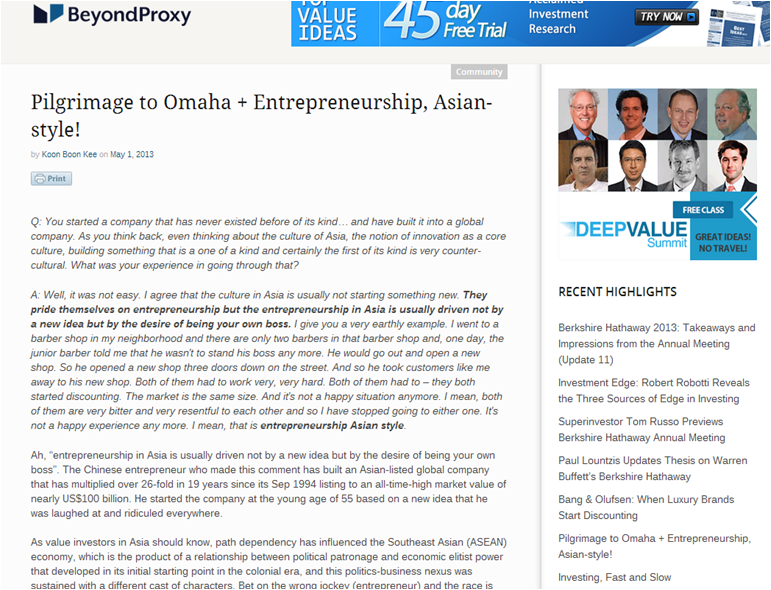
Pilgrimage to Omaha + Entrepreneurship, Asian-style! (Go to BeyondProxy.com, where value investing lives)

Bamboo Innovator is featured in BeyondProxy.com, where value investing lives:

Pilgrimage to Omaha + Entrepreneurship, Asian-style! May 1, 2013 (Weblink: BeyondProxy.com)

Pilgrimage to Omaha

The Science of Serendipity in the Workplace; To Encourage Interaction and Innovation, Companies Try Smaller Spaces, Games; Trivia Helps Break Awkward Silences

April 30, 2013, 8:38 p.m. ET

The Science of Serendipity in the Workplace

To Encourage Interaction and Innovation, Companies Try Smaller Spaces, Games; Trivia Helps Break Awkward Silences

By RACHEL EMMA SILVERMAN

MK-CC874_Serend_G_20130430224537

An installation, planned for Salesforce.com’s workplace, tabulates workers’ responses to ‘voting doors.’

Companies aren’t leaving serendipity to chance.

Firms are thinking up new ways to encourage interactions among employees who normally don’t work with each other. The hope is that these casual face-to-face chats among people with different skills might spark new ideas, lead to new solutions or at the least, increase workplace camaraderie.

To make those connections happen, some firms are taking a scientific approach—collecting and analyzing data about their teams and mathematically computing the likelihood that employees will meet. In some instances, they are squeezing workers into smaller spaces so they are more likely to bump into each other. In others, they are installing playful prompts, like trivia games, to get workers talking in traditional conversational dead zones, such as elevators.

But despite all the buzz around serendipity—several panels at the popular tech conference South by Southwest Interactive discussed the topic—it is hard to know for sure whether any of these efforts really work. The real challenge, companies and workplace scholars say, isn’t merely connecting workers with their colleagues so much as it is connecting them with the right ones. Read more of this post

Why Innovation Is Tough to Define — and Even Tougher to Cultivate

Why Innovation Is Tough to Define — and Even Tougher to Cultivate

Published: April 30, 2013 in Knowledge@Wharton

Innovation: It’s something everyone is in favor of, everyone likes the idea of, yet no one really understands it, according to Wharton legal studies and business ethics professor Kevin Werbach. Werbach moderated a panel on the topic at the recent Wharton Economic Summit 2013 held in New York City, during which he challenged the participants to define innovation, talk about its relationship to entrepreneurship, and explain what is needed to nurture it. He noted that innovation is essential for companies to grow, and that it is transformative.

In response to a question about whether innovation is necessarily related to new technology and big breakthroughs, Lady Barbara Judge, chairman of the United Kingdom’s Pension Protection Fund, defined innovation as either “using something new, or something known, but in a different way, different time or a different place.”

To illustrate the latter, she spoke of two men who are bringing car sharing, a concept popularized most notably by the Nasdaq-traded company Zipcar, to India in the guise of a company called Zoom. “It is not new technology but somebody saw it, used it, did it in a different place, in a different time and it’s really very innovative,” she said of the fledgling firm. Read more of this post

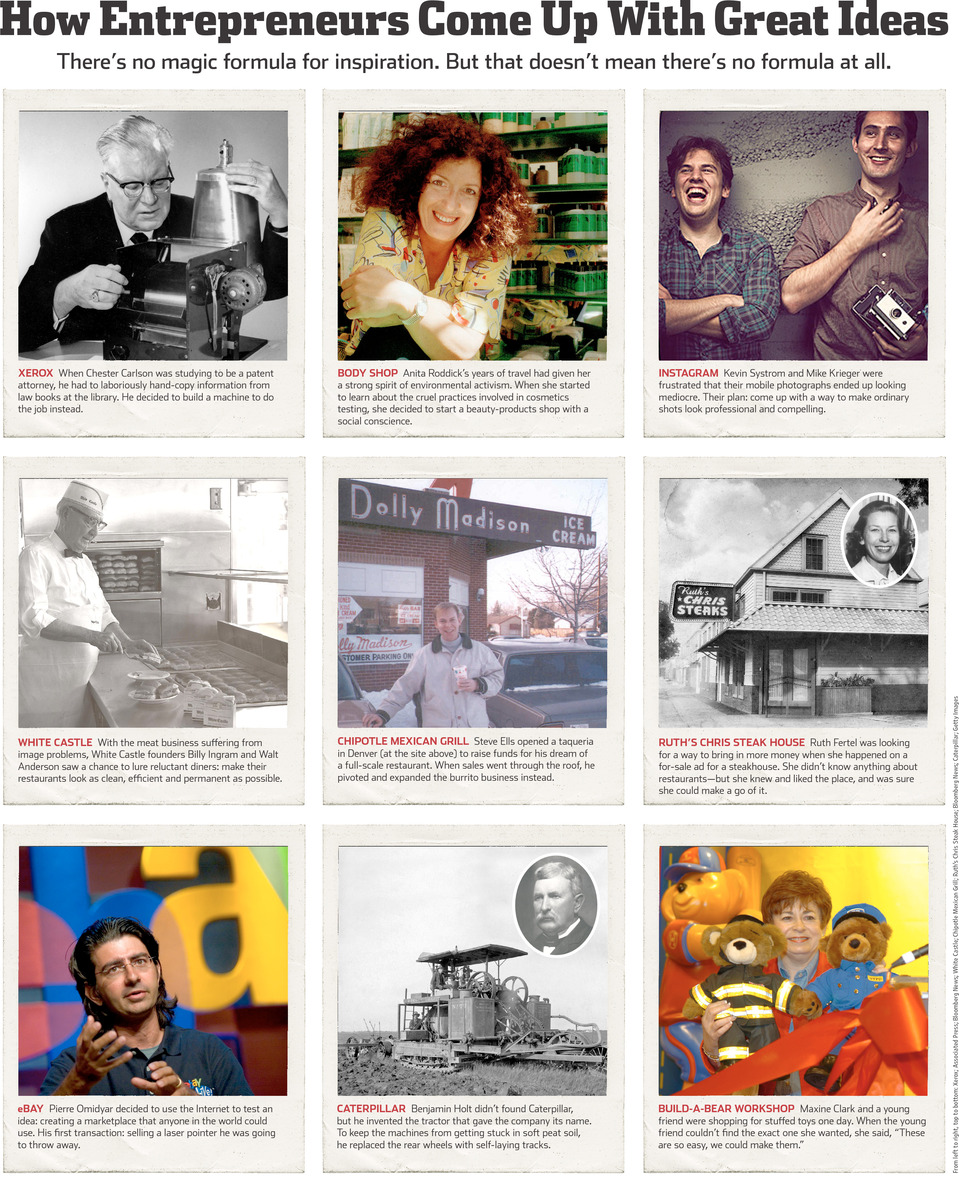
How Entrepreneurs Come Up With Great Ideas: There is no magic formula. But that doesn’t mean there’s no formula at all.

April 29, 2013

How Entrepreneurs Come Up With Great Ideas

There is no magic formula. But that doesn’t mean there’s no formula at all.

SM-AA713_SMCOVE_G_20130425114620

At the heart of any successful business is a great idea. Some seem so simple we wonder why nobody thought of them before. Others are so revolutionary we wonder how anybody could’ve thought of them at all. But those great ideas don’t come on command. And that leaves lots of would-be entrepreneurs asking the same question: How did everybody else get inspiration to strike—and how can we work the same magic? To find out, we turned to the experts—investors, advisers and professors who have seen and heard countless success stories, as well as entrepreneurs who have written success stories of their own. They saw inspiration coming from all sorts of sources—everyday puzzles, driving passions and the subconscious mind. Here’s what they had to say. Read more of this post