Invest in people, not resources; Most workplaces seem diabolically designed to kill creativity, intelligence, and productivity, and thus drive away talent

Invest in people, not resources

BY BOB GOWER 
ON APRIL 26, 2013

There is a supply-and-demand paradox brewing in the software business, and it’s getting worse by the day. Companies are searching for rock-star talent, while at the exact same moment talented people are searching for great work. People on both sides of this issue are frustrated — companies can’t find the right workers, or enough of them and talented workers feel stifled, bored, and in many cases exhausted, and even oppressed, by the work they do find. It’s an easy field for employers to stand out in, and yet so few fail to create the kind of engaging workplaces that attract top talent. Most blame their troubles on the market or a lack of money, but it’s hard to take this argument seriously when Wikipedia attracted an army of volunteers with seemingly little effort, and then produced so much value it drove Microsoft’s well-funded Encarta out of business. How did Wikipedia attract and motivate so much unpaid talent, and how does this hugely popular project keep doing it?

The secret to hiring top talent is simple — but not easy. Most workplaces seem diabolically designed to kill creativity, intelligence, and productivity, and thus drive away talent. If you want to hire well, you need to first engage and inspire the talent you do have, and that’s not about money. It’s about treating people like people. It’s a matter of helping them align toward a compelling common vision, giving them the tools and environments they need, then getting out of their way.

Read more of this post

Knock, Knock, Who’s the “Buffett CEO” in Asia? Part 1 and 2 (Go to BeyondProxy.com, where value investing lives)

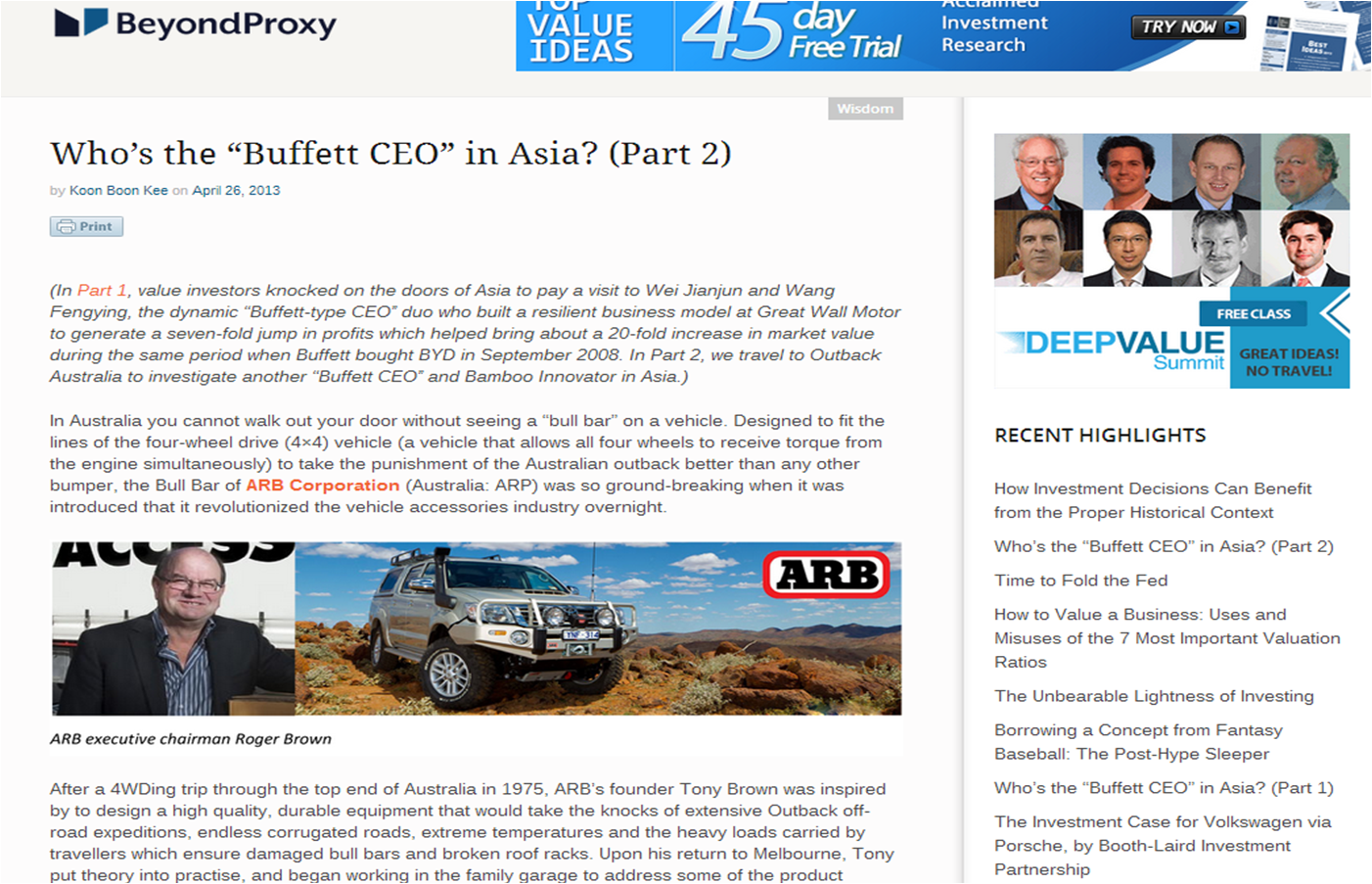
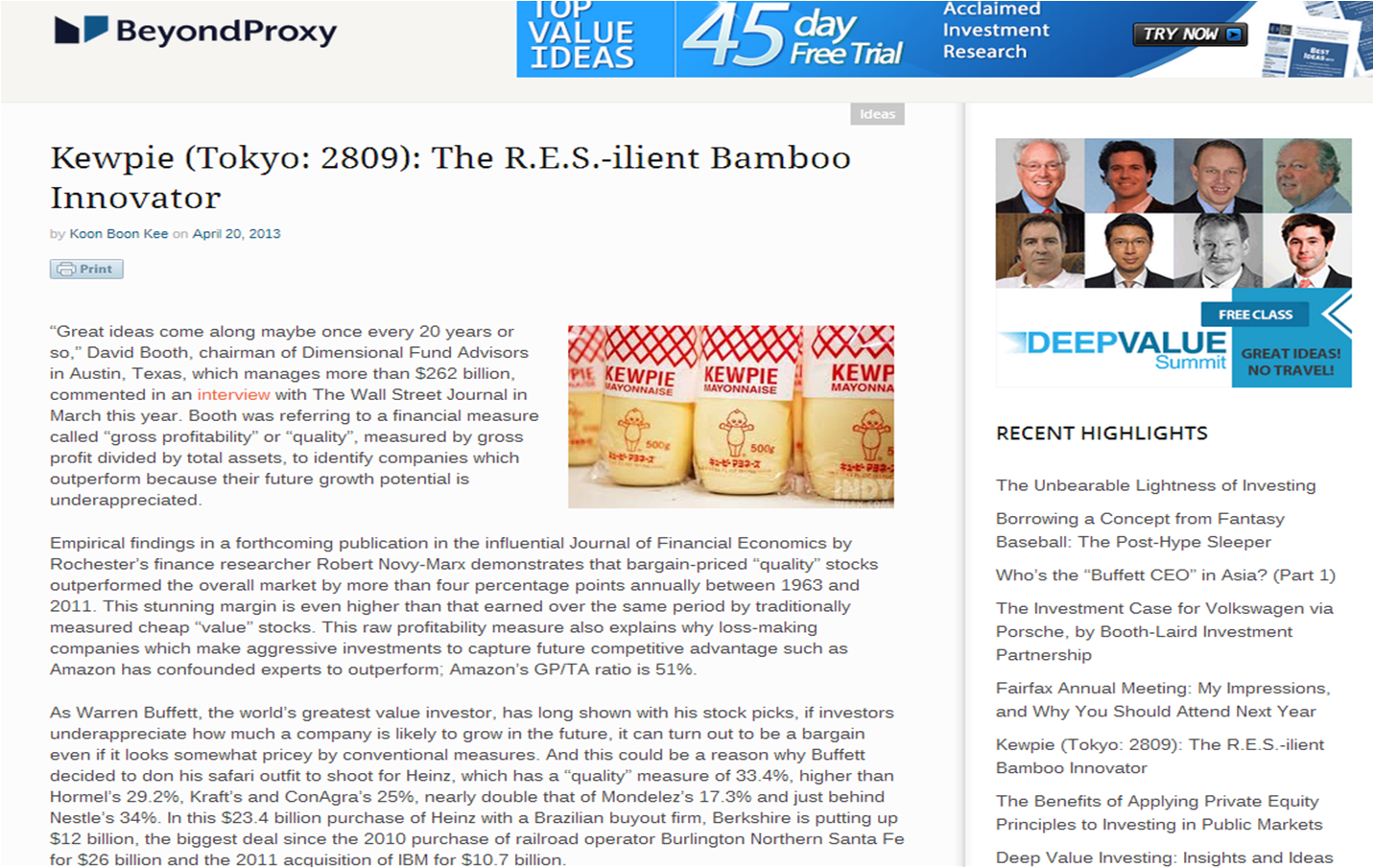
GWMARBKewpieJMATAsiaBamboo Innovator is featured in BeyondProxy.com, where value investing lives:

Who’s the Buffett CEO in Asia? Part 1 on China’s Great Wall Motor, April 23, 2016 (Weblink: BeyondProxy.com)

Who’s the Buffett CEO in Asia? Part 2 on Australia’s ARB Corporation, April 26, 2013 (Weblink: BeyondProxy.com)

Kewpie: Japan’s Heinz and R.E.S.-ilient Bamboo Innovator, April 20, 2013 (Weblink: BeyondProxy.com)

Value Investors in Asia: Making Sense of the Micro Vs. Macro Dilemma, April 16, 2013 (Weblink: BeyondProxy.com)

How IDEO brings design to corporate America

How IDEO brings design to corporate America

By Dinah Eng @FortuneMagazine April 11, 2013: 8:06 AM ET

130409154900-how29-a-620xa

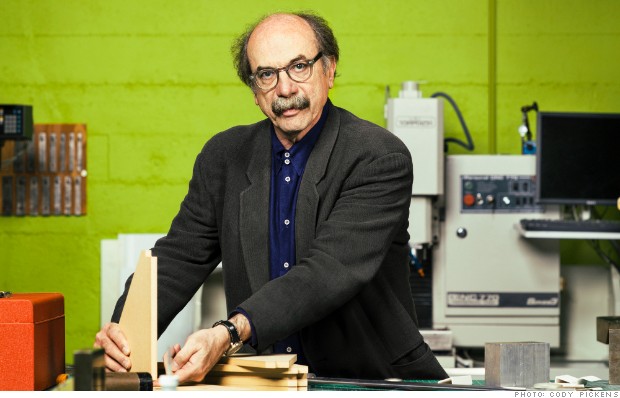
David Kelley in IDEO’s Palo Alto workshop

You may not know the design firm IDEO (pronounced EYE-dee-oh), but chances are you know its work. If you’ve used an Apple mouse (IDEO fashioned the company’s first, in 1980), swept with a Procter & Gamble (PGFortune 500) Swiffer (it collaborated on the hit), or even stood in line at an airport recently (the firm has worked with the Transportation Security Administration to make the process friendlier), you’ve felt the legacy of David Kelley. He founded IDEO in Palo Alto in 1978 and built it into a global operation with 600 employees and $130 million in revenue (he declines to divulge profits). IDEO brings a human-centered approach to products, services, and organizational concepts for the likes of Samsung, Eli Lilly (LLYFortune 500), and Bank of America (BACFortune 500). Kelley, 62, is also Stanford University’s resident design Yoda. The avowed “variety junkie” is proud that IDEO does everything from designing the ideal home for wounded soldiers to helping Elmo teach kids good behavior via a mobile app. His story:

I grew up in Barberton, Ohio, where my father was an engineer at Goodyear and my mother was a housewife. It was a typical Midwest upbringing, and I wasn’t really into college preparatory stuff. What was exciting to me was taking apart the car or the washing machine.

In 1973, I got a BS in electrical engineering from Carnegie Mellon University and went to work forBoeing (BAFortune 500) in Seattle, designing things for the interior of the 747. When I found out about the Stanford Product Design Program, I became interested in the human-centered side of technology, but didn’t think I’d get into the program. So I moved to Dayton and worked for National Cash Register (NCR,Fortune 500), designing new banking terminals, until I found out I was admitted.

Going to the Stanford program was a perfect fit. I love trying to understand what people want, what they value, and designing something for them. I graduated in 1977 with my MS in engineering and product design, and discovered that I really liked teaching. In 1978, I went to my mentor, professor Bob McKim, and said I wanted to keep teaching and I wanted to start my own company. He introduced me to Dean Hovey, who was studying at Stanford, and we started a company called Hovey-Kelley Design. A couple of professors who had their own companies in Silicon Valley gave us our first projects — designing a reading machine for blind people and a medical device called a differential [blood] cell counter.

Soon after Dean and I started our company, another Stanford colleague introduced us to Steve Jobs. We ended up doing a lot for Apple (AAPLFortune 500). They were technologically focused, and we focused on the human side. We’d ask [with the first Apple mouse], should you use the mouse with your fingertips or slide it like a bar of soap? Once we started doing Apple products, people wanted to know who we were.

Back then, we were paying about $300 a month for three offices. I remember flinching when I signed a 10-year lease because I still owed on student loans and I had a negative net worth. I had no interest in calculating revenue, and still don’t. We charged $25 an hour and had six employees. Half the time we worked, and half the time we didn’t. All I cared about was how much we were paid per hour, and if we had enough to keep everybody busy. Read more of this post

Cal Newport: The Secret To Success Is The “Craftsman’s Mindset”

Interview – Author Cal Newport on how you can become an expert and why you should *not* follow your passion

by eric barker

Newport

Cal Newport holds a PhD from MIT and is an assistant professor of Computer Science at Georgetown University. He runs the popular blog Study Hacks (which I highly recommend) and is the author of four books including, most recently, So Good They Can’t Ignore You: Why Skills Trump Passion in the Quest for Work You Love. Cal and I talked about the secrets to becoming an expert, how deliberate practice works and why following your passion can be a *bad* idea. My conversation with Cal was over 45 minutes, so for brevity’s sake I’m only going to post edited highlights here.

Don’t Follow Your Passion

Cal:

I set out to research a simple question:  How do people end up loving what they do? If you ask people, the most common answer you’ll get is, “They followed their passion.” So I went out and researched: “Is this true?” From what I found, “Follow your passion” is terrible advice. If your goal is to end up passionate about what you do, “Follow your passion” is terrible advice. So the first fundamental misunderstanding is this idea that we all have a pre-existing passion that’s relevant to a career, and if we could just discover it, then we would be fine. Research says actually most people don’t have one. The second problem is that it’s built on this misbelief that matching your work to something you have a very strong interest in is going to lead to a long-term satisfaction and engagement in your career. It sounds obvious that it should be true, but actually the research shows that’s not at all the reality of how people end up really enjoying and gaining great satisfaction and meaning out of their career. If you study people who end up loving what they do, here’s what you find and if you study the research on it, you find the same thing: Long-term career satisfaction requires traits like a real sense of autonomy, a real sense of impact on the world, a sense of mastery that you’re good at what you do, and a sense of connection in relation to other people. Now, the key point is those traits are not matched to a specific piece of work and they have nothing to do with matching your job to some sort of ingrained, pre-existing passion.

The Secret To Success Is The “Craftsman’s Mindset”

Cal:

My advice is to abandon the passion mindset which asks “What does this job offer me? Am I happy with this job? Is it giving me everything I want?” Shift from that mindset to Steve Martin’s mindset, which is “What am I offering the world? How valuable am I? Am I really not that valuable? If I’m not that valuable, then I shouldn’t expect things in my working life. How can I get better? Like a craftsman, you find satisfaction in the development of your skill and then you leverage that skill once you have it to take control of your working life and build something that’s more long-term and meaningful… When I talk about the habits of the craftsman mindset, it’s really the habits of deliberate practice. So someone who has the craftsman mindset is trying to systematically build up valuable skills because that’s going to be their leverage, their capital for taking control of their career and they share the same habits you would see with violin players or athletes or chess players.

The craftsmen out there are not the guys checking their social media feeds every five minutes. They’re not looking for the easy win or the flow-state. They’re the guys that are out there three hours, pushing the skill. “This is hard but I’m going to master this new piece of software. I’m going to master this new mathematical framework.” That’s the mindset, the habit of the craftsman.

How To Become An Expert At Something

Cal:

What you need is a clearly identified sort of skill you’re working on. You need some notion of feedback. So you have to have some notion of, “How good am I at this now, and am I any better now that I’ve done this versus not doing it?” So that’s sort of the coaching aspect of things. And then when actually working, you have to work deeply, which means you have to sort of work on the skill with a persistent, unbroken focus, and you have to try to push yourself a little bit beyond where you’re comfortable. So you should not really be able to easily get to the next step in what you’re doing. At the same time, you should, with enough strain, be able to make some progress.

What You’re Doing Wrong When Trying To Become An Expert

Cal:

I think when people want to get better at something the biggest mistake they make is seekingflow. It’s a very enjoyable state. It’s where you’re lost in what you’re doing, you’re applying your skills seamlessly and fluidly, and you feel like you have control.

But we know from research on how people actually gain expert levels of performance that the actual state in which you’re getting better is one of strain, and that’s different than flow. It’s a state where you actually feel like you’re being stretched. It’s uncomfortable. You’re doing things beyond your current abilities. It’s not fluid. You’re not necessarily lost. Your mind might be saying, “This is terrible. This is terrible. Check your e-mail. This is terrible. What if there is something on Facebook?

We avoid that for the most part, but we know that if you just keep doing what you know how to do already, you’ll hit a plateau almost immediately. So I think the avoidance of strain is the biggest mistake people make in trying to get better. Read more of this post

Entrepreneurs shine through in gloomy times; winners of the Queen’s Awards for Enterprise are a showcase for the country’s ability to create innovative products and services and sell them around the world.

April 22, 2013 12:43 am

Entrepreneurs shine through in gloomy times

By Brian Groom

Five years into the most prolonged economic downturn of modern times, British business could do with cheering itself up. A glance through this year’s winners of the Queen’s Awards for Enterprise should help.

From a maker of mass spectrometers to a nail bar chain, from a maker of milking equipment to a supplier of food supplements to improve fertility, the winners of the awards – first handed out in 1966 – are a showcase for the country’s ability to create innovative products and services and sell them around the world.

The 2013 list, published to mark the Queen’s birthday on April 21, contains 152 business awards, mixing FTSE companies with subsidiaries of foreign-owned groups and private businesses. Read more of this post

Forget the long to-do lists and choose one thing to be good at

Forget the long to-do lists and choose one thing to be good at

By Vickie Elmer April 19, 2013

Success doesn’t come from a four-hour workweek or a list of seven steps. People who are extraordinarily successful are known for just one thing, one passion, one amazing skill, says Gary Keller and co-author Jay Papasan in their new book called The One Thing. That is true for Warren Buffett choosing investments or Bill Gates and computers. This notion comes partly from Italian economist Vilfredo Pareto’s principle, which showed that 80% of wealth was held by 20% of the people. This works elsewhere as the 80/20 principle, where a small portion of effort leads to oversized results. “Things don’t matter equally. …The smaller I make my life, the bigger it gets,” says Keller, the co-founder and chairman of Keller Williams Real Estate. Great bosses understand that businesses will succeed when staff are encouraged to excel in one domain. ”I want my phones answered extraordinarily. I want my contracts read extraordinarily. I want software done extraordinarily,” Keller said about his own real estate business. Here are three lessons from The One Thing:

1.  Success is sequential, not simultaneous.  Many people want it all. Yet when Keller coached “a lot of very successful men and women” in the 1990s, he would see them create a list of assignments to tackle. By their next conversation, they hadn’t accomplished the most important ones. Finally, he started making them choose one thing they would concentrate on between sessions. That led to dramatically improved results. He would ask them the focusing question: “What’s the one thing I can do such that by doing it, everything else will be easier or unnecessary?” That question runs through the book, and can serve to focus on big picture goals as well as daily priorities.

2. Nail your “one thing” by lunch.  Schedule your time block—a minimum of two hours, three or more is better—for the first part of your day when your willpower is highest. “By noon or 1 o’clock at latest, you’ve had an awesome day,” he said. “You’ve done what mattered most. Now you deal with all the other stuff.” For executive meetings, know the one thing that drives your business’ success, and make that the first item on your agenda always.

3. Everyone blows it. Keller wanted his book to be grounded in research, so the first draft came in at 400 pages. His publisher said: “Why don’t you practice what you preach?” The authors ended up cutting it in half.

How a Potter Took Accounting Into the Industrial Age

How a Potter Took Accounting Into the Industrial Age

ipLedfefsESY

In the mid 1700s, Josiah Wedgwood built the world’s first industrialized pottery factory. Source: Getty Images

This week, the International Integrated Reporting Council introduced a draft of a new framework for corporate accounting that would require companies to go beyond reporting just financial capital and also encompass environmental, social and governance risks.

The structure — known as “integrated reporting” — is a response to the realization brought on by the 2008 financial crisis and increasing environmental stresses that we need a new accounting paradigm for the 21st century. The limits of current national-accounting practices were acknowledged in 2012 when the United Nations adopted a new international standard to give “natural capital” equal status to gross domestic product as a gage of a nation’s economy.

These aren’t the first such paradigm shifts in the history of accounting. At the end of the 18th century, the double-entry account-keeping practices developed by Italian merchants in the Middle Ages were updated for the new industrial era.

The first signs that double entry could be adapted to the new age of factories, wage labor and large-scale capital investment appeared in the north of England, in the works of the renowned potter Josiah Wedgwood. Read more of this post

Innovator: Ruggero Scorcioni’s App Uses Brain Waves to Block Calls

Innovator: Ruggero Scorcioni’s App Uses Brain Waves to Block Calls

By Caroline Winter on April 18, 2013

tech_innovator17__01__630x420

Neuroscientist and former software engineer Ruggero Scorcioni found himself consistently distracted by the phone while he was trying to work. “If I’m busy coding or thinking about research and have phone calls coming in, it’s hard to get back into the same mental state,” says Scorcioni, 42. “Maybe you had a great idea, but then it’s gone.” In January, on a whim, he entered an AT&T app-development hackathon, and came up with a solution.

His idea was sparked by a gift to participants: a cat-ear headset built by Neuro-wear with sensors that track the wearer’s brain waves and perk up fluffy motorized ears during periods of high brain activity. Scorcioni, who’d just finished a fellowship at the Neurosciences Institute in La Jolla, Calif., decided to hack the headset to create an app that blocks incoming calls when the receiver is concentrating. With 26 hours to complete the hackathon, he worked until the last minute, pausing only for two hours of sleep and a shower. That labor produced a working prototype of Good Times, which analyzes real-time brain wave data from the headset, then sends commands to AT&T’s telephone network to either permit or block incoming calls. Blocked callers are redirected to an automated message asking them to try again later. Scorcioni describes the app as “a mentally activated ‘Do Not Disturb’ sign.” Read more of this post

In Beijing, housing is so expensive that migrant workers are living in bomb shelters

In Beijing, housing is so expensive that migrant workers are living in bomb shelters

By Nate Berg — 12 hours ago

Nate Berg is a freelance reporter and a former staff writer for The Atlantic Cities. He lives in Los Angeles.

life-underground-in-beijing

The numbers are undeniably mind-boggling: An estimated two million people in Beijing are said to be living below the earth’s surface, in thousands of 100-square-foot spaces located just one or two stories below street level. These figures have been making headlines (and trending upwards) for a couple of years now. Assuming they’re accurate, that would mean 10 percent of the city’s 20 million people sleep in windowless, subterranean residences.

That they are there speaks to the crushingly expensive housing market in China’s bulging top-tier cities. The makeshift conversion of approximately 20,000 antiquated bomb shelters and basements across Beijing has also no doubt led to a rise in dangerous living conditions: it’s common to find multiple people sharing these small emergency shelters made only slightly more hospitable with space heaters and hot plates.

The only affordable alternative would be way out on the city’s periphery. And yet, if you ask them, many of these people, most of them migrant workers, will tell you their choice to live underground is vastly better than the alternative. Read more of this post

The Agility Factor: A few large companies in every industry show consistently superior profitability relative to their peers, and they all have one thing in common: a highly developed capacity to adapt their business to change

April 15, 2013

The Agility Factor

A few large companies in every industry show consistently superior profitability relative to their peers, and they all have one thing in common: a highly developed capacity to adapt their business to change.

by Thomas Williams, Christopher G. Worley, and Edward E. Lawler III

Everybody knows that big corporations, by nature, maneuver like battleships. Held back by their own inertia and current business strategies, they cannot turn quickly when the competitive environment changes. Everybody also knows that high performance, as measured by shareholder returns, is impossible to sustain over the long term; no company consistently beats the market.

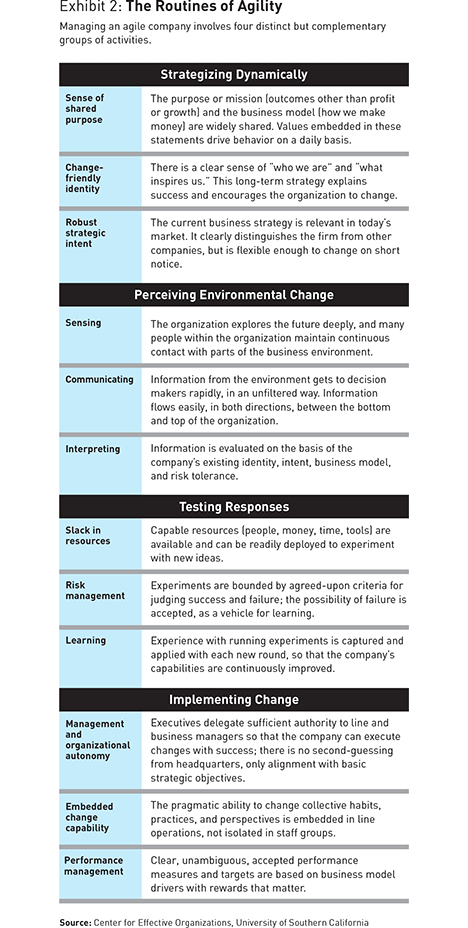
But a recent in-depth study of long-term performance suggests an alternative point of view about business strategy. When the measure of performance is profitability, a few large companies in every industry consistently outperform their peers over extended periods. And they maintain this performance edge even in the face of significant business change in their competitive environments. The one factor they seem to have in common is agility. They adapt to business change more quickly and reliably than their competitors; they have found a way to turn as quickly as speedboats when necessary.

00188_ex02 Read more of this post

People Are the New Channel; This new world is disorienting because pipes and people work very differently as channels. Pipes flow out; people flow in. Content is pushed out through pipes, but pulled in through people

People Are the New Channel

by Mark Bonchek and Cara France  |  11:00 AM April 15, 2013

In the past, channels delivered messages to audiences. You either owned the pipe or paid to use someone else’s. You controlled the message all the way through that pipe.

In a digital and social age, pipes are less important. People are the channel. You don’t own or rent them. You can’t control them. You can only serve and support them.

This new world is disorienting because pipes and people work very differently as channels. Pipes flow out; people flow in. Content is pushed out through pipes, but pulled in through people. Read more of this post

Mental Models: The Bamboo Innovator Approach to Investing in Asia, with Singapore-Based Value Investor KB Kee (BeyondProxy.com, GreatInvestors.TV, Youtube, Frequency.com)

http://www.beyondproxy.com/mental-models/

http://www.beyondproxy.com/detecting-fraud/

http://www.beyondproxy.com/accounting-pitfalls-at-asian-companies/

http://greatinvestors.tv/video/insights-into-accounting-pitfalls-at-asian-companies-with-si.html

http://greatinvestors.tv/video/beware-of-other-receivables-accounting-at-asian-companies-wi.html

http://www.frequency.com/video/insights-into-accounting-pitfalls-at/85354333/-/5-1707

MentalModelDetectFraudPitfalls

Who Says Innovation Is Dead in Age of Crazy Cheesy Crust

Who Says Innovation Is Dead in Age of Crazy Cheesy Crust

Move over hamburgers and fries. Here come the sweet-chili chicken wraps and bacon-filled tater tots.

Looking to lure Americans with the coolest new menu item, Burger King Worldwide Inc (BKW)., McDonald’s Corp. (MCD) (MCD) and Red Robin Gourmet Burgers Inc (RRGB) (RRGB). and others are turning up the heat in their test kitchens. At the same time, classically trained chefs, looking for more regular work hours and higher pay, are no longer snubbing large chains. The result has been an arms race among eateries to create the most exciting new foods to attract consumers and boost sales.

“Over the last 12 to 18 months, you’ve seen a lot of innovation,” Eric Hirschhorn, Burger King’s vice president of global innovation, said in an interview. The Miami-based chain last year introduced 57 new items, the biggest menu overhaul in the company’s history and more than twice as many as in 2011, he said. In March, the Whopper seller rolled out bacon-filled tater tots for $1.99. Read more of this post

As ye decide, So shall ye innovate (Part 1)

As ye decide, So shall ye innovate (Part 1)

Published: 11 Apr 2013 at 00.00

Here’s a question for you: What organisation do you think is more likely to be a creative organisation: One where most decisions are made by a few individuals high at the top of the organisational hierarchy? Or one where decision-making is spread throughout the hierarchy, and decision authority is delegated and shared?

How an organisation structures its decision-making processes is a good predictor of the level of innovation you can expect from it. Let’s see how organisational decision-making affects organisational innovation.

Diagnosing organisational innovation readiness: For the past few years I have been working on a method to help ordinary organisations become creative ones. This method shows show businesses how to turn a “me too” copycat corporate culture into one with unlimited creative potential that can fluently produce new “wow” products and services. Read more of this post

Givers take all: The hidden dimension of corporate culture; By encouraging employees to both seek and provide help, rewarding givers, and screening out takers, companies can reap significant and lasting benefits.

Givers take all: The hidden dimension of corporate culture

By encouraging employees to both seek and provide help, rewarding givers, and screening out takers, companies can reap significant and lasting benefits.

April 2013 • Adam Grant

After the tragic events of 9/11, a team of Harvard psychologists quietly “invaded” the US intelligence system. The team, led by Richard Hackman, wanted to determine what makes intelligence units effective. By surveying, interviewing, and observing hundreds of analysts across 64 different intelligence groups, the researchers ranked those units from best to worst.

Then they identified what they thought was a comprehensive list of factors that drive a unit’s effectiveness—only to discover, after parsing the data, that the most important factor wasn’t on their list. The critical factor wasn’t having stable team membership and the right number of people. It wasn’t having a vision that is clear, challenging, and meaningful. Nor was it well-defined roles and responsibilities; appropriate rewards, recognition, and resources; or strong leadership.

Rather, the single strongest predictor of group effectiveness was the amount of help that analysts gave to each other. In the highest-performing teams, analysts invested extensive time and energy in coaching, teaching, and consulting with their colleagues. These contributions helped analysts question their own assumptions, fill gaps in their knowledge, gain access to novel perspectives, and recognize patterns in seemingly disconnected threads of information. In the lowest-rated units, analysts exchanged little help and struggled to make sense of tangled webs of data. Just knowing the amount of help-giving that occurred allowed the Harvard researchers to predict the effectiveness rank of nearly every unit accurately.

The importance of helping-behavior for organizational effectiveness stretches far beyond intelligence work. Evidence from studies led by Indiana University’s Philip Podsakoff demonstrates that the frequency with which employees help one another predicts sales revenues in pharmaceutical units and retail stores; profits, costs, and customer service in banks; creativity in consulting and engineering firms; productivity in paper mills; and revenues, operating efficiency, customer satisfaction, and performance quality in restaurants.

Across these diverse contexts, organizations benefit when employees freely contribute their knowledge and skills to others. Podsakoff’s research suggests that this helping-behavior facilitates organizational effectiveness by:

  • enabling employees to solve problems and get work done faster
  • enhancing team cohesion and coordination
  • ensuring that expertise is transferred from experienced to new employees
  • reducing variability in performance when some members are overloaded or distracted
  • establishing an environment in which customers and suppliers feel that their needs are the organization’s top priority

Yet far too few companies enjoy these benefits. One major barrier is company culture—the norms and values in organizations often don’t support helping. After a decade of studying work performance, I’ve identified different types of reciprocity norms that characterize the interactions between people in organizations. At the extremes, I call them “giver cultures” and “taker cultures.” Read more of this post

Be like the bamboo, not the oak (Today, 8 April, 2013); “Singapore is too small and its talent pool is too small to produce a world-class manufacturing giant of the Fortune 500 class,” Singapore’s founding Prime Minister Lee Kuan Yew once said. A cryptic remark, indeed, because it does not imply that he thinks Singapore cannot produce knowledge-based giants, or resilient “bamboo innovators”

Be like the bamboo, not the oak
“Singapore is too small and its talent pool is too small to produce a world-class manufacturing giant of the Fortune 500 class,” Singapore’s founding Prime Minister Lee Kuan Yew once said. A cryptic remark, indeed, because it does not imply that he thinks Singapore cannot produce knowledge-based giants, or resilient “bamboo innovators”.
BY KEE KOON BOON –
6 HOURS 19 MIN AGO

“Singapore is too small and its talent pool is too small to produce a world-class manufacturing giant of the Fortune 500 class,” Singapore’s founding Prime Minister Lee Kuan Yew once said. A cryptic remark, indeed, because it does not imply that he thinks Singapore cannot produce knowledge-based giants, or resilient “bamboo innovators”.

Why bamboo innovators? Bamboos bend, not break, even in the most terrifying storm or devastating earthquake that would snap the mighty oak tree. It survives, therefore it conquers.

Disruptive industry trends and black-swan crises have become a permanent fixture in today’s marketplace. How wonderful it would be if countries, companies and individuals can stay resilient amid such upheavals and unorthodox challenges.

The study of bamboo innovators could inspire companies to be productive innovators in order to surpass stall-points in their business models during tumultuous periods, particularly for small and medium enterprises aspiring to scale up to become global champions.

But why is it that Asian companies are predominantly product manufacturers in the first place? This could ironically be a result of the Asian values of hard work and sacrifice.

It is far easier for the Asian entrepreneur to be the middleman taking orders from a few important anchor multinational corporation customers with access to the end-customers, take capital risk investing in tangible assets and work hard to produce the required products with quality and efficiency — than to attempt to build business models that have direct ownership of the hundreds and thousands of end-customers.

As a result, these entrepreneurs are unwilling to share the rewards with their “undeserving” staff who took neither risk nor sacrifice. They treat employees as expenses and not intangible assets, make most or all of the decisions and hoard most resources and information, running the firm as a “one-man show”. Eventually, they may face the challenge of business continuity arising from succession woes.

NEW IDEAS

Keyence is an example of the unconventional Asian firm. Founder Takemitsu Takizaki liberated the firm from manufacturing conventions and built a knowledge-based enterprise in laser sensors for factory automation, serving more than 100,000 customers in 70 countries.

Despite having less than 1 per cent global market share in a commodity-like product and only around 3,000 employees, Keyence commands a US$17-billion (S$21.1 billion) market value — approximately similar to Singapore’s Keppel Corp, a global leader in offshore oil rig design and building.

Mr Takizaki understood keenly that Keyence cannot improve on Japan’s legendary manufacturing efficiency. So, unlike its manufacturing-based competitors who leave sales to distributors, wholesalers and agents, it deliberately avoids making products, except for manufacturing steps that involve trade secrets kept in-house.

Most of its employees are either “sales” or “research” staff. In their direct contact with the customers, Keyence’s in-house “sales” team picks up new product ideas on frequent factory visits. For instance, its front-liners observed from the production lines at instant noodle factories that the noodle quality was compromised because the noodles were manufactured at variable thicknesses. Laser sensors that could measure noodles to 1/100th of a millimetre were developed to ensure consistency.

A quarter of sales at Keyence is generated from such new products every year, more than what 3M achieves. To excel in these areas, Keyence had to cultivate a meritocratic culture, and it is known for having some of the highest-paid employees in corporate Japan.

Bright young people from rival firms are attracted to Keyence by the performance-based pay. The average salary there is US$100,000. Engineers also get to do their own research, rather than labouring for years under grey-haired supervisors.

THE EMPTY CORE

Keeping the front line or the “periphery” resilient and innovative, and the centre or the “core” diffused, and enforcing meritocratic values at all levels have compounded immense value at Keyence. This “core-periphery” growth pattern is also that of the bamboo: The vitality of its growth revolves around its “empty” centre.

Instead of constructing itself inch by solid inch, like a tree, the nutrients and moisture that would have been exhausted making and maintaining its empty centre can be utilised for growth of its periphery in the stem. From a builder’s viewpoint, the architecture of the bamboo presents a powerful configuration: Fibres of greatest strength occur in increasing concentration towards the periphery.

Manufacturing and project-based companies often tout the size of their order book and their idea of “team” is about having high-profile dealmakers who can bring in the sales orders; the job of “everyone else” is to execute efficiently and “productively”.

The well-connected dealmakers may be able to pull in high-dollar projects, but because of the difficulties in coordinating and executing large-scale complex projects, these deals cannot be repeated and the hype associated with a big order book starts to fade, particularly when cost overruns and delivery delays rear their ugly heads. Bigger becomes riskier.

Even in manufacturing, the only way to perform and execute large-scale complex projects repeatedly is to create a culture of excellence where the interests of emotionally engaged front-liners matter in the innovation and value creation process.

Customers are attracted to this contagious performance culture rather than to the dealmakers on a relationship basis, resulting in a valuation breakthrough beyond the billion-dollar market value barrier that many Asian companies find difficult to break.

“Fortune 500”? With “emptiness” in business model design, Singapore can instead aim for its own resilient “Bamboo Innovator 500” powerhouse with a US$10-trillion value.

ABOUT THE AUTHOR:

Kee Koon Boon, a former lecturer of accounting at the Singapore Management University, has been an investment professional for the past decade. He is a presenter at the Emerging Value Summit 2013 on April 9-10.

Resilient Growth In Crisis? Bamboo Innovators CSL and Keppel Show How

Resilient Growth In Crisis? Bamboo Innovators CSL and Keppel Show How

By KEE Koon Boon

8 April 2013

“Sometimes to be reborn, you must first die,” Dr. Victor Fung, group chairman of the multi-billion Li & Fung group of companies, cites pensively this old Chinese proverb in order to ask an open-ended question, “In a world that’s speeding up, how will companies change enough without crisis?”

We cannot avoid, or even choose, a crisis in order to engender the change that is required to overcome stall points in growth and to stay relevant in today’s marketplace where disruptive industry trends and black-swan crises have become a permanent fixture. When the inevitable traumatic upheavals and unorthodox challenges do come, innovators craft their business models to stay resilient like the bamboo, which bend, not break, even in the most terrifying storm that would snap the might resisting oak tree.

Australia’s CSL and Singapore’s Keppel are two such companies who have experienced near-deaths in daring greatly to scale and globalize their once domestic SME operations right under the noses of powerful incumbent global giant rivals – and they were renewed and reborned to be resilient Bamboo Innovators.

In its remarkable transformation from a sleepy government outfit providing snakebite antivenin since its privatization and listing in 1994 with a market value of A$500 million to a A$29 billion global biotech champion, CSL had experienced a near-death crisis in 2002. Similarly, Keppel, the global leader in offshore oil rig design and building, had hit a crisis in 1973, 1983 and 1990. Both were able to bounce back higher to scale greater heights. Why? Both companies have dedicated leaders cultivating a culture rooted in trust, cooperation and empowerment to contend with and heal creative dissent to handle large-scale complex projects repeatedly with excellence.

Brian McNamee was plucked from relative obscurity at the age of 33 to head CSL at the recommendation of then Industry Minister John Button. Similarly, the late Hon Sui Sen, founding Chairman of Singapore’s Economic Development Board (EDB), picked Chua Chor Teck to be Keppel’s first managing director in May 1972 and to take over and “Singaporeanize” Keppel from the hands of British managers of the Swan Hunter Group, then one of the best known shipbuilding companies in the world that has now disappeared.

During the era when America was dubbed the OPEC (Organization of Plasma Exporting Companies) of the global plasma industry, CSL broke the dominance of America’s grip by buying Swiss plasma fractionation pioneer ZLB for A$1 billion in 2000 and Germany’s Aventis Behring for US$925 million in 2004. Today, domestic earnings account for 10 percent of the group earnings at CSL with the bulk provided by its global businesses. Similarly, Keppel got its design and technology in oil rig from acquiring rig builder Far East Livingstone Shipbuilding (FELS), which Keppel took majority control in 1973 during the oil crisis. Subsequently, the late Sim Kee Boon, Chairman of Keppel Corp from 1984 to 1999, continued to lead the globalization push of Keppel, subsequently continued by the capable leaders Mr. Lim Chee Oon, Mr. Choo Chiau Beng, Mr. Tong Chong Heong, Mr. Loh Wing Siew and so on. Mr. Sim outlined the basic strategy of avoiding “green-field” or start-from-scratch projects and to invest in yards that are already there. For instance, Keppel acquired Allison-McDermid in America, AHI in Middle East, PEM Setal in Brazil, and Verolme Botlek in Europe. Mr. Sim’s dream was to see Keppel become like a Nestle with a very significant global presence.

The big-picture “plan” to globalize is seen obvious but managing the unseen risks and creating adaptive advantages along the way are more important. For the first two years, ZLB lived up to its promise, resulting in solid earnings growth for CSL, and its market value more than doubled. But the wheels came off in 2002 when the industry went into oversupply and a combination of sharply falling product prices and disadvantageous currency mismatch nearly crippled CSL. Back in 1983, Keppel’s cash purchase of Straits Steamship saddled it with a debt of S$845 million. Furthermore, the shipbuilding industry during that period was pronounced a sunset industry by the pundits as the industry went into oversupply with more than 80 shipyards capable of building rigs. Keppel survived the crisis and was the only surviving rig-builder in the world in 1986 then. Subsequently, another crisis hit shortly after Keppel’s acquisition of Texas-based jackup yard Allison-McDermid in 1990 when an American firm brought a US$565 million litigation case against Keppel for alleged breach of contract and damages involving the building of jackup offshore drilling rigs. CSL turned risk into opportunity by acquiring Aventis Behring to consolidate its position as the industry recovers. Keppel eventually won the suit. Keppel saw the need for control and bought out its partner, renaming the entity AmFELS which became a wholly-owned subsidiary of Keppel. It grew to become one of the best-equipped offshore yards in the Gulf of Mexico.

Growth through acquisitions has proven to be the graveyard for many companies in general. Warren Buffett, the world’s greatest investor, likened growing via acquisitions to kissing unresponsive corporate toads who croaked and the tempting but value-destroying toy that executives must have because their peers have one too. Post-acquisition efforts in integrating the companies into the parent company to compete as a coherent whole prove crucial to successfully scale to greater heights and not blow up. Both CSL and Keppel are able to do so because of the foundation laid down in the culture carefully nurtured by Mr. McNamee and Mr. Chua.

“We respected them greatly for their skills and their capabilities, so we weren’t cultural imperialists. We greatly respect our Swiss and German colleagues and so there was no notion that they were being taken over and that they were going to work to our method,” McNamee articulated how their culture of trust and respect provided both parties a common ground to work together towards a global vision for the group. The culture of empowerment at CSL is embedded into its business model to foster open innovation and extensive collaboration with its acquired companies and a network of high-quality academics, scientists and physicians across the world. CSL minimises a silo formation by giving people personal responsibility and by running R&D using a matrix structure. This intangible culture has delivered powerful tangible results, including how CSL beat competitors to be the first to market with an effective vaccine against the global swine flu epidemic and in developing the anti-cervical cancer drug Gardasil. The dedication of McNamee is also touching. He was diagnosed to have cancer and kidney problems when he was planning to buy ZLB. Swiss giant Novartis also offered more money and fanned the patriotism flame that ZLB should remain in Swiss hands. Due to the persistence of McNamee who flew to Switzerland against medical advice to personally negotiate the deal, CSL acquired ZLB despite paying 20 percent less than its rival bidder.

In his touching eulogy for Mr. Chua, “the much-loved leader among his men” who passed away from cancer in 1986 when he was 47, Keppel’s influential long-time US representative Mr. John Bajor commented, “Yes there’s complete dedication expected but the return in caring for each employee is the spirit he so carefully nurtured and left behind. It has become the Keppel way.” Mr. Sim also paid tributes to Mr. Chua who “tried exceedingly hard to inculcate in the organisation the ‘Keppel culture’ of loyalty, thrift and hard work.” Mr. Chua’s dedication and his “genuine interest in helping junior officers overcome difficulties in order to advance their career” has laid the foundation to the “Can Do” spirit of excellence at all levels in Keppel for many years to come.

The story at Bamboo Innovators CSL and Keppel highlighted the intangible culture of kindness, caring and empowerment is akin to the invisible intricate underground root structure that makes the ground around a bamboo grove very stable – and make possible the adaptability of the bamboo to bend, not break, with storms and crisis, and to remain relevant and evergreen no matter how the world around us speeds up and changes.

Great Scientist ≠ Good at Math; E.O. Wilson shares a secret: Discoveries emerge from ideas, not number-crunching

April 5, 2013, 10:07 p.m. ET

Great Scientist ≠ Good at Math

E.O. Wilson shares a secret: Discoveries emerge from ideas, not number-crunching

By E.O. WILSON

For many young people who aspire to be scientists, the great bugbear is mathematics. Without advanced math, how can you do serious work in the sciences? Well, I have a professional secret to share: Many of the most successful scientists in the world today are mathematically no more than semiliterate.

During my decades of teaching biology at Harvard, I watched sadly as bright undergraduates turned away from the possibility of a scientific career, fearing that, without strong math skills, they would fail. This mistaken assumption has deprived science of an immeasurable amount of sorely needed talent. It has created a hemorrhage of brain power we need to stanch. Read more of this post

Five routes to more innovative problem solving; Tricky problems must be shaped before they can be solved. To start that process, and stimulate novel thinking, leaders should look through multiple lenses.

Five routes to more innovative problem solving

Tricky problems must be shaped before they can be solved. To start that process, and stimulate novel thinking, leaders should look through multiple lenses.

April 2013 • Olivier Leclerc and Mihnea Moldoveanu

Source: Strategy Practice

Rob McEwen had a problem. The chairman and chief executive officer of Canadian mining group Goldcorp knew that its Red Lake site could be a money-spinner—a mine nearby was thriving—but no one could figure out where to find high-grade ore. The terrain was inaccessible, operating costs were high, and the unionized staff had already gone on strike. In short, McEwen was lumbered with a gold mine that wasn’t a gold mine.

Then inspiration struck. Attending a conference about recent developments in IT, McEwen was smitten with the open-source revolution. Bucking fierce internal resistance, he created the Goldcorp Challenge: the company put Red Lake’s closely guarded topographic data online and offered $575,000 in prize money to anyone who could identify rich drill sites. To the astonishment of players in the mining sector, upward of 1,400 technical experts based in 50-plus countries took up the problem. The result? Two Australian teams, working together, found locations that have made Red Lake one of the world’s richest gold mines. “From a remote site, the winners were able to analyze a database and generate targets without ever visiting the property,” McEwen said. “It’s clear that this is part of the future.”1

McEwen intuitively understood the value of taking a number of different approaches simultaneously to solving difficult problems. A decade later, we find that this mind-set is ever more critical: business leaders are operating in an era when forces such as technological change and the historic rebalancing of global economic activity from developed to emerging markets have made the problems increasingly complex, the tempo faster, the markets more volatile, and the stakes higher. The number of variables at play can be enormous, and free-flowing information encourages competition, placing an ever-greater premium on developing innovative, unique solutions.

This article presents an approach for doing just that. How? By using what we call flexible objects for generating novel solutions, or flexons, which provide a way of shaping difficult problems to reveal innovative solutions that would otherwise remain hidden. This approach can be useful in a wide range of situations and at any level of analysis, from individuals to groups to organizations to industries. To be sure, this is not a silver bullet for solving any problem whatever. But it is a fresh mechanism for representing ambiguous, complex problems in a structured way to generate better and more innovative solutions.

The flexons approach

Finding innovative solutions is hard. Precedent and experience push us toward familiar ways of seeing things, which can be inadequate for the truly tough challenges that confront senior leaders. After all, if a problem can be solved before it escalates to the C-suite, it typically is. Yet we know that teams of smart people from different backgrounds are more likely to come up with fresh ideas more quickly than individuals or like-minded groups do.2 When a diverse range of experts—game theorists to economists to psychologists—interact, their approach to problems is different from those that individuals use. The solution space becomes broader, increasing the chance that a more innovative answer will be found.

Obviously, people do not always have think tanks of PhDs trained in various approaches at their disposal. Fortunately, generating diverse solutions to a problem does not require a diverse group of problem solvers. This is where flexons come into play. While traditional problem-solving frameworks address particular problems under particular conditions—creating a compensation system, for instance, or undertaking a value-chain analysis for a vertically integrated business—they have limited applicability. They are, if you like, specialized lenses. Flexons offer languages for shaping problems, and these languages can be adapted to a much broader array of challenges. In essence, flexons substitute for the wisdom and experience of a group of diverse, highly educated experts.

To accommodate the world of business problems, we have identified five flexons, or problem-solving languages. Derived from the social and natural sciences, they help users understand the behavior of individuals, teams, groups, firms, markets, institutions, and whole societies. We arrived at these five through a lengthy process of synthesizing both formal literatures and the private knowledge systems of experts, and trial and error on real problems informed our efforts. We don’t suggest that these five flexons are exhaustive—only that we have found them sufficient, in concert, to tackle very difficult problems. While serious mental work is required to tailor the flexons to a given situation, and each retains blind spots arising from its assumptions, multiple flexons can be applied to the same problem to generate richer insights and more innovative solutions.

Networks flexon

Imagine a map of all of the people you know, ranked by their influence over you. It would show close friends and vague acquaintances, colleagues at work and college roommates, people who could affect your career dramatically and people who have no bearing on it. All of them would be connected by relationships of trust, friendship, influence, and the probabilities that they will meet. Such a map is a network that can represent anything from groups of people to interacting product parts to traffic patterns within a city—and therefore can shape a whole range of business problems.

For example, certain physicians are opinion leaders who can influence colleagues about which drugs to prescribe. To reveal relationships among physicians and help identify those best able to influence drug usage, a pharmaceutical company launching a product could create a network map of doctors who have coauthored scientific articles. By targeting clusters of physicians who share the same ideas and (one presumes) have tight interactions, the company may improve its return on investments compared with what traditional mass-marketing approaches would achieve. The network flexon helps decompose a situation into a series of linked problems of prediction (how will ties evolve?) and optimization (how can we maximize the relational advantage of a given agent?) by presenting relationships among entities. These problems are not simple, to be sure.3But they are well-defined and structured—a fundamental requirement of problem solving. Read more of this post

How P&G Presents Data to Decision-Makers: Over 50,000 P&G employees now have access to a “Decision Cockpit”

How P&G Presents Data to Decision-Makers

by Tom Davenport  |   3:00 PM April 4, 2013

Those of us who believe that managers make better decisions when key data are presented visually tend to get very excited about all the innovation going on in the graphical display of information. (For a sampling of some new and cool tools, see the popular Hans Rosling TED talk.) However, if you work in a large organization and want it to make better use of data visualization, I’d argue thatcommonality is more important than creativity. If you can establish a common visual language for data, you can radically upgrade the use of the data to drive decision-making and action. The best case I can cite for this argument is Procter & Gamble, which has institutionalized data visualization as a primary tool of management. Working with visual analytics software vendor Tibco Spotfire, P&G has put visual displays of key information on desktops — over 50,000 P&G employees now have access to a “Decision Cockpit” (shown below).

MyCockpit-thumb-580x433-3673 Read more of this post

The chemist in the kitchen: Rachel Edwards-Stuart cooked up a career from applying lab techniques to modern cuisine

April 4, 2013 5:16 pm

The chemist in the kitchen

By Emma Jacobs

images (5)

In her elements: Rachel Edwards-Stuart uses her academic studies to create culinary transformations

Nervy, nerdy Rachel Edwards-Stuart fizzes about the kitchen in her north London higgledy-piggledy flat, pulling out bits of equipment. A water bath, a blow torch, pipettes. Ah, here is the smoking gun. “The tube is over there,” she yanks a foot-long piece of rubber from a shelf. “My cleaning lady hides things in weird places.” She pauses. “I don’t know where you’d normally put a tube from a smoking gun.”

The 30-year-old food scientist is such an enthusiast for the overlapping spheres of science and gastronomy that she interrupts one train of thought with another and another.

Her primary job is to teach the science of cooking and ways of creating gastronomic experiments to chefs – professionals in restaurants as well as amateurs who aspire to make such gourmet confections at home. But she also advises chefs and the food industry. She shares the evangelising passion of a mad professor desperate to communicate their ideas while baffled by their audience’s ignorance. Read more of this post

Samsung Electronics marketing blitz stirs debate over innovation

Samsung Electronics marketing blitz stirs debate over innovation

7:06am EDT

By Miyoung Kim

SEOUL (Reuters) – Samsung Electronics is spending more on marketing than R&D for the first time in at least three years, prompting some pundits to warn that the IT giant is sacrificing innovation at a time when the market is teeming with ever smarter gadgets.

The South Korean firm, which warned on Friday it will not post record quarterly earnings for the first time since 2011, looks set to spend big bucks on marketing upcoming mobile devices, including the Galaxy S4 smartphone, to convert more iPhone and iPad users loyal to arch rival Apple Inc.

While the new Galaxy smartphone, unveiled to much fanfare in New York last month, will boast a motion-detecting technology that stops and starts videos depending on whether someone is looking at the screen, and flip between songs and photos at the wave of a hand, industry watchers say the device would not overturn an industry that lives and dies by innovation.

“(Samsung) lagged behind in creating a new category. Apple created a new category with tablets. We are waiting to see something like that happen from Samsung,” said Rachel Lashford, an analyst at research firm Canalys in Singapore. Read more of this post

Is Innovation Killing the Soap Business? New products ought to expand the revenue pie for manufacturers and retailers, not shrink it

Updated April 3, 2013, 7:51 p.m. ET

Is Innovation Killing the Soap Business?

By PAUL ZIOBRO and SERENA NG

MK-CC128A_LAUND_G_20130403181811

The laundry-soap business has a problem—it is shrinking—thanks to premeasured pod detergents from Procter & Gamble Co. PG -1.06% and others that keep consumers from overdosing. For years, consumer-product makers could count on extra sales from shoppers who poured in too much detergent with every load. The phenomenon became more pronounced when manufacturers rolled out increasingly concentrated detergent.

But the bubble burst when P&G introduced its new laundry product—Tide Pods capsules—which fixed the amount of detergent used per wash and ushered in the era of “unit dose” products. Total U.S. sales of laundry detergents fell 2.1% in the 12 months to March, according to market-information firm Nielsen, whose data excludes sales from Costco Wholesale Corp. COST -1.23% and some other retailers. Compared with the pre-pod age three years ago, detergent sales are down 5.1% in dollar terms, to $7.06 billion from $7.44 billion. The sales downturn has set off an unusually frank debate in the industry over when innovation goes too far, and it has led to finger-pointing about who might be at fault. James Craigie, the outspoken chief executive of Church & Dwight Co., CHD -0.90% which sells low-price detergents under the Arm & Hammer and Xtra brands, has an answer: P&G.

“Pod is killing the laundry detergent category,” Mr. Craigie said at an industry conference in February.

New products ought to expand the revenue pie for manufacturers and retailers, not shrink it, he said. That is what innovation always did in the past, he said. The last round of more-concentrated liquid, in 2008, drove laundry detergent sales up 5%, he said. At the same conference,Clorox Co. CLX -2.43% noted that concentrated bleach helped lift overall bleach sales, a fact that Mr. Craigie reiterated. Read more of this post

Creating ‘bamboo innovators’ in S’pore now on AsiaOne

Now on AsiaOne: http://www.asiaone.com/News/Latest%2BNews/Singapore/Story/A1Story20130402-413040.html

Creating ‘bamboo innovators’ in S’pore
20130402.152437_bt_gilv7

Uncertain conditions can breed innovative businesses, where risk-taking educators nurture flexible students. -ST
Kee Koon Boon

Wed, Apr 03, 2013
The Straits Times

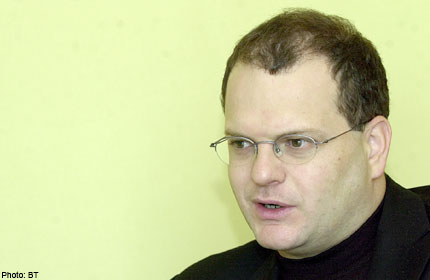
Gil Shwed, CEO & Founder of Check Point Sofware.

SINGAPORE – “Can my kid watch how you milk cows?”

“Can my kid see how you print the newspaper?”

These were questions asked by Israeli inventor and entrepreneur Gil Shwed’s mother when she took him on educational “adventure trips” when he was young, exposing him to a dairy farm, a printing house, and his father’s office in 1972, where at age five he saw a computer for the first time.

He soon signed up for computer classes at age nine, a summer coding job at 12, and took computer science classes at the Hebrew University while still in high school.

Unlike his career-minded peers, Mr Shwed persisted with an idea first cooked up during his military conscription: building a type of computer security software that links up computer networks in a way that would allow some users access to confidential materials while denying access to others. He embarked upon the project with two friends after army conscription and without the security of “proper” jobs.

By 1994, the trio’s Firewall product won the best software award at a computer show, vindicating a venture capital firm’s faith in Mr Shwed’s vision. Check Point Software Technologies listed on Nasdaq in 1996. Its market value today has jumped 12-fold to US$10 billion (S$12.4 billion).

Binding the trio together was a pioneering ethos where “education” with a “bitzu’ism” quality was at its heart. A bitzu’ist is a Hebrew word that loosely translates to “pragmatist” with a resilient quality, like bamboo that bends but does not break in the wildest storms when even oak trees snap. The bitzu’ist is the “builder, the irrigator, the pilot, the gun-runner, the settler all rolled into one”.

Mr Shwed thinks of his home country Israel as a “start-up nation”. “We managed to create a country from zero. We’ve had an entrepreneurial spirit for over 100 years. One thing that really helps us here is that we don’t have a local market.”

Surrounded by hostile neighbours and with few natural resources, Israel has the highest density of start-ups in the world, with one for every 1,800 Israelis. With a population of 7.7 million with 70 different nationalities, Israelis think globally when creating products and innovative firms.

Developing human capital is the key to growing the Israeli economy. Its education system is not about chasing after instrumental achievements such as “grades” or a “checklist-based holistic curriculum vitae” or “high graduation salary”.

The education system in Israel is made market-relevant when plugged into an unique ecosystem that constantly searches for and supports innovative ideas and new products to help build “bamboo innovator” companies such as Check Point.

In “Singapore version 1.0’s” growth since independence, the education system is meritocratic, highly competitive and “standardised”, lifting the technical competence and social mobility of Singaporeans to fit multinational companies (MNCs) with their export-oriented strategies.

This is augmented by higher valued-added services from logistics, shipping and maritime support to legal, finance and accounting, generating high wages to beat inflationary pressures. “Education 1.0” is about meeting the needs of capable MNCs which connect Singapore’s small, open economy to the real marketplace.

Yet the highly skilled workforce is not able to translate its “intangibles” in know-how into building and even owning “bamboo innovators”. The “earnings” accrued from this know-how remain with the MNCs.

In investing lingo, a high-salaried MNC worker has a price earnings (PE) ratio of one while a MNC can have a PE value of 20 times. A productive “bamboo” worker is one who, when a wind blows away his MNC title and position, can still remain a resilient innovator to create value because he has that intangible quality that is indestructible.

MNCs are concerned about the Singapore workforce lacking the initiative and innovativeness desired by knowledge-based industries, thus creating a barrier to a breakthrough in wages and productivity. It is the hollow “emptiness” in its centre – the intangibles – that gives bamboo great strength and flexibility in a raging storm.

The Singapore workforce’s accumulation of wealth and tangible assets for their own sake has evolved into a sense of entitlement, a dangerous liability that erodes character, moral values and social cohesion.

Reform attempts through character education and creative thinking alone are not only difficult but also decidedly off-track. As economist David Landes puts it, nothing dilutes drive and ambition more than a sense of entitlement. This kind of distortion makes an economy inherently uncompetitive.

Instead of the diminishing marginal returns from repeating “Education 1.0”, where school results are instrumental, these complex uncertain times require an education system that enables students to grope and reach directly into the global marketplace, to be sensitive and alert to existing anomalies and paradigms, and to how things ought to function and behave.

Educators must connect and sensitise students to the chaotic global marketplace. It is this sensitivity and alertness that leads to creating “bamboo innovators”.

Reflecting former deputy prime minister Goh Keng Swee’s view about the spirit of education as both “a search for truth” and “the way to a better life”, Singapore’s “Education 2.0” system should centre on how and why resilient firms continue to create value in uncertain and difficult times.

The system should also educate students who dare to become “bamboo innovators” like Mr Shwed, and who will build enduring creations.

As former Israeli president Shimon Peres said, “the most careful thing is to dare”.
The Innovators: The Men Who Built America

http://en.wikipedia.org/wiki/The_Men_Who_Built_America

The Men Who Built America (also known as The Innovators: The Men Who Built America in some international markets) is a History eight-hour, four-part miniseries docudramabroadcast in Fall (autumn) 2012, and on the History Channel UK in Spring 2013. The series focuses on Cornelius VanderbiltJohn D. RockefellerAndrew CarnegieJ. P. Morgan and Henry Ford and how their industrial innovations and business empires revolutionized and, as alluded to in the title, “built” America. The series is directed by Patrick Reams and Ruán Magan and is narrated by Campbell Scott. It averaged 2.6 million total viewers, 1.2 million Adults 25-54 and 1 million Adults 18-49 across 4 nights.

418831_563132657043923_1061238913_n (1)

Tactics to Spark Creativity; To have a good idea, “you have to be able to float through your environment with your antennae up, like a butterfly, and just let things ping your antennae.”

April 2, 2013, 7:20 p.m. ET

Tactics to Spark Creativity

Even People Who Lack Ideas Can Set the Scene for Inspiration; Just Walk Away

By SUE SHELLENBARGER

Why is it that some people rack their brains for new ideas, only to come up empty—while others seem to shake them almost effortlessly out of their sleeves? Whether creativity is an innate gift or a cognitive process that anyone can jump-start is a question so intriguing that researchers keep studying it from different angles and discovering new and surprising techniques. Several recent studies suggest that the best route to an “aha moment” involves stepping away from the grindstone—whether it’s taking a daydream break, belting back a drink or two or simply gazing at something green. Of course, personality can make a difference. People who rate high in openness to new experiences in personality tests also may be more distractible and curious, according to a 2010 study in Creativity Research Journal. Among 158 college students, those who were less inhibited and more receptive to lots of stimuli also were able to generate more ideas than others, says the study by British researchers.

But personality isn’t the only path to inspiration, researchers say. Walking away from a problem to do simple, routine tasks, and letting the mind wander in the process, can spark creative new connections or approaches to solving dilemmas, says a 2012 study in Psychological Science. That helps explain why “a lot of great ideas occur at transition times,” when people are waking up or falling asleep, bathing, showering or jogging, says Jennifer Wiley, a psychology professor at University of Illinois at Chicago and lead author of a 2012 research summary in Current Directions in Psychological Science. Read more of this post

Video: Haptic-feedback shoes guide blind walkers

Video: Haptic-feedback shoes guide blind walkers

Posted by: Kate Torgovnick

April 1, 2013 at 5:51 pm EDT

The footage in this video — which shows a man, a woman and a teenager walking down paths, around curves, up stairs and across streets — may not at first viewing seem remarkable. But the people in this video are blind — and walking without a cane or guide dog. Instead, they are being guided by their shoes. These shoes, which TED Senior Fellow Anthony Vipin Das introduced us to at TED2013, use haptic feedback and GPS technology to guide the blind. Each pair contains electronic circuitry, sensors and small actuators that give the wearer feedback on their movement as they walk, vibrating to tell them when to turn or lift their feet. (See Katherine Kuchenbecker’s great TED-Ed lesson to the field of haptic technology, which debuted on TED.com just last week.) They use a voice-programmed app that reads local GPS maps and plan routes. They have sensors that note obstacles and tell the wearer to stop. The shoes can also read gestures from the walker — for example, two taps means “take me home.” These shoes are called Le Chal, which means “take me there” in Hindi. And as Vipin Das shared in this Q&A with the TED Blog, they are being tested in their first clinical study at LV Prasad Eye Institute in Hyderabad, India. Expected to be available this year, the shoes can be pre-ordered at Ducere Technology’s website. “It’s very encouraging to see the kind of response we’ve had from wearers,” Vipin Das tells the TED Blog. “They were so moved because it was probably the very first time that they had the sense of independence to move confidently — that the shoe was talking to them, telling them where to go and what to do.”

Frank Sherman’s Horizon Coach Lines is one of the largest privately owned of its kind in North America. “You have to know how to handle 5,000 people an hour”; “We are changing the culture of Horizon from the ground up”; “We kept it asset-light”

Value Added: His bus business moves big crowds for big profits

By Thomas Heath, Monday, April 1, 6:05 AM

ValueAdded0401voisard081364673307

Frank Sherman runs his sprawling, Sandy Spring-based special-events bus business — with its 1,250 coaches and shuttles — with military precision.

He has to when dealing with the hordes who need to board his buses at events such as technology exhibitions, Republican conventions and Major League Baseball All-Star games.

If the buses aren’t present and the line doesn’t move, people lose faith. A docile crowd can turn unruly, ruining his reputation in an afternoon.

“You have to know how to handle 5,000 people an hour,” said the 52-year-old businessman, who has been riding the bus business since he was a kid, helping his father’s tour service whisk customers to weekend trips in New York and New England. Read more of this post

Creating ‘bamboo innovators’ in S’pore (Straits Times, April 1, 2013)

http://www.stasiareport.com/premium/opinion/story/creating-bamboo-innovators-spore-20130401

Creating ‘bamboo innovators’ in S’pore

Uncertain conditions can breed innovative businesses, where risk-taking educators nurture flexible students.

Published on Apr 01, 2013
Check Point Software Technologies CEO and founder Gil Shwed, an Israeli inventor and entrepreneur who started the Firewall security software. — PHOTO: CHECK POINT SOFTWARE TECHNOLOGIE
By Kee Koon Boon For The Straits Times
Read the published version below and the unedited longer version hereRead more of this post

New book shares insights from Steve Jobs’ 1st boss, Atari’s Steve Bushnell; Bushnell turned down an offer from his former employee to invest $50,000 in Apple during its formative stages, a one-third stake now worth $120 billion

New book shares insights from Steve Jobs’ 1st boss

(philstar.com) | Updated March 28, 2013 – 4:11pm

bushnell

In this photo taken Wednesday, Mar. 20, 2013, Nolan Bushnell, the founder of Atari poses for a photo at “Two-Bits-Circus,” a Los Angeles idea factory focused on software, hardware and machines. Bushnell was the first guy to give Steve Jobs his first full-time job in Silicon Valley at Atari. (AP Photo/Damian Dovarganes)

SAN FRANCISCO (AP) — When Steve Jobs adopted “think different” as Apple’s mantra in the late 1990s, the company’s ads featured Albert Einstein, Bob Dylan, Amelia Earhart and a constellation of other starry-eyed oddballs who reshaped society.

Nolan Bushnell never appeared in those tributes, even though Apple was riffing on an iconoclastic philosophy he embraced while running video game pioneer Atari in the early 1970s. Atari’s refusal to be corralled by the status quo was one of the reasons Jobs went to work there in 1974 as an unkempt, contemptuous 19-year-old. Bushnell says Jobs offended some Atari employees so much that Bushnell eventually told Jobs to work nights when one else was around.

Bushnell, though, says he always saw something special in Jobs, who evidently came to appreciate his eccentric boss, too. The two remained in touch until shortly before Jobs died in October 2011 after a long battle with pancreatic cancer.

That bond inspired Bushnell to write a book about the unorthodox thinking that fosters the kinds of breakthroughs that became Jobs’ hallmark as the co-founder and CEO of Apple Inc. Apple built its first personal computers with some of the parts from Atari’s early video game machines. After Jobs and Steve Wozniak started Apple in 1976, Apple also adopted parts of an Atari culture that strived to make work seem like play. That included pizza-and-beer parties and company retreats to the beach.

“I have always been pretty proud about that connection,” Bushnell said in an interview. “I know Steve was always trying to take ideas and turn them upside down, just like I did.”

Bushnell, now 70, could have reaped even more from his relationship with Jobs if he hadn’t turned down an offer from his former employee to invest $50,000 in Apple during its formative stages. Had he seized that opportunity, Bushnell would have owned one-third of Apple, which is now worth about $425 billion — more than any other company in the world.

Bushnell’s newly released book, “Finding The Next Steve Jobs: How to Find, Hire, Keep and Nurture Creative Talent,” is the latest chapter in a diverse career that spans more than 20 different startups that he either launched on his own or groomed at Catalyst Technologies, a business incubator that he once ran. Read more of this post