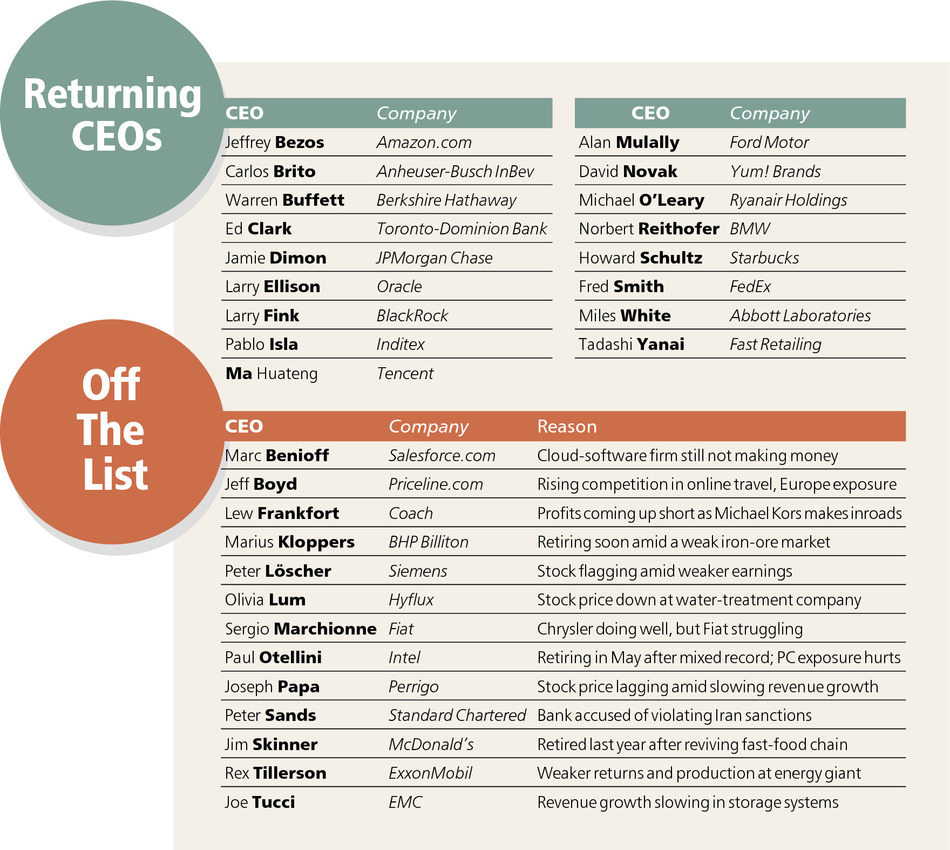
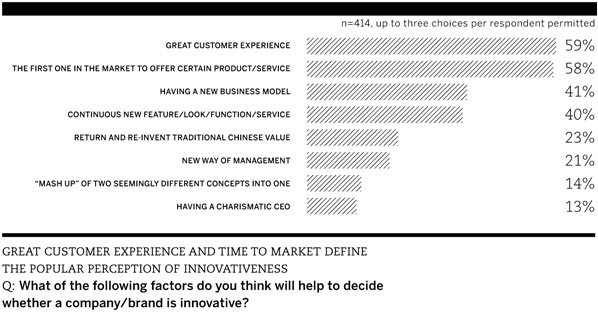
Innovation by Asian business leaders no longer a luxury; Amid the changing rules driven by the acceleration of globalisation, Asian leaders must be game-changing innovators to succeed in the new normal

Innovation by Asian business leaders no longer a luxury

The Nation March 30, 2013 1:00 am

Amid the changing rules driven by the acceleration of globalisation, Asian leaders must be game-changing innovators to succeed in the new normal, according to a study by global management consulting firm Hay Group.

Increasing globalisation is a given, with international competition likely to grow fiercer and markets even more diversified. The rise of India and China, coupled with the global economic power shift towards Asia, is reshaping the world before our very eyes. In the West, the number of jobs is falling; in the East, leaders have to learn how to manage in new markets as they expand westwards.  Read more of this post

It’s not just long winters that push Swedes to innovate

It’s not just long winters that push Swedes to innovate

By Nathan Hegedus — 4 hours ago

Nathan Hegedus is a Stockholm-based journalist and communications consultant.

Innovation is a difficult quality to measure, but, by all accounts, Sweden is an innovative place and only getting more so, with top rankings in innovation surveys from the Legatum Institutethe World Intellectual Property Organization, and theWorld Economic Forum. The foundation for this economic strength seems to transcend the absolute terms by which many people view Sweden—either as socialist nightmare or a capital of cool or a place scarred by long winters and Lutheran angst.  In fact, Swedes seem to be pragmatically pulling from their entire heritage—a culture of entrepreneurship going back a century, the social stability of the welfare state, and that sense of pop culture—to reach forward into a globalized future. This is most obvious in a recent slew of stories on the vibrant Stockholm startup scene, headlined by Skype and Spotify, but now including hot companies likeiZettleKlarna and Wrapp.

But innovation in Sweden is not limited to techy startups. Sweden is a world leader in life sciences, with clusters in both the Stockholm area and in southern Sweden, in conjunction with Denmark. And it’s also long been considered on the cutting edge of clean tech, largely inspired in practice and principle by its vast natural resources—meaning its rivers, wind, seas and forests. The country actually imports800,000 tons of trash a year to fuel efficient waste-to-power plants and gets more of its energy from biomass than oil, has set a goal to be oil-free by 2020, and is the leader within the EU in renewable energy. All this creates a welcoming ecosystem for Swedish clean tech companies like gasification firm Chemrec and solar company ClimateWell. In the World Wildlife Fund’s 2012 Clean Tech rankings, Sweden ranked third behind only Denmark and Israel. From the report: Sweden and the USA show a common pattern, scoring well on “evidence of emerging cleantech companies” and “general innovation drivers”. Sweden edged out the USA by scoring stronger (on a relative basis) on the “evidence of commercialised cleantech innovation” factor mainly due to its relatively strong deployment of renewable energy. But Sweden and other Nordic countries across the board need to raise their manufacturing rate and be careful to avoid getting stuck as boutique innovators who never reach a larger scale.

So why does Swedish business “punch above its weight” in terms of innovation, as Skype founder Niklas Zennström recently put it? Read more of this post

The Manual of Ideas: The Proven Framework for Finding the Best Value Investments

The Manual of Ideas: The Proven Framework for Finding the Best Value Investments [Hardcover]

John Mihaljevic (Author)

51Kfbwn7N9L._SY300_

Book Description

Publication Date: August 19, 2013

Reveals the proprietary framework used by an exclusive community of top money managers and value investors in their never-ending quest for untapped investment ideas

Considered an indispensable source of cutting-edge research and ideas among the world’s top investment firms and money managers, the journal The Manual of Ideas boasts a subscribers list that reads like a Who’s Who of high finance. Written by that publication’s managing editor and inspired by its mission to serve as an “idea funnel” for the world’s top money managers, this book introduces you to a proven, proprietary framework for finding, researching, analyzing, and implementing the best value investing opportunities. The next best thing to taking a peek under the hoods of some of the most prodigious brains in the business, it gives you uniquely direct access to the thought processes and investment strategies of such super value investors as Warren Buffett, Seth Klarman, Glenn Greenberg, Guy Spier and Joel Greenblatt.

  • Written by the team behind one of the most read and talked-about sources of research and value investing ideas
  • Reviews more than twenty pre-qualified investment ideas and provides an original ranking methodology to help you zero-in on the three to five most compelling investments
  • Delivers a finely-tuned, proprietary investment framework, previously available only to an elite group of TMI subscribers
  • Step-by-step, it walks you through a proven, rigorous approach to finding, researching, analyzing, and implementing worthy ideas

8 business lessons from the birds and the bees; So-called biomimicry, in which scientists copy nature to solve human problems, is taking hold in industries from energy to consumer goods

8 business lessons from the birds and the bees

So-called biomimicry, in which scientists copy nature to solve human problems, is taking hold in industries from energy to consumer goods. Imagine a day when bees provide inspiration for energy efficient buildings and cars that drive themselves, sharks offer the promise to reduced hospital infections and geckos give ideas for hanging big-screen TV sets. It’s already here. The burgeoning field of biomimicry, in which scientists copy nature to solve human problems, has drawn interest across industries — from energy to consumer goods. “There is a whole pipeline of people inventing by looking to the natural world,” says Janine Benyus, founder of Biomimicry 3.8, a consultancy that has helped Colgate-Palmolive (CLFortune 500), Levis, Nike (NKEFortune 500) and Boeing (BAFortune 500) reformulate products using biomimicry Here’s a look at how nature is breeding new ideas.

Geckos

Amherst University scientists studied how geckos cling flat to surfaces to develop a copycat reusable fabric for hanging heavy loads. The gravity-defying secret: a unique arrangement of tendons and skin. The fabric, called “geckskin,” could be on the market in 2014. A piece the size of an index card could hold everything from glass to a 42-inch TV screen — anything up to 700 pounds — on a flat surface.

Bees

Bees coordinate to do amazing tasks like building nests and chasing off invaders. Now Toronto-based Regen Energy has applied that “swarm logic” to develop software that lets heating and cooling units in big box stores work together wirelessly to decide when and how often units run to maximize energy efficiency. Target (TGTFortune 500) and Sears (SHLDFortune 500)rely on Regen Energy to manage energy at their stores.

Lotus Leaf

Germany’s stucco and coating company Sto AG created a unique kind of exterior paint modeled after the lotus leaf’s ability to dry quickly and stay clean after a rainstorm. Sto copied the plant’s bumpy microstructure to come up with Lotusan paint, designed to stay cleaner and last twice as long as traditional paint.

Lotus Leaf II

Mussels

Northwestern University researchers studied the sticking power of mussels and found that they have unique protein-based adhesives that works well in wet environments. They then copied that makeup to create polymer surgical glue that one day could repair fetal membranes and hopefully prevent preterm labor.

Termites

Termite mounds inspired African architect Michael Pearce when designing a Zimbabwe shopping center. The finished Eastgate Centre copies the mounds’ natural thermal design, using ducts and 48 huge chimneys to move hot daytime air out. The building uses 60% less energy than traditional buildings.

Fish

Nissan is researching how schooling fish and bumblebees can work together to change direction, traveling side-by-side at the same speed and navigating intelligently to avoid obstacles. The goal: mimic that system in cars that drive themselves, avoiding traffic jams and collisions.

Sharks

A University of Florida professor discovered that the tiny microscopic diamond-shape patterns on a shark’s skin actually allow the animal to stay free of marine bacteria. Now Sharklet Technologies in Aurora, Colo., mimics those mathematical patterns to create antibacterial surface textures for medical devices and hospital countertops. Depending on the pathogen, the textures can cut bacteria by 90% to 99.9%.

Fireflies

The inspiration behind better light bulbs in your home? Fireflies. Scientists in Belgium, France, and Canada studied then copied the firefly’s jagged pattern on its reflector panels to come up with a new coating for brighter LED lights. The result: a 55% boost in efficiency compared to traditional LED lights. Researchers hope the innovation will lead to better LEDs in camera phones, televisions, cars, and residential lighting.

16 Secrets To Creating Breakthrough Ideas; Culturematic: How Reality TV, John Cheever, a Pie Lab, Julia Child, Fantasy Football . . . Will Help You Create and Execute Breakthrough Ideas

16 Secrets To Creating Breakthrough Ideas

Mariana Simoes | Mar. 28, 2013, 2:08 PM | 18,954 | 1

What do Arianna HuffingtonJay-Z and the founders of Twitter all have in common?

They changed the face of American culture forever.

They have enabled us to “see ourselves, or something in the world, differently,” explains author Grant McCracken. In his book  “Culturematic,” McCracken discusses how these and other innovators came up with revolutionary concepts that helped shape the way we see the world today.

McCracken describes “culturematic” as “a little machine for making culture. It’s an ingenuity engine.” The cultural innovators practicing this art form all get one key thing right: They challenged the traditional order in which our world is run. “They speak to us because they go against the grain of expectation,” McCracken shares.

We chose 16 of the most valuable secrets from their successes.

Twitter Founders: Don’t do it for others, do it for yourself

“In the early days, the founders of Twitter — Biz Stone, Jack Dorsey and Evan Williams — thought Twitter might appeal to ‘technical geeks’ in San Francisco, who would use it ‘to fool around with and to find out what each other’s up to.’ … At this early stage they were driven by personal passion. So it didn’t especially bother them that, as Stone recalls, ”for the first nine months or so everyone just thought we were fools [and that Twitter] was the most ridiculous thing they’d ever heard of…’ First we make the tech, then the tech makes up.”

Jay-Z: Always be versatile and willing to reinvent yourself

“Many hip-hop artists are unabashedly in it for the money. Some of the point of the exercise is, in the words of 50 Cent, ‘to get rich [or] die trying.’ In 1998 Jay-Z released Vol.2: Hard Knock Life, [which] went to the top of the charts. …The song in question, ‘Hard Knock Life’ attracted immediate attention for its use of a refrain from the Broadway musical ‘Annie.‘ This looked like a deliberate effort to make Jay-Z look less threatening and more accessible, less gangsta more pop. … His choice was, in the words of one critic, ‘completely unexpected.'” Read more of this post

Cao Shiru, the woman behind Zhongnanhai’s Hongqi supermarket; “In business, it is not enough to be self-possessed, you also need innovation”; Cao gives her staff the freedom to carry out their plans and backs them strongly if she believes that their ideas are right.

Cao Shiru, the woman behind Zhongnanhai’s Hongqi supermarket

Staff Reporter 2013-03-28

CFP409141893-153133_copy1

Until its mysterious closure, Hongqi of Chengdu was the only supermarket chain to operate an outlet in Zhongnanhai, the government compound in the heart of Beijing that houses the State Council and the headquarters of the Communist Party.

Despite the setback, the chain’s founder Cao Shiru has proved herself a canny operator in the retail industry, reports the semi-monthly China Entrepreneur.

“The first two characters of my name are pronounced the same as supermarket in Mandarin,” Cao told the magazine, explaining why she has a strong affinity for the retail sector.

Cao’s chain employs over 13,000 workers, and while around 80% of them are female, most of her senior executives are men.

Yu Shi, the company’s deputy general manager, told the magazine that Cao gives her staff the freedom to carry out their plans and backs them strongly if she believes that their ideas are right. Read more of this post

Liberate Your Employees and Recharge your Business Model

Liberate Your Employees and Recharge your Business Model

by Karan Girotra and Serguei Netessine  |   1:00 PM March 27, 2013

It finally seems that the uproar over Marissa Meyer’s diktat banning flexible work policies at Yahoo is dying down. While good arguments were made on both sides of the issue, what got lost in the charged debate was the potential for evolving traditional business models through changing the employee-employer relationship.

Our research on identifying replicable templates for business model innovation shows that innovating how a company engages with its workforce is an often overlooked way of increasing business model performance. The basic structure of the firm-employee relationship has not changed much over the last 50 years. Relying on a forecast of organizational needs, firms select the nature and number of employees, who are then assigned some working hours and tasks to do in those hours.

But a few pioneering companies are challenging each aspect of this traditional model and are offering unprecedented opportunities along the way.

Rethinking Who Your Employees Are

Traditional organizations identify a set of individuals as their “employees” before they are fully aware of the employee’s talents and their needs.  Read more of this post

100 Years of Georg Wilhelm Claussen: A Century for Brands and People. He stands for continuity and innovation, for successful brand management and humane cooperation.

100 Years of Georg Wilhelm Claussen: A Century for Brands and People

  • For almost 75 years Georg W. Claussen has been part of the success story of Beiersdorf
  • For more than three decades he shaped the development of world brands like NIVEA, Eucerin, Labello, 8×4, Hansaplast and tesa as Chairman of the Board and on the Supervisory Board
  • On June 5th the Hamburg-native will turn 100

Hamburg, June 4, 2012 – Georg W. Claussen is an unusual German company figure – the grand nephew of Dr. Oscar Troplowitz, the man who in 1911 invented the largest skincare brand with NIVEA – he consistently lived corporate responsibility and embodies like no other the values of Beiersdorf. He stands for continuity and innovation, for successful brand management and humane cooperation.

_Original_9916_1477624_georg_w_claussen_beiersdorf
Record Setting Life Achievement
As a young man in 1938, Claussen entered the company and starting in 1952, he was a member of the board. In 1957 he became the Chairman of the Managing Board of the then 75-year old Beiersdorf AG. For 22 years he held this position until he switched to the Supervisory Board for another nine years. More than three decades long he shaped the development of world brands like NIVEA, Hansaplast, 8×4 and tesa. Since 1989, he has been part of the company as an Honorary Chairman of the Company. He completed 58 Annual General Meetings behind the podium, first as Chairman of the Board, later as Chairman of the Supervisory Board, then as Honorary Chairman of the Company – surely a unique record in German economy.

An Impressive Figure
The “Elder”, as he is lovingly and respectfully named at Beiersdorf, is in very close contact with the company. Until recently he still worked regularly in his office on the 5th floor of company headquarters on Unnastrasse. “Mr. Claussen was a partner in dialogue for the board and management on many subjects,” said HR and Finance Board Member Dr. Ulrich Schmidt, who has known Claussen for almost 30 years. “As a businessman, not only the brands and markets were important to Claussen, but also the people.” And he embodies something that has become rare today: “Hanseatic Understatement.” He does good without having to talk about it. In this way his outstanding engagement for his home city of Hamburg, and his generous support of numerous institutions and facilities of art, culture, science and social work have earned great respect. The Claussen Simon Foundation, for example, founded in 1982, supports science and its offspring. Read more of this post

New York’s wonder shows planners’ limits; Unplanned social interactions are the key to vibrant cities and companies

March 26, 2013 5:59 pm

New York’s wonder shows planners’ limits

By John Kay

Unplanned social interactions are the key to vibrant cities and companies

The Financial Times reader visiting New York might typically stay or shop in midtown and speed to Wall Street by car or subway. With a few hours to spare, I chose to wander in the area in between, with no particular destination in mind. Greenwich Village, Chelsea, the Bowery and the Lower East Side are full of quirky buildings, eccentric shops and charming cafés, and layer upon layer of American social history.

This is hardly an original observation. It was made to brilliant effect 50 years ago by Jane Jacobs in The Death and Life of Great American Cities. That book was the product of her campaign to stop Robert Moses, the city and state public works executive, building the Lower Manhattan Expressway, an elevated highway that would have enabled motorists to speed directly from Queens to New Jersey via the Williamsburg Bridge and the Holland Tunnel. In the process, it would have destroyed the character of the area through which it passed.

Jacobs explained, through meticulous observation, how the life of cities is the product of multiple, unplanned social interactions. The density of urban living, far from being an evil, is the source of its vitality. Short streets divided into many blocks lead residents and visitors to take a multiplicity of routes and acquire a variety of experiences. Jacobs explained why the planned cities of the world such as Canberra, Brasília, Chandigarh and Letchworth Garden City are so boring. And her readers were told how the expressways Moses had built had damaged the life of the outer boroughs of New York. Read more of this post

China Will Have 300 Million Android Users by the End of 2013 (INFOGRAPHIC)

China Will Have 300 Million Android Users by the End of 2013 (INFOGRAPHIC)

Mar 25, 2013 at 09:58 AM by Steven Millward, in GamingMobile
Let’s start Monday morning with some big numbers. Now that smartphones account for73.2 percent of all mobiles sold in China, and with many locals opting for Android devices across a variety of price-points, it’s not too big a surprise that China is an Android nation. As neatly outlined in this brand-new infographic, China had 224 million Android users at the end of last year (already three times larger than the number of US fandroids), and is on course for 300 million by the end of this year.
Read more of this post

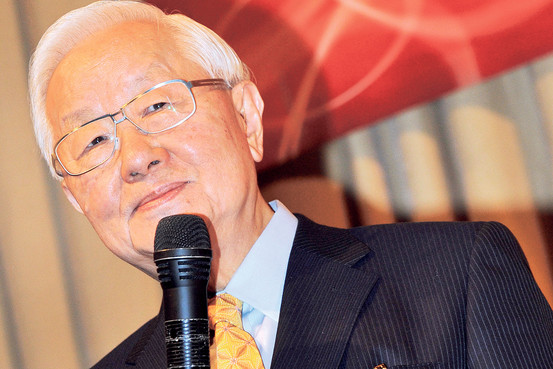
World’s Best CEOs: Morris Chang, Founder/Chairman of TSMC (Market Cap $85 Billion) Rides the Train

Rich Taiwanese Businessman Morris Chang Rides the Train

by Stuart Dingle on Thursday, October 11, 2012

From Yahoo Taiwan:

Taiwan_Morris_Chang_Rides_Train_021

Morris Chang riding the train to work? Its true. Photo spreading on internet like wildfire

TSMC chairman Morris Chang also rides the train to work? Today a photo rapidly spread around the internet, showing TSMC Chairman Morris Chang surprisingly riding the train with the general public, the big boss gave up his luxury car to ride on the general public transit system, leading to widespread discussion among netizens, who rapidly spread the news. Because a ‘big boss riding the train’ is truly too difficult to imagine, when this photo was exposed on Facebook, it was first suspected to have been photoshopped, or simply showed someone who ‘looks a lot like Morris Chang’ riding the train. However, some attentive netizens compared the photos with others, and discovered that this March, ‘Commonwealth magazine’s‘ 492nd edition featured Morris Chang on the cover page,and both the tie worn by Morris Chang on the cover,and the tie worn by Morris Chang in the photo, had an identical style and colour, meaning that the man in the photo is unmistakeably Morris Chang.

It’s understood that when Morris Chang attended this year’s TSMC shareholder meeting, he was worried about being delayed by traffic, so the punctual Morris Chang took the train before getting on the High Speed Rail to Taipei, not only reducing carbon emissions but also ensuring he won’t be delayed. The female student pictured in the photo sitting next to Morris Chang was immersed in her study on the train, with some netizens jokingly saying that if this student would just raise her head and talk to Morris Chang for ten minutes, it would be worth 10 years of study.

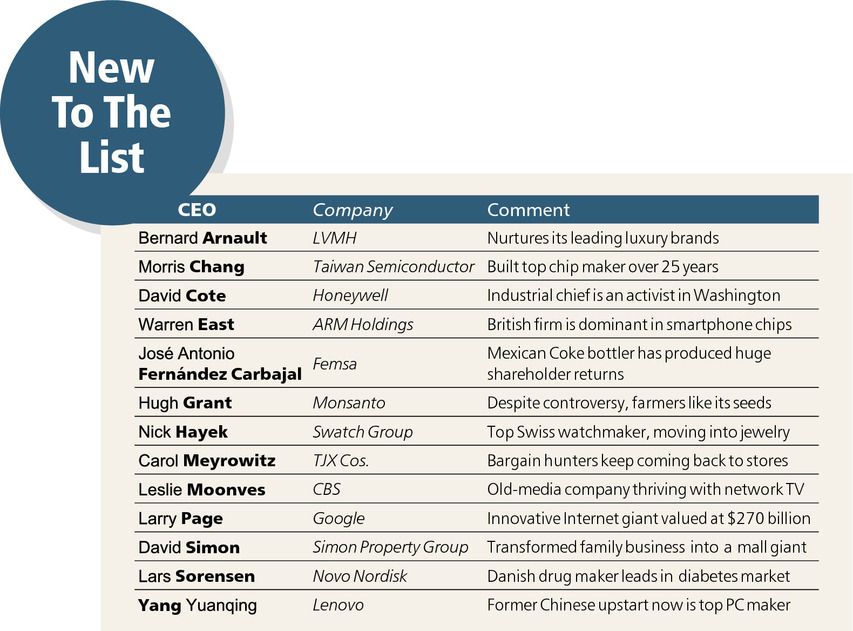
World’s Best CEOs; Profiles of the World’s Best CEOs — Many Paths to Greatness

SATURDAY, MARCH 23, 2013

Profiles of the World’s Best CEOs — Many Paths to Greatness

Profiles of our 30 superstars at Google, BlackRock, BMW — and more.

BA-BB432_ceo_so_G_20130323003833BA-BB369_ceo_ch_G_20130322235543

ON-BA406_NEWCEO_G_20130323013610

ON-BA405_CEOs03_G_20130323013605 Read more of this post

Lockheed Martin Says This Desalination Technology Is An Industry Game-Changer; The problem is that current filters use plastic polymers that require an immense amount of energy (800 to 1,000 pounds per square inch of pressure) to push water through. Lockheed has developed a special material (graphene) that doesn’t need as much energy to drag water through the filter.

Lockheed Martin Says This Desalination Technology Is An Industry Game-Changer

Dina Spector | Mar. 22, 2013, 12:45 PM | 9,777 | 33

The latest technology for removing salt from seawater, developed by Lockheed Martinwill be a game-changer for the industry, according to Ray O. Johnson, senior vice president and chief technology officer of the jet and weapons manufacturer.

Desalination technology is used in regions of the world, particularly developing countries, where fresh water is not available. Water from oceans or rivers is diverted into treatment plants where the salt is removed and clean drinking water is produced through a process called reverse osmosis.

Imagine a tank with seawater on one side and pure water on the other, separated by a filter with billions of tiny holes. Lots of pressure on the salty side pushes water through faster than the salt, so fresh water comes out the other end.

The problem is that current filters use plastic polymers that require an immense amount of energy (800 to 1,000 pounds per square inch of pressure) to push water through.

Lockheed has developed a special material that doesn’t need as much energy to drag water through the filter.

Graphene is a substance made of pure carbon. Carbon atoms are arranged in a regular hexagonal or honeycomb pattern in a one-atom thick sheet. Read more of this post

Singapore’s leading inventor Nelson Cheng: ‘I go around looking for trouble’

Singapore’s leading inventor: ‘I go around looking for trouble’

pspatent01

S’pore’s leading inventor Nelson Cheng reveals how he comes up with ideas. -TNP
Jennifer Dhanaraj

Wed, Mar 20, 2013
The New Paper

SINGAPORE – Meet Singapore’s leading inventor.

And when he says “eureka” – it is potentially worth a couple of million dollars.

Mr Nelson Cheng, 56, is the president and founder of local chemical company Magna International.

According to the Intellectual Property Office of Singapore (Ipos), while the Agency for Science, Technology and Research (A*Star) – the nation’s lead agency for scientific research – has consistently been the local leader in applying for patents, the individual who has obtained the most patents is Mr Cheng.

He has eight patents locally – which, according to him, already have a commercial value of “hundreds of millions”.

When we meet him in his office on Enterprise Road, the wall of its conference room is adorned with gold and silver certificate plaques of successful patent grants from all over the world.

In all, he has filed 16 patents worldwide. These include ones in Taiwan and the European Union for the same inventions that he has patented here. This is to “protect his inventions” in overseas markets.

“Every time I am awarded a patent, I still feel immense joy. It never gets old,” he says with a twinkle in his eye.

His innovations range from biodiesel lubricants to corrosion inhibitors that can be used in the commercial, industrial and even military sectors.

Mr Cheng filed his first patent with Ipos in 2007 – and it was a long, drawn out process. Read more of this post

CEO Jim Donald’s Memo to Staff: Take More Risks; Growth and innovation come from daring ideas and calculated gambles, but boldness is getting harder to come by at some companies.

March 19, 2013, 6:54 p.m. ET

Memo to Staff: Take More Risks

MK-CB740_RISK_DV_20130319154202

CEOs Urge Employees to Embrace Failure and Keep Trying

By LESLIE KWOH

When Jim Donald took the helm at Extended Stay America a year ago, he sensed fear.

Many employees at the national hotel chain, which had recently emerged from bankruptcy, were still stuck in survival mode. Worried about losing their jobs, they avoided decisions that might cost the company money, such as making property repairs or appeasing a disgruntled guest with a free night’s stay.

“They were waiting to be told what to do,” recalls the former Starbucks Corp.SBUX -0.18% chief executive. “They were afraid to do things.”

So Mr. Donald gave everyone a safety net: He created a batch of miniature “Get Out of Jail, Free” cards, and is gradually handing them out to his 9,000 employees. All they had to do, he told them, was call in the card when they took a big risk on behalf of the company—no questions asked.

Growth and innovation come from daring ideas and calculated gambles, but boldness is getting harder to come by at some companies. After years of high unemployment and scarred from rounds of company cost-cutting and layoffs, managers say their workers seem to have become allergic to risk. Read more of this post

Taxation to be introduced for China’s e-commerce industry

Taxation to be introduced for China’s e-commerce industry

Staff Reporter 2013-03-19

China’s State Administration of Taxation announced measures for the administration of online invoices on March 7, which include a trial electronic invoicing system. The measures will come into effect from April 1.

The measures are seen by many as a step towards taxing the country’s emerging e-commerce industry, reports Time Weekly in Guangzhou.

The weekly quotes sources saying that online shops which make more than 240,000 yuan (US$38,000) a year will be required to pay taxes. Read more of this post

Oh, the joys of screwing up: People (and companies) learn best by accelerating the failure cycle, not by avoiding it

Oh, the joys of screwing up

March 18, 2013: 11:46 AM ET

People (and companies) learn best by accelerating the failure cycle, not by avoiding it.

By Jeff DeGraff

(TheMIX) — Innovation poses two problems for most leaders, given the way they are trained to think. First, its value diminishes over time; it goes sour, like milk. This year’s “must-have” gadget will end up in a landfill next Christmas or at least be overwritten by version 2.0.

Second, innovation only pays off in a future for which you presently have no data. As Kierkegaard put it “Life can only be understood backwards; but it must be lived forwards.”

So, you can’t answer the two questions that will determine the value of your clever initiative: How much? How fast? The speed and magnitude of an innovation is situational. If you don’t time the market right, anticipate the new breakthrough tech, or if you sell your product in the wrong color, you’re out. And there is that other little challenge of having competitors, known and otherwise, conspiring to cut you off at the pass.

A leader who is in denial about this uncertainty might collect excessive data, a passive aggressive form of resistance, instead of launching a wide array of experiments that will accelerate the path to failure and provide real information.

Leaders ought to focus on the highly ambiguous situations where uncertainty not only elicits new ideas but provokes new ways of thinking. Artists call this sensation defamiliarization — meaning seeing common things in uncommon ways.

A company’s culture, competencies, and practices will largely determine the vision, values, goals and even processes it pursues. Sure, your team did that assessment of personality types at your last leadership retreat but, when push comes to shove, everyone needs to do things the right way: your way, your boss’ way, your client’s way. Forget the breakthroughs that come from the tension of accepting diverse approaches to solve problems. It’s time to get with the program. You don’t have time, money, or patience for this constructive conflict nonsense.  Read more of this post

Tinkering key to innovation

Tinkering key to innovation

Created: 2013-3-16

Author:Wang Yong

DESPITE the global success of Apple iPhones, the US suffers a stasis in technological innovation – at least in the eye of American journalist Alec Foege, author of “The Tinkerers: The Amateurs, DIYers, and Inventors Who Make America Great.” While Thomas Edison (1847-1931) tinkered with projects in an unstructured way, the author says that a modern-day American would more often than not be enslaved by standardized test scores that leach creativity. American children today are also less creative, observes the author, who believes that many busy parents deprive their children of any opportunities for unstructured play – the setting where taking old things apart and creating new things used to be part of growing up. Partly because of this rigid education that suppresses the spirit and skills of tinkering, the US is no longer the biggest producer of engineers and scientists. As the author points out, it has fallen behind many other countries in filing new patents. “True tinkering is all about risk and unusual behavior. The far-flung fanaticism that world-class tinkering requires rarely thrives in an institutional setting,” says the author. Because the education system cannot be overhauled any time soon – most universities and colleges in America still survive and will continue to survive on mass-producing standard graduates and diplomas – one way to improve the nation’s creative spirit and capacity is for the government and corporations to fund pure experiments.  Read more of this post

Information innovator

Saturday March 16, 2013

Information innovator

By JENNIFER LO

INFORMATION technology (IT) is all about innovation. Vish Iyer can’t agree more.

Mobility, social media and big data are all hot-button topics. Cloud computing frees up people from the desk, so an IT system can be managed even on the road. “For a bank, it could be payment via Internet banking or mobile phone,” says the high-flying corporate executive.

“For an insurance company, it could mean enabling an agent to get quotations and conduct transactions on his or her mobile.” For an airline, pilots no longer carry huge bags with heavy operating manuals. “We put that on an iPad,” he adds.

Few would believe the president for Asia Pacific at Tata Consultancy Services (TCS) has neither training in IT nor a background in engineering. He learns by doing.

Born and raised in Kolkata around the time when India’s first computer arrived, Iyer graduated from St Xavier’s College, one of the city’s best-known educational institutions with a major in taxation and economics.

Now the head of the largest service provider in the Asia-Pacific region based in Singapore, he manages 10,000 employees in 13 countries including Australia, Japan, China and South Korea.

The 45-year-old Indian company, whose clients include Microsoft andING Group, is the provider of IT services and business solutions, with a turnover exceeding US$12bil and market capitalisation of US$45bil on the Bombay Stock Exchange.

It is part of the Tata group, India’s largest conglomerate in seven sectors including communications, engineering and energy, with a revenue of more than US$100bil in the fiscal year 2011-12. Read more of this post

Innovator: Martin Riddiford’s Gravity-Powered Lamp to replace hazardous kerosene lamps still used in many developing countries

Innovator: Martin Riddiford’s Gravity-Powered Lamp

By Caroline Winter on March 14, 2013

tech_innovator1213__01__630x420

Hazardous kerosene lamps, still used in many developing countries, are a major expense for many of the world’s estimated 1.5 billion families without electricity. Poor households typically spend at least 10 percent of their income on kerosene, as much as $36 billion a year worldwide, according to the World Bank. So far, efforts to use solar energy to power lights in developing nations have run up against cost and technical challenges. Attempts to use hydroelectric microgrids or repurpose old car batteries have also been problematic, says Joe Hale, president of the nonprofit Global BrightLight Foundation. Gravity could help. British industrial designer Martin Riddiford has created a pineapple-size lamp powered by a 25-pound weight that falls about six feet in a half-hour. That may not sound like much, but it’s enough to drive a silent motor at thousands of rotations per second. The GravityLight, which shines slightly brighter than most kerosene lamps, requires a certain amount of elbow grease: Once the weight reaches bottom, it must be manually lifted to repeat the process.

Riddiford, 57, a co-founder of London-based product design firm Therefore, got the idea four years ago after leaving a meeting with a charity interested in solar tech. “I just sort of had this vision of, well, why can’t you use human power and store it as potential energy rather than in a battery,” he says. The designer, whose Brinlock Abacus calculator was the first with number-shaped buttons, and whose firm has developed products for Toshiba, Samsonite, and Nike (NKE), says he regrets not having done charitable work overseas in his youth and hopes to make up for it with his light. The first prototype, a large-scale contraption involving a bicycle wheel and a windup LED flashlight, was refined over four years into its current cheap yet durable plastic version. “It’s technically quite tricky to get it so it doesn’t jam, but we solved that problem through lots of experimentation,” Riddiford says. GravityLight will have its first field tests this summer in Africa, Asia, Latin America, and the Middle East. Once Riddiford’s team works out the final kinks, the basic model will retail for about $5. Therefore is also weighing development of a brighter version with more settings for camping and emergencies, and may eventually use its gravity-based technology to develop a cell phone charger. In December, Therefore pitched the lamp on crowdfunding site Indiegogo to help cover production costs, and in a month received $400,000, far more than the $55,000 it sought. Bill Gates called GravityLight “a pretty cool innovation,” and Therefore says donors and potential partners range from soda companies to the U.S. Department of Defense. “It’s such a clean source of light, and it’s easy to operate,” says Global BrightLight Foundation’s Hale. “The market is unlimited for them.” Still, before GravityLight goes to market, Riddiford says, “It will have to stand the test of four continents trying to kill it, trying to stamp on it, destroy it, and use it and abuse it.”

Problem: Kerosene light is a big cost for 1.5 billion families worldwide

A solution: A $5 lamp powered by a 25-pound falling weight

Early response: Plaudits from Bill Gates, interest from the Pentagon

Sparking Innovation and More: “Eureka moments are overrated. ‘Innovations must assume that their plans are partly right and partly wrong. And then work hard at figuring out which part of the plan is wrong.”

etc_cc12lineup_950

The Incredible Science Behind How Nature Solves Every Engineering Problem

The Incredible Science Behind How Nature Solves Every Engineering Problem

Jennifer Welsh | Mar. 14, 2013, 9:13 AM | 2,470 | 

A new trend is emerging, where researchers, designers, and everyone in between are starting to ask, “how can we be more like nature — more renewable, more constructive and more sustainable?”

In a world filled with 7 billion people crammed into mega cities, human kind will have to adapt before we can continue to grow, or else we will destroy the only home we’ve ever known. We need to look to nature for instructions on how to survive on this planet in ways that are “conductive to life,” according to biomimicry pioneer Janine Benyus.

Benyus is the founder of Biomimicry 3.8 (the name is a play on the 3.8 billion years that life on Earth has spent evolving). She’s also the author of a book called Biomimicry: Innovation Inspired By Nature (William Morrow Paperbacks, 2002).

Benyus’s Biomimicry 3.8 workshops have spawned dozens of groups at local levels, bringing together people from all over the world to discuss, talk to scientists, and learn about biomimcry.

Adiel Gavish attended one of these workshops in Costa Rica in 2007, and set up the BiomimicryNYC group in December of 2011.

“Our network is really just here to create a community, to connect these people who are really excited about this next frontier of sustainability,” Gavish said. The program brings people together “to inform one another of all the exciting things we are doing and to catalyze some biomimcry projects and programs in the New York City metro region.”

Read more of this post

Germany’s Model Stresses Execution Over Innovation

March 13, 2013, 4:48 p.m. ET

Germany’s Model Stresses Execution Over Innovation

By BEN ROONEY

BERLIN—Henning Wehn has carved a niche for himself as Germany’s comedy ambassador to the U.K. On a recent TV program when asked what was the worst thing to overhear about yourself, playing to the German stereotype he replied “he isn’t all that efficient.”

The Wall Street Journal Deutschland recently held a tech cafe event in the heart of the capital’s startup district, Mitte, and much of the talk around the tables of the Kaffeemitte was on German entrepreneurship. The general consensus was that while Germany may not culturally be the most entrepreneurial country, the emphasis on execution was a national strength.

It should come as no surprise, then, that a particularly German way of building startups is emerging from the capital city; companies that are less focused on product innovation, and instead hone their execution.

Stepping away from the accelerator model (find existing exciting startups that are doing innovative things, provide them with mentors and a working space in return for equity), Berlin appears to be favoring the incubator (create companies that target specific and identified markets, hire smart people to run with the idea and provide them with the tools to execute).

Leading the way is the powerhouse of the German online economy, Rocket Internet. Founded by the media-shy Samwer brothers, it takes a proven business model, clones it and then just out-executes its competitors. According to the company’s youthful managing director, Alexander Kudlich, “We are able to launch within 3 1/2 weeks—from decision to launching.”

“It’s only about operationally doing every little thing right and faster and better than the others.” Read more of this post

Why the ‘most innovative companies’ aren’t; Leaders of complex organizations tend to surround themselves with likeminded people, which reinforces conventional approaches. At every stage in the life of a new idea or initiative, compliance crushes dissent.

Why the ‘most innovative companies’ aren’t

March 13, 2013: 3:32 PM ET

You may recognize their brands, but these admired companies have few practices in common that would distinguish them from the rest of the rabble.

By Jeff DeGraff

(TheMIX) — Pull out the list of the “most innovative companies” from your favorite business magazine. With the exception of their brand recognition, which is the entry fee for these beauty pageants, they have few innovation practices in common that would distinguish them from the rest of the rabble, whether it’s unique strategies, unusual financing, or novel ways of hiring and staffing.

The fact is that one size never fits all. What makes innovation companies unique is, well, unique. They are highly adapted for their specific situation.

Corporations spend billions of dollars on innovation training every year. Take a close look at popular leading innovation programs and you are likely to find a wide array of distinct subjects and approaches. Read more of this post

How Benjamin Franklin Invented the Mail-Order Business

How Benjamin Franklin Invented the Mail-Order Business

In her 1996 autobiography “An Eye for Winners,” the catalog pioneer Lillian Vernon credited Benjamin Franklin with introducing the “American institution” of mail-order retailing.

Undeniably, Franklin is responsible for many innovations (the first successful circulating library, bifocals and the lightning rod, to name a few). But mail order?

In 1744, Franklin published “A Catalogue of Choice and Valuable Books, Consisting of Near 600 Volumes, in most Faculties and Sciences,” whose title page laid out the terms of sale for the titles he offered, which ranged from treatises on law and philosophy to works of poetry. His sale was to start at 9 a.m. sharp on April 11, and would last for three weeks “and no longer.” Terms were cash only. Notably, the printer, publisher and postmaster allowed people outside of town the opportunity to purchase the books, as well: “Those Persons that live remote, by sending their Orders and Money to said B. Franklin, may depend on the same Justice as if present.”

Franklin didn’t specify how, precisely, his remote customers were to receive their books, and according to James N. Green, an expert on Franklin and the librarian of the Library Company of Philadelphia — the subscription library founded by Franklin — there is no evidence of bound books being sent by post riders during this era, which would have qualified the shipments as “real” mail order. According to Green, “they probably would have been sent by whatever wagon was going that way, like other freight.” Read more of this post

Can a New Culture Fix Troubled Companies?

March 12, 2013, 7:30 p.m. ET

Can a New Culture Fix Troubled Companies?

By JOANN S. LUBLIN

Bob Flexon, chief executive of Dynegy Inc., DYN +2.03% occupies a 64-square-foot cubicle, identical to the ones used by the 235 colleagues who surround him at its Houston headquarters. Hourly employees sometimes stop by his desk to chat.

MK-CB542_CORPCU_G_20130312170955

Eric Kayne for The Wall Street Journal

Dynegy CEO Bob Flexon, shown in his 64-square-foot cubicle on an open floor, where 235 headquarters colleagues surround him.

It’s a long way from the expansive office suite, $15,000 marble desk and Oriental rugs that Mr. Flexon inherited when he arrived at Dynegy in July 2011, four months before the power producer filed for bankruptcy.

Under his command, Dynegy shifted its headquarters last May to a single, open floor in a different building.

The move, which saved $5 million a year, is the most visible symbol of Mr. Flexon’s attempts to overhaul the company’s culture. He aims to transform a business previously focused on day-to-day survival into an agile operator poised for growth.

Among other changes, he made frequent visits to the company’s power plants, banned employees from checking email and phones during meetings and restored annual performance reviews. “The idea was to instill a winning spirit,” Mr. Flexon says. Though Dynegy emerged from bankruptcy last October, its cultural restructuring remains a work in progress.

Increasingly, leaders of troubled businesses try to fix the company’s culture along with its bottom line. Since the financial crisis struck in 2008, CEOs have sought to improve collaboration and decision making, recognizing that a strong culture is “a critical component of their long-term success,” says Nick Neuhausel, a partner at consulting firm Senn Delaney, which advised Dynegy.

“The right culture change can—without question—improve results,” says John Kotter, co-author of the book “Corporate Culture and Performance” and head of research at consulting firm Kotter International. But putting a sick business on a healthier strategic path while changing its culture “is much more difficult than most executives realize,” he cautions. Read more of this post

Fortune 500? Singapore’s Bamboo Innovator 500!

Fortune 500? Singapore’s Bamboo Innovator 500!

By KEE Koon Boon

13 March 2013

“Singapore is too small and its talent pool is too small to produce a world-class manufacturing giant of the Fortune 500 class”, Singapore’s former Minister Mentor Lee Kuan Yew once said. A cryptic remark indeed because it does not imply that the venerable founder of modern Singapore thinks Singapore cannot produce knowledge-based giants, or resilient “Bamboo Innovators”.

Why “Bamboo Innovators”? Bamboos bend, not break, even in the most terrifying storm or devastating earthquake that would snap the mighty resisting oak tree. It survives, therefore it conquers. Disruptive industry trends and black-swan crises have become a permanent fixture in today’s marketplace. How wonderful it would be if countries, companies and individuals can stay resilient amidst the disruptive upheavals and unorthodox challenges – like the bamboo. The study of Bamboo Innovators can hopefully inspire companies to be productive innovators in order to surpass stall points in their business models during tumultuous periods, particularly SMEs aspiring to scale up to become global champions.

But why is it that Asian companies are predominantly product manufacturers in the first place? This could ironically be a result of the Asian values of hardwork and sacrifice. It is far easier for the Asian entrepreneur to be the middleman in getting orders from a few important anchor MNC customers who have access to the end customers, take capital risk in investing in tangible assets, and work hard in producing the required products with quality and efficiency, rather than attempt to build business models that have direct ownership of the hundreds and thousands of end customers. To do the latter would require interacting intensively with the end customers, a task which is beyond that of a lone powerful entrepreneur. As a result, Asian entrepreneurs are unwilling to share the rewards with their “undeserving” staff who did not take risk or sacrifice, thus treating employees as expenses, making most or all of the decisions and hoarding most of the resources and information themselves, running the firms as a “one-man-show”, and facing potential business continuity challenges from succession woes.

Keyence, established in 1974, is an illustration of the unconventional Asian firm. Takemitsu Takizaki, the 67-year-old founder, liberated the firm from manufacturing conventions and built a knowledge-based enterprise in laser sensors for use on automated factory assembly lines serving over 100,000 customers in 70 countries. Despite having only less than 1 percent global market share in a commodity-like product and only around 3,000 employees, Keyence commands a US$17 billion market value, approximately similar to Singapore’s Keppel Corp, a global leader in offshore oil rig design and building. It is also double the value of Nidec, another outstanding Japanese company which has more than 80 percent global market share in miniaturized motor and 100,000 employees.

Takizaki-san, who stepped down from the CEO role to be the Chairman in 2000, understood keenly that Keyence cannot improve on Japan’s legendary manufacturing efficiency. So, unlike its manufacturing-based competitors which focus on manufacturing and leave sales to distributors, wholesalers and agents, it deliberately avoids making products, except for manufacturing steps that involve trade secrets which are kept in-house. Most of its 3,000 employees are either “sales” or “research” staff. In their direct contact with the customers, Keyence’s in-house “sales” team pick up new product ideas on frequent factory visits. They would report back to the research department on what new machines their customers would find useful. They also tell the production department about demand for existing products, helping Keyence to regulate its output and reduce inventories. For instance, Keyence’s frontline solution providers observed from the production lines at instant noodle factories that the noodle quality was compromised because they were manufactured at variable thicknesses. Laser sensors that could measure noodles to 1/100th of a millimetre were develop and used by giants such as Nissin to keep noodle thickness consistent. 25 percent of sales at Keyence are generated from such new products, even higher than 3M.

To excel in these areas, Keyence had to cultivate a meritocratic culture and it is “notorious” for having one of the highest-paid salaries in corporate Japan for its employees. Bright young people from rival firms are attracted to Keyence by the performance-based pay. The engineers also get the chance to do their own research, rather than labouring for years under grey-haired supervisors. The average pay of the employees at Keyence is US$100,000.

“Ownership” of customer by decentralizing and empowering frontline employees also helped IBM to stave off a near-death experience in the early 1990s. When Lou Gerstner took over as CEO in April 1993, IBM had three consecutive years of financial losses, including losing a record $8 billion in 1993, and was about to be broken up. Lou reduced the Big Blue’s dependency in mainframe manufacturing, which was supplanted by personal computers and servers, and built the global platform for services to provide higher value to customers, a core business which today accounts for over 40 percent of its overall profits. Lou had multiplied the market cap 10-folds to $100 billion by the time he passed over the leadership baton in 2002 to Sam Palmisano, who quadrupled earnings and created an additional $130 billion in shareholders’ value in 10 years as he positioned IBM in software and analytics, a task now continued by the new CEO Virginia Rometty.

Keeping the frontline, or the “periphery”, to be resilient and innovative, and the center, or the “core”, to diffuse and enforce meritocratic values to all levels, has compounded immense value at both Keyence and IBM. This core-periphery growth pattern is also that of the bamboo whereby the vitality of its growth revolves around its “empty” center. Instead of sanely constructing itself inch by solid inch like trees, soberly climbing into the contested forest air, the nutrients and moisture that would have been exhausted making and maintaining its empty center can be utilized for growth of its periphery in the other culms (stem). From a builder’s viewpoint, the architecture of the bamboo culm presents a powerful configuration: fibers of greatest strength occur in increasing concentration toward the periphery of the plant.

Manufacturing and project-based companies often tout the size of their “orderbook” and their idea of “teamwork” is about hiring high-profile rainmakers or dealmakers who can bring in the sales orders and the job of everyone else is to execute efficiently and “productively”. The well-connected dealmaker may be able to pull in high-dollar projects but because of the difficulties in coordinating and executing large-scale complex projects, these projects or deals cannot be repeated and the hype associated with big orderbook starts to fade, particularly when cost overruns and delivery delays start to rear their ugly heads. Bigger becomes riskier. Even in manufacturing, the only way to perform and execute large-scale complex projects repeatedly is to create an intangible culture and environment of excellence where the interests of the mid-level and frontline individuals matter by aligning their interests and empower them to become. Customers are attracted to this contagious performance culture rather than to the dealmakers on a relationship basis, or even to the core “team”, resulting in a valuation breakthrough beyond the billion-dollar market value barrier that many Asian companies find hard to break.

A service-based economy does not emanate from taking a broad sector or industry approach, such as identifying “hot” services such as healthcare, education, media and so on. Such a headlong approach can only get the growth engine going only so far. Services sustainability has to stem from equitizing customer ownership based upon performance and interaction, trust, mutual respect and interdependency. This inevitably requires “emptiness” in the business model design like the bamboo with a core-periphery growth structure in order to scale up in a sustainable way. A powerful lone entrepreneur at the center who believes that he has work so hard and sacrificed so much, or a “I-did-it-all-by-myself” mentality, often does not believe in sharing with other “undeserving periphery” people if he does not cultivate a culture rooted in kindness, trust and cooperation.

Culture is like the invisible intricate underground root structure that makes the ground around a bamboo grove very stable – and make possible the flexibility and adaptability of the bamboo to bend, not break, with the wind. Kindness is like water nourishing the powerful roots of bamboo. A culture rooted in kindness definitely seems incompatible in a harsh, competitive business world. But kindness is trusting and ready to risk in new innovations. Kindness is an inner revolution; as is innovation. We become more fluid, more willing to risk. Kindness is about putting less in our possession and more in people. The boundaries between us and others begin to merge, so that we feel engaged and committed as part of a whole in which it is possible to share resources, emotions and innovations.

Rootedness in a culture of kindness and trust triggers the intense instinct, emotional focus and commitment with regard to actively planning for the enterprise’s future as one cohesive singular enterprise, to accept and embrace those who want to contribute, and to engender love amongst the members despite differential rewards and efforts as all work towards the objective of creating a resilient structure as a true compounder, the evergreen Bamboo Innovator.

Fortune 500? With “emptiness” in business model design and “rootedness” in a kindness culture, just like Keyence and Keppel which have almost US$20 billion in value, Singapore can have its own unique Bamboo Innovator 500 powerhouse with a US$10 trillion value.

Education 2.0 in Singapore: The Bitzu’istic Bamboo Innovator

Education 2.0 in Singapore: The Bitzu’istic Bamboo Innovator

By KEE Koon Boon

12 March 2013

“Can my kid watch how you milk cows?”

“Can my kid see how you print the newspaper?”

As a young boy, Gil Shwed was taken on learning adventure trips by his loving mother – to dairy farm, to printing house, including to his father’s office in 1972 where he saw a computer for the first time when he was five years old. Enlivened, and grounded in the values of sacrificial love since young, Gil pursued excellence in an “education” in computer skills by signing himself up for an afternoon computer class in a religious community center at nine, embarking on a summer job coding for a language-translation software company at twelve, and taking computer science classes at the Hebrew University while in high school.

While his high-profiled peers boisterously chased fashionable dollar-seeking career strategies with their well-endowed grades and holistic CV, Gil diligently and silently persisted in building a computer security software, an idea that he had cooked up during his four-year mandatory military conscript in which he strung together military computer networks in a way that would allow some users access to confidential materials while denying access to others. After leaving the army service, Gil, together with his two friends, Shlomo Kramer and Marius Nacht, would work together on borrowed computers in the cramped and hot apartment that belongs to Kramer’s grandmother without much extrinsic reward, and without the psychological security of a “proper” real job, until 1 a.m., then comforted themselves with companionship and Japanese food or went for a drink on the beach.

Gil’s “education” was made market-relevant when plugged into the unique self-organized ecosystem that constantly searches for and supports innovative ideas and new products. A VC fim shared in Gil’s vision and gave him technical and business assistance. The trio unveiled their product at a computer show in Las Vegas in 1994 and won the best software award. That product was called FireWall and their flagship product has never been breached. Their company, Check Point Software Technologies, went on to list in NASDAQ in 1996 and its market capitalization had since multiplied 12-folds to around US$10 billion presently.

“Education” with that bitzu’ism quality was at the heart of the pioneering ethos that connected not only the trio together but also into the global marketplace, adding on to the social capital that higher “education” brings to society when resilient “Bamboo Innovators” are created. A bitzu’ist is a Hebrew word that loosely translates to “pragmatist” with a resilient quality, like the bamboo that bend but not break in the wildest storms that snapped the mighty resisting oak trees. The bitzu’ist is “the builder, the irrigator, the pilot, the gunrunner, the settler” – all rolled together into one.

Gil thinks of his home country Israel as a “startup nation”: “We managed to create a country from zero. We’ve had an entrepreneurial spirit for over 100 years. Brought in immigrants. Fed them. Created a legal system. Built cities. Set up farms in the desert. Invented techniques like drip irrigation. One thing that really helps us here is that we don’t have a local market. We are thinking of customers who are 6,000+ miles away from home.” Adversity, like necessity, breeds inventiveness. Surrounded by hostile neighbors that makes regional trade impossible and endowed with little natural resources, Israel has the highest density of start-ups in the world with one for every 1,800 Israelis from its population base of 7.4 million with seventy different nationalities as Israelis think globally to create international products. These physical constraints ironically positioned Israel for the global turn toward knowledge- and innovation-based economies and companies. After the US, Israel has more companies listed on the NASDAQ than any other country in the world, including the entire European continent, as well as India, China, Korea, Singapore combined. These agile startups darting between the legs of multinational monsters are hungry global champions, with some long-term entrepreneurs who looked not for the tempting quick flips but stayed the painful course to build and last for the long-term, such as Gil’s Check Point, scaling up to become world leaders, brick by brick.

Warren Buffett, the world’s greatest investor and the apostle of risk aversion, broke his decades-long record of not buying any foreign company with the purchase of an 80 percent stake in Iscar Metalworking, the world’s second largest maker of cutting tools which is founded in 1952 in a wooden garage, for US$4 billion in May 2006 – seemingly vulnerable assets in war-torn Israel. Buffett’s view is that if Iscar’s facilities are bombed, it can go build another plant. The plant does not represent the value of the company. It is the “intangible” – the talent of the management, the international base of loyal customers, and the brand – that constitute Iscar’s value. As Iscar’s founder Stef Wertheimer puts it firmly, “We do not miss a single shipment. For our customers around the world, there was no war.” By responding to threats this way, Wertheimer and his team have transformed the very dangers that may make Israel seem risky into evidence of Israel’s inviolable assets. Israelis, by making their economy and their business reputation both a matter of national pride and a measure of national steadfastness, have created for foreign investors a confidence in Israel’s ability to honor, or even surpass, its commitments.

What is striking about Israel is that the development of human capital is the key to growing the economy. Its “education” was made relevant because it was plugged into the unique ecosystem such that the combination of sacrifices and competence has a performance-based outlet to be converted into longer-term relevance for the global marketplace in building a “Bamboo Innovator” company such as Check Point.

In the growth of Singapore 1.0 since its self-governance, the system in education is rightly about forging a meritocratic and highly-competitive “standardized” education system to lift the technical competence and social mobility of the masses to the plateau where they will be able to get the rays of the sun emitted by the multinational companies in its export-oriented economic strategies. This is augmented by higher valued-added services from logistics, shipping and maritime support to legal, finance and accounting, generating high-wages to beat inflationary pressures. This was masterful strategic grand-positioning amidst the geopolitical forces of power in the “hard times” era to meet the exigencies of the global forces in order for the population to stay employed and survive.

In other words, Education 1.0 is about plugging in to the needs of capable MNCs, who, in turn, connect the small, open economy of Singapore to the real marketplace. Along the way, short-term transactional-based tangible wealth was collected amongst the individuals through industriousness in work, and passed on when invested in private assets that have the potential for long-term capital appreciation, such as property, to foster a sense of ownership and stability. As the late Dr Goh Keng Swee, the indefatigable economic architect of Singapore, elucidated: “The way to better life was through hard work, first in schools… and then on the job in the work place. Diligence, education and skills will create wealth.”

Yet, the highly-skilled workforce is not able to house whatever of their “intangibles” in know-how into building and even owning “Bamboo Innovators”. The capitalization of tangible “profits” that accrue from these intangible know-how are housed in and owned by the MNCs vehicles. In investing lingo terms, a high-salaried worker in MNC has a “Price-Earnings” (PE) ratio of one while a MNC can have a PE value of 20 times. A productive “Bamboo” worker is one who, when a wind blows away his or her MNC title and position, can still remain resilient innovators to create value because they have that indestructible “intangible” quality. Interestingly, it is the hollow “emptiness” in its center – the “intangibles” – that gives the bamboo great strength and flexibility in a raging storm. In addition, there are growing concerns expressed by the MNCs that the Singapore workforce lacks the initiative and innovativeness that the knowledge-based industries desire, imposing a barrier to a breakthrough in wages and productivity.

Making further economic and social advancements from this blockage by putting guile ahead of industriousness, their “retained earnings” are deployed into scalping, speculative and hedonic activities which can be socially destabilizing. Their accumulated wealth and assets for its own sake evolve to a sense of entitlement, festering into a dangerous liability that erodes character, moral values, and social cohesion. And healing attempts or reform through efforts in “character education” and “creative thinking” alone is not only difficult but also decidedly off-track. As economist David Landes puts it aptly, nothing is more dilutive to drive and ambition than a sense of entitlement, ingraining in the minds of the elites and the population that they are superior, which reduces their “need to learn and do”. This kind of distortion makes an economy inherently uncompetitive.

Thus, even though America consistently ranked far below Singapore and the East Asian nations in educational metrics such as standardized test scores or prizes won in math and science competitions, the U.S. “education ecosystem” with that bitzu’ism quality continuously enabled the emergence of long-term entrepreneurs with a sense of mission, such as Sam Walton (Wal-Mart), Warren Buffett and Charlie Munger (Berkshire Hathaway), Bill Gates (Microsoft), Steve Jobs (Apple), Ray Kroc (McDonald’s), Jim Sinegal (Costco), Howard Schultz (Starbucks), Jeff Bezos (Amazon), the “Google guys”, and so on.

Instead of getting diminishing marginal returns from repeating the strategy of Education 1.0 that treats educational achievements as instrumental, the education system in this “complex uncertain times” era requires enabling the population to grope and reach directly into the global marketplace, to be sensitive and alert to existing anomalies and paradigms of how things ought to function and behave in the marketplace. It is this sensitiveness and alertness that lead to their discovery through their strong conviction and belief that they can do it significantly better by creating “Bamboo Innovators”. A nation of long-term entrepreneurs who are able to burst asunder the limits of existing knowledge to find and exploit the niches of relative advantage when they introduced their new innovations to positively create value for the customers and society.

At the heart of the educational curricula in any discipline and subject is for the educators and teachers to connect and sensitive the students to the chaotic global marketplace. The disengaged students, upon seeing the reflection of their foggy and incompatible images in this grand mirror, would see inside themselves, embarking on a self-discovery and self-learning journey or Work to equip themselves with both the knowledge and character to once again see themselves more clearly in this mirror. They will experience the uncanny: the raw sensual data reaching their eyes before and after are the same, but with the pertinent framework of meaning, the chaotic features and anomalies in the marketplace are visible. Visible for them to experience the burning sense of mission to sacrifice in undertaking the lifelong Work of building durable enterprises with compulsion, persistence and a sense of urgency. The sacrifices and, at times, pain, can break the heart, but doing anything else would be unimaginable. There will be no idle time to waste for every moment has a strategic importance. Sensitized students will be constantly attentive to the possibility that they may be mistaken, and they will be enlivened by a sense of responsibility towards the Work, internalizing the well-working of the Work as an object of passionate concern and personal committment. This is an ethical virtue.

And being rich or poor is irrelevant in the bitzu’istic education ecosystem without that delusive and destructive chase towards instrumental educational achievements, such as creating “input” in “grades” or “output” in “checklist-based holistic CV” or “high graduation salary”, for it is now plugged into the marketplace. This experience of the uncanny does not reveal itself to idle spectators; to “get it” is an ethical virtue. The poor can beat the rich because they can be more virtuous. Both the poor and the rich can rise through the marketplace by staying productive as diligent builders of enduring enterprises, “Bamboo Innovators” such as Check Point which remain relevant no matter how the uncertain world around us changes as they hold fast to the resilient principles in value creation.

In a rendition of Dr Goh’s view on the spirit of education as both “a search for truth” and “the way to better life”, the mother of purpose and progress in Education 2.0 is to center around the understanding of how and why resilient companies continue to create value in uncertain and difficult times – and educating students to dare greatly to become “Bamboo Innovators” at an individual level like Gil Shwed in building enduring creations can originate that “indestructible intangible” quality which they carry within themselves as an inner compass to navigate the world. After all, as former Israeli President Shimon Peres puts it, “the most careful thing is to dare”, which also articulates the pioneering definition of the Singaporean trait of kiasuism to scale new heights, just like the expression “the bamboo blossoms at ever higher nodes”.

CLAY CHRISTENSEN: Jeff Bezos, Scott Cook, And Steve Jobs Got Disruption Right; “Data is heavy. People want to solve problems and tell their bosses they solved it, not bring them issues all the time. As a result, the higher you get, the less real information you receive

CLAY CHRISTENSEN: Jeff Bezos, Scott Cook, And Steve Jobs Got Disruption Right

Max Nisen | Mar. 11, 2013, 6:31 PM | 1,255 | 1

It’s been some 16 years since Clay Christensen published “The Innovator’s Dilemma” and brought the concept of disruptive innovation to the wider world. Despite that, many companies and executives still haven’t managed to take its core lesson to heart, that it’s not enough to just look at the data. You have to constantly ask questions and look to the future. In an interview appearing at strategy+business, Christensen argues that many executives are pushed to make decisions that are quick and profitable, and they frequently rely heavily on incomplete data. “Data is heavy,” Christensen says. People want to solve problems and tell their bosses they solved it, not bring them issues all the time. As a result, the higher you get, the less real information you receive.

The most successful executives think about why things might turn out differently, have a theory, and constantly update it. Few people are good at that. They don’t ask the right questions, and they aren’t paranoid enough.  Read more of this post

Will We Ever See Another Four Great Inventions from China? Examining Chinese innovation from the consumers’ point-of-view

Will We Ever See Another Four Great Inventions from China?

Examining Chinese innovation from the consumers’ point-of-view.

By Brandon Berry Edwards 艾顿, Lilian Tse 谢丽欣, and Vivian Weng 翁维蔬

will-we-ever-see-2

China’s Four Great Inventions—papermaking, the compass, gunpowder, and printing—were innovations from bygone eras. When looking at China’s history over the past 50 years, it’s very difficult to find a single innovation that has made a significant impact on the world. Instead, the “Chinese version of something Western” phenomenon has characterized much of China’s recent product launches. For example, there is Taobao.com, which is essentially the Chinese version of eBay. Whether China can shed its copycat reputation and become a source of global innovation has become a constant source of debate. While the country’s economy has been growing at an astonishing rate, with an increasingly sophisticated domestic market, the country’s highly centralized government and weak intellectual property system have severely hampered China’s standing as a global innovator.

It may be too simplistic to assume that the notion of innovation is understood, standardized, and commonly defined across the world. China is considered the world’s largest developing market, displaying both characteristics of other emerging markets as well as its own wholly unique notions of success. The simple concept of innovation is very nuanced in China and is most deeply understood by listening to Chinese consumers directly and analyzing what has and hasn’t worked in the marketplace thus far.

Chinese consumers now set new standards

While the macro-economic view of China’s innovation is well covered, the point of view of the Chinese consumer is less known. Read more of this post