It’s About the Work, Not the Office; Corralling workers in one place doesn’t necessarily lead to productivity or innovation

March 7, 2013

It’s About the Work, Not the Office

By JENNIFER GLASS

THE recent decision by Marissa Mayer, the chief executive of Yahoo, to eliminate telecommuting for all workers brings her company back in line with most of corporate America, where working from home is more illusion than reality. Although many — some estimate most — American jobs could successfully be performed at home, only roughly 16 percent of American employees actually telecommute in any given year. And that figure is reached only by using a very generous definition of telecommuting — working from home at least one hour per week.

The idea behind the Yahoo announcement, as well as a more limited announcement from Best Buy this week that will add restrictions to its telecommuting policy, was that bringing workers back to the office would lead to greater collaboration and innovation. This is despite numerous studies showing that telecommuting workers are more productive than those working on-site.

Yet a work force culture based on long hours at the office with little regard for family or community does not inevitably lead to strong productivity or innovation. Two outdated ideas seem to underlie the Yahoo decision: first, that tech companies can still operate like the small groups of 20-something engineers that founded them; and second, the most old-fashioned of all, that companies get the most out of their employees by limiting their autonomy. Read more of this post

Talking It Out: The New Conversation-centered Leadership; Leadership Conversations is part of a growing recognition that the so-called “command and control” model of organizational leadership is fast becoming outdated in today’s world

Talking It Out: The New Conversation-centered Leadership

Published : March 06, 2013 in Knowledge@Wharton

Every year, hundreds of thousands of new graduates enter the business world, eager to climb the corporate ladder. Their progress on the early rungs of that journey will often be determined by qualities like hard work, determination, knowledge and technical proficiency. But business consultants Alan S. Berson and Richard G. Stieglitz argue that those same qualities prove less helpful at higher rungs on the ladder, and may even be one’s downfall if they are not balanced by a very different set of leadership qualities. They sum up the thesis of their new book, Leadership Conversations: Challenging High-Potential Managers to Become Great Leaders, like this: “As you move into upper leadership levels, your technical skills — what you know — become less important. What counts is whom you know and, perhaps more important, who knows and trusts you.”

The importance of building strong working relationships within an organization may seem self-evident. But Berson and Stieglitz go well beyond a call to establish and maintain open lines of communication. The kind of conversations they are advocating for are not simply talk for talk’s sake. Rather, they are the heart and soul of any thriving organization’s culture: a strategic tool incorporating very specific techniques toward very specific ends.

A Changed Environment

Leadership Conversations is part of a growing recognition that the so-called “command and control” model of organizational leadership is fast becoming outdated in today’s world. The reasons for this shift are many. Today’s business environment is increasingly global, diverse, fluid and unpredictable. Technological change and the rise of social media have fundamentally altered the way companies interact with their customers. Rigidly hierarchical organizations risk losing ground to more nimble, collaborative ones. Read more of this post

Learning From the Octopus: How Secrets from Nature Can Help Us Fight Terrorist Attacks, Natural Disasters, and Disease

Learning From the Octopus: How Secrets from Nature Can Help Us Fight Terrorist Attacks, Natural Disasters, and Disease

Rafe Sagarin (Author)

Book Description

Publication Date: March 27, 2012 | ISBN-10: 0465021832

Despite the billions of dollars we’ve poured into foreign wars, homeland security, and disaster response, we are fundamentally no better prepared for the next terrorist attack or unprecedented flood than we were in 2001. Our response to catastrophe remains unchanged: add another step to airport security, another meter to the levee wall. This approach has proved totally ineffective: reacting to past threats and trying to predict future risks will only waste resources in our increasingly unpredictable world.

In Learning from the Octopus, ecologist and security expert Rafe Sagarin rethinks the seemingly intractable problem of security by drawing inspiration from a surprising source: nature. Biological organisms have been living—and thriving—on a risk-filled planet for billions of years. Remarkably, they have done it without planning, predicting, or trying to perfect their responses to complex threats. Rather, they simply adapt to solve the challenges they continually face.

Military leaders, public health officials, and business professionals would all like to be more adaptable, but few have figured out how. Sagarinargues that we can learn from observing how nature is organized, how organisms learn, how they create partnerships, and how life continually diversifies on this unpredictable planet.

As soon as we dip our toes into a cold Pacific tidepool and watch what we thought was a rock turn into an octopus, jetting away in a cloud of ink, we can begin to see the how human adaptability can mimic natural adaptation. The same mechanisms that enabled the octopus’s escape also allow our immune system to ward off new infectious diseases, helped soldiers in Iraq to recognize the threat of IEDs, and aided Google in developing faster ways to detect flu outbreaks.

While we will never be able to predict the next earthquake, terrorist attack, or market fluctuation, nature can guide us in developing security systems that are not purely reactive but proactive, holistic, and adaptable. From the tidepools of Monterey to the mountains of Kazakhstan, Sagarin takes us on an eye-opening tour of the security challenges we face, and shows us how we might learn to respond more effectively to the unknown threats lurking in our future. Read more of this post

To Become More Adaptable, Take a Lesson from Biology. Decentralization. The most successful biological organisms are structured or organized in such a way as to eschew centralized control in favor of allowing multiple agents to independently sense and quickly respond to change

To Become More Adaptable, Take a Lesson from Biology

by Rafe Sagarin  |  12:30 PM March 5, 2013

Remember when Apple’s stock traded at $7 a share? I do, because that’s when I sold my shares. Tech experts’ sage predictions had convinced me that the Mac would never make a dent in the PC market. As it turned out, the Mac didn’t need to make a dent, because Apple mutated its cute computer DNA into cute music players and phones that fit massive unfilled niches. Yet even the genius architect of this turnaround made faulty predictions sometimes. Remember the invention Steve Jobs said was going to be “bigger than the PC”? You may have seen a mall cop riding onerecently.

Even the best of us are horrible at predicting the future. That’s too bad, because our world is full of risk that we’d love to avoid and opportunity that we’d love to seize.

Fortunately, there’s a rich source of lessons on how to thrive in an unpredictable world, and it has been cranking out success stories for 3.5 billion years. It’s called biology.

All of Earth’s successful organisms have thrived without analyzing past crises or trying to predict the next one. They haven’t held “planning exercises” or created “predictive frameworks.” Instead, they’ve adapted. Adaptability is the power to detect and respond to change in the world, no matter how surprising or inconvenient it may be.

While there’s much chatter in the management world about the need to be adaptable, only a few creative companies and innovative managers have probed the natural world for its adaptability secrets. But when they have, they’ve been remarkably successful. A study of nature offers straightforward guidance through four key practices of adaptable systems.

Decentralization. The most successful biological organisms are structured or organized in such a way as to eschew centralized control in favor of allowing multiple agents to independently sense and quickly respond to change. An octopus, despite its surprisingly intelligent brain, doesn’t order each arm to change a certain color when it needs to hide quickly. Rather, individual skin cells across its body sense and respond to change and give the octopus a collective camouflage. Read more of this post

Analytical Innovators: What makes companies that are great at analytics different from everyone else

From Value to Vision: Reimagining the Possible with Data Analytics

Big Idea: Data & Analytics March 05, 2013

David Kiron, Renee Boucher Ferguson and Pamela Kirk Prentice

Introduction

Signs of an Analytics Revolution

Case Study: Oberweis Dairy

Three Ways to Compete with Analytics

Case Study: Caesars Entertainment

The Analytical Innovators

Mindset and Culture

Key Actions

Outcomes: Power Shifts to Those with Insight

On Becoming an Analytics Innovator

The Analytically Challenged

The Analytics Practitioners

Conclusion

About the Research

Acknowledgments

Authors

David Kiron is the executive editor of MIT Sloan Management Review’s Big Ideas initiatives. He can be reached at dkiron@mit.edu.

Renee Boucher Ferguson is the Data & Analytics contributing editor at MIT Sloan Management Review, researching the current and new analytical approaches that change how executives make decisions and innovate. She can be reached at rbfergus@mit.edu.

Pamela Kirk Prentice is the chief research officer at SAS Institute Inc., specializing in deriving insights from qualitative and quantitative information to help address key business issues. She can be reached at pamela.prentice@sas.com.

Companies benefit from analytics

Global study from MIT Sloan Management Review and SAS finds companies gain competitive edge by using analytics.

March 5, 2013

New research released today by MIT Sloan Management Review and SAS reports that 67 percent of companies surveyed are gaining a competitive advantage by using analytics — marking a 15 percent increase from last year and 80 percent increase from two years ago.

The report, “From Value to Vision: Reimagining the Possible with Data Analytics,” derived from a global survey of more than 2,500 business executives, identifies a group of companies leading the way in the analytics revolution, dubbed “Analytical Innovators.” Companies in this category report both strong competitive advantage and improved innovation from using analytics, which are means of interpreting certain data to gain insight and drive business planning. Analytical Innovators are significantly more likely to exhibit three characteristics: a widely shared belief that data is a core asset; more effective use of more of their data for faster results; and support for analytics by executives.

Another important characteristic of Analytical Innovators is their report of power shifts in their organizations: Analytical Innovators are four times more likely than less analytically inclined companies to say that analytics have shifted the power structure within their organizations.

“This is a significant finding, in that power shifts can be disruptive. They often call into question experience and intuition that managers and employees have built up over years,” says David Kiron, executive editor for MIT Sloan Management Review. “Now, those who know how to marshal the data and put analytics behind their decision making are in a position of advantage.”

The study also identified two types of companies less analytically sophisticated than Analytical Innovators: Analytics Practitioners (representing 60 percent of respondents), which have made significant progress, but have not achieved the top level of competitive advantage and innovation from using analytics; and the Analytically Challenged (28 percent of respondents), which are less mature in their use of analytics and have not derived as much value from them as the other groups.

“As we studied all three groups, we were able to clearly see the specific differentiators among the groups,” says Pamela Prentice, chief research officer for SAS. “This enabled us to develop a framework for companies to evaluate their own standing, and to provide recommendations based on a company’s current status.”

The study’s recommendations for the Analytically Challenged include:

  • Start improvements at the local level before trying to address organization-wide issues of technology latency.
  • To further collaboration, build ongoing relationships, facilitate discussions and share information of value to other departments.
  • Fight inertia by developing an executive communication strategy for your analytics case, including a return on investment rate and recommended actions.

P&G’s Legendary Ex-Chief On How Today’s CEOs Are Failing; “They think that benchmarking, best practices and copying what the rest of the industry does is a strategy.” They also get seduced by success, expecting that what’s worked in the past will serve them just as well in the future.

P&G’s Legendary Ex-Chief On How Today’s CEOs Are Failing

Max Nisen | 5 minutes ago | 15 | 

A.G. Lafley was one of the most successful executives in recent times. During his nine years at the top of Procter & Gamble, the consumer product company’s value increased by more than $100 billion. In a recent interview, Lafley told the Wall Street Journal what he saw as current CEOs’ biggest shortcoming:

They don’t think they need a strategy, or their strategies are flawed. They think they have a hot product or hot service, and these don’t last forever. They think that benchmarking, best practices and copying what the rest of the industry does is a strategy. They try to be all things to all people. If you’re not clear about which customers you’re going to serve, how to serve them in a unique and better way that creates real value for them, and your core competencies, you’re just not going to have as much of a chance to win.

Essentially, Lafley is arguing, executives hate to make choices. When they take charge and commit to a strategy or a particular customer group, they become responsible for the consequences. Instead, they play it safe. They look to best practices, and they look to competitors. That may be the easiest path, but that’s not one where you can win. They also get seduced by success, expecting that what’s worked in the past will serve them just as well in the future. During his time at P&G, Lafley developed a 5-step program designed not just to succeed in a market, but to win it entirely, which he lays out in “Playing To Win.” Businesses have to decide what winning is, where to play, how to win, what their core competencies are, and what management systems they need to execute their strategy. Not only that, but they have to build those kinds of questions into their culture, so things are approached strategically on every level and constantly re-evaluated.

Joy at Work: A Revolutionary Approach To Fun on the Job; the story of AES, whose business model and operating ethos -“let’s have fun”-were conceived during a 90-minute car ride from Annapolis, Maryland, to Washington, D.C. In the next two decades, it became a worldwide energy giant

Joy at Work: A Revolutionary Approach To Fun on the Job [Paperback]

Dennis W. Bakke (Author)

images

Book Description

Publication Date: July 1, 2006

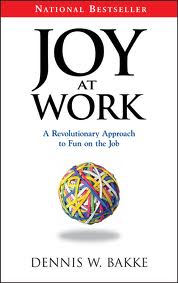
Imagine a company where people love coming to work and are highly productive on a daily basis. Imagine a company whose top executives, in a quest to create the most “fun” workplace ever, obliterate labor-management divisions and push decision-making responsibility down to the plant floor. Could such a company compete in today’s bottom-line corporate world? Could it even turn a profit? Well, imagine no more.

In Joy at Work, Dennis W. Bakke tells the true story of this extraordinary company–and how, as its co-founder and longtime CEO, he challenged the business establishment with revolutionary ideas that could remake America’s organizations. It is the story of AES, whose business model and operating ethos -“let’s have fun”-were conceived during a 90-minute car ride from Annapolis, Maryland, to Washington, D.C. In the next two decades, it became a worldwide energy giant with 40,000 employees in 31 countries and revenues of $8.6 billion. It’s a remarkable tale told by a remarkable man: Bakke, a farm boy who was shaped by his religious faith, his years at Harvard Business School, and his experience working for the Federal Energy Administration. He rejects workplace drudgery as a noxious remnant of the Industrial Revolution. He believes work should be fun, and at AES he set out to prove it could be. Bakke sought not the empty “fun” of the Friday beer blast but the joy of a workplace where every person, from custodian to CEO, has the power to use his or her God-given talents free of needless corporate bureaucracy.

In Joy at Work, Bakke tells how he helped create a company where every decision made at the top was lamented as a lost chance to delegate responsibility–and where all employees were encouraged to take the “game-winning shot,” even when it wasn’t a slam-dunk. Perhaps Bakke’s most radical stand was his struggle to break the stranglehold of “creating shareholder value” on the corporate mind-set and replace it with more timeless values: integrity, fairness, social responsibility, and a sense of fun. Read more of this post

The Decision Maker: Unlock the Potential of Everyone in Your Organization, One Decision at a Time; How Dennis Bakke build AES into a Fortune 200 global power company with 27,000 people in 27 countries.

The Decision Maker: Unlock the Potential of Everyone in Your Organization, One Decision at a Time [Hardcover]

Dennis Bakke (Author)

DecisionMaker Cover-Perseus.indd

Book Description

Publication Date: March 5, 2013

Who makes the important decisions in your organization? Strategy, product development, budgeting, compensation—such key decisions typically are made by company leaders. That’s what bosses are for, right? But maybe the boss isn’t the best person to make the call.

That’s the conclusion Dennis Bakke came to, and he used it to build AES into a Fortune 200 global power company with 27,000 people in 27 countries. He used it again to create Imagine Schools, the largest non-profit charter-school network in the U.S.

As a student at Harvard Business School, Bakke made hundreds of decisions using the case-study method. He realized two things: decision-making is the best way to develop people; and that shouldn’t stop at business school. So Bakke spread decision-making throughout his organizations, fully engaging people at all levels. Today, Bakke has given thousands of people the freedom and responsibility to make decisions that matter.

In The Decision Maker, a leadership fable loosely based on Bakke’s experience, the New York Times bestselling author shows us how giving decisions to the people closest to the action can transform any organization.

The idea is simple.

The results are powerful.

When leaders put real control into the hands of their people, they tap incalculable potential. The Decision Maker, destined to be a business classic, holds the key to unlocking the potential of every person in your organization. Read more of this post

The Truth Behind “Secret” Innovation At Nike, Apple, Google X

The Truth Behind “Secret” Innovation At Nike, Apple, Google X

BY AUSTIN CARR

MARCH 5, 2013

Our annual guide to the state of innovation in our economy, featuring the businesses whose innovations are having the greatest impacts across their industries and our culture as a whole.  Read more of this post

Big data in the age of the telegraph: Daniel McCallum’s 1854 organizational design for the New York and Erie Railroad resembles a tree rather than a pyramid. It empowered frontline managers by clarifying data flows

Big data in the age of the telegraph

Daniel McCallum’s 1854 organizational design for the New York and Erie Railroad resembles a tree rather than a pyramid. It empowered frontline managers by clarifying data flows.

March 2013 • Caitlin Rosenthal

In 1854, Daniel McCallum took charge of the operations of the New York and Erie Railroad. With nearly 500 miles of track, it was one of the world’s longest systems, but not one of the most efficient. In fact, McCallum found that far from rendering operations more efficient, the scale of the railroad exponentially increased its complexity.1

The problem was not a lack of information: the growing use of the telegraph gave the company an unprecedented supply of nearly real-time data, including reports of accidents and train delays.2 Rather, the difficulty was putting that data to use, and it led McCallum to develop one of the era’s great low-tech management innovations: the organization chart. This article presents that long-lost chart (see sidebar, “Tracking a missing org chart”) and shows how aligning data with operations and strategy—the quintessential modern management challenge—is a problem that spans the ages. Read more of this post

Emerging Value Summit 2013 (April 9-10). R.E.S.-ilient Compounders in (the Next) Crisis: Buffett + Bosch + Baiyao = Bamboo Innovators

Dear Friends and All,

Value investors focused on emerging markets will gather at the “Emerging Value Summit 2013” (http://www.valueconferences.com/reg/emerging13/) on April 9-10 to share their insights and ideas. Some of the speakers include Tata Capital CEO Mr Praveen Kadle, FCA Corp Founder & CEO Mr Robert Scharar, Ms Lauren Templeton etc. The Emerging Value Summit 2013 is organized by The Manual of Ideas, the definite source of value investing ideas (http://www.manualofideas.com/).

I am honored to be invited by Oliver from The Manual of Ideas to be one of the speakers to share with you the topic:

R.E.S.-ilient Compounders in (the Next) Crisis: Buffett + Bosch + Baiyao = Bamboo Innovators”. Thank you Oliver.

Further updates will be uploaded on the Emerging Value Summit 2013 website from next week.

Thank you for your kind feedback and encouragement all along. Hope you will enjoy this latest upcoming presentation about Bamboo Innovators, a research series to establish thought leadership on resilient and innovative value creators in Asia and around the world.

Kind regards,

Koon Boon (KB)

Why innovation is sequester-proof

Why innovation is sequester-proof

By Vivek Wadhwa, Tuesday, March 5, 1:39 AM

This may come as surprise to people in Washington (or perhaps not), but the sequester is hardly a topic of discussion in Silicon Valley. Indeed, it’s not even a trending topic on Twitter. That is how unimportant short-term government decisions are to innovation. While lawmakers battle over taxes and fiscal cliffs, entrepreneurs are busy solving humanity’s problems so that we can go from debating how we distribute scarce resources to discussing how we equitably share the bounty we are creating.

In his bestselling book, “Abundance”, my colleague, XPRIZE Chairman and CEO and Singularity University founder Peter Diamandis, tells the story of how aluminum went from a rare metal to something we casually wrap our food in. When the king of Siam hosted Napoleon III in the 1840s, writes Diamandis, the people working for Napoleon were served with silver utensils. Those working for the king received gold. The king himself got aluminum-the rarest metal at the time. Aluminum was so valuable because it was extremely difficult to extract from bauxite-though it is one of the most abundant elements on Earth. Then came electrolysis technology, which used electricity to liberate aluminum from bauxite, driving down aluminum’s value.

It isn’t just aluminum that has become abundant — so have electrical power, refrigeration, television, telephones, cars, and air conditioning. Two hundred years ago, kings and queens didn’t have these luxuries. Today, many people who are classified as poor in the U.S. do. This prosperity has not reached most of the developing world yet. But the proliferation of mobile phones shows what is possible. Within ten years, their numbers have gone from zero to nearly 1 billion in both India and China. Even some of the poorest villagers own them. Read more of this post

Big-Bang Disruption; A new kind of innovator can wipe out incumbents in a flash

Big-Bang Disruption

by Larry Downes and Paul F. Nunes

By now any well-read executive knows the basic playbook for saving a business from disruptive innovation. Nearly two decades of management research, beginning with Joseph L. Bower and Clayton M. Christensen’s 1995 HBR article, “Disruptive Technologies: Catching the Wave,” have taught businesses to be on the lookout for upstarts that offer cheap substitutes to their products, capture new, low-end customers, and then gradually move upmarket to pick off higher-end customers, too. When these disrupters appear, we’ve learned, it’s time to act quickly—either acquiring them or incubating a competing business that embraces their new technology.

But the strategic model of disruptive innovation we’ve all become comfortable with has a blind spot. It assumes that disrupters start with a lower-priced, inferior alternative that chips away at the least profitable segments, giving an incumbent business time to start a skunkworks and develop its own next-generation products.

That advice hasn’t been much help to navigation-product makers like TomTom, Garmin, and Magellan. Free navigation apps, now preloaded on every smartphone, are not only cheaper but better than the stand-alone devices those companies sell. And thanks to the robust platform provided by the iOS and Android operating systems, navigation apps are constantly improving, with new versions distributed automatically through the cloud.

The disruption here hasn’t come from competitors in the same industry or even from companies with a remotely similar business model. Nor did the new technology enter at the bottom of a mature market and then follow a carefully planned march through larger customer segments. Users made the switch in a matter of weeks. And it wasn’t just the least profitable or “underserved” customers who were lured away. Consumers in every segment defected simultaneously—and in droves.

That kind of innovation changes the rules. We’re accustomed to seeing mature products wiped out by new technologies and to ever-shorter product life cycles. But now entire product lines—whole markets—are being created or destroyed overnight. Disrupters can come out of nowhere and instantly be everywhere. Once launched, such disruption is hard to fight.

We call these game changers “big-bang disrupters.” They don’t create dilemmas for innovators; they trigger disasters. Read more of this post

Jonah Berger On The Power Of Scarcity; Contagious: Why Things Catch On

Jonah Berger On The Power Of Scarcity

BY JONAH BERGER

MARCH 1, 2013

In Fast Company’s April issue, we’ll profile Jonah Berger, the 32-year-old Wharton professor who has become one of the world’s foremost experts on what goes viral and why. It’s easy to find examples of products or ideas that have spread and become popular, but as he writes, “It’s much harder to actually get something to catch on. Even with all the money poured into marketing and advertising, few products become popular.” His new book Contagious: Why Things Catch On, being published next week by Simon & Schuster, tries to answer the question, Why do some products, ideas, and behaviors succeed when others fail? In this exclusive excerpt, which will be serialized in five parts, he explores the concept of social currency, one of the six elements Berger says helps unravel the mysteries of virality.

In 2005, Ben Fischman became CEO of the discount shopping website SmartBargains.com. The business model was straightforward: companies wanting to offload clearance items or extra merchandise would sell them cheap to SmartBargains, and SmartBargains would pass the deals on to the consumer. There was a broad variety of merchandise, and prices were often up to 75% lower than retail. But by 2007 the website was floundering. Margins had always been low, but excitement about the brand had dissipated, and momentum was slowing. A year later Fischman started a new website called Rue La La. It carried high-end designer goods but focused on “flash sales” in which the deals were available for only a limited time–24 hours or a couple of days at most. And the site followed the same model as sample sales in the fashion industry. Access was by invitation only. Sales took off, and the site did extremely well. So well, in fact, that in 2009 Ben sold both websites for $350 million.

Rue La La’s success is particularly noteworthy, given one tiny detail. It sold the exact same products as SmartBargains. How come Rue La La was so much more successful? Because it made people feel like insiders.

Read more of this post

Maker’s Schedule, Manager’s Schedule; Most powerful people are on the manager’s schedule. It’s the schedule of command

Maker’s Schedule, Manager’s Schedule

Paul Graham

July 2009
One reason programmers dislike meetings so much is that they’re on a different type of schedule from other people. Meetings cost them more.

There are two types of schedule, which I’ll call the manager’s schedule and the maker’s schedule. The manager’s schedule is for bosses. It’s embodied in the traditional appointment book, with each day cut into one hour intervals. You can block off several hours for a single task if you need to, but by default you change what you’re doing every hour. When you use time that way, it’s merely a practical problem to meet with someone. Find an open slot in your schedule, book them, and you’re done.

Most powerful people are on the manager’s schedule. It’s the schedule of command. But there’s another way of using time that’s common among people who make things, like programmers and writers. They generally prefer to use time in units of half a day at least. You can’t write or program well in units of an hour. That’s barely enough time to get started.

When you’re operating on the maker’s schedule, meetings are a disaster. A single meeting can blow a whole afternoon, by breaking it into two pieces each too small to do anything hard in. Plus you have to remember to go to the meeting. That’s no problem for someone on the manager’s schedule. There’s always something coming on the next hour; the only question is what. But when someone on the maker’s schedule has a meeting, they have to think about it. Read more of this post

Why Innovation By Brainstorming Doesn’t Work

Why Innovation By Brainstorming Doesn’t Work

BY DEBRA KAYE

FEBRUARY 28, 2013

Anything–even doing laundry–will help you dream up new ideas better than sitting in a meeting, says Debra Kaye, author of “Red Thread Thinking.” A case study of the history of the single-use detergent pod. Eleven men and women file into a conference room and take their places around a large table. Coffee cups and pastries are assembled in front of them. George, the leader, steps up to a large whiteboard and scrawls across the top “SOAP STORM SESSION 9/18/12.” “Okay, let’s begin,” he tells the group. “Let’s just start free-associating. What do we think of when we think clean laundry?” he asks. “To get the ball rolling, I’ll write a few words down,” he says and dashes off chore, piles, whites and brights, and fresh on the board. “What else?” he asks. Several people add a few more words: time-consuming, fold, bright, uncontaminated, pretty, nice, old-fashioned, and pleasant. The meeting continues for about an hour, with more words and thoughts added. The plan was for the team to come up with a new idea for laundry detergent. When the meeting is over, the team members file back to their cubicles, word lists in hand, to ponder the outcome–but none of them ever produced any new insights into doing laundry that would lead to a new product. That’s because the group made the fatal error of trying to innovate by brainstorming around the idea of the central attribute of laundry–cleanliness. So while they came up with a pretty long list of words, none of the few concepts that came out of the meeting–“cleans in a shorter time,” “cleans without presoaking,” “brightens without fading”–was out-of-the-box spectacular. This scenario takes place every day in office suites around the world. That’s an important point to remember, because companies everywhere are brainstorming the same things about clean laundry as my imaginary team. Everything about clean laundry likely has been thought of before. It turns out that a brainstorming session is a great place to load up on baked goods and caffeine, but it’s not so great for generating ideas. In fact, the team in my imaginary example would have come up with more original associations and innovative thoughts had they stayed home and sorted a sock drawer, taken a hike, relaxed in a bathtub, or done just about anything else autonomously–including a load of laundry.

The conventional wisdom that innovation can be institutionalized or done in a formal group is simply wrong. Part of what we know about the brain makes it clear why the best new ideas don’t emerge from formal brainstorming. First, the brain doesn’t make connections in a rigid atmosphere. There is too much pressure and too much influence from others in the group. The “free association” done in brainstorming sessions is often shackled by peer pressure and as a result generates obvious responses. In fact, psychologists have documented the predictability of free association. Read more of this post

The World’s Most Admired Companies: Built for brilliance; Seven of those top 10 companies are one-man phenomena: Apple, Google, Amazon, Starbucks, Southwest Airlines, Berkshire Hathaway, FedEx

The World’s Most Admired Companies: Built for brilliance

By Geoff Colvin, senior editor-at-large @FortuneMagazine February 28, 2013: 7:55 AM ET

The most important trend in the World’s Most Admired Companies ranking isn’t the concentration of tech firms at the top, striking though that is. The list holds an even larger and more powerful pattern: Seven of those top 10 companies are one-man phenomena. Apple, Google, Amazon, Starbucks, Southwest Airlines, Berkshire Hathaway, FedEx — each is the reflection of a single individual (or two, at Google) who is still around, with the notable exception of Apple’s Steve Jobs, gone less than 18 months.

To see how unusual that is and what large questions it raises for any company’s future in today’s economy, one must consider the very first Most Admired list, which appeared 30 years ago, in 1983. Only one among the top 10 was a one-man phenomenon: Digital Equipment, run by founder Ken Olsen. The others were all long-established institutions, corporate aristocracy: IBM, Hewlett-Packard, Johnson & Johnson, Eastman Kodak, Merck, AT&T, General Electric, General Mills.

Why this massive shift? In an information-based economy, a company can rocket to industry dominance and a towering valuation in the space of a founder’s career, much faster than in an industrial economy. It can also fall right back down, as Yahoo, AOL, and MySpace prove. Read more of this post

Billionaire inventor James Dyson: Why we invent in Britain, but build in Singapore

Why we invent in Britain, but build in Singapore

James Dyson

Published at 12:01AM, February 26 2013

Singapore offers skills, location and a supply chain. The UK’s future lies in ideas and patents

For the past 15 years, Dyson’s highly-skilled engineers have been developing a tiny revolution in our laboratories. It is a new motor a third the size of a traditional one, but which can spin 100,000 times a minute — five times faster than a Formula One engine. Making 6,000 adjustments a second for optimal performance, the Dyson digital motor can supercharge prosaic machines.

At Dyson we invest heavily in our ideas and develop all of our technology in Britain: All our research takes place in Malmesbury where we employ 850 world-class design engineers and scientists — about a third of them recent graduates.

Our new motor performs like no other — and because we are developing it in our own laboratories, with our own people, no one else can get their hands on it (despite trying!).

This is not only good for Dyson, but also for Britain. The intellectual property is owned here and all the profits will flow back to the United Kingdom where we pay more than 85 per cent of our global tax.

But last week, Dyson opened a new £150 million (S$281.4 million) motor manufacturing facility in Singapore. Why?

Savvy governments understand the need to support advances like our new motor and to create incentives for companies to develop them. They also value the highly skilled workforce able to develop them — 40 per cent of graduates are engineers, versus 2 per cent in Britain. They realise that the more successful the company, the more they export, bringing more revenue into the country and employing more people.

And the potential for discovery at the moment is enormous, particularly in the sphere of materials. There are significant gains to be made from materials such as carbon 60 and graphene, which was discovered in Manchester. This is 40 times stronger than steel and 1,000 times more conductive than silicon.

Thankfully, Britain is moving in the right direction and there is a renewed desire to develop technology on its shores.

Prime Minister David Cameron has increased the research and development tax credit — which supports companies that take risks and invest in developing ideas for the future — to 225 per cent. As a result, patent applications rose 29 per cent in 2011 and investors have reacted positively.

But Britain still has a shortage of engineers — it has a 60,000 engineering deficit. Who will develop the ideas?

IDEAS AS TRUMP CARDS

Britain is not the only country that is creating incentives for invention — and companies such as ours are in global competition. Singapore understands this and rewards investment in research and development with a thumping 400 per cent tax credit. The country supports and values inventiveness and backs it up with an education system that encourages ingenuity — they have plenty of world-class engineers.

Bereft of natural resources, Singapore realises that human resources and ideas are its trump cards.

The result is a buoyant economy, with highly inventive companies such as Rolls-Royce knocking at its door.

Building a complex motor such as the one that Dyson is developing, with minute tolerances, requires the precision of a fully automated production line. The highly-skilled workforce, the tax incentives and the nearby supply chain make Singapore appealing for us.

We will make six million motors this year; increasing our production capacity by 100 per cent — a necessary jump to meet rising demand, particularly from Japan and America. We source the motor’s 22 components from across Asia, so it makes little sense to ship them to Britain, only to export the finished motors back again. So Singapore is the obvious place for production.

Britain’s focus should be on generating ideas and patenting them — that is the high-value part of the process and the one that will earn this country a competitive advantage. Britons must focus on being the best problem solvers in the world, developing technology and then exporting it.

And for this Britain needs high quality engineers, backed up by supportive government incentives. The country has the foundations in place — but continuing government support, both through the education system and tax system, is essential.

Sir James Dyson is the founder of Dyson, the technology company. This commentary first appeared in British daily The Times.
Is the start-up nation sustainable? Israeli policy talks in terms of growth, not leadership, and that is no longer enough, argues Roy Keidar

Is the start-up nation sustainable?

Israeli policy talks in terms of growth, not leadership, and that is no longer enough, argues Roy Keidar.

26 February 13 12:59, Roy Keidar

The book “Start-up Nation” is very popular among American Jews. The idea that a small place like Israel, poor in natural resources and facing major security and diplomatic challenges, is number one in the world in start-ups per capita is a source of pride for Jews and Israelis, and an inspiration for other nations. But many people have begun to ask: In view of the processes underway in Israeli society and culture on one hand, and global trends on the other, is the “Start-up Nation” sustainable?

Israel’s success story is interesting and unique. It begins with the need of a society of immigrants to survive in the region. This need gave rise to technological innovations, such as drip irrigation, solar energy, and a slew of defense products developed in Israel. The adage, “Necessity is the mother of invention” was realized in Israel.

But it is not enough. Over the years, we have created a winning combination of scientific ability and an Israeli tendency to take risks. This combination was also the result of high-quality Russian-speaking immigrants, which brought to Israel thousands of scientists, and skilled manpower who were discharged from the army’s technology units.

Following Israel’s economic changes of the 1980s, the opening to the global environment and foreign capital, and access to overseas scientific and technological know-how, the country discovered the formula, which gave rise to the “Start-up Nation” model for the 2000s. And this without even mentioning Israeli genius.

But in the past decade, there have been signs that the model is becoming frayed, especially when global trends and their effect on Israel are examined. The world is competing for innovation and creativity. Multinationals aggressively buy talent, and skilled personnel move from country to country following financial incentives.

Governments provide huge budgets and tax breaks for R&D to create strong national economic clusters. Former growth engines, such as information, computers and telecommunications (ICT) are giving way to new technologies, such as self-production and 3D printers, which require different specializations and preparations to adapt the economy.

Given Israel’s security and economic challenges, it must be the world’s scientific-technological innovation spearhead, since this is the country’s largest resource and the only non-perishable one. The assumption that what worked in the past will also work in the future, and that the market should be allowed to do its thing cannot serve as a working assumption. The world is changing, and Israel must adapt and renew.

How can Israel create the conditions to remain the world’s scientific-technological innovation spearhead? The answer cannot be found in a book or plan, nor can it only depend on the government, the education system, or the private market. The way to be the spearhead of innovation begins and ends with a common vision which sets innovation as the goal and calls on all parties to adapt their operating strategies to achieving this vision, which does not currently exist in Israel.

Israeli policy talks in terms of growth, not leadership, and in the 21st century that is no longer enough.

The author is the CEO of the Reut Institute

Want to Change the World? Be Resilient.

Want to Change the World? Be Resilient.

by John McKinley  |   1:00 PM February 26, 2013

What’s the difference between someone with a good idea and a person who can transform their ideas into real impact? To tackle the world’s biggest problems, we need to be able to identify and support the people who are capable of creating lasting change. At Acumen Fund, we spend a lot of time trying to find and train aspiring and established leaders from around the world who have the right mix of talent, ideas, and passion.

And what we’ve found time and again is: Resilience matters most.

Resilient leaders have three key characteristics:

  1. Grit: Short-term focus on tasks at hand, a willingness to slog through broken systems with limited resources, and pragmatic problem-solving skills.
  2. Courage: Action in the face of fear and embracing the unknown.
  3. Commitment: Long-term optimism and focus on big-picture goals.

Read more of this post

Is traditional leadership on its way out? Today leadership is about Creativeship, which he defines as “the creation of sustainable cultures and business models.”

Is traditional leadership on its way out?

Ray Williams | Feb 26, 2013 5:47 PM ET
In an earlier article in the Financial Post, I argued “If management is so good at predicting outcomes through analytical and scientific methods why have so few public companies performed well?” The leadership of today’s business institutions has increasingly been put under the microscope.

“Companies that are managed the traditional way — by executives developing analytically driven strategy and shaping the organization to meet the needs of the business as they see them — are obsolete. Management as we have known it, is too cumbersome,” argues Thomas Hout in an article in the Harvard Business Review.  That sentiment is also held by Alan Murray, who in an article in the Wall Street Journalwrites that management, as an innovation, won’t survive the 21st century.

Barbara Kellerman, author of The End of Leadership, contends that the leadership industry is a $50 billion a year business, that has been unable to produce true leaders and in essence, failed. Kellerman argues while leaders once dominated and controlled followers, now followers are more educated and independent, and leaders must now rely on influence and persuasion.

Bob Kelleher, author of Creativeship: A Novel for Evolving Leaders contends the definition of leadership as “the ability to lead people, build fellowship and make money” is archaic and so “yesterday.” Read more of this post

Are IPOs Good for Innovation? A Stanford scholar says going public often slows innovation

Are IPOs Good for Innovation?

by Edmund L. Andrews | Feb 27, 2013

A Stanford scholar says going public often slows innovation

For many entrepreneurs, it is a dream on par with finding the Holy Grail: an initial public stock offering that can turn a startup into the next Google and a 20-something founder into the next mega-millionaire.

Yet, for all that money and drama, do initial public offerings — IPOs — speed up technological innovation?

Not necessarily. An eye-popping new study by Shai Bernstein, an assistant professor of finance at the Stanford Graduate School of Business, finds that innovation slowed down by about 40% at tech companies after they went public.

In a meticulous analysis of patent data from nearly 2,000 companies, Bernstein found that newly public companies became noticeably more incremental and less ambitious with their in-house research than comparable firms that stayed private. Read more of this post

Watch Zuck, Bill Gates, Jack Dorsey, & Others In Short Film To Inspire Kids To Learn How To Code

Watch Zuck, Bill Gates, Jack Dorsey, & Others In Short Film To Inspire Kids To Learn How To Code

COLLEEN TAYLOR

posted 2 hours ago

Code.org, the new non-profit aimed at encouraging computer science education launched last month by entrepreneur and investor brothers Ali and Hadi Partovi, has assembled an all-star group of the world’s most well-known and successful folks with programming skills to talk about how learning to code has changed their lives — and isn’t quite as hard as people might think.

As you can see in the five minute clip embedded above, the short film (nine minutes in its full length version) which was directed by Lesley Chilcott, known as the producer of Waiting for Supermanand An Inconvenient Truth, is a who’s who featuring Mark ZuckerbergBill GatesJack Dorsey,Drew HoustonTony Hsieh, Miami Heat player Chris Bosh (he studied computer imaging at Georgia Tech before joining the NBA), and many more. It’s a very human look at what can certainly seem to many as a dry or intimidating subject, and it’s really a pleasure to watch. Read more of this post

Culture as Risk Mitigant: Cockpit, Country and Company

Culture as Risk Mitigant: Cockpit, Country and Company

Posted: 02/21/2013 11:27 am

How did the national airline of Korea transform itself from one of the most accident-prone to one of the safest carriers in the world in less than a decade? As Malcolm Gladwell forcefully argues in Outliers, the driver was “cockpit culture.”

Most plane crashes are the result of an accumulation of minor malfunctions rendered disasterous by human interaction. As is hauntingly evident from flight recorder transcripts, preventable errors have prevailed due to a breakdown of teamwork and communication.

Cultures can be distinguished by the scale of their power index — the rigidity with which hierarchical distance is maintained — and the extent to which individuals are reliant on rules as opposed to resourcefulness in the face of ambiguities.

The assertiveness and choice of words with which a deputy communicates with his captain or his controller is a direct function of his cultural context. Consequently, linguists and psychologists proved to be as relevant to airline safety as technical engineers. Read more of this post

Kindness + The Accounting of Words and Value Investing

I was just discussing this afternoon about how can one “measure/quantify” the criteria of “kindness”. This is in relation to Yahoo’s Marissa Mayer scrapping the “work-from-home” policy which would affect several working mothers and the policy does not seem aligned with a culture of kindness and trust to foster productivity and innovations. And there are reports that Marissa Mayer paid to have a nursery built in her office; “not all Yahoos have that kind of money and clout” was the feedback gathered by journalist Nicholas Carson from some Yahoo staff. In the R.E.S.-ilience framework of Bamboo Innovators, R stands for Rootedness in a Kindness culture. Perhaps the lack of Kindness can be “quantified” by the disproportionate size of the office and size of perks to the top executives and managers. In a positive way, Kindness can be “measured” by the “number of jokes/humor” in annual reports and company publications, just like Warren Buffett’s folky humor in his widely-followed Berkshire Hathaway’s Letter to Shareholders. Words can reveal kindness and there is growing awareness of how linguistic/textual analysis can be used to highlight the intentions of managers and leaders. Talk about using unorthodox “data”. Below is a brief article “The Accounting of Words and Value Investing” that I wrote in September 2010 which also has relevance to investigating Bamboo Innovators.

Koon Boon

26 Feb 2013

Singapore

27 September 2010 (Updated 22 March 2013)

The Accounting of Words and Value Investing for Bamboo Innovators

By KEE Koon Boon

Have taken down this article as i am submitting this for a posting at a media outlet for a 1-month exclusivity period. Will update accordingly. Thank you.

Seeing Through the Fog of Innovation

Seeing Through the Fog of Innovation

by Scott Anthony  |   1:00 PM February 25, 2013

The Fog of Innovation — that moment when you realize that the data you need to make a critical decision about an innovative idea just aren’t clear. Unfortunately, the data rarely are.

For most large companies that find themselves lost in the fog, the default answer is to keep studying. After all, a risk that doesn’t pan out tends to have more negative repercussions than risks not taken. But remember: data only become crystal clear when it is too late to take action on that data. And time spent waiting for perfect clarity creates room for disruptive upstarts and hungry competitors.

Notably, there is a group that don’t get stuck in the fog: Venture capital-backed startups. (The do, however, have other issues.) How does a startup do it without all of the analytical horsepower of a large company? It works best when three components come together: Read more of this post

INTUIT FOUNDER: ‘Success Makes Companies Stupid’

INTUIT FOUNDER: ‘Success Makes Companies Stupid’

Max Nisen | Feb. 25, 2013, 6:35 PM | 854 | 3

Intuit is one of the unsung success stories of Silicon Valley. The maker of software like Quicken, TurboTax, and QuickBooks has been around for 30 years and made $4.15 billion in revenue last year.

Intuit’s founder, Scott Cook, believes that success can actually be dangerous to the company. At a seminar with Harvard Business School faculty, he said that “Success is a powerful thing, it tends to make companies stupid, and they become less and less innovative.”

According to Harvard Business School Working Knowledge, Cook argues that companies need to adopt the lean startup model pioneered by Eric Ries. That means “launching as quickly as possible with a “minimum viable product,” a bare-bones creation that includes just enough features to allow for useful feedback from early adopters. The company then releases a quick succession of product upgrades, forming hypotheses and conducting experiments with each new version along the way.”

Getting feedback early and often means the product improves quickly, picking up new users along the way.

That’s the polar opposite of the way many successful companies come up with new products. They spend years developing things, many of which are only minor improvements on what already exists. Once something’s set into motion, it has a great deal of inertia and can take a long time to stop, even if it’s not working.

That’s an easy way for a company to stagnate. However, adopting something like the lean startup model takes a significant cultural shift. It’s not easy to take product teams used to taking years and get them to take ideas from birth to execution in months. It also takes creating a culture that’s OK with failure and starting again, which is the opposite of what you see in many large companies.

Some companies choose to have a small part of their company, like a skunk works, to constantly try to innovate. But when it’s a small part of the company, you see small benefits. Far more effective is forcing a whole company to constantly experiment and innovate.

JCPenney COO: ‘I Hated The JCPenney Culture, It Was Pathetic’

JCPenney COO: ‘I Hated The JCPenney Culture, It Was Pathetic’

Kim Bhasin | Feb. 25, 2013, 11:51 AM | 16,278 | 13

P1-BK427_PENNEY_NS_20130224170304P1-BK428_PENNEY_G_20130224170604

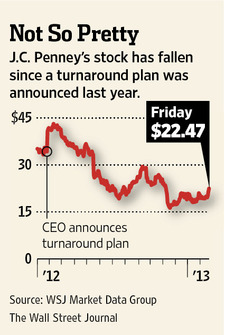
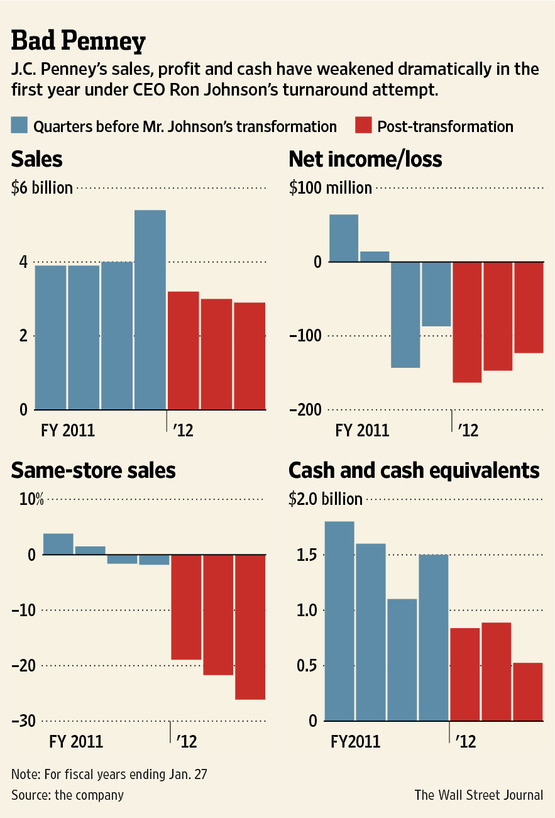
JCPenney experienced a seismic shift on corporate culture when CEO Ron Johnson took the helm of the company more than a year ago.

The new guard didn’t like JCPenney’s old way of doing things at headquarters.

Not one bit.

Dana Mattioli at The Wall Street Journal spoke with JCPenney COO Michael Kramer about the company’s culture and the mass layoffs at the company’s headquarters. He’s one of the execs brought in by Johnson, who he’d previously worked with at Apple.

“I hated the JCPenney culture,” Kramer told the WSJ. “It was pathetic.” Read more of this post

East Meets West in Class

Updated February 25, 2013, 5:02 p.m. ET

East Meets West in Class

Pericles Lewis is founding president and professor of humanities at Yale-NUS College, a joint venture between Yale University and National University of Singapore, to open in August.

IV-AA332A_LEWIS_G_20130225140903 Read more of this post

Innovation is the fuel of economic growth, and the Holy Grail for companies and countries around the globe; Israel’s Innovation Formula

February 25, 2013, 4:49 p.m. ET

In Search of the Spark…and the Next Big Thing

Innovation is the fuel of economic growth, and the Holy Grail for companies and countries around the globe

By JOHN BUSSEY

What makes a company innovative? An individual? A country? Why is Silicon Valley still such an exceptional—and singular—example of self-propelled creativity? And what will happen when India and China finally learn to mix the magic sauce of innovation in bulk?

Innovation isn’t just at the center of human creativity and corporate profit. It’s fuel for economic growth and one reason hundreds of millions of people in developing countries have leapt up the income curve over the past two decades. Governments, especially authoritarian ones, understand that without it, growth may slow, jobs may get scarce and instability may rise.

“There are already areas of entrepreneurial ferment across Asia,” Tarun Khanna of the Harvard Business School told a group of entrepreneurs, CEOs and industry executives at The Wall Street Journal’s conference on Unleashing Innovation in Singapore last week. The key question, Mr. Khanna counseled the delegates from 25 countries, “is how do we take these little sparks and scale them up in some way that’s meaningful.”

That’s the same question corporate chiefs—from General Electric GE -2.48% toNokia NOK1V.HE +0.98% to Sony 6758.TO -2.31% —are asking every day. How can they generate the spark that ignites the next big thing? Executives at the conference heard some familiar advice: cultivate creativity, a dynamic workplace, irreverence, risk-taking and cross-discipline networking. Read more of this post