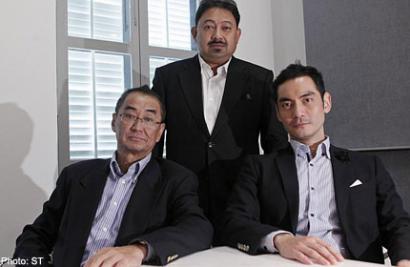
The fraud detective: Jim Chanos saw through Enron, Tyco, and the subprime mortgage mess. And made money on them

The fraud detective

Jim Chanos saw through Enron, Tyco, and the subprime mortgage mess. And made money on them.

By Richard Conniff | Sep/Oct 2013

On a muggy Thursday in the dog days of August 2011, the news broke that the American technology giant Hewlett-Packard was about to acquire British software maker Autonomy Corp. The offer price represented a 64 percent premium on the previous day’s close. At his office in mid-Manhattan, hedge fund manager Jim Chanos ’80 did not rejoice. Only a few weeks earlier, his firm, Kynikos Associates, had put together a report on Autonomy, calling its chief operating officer unqualified, its customers unenthusiastic, its market share and growth numbers questionable, its financial disclosures “very poor,” and its margin profile “suspiciously high.” Read more of this post

Will history repeat itself at KT? Prosecutors raided KT’s head office and its chief Nam Joong-soo’s residence as part of an investigation into bribery allegations involving the telecom operator

2013-10-22 18:26

Will history repeat itself at KT?

Kim Tae-gyu
On Oct. 16, 2008, prosecutors raided KT’s head office in Bundang, Gyeonggi Province and its chief Nam Joong-soo’s residence as part of an investigation into bribery allegations involving the telecom operator and its affiliates. It took less than a month for Nam to resign ― he stepped down on Nov. 5 after a court issued an arrest warrant for him on charges of accepting 300 million won ($260,000) in bribes from subsidiaries and contractors. New CEO Lee Suk-chae filled the vacancy on Jan. 14, 2009, igniting controversy that all prior moves were politically motivated after the launch of the Lee Myung-bak administration in February 2008. Read more of this post

FSS to conduct special probe into Hyosung Group; family of chairman Cho Seok-rae borrowed money from Hyosung Capital, a financial arm of the group, under borrowed names

FSS to conduct special probe into Hyosung Group

2013.10.23 14:47:24

Hyosung Group, which was investigated by the Financial Supervisory Service (FSS) earlier this year, will be under another special probe on allegations that the family of chairman Cho Seok-rae borrowed money from Hyosung Capital, a financial arm of the group, under borrowed names. The FSS will launch a probe next month into Hyosung Capital on suspicions that chairman Cho Seok-rae’s family received several billion won loans from Hyosung Capital using borrowed names of corporate executives, according to a local news agency, Yonhap News Wednesday. Extending loans to the family of the owner did not infringe the relevant law, but FSS has apparently found some irregularities in Hyosung Capital`s loan approval procedure to the owners through its board and is considering restrictions against the group, according to the FSS’s probe on the financial unit of the group from April to May. Back then, the FSS did not investigate into whether the loans under the borrowed names were extended to the family, but this time, appointed a special prosecutor for the probe with rising suspicions. Meanwhile, Seoul Regional Tax Office filed a charge on September 30 against the conglomerate with the prosecution on allegations that the group raised slush funds by evading corporate tax through an accounting fraud worth one trillion won from 1997 and it did not pay taxes through management of borrowed-name assets.

A new financial reporting standard (FRS) affecting the consolidation of financial statements will become effective for annual periods beginning on or after Jan 1, 2014, the Singapore Exchange (SGX) reminded investors

PUBLISHED OCTOBER 23, 2013

SGX reminds investors of new consolidation rule

MICHELLE QUAH MICHQUAH@SPH.COM.SG

A NEW financial reporting standard (FRS) affecting the consolidation of financial statements will become effective for annual periods beginning on or after Jan 1, 2014, the Singapore Exchange (SGX) reminded investors yesterday. The new standard, FRS 110, issued by the Accounting Standards Council, could change the entities that consolidated into the group’s consolidated financial statements. “FRS 110 . . . makes control the basis for determining the entities to be included in consolidated financial statements. More entities will be included in the consolidated financial statements if the issuer is able to establish control over them,” SGX said in a mailer, sent via its investor education portal My Gateway, yesterday. “This means the assets, liabilities, income, and expenses of these ‘investees’, or subsidiaries, will be reflected in the consolidated financial statements as if they were part of the issuer group, likely affecting the final figures,” SGX’s report added. Read more of this post

Proposed changes in auditor reporting are expected to dramatically change the way external auditors reflect their opinions on companies’ financial statements

PUBLISHED OCTOBER 23, 2013

Changes ‘to add colour and insight to audit reports’

ISCA event discusses today how proposals will apply in S’pore context

MICHELLE QUAH MICHQUAH@SPH.COM.SG

Changing auditor reporting

[SINGAPORE] Proposed changes in auditor reporting are expected to dramatically change the way external auditors reflect their opinions on companies’ financial statements. Among the key proposals are the provision of more information on how audits are performed – a new section will highlight the key audit matters that came up during the audit – and the audit opinion will be placed right at the beginning of the audit report to increase its prominence. The aim is to provide greater transparency on what goes into an audit and to increase the usefulness of the audit report to users, building on the standard one-page document most audit reports are these days. Read more of this post

Fund firms wrestle with “star manager” syndrome

Fund firms wrestle with “star manager” syndrome

Tuesday, Oct 22, 2013

Reuters

LONDON – Neil Woodford’s surprise announcement last week of his planned departure from fund manager Invesco Perpetual neatly encapsulates the risks to fund firms who employ such star managers and the investors who back them. They can leave. Woodford, widely feted for a defensive stock-picking style that made money throughout the financial crisis, is responsible for running around 30 billion pounds (S$60.22 billion) of assets, out of the firm’s 70 billion total. His 25-year career made him one of the best known money managers among Britain’s private investors. Yet for the fund firms who employ such individuals, there are clear risks of becoming over-dependent on their presence. Read more of this post

Repeatedly burned, short sellers avoid momentum stocks

Updated: Tuesday October 22, 2013 MYT 6:55:17 AM

Repeatedly burned, short sellers avoid momentum stocks

NEW YORK: Even as some of Wall Street’s biggest trading favorites – considered by many to be massively overvalued – report earnings this week, short sellers are staying away. Shorts have become gun-shy as the market has continued to rally, making bets against high-flying stocks like Netflix or Tesla very expensive ones. Steep losses have been amplified by “short squeezes,” where shorts are forced to cover their bets to prevent further losses. Read more of this post

What happens when retailer Sears is supposedly valuable for its tangible property assets and the business is managed by a dealmaker? 18 Depressing Photos That Show Why Nobody Wants To Shop At Sears

18 Depressing Photos That Show Why Nobody Wants To Shop At Sears

ASHLEY LUTZ OCT. 21, 2013, 8:26 AM 71,887 57

Sears, once America’s golden retailer, is a company in crisis.  The company has shuttered hundreds of stores in recent years. The embattled company has been selling some its most profitable stores to raise money. Brian Sozzi, chief equities strategist at Belus Capital Advisors, took poignant photos inside of New Jersey  and New York Sears locations. “To understand why Sears is in a ‘sell stores mode’ one must look no further than the stores themselves, where the truth is to be found,” Sozzi writes. His photos show the sad reality of what Sears is today.

Sears’ mannequins are outdated in comparison with competitors like Macy’s, Lord & Taylor, and JCPenney, Sozzi says. “If you are living darn near paycheck to paycheck, does this presentation excite you about making a purchase with a couple saved up electronic dollars?”

shld-mann-e1382137232438

Sozzi points out that this display is confusing. “Huh? A random football themed carpet with no promotion around it?” he says.

football-carpet1-e1382137446920 Read more of this post

Wang Fengying, China’s only female motor industry CEO

Wang Fengying, China’s only female motor industry CEO

Staff Reporter

2013-10-21

CFP420550083-103435_copy1

Wang Fengying at a Great Wall Motor product launch in Tianjin in August 2011. (Photo/CFP)

Wang Fengying, general manager and CEO of Great Wall Motor Company, is the only female CEO in China’s massive motor industry. Born in October 1970 in the city of Baoding in north China’s Hebei province, Wang obtained her bachelor’s degree from the Tianjin Institute of Finance and began working for Great Wall Motor in 1991. She later returned to her alma mater and completed a master’s degree in economics in 1999. Wang, who turns 43 this month, as spent her entire career at Great Wall Motor. After working at the company for 13 years, predominantly in sales and marketing, she was promoted to general manager and CEO, making her the first — and to date only — female chief executive of a motor vehicle manufacturer in China. Read more of this post

Shanghai ZPMC, the world’s biggest maker of container cranes, move from profit to loss; ZPMC reached the limits to fast growth

October 21, 2013 3:33 pm

Crane maker’s move from profit to loss

By Olaf Plötner and Wang Xuyi

The story. Shanghai Zhenhua Heavy Industries (also known as ZPMC), the world’s biggest maker of container cranes, was founded in 1992 by the charismatic Guan Tongxian. By 2001, ZPMC had listed in Shanghai and was the global leader in a market traditionally dominated by European, North American and Japanese companies. In 2008 its market share was estimated at more than 70 per cent, and profits were above the industry norm. But by 2012 revenues were falling and the company was experiencing operating losses of Rmb1.3bn. What had gone wrong? Read more of this post

China Metal Recycler, accused of fraudulent accounting, in wind-up fight; Atlantis Investment Management Liu Yang, dubbed “China’s female Buffett”, sold 4.42m shares in Aug off-market at HK$1, a discount of 90%

Recycler steels in wind-up fight
Gary Chau
Tuesday, October 22, 2013
China Metal Recycling (0773) chairman Chun Chi-wai said yesterday a petition by the Securities and Futures Commission to liquidate his company is not in the interests of shareholders. It was Chun’s first public statement since his arrest in July for alleged fraudulent accounting. Outside the High Court, he said the liquidation is neither fair nor appropriate and claimed he did nothing illegal. The SFC probe has already affected the Guangzhou-based recycler’s operations and caused losses, he said. Read more of this post

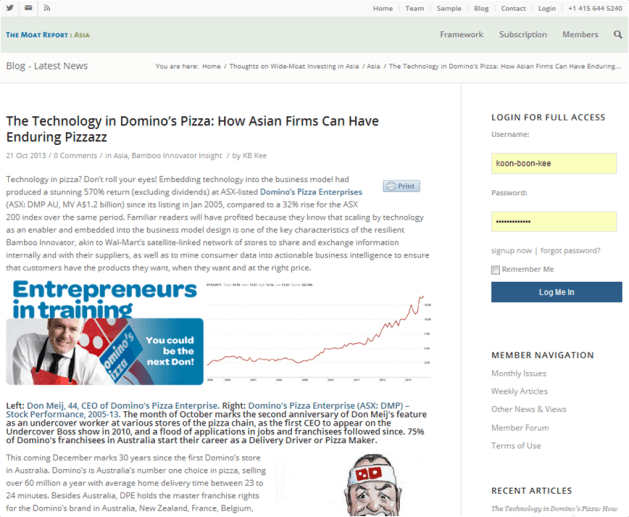
The Technology in Domino’s Pizza: How Asian Firms Can Have Enduring Pizzazz (Bamboo Innovator Insight)

The following article is extracted from the Bamboo Innovator Insight weekly column blog related to the context and thought leadership behind the stock idea generation process of Asian wide-moat businesses that are featured in the monthly entitled The Moat Report Asia. Fellow value investors get to go behind the scene to learn thought-provoking timely insights on key macro and industry trends in Asia, as well as benefit from the occasional discussion of potential red flags, misgovernance or fraud-detection trails ahead of time to enhance the critical-thinking skill about the myriad pitfalls of investing in Asia at the microstructure- and firm-level.

  • The Technology in Domino’s Pizza: How Asian Firms Can Have Enduring Pizzazz, Oct 21, 2013 (Moat Report Asia, BeyondProxy)
Pizzazz

Dear Friends and All,

The Technology in Domino’s Pizza: How Asian Firms Can Have Enduring Pizzazz

Technology in pizza? Don’t roll your eyes! Embedding technology into the business model had produced a stunning 570% return (excluding dividends) at ASX-listed Domino’s Pizza Enterprises (ASX: DMP AU, MV A$1.2 billion) since its listing in Jan 2005, compared to a 32% rise for the ASX 200 index over the same period. Familiar readers will have profited because they know that scaling by technology as an enabler and embedded into the business model design is one of the key characteristics of the resilient Bamboo Innovator, akin to Wal-Mart’s satellite-linked network of stores to share and exchange information internally and with their suppliers, as well as to mine consumer data into actionable business intelligence to ensure that customers have the products they want, when they want and at the right price.

This coming December marks 30 years since the first Domino’s store in Australia. Domino’s is Australia’s number one choice in pizza, selling over 60 million a year with average home delivery time between 23 to 24 minutes. Besides Australia, DPE holds the master franchise rights for the Domino’s brand in Australia, New Zealand, France, Belgium, Monaco and The Netherlands, and is the largest franchisee for the brand in the world. DPE also recently acquired 75% of Domino’s Japan from Bain Capital in Aug/Sep 2013 for A$128 million, plus agreeing to supply new debt funding of another A$96.4 million for a total of about A$225 million, adding 259 Japanese stores (216 corporate and 43 franchise) to increase DPE’s total store network to over 1,200 stores. Thus, for value investors seeking exposure to Japan but are wary of the governance risks of the domestic stocks, DPE provides an interesting alternative with significantly lower governance risk. Stocks listed outside of Japan with exposure to Japan could be an interesting topic of discussion in the highly insightful Japan Investing Summit on Nov 5-6. Long-time value investors in Japan are cognizant that stocks with high net cash or net current asset as a percentage of their market cap are potential value traps since the cash and liquid assets are “borrowed” by their powerful bank shareholders as part of the keiretsu network, a phenomenon documented empirically as the “keiretsu” valuation discount and investor activism pushing for change usually becomes an act of kicking the hornet’s nest. Empirical fans would find the research of Takeo Hoshi (Stanford University), Anil Kashyap and Douglas Skinner (Chicago Booth School of Business), and Suraj Srinivasan (Harvard Business School) to be particularly useful in understanding governance risks in Japan.

Back to pizza. What did Domino’s Pizza do to embed technology into its business model? What are the 5 Key Bamboo Innovator Takeaways?

The Moat Report Asia Members’ Forum has been getting penetrating quality dialogues from our existing institutional subscribers from North America, the Nordic, Europe, the Oceania and Asia, including professional value investors with over $20 billion in asset under management in equities. Questions range from:

  • The nuances of internal dealings in Asia, including the case discussion of the recent deal in which HK billionaire’s Lee Shau-kee Henderson Land acquiring Towngas or Hong Kong & China Gas (3 HK) from his family holdings, seemingly déjà vu from the early Oct 2007 transaction when the market peak.
  • The case of F&N Singapore spinning out its property unit FCL Trust and getting “free” special dividend-in-specie and the potential risk in asset swap restructuring to deleverage the hidden debt in the entire Group balance sheet.
  • The dilemma of whether to invest in a Southeast Asian-listed company and hidden champion with a domestic market share of 60% due to family squabbles.
  • Discussion of the wise and thoughtful 107-year-old Irving Kahn’s investment into a US-listed but Hong Kong-based electronics company with development property project in Shenzhen’s Qianhai zone and the possible corporate governance risks that could be underestimated or overlooked, as well as their history of listing some assets in HK in 2004.. This is also a case study of “buy one get one free” in John’s highly-acclaimed book The Manual of Ideas in which the “free” property is lumped together with the (eroding) core business to make the combined entity look cheap and undervalued. What are the potential areas that value investors need to watch out for when adapting the SOTP (sum-of-the-parts) method in Asia?
  • And many more intriguing questions.

Do find out more in how you can benefit from authentic and candid on-the-ground insights that sell-side analysts and brokers, with their inherent conflict-of-interests, inevitable focus on conventional stock coverage and different clientele priorities, are unwilling or unable to share. Think of this as pressing the Bloomberg “Help Help” button to navigate the Asian capital jungle. Institutional subscribers also get access to the Bamboo Innovator Index of 200+ companies and Watchlist of 500+ companies in Asia and the Database has eliminated companies with a higher probability of accounting frauds and  misgovernance as well as the alluring value traps.

The CEO Of Cisco Bills The Company When He Flies In His Own Private Jet; In 2013, John Chambers billed Cisco $2.8 million in jet expenses; since 2009, Chambers has billed Cisco $11.1 million in private jet expenses

The CEO Of Cisco Bills The Company When He Flies In His Own Private Jet

JULIE BORT OCT. 18, 2013, 5:12 PM 4,803 10

Many big tech companies, like HP and IBM, keep fleets of private jets to fly their executives around in convenience, safety and style. But at Cisco, CEO John Chambers works it in reverse. He owns his own jet and then he sends Cisco a bill when he uses it for work, which he presumably does a lot. In 2013, he billed Cisco $2.8 million in jet expenses, according to forms filed with the SEC. Unlike car mileage, there doesn’t seem to be an IRS standard when reimbursing for your private jet. Chambers just has to make sure that his expense rate isn’t higher than what it would cost to hire a private chartered jet. That’s not hard to do. It will cost you $21,000 to charter a 4-passenger plane for an hour to fly from San Jose to L.A. on a JetSuite private charter (non-member rate). Blogger Brad Reese calculates that since 2009, Chambers has billed Cisco $11.1 million in private jet expenses. $2.8 million certainly isn’t a lot of money by Cisco’s standards. But just for kicks, we looked at what it would cost to fly first-class on a commercial airline (United), from San Jose, California (where Cisco is based) to Bangalore, India (where Cisco has an R&D facility). About $16,000. For $2.8 million, one person could fly 175 times, first-class to Bangalore at that rate. Or four people (a small entourage) could fly 43 times. It’s hard to tell if Cisco is getting a sweet deal by paying for Chamber’s business travel on his private jet. Most companies only disclose the reverse situation. They tell shareholders how much the company spent when executives use the corporate jets for personal travel. This is included their total compensation numbers, so presumably they pay taxes on the benefit (though many companies also pay for their executives to get help preparing their taxes.) For instance, IBM says that its CEO, Ginni Rometty, must use IBM’s jets at all times, even for personal travel, for safety reasons, according to forms filed with the SEC. In 2012, she spent $304,376 for personal travel on the corporate jets.

Farmer’s Dream Fades as Tongyang Defaults: Korea Markets

Farmer’s Dream Fades as Tongyang Defaults: Korea Markets

When a 78-year-old farmer in South Korea was seeking a safe investment for his 300 million won ($282,600) of retirement savings in 2011, his advisers at Tongyang Securities Inc. recommended Tongyang Group bonds. Less than three months after making his latest purchase of debt issued by the nation’s 47th-largest conglomerate, his dreams of a comfortable retirement were shattered as five Tongyang affiliates filed for bankruptcy protection on Sept. 30 and Oct. 1, his son told Bloomberg News by phone from Seoul. Read more of this post

How to Pay Millions and Lag Behind the Market; Rhode Island’s pension investments in hedge funds have trailed returns earned by the S&P 500-stock index and have cost the state $70 million in fees in a single year

October 19, 2013

How to Pay Millions and Lag Behind the Market

By GRETCHEN MORGENSON

Today’s low-interest-rate environment has made the hunt for investment income tougher than ever. Many overseers of public pension funds, desperate to bolster returns and meet ballooning retiree obligations, have turned from traditional investments like stocks and bonds to hedge funds and private equity. These so-called alternative investments now account for almost one-quarter of the roughly $2.6 trillion in public pension assets under management nationwide, up from 10 percent in 2006, according to Cliffwater, an adviser to institutional investors. Investments in public companies’ shares, by contrast, fell to 49 percent from 61 percent in the period. Read more of this post

China Solar Energy Says Directors Detained Amid Fraud Probe

China Solar Energy Says Directors Detained Amid Fraud Probe

China Solar Energy Holdings Ltd. (155), a Hong Kong-based solar panel maker, said its chairman and two directors have been detained by Chinese authorities on allegations of fraud involving the assets of a mainland unit. Chairman Yeung Ngo, Yang Yuchun and non-executive director Hao Guojun were arrested and have been held since Aug. 26, according to the company’s legal advisers, and can’t be contacted, China Solar Energy said in a statement to the Hong Kong stock exchange on Oct. 18. The company is still trying to assess the impact of the investigation on its financial performance and its shares, which were halted on Aug. 16, will remain suspended, it said. Read more of this post

India’s MCX says CEO submits resignation

India’s MCX says CEO submits resignation

4:07am EDT

MUMBAI (Reuters) – The Multi Commodity Exchange of India Ltd (MCEI.BO: QuoteProfileResearchStock Buzz) said on Saturday its managing director and chief executive officer, Shreekant Javalgekar, had submitted his resignation from the company, in which Financial Technologies (FITE.NS: Quote,ProfileResearchStock Buzz) holds a 26 percent stake. It did not specify a reason for the resignation in a statement. Financial Technologies also owns National Spot Exchange Ltd (NSEL). The NSEL has been under investigation by local police since last month after India’s commodities regulator ordered it to suspend trading over suspected violations of rules on contract duration. The MCX board will meet on Tuesday to discuss the appointment of a new CEO, its spokesman said.


Investing for the Fun of It: Many fans of stock indexing set a little money aside to bet on riskier investments. Here’s how to do it safely.

Investing for the Fun of It: Many fans of stock indexing set a little money aside to bet on riskier investments. Here’s how to do it safely.

LIAM PLEVEN

Oct. 18, 2013 6:06 p.m. ET

BF-AF991_19play_DV_20131018164108

Investors flock to index funds because they are simple, inexpensive and often likely to generate higher returns than taking a chance on hot stocks, highflying money managers or a brother-in-law’s tips. The hitch: Passive is dull, as even its fans admit. John Miller, a partner in a Fayetteville, Ga., law firm, set up an account several years ago with about 5% of his investments and started buying individual stocks. Most of his investments are in index funds. He placed a wager on Bank of AmericaBAC -0.20% stock when prices were near financial-crisis lows, and won big. He also purchased shares in a solar-energy firm that he says fell about 85% before he sold. Through it all, he enjoyed himself—without worrying that a disastrous bet would ruin his financial future. Read more of this post

Datuk Soh Chee Wen and the Blumont-Asiason-LionGold saga; Every counter that Datuk Soh Chee Wen owned in Malaysia used to be sought after by punters and market players because their gains were extraordinary

Updated: Saturday October 19, 2013 MYT 7:43:02 AM

Lim, Azlan claim no link to Soh

BY B.K. SIDHU

20131020_asiaons_capital_st

BIZD_MM_1910_p20a_ jaredlim azlan

Soh has been s een as a prominen t mark e t play er in the Malay sian and Singaporean stock exchang es for more than a decade . DATUK Jared Lim and Datuk Mohamed Azlan Hashim have denied any links to tycoon Datuk Soh Chee Wen, whose name has become a topic of conversation at coffee tables and trading rooms of late. The reason is the spectacular rise and collapse of shares in three Singapore companies recently which begs the question as to who is behind the volatile movements of the counters. Lim and Azlan are the Malaysian shareholders in SGX listed-Asiasons Capital, one of the three companies whose share prices once recorded extraordinary gains but caused a mayhem when they plummeted beginning Oct 3. The other two companies are Blumont Group and LionGold Group. Read more of this post

RTOs, M&As and the allure of change; Not all reverse takeovers pan out, and those that do may not translate to a success down the road

PUBLISHED OCTOBER 19, 2013

RTOs, M&As and the allure of change

Not all reverse takeovers pan out, and those that do may not translate to a success down the road

ANGELA TAN ANGELAT@SPH.COM.SG

CHANGE is never easy, yet it oozes promise as the new replaces the floundering old, setting off the scent of something better, stronger and more powerful. Such is the allure of reverse takeovers (RTOs) that has seduced investors here time and time again. Singapore has had its fair share of sweeping corporate transformations: an ailing steel trader, Albedo Group, and a furniture maker, Cacola Furniture International, hopping onto the property bandwagon; a funeral service provider, Asia Pacific Strategic Investments, digging around gold mines; and a ceramic maker, NH Ceramics, burnishing itself as an energy powerhouse. Read more of this post

Where there’s money, there’s risk: Events in America show that no asset is copper-bottomed

Where there’s money, there’s risk: Events in America show that no asset is copper-bottomed

Oct 19th 2013 |From the print edition

20131019_FND001

A GOVERNMENT with debt denominated in its own currency need never default, or so the theory goes. It can simply print more money to pay off the debt. In practice, however, countries do default on local-currency debt: six have done so in the past 15 years, including Jamaica, Russia and Ecuador. Before this week’s budget deal, markets had feared that America could join the list, if only in a technical sense. Read more of this post

Over 45 years, Darden has grown from a single restaurant in a landlocked Florida city to a 2,100-outlet empire, with its Olive Garden and Red Lobster brands blanketing the country

OCTOBER 16, 2013, 8:18 PM

An Activist Investor Is Urging Darden to Break Itself Up

By MICHAEL J. DE LA MERCED and ALEXANDRA STEVENSON

Over 45 years, Darden has grown from a single restaurant in a landlocked Florida city to a 2,100-outlet empire, with its Olive Garden and Red Lobster brands blanketing the country. But as the company struggles with a stagnant stock price, the activist hedge fund Barington Capital is calling for a drastic solution: breaking the company into as many as three separate businesses, according to a letter sent to its board last month that was reviewed by The New York Times. Read more of this post

Berkshire Adds Stocks in Pension Handoff to Buffett Lieutenants

Berkshire Adds Stocks in Pension Handoff to Buffett Lieutenants

Billionaire Warren Buffett is betting that his deputy investment managers can find value hiding in a corner of Berkshire Hathaway Inc. (BRK/A): its $10.4 billion in pension assets. Todd Combs, 42, and Ted Weschler, 52, have been building stock portfolios with funds they oversee for defined-benefit plans at Berkshire subsidiaries, including railroad Burlington Northern Santa Fe. The strategy saves Buffett’s company fees it would pay to outside asset managers and could reduce the need for contributions to the pensions. Read more of this post

Italy’s chocolate king faces succession questions; Ferrero denies report of bid from Nestle

Italy’s chocolate king faces succession questions

10:26am EDT

By Lisa Jucca and Giancarlo Navach

MILAN (Reuters) – Michele Ferrero, Italy’s richest man and the owner of a global chocolate and confectionery empire, has always resisted the temptation to allow outsiders to buy into his company. In a statement on Thursday, his son Giovanni, the Chief Executive of the Ferrero group, rejected suggestions the Italian company had been approached by larger Swiss competitor Nestle and said Ferrero was not for sale. But like other family-controlled Italian companies that flourished in the postwar boom, the ambassador of chocolate-hazelnut spread Nutella, now 88, may soon be discussing succession plans. His other son Pietro, the chosen heir to run the Piedmont-based empire, died of a heart attack in 2011 while riding a bicycle in South Africa. He was 47 and his death opened the way for the ascent of younger brother Giovanni, whom industry insiders consider less interested in running the business. Read more of this post

China Companies Rank Lowest in Survey of Transparency Reporting

China Companies Rank Lowest in Survey of Transparency Reporting

Chinese companies ranked the lowest in a survey of public reporting practices in emerging markets, underscoring concern that the government’s anti-corruption campaign may not take root in the corporate sector. The 33 Chinese multinationals surveyed averaged a score of 2 out of 10 points in Berlin-based Transparency International’s “Transparency in Corporate Reporting” survey, released today. Chery Automobile Co., the closely held carmaker based in Wuhu, China, joined one other company among the 100 surveyed with a score of zero across the three categories measured. Read more of this post

GS Engineering Falls Most in Six Months after it was sued by a group of investors over losses caused by unexpected cost increases on overseas environmental projects

GS Engineering Falls Most in Six Months on Lawsuit: Seoul Mover

GS Engineering & Construction Corp. (006360) fell the most in six months in Seoul trading after the South Korean builder said it was sued by a group of investors over losses caused by unexpected cost increases on overseas projects. GS Engineering dropped as much as 4.8 percent, headed for the biggest decline since April 15, to 35,400 won and traded at 36,050 won as of 12:35 p.m. South Korea’s benchmark Kospi index rose 0.3 percent. Fifteen investors filed the lawsuit against GS Engineering on Oct. 8 at the Seoul Central District Court, the Seoul-based company said in a regulatory filing today. The investors claim GS Engineering failed to make proper estimates in financial statements for costs that may arise from the projects, according to today’s statement. The builder said in April it expects an operating loss this year because of the cost increases. The company said it will appoint a lawyer to handle the case. GS Engineering in April reported an unexpected operating loss in the first quarter because costs increased for some of its overseas environment-related projects. That caused shares of builders to slump on concerns that other construction companies may face similar problems.

To contact the reporter on this story: Kyunghee Park in Singapore at kpark3@bloomberg.net

Chasing trends is a dangerous game; Momentum is a losing strategy for long-term investors

October 16, 2013 9:01 am

Chasing trends is a dangerous game

By Paul Woolley

Momentum is a losing strategy for long-term investors

Big investors currently pursue two very different strategies when appointing external managers. Their traditional approach is to hire fund managers for portfolios benchmarked to market indices with risks quite tightly controlled. They are simultaneously increasing their allocations to hedge funds, measured against cash and free to take every liberty under the sun. Both approaches generally produce disappointing results, especially for long-term investors such as pension funds. As it happens, this is for related reasons. Read more of this post

Practical Applications of The Devil in HML’s Details

Practical Applications of The Devil in HML’s Details

Clifford Asness and Andrea Frazzini : Biographies

Source: The Journal of Portfolio Management, Vol. 39, No. 4.

Report Written By: Cathy Scott

Overview

This article has a catchy title. Its findings are equally as catchy for quantitative portfolio managers who want to pick up an extra 300 to 400 basis points of annual performance on their high-minus-low (HML) investment strategies. Do I have your attention yet?

Practical Applications


The calculation. HML portfolios—or those that are long value stocks/short growth stocks—are constructed using the book-to-price ratio (B/P), the academic-favored flip of the price-to-book ratio (P/B).

The rub. Traditionally, value strategy construction relies on lagged data for both book value and share price. The data lag is anywhere between 6 and 18 months.

The tweak. Use current price data to construct valuation ratios. Beyond improving the ability to identify cheap stocks, it unveils the level of correlation between value and momentum strategies—thereby enhancing the construction of HML portfolios, which in essence blend the two.

The caveat. The tweak doesn’t improve the performance of a stand-alone value strategy. Its efficacy lies in portfolios combining value and momentum strategies. Read more of this post

Prince Frog Falls by Most on Record After Short Seller Glaucus Report

Prince Frog Falls by Most on Record After Short Seller Report

By Vinicy Chan  Oct 15, 2013

Prince Frog International Holdings Ltd. (1259) plunged by the most on record after short-seller Glaucus Research Group questioned the company’s sales and branded the baby-care products maker a “strong sell.” Prince Frog shares were halted in Hong Kong trading today after dropping as much as 26 percent to HK$4.66, headed for the biggest decline since its July 2011 listing. The Chinese government’s tax records indicate Prince Frog’s net income is “a fraction of reported figures,” Glaucus said while initiating coverage of the shares at “strong sell.” Queenie Hung from Wonderful Sky Financial Group, Prince Frog’s public relations company, declined to immediately comment. The company, based in southern China’s Fujian province, will issue a statement to the Hong Kong Stock Exchange later today, she said. China Minzhong Food Corp. (MINZ), China Metal Recycling Holdings Ltd. and China Medical Technologies Inc. have each separately been the focus of reports by Glaucus. Liquidators were appointed to China Metal in July and China Medical filed for Chapter 15 foreign-firm bankruptcy protection in New York last year. Ten of the 11 analysts covering Prince Frog recommend investors buy the stock, while one rates the stock a hold, Bloomberg data show. The stock is still up 43 percent so far this year, compared with a 2.6 percent gain for the Hang Seng Index.

To contact the reporter on this story: Vinicy Chan in Hong Kong at vchan91@bloomberg.net

These are not the customers you are looking for, Herbalife edition

These are not the customers you are looking for, Herbalife edition

Dan McCrum

Oct 15 12:20 | 7 comments | Share

Part of the LIVING THE HERBALIFE SERIES

ScreenShot041

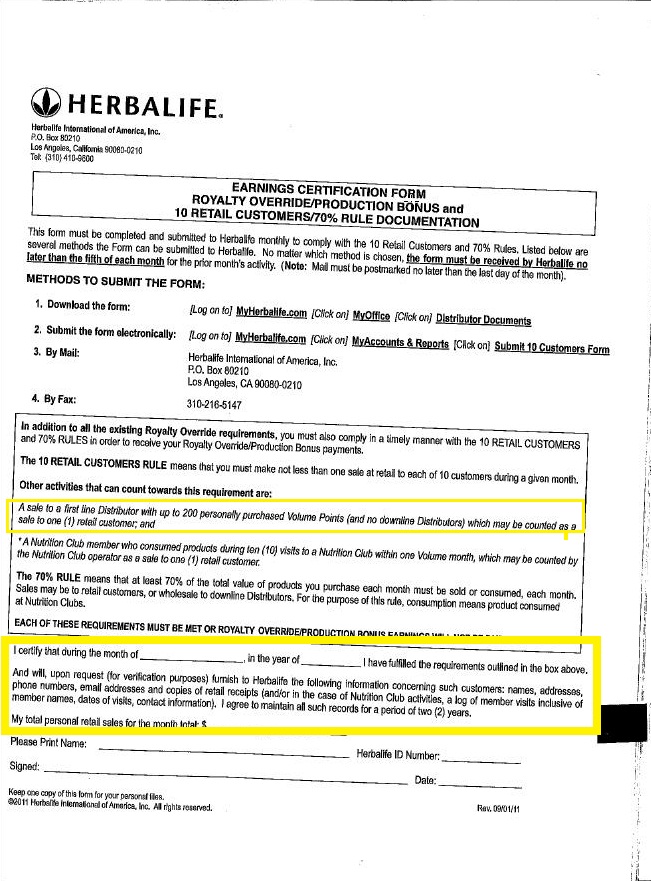
There is something weird about the way that Herbalife has been responding to questions about its customer base. Faced with a barrage of scrutiny over the claims from Bill Ackman that it is a pyramid scheme, and as Herbalife has insisted that it is legitimate, it has turned to market research companies to show that it has plenty of real customers. That seems strange when you consider what each salesperson is required to do in terms of record keeping. Here is the 2011 version of the form that a distributor (direct selling jargon for a salesperson) has to fill in and sign every single month that he or she wants to receive commissions and sales bonuses from Herbalife (click to enlarge). Read more of this post