Celltrion denies stock price manipulation reports; The company said it is true that the chief attended the Financial Supervisory Service’s deliberation committee late last week

Celltrion denies stock price manipulation reports

2013.09.16 14:17:11

Celltrion on Monday denied news reports that its CEO Seo Jung-jin has been involved in stock price manipulation where non-public information was used and unfair profits were taken. The company said it is true that the chief attended the Financial Supervisory Service’s deliberation committee late last week but it was a meeting to correct the misunderstanding of his company. It said that there was no notice on the meeting’s result, emphasizing those charges against the company are baseless. At 2:05 pm, shares of Celltrion fell 3.46% to trade at 48,850 won.

Detecting Accounting Frauds in Asia (Part 1) (Bamboo Innovator Insight)

The following article is extracted from the Bamboo Innovator Insight weekly column blog related to the context and thought leadership behind the stock idea generation process of Asian wide-moat businesses that are featured in the upcoming monthly Moat Report Asia. Fellow value investors get to go behind the scene to learn thought-provoking timely insights on key macro and industry trends in Asia as well as benefit from the occasional discussion of potential red flags, misgovernance or fraud-detection trails ahead of time to enhance the critical-thinking skill about the myriad pitfalls of investing in Asia at the microstructure- and firm-level.

  • Detecting Accounting Frauds in Asia (Part 1), Sep 11, 2013 (BeyondProxy)

DetectingFrauds1


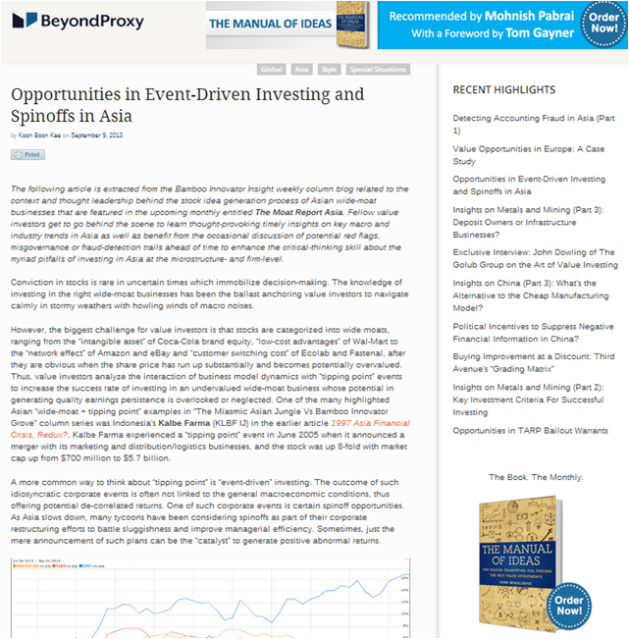
Opportunities in Event-Driven Investing and Spinoffs in Asia (Bamboo Innovator Insight)

The following article is extracted from the Bamboo Innovator Insight weekly column blog related to the context and thought leadership behind the stock idea generation process of Asian wide-moat businesses that are featured in the upcoming monthly Moat Report Asia. Fellow value investors get to go behind the scene to learn thought-provoking timely insights on key macro and industry trends in Asia as well as benefit from the occasional discussion of potential red flags, misgovernance or fraud-detection trails ahead of time to enhance the critical-thinking skill about the myriad pitfalls of investing in Asia at the microstructure- and firm-level.

  • Opportunities in Event-Driven Investing and Spinoffs in Asia, Sep 9, 2013 (BeyondProxy)

Spinoff


Tong Yang asks for financial help from Orion

Tong Yang asks for financial help from Orion

Lee Jin-myung, Hong Jong-sung

2013.09.13 17:20:20

Hyun Jae-hyun, Chairman of Tong Yang Group, has asked for financial help from Dam Chul-gon, Chairman of Orion, in efforts to overcome a cash crunch. Tong Yang Group is the former parent company of Orion, South Korea’s major confectionery maker. According to Tong Yang Group on Thursday, the two businessmen, brother-in-laws to each other, met recently to discuss Tong Yang Group’s liquidity crisis. Hyun asked Dam to provide collateral to help the troubled Tong Yang to issue asset-backed securities worth up to 1 trillion won ($919.87 million). Tong Yang wants the money to repay debts that will mature late this year. But sources said Dam did not make his answer immediately. Tong Yang Group plans to issue ABSs based on assets of the group’s key subsidiaries – Tong Yang Cement and Tong Yang Power and Tong Yang Securities – and to liquidate them with Orion’s backing. This plan was recently discussed with the nation’s financial regulators.

Manila Water tumbled by a record in Philippine trading after the nation’s regulator rejected its petition for a rate increase and ordered the company to cut tariffs

Manila Water Plunges by Record on Rate-Cut Order: Manila Mover

Manila Water Co. (MWC) tumbled by a record in Philippine trading after the nation’s regulator rejected its petition for a rate increase and ordered the company to cut tariffs.

The shares sank 16 percent to 26.1 pesos at 10:57 a.m. local time, heading for the sharpest loss since the stock began trading in March 2005. The stock was the biggest drag on the benchmark Philippine Stock Exchange Index, which dropped 1 percent. Read more of this post

Laura Rittenhouse’s Candor Analytics; Inspired by Warren Buffett, a former Lehman analyst figures out that plain-speaking companies have higher performance

September 3, 2013

Sally Helgesen is an author, speaker, and leadership development consultant, whose most recent book is The Female Vision: Women’s Real Power at Work(with Julie Johnson; Berrett-Koehler, 2010).

Laura Rittenhouse’s Candor Analytics

Warren Buffett’s annual shareholder letters are famous, a key element of his mystique. Inevitably, they’re described in the business media as “folksy.” But this description misses the reason these letters compel admiration from and influence the behavior of investors. The true strength of Buffett’s missives lies in their candor. (For example, here’s Buffett in the 2012 annual report of his firm Berkshire Hathaway, on his controversial investments in local newspapers: “Charlie and I believe that [some newspapers] will remain viable for a long time. We do not believe that success will come from cutting either the news content or frequency of publication. Indeed, skimpy news coverage will almost certainly lead to skimpy readership.”) Read more of this post

Sino Biopharm, Market Cap $3 Billion, Plunges After CCTV Bribery Report

Sino Biopharm Plunges After CCTV Bribery Report: Hong Kong Mover

Sino Biopharmaceutical Ltd. (1177) plunged the most in about 13 years before being suspended in Hong Kong trading, after a report by state-run Chinese Central Television alleged bribery at a unit of the medicine maker. Sino Biopharmaceutical fell 16 percent to HK$4.76, headed for the largest drop since October 2000, before being halted at 11:49 a.m. The stock has been suspended pending an announcement to clarify certain information in recent press reports, the drugmaker said today. Two groups of doctors attended 50-minute meetings organized by the company in China and then left on sponsored trips, according to the broadcast yesterday evening. Read more of this post

Retailers Paul Zahra and Mark McInnes among Australia’s ‘least narcissistic’ CEOs according to an analysis of speech patterns by the Macquarie Graduate School Of Management

Michael Bailey Deputy editor

Retailers Paul Zahra and Mark McInnes among Australia’s ‘least narcissistic’ CEOs. Which sector has the biggest egos?

Published 11 September 2013 11:44, Updated 12 September 2013 07:32

They might operate at the more glamorous end of the economy but David Jones chief Paul Zahra, and his predecessor turned Premier Investments boss Mark McInnes, are among the 10 least narcissistic CEOs of ASX-listed large companies, according to an analysis of speech patterns by the Macquarie Graduate School Of Management. The MGSM measured the personal pronoun use of 100 CEOs, among Australia’s 140 largest listed companies, in the Q&A sessions of analyst briefings used to discuss their company’s earnings during the reporting season just past. The narcissism score for each CEO was the ratio of first person singular pronouns to total first person pronouns used in their speech. To avoid embarrassment and lawsuits, the MGSM has not named Australia’s most narcissistic CEOs, but have named the least egotistical bosses. In ascending order they are: Read more of this post

Starved for scoops, many don’t bother to check the veracity of revenue and profitability numbers for non-public and pre-IPO entities before printing them

Financial Secrets Revealed! (Just Don’t Ask Where They Came From)

Francine McKenna

Using tools instead of tools using me. Journalist/Speaker/CPA. Encantada de todo de America Latina. Two-time Loeb Award finalist

Starved for scoops, many don’t bother to check the veracity of revenue and profitability numbers for non-public and pre-IPO entities before printing them

I’m noticing more numbers no one checked reported as “breaking news” or adding spice to puff pieces with potentially hidden insider agendas. Maybe some journalists are intoxicated by access to the non-public numbers some would pay a lot to know for sure. Maybe it’s just too hard. Worst case scenario journalists can be used as cogs in the equity market pump and dump machine. Read more of this post

Esprit Posts First Annual Loss Since IPO as Sales Slump

Esprit Posts First Annual Loss Since IPO as Sales Slump

Esprit Holdings Ltd. (330), the apparel seller whose two top executives quit last year, reported its first annual loss since a 1993 listing due to sales declines, store closures and a drop in the value of goodwill. The company swung to a loss of HK$4.39 billion ($566 million) for the year ended June, from a HK$873 million profit a year earlier, according to a Hong Kong stock exchange statement today. That compares with the average estimate for a HK$3.4 billion loss from 14 analysts surveyed by Bloomberg. Read more of this post

Cutting Through the Noise: More than two dozen of the country’s top value investors weigh in on key elements of the research and decision-making process

SATURDAY, SEPTEMBER 7, 2013

Cutting Through the Noise

By JOHN HEINS AND WHITNEY TILSON | MORE ARTICLES BY AUTHOR

More than two dozen of the country’s top value investors weigh in on key elements of the research and decision-making process.

Professional investors are an exceedingly competitive lot—unsurprising, given that their chosen field is one where the score delineating winners and losers can be tallied at every market close. But as results-driven as investors tend to be, the best money managers put equal emphasis on the process they follow for conducting research and making portfolio decisions. They have a clear understanding of the most important questions they want answered and how best to answer them. Of course, their methods of discovery can vary widely. Some investors put great emphasis on having macro views that inform their decisions, while others firmly reject that approach. Some consider time spent with management critical to their research process, while others consider it a waste of time. Some see industry specialization among analysts as a benefit; others see it as a detriment. But nearly all successful fundamental investors see their research and decision-making process as a primary source of competitive advantage, and should be able to explain in detail why that’s so. Read more of this post

Leading Indicators for Investors: Corporate spinoffs, share buybacks, insider buying and stock splits can all signal what insiders think lies ahead for their company’s share price

September 6, 2013, 6:17 p.m. ET

Leading Indicators for Investors

Corporate spinoffs, share buybacks, insider buying and stock splits can all signal what insiders think lies ahead for their company’s share price.

LIAM PLEVEN And JOE LIGHT

BF-AF715_07WIws_G_20130906194510

With the economy recovering and markets on a tear, American corporations are snapping into action—spinning off subsidiaries, buying back stock and making other moves that are widely viewed as telling signals of how insiders value their own firms. A recent flurry of high-profile activity raises a question for investors about how to interpret those signals: Buy or beware? In addition to spinoffs and buybacks, the moves in question include insider share purchases and stock splits. Apple,AAPL +0.60% Valero Energy and Whole Foods Market WFM +0.61% are among the big U.S. companies that have made or announced such moves this year. (Among the companies that did a spinoff this year is News Corp NWSA -0.31% ., which split into a media and entertainment company named 21st Century Fox FOXA +0.47% and a publishing business called News Corp, which is the parent of Wall Street Journal publisher Dow Jones & Co.) Read more of this post

Gemalto Sees Doubling of Operating Profit on Security Software

Gemalto Sees Doubling of Operating Profit on Security Software

Gemalto NV (GTO) forecast a doubling of its operating profit by 2017 amid greater demand for its chips and software that make bank cards and mobile phones more secure. Operating profit may reach 600 million euros ($788 million) that year, doubling from 2012, the Amsterdam-based company said in a statement yesterday. Revenue from the platforms and services unit will grow more than 20 percent annually to reach 1 billion euros by 2017, accounting for about half of Gemalto’s projected sales growth in the period, it said. Under Chief Executive Officer Olivier Piou, Gemalto has shifted away from commoditized chips to sell more lucrative packages including security software. Its clients include mobile-phone carriers and banks, as well as companies ranging from Volkswagen AG’s Audi division to Facebook Inc. Piou, who so far has bet on the need to improve the security of new technologies — the likes of mobile payments and machine-to-machine transmissions — predicts there are more opportunities for Gemalto in mobile money and mobile identification. Piou returned Gemalto to profit in 2008, and last year net income rose 25 percent to 201 million euros. Joining France’s leading stock index, the CAC 40, in December, marked another milestone for the executive. A 55-year-old engineer, Piou has headed the company since the 2006 merger of Gemplus International SA and Axalto Holding NV. Shares of Gemalto have gained 27 percent this year. The stock slipped 0.7 percent to 86.26 euros yesterday in Amsterdam trading.

To contact the reporter on this story: Marie Mawad in Paris at mmawad1@bloomberg.net

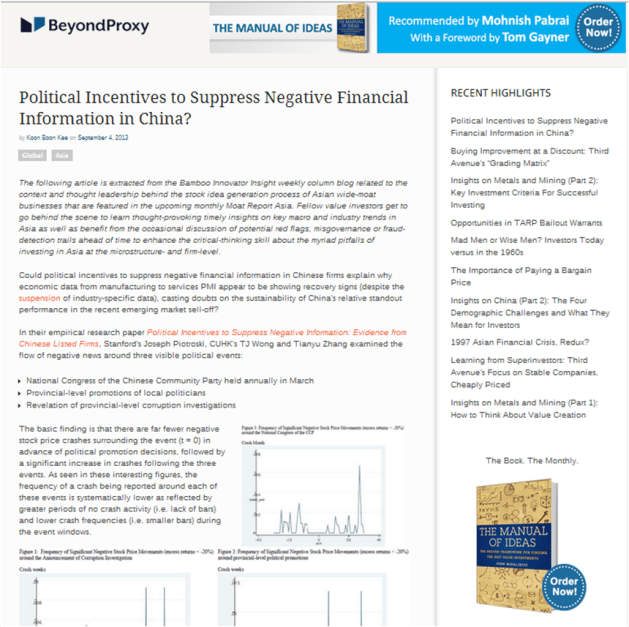
Political Incentives to Suppress Negative Financial Information in China? Moat Report Asia: Bamboo Innovator Insight

The following article is extracted from the Bamboo Innovator Insight weekly column blog related to the context and thought leadership behind the stock idea generation process of Asian wide-moat businesses that are featured in the upcoming monthly Moat Report Asia. Fellow value investors get to go behind the scene to learn thought-provoking timely insights on key macro and industry trends in Asia as well as benefit from the occasional discussion of potential red flags, misgovernance or fraud-detection trails ahead of time to enhance the critical-thinking skill about the myriad pitfalls of investing in Asia at the microstructure- and firm-level.

  • Political Incentives to Suppress Negative Financial Information in China? Sep 4, 2013 (BeyondProxy, Moat Report Asia)

Political Incentives to Suppress Negative Financial News

Weitz Buffett-Malone Bets Best in Value

Weitz Buffett-Malone Bets Best in Value: Riskless Return

Wally Weitz likes to invest with billionaires he’s known a long time. He’s been a shareholder for more than 35 years in Berkshire Hathaway Inc. (BRK/A), run by his Omaha, Nebraska, neighbor Warren Buffett, and has held stakes in companies run by media mogul John Malone for more than 20. The investments helped Weitz’s Partners III Opportunity Fund (WPOPX) produce the best risk-adjusted performance among U.S. value funds in the past five years, according to the BLOOMBERG RISKLESS RETURN RANKING. The $901 million fund had below-average volatility and the second-highest absolute return among 283 vehicles with at least $500 million in assets. Weitz has always looked for companies whose stocks are cheap compared with the cash flow he expects them to generate, a common metric for value investors. Over time, he has come to believe that finding management teams that know how to redeploy any excess cash intelligently is critical to investment success. “Warren Buffett and John Malone could not be more different, but both of them know how to create more than a dollar of value for every dollar they reinvest,” Weitz, 64, said in a telephone interview. Read more of this post

Expert networks: thriving in Asia, away from U.S. scrutiny, even though the legal risks of using the networks outweigh the potential rewards

Expert networks: thriving in Asia, away from U.S. scrutiny

5:27pm EDT

By Rachel Armstrong and Nishant Kumar

SINGAPORE/HONG KONG (Reuters) – Expert networks – a matchmaking service linking investors such as hedge funds with company insiders – are under scrutiny from regulators in the United States, but are expanding across Asia, where the market for corporate intelligence is less transparent. The U.S. Securities and Exchange Commission has charged over three dozen people and firms as part of a broad investigation into ties between investors and expert networks that has uncovered insider trading and helped trigger the high-profile fall of Raj Rajaratnamrun’s Galleon hedge fund. Those cases have bruised confidence in expert networks in the United States, and some clients have stopped using the service for fear of falling foul of regulators. But in Asia, where regulators have yet to pay the industry much attention, the service is thriving – fertile ground where emerging market investors are willing to pay for inside knowledge on company supply chains, key personnel moves or regulatory shifts. Read more of this post

Malone as ‘Happy’ Owner of Liberty Says He’d Look at M&A Offers

Malone as ‘Happy’ Owner of Liberty Says He’d Look at M&A Offers

John Malone, the U.S. cable magnate who built Europe’s largest cable-television operator through acquisitions, said while he would consider offers for Liberty Global Plc, he’s “happy” with the company as is. As Vodafone Group Plc (VOD) nears closing a $130 billion sale of its stake in U.S. venture Verizon Wireless, the question of how the second-biggest mobile phone company could spend the windfall has focused on its recent efforts to expand in cable. Since Vodafone agreed to buy Kabel Deutschland Holding AG (KD8) in June, speculation has shifted to whether Liberty Global will be among its next targets. Read more of this post

Indofood sank 7.7 percent after it offered to buy the remaining Minzhong stock it doesn’t already own for S$1.12 a share as compared to its last traded price of S$0.53 in an attempt to preserve value of its investments

Indonesia Stocks Drop Most in Asia After Trade Gap; Rupiah Falls

Indonesian stocks declined most in Asia and the rupiah weakened after the government unexpectedly reported the biggest trade deficit since at least 2007.

The Jakarta Composite Index fell 2.1 percent to 4,106.08 at 2:15 p.m. local time, after climbing 0.3 percent earlier. PT Indofood Sukses Makmur (INDF), the nation’s biggest instant-noodle maker, sank 7.7 percent after it offered to buy China Minzhong Food Corp. The rupiah depreciated 0.2 percent to 10,940 per dollar and one-month non-deliverable forwards on the currency declined 0.3 percent to 11,473, data compiled by Bloomberg show. Read more of this post

Philippines’ Jollibee aims to become Asia’s largest homegrown chain

Jollibee aims to become Asia’s largest homegrown chain

By Neil Jerome C. Morales (The Philippine Star) | Updated September 2, 2013 – 12:00am

MANILA, Philippines – Fastfood giant Jollibee Foods Corp. (JFC) aims to be the largest homegrown quick service restaurant chain in Asia by 2020. The long-term goal will be supported by continuous store expansions and acquisitions of several more brands abroad, an executive said. “We hope in the next seven years to achieve being the largest,” JFC chief financial officer Ysmael V. Baysa said in an interview. So far, JFC is the largest homegrown fastfood chain in Southeast Asia and the second biggest in the entire Asian continent in terms of sales, Baysa said. “For Asian companies, excluding US (fastfood) franchises, I think we’re second next only to Japan’s Yoshinoya,” Baysa said, adding that the long-term plan was crafted in 2004 when JFC was the top four in Asia. Read more of this post

Korea’s Tongyang Group’s financial woes to deepen from Oct

Tongyang Group’s financial woes to deepen from Oct

2013.09.02

Concerns are mounting in the corporate bond market over Tongyang Group’s fundraising capacity. This is because the Group is expected to face setbacks in financing as Tongyang Group’s major affiliated companies have suffered from a series of credit rating downgrades ahead of the implementation of financial investment regulation amendments in October. The issuance of debt securities by Tongyang-affiliated companies has totaled 576 billion won ($520 million) this year, according to financial investment sources Monday.  Read more of this post

Minzhong Refutes Glaucus Report as Aimed at Pushing Shares Lower

Minzhong Refutes Glaucus Report as Aimed at Pushing Shares Lower

China Minzhong Food Corp. (MINZ), the vegetable processor targeted by Glaucus Research Group, said it “strongly” refutes the short-seller’s report, describing it as going beyond fair comment. Glaucus’s statements on the Putian, China-based company’s performance were made with the sole objective of driving down the company’s share price and gaining from the decline, Minzhong said late yesterday in a statement. The response follows a collapse in Minzhong’s market value after Glaucus said the company deceived investors and regulators. More Chinese businesses trading in Hong Kong, Singapore and New York are drawing scrutiny from short-sellers. China Minzhong tumbled 48 percent, the most on record, in less than two hours on Aug. 26 after Glaucus, which has an office in Newport Beach, California, questioned the company’s accounts in a report. Read more of this post

How You Climb A Mountain Is More Important Than Reaching The Top

How You Climb A Mountain Is More Important Than Reaching The Top

by SHANE PARRISH on AUGUST 30, 2013

Two examples from Patagonia founder Yvon Chouinard’s book,Let My People Go Surfing: The Education of a Reluctant Businessman, demonstrating that process is more important than results.

Focus on the movements, not the goal.

I’ve been a student of Zen philosophy for many years. In Zen archery, for example, you forget about the goal — hitting the bull’s-eye — and instead focus on all the individual movements involved in shooting an arrow. You practice instead your stance, reaching back and smoothly pulling an arrow out of the quiver, notching it on the string, controlling your breathing, and letting the arrow release itself. If you’ve perfected all the elements, you can’t help but hit the center of the target. The same philosophy is true for climbing mountains. If you focus on the process of climbing, you’ll end up on the summit. As it turns out, the perfect place I’ve found to apply this Zen philosophy is in the business world.

How you climb a mountain is more important than reaching the top.

Climbing mountains is another process that serves as an example for both business and life. Many people don’t understand that how you climb a mountain is more important than reaching the top. You can solo climb Everest without using oxygen, or you can pay guides and Sherpas to carry your loads, put ladders across crevasses, lay in six thousand feet of fixed ropes, and have one Sherpa pulling and one pushing you. You just dial “10,000 Feet” on your oxygen bottle, and up you go. Typical high-powered, rich plastic surgeons and CEOs who attempt to climb Everest this way are so fixated on the target, the summit, that they compromise on the process. The goal of climbing big, dangerous mountains should be to attain some sort of spiritual and personal growth, but this won’t happen if you compromise away the entire process. This reminds me of what Viktor Frankl wrote in Man’s Search for Meaning on success:

Don’t aim at success — the more you aim at it and make it a target, the more you are going to miss it. For success, like happiness, cannot be pursued; it must ensue, and it only does so as the unintended side-effect of one’s dedication to a cause greater than oneself or as the by-product of one’s surrender to a person other than oneself. Happiness must happen, and the same holds for success: you have to let it happen by not caring about it. I want you to listen to what your conscience commands you to do and go on to carry it out to the best of your knowledge. Then you will live to see that in the long run—in the long run, I say!—success will follow you precisely because you had forgotten to think of it.

Most Brazil IPOs have lost money since 2005: Credit Suisse

Most Brazil IPOs have lost money since 2005: Credit Suisse

Fri, Aug 30 2013

By Guillermo Parra-Bernal

CAMPOS DO JORDÃO, Brazil (Reuters) – Many initial public offerings in Brazil have led to investor losses over the past eight years, a senior Credit Suisse Group fund manager said on Friday, with the worst results coming from oil and gas – a sector that for years was seen as the nation’s most promising. Only 37 of the 117 IPOs since the start of 2005 have yielded returns above the benchmark CDI interbank lending rate, with remainder losing as much as half of the amount initially invested, according to a presentation by Luiz Stuhlberger, who as chief investment officer oversees 43 billion reais ($18 billion) in assets for Credit Suisse Hedging Griffo. Read more of this post

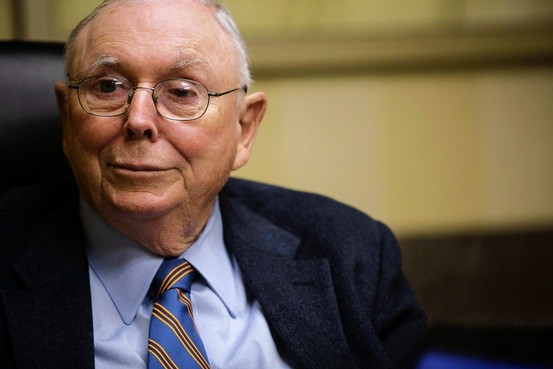
Charlie Munger: Lessons From an Investing Giant

Aug 30, 2013

THE INTELLIGENT INVESTOR

Charlie Munger: Lessons From an Investing Giant

By Jason Zweig

BF-AF687_INVEST_G_20130830161038

One of the least appreciated virtues in investing is courage. Filings with the Securities and Exchange Commission in March and again this month show the extraordinary gumption of Charlie Munger, Warren Buffett’s business partner and vice chairman of Berkshire Hathaway. Mr. Munger, who will turn 90 years old next Jan. 1, is a model for individual investors who wonder how they can possibly beat the professionals at their own game. The pros have more information than you, and their trading machines are faster. But you still have an edge over them—so long as you play a different game by your own, more sensible rules. You can be patient; the pros can’t. You don’t have to be part of the herd; they do. Above all, you can be brave; they almost never are. What makes Mr. Munger a model for individual investors? In the first quarter of 2009, during the most desperate days of the financial crisis, Mr. Munger took 71% of the cash at Daily Journal, a small publishing company he chairs, and poured it into the bank stocks that so many other investors were fleeing. By March 31, 2009, his bet already had gained 60%. With other purchases he made later, Mr. Munger invested $49.7 million into stocks and bonds that today are worth $128.4 million, according to financial statements Daily Journal filed on Aug. 20. Read more of this post

The Seven Deadly Sins of Investing; Financial crisis be damned—investors are still making the same mistakes the always have

August 30, 2013, 5:58 p.m. ET

The Seven Deadly Sins of Investing

Financial crisis be damned—investors are still making the same mistakes the always have.

KIRSTEN GRIND

It has been nearly five years since the depths of the U.S. financial crisis, and investors have learned a lot since then. Or have they? Despite the downturn that left many investors reeling from losses on everything from real estate to the stock market, when it comes to investor behavior—those hard-wired instincts that drive us all—little has changed, say psychologists and financial advisers. Investors still make the kinds of mistakes that have gotten them in trouble for decades. They are wooed by the hottest new trend, they want to follow the crowd—consequences be damned—and they just can’t seem to pay enough attention to important details, such as the steep annual fees charged by many mutual funds. Read more of this post

The Hidden Risk of Investing in Stable Companies; Rising interest rates may hurt dividend-paying stocks, defensive sectors, and large caps more than their counterparts

The Hidden Risk of Investing in Stable Companies

Rising interest rates may hurt dividend-paying stocks, defensive sectors, and large caps more than their counterparts.

By Alex Bryan | 08-28-13 | 06:00 AM | Email Article

Fear of rising interest rates has a lot of investors on edge, to say the least. Clearly, rising interest rates are bad for bond and equity investors. It’s easy to reduce interest-rate risk in a bond portfolio because interest-rate sensitivity, or duration, is directly related to the timing of cash flows. Bond investors can cushion the blow of rising rates by swapping out long for short duration bonds. But for investors who want to stick with stocks in a rising interest-rate environment, the options for reducing interest-rate risk are less clear. While some investment styles may help limit the damage the Fed can inflict on your portfolio, it’s important not to lose sight of the big picture. Read more of this post

New Billionaire Makes Money Off Vietnam-China Cotton Gap; Shanghai-based Texhong Textile (2678) have soared 438 percent in the past 12 months

New Billionaire Makes Money Off Vietnam-China Cotton Gao

A textile maker’s cost-cutting move to shift cotton production to Vietnam has ignited a yearlong rally in its stock, minting a new billionaire in China. Shares of Shanghai-based Texhong Textile Group Ltd. (2678) have soared 438 percent in the past 12 months, boosting the wealth of its co-founder and largest shareholder Hong Tianzhu to $1 billion, according to the Bloomberg Billionaires Index. Hong, 45, hasn’t appeared on any wealth ranking. He owns almost 62 percent of Texhong, which is traded in Hong Kong. He couldn’t be immediately reached for comment by phone. Read more of this post

1997 Asian Financial Crisis, Redux? Bamboo Innovator is featured in BeyondProxy.com, where value investing lives

Bamboo Innovator is featured in BeyondProxy.com, where value investing lives:

  • 1997 Asian Financial Crisis, Redux? Aug 28, 2013 (BeyondProxy)

AFC

China’s Transparency Standards, U.S. Investor Expectations Collide; Government Policy Curtails Scrutiny of Links Between Officialdom and Business

Updated August 27, 2013, 1:44 p.m. ET

China’s Transparency Standards, U.S. Investor Expectations Collide

Government Policy Curtails Scrutiny of Links Between Officialdom and Business

JAMES T. AREDDY

SHENZHEN, China—In the almost six years since VisionChina Media Inc.VISN -4.15% raised $115 million in a U.S. initial public offering, the Chinese broadcasting company hasn’t told U.S. investors its co-founder is the daughter-in-law of a senior figure in the Chinese Communist Party. Should it have? The omission is legal. But it illustrates wide differences between China’s transparency standards and U.S. investors’ expectations. The issue of Chinese political interests overlapping with business comes as inconsistencies pile up over how the U.S. and China treat information. Over the past year, Beijing and Washington have butted heads over jurisdiction to regulate auditors and enforce legal rulings. Accusations by U.S. hedge funds that several China-based, U.S.-traded companies engaged in fraudulent accounting have erased billions of dollars in market value, also hitting shares of companies not accused of wrongdoing. More recently in China, one scandal after another has highlighted ties between business and the relatives of politicians. Read more of this post

The day Gordon Merchant’s Billabong dream crumbled to nothing

James Thomson Editor

The day Gordon Merchant’s Billabong dream crumbled to nothing

Published 27 August 2013 11:59, Updated 28 August 2013 07:40

Billabong

Gordon Merchant’s Billabong pain continues to mount. Hidden within Billabong International’s ugly profit result which was announced on Tuesday morning is an awful little fact: Billabong now thinks the flagship surfwear brand that Gordon Merchant started from his kitchen table in 1973 is worth nothing. Billabong lost $859.5 million in 2013 – taking losses in the last two years to $1.13 billion – after writing off $867.2 million from the value of its brands and goodwill. Read more of this post