If you can’t buy them, bankrupt them; Private Equity Capitalizes on Chinese Firms’ Depressed Shares

JUNE 11, 2013, 9:10 AM

Private Equity Capitalizes on Chinese Firms’ Depressed Shares

By NEIL GOUGH

HONG KONG – If you can’t buy them, bankrupt them.

Three months ago, Ambow Education Holding, a troubled operator of tutoring centers in China that was listed on the New York Stock Exchange, was the target of a $108 million privatization bid by Baring Private Equity Asia.

On Monday, Baring emerged as one of several big shareholders that had succeeded in pushing Ambow into provisional liquidation by a court in the Cayman Islands, where the company is registered, after a dispute with management over an investigation into possible financial misconduct. Read more of this post

Crazy Eddie fraudster says SEC can’t keep up; Corporate audits don’t work, give investors false sense of security

June 7, 2013, 6:01 a.m. EDT

Crazy Eddie fraudster says SEC can’t keep up

Corporate audits don’t work, give investors false sense of security

By Ronald D. Orol, MarketWatch

WASHINGTON (MarketWatch) — Securities regulators are overwhelmed by the volume of fraud and insider-trading violations and don’t have the resources to pursue criminals effectively.

MW-BC651_Sam_An_20130513120933_MG

Former Crazy Eddie CFO Sam Antar.

So says Sam Antar, a felon and former chief financial officer of Crazy Eddie Inc., a well-known criminal enterprise from the 1980s that cost many people their life savings and was even featured on “Saturday Night Live.”

Antar, 56, now teaches FBI agents and Justice Department officials about white-collar crime and how to spot it. He spoke to MarketWatch about the economics of white-collar crime; why he thinks “audit” is a fraudulent term; and why short sellers, along with well-compensated whistleblowers, are best at ferreting out fraud.

Here’s what he had to say:

MarketWatch: You were the CFO of Crazy Eddie, a criminal enterprise passing itself off as a New York electronics retailer in the 1980s. Can you tell me about It?

Sam Antar: It was an 18-year fraud with two parts. As a private company we understated income by skimming money to steal the sales tax and evade income taxes. As a public company we did the opposite: We overstated our income to sell stock at inflated prices. The reason you do that is because as a public company you get a bigger bang for the buck by overstating income and overstating your taxes than understating income and understating taxes. That’s because as a private company you are not trading stock. As a public company your stock trades at a multiple of earnings. Let’s say I understate income by a million dollars, I may save $400,000 in taxes. But if I overstate my income by the same million dollars and overpay taxes by $400,000; that $600,000 in overstated net income, if the stock is trading at 30 times earnings, increases the value of the company by $18 million. It is the economics of white-collar crime: Overpaying taxes and overstating income is better as a public company.

MW: As CFO of Crazy Eddie, you were involved in a lot of the accounting fraud. Do you think auditors are equipped to find fraud?

S.A.: I do not believe that most auditors are adequately trained to find fraud and do battle with fraudsters of my former caliber. Documents don’t commit fraud; the people controlling the documents commit fraud. For example, most auditors are not taught fraud psychology — the behavioral dynamics of fraud. Auditors are rarely taught about emotional manipulation and misdirection used by fraudsters to manipulate their behavior during audits and successfully carry out their crimes. They are unprepared for the psychological games played by fraudsters. Read more of this post

Bamboo Innovator mentioned on TEDxWallStreet

TEDxWallStreet

The 50 Best Performing S&P 500 Stocks in 2013

The 50 Best Performing S&P 500 Stocks in 2013

FRIDAY, JUNE 7, 2013 AT 02:03PM

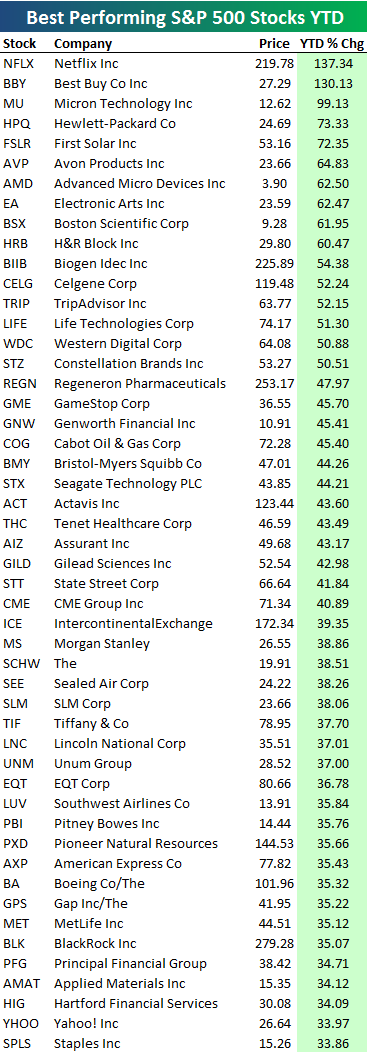
As of 2 PM today, the average stock in the S&P 500 is up 16.94% so far in 2013.  And nearly all stocks in the index are up on the year.  Of the 500 members, 453 of them are in the green this year, while just 47 are in the red. Below is a list of the 50 best performing stocks in the S&P 500 year to date.  As shown, two stocks — Netflix (NFLX) and Best Buy (BBY) — are up more than 100%.  Go figure! Micron (MU) ranks third with a YTD gain of 99.13%, followed by Hewlett-Packard (HPQ) at 73.33% and First Solar (FSLR) at 72.35%.  AVP, AMD, EA, BSX and HRB round out the top ten. One stock that’s clearly not on the list of 2013’s best performing stocks is Apple (AAPL).  Apple is actually down 16.98% YTD, ranking it as the 7th WORST stock in the index on the year.

bestspxytd


South Korea’s conglomerate STX bankruptcy filing is a reminder of the prolonged slump in the marine-transport business; STX Group has $9 billion in total debt

June 9, 2013, 11:44 a.m. ET

STX Bankruptcy Filing Reflects Global Slump in Shipping

By KYONG-AE CHOI and KANGA KONG

SEOUL—The bankruptcy filing by what once was a major profit driver of one of South Korea’s conglomerates is a reminder of the prolonged slump in the marine-transport business. STX Pan Ocean Co., 028670.SE -14.93% the bulk-transportation unit of STX Group,011810.SE -2.03% the country’s 13th-biggest company by assets, filed for court receivership Friday after failing to find a buyer. STX Group had put up for sale its almost 36% interest in STX Pan Ocean, but no buyers came forward. The company, which is listed in Seoul and Singapore, was valued at $231 million in early April but that fell to $170 million by the end of last week. “A combination of a sharp decline in freight rates, a delayed industry recovery, oversupply of ships due to an increased production at Chinese shipyards and higher fuel costs drove up debt and squeezed margins,” STX Pan Ocean said Friday. The decline in the shipping and shipbuilding industries since the 2008 financial crisis has hit STX Group particularly hard. About 90% of the group’s sales come from those businesses. Its other main business, construction, also has been hit by the global economic downturn. “Even if a company ran one of the three businesses—shipping, shipbuilding and construction—it would be hard to survive today. STX has all of them,” said an executive who left STX late last year. STX Group, with more than 10 trillion won, or $9 billion, in total debt, has sold 1.13 trillion won in assets as part of a 2.5 trillion won asset sale plan announced in May of last year. STX has said it would continue to cut its workforce, wages and benefits. It has already cut the number of executives and annual salaries by around a fifth. Read more of this post

Gazprom’s Demise Could Topple Putin; In May 2008, Gazprom’s market capitalization was $369 billion; $83 billion now.

Gazprom’s Demise Could Topple Putin

No large company in the world has been so spectacularly mismanaged as Russia’s state-dominated natural-gas corporation Gazprom OAO. (GAZP) In the last decade, its management has made every conceivable mistake.

Even so, Russian President Vladimir Putin denies the very existence of a crisis and maintains his support for Alexei Miller, the chief executive officer since 2001. Gazprom’s situation is serious not only because it is Russia’s biggest company by market value, but because Putin is its real chairman. Where Gazprom goes, so does Russia and the Putin government.

In May 2008, Gazprom was one of the world’s most valuable companies with a market capitalization of $369 billion. Miller boasted that it would be the first global company to reach $1 trillion. Today, its market value has plummeted to $83 billion and the decline continues. Although it claimed the largest net income of any global company in 2011 at $44.5 billion and still at $38 billion in 2012, its price-earnings ratio has dropped to a fatally low 2.4 for 2013. It has no credibility with shareholders. Read more of this post

Truly Great Companies Add More Than They Extract

JUNE 7, 2013, 11:52 AM

Truly Great Companies Add More Than They Extract

By TONY SCHWARTZ

Perhaps no business consultant enjoys higher esteem in the corporate world than Jim Collins. Over three decades, he has sold millions of copies of his books describing the characteristics of what he terms “great” companies. It is hard not to admire his diligence. Along with a large team of researchers, Mr. Collins spends years gathering evidence and analyzing companies. The primary measure he uses for greatness is how well a company performs for its shareholders over a given period of time. The problem – as we have all been warned – is that past financial performance is no guarantee of future results.

For “Good to Great,” his most successful book, published in 2001, Mr. Collins selected 11 companies as truly elite performers. They included Circuit City (now bankrupt and defunct); Fannie Mae (taken over by the government in 2008 after huge mortgage losses); Pitney Bowes, whose stock has progressively tanked over the last decade; and Altria, the world’s largest tobacco company, which has actually performed well in the marketplace, but earns its revenues almost exclusively from a product that causes five million deaths a year. In “Great by Choice,” published in 2011, Mr. Collins and a co-author, Morten T. Hansen, call out seven companies for “spectacular” results – outperforming the overall stock market and their industry competitors by at least 10 times over a 15-year period. They also set up comparisons with companies in the same industries that performed markedly less well. The most striking comparison involves Microsoft, which Mr. Collins and Mr. Hansen identify as a great performer, and Apple, which they cite as the comparative laggard. Yes, you read that right. Here’s why: the 15-year period the authors happened to examine was 1987 to 2002.

How could so much research miss the mark by so far? Read more of this post

Look How Much Richer You Would Be If You Bought Company Stock Instead Of Products

Look How Much Richer You Would Be If You Bought Company Stock Instead Of Products

Mandi Woodruff | Jun. 8, 2013, 11:39 AM | 27,001 | 4

Whether it’s the latest iGadget or a hot new car, as consumers, we’re always scrambling for dibs on the “next big thing” in stores. But what if we put that money toward stock in the companies behind our favorite products instead? That’s a question recently explored by the Online Trading Academy. With the benefit of hindsight, their team has taken a look back in time to see what might have happened if we’d ditched the supermarket and invested in the stock market.

In 1990, Apple peddled the Macintosh Classic for $1,500. That much cash in Apple stock would have earned you $98,606 today.

Adjusted stock price in 1990: $6.45

Stock Price on April 5, 2013: $423.20

In 1986, the revolutionary Microsoft Windows 2.0 sold for $100. But if you’d put the money directly into company stock instead, today you’d have $11,480.

Adjusted stock price in 1986: $0.25

Stock price on April 5, 2013: $28.70

In 1985, if you chose to invest $200 in Best Buy Stock, instead of splurging on a Sony Walkman for the same price, you would have $36,343 today.

Adjusted in 1985: $0.14

Stock price on April 5, 2013: $25.45

Forty years ago, you could have dropped $460 on an IBM personal typewriter. But you would have made $38,113 if you’d invested that cash in IBM stock instead.

Adjusted stock price in 1962: $2.52

Stock price on April 5, 2013: $209.41

In 1984, a high-end riding lawn mower from Home Depot would have set you back $2,595. A better idea would have been to put that money in stocks and walk away with $699,199 today.

Adjusted stock price in 1984: $0.26

Stock price on April 5, 2013: $70.06

In 1968, if you stuck with your old fridge in lieu of a $500 GE refrigerator and invested that money in stock instead, you would have $47,763 today.

Adjusted stock price in 1968: $0.24

Stock price on April 5, 2013: $22.93

Walmart charged $15.95 for a toaster in 1972. With that cash in Walmart stock instead, you would have earned $30,403 today.

Adjusted stock price in 1972: $0.04

Stock price on April 5, 2013: $76.39

In 1982, you could have ruled the roads in a $6,572 Ford Mustang. A savvier spender would have put that money into Ford itself, and walked away with $314,433 today.

Adjusted stock price in 1982: $0.26

Stock price on April 5, 2013: $12.44

You couldn’t keep Nike Air Jordan’s on shelves back in the late ’80s. But if you saved that $65 and put it in Nike stock instead, you’d have $9,789 to show for it today.

Adjusted stock price in 1987: $0.39

Stock Price on April 5, 2013: $58.97

If you’d had the forethought to invest your annual coffee money ($520) in Starbucks stock in 1992, you’d have enough to buy a franchise of your own: $46,934.

Adjusted stock price in 1992: $0.64

Stock Price on April 5, 2013: $57.80

In 1970, you could have fed Big Macs to a family of four for $2.20. If only you’d put that money in McDonald’s stock instead, you’d have a cool $1,116 today.

Adjusted stock price in 1970: $0.20

Stock price on April 5, 2013: $101.42

A model for fighting fraud; SEC developing software “to sift language in financial reports for clues that executives might be misstating results”

Saturday June 8, 2013

A model for fighting fraud

Optimistically Cautious by ERROL OH

WHAT if the regulators can extract information from a listed company’s annual report and feed it into a computer program to find out if there’s probably some financial sleight of hand going on? That sounds like a tremendous step forward for capital market supervision and enforcement. It also seems a bit far-fetched. But maybe it’s not. The Wall Street Journal reported on May 29 that the US Securities and Exchange Commission (SEC) was renewing its focus on accounting fraud and other problems relating to financial disclosures. The newspaper quoted agency officials as saying the SEC was already developing software “to sift language in financial reports for clues that executives might be misstating results”. The program, according to the article, would analyse the annual report section (usually called the management’s discussion and analysis) in which the companies talk in detail about their performance and prospects. Certain word choices, readers are told, may be red flags that warn of earnings manipulation. One SEC official said tests to determine if the analysis would have sniffed out previous accounting frauds “look very promising”. Here’s a couple of paragraphs from the story: “Firms that bend or break accounting rules tend to play a word shell game,’ said Craig Lewis, the SEC’s chief economist and head of the division developing the model. “Such companies try to deflect attention from a core problem by talking a lot more about a benign’ issue than their competitors, while underreporting important risks’.”

Read more of this post

TSMC to feature on Japanese show about industry in Asia; NHK’s new show — Shima Kosaku’s Asia Success Story — focuses on famous Asian business leaders and their innovative strategies that make their businesses succeed and drive the Asian economy

TSMC to feature on Japanese show about industry in Asia

CNA and Staff Reporter

2013-06-08

TSMC NHK

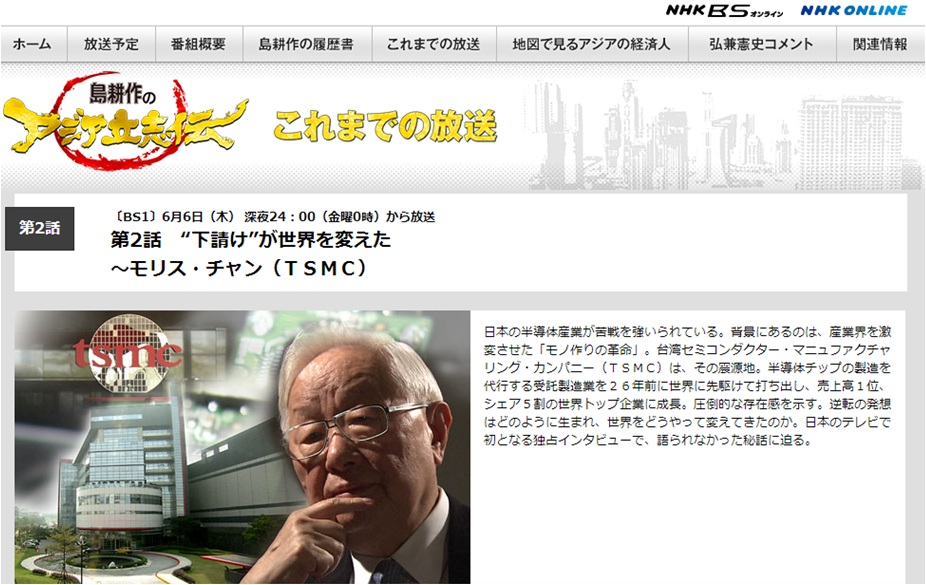
Japan’s NHK network is scheduled to broadcast an animated documentary on Taiwan Semiconductor Manufacturing Co at midnight Thursday, with TSMC’s chairman and CEO Morris Chang portrayed by the fictional character Shima Kosaku.

NHK’s new show — Shima Kosaku’s Asia Success Story — combines documentary footage and anime sequences, and focuses on famous Asian business leaders and their innovative strategies that make their businesses succeed and drive the Asian economy, according the program’s official website.

The TSMC episode, titled OEM that Changed the World — is the second in the series and will depict Chang and his company’s journey to the top of the semiconductor industry. Read more of this post

Why ‘Boring’ Stocks Have an Edge Over ‘Exciting’ Ones

June 7, 2013, 6:18 p.m. ET

BY MARK HULBERT

Why ‘Boring’ Stocks Have an Edge Over ‘Exciting’ Ones

By MARK HULBERT

BF-AF113_HULBER_G_20130607154511

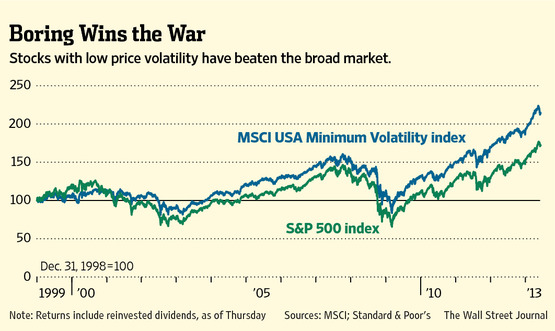
In the stock market, boring is often beautiful. That is because “boring” stocks—those that have exhibited the least historical volatility—on average outperform the most “exciting” issues—those that have been the most volatile. And not by just a small margin, either. By “historical volatility,” we mean the magnitude of a stock’s price swings over a specified period. Just take AppleAAPL +0.76% whose stock has certainly been one of the more volatile in recent years. Its shares have lost 21% over the past 12 months, compared with a 20% gain for those stocks with the least historical volatility, as measured by the MSCI USA Minimum Volatility index. Not all volatile stocks perform as poorly as Apple has over the past year, of course, and not all boring stocks have done well. But the extent to which Apple lags behind the average boring stock over the past 12 months is right in line with historical research conducted by Nardin Baker, who manages global equity at Guggenheim Partners. The firm has $180 billion under management. Read more of this post

What Warren Buffett would change if he ever edited The Intelligent Investor by Benjamin Graham

The Intelligent Investor — By Warren Buffett

What Warren Buffett would change if he ever edited The Intelligent Investor by Benjamin Graham

CHETAN PARIKH

Chetan Parikh enjoys high recall among value investors in India. Rightly so, as he has contributed the most towards creating awareness about value investing through capitalideasonline. His book, India’s Money Monarchs, co-authored with Utpal Sheth and Navin Agarwal, was the first to chronicle the thought process of prominent Indian investors. Over the years, Parikh has not only built an impressive investing track record, he continues to spread the good word by teaching security analysis at Mumbai’s Jamnalal Bajaj Institute of Management Studies

Benjamin Graham laid the foundation for value investing, which Warren Buffett built on. But along the way, the architectural design underwent some significant changes Read more of this post

Charles Brandes: “The Market Has Taught Me To Ignore The Market Most Of The Time”

“The Market Has Taught Me To Ignore The Market Most Of The Time”

While volatility can distort prices in the near term, the value of a business is eventually reflected in stock prices over the long term

OUTLOOK BUSINESS

Volatility, they say, is a friend of value investors. But the crisis of 2008 proved to be an exception to the rule. Take the case of Charles Brandes, the 70-year-old founder of Brandes Investment Partners, who saw assets under management wilt from an eye-popping $111 billion at the end of 2007 to around $21 billion in a span of five years. But the turn of events has not shaken the confidence of the dyed-in-the-wool value investor, who believes that so long as human nature doesn’t change, value investing will remain an effective long-term investment strategy. Incidentally, Brandes is among the privileged few to have legendary value investor, Benjamin Graham, as a mentor Read more of this post

“Investing Is About Figuring Out What Somebody Is Doing Right And Paying Less”; The founder of New York-based Gotham Asset Management does have a magic formula for investing

“Investing Is About Figuring Out What Somebody Is Doing Right And Paying Less”

The founder of New York-based Gotham Asset Management does have a magic formula for investing

Joel Greenblatt is no magician, but the founder of New York-based Gotham Asset Management does have a magic formula for investing. In 2005, Greenblatt, who also has been teaching at Columbia Business School for the past 17 years, published The Little Book that Beats the Market, which explains how investors can outperform market averages by following a simple process of investing in good companies at bargain prices. The ‘Magic Formula,’ as Greenblatt termed it, was about seeking out companies with high return on invested capital, and which could be purchased at a low price. The strategy produced back-tested returns of 30.8% per year from 1988 through 2004, more than double the S&P 500’s 12.4% return over the same period. What better proof than eating your own cooking, Greenblatt’s private investment partnership has logged a 40% annualised return since its inception in 1985. Read more of this post

Russian retailing: A Magnit for investors; A retailer doing well in a business-unfriendly country by catering to the needs of price-sensitive shoppers in the country’s regions. That makes him not only the rare Russian oligarch whose wealth has nothing to do with natural resources, but also the only one who does not make his home in Moscow or in one of Europe’s fancier cities but in Krasnodar, a regional capital in south-western Russia

Russian retailing: A Magnit for investors; A retailer doing well in a business-unfriendly country

Jun 8th 2013 | KRASNODAR |From the print edition

images (14)

STANDING in front of a bank of display screens in Krasnodar, Alexander Barsukov, an executive at the Russian grocery chain Magnit, can see that a hypermarket in Nizhnekamsk, a town of 230,000 people 1,900km (1,200 miles) away, is running low on “Group A” products—ones such as bread and milk that account for 20% of stock but 80% of sales. Mr Barsukov has the store manager notified to restock the shelves; a “control call” will follow up in 40 minutes. The point is to “catch mistakes fast,” he says.

It is this combination of advanced IT systems and efficient logistics that has propelled Magnit to the top of the Russian food-retail industry, a fast-growing, $300-billion-a-year market that is now Europe’s largest. In April, for the first time in its 15-year history, Magnit bested its competitors by posting $4.3 billion in quarterly sales. Long the underdog, Magnit has become an investors’ favourite: its share price has nearly doubled over the past 12 months. Read more of this post

Costco CEO Craig Jelinek Leads the Cheapest, Happiest Company in the World; I hope when I’m 90, and this company is around 30 years from now, I can go eat a hot dog at a Costco food court and hear someone say, ‘I remember you.’”

Costco CEO Craig Jelinek Leads the Cheapest, Happiest Company in the World

By Brad Stone on June 06, 2013

http://www.businessweek.com/articles/2013-06-06/costco-ceo-craig-jelinek-leads-the-cheapest-happiest-company-in-the-world

covertrail24_304feature_costco24__01__304

Costco CEO Craig Jelinek

How this week’s cover got madeJoe Carcello has a great job. The 59-year-old has an annual salary of $52,700, gets five weeks of vacation a year, and is looking forward to retiring on the sizable nest egg in his 401(k), which his employer augments with matching funds. After 26 years at his company, he’s not worried about layoffs. In 2009, as the recession deepened, his bosses handed out raises. “I’m just grateful to come here to work every day,” he says.

This wouldn’t be remarkable except that Carcello works in retail, one of the stingiest industries in America, with some of the most dissatisfied workers. On May 29, Wal-Mart Stores (WMT) employees in Miami, Boston, and the San Francisco Bay Area began a weeklong strike. (A Walmart spokesman told MSNBC the strike was a “publicity stunt.”) Workers at an Amazon.com (AMZN)fulfillment center in Leipzig, Germany, also recently held strikes to demand higher pay and better benefits. (An Amazon spokesman says its employees earn more than the average warehouse worker.) In its 30-year history, Carcello’s employer, Costco, has never had significant labor troubles. Costco Wholesale (COST), the second-largest retailer in the U.S. behind Walmart, is an anomaly in an age marked by turmoil and downsizing. Known for its $55-a-year membership fee and its massive, austere warehouses stocked floor to ceiling with indulgent portions of everything from tilapia to toilet paper, Costco has thrived over the last five years. While competitors lost customers to the Internet and weathered a wave of investor pessimism, Costco’s sales have grown 39 percent and its stock price has doubled since 2009. The hot streak continued through last year’s retirement of widely admired co-founder and Chief Executive Officer Jim Sinegal. The share price is up 30 percent under the leadership of its new, plain-spoken CEO, Craig Jelinek. Read more of this post

STX Pan Ocean, South Korea’s biggest commodities shipping line, filed for court receivership after a drop in rates left it unable to pay off its debt.

STX Pan Ocean Files for Court Receivership on Debt, Losses

STX Pan Ocean Co. (028670), South Korea’s biggest commodities shipping line, filed for court receivership after a drop in rates left it unable to pay off its debt. “STX Pan Ocean has been in a liquidity crisis as the company can’t raise enough funds after a slump and delayed rebound in bulk-shipping markets,” the company said in an e-mailed statement in Seoul, where it filed for receivership. Shares of the shipping line, now halted for trading, have fallen 46 percent in Seoul this year as parent STX Group tries to sell stakes in businesses including Pan Ocean as rates drop. The Baltic Dry Index, a measure of commodity shipping costs, has plunged 90 percent since touching a record high in 2008, and any delay in recovery could hurt more companies. Read more of this post

Buffett Rail Rally Defies Analysts Seeing End to Gains

Buffett Rail Rally Defies Analysts Seeing End to Gains

Investors are driving railroad stocks to the best start to a year since 2008, looking past downgrades by Wall Street analysts, in a bet that Warren Buffett is right about the carriers’ long-term prospects.

A 22 percent surge for the Standard & Poor’s 500 Railroads Index in 2013 is outpacing the S&P 500’s 13 percent jump. The gains are being extended even with the proportion of buy ratings on Union Pacific Corp. (UNP), the largest U.S. railroad, and Kansas City Southern (KSU), the fastest growing, at the lowest since 2010.

Crude-oil cargo, a homebuilding rebound and the fastest auto-sales pace in six years are buoying earnings, and options market trading data analyzed by Bloomberg show investors expect the rally to continue. The rail index’s return has almost doubled the S&P 500’s advance since Buffett’s Berkshire Hathaway Inc. (BRK/A) agreed to buy Burlington Northern Santa Fe Corp. in 2009. Read more of this post

Investing in Korea: Staying Rational Despite Samsung’s Halo Effect. Bamboo Innovator is featured in BeyondProxy.com, where value investing lives

Bamboo Innovator is featured in BeyondProxy.com, where value investing lives:

Investing in Korea: Staying Rational Despite Samsung’s Halo Effect, June 5, 2013 (Weblink: BeyondProxy.com)

Korea

Singapore-listed STX Pan Ocean, the shipping arm of South Korean conglomerate STX Group, will make a decision on applying for court receivership or restructuring after hearing from its largest creditor

STX Pan Ocean’s receivership request hinges on creditor

SINGAPORE — Singapore-listed STX Pan Ocean, the shipping arm of South Korean conglomerate STX Group, will make a decision on applying for court receivership or restructuring after hearing from its largest creditor, the Korea Development Bank (KDB), on its request for funding.

BY – 6 HOURS 23 MIN AGO

SINGAPORE — Singapore-listed STX Pan Ocean, the shipping arm of South Korean conglomerate STX Group, will make a decision on applying for court receivership or restructuring after hearing from its largest creditor, the Korea Development Bank (KDB), on its request for funding. Read more of this post

This shell that is buying Smithfield has no legal or operational connection to Henan Shuanghui whose Chinese assets are reportedly being used as collateral for the shell company to finance a very highly-leveraged acquisition

Smithfield Foods – Shuanghui International: The Biggest Chinese Acquisition That Isn’t

June 2nd, 20131 comment

Peter Fuhrman is Chairman, Founder & CEO at China First Capital, (中国首创)a leading China-focused specialist international investment bank and advisory firm for private capital markets and M&A transactions.

It is, if voluminous press reports are to be believed, the biggest story, the biggest deal, ever in China-US business history. I’m talking about the announced takeover of America’s largest pork company, Smithfield Foods, by a company called Shuanghui International. The deal, it is said in dozens of media reports, opens the China market to US pork and will transform China’s largest pork producer into a global giant selling Smithfield’s products alongside its own in China, while utilizing the American company’s more advanced methods for pork rearing and slaughtering.

One problem. A Chinese company isn’t buying Smithfield. A shell company based in Cayman Islands is. Instead of a story about “China buying up the world”, this turns out to be a story of a precarious leveraged buyout deal (“LBO”) cooked up by some large global private equity firms looking to borrow their way to a fortune. Read more of this post

Wide Moat Investing Summit 2013, July 9-10, 2013 (Presentation by Bamboo Innovator on Jul 10, 8.30am EST)

WideMoat

Bamboo Innovator Workshop for the Singapore Public: Detecting Frauds Ahead of the Investing Curve (Series #2 of 4)

Saturday, 3 August 2013 from 09:00 to 17:00 (SGT)
Singapore
Event Details

Frauds. Warren Buffett commented in the recent Berkshire Hathaway AGM 2013 that when he’s reading through financial statements, he’d find companies he was virtually certain are frauds. In response to a shareholder’s question on what did he find that made him so certain, both Buffett and Munger replied that “there isn’t a 40-point checklist” and that value investors need to understand the interaction between the underlying business model dynamics and the people running the enterprise when examining the numbers.

In Asia, with outbreaks of accounting frauds and corporate governance lapse erupting on a systematic basis at the firm level, how does a value investor go about generating sustainable outsized returns? To paraphrase Sherlock Holmes, to murder (to engage in earnings management) is easy, but to dispose the murdered body (to expropriate or tunnel out the cash and assets out of the company) is harder as it is detectable by the serious institutional investor with his or her keen observation of the various information signals and clues.

It would be premature to speak of “fundamental” analysis using possibly rigged accounting numbers due to propping and tunneling to fashion elaborate but “garbage-in-garbage-out” quant valuation models. Even “technical” analysis can be misleading given prices and volumes are often manipulated by the “insiders” (庄家) who establish the stock inventory (老鼠仓), luring investors in and then offloading in a pump-and-dump cycle. Such exploits by insiders is made easy as most stocks in Asia are still relatively small-cap and illiquid, given that the median market cap of the listed universe of 23,000 stocks in Asia is around $80 million and over 80% are under a billion dollar in market cap.

Thus, the use of “fundamental” or “technical” analysis, or its combination – without a Mungerian I-O accounting framework using the Bamboo Innovator way – can lead to a false sense of confidence that clever insiders exploit at your expense.

Course Highlights:

– Mr Kee Koon Boon, one of the few Asian fund managers being invited to speak at a number of top banking & finance conferences around the world alongside with renowned speakers such asPraveen Kadle, Chief Executive Officer of Tata Capital & Lauren Templeton, President of Lauren Templeton Capital Management

– Learn from an experienced & qualified instructor who has also taught in local Universities

Program Outline and Key Learning Points:

  • UNDERSTAND the importance of the Mungerian I-O (Incentive-Opportunity) accounting framework to adapt value investing principles in Asia.
  • LEARN the three accounting steps that “set-up” companies commonly use to expropriate assets and the ORECTA and other information signals that sophisticated institutional investors use in their cutting-edge empirical research tool-bag.
  • DEVELOP the ability to scan through thick annual reports and financial statements for the Seven Accounting Sins.
  • DEMYSTIFY the various techniques in “earnings management”, “revenue recognition management”, “real activity management” and “income smoothing” and differentiate between opportunistic bookkeeping mischief and discretionary signaling of private information of leading indicators of firm performance by management to investors.
  • ATTAIN the application tools used by sophisticated institutional investors in the accounting of words, that is, textual analysis of disclosures which are an important source of information with value relevance about the firm.
  • DISSECT actual cases of capex-related fraud in prominent Asian listed companies that are invested by reputable fund management institutions who are also caught flat-footed when things unravel.
  • RE-EXAMINE accounting fundamentals that universities impart without the relevant context of value investing, including the use and abuse of the accruals anomaly (AA) in investing strategies adopted by sophisticated institutional investors in various forms.
  • UNIFY at the end of the day all the previously disparate loose-hanging concepts, “descriptive” facts and “checklists” you have learnt from various sources into the practical Bamboo Innovator mental model when it comes to real investment decision-making.

Understand more about the Instructor’s investment approach with the following published articles:

About the Instructor:

Koon Boon is the founder and managing director of the Singapore-based Bamboo Innovator Institute to establish the thought leadership of resilient value creators around the world. KB has been rooted in the principles of value investing for over a decade as a fund manager and analyst in the Asian capital markets. He was a fund manager and head of research/analyst at a Singapore-based investment management organization dedicated to the craft of value investing in Asia. He had been with the firm since 2002 and was also part of the core investment committee in significantly outperforming the index in the 10-year-plus flagship Asian fund. He was previously the portfolio manager for Asia-Pacific equities at Korea’s largest mutual fund company. He received his Masters in Finance (magna cum laude) and double degree in Accountancy and Business Management (both summa cum laude) from the Singapore Management University (SMU). He had taught accounting at his alma mater in SMU and at SIM University. He had published research in the Special Issue of Istanbul Stock Exchange 25th Year Anniversary of the Boğaziçi Journal, Review of Social and Economic Studies, as well as wrote articles about value investing and corporate governance in the media. He had also presented in top banking and finance conferences in Sydney, Cape Town, HK, Beijing and in the recent Emerging Value Summit 2013. He had trained CEOs, entrepreneurs, CFOs, management executives in business strategy, macroeconomic and industry trends in Singapore, HK and China.

The S.E.C. Is ‘Bringin’ Sexy Back’ to Accounting Investigations to crack down on accounting fraud

JUNE 3, 2013, 11:38 AM

The S.E.C. Is ‘Bringin’ Sexy Back’ to Accounting Investigations

By PETER J. HENNING

In April 2003, a New York Times article discussed the push by federal prosecutors to crack down on accounting fraud in which one expert said, “These have become the hot, sexy cases.” What followed were the convictions of chief executives including Jeffrey K. Skilling of EnronBernard J. Ebbers of WorldCom and John J. Rigas of Adelphia Communications. The attraction seems to have worn off. The number of corporate accounting cases at the Securities and Exchange Commission has dropped to its lowest level in a decade, with only 79 such cases filed in the most recent fiscal year. In the past, the S.E.C. relied mainly on the market to flag accounting problems at companies that would lead to an investigation. Enron’s demise, for example, began when questions were raised about its complex reporting of various off-balance-sheet transactions amid a rapidly falling stock price, which led to the issuance of subpoenas to the company and its outside auditor, Arthur Andersen.

Today, the S.E.C. wants to be more proactive by using risk modeling to analyze corporate filings to identify companies that might be outliers in reporting their results. In a speech in December, Craig M. Lewis, director of the agency’s division of risk, strategy and financial innovation, talked about a new “accounting quality model” that could help the S.E.C. “assess the degree to which registrants’ financial statements appear anomalous.” Read more of this post

Legal firms biting at the heels of Sinovel Wind Group; prosecutors are asking for compensation for losses resulting from the company’s fraudulent financial statements

Legal firms biting at the heels of Sinovel Wind Group

Staff Reporter 2013-06-03

CFP432577743-164417_copy1

Sinovel Wind Group announced on May 30 that it has received notice from the China Securities Regulatory Commission of a pending investigation into the company for the alleged violation of the Securities Law. According to NetEase, a Chinese web portal, some legal firms have started soliciting entrustment from investors for suing Sinovel. The prosecutors are asking for compensation for losses resulting from the company’s fraudulent financial statements. On April 13 2013, Sinovel announced that it had received notification from the Beijing Securities Regulatory Bureau, which discovered that some business receipts, related figures, and financial records of the company were off the mark, leading to inflated profits in 2011. According to the Securities Law, investors can file civil suit for compensating their losses caused by false statements which are confirmed and penalized by the China Securities Regulatory Commission. Sinovel listed its shares on the A-share market on Jan. 13, 2011, at an IPO of 90 yuan (US$14.66) per share. The shares closed at 5.76 yuan (US$0.93) on May 29, which translated to a combined 73% decline over the past two years.

Investing in spinoffs—and often their parent companies—can be a ticket to market-beating returns

SATURDAY, JUNE 1, 2013

Graduation Day for Spinoffs

By RESHMA KAPADIA | MORE ARTICLES BY AUTHOR

BA-BC050B_Spino_G_20130601013552

Investing in spinoffs—and often their parent companies—can be a ticket to market-beating returns. But not all are created equal: Four ways to play the recent crop.

The best parents know when their offspring are ready to go off on their own. And when corporate parents spin off parts of their business, it’s often the best thing for investors as well.

Graduation is in the air, and more companies are considering divesting businesses through spinoffs. Last month, industrial company Dover Corp. (ticker: DOV) said it planned to spin off a fast-growing consumer electronics unit. Two media conglomerates—Time Warner (TWX) and Barron’s parent News Corp (NWS)—have announced splits that separate their publishing units from other media properties. And a wave of corporate activism is pushing other executives to consider such moves. While PepsiCo (PEP) has fended off calls to split its snack and drink business in the past, Chief Executive Indra Nooyi said in April that the company is exploring “sensible opportunities to unlock incremental value through meaningful structural alternatives,” amusingly dense corporate jargon that kicked off spinoff speculation.

A good parent company knows when it’s time to let a fledgling business fly solo. And savvy investors know those new companies are good buys. Read more of this post

The 100% Stock Solution

May 31, 2013, 5:43 p.m. ET

The 100% Stock Solution

By LIAM PLEVEN

BF-AF044_01WIcv_G_20130531222703BF-AF069_ALLSTO_G_20130531152422

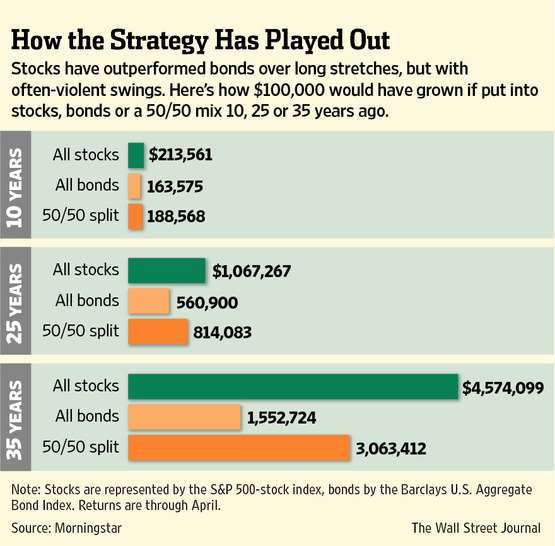
Most investors hold a mix of stocks and bonds, hoping for both growth and safety. Then there are people like Daniel White.

The 36-year-old Chicago lawyer keeps all his investments in the stock market. His 401(k) plan is invested in equities, and so is his wife’s. The college-savings accounts for their four young children also are in stocks. His separate brokerage accounts are, too. The total sum at risk is in the high six figures, he says.

“I’m not an adrenaline junkie,” says Mr. White, who sees the stock-market wagers as part of a broader personal portfolio that includes his job, enough cash to cover the family’s living expenses for an extended period and a house that is fully paid for. Read more of this post

China’s Fifth-Richest Man Wei Jianjun of Great Wall Motor Targets to Sell More SUVs Than GM’s Jeep

China’s Fifth-Richest Man Targets to Sell More SUVs Than Jeep

Chinese billionaire Wei Jianjun has set a target for Great Wall Motor Co. (2333)’s Haval marque to surpass Chrysler Group LLC’s Jeep and become the world’s best selling SUV brand in three to four years. As part of the plan, Great Wall’s chairman has started construction of a new research center the size of 35 soccer fields in the city of Baoding, about 160 kilometers (100 miles) from Beijing. He plans to increase the number of engineers by at least 40 percent to more than 10,000.“We want Haval to have the highest value for money,” Wei, who is China’s fifth-richest man with an estimated net worth of $6.6 billion according to the Bloomberg Billionaires Index, told reporters today at the company’s factory in northern Hebei province. “We want to surprise our customers by that instead of just satisfying them.” Read more of this post

Korea’s financial watchdog will launch an audit into Woori Bank because it is suspected of holding hundreds of “borrowed name” accounts for CJ Group, the subject of ongoing investigations into tax evasion and slush fund creation

2013-05-31 16:57

Regulator to look into Woori for CJ accounts

By Kim Tae-jong

The nation’s financial watchdog will launch an audit into Woori Bank because it is suspected of holding hundreds of “borrowed name” accounts for CJ Group, the subject of ongoing investigations into tax evasion and slush fund creation.

The bank is suspected of abetting the group’s wrongdoings, if proven to be true, this will be another setback, coming right after the Board of Audit and Inspection (BAI) blamed it for having poor management practices. Read more of this post

Bumi Says $201 Million Missing After Review of Berau Finances

Bumi Says $201 Million Missing After Review of Berau Finances

Bumi Plc (BUMI), the coal producer at the center of an ownership dispute between its founders, said a review of spending at one of its two Indonesian units found $201 million of outlays with “no clear business purpose.”

In addition to the $152 million determined to be missing from PT Berau Coal Energy’s finances in 2012, $49 million was identified for the 2011, Bumi said in a statement. The Berau Coal review delayed Bumi’s results by more than two months. It today reported a net loss of $2.3 billion for 2012, compared with the year-earlier loss of $337 million after booking charges of $2.2 billion on its Indonesian coal businesses.

Bumi has been at the center of a battle for control between co-founders Nathaniel Rothschild and Indonesia’s Bakrie family since the $3 billion deal that brought them together started to sour in late 2011. Trading in the stock will remain suspended while the company “continues to enhance its internal systems and controls,” it said today.

Bumi took an impairment charge of $815 million on the Berau assets. PT Bumi Resources, in which Bumi Plc holds a 29 percent stake, posted a net loss of $666.2 million for 2012 as lower coal prices hurt sales at Indonesia’s biggest coal producer. Bumi took a non-cash charge of $1.4 billion on the value of its equity stake in Bumi Resources, it said today. Read more of this post