Bre-X, Canada’s largest mining fraud in history, class action settlement approved after 16 years since its claim of a major gold discovery in Indonesia proved to be a fake; investors get tiny fraction of losses

Bre-X class action settlement approved; investors get fraction of losses

Hugh McKenna, Canadian Press | 13/05/30 7:17 PM ET

David Walsh, mapA1.27MAY.JOHN.TA

National Post filesBre-X became known as the largest mining fraud in Canadian history back in 1997 when its claim of a major gold discovery in Indonesia proved to be a fake.

TORONTO — The lengthy battle by Bre-X investors to recover billions in Canada’s largest mining fraud appears to be over in what one of the original plaintiff lawyers in the case called a “sad day” for accountability in Canada. Under a settlement approved Thursday by the Alberta Court of Queens Bench, the remaining class-action suits were dismissed against the main defendants in the case, the estate of Bre-X’s late founder and CEO, David Walsh, and chief geologist John Felderhof. The Calgary court made the ruling at the request of bankruptcy trustee Deloitte and Touche, which said there was no realistic prospect of realizing any significant recovery through the litigation and that the costs of proceeding were prohibitive. As a result, all parties agreed to a payment of $5.2-million to be divided among investors who apply for a settlement. Read more of this post

While the link between profits and stock returns should be clear, historically investors have not fully appreciated the long-term persistence of profits.

Profitability Matters

While the link between profits and stock returns should be clear, historically investors have not fully appreciated the long-term persistence of profits.

By Alex Bryan | 05-29-13 | 06:00 AM | Email Article

It’s surprising that value stocks have done as well as they have. Value stocks tend to be less profitable than their growth counterparts, and yet they have historically traded at steep enough discounts to outperform growth stocks in nearly every market studied over long horizons. But price is only one aspect of value. Controlling for risk, a company’s future profitability drives its intrinsic value. While companies that consistently generate high profits command higher valuations than traditional value stocks, the market has also historically undervalued these companies. This anomaly is consistent with Warren Buffett and Charlie Munger’s philosophy that it is better to buy a great company at a fair price than a fair company at a great price.

Profitability measures how productively a company uses its investors’ capital and assets. Simply comparing net income or earnings per share across companies does not adequately capture this idea. It is often possible for a company to boost its net income by acquiring more assets, but that does not necessary improve its productivity–just the opposite. The marginal returns to capital tend to diminish with size. In other words, investors often get less “bang for the buck” for each additional dollar invested in the business. In order to control for differences in invested capital and assets, researchers define profitability using metrics, such as return on invested capital, gross profits/assets, and adjusted operating income/book value of equity. Read more of this post

‘Smart beta’, a new weapon in your armoury

May 24, 2013 5:55 pm

‘Smart beta’, a new weapon in your armoury

By David Stevenson

No longer a straight choice between active and passive investing, says David Stevenson

The term “smart beta” doesn’t exactly roll off the tongue. Nor is it likely to become a catchphrase, as in: “I’ve made an absolute killing on my smart beta funds.” But smart beta is something investors could be hearing a lot more about in the years ahead.

My colleague Merryn Somerset Webb outlined the structural limitations of the fund management industry last week.

Basically, most managers are doomed to hug the benchmark because the industry is focused on gathering assets. Better to fail conventionally than to succeed unconventionally, as Keynes said. Passive investing might reduce the costs, but invariably commits you to a momentum investing strategy because most indices are weighted by market capitalisation. The bigger a company gets, the more you have invested in it. Over time, the noise of the market will even out the rises and falls of individual shares and you’ll get the underlying market return, also known as the beta of the index. Read more of this post

If investing is poker, fund managers are a busted flush; The structure of the industry condemns many of them to underperform

May 17, 2013 3:36 pm

If investing is poker, fund managers are a busted flush

By Merryn Somerset Webb

The structure of the industry condemns many of them to underperform

Imeet a lot of fund managers. I tend to like them. Fund managers are mostly charming company. They are, on the whole, clever, interesting and full of sensible sounding ideas. And if you see them at a conference they often have something nice you can take home for your kids.

I’ve written here before about how all these nice men purport to be into value investing (buying cheap stuff) or at least quality value investing (buying good stuff at fair prices) at the moment. They tend to tell me they are running their fund just as Warren Buffett used to run his before it got way too big. They have strict valuation criteria they aren’t going to deviate from. They defy consensus, shut their ears to short-term noise and focus on the long term. Read more of this post

Prosecutors begin raids as South Korea launches tax probe into powerful chaebols

May 29, 2013 3:25 pm

Prosecutors begin raids as South Korea launches tax probe

By Simon Mundy in Seoul

Prosecutors raided the home of one of South Korea’s most prominent businessmen on Wednesday, amid growing scrutiny of offshore financial arrangements made by the country’s corporate elite.

The search of the Seoul residence of Lee Jay-hyun, chairman of the conglomerate CJ Group, was part of an investigation into “allegations of tax evasion through overseas bank accounts”, the company said, while declining to comment further. Mr Lee was not available for comment.

Meanwhile, the authorities said they had launched a probe into 23 companies and individuals suspected of tax evasion through shell companies in tax havens. Read more of this post

Pushing smart beta further; Norway’s Government Pension Fund Global has commissioned MSCI feasibility studies on smart beta strategies for large portfolios

Pushing smart beta further

Posted By Sarah Rundell On 29/05/2013 @ 2:09 pm In ANALYSIS

The rise of smart beta has just got another boost thanks to a study commissioned by Norway’s ministry of finance for its Government Pension Fund Global. It asked index provider MSCI to look into the feasibility of running smart beta strategies for large portfolios. Very few institutions with the size of GPFG’s $400-billion equity portfolio have implemented smart beta strategies yet, mostly because of challenges around investability or liquidity. MSCI, which has around $40 billion benchmarked against its various risk premia, or smart beta, indicies, explored the feasibility of investing a hypothetical portfolio of $100 billion and found that large assets can successfully run on these indices without liquidity worries. Read more of this post

Enduring lessons from the legend of Rothschild’s carrier pigeon

May 28, 2013 5:58 pm

Enduring lessons from the legend of Rothschild’s carrier pigeon

By John Kay

In an era of high-frequency trading, it is differences in perception that offer opportunities

In 1815, the combined forces of Britain and Prussia defeated Napoleon’s army at the Battle of Waterloo. It was, said the Duke of Wellington, a damn close run thing. But even before the dust had settled on the battlefield, a carrier pigeon belonging to the House of Rothschild was on its way across the Channel to London. Nathan Rothschild, informed ahead of other traders that the country was not to be over-run by the French, consequently made a killing by buying British government bonds.

Little of this legend is true but there are elements that are accurate. There was a battle at Waterloo, which ended Napoleon’s career. Wellington did not say it was a damn close run thing but there is evidence he thought so. The Rothschilds used carrier pigeons but that was not how they learnt the battle’s outcome. Rothschild did have early knowledge of the outcome, and may have used it to advantage, but that knowledge was not the source of the house of Rothschild’s fabled wealth. It did, however, earn a great deal, helping governments of all complexions to fund the Napoleonic wars. Read more of this post

I BLEW IT: 11 VCs Regret The Huge Companies They Said “No” To

How One VC Completely Blew A Meeting With A Startup Founder, And How Another Nailed It

Alyson Shontell | May 28, 2013, 12:14 PM | 8,014 | 6

Cash is king, so venture capitalists often have the upper hand when it comes to meeting with early-stage entrepreneurs. But when startups become big and awesome, the tables turn. Some venture capitalists get that. Others don’t seem to. One frustrated entrepreneur, Andy Dunn, has met with a number of investors for his clothing startup, Bonobos. He wrote a rant that described “dumb VCs” he and other entrepreneurs have dealt with. Bonobos is an e-commerce company that has raised more than $70 million. Its clothing is sold online and nationwide in Nordstrom stores. Dunn raised $30 million in March, and that fundraising process may have inspired the rant. Dunn described one “dumb” investor he met with six times. That person never offered to invest but he also never turned Dunn down. Instead, he just wasted Dunn’s time. Later, when Dunn didn’t inform him about his funding round, the investor acted confused. “Dear Dumb VC, it’s not my job to call you. It’s your job to call me,” Dunn writes. “And the fact that we spent all that time together, and you never got me a term sheet is a strong indicator that you’d rather do what’s in your worst interests than what’s in my best.” Jeremy Lieu of Lightspeed, however, wowed Dunn. Lieu came into his first two meetings visibly prepared. “One of the reasons Jeremy Liew from Lightspeed is an investor in Bonobos is he showed up in our first two meetings wearing my pants!” Dunn writes. It proved Liew had tried Dunn’s product. Dunn concludes his post with another anecdote from a fellow entrepreneur. The founder is now working on a billion-dollar startup, but early on, he was blown off by a VC. “This VC was seventy-five minutes late to meeting with me. He never called to say he was running late. When he got to the office, I wouldn’t meet with him. He groveled to get into meeting with me, and my team was pressuring me to just take the conversation, but I told them to politely tell him that he missed the meeting. That night, as he had flown into town to see me, he kept offering drinks or dinner to make up for it via email. He then went so far as to say his partners would be livid with him for screwing this up. I never took the meeting with him and I never rescheduled. I’d never get another meeting with him if I blew off his time like this, so why should he get another meeting with me?” “Dumb VCs” aside, even good VCs have botched great startup deals. Here are some of their biggest regrets.

I BLEW IT: 11 VCs Regret The Huge Companies They Said “No” To

Alyson Shontell | Aug. 8, 2011, 12:26 PM | 96,026 | 3

We asked angel investors and venture capitalists to tell us about the startups that got away. That is, the startups they could have invested in early, but ultimately passed on for whatever reason. Even the best investors make mistakes. They overlook opportunities, aren’t aggressive enough, or miss out rounds. From Ron Conway to Fred Wilson, we have some good stories about who missed what and why. Read more of this post

Korean chaebol CJ Group Chairman Lee Jay-Hyun Faces up to 10 years in Prison if HE is convicted of Tax Evasion, Illegal Capital outflow, stock manipulation and Breach of Trust, prosecutors said

2013-05-28 17:01

CJ chairman faces up to10 years

Kim Jae-won by
CJ Group Chairman Lee Jay-Hyun Faces up to 10 years in Prison if HE is convicted of Tax Evasion, Illegal Capital outflow, stock manipulation and Breach of Trust, prosecutors said.  The prosecution plans to Summon The 53-year -Old food and Entertainment industry mogul as Early as this week for Questioning.  Read more of this post

Mr. Clean Tech Won’t Back Down

May 28, 2013, 8:17 p.m. ET

Mr. Clean Tech Won’t Back Down

By PUI-WING TAM

When renewable-fuels company KiOR Inc. KIOR +0.64% raised money in March, it didn’t tap the stock market, where it has faced a rocky reception since going public in 2011. KiOR turned instead to its earliest investor: billionaire venture capitalist Vinod Khosla.

Out of his own pocket, Mr. Khosla lent KiOR $50 million so the Pasadena, Texas, company could build a facility to turn wood and other nonfood sources of feedstock into a renewable crude oil using a proprietary technology that it further processes into gasoline and diesel fuel. That followed a $25 million loan to KiOR from Mr. Khosla’s venture-capital firm, Khosla Ventures, in early 2012.

KiOR and Mr. Khosla declined to detail terms of the loans. KiOR Chief Executive Fred Cannon said the venture capitalist “has been an outstanding supporter” even though the renewable-fuels sector is out of favor with investors. Read more of this post

Mudslinging in China’s Heavy-Machinery Sector

May 27, 2013, 9:21 a.m. ET

Mudslinging in China’s Heavy-Machinery Sector

By DUNCAN MAVIN

Digging for dirt on China’s machinery sector can be productive, especially when the economy’s stuck in the mud. Several companies that supply excavators, loaders and other construction equipment ran into trouble in 2012 and in the first few months of this year. The main problem was slowing economic growth, though oversupply of equipment was a big factor too. That led to slumping sales, rising inventory levels and a sharp uptick in accounts receivable as hard-up customers took longer to pay. Read more of this post

China’s second-largest construction equipment maker Zoomlion Bonds Fall, Stock Trading Halted After Media Report accusing it of falsifying sales

Zoomlion Bonds Fall, Stock Trading Halted After Media Report

Zoomlion Heavy Industry Science and Technology Co., China’s second-largest construction equipment maker, halted stock trading and saw its bonds decline after a report on Sina.com accused it of falsifying sales. The Shenzhen-listed shares were halted because of the report and trading will resume after the company posts a filing on the issue, Changsha-based Zoomlion said in a statement. The Hong Kong-traded stock was also suspended. Zoomlion’s $600 million of 6.125 percent bonds due December 2022 slumped 2.1 cents on the dollar to 95.4 cents as of 11:21 a.m. in Hong Kong, the lowest level since March 6 and heading for the biggest daily decline since Feb. 4, Bloomberg prices show. Zoomlion’s Hong Kong-traded stock has slumped 31 percent this year as its first-quarter profit plummeted 72 percent. Construction-equipment makers, including bigger rival Sany Heavy Industry Co. (600031), face a drop in orders as slowing economic growth and government curbs on the property market sap demand. Hong Xiaoming, a Zoomlion vice president in charge of the finance department, said in a mobile-phone text message that the company will issue a clarification today. She didn’t elaborate.

To contact the reporters on this story: Jasmine Wang in Hong Kong at jwang513@bloomberg.net; Rachel Evans in Hong Kong at revans43@bloomberg.net

Romancing Alpha, Forsaking Beta

Why a hold recommendation is no recommendation at all

Why a hold recommendation is no recommendation at all

David Kaufman | 13/05/24 | Last Updated: 13/05/24 3:55 PM ET
It is part of the human condition to want to classify things. In the world of finance, where many analysts suffer from what is referred to as “physics envy,” there is an inescapable draw to being able to reduce any problem, large or small, into a neat box that can be labelled with a simple word or phrase. Hence the infatuation with recommending investments as either a buy, sell or hold. If this made sense, that would be one thing. But it doesn’t. There is no such thing as a hold.

The hold recommendation on a stock, at best, gives investors mixed signals. At worst, it makes them suspicious. Either way, the go-between rating is here to stay and knowing how to read it may add considerable value to a portfolio.
The proof of this statement requires an exercise for which three assumptions are necessary. First, that the set of possible investment choices is far greater than the number of required investments. Second, that there are little or no transaction costs (whether in the form of commissions, redemption fees or taxes) that apply in moving from one investment to another. And third, that there is enough liquidity in any investment to buy and sell it without having an impact on its value. Read more of this post

The Hunt for Steve Cohen, founder of SAC Capital, the $14 billion hedge fund, who some regard as the most successful stock picker of his time.

June 2013

The Hunt for Steve Cohen

i.0.steve-cohen-andre-carrilho_0

With arrest after arrest in a massive, seven-year insider-trading investigation, U.S. Attorney Preet Bharara is getting closer to the biggest fish of them all: Steve Cohen, founder of SAC Capital, the $14 billion hedge fund, who some regard as the most successful stock picker of his time. C.E.O.’s have fallen, lives and companies have been upturned, but Cohen has thus far escaped. Bryan Burrough and Bethany McLean go deep inside Bharara’s probe—and SAC’s org chart—to reveal just how much blood is in Wall Street’s waters.

By Bryan Burrough AND Bethany McLeanIllustration by André Carrilho

THAR SHE BLOWS Steve Cohen has become a focal point of a seven-year probe into insider trading, led by U.S. Attorney Preet Bharara. So far, 71 people have been convicted or admitted guilt.  Twenty-five years ago Wall Street, and much of America, was transfixed by a sweeping set of insider-trading investigations centered on the greatest financier of the age, junk-bond king Michael Milken, of Drexel Burnham Lambert. Day after day, week after week, month after month, stories of U.S. Attorney Rudolph Giuliani’s relentless investigation dribbled out to the press. One by one, Giuliani picked off Milken’s minions, confronting them at their homes, handcuffing them at their offices, pulling them before secret grand juries, indicting a few, pressing for evidence that Milken had broken the law. It all took on an inexorable quality. In their hearts, most everyone knew that Milken was going down sooner or later—and he did, paying more than $1 billion in fines and spending 22 months in prison. He was banned for life from the securities industry, and his firm was dismantled. Read more of this post

Growth in Options Trading Helps Brokers but Not Small Investors; Brokerage firms say that options, traditionally used by professional traders, can be profitable for ordinary investors, but this does not square with many investors’ experience

May 24, 2013

Growth in Options Trading Helps Brokers but Not Small Investors

By NATHANIEL POPPER

Some of the brokerage firms that helped pique American’s interest in stocks are now luring them into something much riskier: stock options.

As the stock market soars to new heights, E*TradeAmeritrade and Charles Schwab are advertising the potential rewards of options, which give buyers the right to buy or sell stocks at predetermined prices in the future. Options, like their cousins, futures, have traditionally been the domain of Wall Street traders. But the brokerage firms say futures and options can be profitable for ordinary investors, too — a claim that, while true, does not square with many investors’ actual experience. Read more of this post

How to Use Stock Splits to Build a Winning Portfolio

May 24, 2013, 5:29 p.m. ET

How to Use Stock Splits to Build a Winning Portfolio

By MARK HULBERT

BF-AF027_HULBER_G_20130524130303

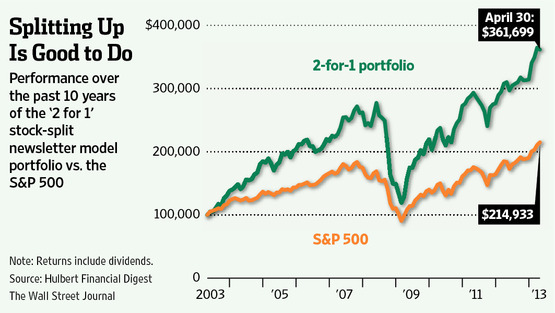
The price of Noble Energy NBL -1.15% shares will be cut in half this coming Wednesday, when the oil-and-gas-exploration company’s previously announced 2-for-1 split goes into effect. This will follow close on the heels of two other companies whose stocks this past week also fell because of 2-for-1 splits: consumer-products company Colgate-Palmolive CL +0.33% and A.O. SmithAOS -0.10% a water-heater manufacturer. In fact, so far this year 25 NYSE or Nasdaq National Market companies have split their shares by 2 for 1 or more, according to data provider Mergent. The number of such companies has been rising steadily along with the bull market; for all of 2009, for example, there were just 12 such splits. Should you change your opinion of Noble Energy, or any of these other companies, just because they split their shares? It is difficult to see why you should. A 2-for-1 split, for example, merely means you now own twice as many shares that are worth half as much. But try telling that to Neil Macneale, editor of an investment-advisory service called “2 for 1,” whose model portfolio contains only those stocks that have recently split their shares, holding them for 30 months. Over the past decade, according to the Hulbert Financial Digest, that portfolio has produced a 14% annualized return, far outpacing the 8% gain of the Standard & Poor’s 500-stock index, including dividends. Read more of this post

Korea’s prosecution may seek an arrest for CJ Group Chairman Lee Jay-hyun on charges of tax evasion, stock manipulation and breach of trust

2013-05-24 18:26

CJ chairman may face arrest

The prosecution may seek an arrest for CJ Group Chairman Lee Jay-hyun on charges of tax evasion, stock manipulation and breach of trust, a senior prosecutor said Friday.
The Seoul Central District Prosecutors’ Office (SCDPO) wants to take the 53-year-old businessman into custody for questioning about his role in dodging tens of billions of won of income tax, manipulating stocks of CJ’s affiliates and damaging the group’s interest by helping his siblings, the prosecutor said. Investigators suspect Lee did not pay at least 10 billion won of income tax while trading stocks of affiliates, such as CJ Corp., CJ CheilJedang and CJ E&M, using “borrowed” names. CJ Corp. is the group’s holding company, while CJ CheilJedang and CJ E&M are its flagship food and entertainment firms. Lee is suspected of manipulating those stock prices using slush funds hidden in foreign banks based in Switzerland, Singapore and Hong Kong. As the funds are from foreign countries, they were taken to be foreign investors, which helped boost the stock prices of the companies. In Korea, foreign investors’ stock purchases are seen as a “buy signal” for local investors, and their trade patterns affect the market greatly. In terms of the breach of trust allegation, investigators are looking into why CJ Corp. bought CJ America’s financially-weak affiliate, which Lee’s sister Lee Mi-kyung owned, damaging the company’s value. Chairman Lee is the major shareholder of CJ Corp., the holding company of the group. Lee may face up to 11 years in prison if the allegations are true. According to the related laws, those who take more than 30 billion won in illegal gains from stock manipulation are subject to up to 11 years jail term. Charges of breach of trust and tax evasion vary from four to 11 years in prison according to the amount of money. Investigators have obtained credible evidence, including testimony from a former executive who handled the company’s finances, that Lee hid as much as 350 billion won in more than 300 different bank accounts in Hong Kong, according to prosecution sources. They suspect CJ also established special purpose companies in the British Virgin Islands, a well-known tax haven, to evade taxes and create slush funds. Prosecutors are also expanding their probe into allegations Lee transferred part of a secret fund worth 50 billion won to his two offspring, without paying gift taxes. Read more of this post

CJ Group Chairman Lee Jay-hyun has been banned from leaving the country in a widening investigation into his massive slush fund, prosecutors said Thursday

2013-05-23 17:15

CJ chairman banned from leaving nation

By Kim Jae-won
CJ Group Chairman Lee Jay-hyun has been banned from leaving the country in a widening investigation into his massive slush fund, prosecutors said Thursday.
Besides the initially-cited 7 billion won, prosecutors suspect that the size of Lee’s slush funds is far larger and gave a significant portion of it to his children, they said.
Sources in the Seoul Central District Prosecutors’ Office say that in 2006 Lee allegedly transferred a combined 50 billion won to his two children — 25 billion won each — in cash without paying gift taxes, raising suspicions that it was part of the slush fund. The group also is suspected of helping CJ America and CJ Indonesia expand their businesses by buying their products at inflated prices. Read more of this post

There is probably money to be made in analyzing the foibles of money managers, to create new strategies by taking on the opposite of what they are doing.

The Rules, Part XXXVIII

23 May, Aleph Blog

There is probably money to be made in analyzing the foibles of money managers, to create new strategies by taking on the opposite of what they are doing.

What errors do most money managers make today?

  • Chasing performance
  • Over-diversification
  • Benchmarking / Hugging the index
  • Over-trading
  • Relying too heavily on earnings growth
  • Analyzing the income statement only
  • Refusing to analyze industries
  • Buy newsy companies
  • Relying on the sell-side
  • Trusting management too much Read more of this post

Investors Beware: Corporate Financial Statements Decline in Predictive Value

Investors Beware: Corporate Financial Statements Decline in Predictive Value

by Bill Snyder | May 22, 2013

Over time, financial statements of public corporations show more losses, intangibles, and earnings restatements, which lower their value for predicting corporate bankruptcies

Corporate bankruptcies, like earthquakes, are rare events. But when they do occur, says Maureen F. McNichols of Stanford’s Graduate School of Business, the results can be financially devastating for investors and other stakeholders. An important role of financial statement information is to permit investors to assess the likely timing and amount of future cash flows. Recent research by McNichols and coauthors examines the usefulness of financial statement and market data for investors who want to ascertain the likelihood of bankruptcy. The results of that research are not completely reassuring.  Read more of this post

How Email App Mailbox Turned A Desperate Situation Into An ~$100 Million Exit 37 Days After It Launched

How Email App Mailbox Turned A Desperate Situation Into An ~$100 Million Exit 37 Days After It Launched

Alyson Shontell | May 22, 2013, 5:09 PM | 2,593 | 1

8551241646_ec6ceb9795_b

Gentry Underwood, co-founder of Mailbox

In January, an email organization app called Mailbox launched, and it promised to help users reach inbox zero. Thirty-seven days later, cloud storage company Dropbox acquired it for a reported $100 million. We sat down with the app’s founder, Gentry Underwood, who told us how he was able to flip the app so quickly and what it is like working for $4 billion Silicon Valley company, Dropbox. To summarize:

Underwood isn’t sure if his app is actually worth $100 million. He also wouldn’t confirm if that was the actual sale price.

Underwood says the quick sale was the result of Underwood’s team being able to determine product-market fit.

Mailbox went viral before the app even launched. Here’s how he drummed up attention for it: Read more of this post

Once described as “China’s Amazon,” e-commerce website Dangdang.com is finding itself fighting to stay afloat due to rabid competition

Major e-commerce pioneer struggling to survive

English.news.cn   2013-05-22

BEIJING, May 22 (Xinhua) — Once described as “China’s Amazon,” e-commerce website Dangdang.com is finding itself fighting to stay afloat due to rabid competition.

The company started selling leftover stock on May 7 despite of an earlier strategy aimed at middle and high-end clothing. CEO Li Guoqing told the Beijing News that his company is struggling to balance its expansion. The price of Dangdang’s shares has dropped from 35 U.S. dollars per share to less than 5 U.S. dollars, despite a booming e-commerce sector that has enjoyed average annual growth of 66 percent. Read more of this post

Korean chaebol woes: Prosecutors are investigating the three siblings who control CJ Group to uncover the whereabouts of an estimated 500 billion won ($450 million) in Hidden Assets

2013-05-22 16:06

CJ probe expands

By Kim Jae-won
Prosecutors are Investigating The Three siblings who Control CJ Group to uncover The whereabouts of an estimated 500 billion won ($ 450 million) in Hidden Assets, Sources said Wednesday.  Read more of this post

In complex world, investing should be simple

LARRY SWEDROE / 

MONEYWATCH/ May 21, 2013, 7:00 AM

In complex world, investing should be simple

(MoneyWatch) Many investors have ventured into the land of alternative investments, including such alternatives as REITs, commodities, private equity and hedge funds. However, a recent paper by the chief investment officer of a pension system says these investors may want to think twice.

Robert Maynard, chief investment officer of the Public Employee Retirement System of Idaho and author of the article “Conventional Investing in a Complex World” (Journal of Investing, Spring 2013), cautions investors who are thinking about abandoning traditional investment plans. He advocates “policies that are simple, transparent, and focused rather than the increasingly popular alternative tactics, such as illiquid instruments and vehicles, leverage, and complex, opaque investment strategies.”

As we have shown here on a regular basis, hedge funds have had a hard time keeping up with the risk-adjusted returns on safe bond investments (let alone with the returns of publicly available stocks). And private equity has underperformed publicly available small value stocks. This is in addition to the greater risks of such investments, plus their lack of transparency and liquidity. Read more of this post

China Development Bank Calls Meeting as Bundled SME Bond Sours; maker of baby formula has stopped operations, its owner can’t be contacted and it’s no longer able to repay principal or interest

China Development Bank Calls Meeting as Bundled SME Bond Sours

China Development Bank Corp. will call a meeting of investors in a bundled bond that the bank underwrote to arrange for payment of interest and principal after one of the borrowers became insolvent.

Harbin Huijiabei Foods Co. was one of four companies that issued the 170 million-yuan ($27.7 million) three-year bond in 2010, the bank said in a statement today on the website of the National Association of Financial Market Institutional Investors. The maker of baby formula has stopped operations, its owner can’t be contacted and it’s no longer able to repay principal or interest, according to the statement.

China introduced bundled bonds in 2009 to help smaller companies raise funds by combining the debt of several enterprises into one security. The Shenzhen Small & Medium Enterprises Credit Financing Guarantee Group Co., the guarantor of the bundled bond, will make payments if Huijiabei can’t, according to the statement.

The investor meeting, scheduled for May 24 in the city of Harbin, comes as slowing economic growth spurs concerns that more companies may be unable to repay borrowing. Bad loans at Chinese banks increased for a sixth straight quarter in the first three months of this year, when economic growth slowed to 7.7 percent from 7.9 percent in the fourth quarter of last year. Read more of this post

Testosterone and Financial Misreporting

Testosterone and Financial Misreporting

Yuping Jia Frankfurt School of Finance and Management

Laurence Van Lent Tilburg University – CentER for Economic Research and Dept. of Accounting

Yachang Zeng Tilburg University – Department of Accounting & Accountancy; Tilburg University – Center for Economic Research (CentER)

May 15, 2013

Abstract: 
We examine the relation between a measure of CEOs’ adolescent exposure to the hormone testosterone and financial misreporting. Testosterone is associated with a set of behaviors in males, including aggression, egocentrism, risk seeking, and a desire to maintain social status. Using a sample of CEOs from Standard and Poor’s 1500 firms during 1996–2010, we document a positive association between our measure of CEO testosterone exposure and financial misreporting. Our primary evidence is based on a sample of financial restatements due to intentional irregularities. Additional analyses are based on misreporting proxies derived from the misstatement-prediction model proposed by Dechow et al. [2011]. The positive association between CEO testosterone exposure and financial misreporting is robust to the various misreporting proxies. We show that our measure of testosterone exposure is different from overconfidence, which prior studies have shown to be associated with misreporting. Finally, we demonstrate that testosterone exposure not only correlates with financial reporting decisions but also predicts the incidence of option backdating in the sample.

NEA Notches 3,000 Percent Return on Tableau Software Investment as Digital Chart Valuation hit $950 Million on Nasdaq Debut

NEA Notches 3,000 Percent Return on Tableau Software Investment

For New Enterprise Associates Inc., its investment return on Tableau Software Inc. (DATA) was off the charts.

NEA’s $29.2 million investment in the digital-chart provider, which made its stock-market debut today, was valued at more than $950 million at the close in New York, making the venture-capital firm the top winner so far this year, Bloomberg.com reported on its Tech Deals blog.

As any Silicon Valley pundit knows, the vast majority of venture-capital bets fail. What makes the business work is the very rare gain of more than 3,000 percent on an investment, like the return NEA has thus far achieved on Tableau.

NEA first backed Seattle-based Tableau in 2004, a year after the company was founded, gaining two board seats and providing $5 million to “expand sales operations and invest in product development,” according to a statement at the time. NEA, with offices in Menlo Park, California, and Chevy Chase, Maryland, put in another $10 million in 2008 and $14.2 million in 2010.

More than 10,000 companies including Apple Inc. (AAPL) to Bank of America Corp. have used Tableau’s software to create easy-to-use charts out of complex data. Read more of this post

Bamboo Innovator Workshop for the Singapore Public: In Search of Compounding Stocks in Uncertain Times (Series #1 of 4)

http://valueinvesting-series1.eventbrite.sg/

From the Fund Management Jungles: Value Investing Exposed and Explored (Workshop Series)

In Search of Compounding Stocks in Uncertain Times (Series #1 of 4)

FE Asia Consultancy Pte Ltd

Saturday, 13 July 2013 from 09:00 to 17:00 (SGT)

Singapore, Singapore

Event Details

“In business, I look for economic castles protected by unbreachable ‘moats’.”

– Warren Buffett

With unresolved crises on the horizon, investors are often immobilized in making investment decision. “Wait for the clouds to clear” is the mantra. Value investing appears to provide a way out to see opportunities in cloudy weather by using the “cheap” price signal to identify “out-of-favor” neglected stocks and invest in them for “reversion back to mean”. Hence, pick stocks with “cheap” valuations based on conventional metrics and ratios – how much lower can they go anyway? – and they will bounce back up to their historical average levels. Or simply wait for a market dip, or a crash, before declaring some magical list of top ten stock tips to invest in. This is NOT value investing.

When Li Ning, the “Nike of China”, announced that its founder is going into industrial park and property development in September 2010, the stock has been a darling, having a competitive “moat” with brand recognition and it has recovered strongly since its bottom in March 2009 by climbing 140% to HK$24 per share. Oh, it is already expected that the market will react negatively to the property news, now it is down 20% to HK$19, value stock, be contrarian, BUY! Down another 20% to HK$15, getting cheaper and it’s out-of-favor, it will bounce back up, BUY! And the value investor catches the falling knife until below HK$5 now; while Nike hits an all-time high.

How do value investors distinguish whether “cheap” stocks are value traps or opportunity?Without an understanding of the underlying business model dynamics and analyzing the durability of the economic moat, an investment decision based on price and macro signals and historical valuation metrics can be misleading and costly. Without an understanding of business model, one would also have sold Wal-mart after it was listed in 1972 as the stock crashed over 60% in the next three years. Wal-mart went on to compound 1,200-fold since 1972 to over US$250 billion in market cap – a $100,000 investment in Wal-Mart becomes a $120 million treasure trove. So why is Wal-mart able to bounce back to scale new heights but the same cannot be said for the “Nike of China”?

Can resilient business models – Bamboo Innovators – outperform even in stormy periods? When Shanghai Composite Index crashed 70% from its peak of 6,000 in October 2007 to below 2,000 at the bottom in March 2009, Yunnan Baiyao was UP around 8%. As the index bounce to 2,200, still down 60% from its peak, Baiyao is up over 220% during the same period. Increasingly, such resilient business models are outperforming in Asia and globally; while the “cheap” stocks get cheaper and they become the fertile ground for “insiders” (庄家) who manipulate prices and volumes and inject “action” via exciting corporate news announcement of “sexy” projects or M&As, luring investors in and then offloading to them in a pump-and-dump cycle. Sophisticated value investors can overcome poor and uncertain macro conditions by investing in resilient compounders because they have their own internal rhythm to create value, like the bamboo, which bend, not break even in the wildest of storm that would have snapped the once-mighty oak tree.

Course Highlights:

– Mr Kee, one of the few Asian fund manager being invited to speak at a number of top banking & finance conferences around the world alongside with renowned speakers such as Praveen Kadle, Chief Executive Officer of Tata Capital & Lauren Templeton, President of Lauren Templeton Capital Management

– Learn from an experienced & qualified instructor who has taught in local Universities

Program Outline and Key Learning Points:

  • LEARN the R.E.S.-ilience factors in the business model and economic moat analysis of how Bamboo Innovators create extraordinary value, particularly the “E” factor which stands for “emptiness” in the business model.
  • GAIN the surprising insight of sophisticated institutional investors who understand why growth in sales, profit and tangible asset may not translate to market capitalization growth and sustainable share price gains.
  • ATTAIN the critical knowledge of 12 types of sophisticated institutional investors that climbing from $50 million to $1 billion in market cap takes an entirely different business model dynamics as compared to scaling up sustainably from $1 billion to $20 billion in market cap.
  • RECOGNIZE the 12 types of business models and their profit patterns and acquire the ability to scan through different businesses in various industries to understand the key levers for growth ahead of the investment curve.
  • UNDERSTAND why and how businesses hit a stall point in growth and without a transformation in business model, bigger can be riskier. Thus “Grow or Perish” become “Grow AND Perish”
  • DISSECT a wide range of real-world cases of Asian and global Bamboo Innovators in various industries and understand the intricacies of their business models, their critical success – and failure – factors.
  • UNIFY at the end of the day all the previously disparate loose-hanging concepts, descriptive facts and “checklists” you have learnt from various sources into the practical Bamboo Innovator mental model when it comes to real investment decision-making.

Understand more about the Instructor’s investment approach with the following published articles:

About the Instructor:

Koon Boon is the founder and managing director of the Singapore-based Bamboo Innovator Institute to establish the thought leadership of resilient value creators around the world. KB has been rooted in the principles of value investing for over a decade as a fund manager and analyst in the Asian capital markets. He was a fund manager and head of research/analyst at a Singapore-based investment management organization dedicated to the craft of value investing in Asia. He had been with the firm since 2002 and was also part of the core investment committee in significantly outperforming the index in the 10-year-plus flagship Asian fund. He was previously the portfolio manager for Asia-Pacific equities at Korea’s largest mutual fund company. He received his Masters in Finance (magna cum laude) and double degree in Accountancy and Business Management (both summa cum laude) from the Singapore Management University (SMU). He had taught accounting at his alma mater in SMU and lectures at SIM University for working professionals. He had published cutting-edge empirical research in the Special Issue of Istanbul Stock Exchange 25th Year Anniversary of the Boğaziçi Journal, Review of Social and Economic Studies, as well as wrote articles about value investing and corporate governance in the media. He had also presented in top banking and finance conferences in Sydney, Cape Town, HK, Beijing and in the recent Emerging Value Summit 2013. He is also an internationally-featured value investor in Greatinvestors.TV and BeyondProxy.com. He had trained CEOs, entrepreneurs, CFOs, management executives in business strategy, macroeconomic and industry trends in Singapore, HK and China.

You Can Do Too Much Due Diligence: The Case of Feedburner

May 132013

You Can Do Too Much Due Diligence

It’s Monday, time for another lesson I’ve learned in the venture capital business. Today I will tell a story that I love telling. It has some of my favorite people in it. Back in 2004, early in my blogging career, I heard about a service that had just launched called Feedburner. It provided a number of useful services for a blog’s RSS feed. So I went and signed up and AVC became one of the first users of the service. I immediately liked the service and the idea. So I contacted the founder/CEO Dick Costolo, who has gone onto bigger and better things. I told Dick that I was interested in making an investment in Feedburner. My friend Brad Feld was also talking to Dick about the same thing so we decided to do the investment together. As part of our investment process, we do a bunch of fact gathering/checking work that is called Due Diligence in the vernacular of the VC business. So my partner Brad Burnham and I put together a list of leading blogs and online publishers who had popular RSS feeds at the time. I think there were a dozen or so publications on that list. It included Weblogs (Engadget), Gawker (Gawker), NY Times, and a bunch more. We know most everyone who ran those operations so we called them. What we heard was surprising. Not one of them was willing to hand over their RSS feed to a third party for analytics and monetization. We were very surprised to hear that and thought a bit about it. But, we decided, we could not invest in something that the big publishers would not support. So regrettably, I called Dick and told him we had to pass and why. Brad Feld went ahead with the investment and Feedburner closed their round without USV. About six months later I ran into Dick at an industry conference. We decided to grab lunch together and during lunch he said to me “you know those dozen publishers you called?” I said “yes, what about them?” He said “every single one of them is on Feedburner now.” I was pissed. How could that be? So I said to Dick, “Would you consider letting us into that last round we walked away from.” He said “No, but I will let you invest at a 50% increase in price”. We did that and became an investor in Feedburner. And that worked out well when Feedburner was sold to Google a few years later. So what did I learn from this lesson? First, trust your gut. I was using Feedburner and knew it was a very useful service. I felt that others would see that too. They did, but it took some time. Second, I learned that a service can get traction with the little guys and in time, the big guys will come along. I have seen that happen quite a bit since then. And finally, I learned that you can do too much due diligence. It’s important to talk to the market and hear what it is saying. But you have to balance that with other things; the quality of the team, the product, the user experience, etc. You cannot rely alone on due diligence, particularly early on in the development of a company and a market.