Oaktree Billionaire Founder Howard Marks’ Full Presentation On “Investing In Uncertain Times”

Howard Marks’ Full Presentation On “Investing In Uncertain Times”

Tyler Durden on 03/07/2013 12:58 -0500

In the following presentation, given by Howard Marks – the world’s largest distressed debt investor – he warns of the perils of “investing in uncertain times.” As Reuters notes, he fears the “unsound practices” from before the financial crisis are creeping back into credit markets, with private equity firms bidding increasingly high prices for companies. Marks points out the ease with which lowly rated companies were issuing debt this year, how companies were paying out record dividends to their shareholders and the increasingly high debt-to-equity multiples private equity firms were paying for companies amid a resurgence in deals. “We have a world in which nobody is thinking bullish. Everybody’s worried and yet people are acting bullish,” and predicts a looming “shake-out” in the hedge fund industry as he asks rhetorically, “today there are 8,000 hedge funds. Are there really 40,000 exceptional people (working for hedge funds)?” In conclusion, Oaktree Capital’s founder warns that investors, in their search for returns, were becoming overly confident while the economic background was still gloomy.

Yacktman Wins as Heebner Is Too Volatile; Investors rewarded Yacktman, who employs an old-school buy- and-hold strategy, with a wave of deposits that helped swell his fund’s assets almost 30-fold in the past four years

Yacktman Wins as Heebner Is Too Volatile: Riskless Return

Donald Yacktman and Kenneth Heebner both crushed fund rivals over the past 13 years, racking up big gains in an era when stocks went sideways. The difference is Yacktman gave investors a smooth ride, Heebner anything but.

From March 2000 through last month, a span in which the Standard & Poor’s 500 Index returned less than 2 percent a year amid two bear markets, Heebner’s $1.5 billion CGM Focus Fund (CGMFX) had the best gain among large mutual funds that buy U.S. stocks. His clients had to stomach the highest volatility, as the fund went from an 80 percent jump in 2007 to a 48 percent drop in 2008. The $9.6 billion Yacktman Fund (YACKX), fifth by total return, avoided much of the roller-coaster ride to produce the top risk-adjusted return, according to the BLOOMBERG RISKLESS RETURN RANKING.

Investors rewarded Yacktman, who employs an old-school buy- and-hold strategy, with a wave of deposits that helped swell his fund’s assets almost 30-fold in the past four years. The rapid- trading Heebner suffered redemptions that chopped his fund’s size by almost two-thirds since 2008, as customers fled in response to what he calls “lumpy” performance. Read more of this post

Buffett Says Gloat Like Rockefeller When Watching Trains

Buffett Says Gloat Like Rockefeller When Watching Trains

Billionaire Warren Buffett said his Berkshire Hathaway Inc. (BRK/A) will benefit from rising U.S. oil production as the company’s trains and tank cars move fuel around the country.

Buffett, 82, highlighted demand for rolling stock made by Berkshire’s Union Tank Car in his annual letter to shareholders March 1. His company acquired the manufacturer, which traces its roots to John D. Rockefeller’s Standard Oil Trust, as part of the 2008 purchase of Marmon Holdings Inc. Buffett told investors to watch for the UTLX logo.

“As a Berkshire shareholder, you own the cars with that insignia,” he wrote to investors in his Omaha, Nebraska-based company. “When you spot a UTLX car, puff out your chest a bit and enjoy the same satisfaction that John D. Rockefeller undoubtedly experienced as he viewed his fleet a century ago.”

U.S. oil output had a record surge last year as new technology made drilling faster, cheaper and better at unleashing crude from rock formations. That’s reducing reliance on imported oil and benefiting railroads and tank car companies.

Berkshire’s railroad, Burlington Northern Santa Fe, is now carrying about 500,000 barrels of oil a day, or roughly 10 percent of what’s produced in the U.S. excluding Alaska and offshore, Buffett said. That’s helped keep volume growing at BNSF as coal shipments decline.

“Fortunately, they discovered oil where our railroad was,” Buffett, Berkshire’s chairman and chief executive officer, said in an interview yesterday on CNBC.

Car leases are generating $1,500 per month for 10-year deals, and more than double that for shorter terms, said Justin Long, an analyst with Stephens Inc. based in Little Rock, Arkansas. Before the recent boom, the cars leased for about $650 per month, Toby Kolstad, president of Rail Theory Forecasts LLC, said in December. Read more of this post

Asian market indices do not provide an efficient risk/reward trade-off; the standard Asian indices are heavily concentrated in a few large-cap stocks. Most indices allocate as much as 60% of the index weight to only one-fifth of the stocks in the universe

Asian market indices do not provide an efficient risk/reward trade-off

Author: Wing-Gar Cheng

6 March 2013

Asian stock market indices have displayed a pronounced inability to provide an efficient risk-reward trade-off, according to researchers at EDHEC-Risk Institute.

The study of 10 major Asian stock market indices over the past decade –  “Assessing the Quality of Asian Stock Market Indices” – shows the standard Asian indices are heavily concentrated in a few large-cap stocks. Most indices allocate as much as 60% of the index weight to only one-fifth of the stocks in the universe.

Investors keen to hold well-diversified equity portfolios are advised to be aware of these inefficiencies. “Investors who want to capture the Asian market premium will do so in a better way if they use indices designed with an efficient weighting scheme.”

Asian equity indices also show severe fluctuations in style and sector exposures. Market indices in more developed countries (Hong Kong, Japan, Singapore, South Korea and Taiwan) demonstrate relatively more stability, whereas market indices in less developed countries (China and India) display higher variability over time in terms of sector allocation, the study found. “Investors clearly need to consider the weighting scheme that will allow them to extract the equity risk premium for a given geography in the best possible way.”

Total worldwide assets under internal indexed management rose to $5.994trn as of 30 June, 2011, a 25% increase over $4.781trn a year ago, the study said. In Asia, total ETF assets increased by 20-30% annually post-2008 and the number of products has risen by more than 200%. Currently, the total ETF assets in the Asia-Pacific are estimated at $81bn, it added. Read more of this post

Analytical Innovators: What makes companies that are great at analytics different from everyone else

From Value to Vision: Reimagining the Possible with Data Analytics

Big Idea: Data & Analytics March 05, 2013

David Kiron, Renee Boucher Ferguson and Pamela Kirk Prentice

Introduction

Signs of an Analytics Revolution

Case Study: Oberweis Dairy

Three Ways to Compete with Analytics

Case Study: Caesars Entertainment

The Analytical Innovators

Mindset and Culture

Key Actions

Outcomes: Power Shifts to Those with Insight

On Becoming an Analytics Innovator

The Analytically Challenged

The Analytics Practitioners

Conclusion

About the Research

Acknowledgments

Authors

David Kiron is the executive editor of MIT Sloan Management Review’s Big Ideas initiatives. He can be reached at dkiron@mit.edu.

Renee Boucher Ferguson is the Data & Analytics contributing editor at MIT Sloan Management Review, researching the current and new analytical approaches that change how executives make decisions and innovate. She can be reached at rbfergus@mit.edu.

Pamela Kirk Prentice is the chief research officer at SAS Institute Inc., specializing in deriving insights from qualitative and quantitative information to help address key business issues. She can be reached at pamela.prentice@sas.com.

Companies benefit from analytics

Global study from MIT Sloan Management Review and SAS finds companies gain competitive edge by using analytics.

March 5, 2013

New research released today by MIT Sloan Management Review and SAS reports that 67 percent of companies surveyed are gaining a competitive advantage by using analytics — marking a 15 percent increase from last year and 80 percent increase from two years ago.

The report, “From Value to Vision: Reimagining the Possible with Data Analytics,” derived from a global survey of more than 2,500 business executives, identifies a group of companies leading the way in the analytics revolution, dubbed “Analytical Innovators.” Companies in this category report both strong competitive advantage and improved innovation from using analytics, which are means of interpreting certain data to gain insight and drive business planning. Analytical Innovators are significantly more likely to exhibit three characteristics: a widely shared belief that data is a core asset; more effective use of more of their data for faster results; and support for analytics by executives.

Another important characteristic of Analytical Innovators is their report of power shifts in their organizations: Analytical Innovators are four times more likely than less analytically inclined companies to say that analytics have shifted the power structure within their organizations.

“This is a significant finding, in that power shifts can be disruptive. They often call into question experience and intuition that managers and employees have built up over years,” says David Kiron, executive editor for MIT Sloan Management Review. “Now, those who know how to marshal the data and put analytics behind their decision making are in a position of advantage.”

The study also identified two types of companies less analytically sophisticated than Analytical Innovators: Analytics Practitioners (representing 60 percent of respondents), which have made significant progress, but have not achieved the top level of competitive advantage and innovation from using analytics; and the Analytically Challenged (28 percent of respondents), which are less mature in their use of analytics and have not derived as much value from them as the other groups.

“As we studied all three groups, we were able to clearly see the specific differentiators among the groups,” says Pamela Prentice, chief research officer for SAS. “This enabled us to develop a framework for companies to evaluate their own standing, and to provide recommendations based on a company’s current status.”

The study’s recommendations for the Analytically Challenged include:

  • Start improvements at the local level before trying to address organization-wide issues of technology latency.
  • To further collaboration, build ongoing relationships, facilitate discussions and share information of value to other departments.
  • Fight inertia by developing an executive communication strategy for your analytics case, including a return on investment rate and recommended actions.
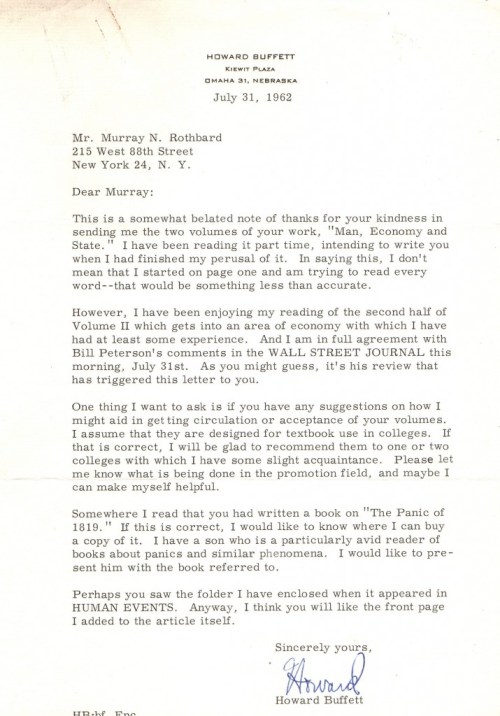

Elder Buffett’s letter to Murray Rothbard: “I have a son who is a particularly avid reader of books about panics and similar phenomena.”

Letter from Howard Buffett to Murray Rothbard: “I have a son who is a particularly avid reader of books about panics and similar phenomena.”

March 4, 2013 by Tobias Carlisle

This letter from Howard Buffett, the highly libertarian “Old Right” United States Representative father of Warren, to anarcho-capitalist historian and economist Murray Rothbard, if real, is incredible. Buffett the Elder wrote to Rothbard that he “read that Rothbard had written a book on ‘The Panic of 1819‘” and wanted to know where he could buy a copy for his son “who is a particularly avid reader of books about panics and similar phenomena.”

Here is the letter:

howard-buffett-715x1024

The timing of the letter – July 31, 1962 – is interesting. The first “flash crash” occurred in May 1962, and was at the time the worst crash since 1929. Time LIFE described the 1962 “flash crash” thus:

The signs, like the rumblings of an Alpine ice pack at the time of thaw, had been heard. The glacial heights of the stock boom suddenly began to melt in a thaw of sell-off. More and more stocks went up for sale, with fewer and fewer takers at the asking price. Then suddenly, around lunchtime on Monday, May 28, the sell-off swelled to an avalanche. In one frenzied day in brokerage houses and stock exchanges across the U.S., stock values — glamor and blue-chip alike — took their sharpest drop since 1929.

Memory of the great crash, and the depression that followed, has haunted America’s subconscious. Now, after all these years, was that nightmare to happen again?

The article continues that, “although the Dow Jones Industrial Average fell almost 6 percent on that one vertiginous Monday and the market was anemic for a year afterwards, the markets as a whole, at home and abroad, did bounce back.” Good to know.

CJ rises as beacon of Korean food, shopping, pop culture

CJ rises as beacon of Korean food, shopping, pop culture

20130305.101204_khera_cj

CJ Group expands bio pharma, entertainment, home shopping, logistics businesses abroad. -Korea Herald/ANN

Kim So-hyun
Tue, Mar 05, 2013
The Korea Herald/Asia News Network

SOUTH KOREA – When CheilJedang spun off from Samsung Group in 1993, not many expected the food company would grow into a major conglomerate encompassing retail and entertainment businesses as well. With food and food service; biopharmaceuticals; entertainment and media; home shopping and logistics as its four core businesses, CJ Group has shown remarkable growth and change over the past 20 years. In addition to keeping the No. 1 spot in the food and bio businesses, CJ acquired Korea Express, the nation’s largest logistics firm, in 2011, and is leading the country’s entertainment and media industries.

The history of CheilJedang, now called CJ, dates back to when its founder Lee Byung-chull built a sugar mill in Busan amid the devastation of the Korean War. It succeeded in domestic sugar production in November 1953, lessening the country’s dependence on expensive sugar imports. Soon met with fierce competition in sugar refining, CheilJedang completed a flour mill using its own technologies and Korean-made machinery in 1958 and began production. The company entered the artificial seasoning product market in 1963, with its Mipoong vying against then-bestseller Miwon of Daesang. CJ developed mass-production techniques for a seasoning product it called “Dashida” in 1975 and nucleic acid for the first time in Korea two years later, which became a stepping stone for the seasoning industry. Dashida, which came in beef, fish and anchovy flavors, was a gustatory delight for ordinary Koreans who weren’t well off. In the 1980s, CJ expanded to processed food items such as beverages and frozen foods, and entered the pharmaceutical business based on new advanced technologies.

Read more of this post

Mutual fund investors are often their own worst enemies, prone to poor timing

Mutual fund investors are often their own worst enemies, prone to poor timing

Article by: MARK JEWELL , Associated Press

  • Updated: February 21, 2013 – 12:15 PM

BOSTON – The recipe for successful investing sounds pretty simple: have reasonably good timing over the long haul and avoid big mistakes. That’s what helps professionals build a worthy track record. For average investors, it’s advisable to set the bar lower. Construct a balanced portfolio of low-cost mutual funds, make regular contributions to invested savings, and stick with it until it’s time to retire.

The problem is that many investors seem to think they’re better than that and can beat the stock market. Yet research consistently shows that it’s a fool’s game.

The latest findings are from Morningstar Inc., which compared the performance numbers that mutual funds posted with the returns that the investors in those funds actually obtained over multiple years. It’s typical to see gaps between the figures. That’s because investors move cash in and out as markets rise and fall, and consequently don’t experience the same results as the funds they invest in. Read more of this post

François Sicart: The Value Investor’s Schizophrenia: Buy-and-Hold Sounds Good, but the Value Discipline Requires One Also To Sell

The Value Investor’s Schizophrenia: Buy-and-Hold Sounds Good, but the Value Discipline Requires One Also To Sell

Superstar investor Warren Buffett is widely quoted as having said, “The best time to sell a stock is…never.”

But Buffett, while a proclaimed disciple of Benjamin Graham, the “pope” of value investing, was later just as much influenced by Philip Fisher, the recognized “pope” of growth investing. In fact, it was Fisher who, in Common Stocks and Uncommon Profits (Harper, 1958), wrote that the best time to sell a stock was “almost never.”

I never met Ben Graham, and have not met Warren Buffet. But I did meet Phil Fisher, who invited me to visit a company with him after reading one of my papers, sometime in the 1980s. Without even a quote machine in his office, he was a voracious reader of company financials, but also a compulsive evaluator of corporate management. He wanted to know and talk to everyone he could in a company, from CEO to operations personnel; and once convinced that a management was among the best, he was willing to pay almost any price for the shares. If he overpaid, his logic went, the company’s earnings growth would make up for it over the ensuing years.

It is not clear that Warren Buffet puts the same premium on superior management. In a May 20, 2008, statement to the Associated Press, he even advised, “Buy into a business that’s doing so well an idiot could run it, because sooner or later, one will.”

This, by the way, was probably inspired by a similar comment from legendary growth investor Peter Lynch in his 1989 book, One Up on Wall Street (Simon & Schuster, 2000), so the feeling does not belong only to value investors.

Clearly, Buffet has retained a great sense of value. But nowadays his philosophy – probably imposed in part by the trading and liquidity restrictions of a very large portfolio – seems closer to that of Philip Fisher, as exemplified by this quote from his 1989 Letter to Berkshire Hathaway Shareholders: “It’s far better to buy a wonderful company at a fair price than a fair company at a wonderful price.”

Personally, I am still more at ease with the value discipline of investment: I feel more comfortable estimating a company’s reasonable worth than putting a dollar value on the quality and future achievements of its management. In addition, the contrarian bias of value investing also pleases me, since it means seizing occasions when the price the investing crowd is willing to pay for a stock is well below its value. Read more of this post

Emerging Value Summit 2013 (April 9-10). R.E.S.-ilient Compounders in (the Next) Crisis: Buffett + Bosch + Baiyao = Bamboo Innovators

Dear Friends and All,

Value investors focused on emerging markets will gather at the “Emerging Value Summit 2013” (http://www.valueconferences.com/reg/emerging13/) on April 9-10 to share their insights and ideas. Some of the speakers include Tata Capital CEO Mr Praveen Kadle, FCA Corp Founder & CEO Mr Robert Scharar, Ms Lauren Templeton etc. The Emerging Value Summit 2013 is organized by The Manual of Ideas, the definite source of value investing ideas (http://www.manualofideas.com/).

I am honored to be invited by Oliver from The Manual of Ideas to be one of the speakers to share with you the topic:

R.E.S.-ilient Compounders in (the Next) Crisis: Buffett + Bosch + Baiyao = Bamboo Innovators”. Thank you Oliver.

Further updates will be uploaded on the Emerging Value Summit 2013 website from next week.

Thank you for your kind feedback and encouragement all along. Hope you will enjoy this latest upcoming presentation about Bamboo Innovators, a research series to establish thought leadership on resilient and innovative value creators in Asia and around the world.

Kind regards,

Koon Boon (KB)

Big-Bang Disruption; A new kind of innovator can wipe out incumbents in a flash

Big-Bang Disruption

by Larry Downes and Paul F. Nunes

By now any well-read executive knows the basic playbook for saving a business from disruptive innovation. Nearly two decades of management research, beginning with Joseph L. Bower and Clayton M. Christensen’s 1995 HBR article, “Disruptive Technologies: Catching the Wave,” have taught businesses to be on the lookout for upstarts that offer cheap substitutes to their products, capture new, low-end customers, and then gradually move upmarket to pick off higher-end customers, too. When these disrupters appear, we’ve learned, it’s time to act quickly—either acquiring them or incubating a competing business that embraces their new technology.

But the strategic model of disruptive innovation we’ve all become comfortable with has a blind spot. It assumes that disrupters start with a lower-priced, inferior alternative that chips away at the least profitable segments, giving an incumbent business time to start a skunkworks and develop its own next-generation products.

That advice hasn’t been much help to navigation-product makers like TomTom, Garmin, and Magellan. Free navigation apps, now preloaded on every smartphone, are not only cheaper but better than the stand-alone devices those companies sell. And thanks to the robust platform provided by the iOS and Android operating systems, navigation apps are constantly improving, with new versions distributed automatically through the cloud.

The disruption here hasn’t come from competitors in the same industry or even from companies with a remotely similar business model. Nor did the new technology enter at the bottom of a mature market and then follow a carefully planned march through larger customer segments. Users made the switch in a matter of weeks. And it wasn’t just the least profitable or “underserved” customers who were lured away. Consumers in every segment defected simultaneously—and in droves.

That kind of innovation changes the rules. We’re accustomed to seeing mature products wiped out by new technologies and to ever-shorter product life cycles. But now entire product lines—whole markets—are being created or destroyed overnight. Disrupters can come out of nowhere and instantly be everywhere. Once launched, such disruption is hard to fight.

We call these game changers “big-bang disrupters.” They don’t create dilemmas for innovators; they trigger disasters. Read more of this post

What does it take to turn around a Web company? A look inside the only two we’ve ever seen

What does it take to turn around a Web company? A look inside the only two we’ve ever seen

BY KEVIN KELLEHER 

ON MARCH 1, 2013

Every time a has-been startup like MySpace or Digg or a big public company like Yahoo or AOL attempts a Web turnaround, the tech media is quick to remind them that Web turnarounds never work.

Technically, we can’t say that anymore. Two companies– Priceline and eBay– have quietly proven that truism wrong, at least from a financial point of view.

Are they anomalies or has it just taken this long to see a turnaround work?

We forget that as industries go, the Web is a young one. The first Web site appeared only 21 years ago. That’s enough time for countless Web startups to appear, for far fewer to succeed and for a subset of those successes to fall on hard times. But it’s hardly enough time to produce any successful case studies in corporate turnarounds. Read more of this post

All the words Warren Buffett had never used until this year

http://data.qz.com/2013/warren-buffetts-2012-letter-to-shareholders/

All the words Warren Buffett had never used until this year

By David Yanofsky — March 3, 2013

Warren Buffett’s annual letter to Berkshire Hathaway shareholders for 2012 is more than 13,000 words long, but some words stand out more than others. There are 188 words in this year’s missive— including ”fret,” “software,” and “recession-resistant”—that Buffett had never used in his previous 35 letters, which describe his thoughts about Berkshire’s performance and the global business climate.

buffettimage

A Wonderful Lesson From Warren Buffett That Explains One Of The Biggest Mysteries About Amazon; Novy-Marx (2012) shows, however, that a simple quality metric, gross profits-to-assets, has roughly as much power predicting the relative performance of different stocks as tried-and-true value measures like book-to-price

A Wonderful Lesson From Warren Buffett That Explains One Of The Biggest Mysteries About Amazon

Joe Weisenthal | Mar. 2, 2013, 8:53 AM | 16,147 | 21

Warren Buffett is known as the world’s most famous “value investor,” but that term is not well understood.

In his latest letter to shareholders (.pdf), Buffett includes a great paragraph explaining that value is not synonymous for cheap.

More than 50 years ago, Charlie told me that it was far better to buy a wonderful business at a fair price than to buy a fair business at a wonderful price. Despite the compelling logic of his position, I have sometimes reverted to my old habit of bargain-hunting, with results ranging from tolerable to terrible. Fortunately, my mistakes have usually occurred when I made smaller purchases. Our large acquisitions have generally worked out well and, in a few cases, more than well.

As Charlie Munger evidently taught Buffett, it’s better to buy high-quality businesses for a fair amount than finding assets at bargain basement prices. Read more of this post

The Quality Dimension of Value Investing

The Quality Dimension of Value Investing

Robert Novy-Marx

Robert Novy-Marx is assistant professor of finance at the Simon Graduate School of Business at the University of Rochester, New York, and a faculty research fellow of the National Bureau of Economic Research.

Buying high quality assets without paying premium prices is just as much value investing as buying average quality assets at discount prices. Strategies that exploit the quality dimension of value are nearly as profitable as traditional value strategies based on price signals alone. Accounting for both dimensions by trading on combined quality and price signals yields dramatic performance improvements over traditional value strategies. Accounting for quality also yields significant performance improvements for investors trading momentum as well as value.

Want To Build A $1B Consumer Tech Company? Look For Long-Haul Founders And Don’t Fear Incumbents

Want To Build A $1B Consumer Company? Look For Long-Haul Founders And Don’t Fear Incumbents

JACOB MULLINS ,posted 6 hours ago

Editor’s note: Jacob Mullins is a VC at Shasta Ventures who primarily focuses on consumer web and mobile companies. Follow him on Twitter @jacob

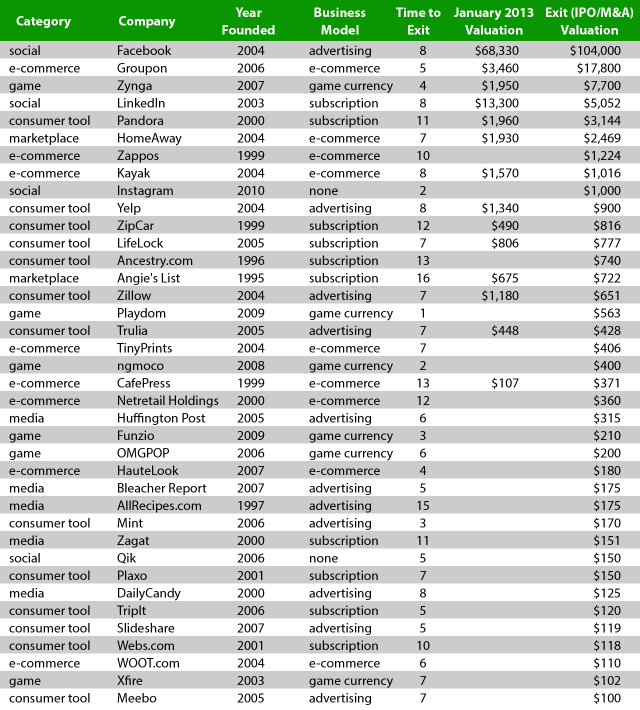
With the recent talk about the growing “billion-dollar club” in startups, I’ve been wondering, as a Series A investor, what characteristics a $1 billion consumer tech company has. I examined the pool of consumer companies that have had exits over $100 million within the current era of consumer tech, which I consider to be post-recession 2008. I wanted to see what I could learn and ideally reverse-engineer common characteristics that would help me identify the next big winners when I see them today or in the future. I created a dataset pulling from a number of venture capital data sources, including CrunchBase, and narrowed it down to my own specifics: U.S., venture-backed companies that have had realized outcomes, both IPO and M&A, over $100 million since 2008. Because private-equity funding and M&A details are less clearly reported, this may not be a comprehensive list of consumer companies. Also, I did not include software/enterprise companies, of which there are many more.

COMMON CHARACTERISTICS OF CONSUMER TECH COMPANIES

billion-chart
Here are a few highlights:

  • 38 companies over the past five years have exited over $100 million
  • Only nine companies over the past five years have exited over $1 billion; all but one of these nine (Zappos) exited in 2011/2012
  • 29 of the 38 outcomes happened in 2011 and 2012
  • 14 of these companies exited via IPO, all in 2011 and 2012
  • seven of the nine most valuable exits were all public offerings (Zappos and Instagram are the two M&A transactions worth $1 billion or more. I’m continuing to value the Instagram acquisition at the original offer of $1 billion, not taking the decreased market value of public Facebook stock into account.)

This simple survey affirmed my belief that achieving outsized results within the consumer company landscape is incredibly difficult. Now that we’re sure it’s difficult, what insight can we glean? Read more of this post

Buffett: Performance streak may end this year; “To date, we’ve never had a five-year period of underperformance, having managed 43 times to surpass the S&P over such a stretch”: Long-time Berkshire investors said they detected almost a sense of frustration in this year’s letter

Buffett: Performance streak may end this year

12:30am EST

By Ben Berkowitz

(Reuters) – Berkshire Hathaway may end a long streak of outperforming the S&P 500 this year, Chief Executive Warren Buffett warned shareholders on Friday, even as he said he was still eagerly hunting for acquisitions to grow the ice-cream-to-insurance conglomerate.

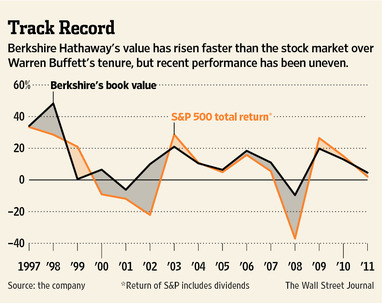
In his annual letter to investors, Buffett opened up with a caution that this year, for the first time, the growth in Berkshire’s book value per share may underperform the growth in the S&P 500 when measured over a five-year period.

“To date, we’ve never had a five-year period of underperformance, having managed 43 times to surpass the S&P over such a stretch,” he wrote. “But the S&P has now had gains in each of the last four years, outpacing us over that period. If the market continues to advance in 2013, our streak of five-year wins will end.”

Buffett said he expects the growth in Berkshire’s intrinsic business value will over time exceed the S&P’s returns by small margins. But at the same time, he said the firm would continue to underperform in a strong market like this year.

Long-time Berkshire investors said they detected almost a sense of frustration in this year’s letter. Read more of this post

Warren Buffett may be souring on stocks; The Oracle of Omaha still likes the market — but he’s hardly pounding the table

Warren Buffett may be souring on stocks

By Stephen Gandel, senior editor March 1, 2013: 4:03 PM ET

The Oracle of Omaha still likes the market — but he’s hardly pounding the table.

chart-stocks-gdp2

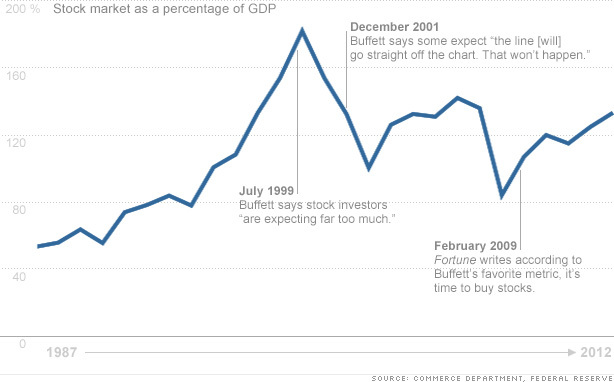
FORTUNE — In his annual letter to Berkshire Hathaway (BRKA) shareholders, released Friday afternoon, Buffett says he still believes U.S. stocks will “do well.” He notes that he made his first stock purchase during the bleakest part of World War II, so even if things look not so great right now, you should end up doing fine as well. But compare that to last year’s letter. Buffett devoted three and a half pages – over 1,900 words – to a detailed explanation of why he thought stocks were a much better investment than say gold or bonds. (See Warren Buffett: Why stocks beat gold and bonds.) He also said he was bullish on U.S. housing. This time around he devotes four paragraphs to the case for stocks. And even in that small space, Buffett says that investors should expect periodic setbacks, and he includes two statistics that could signal one may be coming up sooner rather than later. Buffett points out that the Dow Jones Industrial Average rose “a staggering” 17,320% in the 20th century — despite “four costly wars, a Great Depression and numerous recessions.” Here’s the problem: During nearly the same period, Buffett says GDP per capita rose much less about 500%. Buffett has used this comparison of the economy to stock market valuations before. He featured the metric in a story he wrote for Fortune back in 2001. (See Warren Buffett on the stock market) By that time, stocks had already fallen a bit from their dot-com infused highs. But they still weren’t a buy, Buffett said at the time. Despite their fall, stocks collectively were trading at a value of 133% of the gross national product of the U.S. (Buffett used GNP because it goes back 80 years, but for recent history using GDP works just fine.)

So where are stocks trading today? You guessed it. 133% of GDP. The metric hit a high of 190% back in 1999. So we are a little ways from panic territory, but that doesn’t mean the market is a safe place to be right now. Far from it. Back in 2001, Buffett said investors who buy when the relationship of stock values to the economy falls in the 70% to 80% range should do well. That means stocks would have to plummet 43% before we are back in Buffett buy territory. Even so, Buffett doesn’t appear to be worried. In his own portfolio, Buffett in the past year has added to his stakes in Wal-Mart (WMT) and Wells Fargo (WFC), two companies that are likely to go up only if the economy and the rest of the market does as well. It’s hard to tell if that’s because Buffett believes stocks are cheap, or just because he believes the other investing options are worse. “The risks of being out of the [stock market] game are huge compared to the risks of being in it,” writes Buffett in the letter. “Every tomorrow has been uncertain.”

Buffett: $24 Billion Gain ‘Subpar’; Berkshire Boss Says He Is Donning His ‘Safari Outfit’ as He Continues the Hunt for Big Acquisitions

Updated March 1, 2013, 6:58 p.m. ET

Buffett: $24 Billion Gain ‘Subpar’

Berkshire Boss Says He Is Donning His ‘Safari Outfit’ as He Continues the Hunt for Big Acquisitions

By ANUPREETA DAS And ERIK HOLM

Warren Buffett bemoaned Berkshire Hathaway Inc.’s BRKB -0.11% failure to land a major acquisition during 2012 to use its swelling cash hoard, and in his annual letter to shareholders called his company’s performance “subpar” despite a $24 billion increase in its net worth. The value of the Omaha, Neb., company rose 14% in 2012, Berkshire said Friday, compared with a 16% total return in the Standard & Poor 500-stock index, including dividends. But Berkshire’s ballooning size means that keeping up with the market continues to get tougher, as Mr. Buffett has long warned it would.

“When the partnership I ran took control of Berkshire in 1965, I could never have dreamed that a year in which we had a gain of $24.1 billion would be subpar,” Mr. Buffett, Berkshire’s chairman and chief executive, said. “But subpar it was.” The lagging performance is just the company’s ninth in the 48 years that Mr. Buffett has steered the company, but the third in four years. If the stock market continues to advance in 2013, it could jeopardize his streak of beating the S&P on a rolling five-year basis, as Mr. Buffett said Berkshire’s relative performance is stronger when the market is down or flat.

Not landing a large deal in 2012 was another disappointment, Mr. Buffett said: “I pursued a couple of elephants, but came up empty-handed.” Two years ago, he said he was on the prowl for big deals as a way to boost returns on Berkshire’s billions of dollars in cash. At the time, Mr. Buffett said, “Our elephant gun has been reloaded, and my trigger finger is itchy.” Read more of this post

Robert Hagstrom: What Is the Difference between Investing and Speculation?

Investing is the relentless process of translating and refining tacit knowledge into a distinctive and unique investment framework or mental model that is scalable beyond one single person and adaptable in different relevant contextual situation, particularly in dealing with what we do not know. Investors write with a framework as the north star to guide and navigate the marketplace jungle where dangerous animals, poisonous creatures and alluring sirens lurk at the corner. Speculators never bother to write. Investors care deeply about ideas and research. Speculators care solely about “making money”. Writing, research, ideas, knowledge – these are frivolous/useless pursuits with no immediate or short-term profits to Speculators. Investors have an instinctive longing to weave outside our own skin some reflection of our mind. Investors uphold the notion of responsibility, which emphasizes the active nature of the agent/knower, as well as the element of choice involved in the activity of the agent/knower, who can be assessed to be responsible or irresponsible as having fulfilled his obligations to fellow enquirers as part of membership in a community. Getting closer to the truth as a result of one’s virtues is more valuable for Investors than getting it on the cheap for Speculators.

KB

What Is the Difference between Investing and Speculation?

Robert Hagstrom, CFA

27 February 2013

Editor’s note: Today, we are doing something different. Robert approached us with a question that we found interesting, so we decided to pose it to some professional investors. In addition to our regular coverage, we are pleased to feature his framing of an interesting debate. We will be publishing select responses to the question over the next few days. If you are compelled, we invite you to comment below, tweet us @cfainvestored, or reach out to us via email.

What is the difference between investing and speculation? At first, you think the answer is simple because the distinction is obvious — that is, until you actually put pen to paper and try to answer the question.

Go ahead; take a few seconds and think about it. Write down “investing.” Now write the definition. Do the same for “speculation.” If you are like me, frustration quickly builds because the answers do not come quickly or easily, and they should. After all, these terms have been a part of the financial lexicon since Joseph de la Vega wroteConfusion of Confusions in 1688, the oldest book ever written on the stock exchange business. In his famous dialogues, de la Vega observed three classes of men. The princes of business, called “financial lords,” were the wealthy investors. The merchants, the occasional speculators, were the second class. The last class was called the “persistent speculators” or the “gamblers.” Read more of this post

If you had listened to Warren Buffett on gold a year ago you would have made a lot of money; The great thing about Warren Buffett is that all of his writing stands the test of time

If you had listened to Warren Buffett on gold a year ago you would have made a lot of money

Joe Weisenthal, Business Insider | Mar 1, 2013 10:05 AM ET
Warren Buffett‘s annual must-read shareholder letter is supposed to come out today, according to reports.

But the great thing about Buffett is that all of his writing stands the test of time.

Last year in his letter he made a great call on gold, explaining famously that for $9.6 trillion, you could buy all the gold in the world, and it would fit into a nice cube inside of a baseball field diamond.

Or for that money, you could buy all US cropland (400 million acres) + 16 ExxonMobils, and still have another $1 trillion in pocket money left over. Read more of this post

Breakfast with AQR’s Billionaire Hedge Fund Manager Cliff Asness; AQR could not be the success it is if David Kabiller did not have skills that complement the acute personality and thinking of Asness. Turning ideas into a money-making reality requires a partnership

Breakfast with AQR’s Cliff Asness

Posted By AMANDA WHITE On 01/03/2013 @ 1:37 pm In IN CONVERSATION

Having a breakfast meeting with Cliff Asness is a wake-up call. He will let you know if you’re late – something he holds in very little regard. He admits he has to constantly remind himself that just because he’s 20 minutes early to everything that others are not automatically then 20 minutes late. Asness is open, he’s entertaining, even funny. And he also possesses the rare combination, at least in this industry, of intellectual genius and social libertarianism. It’s very engaging and you quickly get the feeling that you’re only scratching the surface of his intellect as he changes from political activist to quantitative mathematician to social philosopher.

Social justice is also good business

Having two sets of twins is an almost perfect justice for a man who revels in the competitive game of statistics – he’s clearly an overachiever. But while he boasts about the competitive achievements particular to quantitative investment managers, his intellectual reach doesn’t stop there. His social and political interests include gay marriage and tax.

“I believe in all forms of small government, not just economic. Read more of this post

Shares of the fallen doughnut maker Kripsy Kreme have risen from a buck and change to about $13 in four years

Krispy Kreme’s Unlikely Comeback

By Roben Farzad on February 22, 2013

In the three years following Krispy Kreme Doughnuts’ (KKD) initial public offering in 2000, its shares soared 840 percent, despite a bear market. Back then, everyone wanted a bite of the Winston-Salem (N.C.) doughnut maker: Baseball great Hank Aaron scored a franchise in Atlanta, and American Bandstander Dick Clark lobbied unsuccessfully for a Times Square concession. In 2003 the cover of Fortune magazine anointed Krispy Kreme “America’s hottest brand.”

The hot-glazed hype peaked just as the Atkins diet and its carbophobia took hold. It didn’t help that Krispy Kreme alienated its franchisees by skimping on brand promotion. And when rival Dunkin’ Donuts (DNKN) reinvented itself as a top destination for coffee, its Southern rival failed to serve up a competitive brew.

Short-sellers swarmed Krispy, and were vindicated in 2004 when the company reported its first quarterly loss since going public. Later that year, the Securities and Exchange Commission opened an inquiry into accounting irregularities. As stores shut down and rumors of bankruptcy swirled, the market increasingly saw Krispy Kreme as another fast-food flameout. The stock hit bottom at $1.08 four years ago.

A lot has changed since. Krispy now trades for $13.25 a share, up more than 60 percent from a year earlier. New management has returned the company to profitability after 14 quarters of losses. International franchises kicked in $4.3 million in operating income in Krispy’s latest quarter; in the U.S., where the company owns many of its stores, franchises contributed just $1.2 million. An appreciation for fried dough, it seems, transcends cultural barriers, with appetite for Krispy Kreme’s flagship product particularly strong in Asia and the Middle East. Backed by a 12 percent equity investment from Kuwait’s Al Kharafi family, the company last year set a target to increase franchises abroad to 900 stores by 2017 from 506 now. At home, the chain hopes to expand to 400 U.S. stores from 240 over the same period. Read more of this post

Buffett to Update His Acquisition Hunt; Investors Are Curious if Berkshire CEO Is Still Looking for Big Deals After Heinz

Updated February 28, 2013, 5:23 p.m. ET

Buffett to Update His Acquisition Hunt

Investors Are Curious if Berkshire CEO Is Still Looking for Big Deals After Heinz

By ANUPREETA DAS And SERENA NG

Two years ago, Warren Buffett told Berkshire Hathaway Inc. BRKB +0.94%shareholders he was on the lookout for major acquisitions, as part of his unending effort to profitably employ the buckets of cash his company collects every month.

Since then, however, the billionaire investor has fired what he called his “elephant gun” just twice. Berkshire in February said it would join with a Brazilian investment firm to buy ketchup maker H.J. Heinz Co. HNZ -0.11% for $23.4 billion. In 2011, Berkshire bought engine lubricant-maker Lubrizol Corp. for $9 billion.

MI-BU438_BERKSH_G_20130228161413MI-BU435_BERKSH_NS_20130228160603

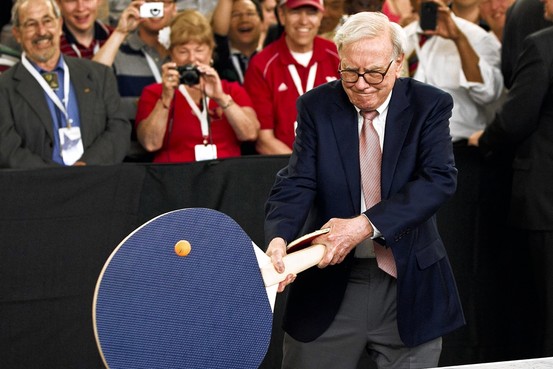
Shareholders watch as Warren Buffett, chairman and CEO of Berkshire Hathaway, deploys an oversize bat against table tennis prodigy Ariel Hsing in Omaha, Neb., in May.

The challenge of finding a big target at the right price will again be on investors’ minds when Berkshire files its annual report Friday afternoon. The report includes the shareholder letter penned by the 82-year-old Mr. Buffett, which over the years has been the source of many of the bon mots for which the Omaha, Neb., company’s chairman and chief executive is known. Read more of this post

The World’s Most Admired Companies: Built for brilliance; Seven of those top 10 companies are one-man phenomena: Apple, Google, Amazon, Starbucks, Southwest Airlines, Berkshire Hathaway, FedEx

The World’s Most Admired Companies: Built for brilliance

By Geoff Colvin, senior editor-at-large @FortuneMagazine February 28, 2013: 7:55 AM ET

The most important trend in the World’s Most Admired Companies ranking isn’t the concentration of tech firms at the top, striking though that is. The list holds an even larger and more powerful pattern: Seven of those top 10 companies are one-man phenomena. Apple, Google, Amazon, Starbucks, Southwest Airlines, Berkshire Hathaway, FedEx — each is the reflection of a single individual (or two, at Google) who is still around, with the notable exception of Apple’s Steve Jobs, gone less than 18 months.

To see how unusual that is and what large questions it raises for any company’s future in today’s economy, one must consider the very first Most Admired list, which appeared 30 years ago, in 1983. Only one among the top 10 was a one-man phenomenon: Digital Equipment, run by founder Ken Olsen. The others were all long-established institutions, corporate aristocracy: IBM, Hewlett-Packard, Johnson & Johnson, Eastman Kodak, Merck, AT&T, General Electric, General Mills.

Why this massive shift? In an information-based economy, a company can rocket to industry dominance and a towering valuation in the space of a founder’s career, much faster than in an industrial economy. It can also fall right back down, as Yahoo, AOL, and MySpace prove. Read more of this post

Kindness + The Accounting of Words and Value Investing

I was just discussing this afternoon about how can one “measure/quantify” the criteria of “kindness”. This is in relation to Yahoo’s Marissa Mayer scrapping the “work-from-home” policy which would affect several working mothers and the policy does not seem aligned with a culture of kindness and trust to foster productivity and innovations. And there are reports that Marissa Mayer paid to have a nursery built in her office; “not all Yahoos have that kind of money and clout” was the feedback gathered by journalist Nicholas Carson from some Yahoo staff. In the R.E.S.-ilience framework of Bamboo Innovators, R stands for Rootedness in a Kindness culture. Perhaps the lack of Kindness can be “quantified” by the disproportionate size of the office and size of perks to the top executives and managers. In a positive way, Kindness can be “measured” by the “number of jokes/humor” in annual reports and company publications, just like Warren Buffett’s folky humor in his widely-followed Berkshire Hathaway’s Letter to Shareholders. Words can reveal kindness and there is growing awareness of how linguistic/textual analysis can be used to highlight the intentions of managers and leaders. Talk about using unorthodox “data”. Below is a brief article “The Accounting of Words and Value Investing” that I wrote in September 2010 which also has relevance to investigating Bamboo Innovators.

Koon Boon

26 Feb 2013

Singapore

27 September 2010 (Updated 22 March 2013)

The Accounting of Words and Value Investing for Bamboo Innovators

By KEE Koon Boon

Have taken down this article as i am submitting this for a posting at a media outlet for a 1-month exclusivity period. Will update accordingly. Thank you.

JCPenney COO: ‘I Hated The JCPenney Culture, It Was Pathetic’

JCPenney COO: ‘I Hated The JCPenney Culture, It Was Pathetic’

Kim Bhasin | Feb. 25, 2013, 11:51 AM | 16,278 | 13

P1-BK427_PENNEY_NS_20130224170304P1-BK428_PENNEY_G_20130224170604

JCPenney experienced a seismic shift on corporate culture when CEO Ron Johnson took the helm of the company more than a year ago.

The new guard didn’t like JCPenney’s old way of doing things at headquarters.

Not one bit.

Dana Mattioli at The Wall Street Journal spoke with JCPenney COO Michael Kramer about the company’s culture and the mass layoffs at the company’s headquarters. He’s one of the execs brought in by Johnson, who he’d previously worked with at Apple.

“I hated the JCPenney culture,” Kramer told the WSJ. “It was pathetic.” Read more of this post

Your business model is obsolete; Assume this: Everything you think you know about staying competitive doesn’t work anymore

Your business model is obsolete

February 25, 2013: 5:00 AM ET

Assume this: Everything you think you know about staying competitive doesn’t work anymore.

By Geoff Colvin, senior editor-at-large

FORTUNE — When Carlos Ghosn announced last year that Nissan, which he runs, will start making ultracheap cars for emerging markets under the revived Datsun brand — and will make a profit on them — the mainstream response was contemptuous. “A big mistake,” a Toyota (TM) executive told the Wall Street Journal; “another blunder,” said a Japanese professor. Make a profit on a $3,000 vehicle? Everyone knows the profits are in pickup trucks and luxury cars.

No one can predict if Ghosn’s new vision will work. His previous rethinking of the business, the all-electric Leaf, hasn’t amounted to much so far. But applaud Ghosn for this: He is trying to develop the most crucial competency for every company today, innovating the business model.

“Innovation” is the hottest word in business, but most of the discussion centers on products and services. The more profound challenge for most companies now is imagining a new business model, a new answer to the fundamental question, How do we make money? Read more of this post

The Ways Art Investors Blow It; Adding art to your portfolio can be a lot trickier than putting it on your wall.

February 25, 2013

The Ways Art Investors Blow It

Three common mistakes novices fall prey to—and how to avoid them

By DANIEL GRANT

Adding art to your portfolio can be a lot trickier than putting it on your wall.

With regular investments looking uncertain these days, individuals and financial pros are snapping up artwork to diversify their holdings—and, with any luck, realize big returns.

WE-AA434_FINEAR_G_20130221154803

But with more competition for desired pieces, prices are soaring ever higher and the chances of making a costly mistake are rising too. Here’s a look at some of the pitfalls of art investors face and how to avoid them. Read more of this post

Comic-book investing is a funny business—and sometimes a profitable one

February 25, 2013

Wham! Ka-Pow! Zounds!

Comic-book investing is a funny business—and sometimes a profitable one

By STEVE ROSENBUSH

In August 2008, comic-book dealer Metropolis Collectibles Inc. auctioned a copy of Action Comics No. 1—which introduced the character of Superman in 1939—for $317,200. At the time, it was the largest sum ever paid for a comic book.

When the real estate and stock markets tanked in 2008, some savvy investors turned to the so-called “golden age” comic books, and the market has continued to boom. WSJ’s Steve Rosenbush talks to Vincent Zurzolo, COO of Metropolis Collectibles.

Last November, Metropolis sold another copy of Action Comics No. 1. The price this time: $2.2 million.

While some other asset classes withered in the wake of the recent financial crisis, comic books have emerged triumphant. They’re not all investment superheroes, but overall demand has risen steadily in recent years, says Ed Jaster, a senior vice president and comic-book specialist at Heritage Auctioneers & Galleries Inc. in New York. Read more of this post