Thinking outside the bottle; Even the world’s biggest brands can struggle to succeed in India. Coca-Cola chairman and CEO Muhtar Kent urges global companies to accept the market as it is, not as they wish it to be

Thinking outside the bottle

Even the world’s biggest brands can struggle to succeed in India. Coca-Cola chairman and CEO Muhtar Kent urges global companies to accept the market as it is, not as they wish it to be.

December 2013 | byMuhtar Kent

I moved to India with my family as a young boy. My father, a career diplomat, was dispatched to New Delhi to serve as the Republic of Turkey’s ambassador to India. We lived in New Delhi for two magical years. I don’t remember anything from those days about India’s politics or economics. What I do remember are the vibrant colors of clothing and flowers and shops that lined the streets, and the natural beauty of the Indian countryside, from the mountains to the north to the plains of the Ganges basin to the south. I remember the mysterious music, the aromas of spicy curries and chutneys that friends of my parents would prepare for us. And of course I remember the people: friendly, bright-eyed, ambitious, and sometimes very poor. Everywhere, crowds of people. Read more of this post

Coke’s Global Brands and Distribution Network Are Unmatched

Coke’s Global Brands and Distribution Network Are Unmatched

By Thomas Mullarkey, CFA | 12-04-13 | 06:00 AM | Email Article

Coca-Cola (KO) described its 2020 vision in 2009 and since then has been making steady progress in achieving its goals. The company hopes to double the amount of Coca-Cola beverages consumed around the world and double system revenue in that time frame. While we believe volume growth during the next decade will be led by emerging markets, we think Coca-Cola’s sales in mature geographies will also expand as the firm broadens its portfolio of still beverages. Coca-Cola’s vast distribution network and powerhouse brands are second to none and have helped the company create one of the widest economic moats in our consumer defensive coverage universe. We believe the firm’s wide moat justifies an above-average multiple, and the shares look undervalued compared with our $45 fair value estimate. Read more of this post

How to Live In a Grey World with Black-and-White Values? Musings on the Indian Accounting Standards 18, “Willful Defaulters”, Frugal Innovations and Avalokiteśvara

The following article is extracted from the Bamboo Innovator Insight weekly column blog related to the context and thought leadership behind the stock idea generation process of Asian wide-moat businesses that are featured in the monthly entitled The Moat Report Asia. Fellow value investors get to go behind the scene to learn thought-provoking timely insights on key macro and industry trends in Asia, as well as benefit from the occasional discussion of potential red flags, misgovernance or fraud-detection trails ahead of time to enhance the critical-thinking skill about the myriad pitfalls of investing in Asia at the microstructure- and firm-level.

The weekly Bamboo Innovator Insight series brings to you:

  • How to Live In a Grey World with Black-and-White Values? Musings on the Indian Accounting Standards 18, “Willful Defaulters”, Frugal Innovations and Avalokiteśvara, Dec 2, 2013 (Moat Report AsiaBeyondProxy)

Grey World

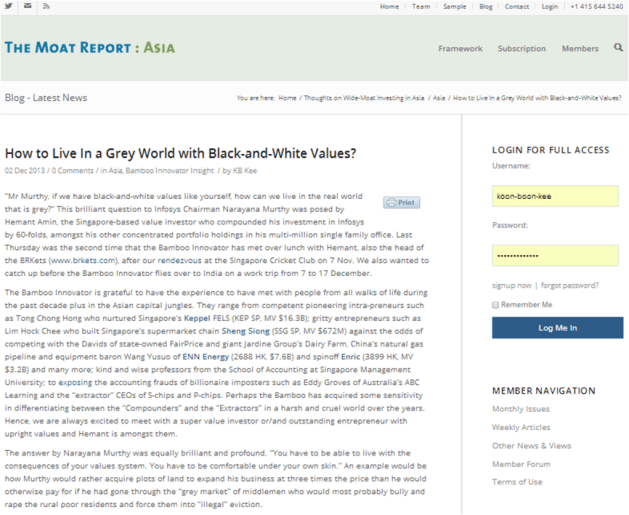
How to Live In a Grey World with Black-and-White Values? Musings on the Indian Accounting Standards 18, “Willful Defaulters”, Frugal Innovations and Avalokiteśvara

“Mr Murthy, if we have black-and-white values like yourself, how can we live in the real world that is grey?” This brilliant question to Infosys Chairman Narayana Murthy was posed by Hemant Amin, the Singapore-based value investor who compounded his investment in Infosys by 60-folds, amongst his other concentrated portfolio holdings in his multi-million single family office. Last Thursday was the second time that the Bamboo Innovator has met over lunch with Hemant, also the head of the BRKets (www.brkets.com), after our rendezvous at the Singapore Cricket Club on 7 Nov. We also wanted to catch up before the Bamboo Innovator flies over to India on a work trip from 7 to 17 December.

The Bamboo Innovator is grateful to have the experience to have met with people from all walks of life during the past decade plus in the Asian capital jungles. They range from competent pioneering intra-preneurs such as Tong Chong Heong who nurtured Singapore’s Keppel FELS (KEP SP, MV $16.3B); gritty entrepreneurs such as Lim Hock Chee who built Singapore’s supermarket chain Sheng Siong (SSG SP, MV $672M) against the odds of competing with the Davids of state-owned FairPrice and giant Jardine Group’s Dairy Farm, China’s natural gas pipeline and equipment baron Wang Yusuo of ENN Energy (2688 HK, $7.6B) and spinoff Enric (3899 HK, MV $3.2B) and many more; kind and wise professors from the School of Accounting at Singapore Management University; to exposing the accounting frauds of billionaire imposters such as Eddy Groves of Australia’s ABC Learning and the “extractor” CEOs of S-chips and P-chips. Perhaps the Bamboo has acquired some sensitivity in differentiating between the “Compounders” and the “Extractors” in a harsh and cruel world over the years. Hence, we are always excited to meet with a super value investor or/and outstanding entrepreneur with upright values and Hemant is amongst them.

The answer by Narayana Murthy was equally brilliant and profound. “You have to be able to live with the consequences of your values system. You have to be comfortable under your own skin.” An example would be how Murthy would rather acquire plots of land to expand his business at three times the price than he would otherwise pay for if he had gone through the “grey market” of middlemen who would most probably bully and rape the rural poor residents and force them into “illegal” eviction.

Besides Infosys, another concentrated compounding bets that returned multiple-fold for Hemant include HDFC (HDFC IN, MV $20.6B) and its subsidiary spinoff GRUH Finance (GRHF IN, MV $671M). As Asia slows down, many tycoons have been considering spinoffs as part of their corporate restructuring efforts to battle sluggishness and improve managerial efficiency. As explained in our earlier articles, not all spinoffs are value-creating opportunities. Heavily-indebted firms are in deleveraging mode to dispose highly-geared businesses to investors in spinoffs. The upcoming spinoff events in Asia need to be examined carefully for their business fundamentals (whether they have a wide moat and a unique scalable business model) and their motivation. In India, one of the more useful accounting clues to separate the Compounders vs the Extractors in India has been the Indian Accounting Standards 18 (IAS 18), which we will elaborate after understanding the (hidden) debt problem in India and Asia.

Despite the entrenched problems in India, both Hemant and the Bamboo Innovator share the same investment insight that India is a unique vibrant and versatile hub for “frugal innovations”: cost-effective and affordable solutions of various varieties that cater to price-sensitive consumers. Like the three sources of wide-moat in Bamboo Innovators to separate the resilient compounders vs the extractors, India’s Frugal Innovators are those with the:

1)       Indestructible intangible know-how in proprietary know-how in the system to scale up or know-how in unique products or trust and support in the community of customers and suppliers, such as Tata Consultancy Services TCS; NBFCs such as HDFC and its subsidiary GRUH with their accumulated knowledge base in assessing the credit quality of its borrowers which cultivates and snowballs trust and support from its customer base; the “unique” products of Bosch India, Pidilite Industries, Britannia, Jyothy, Eicher, Emami;

2)       Core-periphery network with the strong touch-points and periphery network eg Asian Paints, Godrej Consumer, Mahindra & Mahindra;

3)       Open innovation in co-creating value with external partners, such as the MNCs Nestle India etc, Amara Raja vs Exide, Hero Motocorp.

One prominent Buddhist story according to Mahāyāna doctrine tells of Avalokiteśvara (Sanskrit: अवलोकितेश्वर lit. “Lord who looks down”), the bodhisattva vowing never to rest until he had freed all sentient beings from samsara. Despite strenuous effort, he realizes that still many unhappy beings were yet to be saved. After struggling to comprehend the needs of so many, his head splits into eleven pieces. Amitabha Buddha, seeing his plight, gives him eleven heads with which to hear the cries of the suffering. Upon hearing these cries and comprehending them, Avalokiteśvara attempts to reach out to all those who needed aid, but found that his two arms shattered into pieces. Once more, Amitabha Buddha comes to his aid and invests him with a thousand arms with which to aid the suffering multitudes. The Chinese name of Avalokiteśvara is Guanyin (观音菩萨), which means “Observing the Sounds or Cries of the World”. The Goddess of Mercy goes all out to hear and see the pains and sorrows and negative things to help with her thousand hands and eyes (“即发誓言,若我当来堪能利益安乐一切众生者,令我即时身千手千眼具足.” 《千手千眼观世音菩萨广大圆满无碍大悲心陀罗尼经》). In their own ways, Frugal Innovators attempt to design cost-effective, “good enough” solutions that can reach out to meet the aspirations and solve the problems of millions of consumers with the indestructible intangible asset in the form of their first-hand knowledge of the ground situation of targeted customer group. Seeking to hear and see the negative things and acknowledging sadness and failures is perhaps the first step to becoming a Bamboo Innovator and resilient compounder.

The Bamboo Innovator will be away to India on a work trip from 7 to 17 December and will resume the weekly Bamboo Innovator Insight article in the last week of December. We are grateful for your support and understanding all this while.

China Banks Manage Debt Levels With Loan Rollovers; China’s banks are among the world’s healthiest and most profitable, based on their financial statements. But investors aren’t convinced; Hands-On Bavarian Count Presides Over a Pencil-Making Empire

China Banks Manage Debt Levels With Loan Rollovers

Regulators Discourage Banks From Rolling Over Troubled Loans

CYNTHIA KOONS

Updated Dec. 3, 2013 5:32 a.m. ET

AI-CF217_CLOANS_G_20131203051204

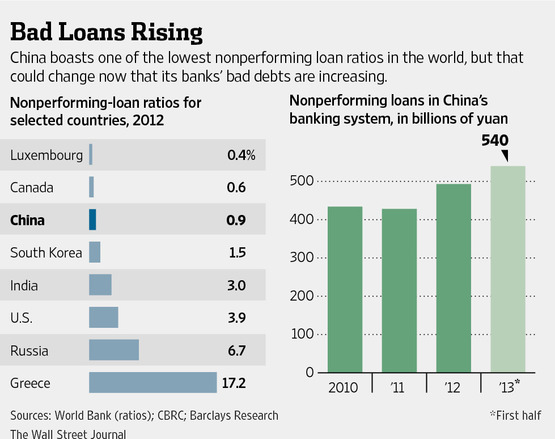
China’s banks are among the world’s healthiest and most profitable, based on their financial statements. But investors aren’t convinced. Nonperforming loans account for less than 1% of total loans, a ratio that has been falling in recent years and is now one of the lowest in the world, according to World Bank data. Despite this, price-to-book values of the country’s leading banks have been declining over the past few years, reflecting worries about deteriorating credit quality in China. Read more of this post

AQR Capital’s Cliff Asness: My Top Ten Peeves

Cliff Asness: My Top Ten Peeves

by ValueWalk StaffDecember 2, 2013

Saying I have a pet peeve, or some pet peeves, just doesn’t do it. I have a menagerie of peeves, a veritable zoo of them. Luckily for readers, I will restrict this editorial to only those related to investing (you do not want to see the more inclusive list) and to only a mere 10 at that. The following are things said or done in our industry or said about our industry that have bugged me for years. Because of the machinegun nature of this piece, these are mostly teasers. I don’t go into all the arguments for my points, and I blatantly ignore counterpoints (to which I assert without evidence that I have countercounterpoints). Some of these are simple, so perhaps the teaser suffices. But some deserve a more thorough treatment that hopefully I, or someone else, will undertake. Some are minor, truly deserving the title “peeve,” and some, more weighty. In each case, as befits an opinion piece, it’s not just my discussion of the peeve but the very prevalence of the peeve itself that is my opinion. I do not extensively cite sources for them. I contend that they are rather widespread throughout the land of financial media, pundits, advisers, and managers. Thus, citing one or two sources would be unfair, and citing them all, impossible. Therefore, please feel free to disagree not just with my discussion of the peeves but also about their very existence! Without further ado, here is a list of things held together by only three characteristics: (1) They are about investing or finance in general, (2) I believe they are commonly held and often repeated beliefs, and (3) I think they are wrong or misleading and they hurt investors.

You Can Invest Just Like Warren Buffett, If You’re a Quant Hedge Fund

You Can Invest Just Like Warren Buffett, If You’re a Quant Hedge Fund

The Internet has paid a lot of attention today to this National Bureau of Economic Research working paper called “Buffett’s Alpha,”1 whose principal conclusions are:

1. You could build a robot that replicates Warren Buffett’s stock-picking performance.

2. The ingredients of that robot are (1) 1.6x leverage, which is what Buffett runs at Berkshire Hathaway Inc.,2 and (2) a statistical factor-weighting investment approach that overweights what the authors call “high-quality” (growing, high-payout, profitable) companies with low betas.

3. AQR Capital Management LLC, the quantitative hedge fund that employs the paper’s authors, can build such a robot with trivial ease, really by just pushing a button, it’s no problem, watch, they will do it for you. Read more of this post

Bill Ackman’s ‘Moby-Dick’ Bet Against Herbalife

Bill Ackman’s ‘Moby-Dick’ Bet Against Herbalife

Depending on whom you ask, Herbalife Ltd. is either a pyramid scheme that preys on the poor or the innovative manufacturer of dietary supplements favored by a former secretary of state. Bill Ackman, a member of the first camp, admitted in an interview with Bloomberg TV to losing $400 million to $500 million since his Pershing Square Capital Management LP hedge fund started short selling Herbalife shares about a year ago. Ackman also said that this wasn’t “just a trade” for him — he promised to keep betting against the company “to the end of the earth,” a phrase reminiscent of Captain Ahab’s vow that he would chase the white whale “round perdition’s flames before I give him up.” Read more of this post

Greenblatt: Patience–the Secret to Value Investing; Value investing works like clockwork, but your clock has to be really slow, says the Columbia professor and CIO of Gotham Asset Management

Greenblatt: Patience–the Secret to Value Investing

By Anthony Dasaro | 10-31-2013 12:00 PM

Value investing works like clockwork, but your clock has to be really slow, says the Columbia professor and CIO of Gotham Asset Management. 

A.J. Dasaro: Hi, this A.J. Dasaro for Morningstar. Joining me today is Joel Greenblatt, chief investment officer and managing principal of Gotham Asset Management, the successor to Gotham Capital, an investment firm he founded in 1985. Joel is a professor at Columbia Business School and the author of You Can Be a Stock Market Genius and The Little Book That Beats the Market. Today, he is joining me as the portfolio manager for Gotham’s three long/short equity mutual funds. Joel, thanks for being here today. Read more of this post

The chairman of debt-ridden Tongyang Group and his wife took remuneration of $4.3 million as their empire was tanking

Tongyang boss earned $3.2 million

Hyun told Assembly last month that all his money was in firm

BY KIM JUNG-YOON [kjy@joongang.co.kr]

Dec 02,2013

The chairman of debt-ridden Tongyang Group, Hyun Jae-hyun, and his wife, Vice Chairwoman Lee Hye-kyung, took remuneration of 4.5 billion won ($4.3 million) as their empire was tanking, leading to losses for around 50,000 investors. From January through September, Hyun took more than 3.45 billion won in wages and bonuses from Tongyang Incorporated and Tongyang Networks, according to the Korea Exchange, and Lee took 1.08 billion won of compensation from Tongyang Incorporated.
The Tongyang Group debacle surfaced in late September when the conglomerate failed to secure enough liquidity to pay back its due debts and filed for court receivership for five affiliates. Read more of this post

Success is success only if it can be sustained: Invest only in companies with good governance records

Updated: Saturday November 30, 2013 MYT 6:58:56 AM

Success is success only if it can be sustained

BY SHIREEN MUHIUDEEN

Invest only in companies with good governance records

MORE and more global institutional investors are embracing the environment, social and governance (ESG) perspective when deciding where to allocate their assets. Governments, too, are increasingly studying how their prospective projects will affect ESG issues. In all this, there are two areas of focus – ensuring greater transparency and improving accountability for one’s actions. The importance of both becomes clear when you consider that the biggest challenges governments face when they try to improve governance are corruption and self-interest. Read more of this post

SEC ups efforts to combat manipulations of ‘microcap’ stocks; “The problem with policing fraudulent microcaps is that they are like mushrooms. They keep popping up no matter how many you shut down.”

SEC ups efforts to combat manipulations of ‘microcap’ stocks

By Dina ElBoghdady, Friday, November 29, 5:49 AM

The Securities and Exchange Commission is redoubling its effort to combat the manipulation of “microcap” stocks, opening about half a dozen investigations each month into schemes suspected of bilking mom-and-pop investors, agency officials said. As the SEC describes it, the term microcaps typically refers to the low-priced shares offered by the smallest of public companies, the ones that do not qualify to be listed on the large national exchanges, often because their stock is too thinly traded or too cheap. Read more of this post

Learning from Malaysian listings of Chinese companies

Learning from Malaysian listings

Friday, November 29, 2013 – 14:43

Elaine Tan

China Daily/Asia News Network

Chinese companies struggle to raise their profiles as investors are wary of unfamiliar names

When Xingquan International Sports Holdings sought a listing on Bursa Malaysia, the Malaysian stock exchange, it was welcomed with open arms. The 2009 initial public offering (IPO) of China’s fifth largest outdoor sportswear manufacturer marked the first by a foreign-owned company after a concerted 16-month effort by the Securities Commission and the stock exchange to internationalize the Malaysian capital market. Read more of this post

Charles Ellis: Lessons on Grand Strategy; Investing Lessons From Military Strategists

Lessons on Grand Strategy

Charles D. Ellis, CFA

July/August 2013, Vol. 69, No. 4: 6–9
(doi: 10.2469/faj.v69.n4.5)

Abstract


Grand Strategy,1 whereby all aspects of a nation’s strength—military, economic, political, cultural, and organizational—are combined into an overall, long-term program to advance the nation’s major interests, has important lessons for all leaders of investment management organizations. For long-term success, such leaders need a coherent, integrated combination of an inspiring purpose or mission and superior recruiting and training of investment managers and professional managers who will excel in information technology, trading, risk controls, efficient and effective support operations, business development, customer service, and both research and portfolio management. Read more of this post

Mockingjay and IFRS 10/FRS 110 in Asia 2014: Changing Balance Sheet and The Rebellion Year for Accounting Frauds?

The following article is extracted from the Bamboo Innovator Insight weekly column blog related to the context and thought leadership behind the stock idea generation process of Asian wide-moat businesses that are featured in the monthly entitled The Moat Report Asia. Fellow value investors get to go behind the scene to learn thought-provoking timely insights on key macro and industry trends in Asia, as well as benefit from the occasional discussion of potential red flags, misgovernance or fraud-detection trails ahead of time to enhance the critical-thinking skill about the myriad pitfalls of investing in Asia at the microstructure- and firm-level.

The weekly Bamboo Innovator Insight series brings to you:

  • Mockingjay and IFRS 10/FRS 110 in Asia 2014: Changing Balance Sheet and The Rebellion Year for Accounting Frauds? Nov 25, 2013 (Moat Report Asia, BeyondProxy)

Rebellion

Dear Friends and All,

Mockingjay and IFRS 10/FRS 110 in Asia 2014: Changing Balance Sheet and The Rebellion Year for Accounting Frauds? 

“Fire is catching! And if we burn, you burn with us!” 
― Katniss Everdeen in Mockingjay, series #3 of The Hunger Games

When you’re in the arena … you just remember who the enemy is.”

– Haymitch in Catching Fire, series #2 of The Hunger Games

Audit firms that show up year after year to express their “true and fair” opinion on the financial statements to be free of material misstatements run the risk of getting complacent and, worse still, in cahoots with their clients in their chemical dependence on the comfortable audit fees, like the victors of previous Hunger Games who show up annually at the event and spend the rest of their time in the relative comfort of the Victor’s Village in each district. Last week on Nov 19, an arrow struck into the client-auditor nexus that perpetuates frauds in Asia: The Seoul Central District Court ordered Samil-PwC, the largest auditor in Korea, to pay a $13 million fine to a group of 137 shareholders for failing to conduct its audit in Kosdaq-delisted software firm Forhuman with due care. The shareholders filed the lawsuit to claim compensation for their losses after the company was delisted from the Kosdaq exchange over embezzlement and accounting fraud scandals. Lee Yong-hee, the company’s CEO, was ordered to pay more than $23 million on charges of embezzling $9.4 million. Forhuman was listed on the Kosdaq market in 2002. From 2008 to 2010 it recorded $15.5 million of net losses. However, the software developer forged its accounting records, recording $39 million of net profit instead. During that period, Samil-PwC consistently gave Forhuman high evaluation scores.

This is the first time that a court has ruled to hold big accounting firms such as Samil-PwC responsible for poor auditing, whether in Korea or in Asia. And this ruling came despite the financial regulator defending Samil-PwC, arguing that it would be wrong if an auditor should assume responsibility for what was perpetrated by a client company. Both retail and institutional investors in Asia have frequently fallen prey to the negligence of auditors in terms of their duties or collusion with companies, as has been seen in the savings banks and Tongyang Group scandals which prompted the unprecedented ruling in Korea. Over the last three years in Korea, accounting firms had to pay a total of only $3.2 million for partial responsibility and settlements in accounting scandal cases. Incorporated accounting companies also came up with clever ways to escape responsibility over charged of negligence. The ruling against Samil PricewaterhouseCoopers was the second decision made by the same court in the same month that an accounting firm is responsible for negligence. The Seoul Central District Court ruled on Nov 9 that BDO-Daejoo is partially responsible for compensating investors of the failed Samhwa Mutual Savings Bank.

Accounting fraud has long been a prevalent and deep-seated problem. There had been various measures to tackle it, but fraudulent practices continue. In Hunger Games, the mockingjay bird becomes a symbol of rebellion in the second series Catching Fire. Hopefully, the Forhuman is the “mockingjay” symbol that can spread throughout Asia to unravel more accounting frauds with the various colluders from auditors to financial advisors/dealmakers with the company’s insiders. The S-chip (or Singapore-listed Chinese companies) scandals have also cases of auditor partners directly or indirectly involved, such as Ziwo in which the Deloitte Singapore audit partner was advertised to have invested in the company as one of the largest shareholders. As explained in our series on Detecting Accounting Frauds (Part 1 and Part 2), Ziwo is a typical case in employing the capex inflation (“Grand Capex”) and consolidation trick in accounting by using balance-sheet items in the “Subsidiary”, “Amount Due from Subsidiary” and “Prepayment/Advances” accounts (“Roll-Away Loans or Advances”) to generate artificial sales and mask possible acts of tunneling and expropriation of cash and assets. Since the media blitz which includes the audit partner’s investment, the all-expense-paid IR trip and bullish sell-side research piece, share price of Ziwo is down nearly 90% from S$0.42 to S$0.05.

Like Ziwo, the fraudulent accounts of Korea’s Forhuman are detected via their affiliate overseas business partners in Japan. These are all part of the related-party transactions atypical of Asian firms. Noteworthy for Forhuman, Ziwo and Prince Frog is that if their hidden “related-party” entities (subsidiaries, associates, SPEs/VIEs (special purpose entities/ variable interest entities), JVs, pool arrangements, financial assets/instruments) are consolidated into the balance sheet as they ought to be, a far clearer picture on the financial health, particularly the hidden liabilities and debt, of the group (of companies) can be analyzed and evaluated. Value investors would be able to observe the explosion in the hidden debt and liabilities for Korea’s Forhuman at the group level once the Japanese affiliated entities are consolidated into their balance sheet and not be misled by the nice quant numbers of just the listed vehicle at the company level.

IFRS10

What are the implications of the new IFRS 10 Consolidated Financial Statements (the outgoing IAS 27), effective for annual periods beginning on or after Jan 1, 2013 but delayed in Singapore to allow more time for implementation. In Singapore, the FRS 110 will be effective for annual periods beginning on or after Jan 1, 2014. The power of control is one of the most difficult questions to answer in accounting since it involves subjective judgment, leading to diversity in practice related to consolidation. What is the impact on family business groups such as Jindal, Jaypee/Jaiprakash, Essar, Adani, JSW, GMR, Lanco, Videocon, and GVK? Or the chaebols in Korea such as Doosan, Dongbu, Hanjin and Kolon? Or to the REIT/real estate/construction industry and shipping industry? Yet, all these accounting standard changes are not impactful if the auditors are not held accountable for any material misstatements and fraud revelation. Hence the importance of the mockingjay symbolized by the court ruling case for delisted Kosdaq tech firm Forhuman last week. The auditors are now in the fire. What are the 4 key Bamboo Innovator takeaways?

The Secret Science of Stock Symbols

November 14, 2013

The Secret Science of Stock Symbols

Posted by Adam Alter

Between the beginning of October and early November, the following eight companies were among more than twenty that began trading on the New York Stock Exchange: OCI Partners, Springleaf Holdings, Brixmor Property Group, Essent Group, 58.com, Mavenir Systems, Midcoast Energy Partners, and Twitter. They’re a diverse group of tech, energy, property, and finance companies, valued at their respective I.P.O.s between three hundred and sixty million dollars (Mavenir Systems) and $24.5 billion dollars (Twitter). Read more of this post

Why to Buy Large-Cap Stocks Now; Large-Cap Stocks Tend to Lead the Market Over the Last Several Weeks of the Year

Why to Buy Large-Cap Stocks Now

Large-Cap Stocks Tend to Lead the Market Over the Last Several Weeks of the Year

MARK HULBERT

Nov. 22, 2013 6:13 p.m. ET

BF-AG255_HULBUR_D_20131122143307

Many investors are already familiar with the so-called January effect—the tendency for the stocks of the smallest companies to perform particularly well at the beginning of the year. Less well known, but equally pronounced, is another seasonal pattern, though this one occurs before the end of the year rather than after: Until Dec. 31, it’s the stocks with the largest capitalization that tend to lead the market. To exploit these tendencies, you should more heavily weight your equity portfolio toward large-cap stocks from now until the end of the year, at which point you would tilt toward small caps. Read more of this post

Damodaran: The more comfortable you are in valuing a company, the less point there is to doing that valuation.

Tuesday, November 19, 2013

Value in the eye of the storm: Why you should welcome uncertainty!

One of the responses to my last post on valuing young companies was that even if you can value companies early in the life cycle, you cannot do so with any degree of confidence. I concede that point, but that is exactly why I would try to value them! I know that statement makes little sense, but to solidify my argument, take a look at the following list of five assets/entities and rank them on the basis of the confidence you will feel in valuing each one (I have provided my rankings and the reasons in the table). Read more of this post

How Mohnish Pabrai Uses Checklists

Prince Frog Plummets on Short Seller’s Report: Hong Kong Mover

Prince Frog Plummets on Short Seller’s Report: Hong Kong Mover

Prince Frog International Holdings Ltd. (1259) plunged 22 percent as it traded in Hong Kong for the first time since allegations from short-seller Glaucus Research Group dropped the stock by a record last month. The shares of the Chinese maker of children’s care products such as bath soap and lotion fell HK$1 to HK$3.63, the lowest in eight months. Read more of this post

Shortcomings of The NPV Approach To Valuing Stocks

Shortcomings of The NPV Approach To Valuing Stocks

by csinvestingNovember 20, 2013

Part I: What are the three major shortcomings of using the Net Present Value Approach (“NPV”) to valuing companies?

The NPV approach has three fundamental shortcomings. First, it does not segregate reliable information from unreliable information when assessing the value of a project. A typical NPV model estimates net cash flows for several years into the future from the date at which the project is undertaken, incorporating the initial investment expenditures as negative cash flows. Five to ten years of cash flows are usually estimated explicitly. Cash flows beyond the last date are usually lumped together into something called a “terminal value.” A common method for calculating the terminal value is to derive the accounting earnings from the cash flows in the last explicitly estimated year and then to multiply those earning by a factor that represents an appropriate ratio of value to earnings (i.e., a P/E ratio). If the accounting earnings are estimated to be $12 million and the appropriate factor is a P/E ratio of 15 to 1, then the terminal value is $180 million. Read more of this post

Stop fraudulent accounting

Stop fraudulent accounting

Nov 20,2013

Accounting fraud has long been a prevalent and deep-seated problem. There had been various measures to tackle it, but fraudulent practices continue. Listed companies subject to routine audits live in fear of the bill they will get once the books are cleaned up. Of course, the primary responsibility for stopping accounting fraud lies with the companies themselves. Companies can cook up the books and hide liabilities in many different ways if they want to, leaving their accountants to claim they could not uncover all those dubious practices.  Read more of this post

Investing Is Still More Art Than Science

Investing Is Still More Art Than Science

By Morgan Housel | More Articles
November 18, 2013 | Comments (10)

I was in Orlando this weekend at the American Association of Individual Investors annual conference. Investor James O’Shaughnessy, who I greatly admire, gave a wonderful talk called “What works on Wall Street.” It got me thinking about something important. It’s actually one of the things that drives me crazy about finance. O’Shaughnessy began noting that in Benjamin Graham’s day, the first half of the 20th century, good financial data was extremely hard to come by, and good historical data going back more than a few years was nonexistent. This made studying finance close to impossible. Graham (Warren Buffett’s early mentor) once said that until more data was available, investors couldn’t dare call their trade a profession. It was an art, but not a profession. Read more of this post

“They come to visit certain companies. They see them, they leave. But their eyes remain fixated on what they came to see.”

Michael Bleby Reporter

Meet the fund manager who runs $500m – from $10-a-night hotels

Published 19 November 2013 11:52, Updated 19 November 2013 13:03

If you meet a middle-aged American staying in a $10-a-night room in the central Java city of Yogyakarta, don’t assume he’s just another backpacker. If his name is Robert Levitt, he is a fund manager working out how to use his $US500 million in funds under management. Right now, the traffic congestion in Yogyakarta is what occupies Levitt’s mind. Traffic congestion has long been a thing in the capital city of Jakarta, with its 9 million people, but seeing the rapid growth of small-car ownership and consequent gridlock in this regional city of 400,000, tells Levitt there is an opportunity. Read more of this post

Ritholtz: Warren Buffett’s Exxon Bungle

Warren Buffett’s Exxon Bungle

By Barry Ritholtz  Nov 20, 2013

How often do you make a decision to sell something for a giant gain? Quite a few times across the arc of a career, if you are a half-decent investor. But how often is that sell decision a terrible mistake? Today, I want to tell the tale of Warren Buffett’s bungled profit-taking in Exxon. We all have war stories of the profitable sale that should never have been made. I took profits in a 2001 purchase of Apple at $15 (pre-split) at $43 to buy a house. (It was post-iPod, pre-iPhone). So who am I to criticize the sale of XOM? Read more of this post

Are You Crafty Enough? Yellen’s Non-Bubble, Henry Ford’s Art Book Present and Korea’s Com2Us-Gamevil (Bamboo Innovator Insight)

The following article is extracted from the Bamboo Innovator Insight weekly column blog related to the context and thought leadership behind the stock idea generation process of Asian wide-moat businesses that are featured in the monthly entitled The Moat Report Asia. Fellow value investors get to go behind the scene to learn thought-provoking timely insights on key macro and industry trends in Asia, as well as benefit from the occasional discussion of potential red flags, misgovernance or fraud-detection trails ahead of time to enhance the critical-thinking skill about the myriad pitfalls of investing in Asia at the microstructure- and firm-level.

The weekly Bamboo Innovator Insight series brings to you:

  • Are You Crafty Enough? Yellen’s Non-Bubble, Henry Ford’s Art Book Present and Korea’s Com2Us-Gamevil, Nov 18, 2013 (Moat Report AsiaBeyondProxy)

Bubble

Dear Friends and All,

Are You Crafty Enough? Yellen’s Non-Bubble, Henry Ford’s Art Book Present and Korea’s Com2Us-Gamevil

“Mirror, mirror on the wall, who’s the bubble of them all?”

Checking the various Fed quant valuation models that attempt to mirror the actual world’s fundamentals and prospects, Fed chair Janet Yellen replied at her confirmation hearing before the Senate Banking Committee on Thursday 14 Nov asking about bubbles: “Stock prices have risen pretty robustly, but I think that if you look at traditional valuation measures, you would not see stock prices in territory that suggests bubble-like conditions.” Yet, the very action of artificially driving down interest rates is what’s making stocks look cheap. When pressed further by the senators, Yellen reassured them that she does not see the era of low interest rates and quantitative easing continuing indefinitely. “This program cannot continue forever,” Yellen said. The FOMC “is focused on a variety of risks and recognizes that the longer this program continues, the more we will need to worry about those risks,” she said.

Yellen’s non-bubble proclamation reminded me of a closed-door presentation two-plus years ago that the Bamboo Innovator did to the CEO and top management team of an Asean-listed tech company that had a market value of over S$500 million then. I deliberately asked rhetorically a difficult question that would embarrass myself in front of the group of tech veterans: “Is there a bubble in tech stocks? What’s the difference between now and the Internet bubble that burst in 2000/01?”

Legs shuffle, some murmurings, people look uncomfortably at one another before settling their piercing eyes on me, waiting to shred apart my comments since everyone knows firmly that no one has the clear answer to this question. Before I made my remarks, the word regret did flash quickly through my brain but I believe in asking the authentic and uncomfortable questions to bring forth a meaningful dialogue, even if it makes me look painfully stupid. “Do you observe that this time round, there’re more large sophisticated giant buyers such as the likes of Tencent, Baidu, Alibaba holding sway the valuation – and overvaluation – of the off-market new assets created whose present fundamentals may still be awkward? In the previous round, it’s the mom-and-pop retail investors and fund managers driving the craze in the public market. Now, there’s an active private market for trade sellers with spillovers to the public market. These mega trade buyers believe they can integrate these smaller companies into their own business model as an offensive strategy to create bigger value for their customers. The mom-and-pop and fund managers hold paper; the trade buyers wring value – hopefully.” This is an important but less-visible fringe activity around the visible “bubble” that they have also observed but did not articulate it out to one another. The palpable tension in the room eased and positive energy ensued in our interesting discussion on wide-moat business models in Asia’s tech sector.

Observing the less-visible fringe activities that are not and cannot be captured in the traditional valuation measures has yielded interesting insights on the evolution of bubbles. Now, (too) many smaller private investors seek access to the party, lured by the explosion of VCs, PEs and dealmakers promising multibaggers. They want to be part of the thrill and become the conversational life of the party: “Oh, I have invested in that Unicorn”. Partly blinded by the “social returns” of investing in promising growth companies, the blasé attitude of private investors to the investment risks, believing that they are clever and crafty enough to discern the right VC, PE and dealmaker and right investments reminds me of the thought-provoking story of Henry Ford’s art book present and Joseph Duveen:

The year of 1920 had been a particularly bad one for American art dealers. Big buyers – the robber-baron generation of the previous century – were getting to an age where they were dying off like flies, and no new millionaires had emerged to take their place. Things were so bad that a number of the major dealers decided to pool their resources, an unheard-of-event, since art dealers usually get along like cats and dogs.

Joseph Duveen, art dealer to the richest tycoons of America, was suffering more than the others that year, so he decided to go along with this alliance. The group now consisted of the five biggest dealers in the country. Looking around for a new client, they decided that their last best hope was Henry Ford, then the wealthiest man in America. Ford had yet to venture into the art market, and he was such a big target that it made sense for them to work together.

The dealers decided to assemble a list, “The 100 Greatest Paintings in the World” (all of which they happened to have in stock), and to offer the lot of them to Ford. With one purchase, he could make himself the world’s greatest collector. The consortium worked for weeks to produce a magnificent object: a three-volume set of books containing beautiful reproductions of the paintings, as well as scholarly texts accompanying each picture. Next they made a personal visit to Ford at his home in Dearborn, Michigan. There they were surprised by the simplicity of his house: Mr Ford was obviously an extremely unaffected man.

Ford received them in his study. Looking through the book, he expressed astonishment and delight. The excited dealers began imaging the millions of dollars that would shortly flow into their coffers. Finally, however, Ford looked up from the book and said, “Gentlemen, beautiful books like these, with beautiful coloured pictures like these, must cost an awful lot!” “But Mr Ford!” exclaimed Duveen, “we don’t expect you to buy these books. We got them up especially for you, to show you the pictures. These books are a present to you.” Ford seemed puzzled. “Gentlemen,” he said, “it is extremely nice of you, but I really don’t see how I can accept a beautiful, expensive present like this from strangers.” Duveen explained that the reproductions in the books showed paintings they had hoped to sell to him. Ford finally understood. “But gentlemen,” he exclaimed, “what would I want with the original pictures when the ones right here in these books are so beautiful?”

Duveen prided himself on studying his victims and clients in advance, figuring out their weaknesses and the peculiarities of their tastes before he ever met them. He was driven by desperation to drop this tactic just once, in his assault on Henry Ford. It took him months to recover from his misjudgement, both mentally and monetarily. Ford was the unassuming, plain-man type who just isn’t worth the bother. He was the incarnation of those literal-minded folks who do not possess enough imagination to be deceived. From then on, Duveen saved his energies for the Mellons and Morgans of the world – men crafty enough for him to entrap in his snares.

The tone of the fringe activities in the past two-plus years in Asia has changed from one of healthy doubt to that of “craftiness”. Most of every private investors and high-net-worth entrepreneurs these days believe that they are “crafty enough” to invest in the right “art piece”, the right lottery-like multibagger company and exit at the right time and avoid losses during this evolution of the muddle-through bubble period. After all, the negative news and expectations are supposed to be already all out there in the market and prices have already impounded these informational content. In some sense, they resemble the sophisticated investors whom art dealer Joseph Duveen – the VCs, PEs, dealmakers – sought to court: “the Mellons and Morgans of the world – men crafty enough for him to entrap in his snares.” Sometimes, we ourselves determine the kind of people whom we attract and value investors who are lifelong learners are never crafty enough – we are simple-minded folks who appreciate the value of having a authentic dialogue with a group of like-minded people who genuinely care about one another.

Also, what are the implications of the recent merger of Korea’s top mobile gaming operators Com2Us and Gamevil? What are the 4 key Bamboo Innovator takeaways?
Accounting Fraud Gets Sexy at the SEC; The Securities and Exchange Commission is ferreting out fraud and fake financial reporting with renewed zeal

November 18, 2013

Accounting Fraud Gets Sexy at the SEC

The Securities and Exchange Commission is ferreting out fraud and fake financial reporting with renewed zeal, attorneys and investigators find.

David M. Katz

After a period in which the Securities and Exchange Commission turned most of its attention to misdeeds involving collateralized debt obligations, subprime mortgages and similar products of the financial crisis, the SEC appears to be focusing on accounting fraud and faulty financial reporting again — with a vengeance, insiders say. Read more of this post

Value Investing And Discovering a Multi-bagger

Value Investing And Discovering a Multi-bagger

by ValueWalk StaffNovember 18, 2013

Just the other day, one of the market ‘experts’ on a business news channel while recommending a stock, said that it had the potential to be a multi-bagger. Overall market sentiment has been subdued over the last five years and we were hearing the word multi-bagger after quite some time. Our mind raced back to the analyst meet of a technology sector company during the rah-rah days of the late 1990s. Read more of this post

Disney Reminds Us Of A Time When Anyone Could Invest Early And Really Make A Lot Of Money

Disney Reminds Us Of A Time When Anyone Could Invest Early And Really Make A Lot Of Money

BRYAN TAYLORGLOBAL FINANCIAL DATA NOV. 17, 2013, 10:52 AM 1,814 1

Invest $1 in 1948 and have $48,000 today!

With the recent IPOs of Twitter and Facebook, two of the largest social/entertainment media giants, one would imagine that investing in those companies would pay big compared to the Walt Disney Co. However, the Walt Disney Co. outperformed them both by comparison in its day, and did it with an interesting story to tell. Today, employees and venture capitalists reap most of the benefits before the company IPOs on the New York Stock Exchange (NYSE) or NASDAQ , but it wasn’t always this way. In the past, most companies traded over-the counter for years before listing on the NYSE. Companies had to pay their dues before they moved to the NYSE, and for this reason, a majority of their outperformance occurred while they traded over-the-counter. Read more of this post

Benefits of Studying Insiders’ Trading Patterns

Nov 18, 2013

Benefits of Studying Insiders’ Trading Patterns

FRANCESCO GUERRERA

Michael Babich seems like the right kind of insider trader—the legal kind. In mid-August, Mr. Babich, chief executive of the pharmaceutical company Insys Therapeutics Inc.INSY -1.37%, spent around $25,000 to buy 1,000 shares of the Nasdaq-listed company. “It was a day I felt I needed to show my confidence in my company,” he told me. “There was no news and no events. I saw value.” Read more of this post

A local court ordered one of Korea’s largest accounting firms to pay a massive $36m compensation to the shareholders of a delisted Kosdaq company for failing to conduct its audits with due care

Accounting firm to pay in suit by shareholders

BY SER MYO-JA, KIM KI-HWAN [myoja@joongang.co.kr]

Nov 19,2013

A local court ordered one of the country’s largest accounting firms to pay a massive compensation to the shareholders of a delisted Kosdaq company for failing to conduct its audits with due care.  Read more of this post