NQ Mobile Halts Muddy Waters-Led Rout, Rises First Time in Seven Days on Deposit Verification

NQ Mobile Halts Muddy Waters-Led Rout: China Overnight

NQ Mobile Inc. (NQ) jumped 25 percent, leading gains in Chinese equities traded in New York, after taking further steps to refute allegations by Muddy Waters LLC that sank the stock by 62 percent in the previous three days. American depositary receipts of NQ Mobile, a mobile-services provider, surged to $11.01 yesterday, advancing for the first time since Oct. 18. Muddy Waters, the research firm founded by short seller Carson Block, said in an Oct. 24 report that the company inflated revenue and misrepresented cash balances. NQ Mobile denied the allegations. The Bloomberg China-US Index of the most traded Chinese stocks in the U.S. climbed 1.7 percent to 102.6, set for a fourth monthly gain. Read more of this post

Tired Asian Businessmen, Assessing Management Quality and the $15 Billion Oshin Retail Stock in China (Bamboo Innovator Insight)

The following article is extracted from the Bamboo Innovator Insight weekly column blog related to the context and thought leadership behind the stock idea generation process of Asian wide-moat businesses that are featured in the monthly entitled The Moat Report Asia. Fellow value investors get to go behind the scene to learn thought-provoking timely insights on key macro and industry trends in Asia, as well as benefit from the occasional discussion of potential red flags, misgovernance or fraud-detection trails ahead of time to enhance the critical-thinking skill about the myriad pitfalls of investing in Asia at the microstructure- and firm-level.

  • Tired Asian Businessmen, Assessing Management Quality and the $15 Billion Oshin Retail Stock in China, Oct 28, 2013 (Moat Report AsiaBeyondProxy)

Oshin

Dear Friends and All,

Tired Asian Businessmen, Assessing Management Quality and the $15 Billion Oshin Retail Stock in China

“A tired businessman is one whose business is usually not a successful one.” – Joseph R. Grundy (1863-1961), Quaker businessman and US senator

“For many CEOs the hours are relentless; you’re working around the clock seven days of the week. I need a break. I think three-and-a-half years in the department store is a long time and if you think about our restructuring post the global financial crisis [and] us not being ready for the digital world, it has taken its toll and I’m just simply tired. The past three-and-a-half years as a CEO … weren’t normal, let’s face it. It was tough going and I am signalling my intention to resign ….” – Paul Zahra, CEO of David Jones, on Oct 22, 2013

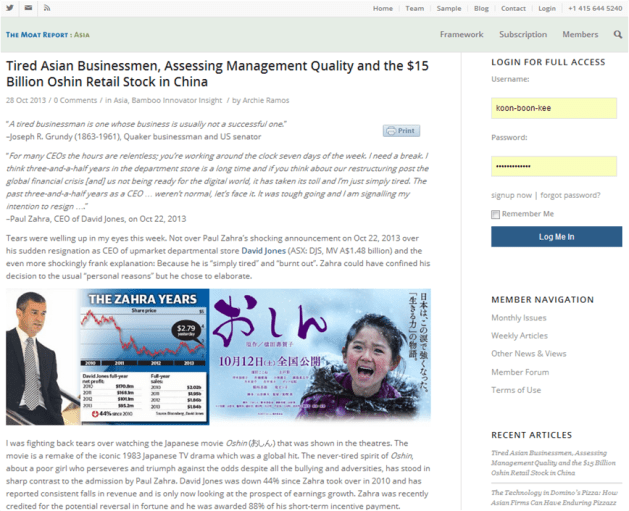
Tears were welling up in my eyes this week. Not over Paul Zahra’s shocking announcement on Oct 22, 2013 over his sudden resignation as CEO of Australian upmarket departmental store David Jones (ASX: DJS, MV A$1.48 billion) and the even more shockingly frank explanation: Because he is “simply tired” and “burnt out”. Zahra could have confined his decision to the usual “personal reasons” but he chose to elaborate.

I was fighting back tears over watching the Japanese movie Oshin (おしん) that was shown in the theatres. The movie is a remake of the iconic 1983 Japanese TV drama which was a global hit. The never-tired spirit of Oshin, about a poor girl who perseveres and triumph against the odds despite all the bullying and adversities, has stood in sharp contrast to the admission by Paul Zahra. David Jones was down 44% since Zahra took over in 2010 and has reported consistent falls in revenue and is only now looking at the prospect of earnings growth. Zahra was recently credited for the potential reversal in fortune and he was awarded 88% of his short-term incentive payment.

Oshin is inspired by the touching story of the late Katsu Wada, the indefatigable entrepreneur who founded the once-successful Japanese departmental chain Yaohan in 1930. The film-maker explained that the 30-year lag for the movie version of the series was to celebrate the 30th anniversary of Oshin and that even after 30 years, “there are some things that never change, like the inspirational story of perseverance”. Even though I have watched the TV series like most older-generation Asians and am familiar with the story, I still cried in one particular scene. Before Oshin’s beloved grandmother died, she had a mouthful of the rice porridge – wages that were earned by Oshin when she was taken in by the kind and wise matriarch Mrs Yashiro in exchange for her labor at the Kagawa-family rice dealer shop. Oshin’s grandmother’s touching parting words: “The rice is very tasty.”

The death of her grandmother steels Oshin’s resolve to make something good out of her life. The story of Oshin is to remind people to cherish those around them and to keep going no matter what happens. Perhaps I was also a little emotional because building up The Moat Report Asia has its unique challenges and what kept me going was the sense of duty to value-add to our subscribers and readers with authentic and refreshing views about resilient compounders in Asia as accounting frauds of companies with attractive quant financials and net-net numbers break out systematically and syndicates manipulating share prices and volumes run rampant. Like Oshin who treasure the people around her, I cherish every one of our subscribers and they come from North America, the Nordic, Europe, the Oceania and Asia, including value investors with over $20 billion in asset under management in equities.

Quaker entrepreneur Joseph Grundy (1863-1961) illuminated a useful way to assess management quality with his penetrating quote: “A tired businessman is one whose business is usually not a successful one.” The story of Paul Zahra and Oshin highlighted two interesting questions:

  • Avoiding stocks whose companies are run by managers who are tired appear to be a sound method to lower downside risks. If so, is it possible to know in advance why managers get tired and burn out?
  • Why then do others not get tired like Oshin? How to identify and invest in stocks whose management and culture that have such Oshin-like quality?

To answer these questions, let’s explore the case of the $94-billiion retail grocery market in China:

  • Why is there one Oshin-like company in China, with a market value of $15 billion, who is growing sustainably when everyone else, from Tesco, Wal-Mart to Asia’s richest businessman Li Ka-Shing’s Park N’Shop and Thai billionaire tycoon’s CP Lotus, are “tired” with faltering growth and losses?
  • Also, what are the 3Ms that resulted in entrepreneurs and managers to not become tired? The 3Ms is also a simple and practical way to help value investors assess management quality.
  • How can companies avoid the fate of a Yaohan and investors to detect the downfall ahead of time?

“In business, I look for economic castles protected by unbreachable ‘moats’.”

– Warren Buffett

The Moat Report Asia is a research service focused exclusively on competitively advantaged, attractively priced public companies in Asia. Together with our European partners BeyondProxy and The Manual of Ideas, the idea-oriented acclaimed monthly research publication for institutional and private investors, we scour Asia to produce The Moat Report Asia, a monthly in-depth presentation report highlighting an undervalued wide-moat business in Asia with an innovative and resilient business model to compound value in uncertain times.

Learn more about membership benefits here: http://www.moatreport.com/subscription/

Our latest upcoming monthly issue for the month of October examines a Northeast Asia-listed company with global #1 market share leadership in 4 different products, including making the components for an innovative consumer product whose sales have climbed from $90 million to $526 million in the recent three years. The company is a hidden global consolidator with underappreciated growth. The stock is trading at PE 11.5x, EV/EBITDA 9x and generates a sustainable dividend yield 5.75%.

Our past monthly issues in August and September investigate a Taiwan and Southeast-Asian-listed entrepreneurial company, both with a dominant 80% domestic market share and have innovative business models to generate substantial cashflow to support both expansion and a 4-5% dividend yield. There is also a behind-the-scene conversation with the CEO of the two companies to understand their thinking process in building up the business.

The Moat Report Asia Members’ Forum has been getting penetrating quality dialogues from our existing institutional subscribers from North America, the Nordic, Europe, the Oceania and Asia, including professional value investors with over $20 billion in asset under management in equities. Questions range from:

  • The nuances of internal dealings in Asia, including the case discussion of the recent deal in which HK billionaire’s Lee Shau-kee Henderson Land acquiring Towngas or Hong Kong & China Gas (3 HK) from his family holdings, seemingly déjà vu from the early Oct 2007 transaction when the market peak.
  • The case of F&N Singapore spinning out its property unit FCL Trust and getting “free” special dividend-in-specie and the potential risk in asset swap restructuring to deleverage the hidden debt in the entire Group balance sheet.
  • The dilemma of whether to invest in a Southeast Asian-listed company and hidden champion with a domestic market share of 60% due to family squabbles and a legal suit over the company’s ownership.
  • Discussion of the wise and thoughtful 107-year-old Irving Kahn’s investment into a US-listed but Hong Kong-based electronics company with development property project in Shenzhen’s Qianhai zone and the possible corporate governance risks that could be underestimated or overlooked, as well as their history of listing some assets in HK in 2004.. This is also a case study of “buy one get one free” in John’s highly-acclaimed book The Manual of Ideas in which the “free” property is lumped together with the (eroding) core business to make the combined entity look cheap and undervalued. What are the potential areas that value investors need to watch out for when adapting the SOTP (sum-of-the-parts) valuation method in Asia?
  • And many more intriguing questions.

Do find out more in how you can benefit from authentic and candid on-the-ground insights that sell-side analysts and brokers, with their inherent conflict-of-interests, inevitable focus on conventional stock coverage and different clientele priorities, are unwilling or unable to share. Think of this as pressing the Bloomberg “Help Help” button to navigate the Asian capital jungle. Institutional subscribers also get access to the Bamboo Innovator Index of 200+ companies and Watchlist of 500+ companies in Asia and the Database has eliminated companies with a higher probability of accounting frauds and  misgovernance as well as the alluring value traps.

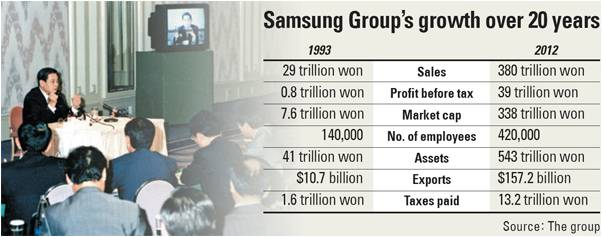
Samsung commemorates 20th anniversary of the Frankfurt Declaration, in which Lee’s call for a crisis-conscious business management philosophy, named New Management, began the strenuous and extraordinary transformation of a B2B parts manufacturer into a trendsetting global leader

Samsung lauds 2 decades of crises

Chairman Lee’s New Management born at emergency meeting

BY MOON GWANG-LIP [joe@joongang.co.kr]

Oct 29,2013

Samsung couple Samsung 20 years

Arguably the biggest success of Samsung Group is not semiconductors or displays or even the smartphones that have put the brand among the most famous and appreciated in the world. Those products, analysts say, are merely the fruit of the group’s biggest achievement: a continuing sense of crisis that many industrialists in history have tried to inculcate in their companies. Few have done it so well as Samsung’s Lee Kun-hee.  Read more of this post

Communication is key in penny stock regulation in Singapore; the lifting of the “designated” status of the three scandal-hit securities – a seemingly “all-clear” signal – conflicted with the revelation a few days later that SGX and the MAS were reviewing the saga

PUBLISHED OCTOBER 29, 2013

EDITORIAL

Communication is key in penny regulation

SOMETIMES, the free market fails to reflect the actual value of securities traded on it by a wide margin. Investment guru Benjamin Graham used the allegory of a manic-depressive “Mr Market”, divorced from reality, whose mood swings influence the prices he is willing to buy and sell at. Yale University professor Robert Shiller, one of this year’s winners of the Nobel Prize in economics, warned in his 2000 book Irrational Exuberance that bubbles in real estate and the stock market can build up as people imitate one another’s buying decisions. Prof Shiller said policy interventions to protect societal interests are justified in the event of a market bubble. Read more of this post

Muddy Waters: NQ’s Top Ten Lies Since Friday

Muddy Waters, LLC

October 29, 2013

Reiterating price target <$1

NQ’s Top Ten Lies Since Friday

Muddy Waters noted numerous lies and deceptions in NQ’s responses to our October 24, 2013 report. This report lists the ten most egregious falsehoods we noted from the October 25th conference call, and Co-CEO Omar Khan’s television interviews that same day with Fox Business News and Bloomberg. Read more of this post

Two of Australia’s best-known investors will go head to head after Mark Carnegie launched a $1 billion proposal to break up one of the last remaining cross-shareholding arrangements on the ASX between Brickworks and Pattinson

James Thomson Editor

BRW Rich List veteran Robert Millner facing attack on Brickworks-Soul Patts tie-up

Published 24 October 2013 08:46, Updated 25 October 2013 07:04

e1e47c02-3c2b-11e3-b283-dd988051129c_A66C3431-483--646x363

Robert Millner is unlikely to give in to pressure from Mark Carnegie and Matt Williams to break up the cross shareholding between Soul Patts and Brickworks. Photo: Rob Homer

Two of Australia’s best-known investors will go head to head in the coming months after Mark Carnegie launched a $1 billion proposal to break up one of the last remaining cross-shareholding arrangements on the ASX between Washington H Soul Pattinson and Brickworks. The proposal will see Carnegie and his brother in arms in this fight, Perpetual fund manager Matt Williams, take on a man who is investment royalty in Australia, Robert Millner. Read more of this post

Treasury Wine faces class action over US disclosure

Treasury Wine faces class action over US disclosure

October 28, 2013 – 11:48AM

Eli Greenblat

Wine glut … Treasury Wine Estates booked $35 million to destroy stocks. Photo: Ron Chapple

Litigation funder IMF is calling for aggrieved shareholders to sign up for a possible court action against Treasury Wine Estates, the owner of a portfolio of leading and iconic wine brands such as Penfolds, Wolf Blass and Lindemans, claiming ‘‘deceptive and misleading conduct’’ over disclosures around its troubled US business. Treasury Wine Estates, the world’s largest pure-play winemaker, shocked markets and investors in July when it admitted an oversupply of poor and unwanted wine in the US would trigger a $160 million write-down and include a $35 million charge to destroy past-its-date wine stocks. Read more of this post

Samsung chairman owns most lavish home among tycoons

2013-10-28 10:38

Samsung chairman owns most lavish home among tycoons

Lee Kun-hee, chairman of the world’s top maker of smartphones Samsung Electronics Co., owns the most expensive houses out of the country’s top 30 business leaders, data showed Monday. The combined declared value of houses held by the 30 business tycoons reached 157.7 billion won (US$148.4 million) at end-June, up 9.6 percent from a year earlier, according to the data by market researcher Chaebul.com. Read more of this post

‘Focus on core business and compete globally’

2013-10-27 14:10

‘Focus on core business and compete globally’

IE Business School professor warns chaebol of risks in diversification
By Choo Sung-ho

The country’s three recently-failed conglomerates — Woongjin, STX and Tongyang — appear to have collapsed under mainly snowballing debt. But at the root of their demise are a series of bad managerial decisions by group chairmen. Rather than focus on core businesses, they expanded into other areas, largely construction, shipbuilding and other old industries. To finance their “reckless” expansion, they borrowed the excessive amounts of money from financial institutions and issued corporate bonds. But their businesses suffered greatly amid the prolonged global economic downturn and became unable to service debts. Read more of this post

Singapore’s penny stock mystery increases pressure on exchange

Singapore’s penny stock mystery increases pressure on exchange

5:05pm EDT

By Rachel Armstrong and Anshuman Daga

SINGAPORE (Reuters) – Singapore Exchange Ltd (SGXL.SI: QuoteProfileResearchStock Buzz)’s role as the city-state’s equity market regulator is coming under increasing scrutiny in the fall-out from a penny stock crash earlier this month. The sudden implosion of Blumont Group Ltd (BLUM.SI: QuoteProfileResearchStock Buzz), LionGold Corp (LION.SI: QuoteProfileResearchStock Buzz), and Asiasons Capital Ltd (ASNS.SI: QuoteProfile,ResearchStock Buzz) – after huge run-ups in their share price earlier in the year had turned them briefly into billion dollar companies – left many in the market mystified and raised question marks over whether the exchange missed red flags and was too slow to act. Read more of this post

Mohnish Pabrai Columbia Business School Presentation Oct 27, 2013 (3 minute video)

The former chief executive of crisis company Boart Longyear has spoken for the first time since his sacking, and expressed his sadness at the mining services company’s recent struggles.

Boart’s demise ‘hard to watch’, says former CEO

October 28, 2013

Peter Ker

The former chief executive of crisis company Boart Longyear has spoken for the first time since his sacking, and expressed his sadness at the mining services company’s recent struggles. Craig Kipp, who led Boart to both record revenues and profits in June 2012 before being sacked three months later, said Boart remained a ”great business” that had been hit by two monumental downturns over the past five years. ”It has been hard to watch, I am trying to help as many former employees as I can. I am pulling for them and for Boart,” he said. ”The impact on the investors, employees and suppliers has been devastating.” Read more of this post

Malaysia’s LTKM’s missing chairman scandal: Bank Negara took out newspaper ads to ask for information on LTKM chairman Ahmad Khairuddin Ilias or his whereabouts.

Updated: Saturday October 26, 2013 MYT 8:23:17 AM

Missing person, missing governance?

BY ERROL OH

LTKM must promptly update stakeholders on status of chairman sought by authorities

IF you’ve watched enough crime shows, you should be familiar with scenes in which anxious relatives or friends are told that they can’t report a person as missing as long as it has not been 24 hours since he was last contacted. There is, in fact, no such waiting period – presumably, delayed police action is a convenient plot device – but should there be one for chairmen of listed companies whom the authorities can’t locate? Shouldn’t the companies immediately say something when advertisements identify their chairmen as persons sought to assist in investigations? This isn’t a hypothetical situation. Poultry player LTKM Bhd is facing those exact circumstances. This week, Bank Negara took out newspaper ads to ask for information on LTKM chairman Ahmad Khairuddin Ilias or his whereabouts. The one in The Star appeared on Wednesday. The ads have his photograph, identity card number and last address. Read more of this post

Paul Zahra leaves David Jones at the crossroads

Paul Zahra leaves DJs at the crossroads

October 26, 2013

Eli Greenblat

ZAH_DJ_LW-20131025193802881550-620x349

Trying it on for size: Paul Zahra and Megan Gale. Photo: Getty Images

It was another red carpet party in Melbourne and newly appointed David Jones boss Paul Zahra had found himself perched on a stage, sandwiched between smouldering Amazonian model and store ambassador Megan Gale and the sometimes twitching, slightly manic musical savant David Helfgott. In the crowd was the kind of collection of odd celebrities, TV personalities and company directors that only a fashion event could bring under one roof: singer Kate Cebrano, game-show host Eddie McGuire and Nine boss Jeff Browne, horse-racing power family Gai and Robbie Waterhouse, TV morning show presenters Karl Stefanovic and Lisa Wilkinson, Australian Olympic Committee president John Coates and one or two fund managers bumping around gawking at the supermodels and wondering how much this was costing shareholders. Read more of this post

Malaysia’s Lion Corp headed by Parkson’s Tan Sri William Cheng now a Practice Note 17 company and auditors had emphasised on the company and its subsidiaries’ ability to continue as a going concern

Updated: Friday October 25, 2013 MYT 7:52:13 PM

Lion Corp now a Practice Note 17 company

KUALA LUMPUR: Lion Corporation Bhd has announced that it is a Practice Note 17 (PN17) company as it is an affected listed issuer. Lion Corp said on Friday its auditors had emphasised on the company and its subsidiaries’ ability to continue as a going concern in the audited consolidated financial statements for the financial year ended June 30, 2013. Its shareholders’ equity on a consolidated basis as at June 30, 2013 was less than 50% of the issued and paid-up capital. The company has 12 months to submit a regularisation plan to the Securities Commission if the plan will result in a significant change in the business direction or policy of the company. It also had to announce within three months on whether the regularisation plan would result in a significant change in its business direction or policy. If it fails to regularise its condition, it will announce the dates of the suspension and de-listing of its listed securities immediately upon notification of suspension and de-listing by Bursa Securities. Lion Corp said it was looking into formulating a plan to regularise its financial condition.


Finding out whether your broker has a conflict of interest can make the difference between a successful investment and a disastrous one

Oct 25, 2013

Pros and Conflicts: Whose Side Is Your Broker On?

JASON ZWEIG

Finding out whether your broker has a conflict of interest can make the difference between a successful investment and a disastrous one. A new report by securities regulators suggests how brokerage firms can mitigate their many conflicts. At the same time, the report’s findings could make one of the most important and difficult tasks for investors—knowing your broker—a little easier. Earlier this month, the Financial Industry Regulatory Authority, which oversees how brokers sell investments, released a 44-page study on conflicts of interest in the securities industry. Read more of this post

NQ Mobile hits back at Muddy Waters, releases account details

NQ Mobile hits back at Muddy Waters, releases account details

Fri, Oct 25 2013

By Paul Carsten and Soham Chatterjee

(Reuters) – NQ Mobile Inc, the Chinese mobile security software company labelled a “massive fraud” by Muddy Waters Research Group, hit back on Friday by releasing details of its bank accounts and threatening legal action. NQ described as “false and inaccurate” the allegations by Muddy Waters, owned by short-seller Carson Block, but said a special committee of independent directors would investigate. Read more of this post

Muddy Waters Breaks Cold Streak Going Back to China in NQ Short

Muddy Waters Breaks Cold Streak Going Back to China in NQ Short

Carson Block, the Muddy Waters LLC founder whose short sales outside of China have borne little fruit, reclaimed a measure of success this week targeting a company in the country where he started out. NQ Mobile Inc. (NQ), a Beijing-based mobile services provider that started the week with a market capitalization of more than $1 billion, lost half its value after Block said on Oct. 24 that it fabricated revenue and lied about its cash. The shares extended a two-day slump to 54 percent yesterday even as the company labeled the assertions false, inaccurate and malicious. Read more of this post

If Chinese companies cannot use the IPO proceeds to fund losses in the VIE, so how did the funds get into the VIE? Loan payable by the VIE to a related company is eliminated in consolidation. How was this loan legal?

Four new IPOs and forex problems

SFC proposes audit regulatory reforms

We have had several Chinese companies file for IPOs in the US recently.500.com is an online sports lottery company.58.com is China’s copy of Craigslist. Sungy Mobile is mobile internet, mostly games.Qunar Cayman Islands is similar to Kayak.

Auditors of these companies are:

500.com           EY
58.com             PwC
Sungy Mobile    KPMG
Qunar               EY

Deloitte won none of these engagements although it previously had the largest market share by number of companies. Some private equity people have told me that they have been avoiding Deloitte for fear that their SEC problems might get in the way of a timely offering. The problems that the Big Four are having with the SEC get extensive coverage in the risk factors, with three of them saying that if the SEC acts against the China Big Four, they willnot be able to file financial statements and may be delisted. I was pleased to see that KPMG signed Sungy’s report using its mainland affiliate, breaking from its former practice of signing these reports in Hong Kong. The mainland affiliate does the audits; it needs to sign the reports.  Read more of this post

Accounting World, Still Resisting Sunlight; The American accounting industry has fiercely battled any attempt by regulators to require partners to sign off publicly on audits

October 24, 2013

Accounting World, Still Resisting Sunlight

By FLOYD NORRIS

The accounting business has sometimes had an attitude of — how shall I put it? — contempt for those who would regulate it. The people who run the major firms know best, and regulators should yield to their superior judgment. Nowhere is that clearer than when regulators penalize partners of big firms. The Tammy Wynette song “Stand by Your Man” could be the industry’s anthem. In 2001, when the Securities and Exchange Commission settled charges against Arthur Andersen for its involvement in financial fraud at Waste Management, a partner named Robert G. Kutsenda was banned for a year. He was not the partner in charge of the Waste Management audit, but an e-mail showed he had approved accounting that the S.E.C. said was improper. Read more of this post

The oracles at CNBC: good stock advice doesn’t come from TV; Stock market superstars and pundit prognosticators may have loud and lucky forecasts, but they don’t have any crystal ball

The oracles at CNBC: good stock advice doesn’t come from TV

Stock market superstars and pundit prognosticators may have loud and lucky forecasts, but they don’t have any crystal ball

Suzanne McGee

theguardian.com, Thursday 24 October 2013 13.59 BST

CNBC’s Jim Cramer’s forecasts are only right 46.8% of the time, according to CXO. Photograph: Lisa Carpenter

Turn off the television. Put down the remote control. Back away from the streaming CNBC content. Turn off the noise. By noise, I don’t mean only the literal noise of market veterans talking across each other and interrupting as the debate of just how many billions of dollars the recent government shutdown will end up costing the American economy. That’s important, of course – but at this stage in the game, one person’s educated guess isn’t going to be much better than someone else’s. And while every winning streak that makes a money manager or investment strategist a superstar is some combination of skill and luck, it’s also just one lucky call away from turning into a losing streak. Read more of this post

China’s NQ Mobile Sinks as Muddy Waters Calls Company ‘Massive Fraud’

October 24, 2013

Muddy Waters Initiates Coverage on NQ Mobile Inc. (NYSE: NQ)

Muddy Waters rates NQ Mobile Inc. (NYSE: NQ) shares a Strong Sell. In this latest report Muddy Waters highlights:

  • NQ is a massive fraud. We believe it is a “Zero”. At least 72% of NQ’s purported 2012 China security revenue is fictitious. NQ’s largest customer by far is really NQ. Our research estimates that NQ’s real market share in China is only about 1.5%, versus the approximately 55% it reports. We estimate that its China paying user base is less than 250,000, versus the six million NQ claims.
  • NQ’s Antivirus 7.0 is unsafe for sale to consumers, and we consider it to be spyware that makes users’ phones vulnerable to cyber attack. NQ makes a weak attempt to protect users’ private data as it’s uploaded through the Chinese government’s firewall to NQ’s server. Phones are vulnerable to MITM attacks because NQ fails to adhere to basic security protocols. MW engaged top-flight security software engineers to analyze this product.
  • NQ’s purported international revenue of $36.5 million is likely less real than its PRC revenue. NQ claims to generate international revenue in obscure markets, and through mysterious counterparties that seem to seldom pay.
  • NQ’s future is as bleak as its past. The recent pivot to advertising and gaming is merely an attempt to change to a fraud that NQ hopes will be less obvious. NQ cannot monetize users that it does not have.
  • NQ’s acquisitions are highly likely to be corrupt.

NQ’s cash balances are highly likely to not be real. In NQ’s 2012 20-F, PwC classified all cash and term deposits as Level 2 assets (slightly hard to value), which is the first time we have seen this. NQ’s purported movements of cash from its IPO almost certainly did not occur due to PRC FX controls. We therefore believe the term deposits are likely forgeries.

NQ Mobile Sinks as Muddy Waters Calls Company ‘Fraud’

NQ Mobile Inc. (NQ), a Chinese mobile-security service provider, sank the most on record after Muddy Waters LLC called the company a “massive fraud.” NQ Mobile dropped as much as 63 percent to $8.46 in New York, the most since the company’s initial public offering in May 2011, before trading was suspended. Shares were up 279 percent this year as of yesterday. Read more of this post

Singapore Regulators Reviewing Small-Cap Crash; Tumble in Asiasons, Blumont, LionGold Wiped Out Billions in Market Value

Singapore Regulators Reviewing Small-Cap Crash

Tumble in Asiasons, Blumont, LionGold Wiped Out Billions in Market Value

CHUN HAN WONG

Oct. 24, 2013 12:38 p.m. ET

SINGAPORE—Singapore regulators are reviewing recent volatility in three small-capitalization stocks that saw sharp plunges this month wipe out billions of dollars in market value and months of big gains, the city-state’s central bank said Thursday. Asiasons Capital Ltd. 5ET.SG -10.87% , Blumont Group Ltd. A33.SG -7.50% and LionGoldCorp. A78.SG -11.86% have lost more than eight billion Singapore dollars (US$6.5 billion) in combined market value this month. Their prices tumbled on Oct. 4, sparking a broader selloff in small-cap stocks and prompting Singapore Exchange Ltd. S68.SG 0.00% to briefly suspend the stocks and to ban short selling and margin trading on them for two weeks. Read more of this post

Shares of Asustek hammered by scam probe; Asustek had applied environmental protection certification labels used on old models to new products, a way to win more than NT$10 billion-worth of contracts with the government

Shares of Asustek hammered by scam probe

CNA
October 24, 2013, 12:07 am TWN

TAIPEI — Shares of Asustek Computer Inc., one of Taiwan’s leading personal computer vendors, fell sharply Wednesday as the local media reported that prosecutors had launched an investigation into an alleged scam involving the company, dealers said. After the negative leads surfaced, the stock faced heavy downward pressure upon market opening and fell almost 5 percent to the day’s low of NT$213.50 (US$7.26) at one point before rebounding. Read more of this post

Seeking Moats in the Small-Cap Universe

Seeking Moats in the Small-Cap Universe

By Todd Wenning | 10-23-13 | 06:00 AM | Email Article

I’m excited to kick off a monthly series on small-cap stocks for Morningstar.com. The focus of the series will be identifying smaller firms that exhibit moatworthy characteristics and are run by skillful management teams. This is a promising combination for any company to have, but it’s particularly attractive for smaller companies with long growth runways, as they have the ability to compound shareholders’ capital at high rates of return over long periods of time.

Easier Said Than Done
Of course, it’s not a simple task to identify such companies at just the right time. Indeed, there are many “false positives” for enterprising small-cap investors to sort through during their research process. For an illustration of the concept, consider the following examples.

  • A company with significant short-term competitive advantages that may not be defensible in the medium to long term. As such, it may not possess an economic moat. Apparel retailers, for instance, are often found in this category–as fashion trends shift, some firms enjoy a temporary advantage only to lose it when the next trend emerges. A few names that come to mind here are New York & Company (NWY), Christopher & Banks (CBK), and Pacific Sunwear (PSUN).
  • A company that has an economic moat, but whose advantages are slowly being eaten away by able competitors, resulting in less attractive long-term returns on capital.
  • A company that has exhibited strong growth in recent years or has a valuable franchise, but may be nearing the end of its growth runway, with management struggling to extend it through new product launches. A classic example here is World Wrestling Entertainment (WWE). The company is the undisputed heavyweight in its niche, but scalability is limited, as there are only so many events and products the company can tie to its wrestling franchise. Back in 2000, you may recall, the company tried to launch the “XFL” as an alternative to the National Football League, but the project folded a year later. This speaks to the company’s struggles to find new growth runways outside of wrestling.
  • A company that has an attractive business model but is led by poor capital allocators who have consistently made value-destructive investments that limit the company’s long-term potential. Read more of this post

East Coast Q3 Letter: Our Seventy-Two Point Check List

East Coast Q3 Letter: Our Seventy-Two Point Check List

by ValueWalk StaffOctober 23, 2013

A great matter is architecture, nor can everyone undertake it. He must be of the greatest ability, the keenest enthusiasm, the highest learning, the widest experience, and, above all, serious, of sound judgment and counsel, who would presume to call himself an architect. The greatest glory in the art of building is to have a good sense of what is appropriate. For to build is a matter of necessity; to build conveniently is the product of both necessity and utility; but to build something praised by the magnificent, yet not rejected by the frugal, is the province only of an artist of experience, wisdom, and thorough deliberation. Moreover, to make something that appears to be convenient for use, and that can without doubt be afforded and built as projected, is the job not of the architect so much as the workman. But to preconceive and to determine in the mind and with judgment something that will be perfect and complete in its every part is the achievement of such a mind as we seek. Through his intellect he must invent, through experience recognize, through judgment select, through deliberation compose, and through skill effect whatever he undertakes. I maintain that each is based on prudence and mature reflection. …Yet he should not be inarticulate, nor insensitive to the sound of harmony; … that he does not obstruct the light; that he does not transgress the servitudes on rain dripping from the eaves, on watercourses, and on rights of way, except where there is provision; and that he has a sound knowledge of winds, their direction, and their names; still, I would not criticize him for being better educated. But he should forsake painting and mathematics no more than the poet should ignore tone and meter. Nor do I imagine a limited knowledge of them is enough. …

Do investment consultants pick future winners?

LARRY SWEDROE / 

MONEYWATCH/ October 21, 2013, 10:58 AM

Do investment consultants pick future winners?

(MoneyWatch) Many retirement plans, foundations, universities, endowments and other plan sponsors hire investment consultants. It’s estimated that as of June 2011, over $13 trillion of tax-exempt U.S. institutional assets were advised on by investment consultants. Previous studies have found that over 80 percent of U.S. public plan sponsors and half of corporate sponsors engage consultants. Read more of this post

Icahn Sells 2.99 Million Shares of Netflix After Surge

Icahn Sells 2.99 Million Shares of Netflix After Surge

Billionaire Carl Icahn said he sold 2.99 million shares of Netflix Inc. (NFLX), citing a 457 percent rise in the stock since his original investment in November 2012. The shares fell in extended trading. Following the sale, Icahn, 77, still holds 2.67 million shares, or a 4.5 percent stake in Los Gatos, California-based Netflix, according to a regulatory filing today. The investor said his cost for the stock was $58 a share, suggesting a gain of almost $800 million from the sales. Read more of this post

MCX Panel to Run Top India Commodity Bourse as Probe Widens; “Jignesh Shah is just buying time. There is a strong possibility that MCX may change hands and the current promoters may lose control.”

MCX Panel to Run Top India Commodity Bourse as Probe Widens

The Multi Commodity Exchange of India Ltd. formed a panel to run the nation’s biggest platform for commodities as authorities widened a probe into trading practices at a related spot bourse. Pravir Vohra and G. Ananth Raman have been appointed as independent directors to the board, Multi Commodity, also known as MCX, said in an exchange filing today. Parveen Kumar Singhal, a deputy managing director, will act as the chief executive until a managing director is named, it said. Read more of this post

Guangzhou newspaper demands release of Zoomlion whistleblower journalist who wrote articles questioning the accounting of the Chinese construction machinery company

Xin Kuai Bao demands release of Zoomlion whistleblower Chen Yongzhou

Staff Reporter 2013-10-23

20131023000151

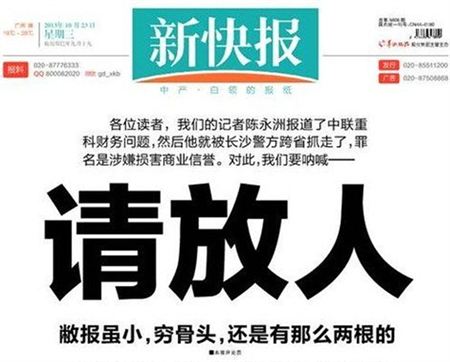
“Please release him”: the front page of the Xin Kuai Bao on Wednesday. (Internet photo)

The Guangzhou-based Xin Kuai Bao newspaper has taken a courageous stance by calling on public security authorities to release one of its journalists after he was arrested for writing articles questioning the finances of Chinese construction machinery company Zoomlion. Chen Yongzhou was arrested on Oct. 19 by public security officials from Changsha, the Hunan provincial capital where Zoomlion is based. Chen had written 15 articles about Zoomlion for Xin Kuai Bao, including 10 between September last year and June. A story published on May 27 this year accused Zoomlion of improper accounting methods, forcing the company to halt trading of its shares in Hong Kong and Shenzhen despite slamming the allegations as “distorted” and “misleading.” A Zoomlion spokesperson confirmed that the construction and sanitation equipment manufacturer filed a complaint against Chen with local police last week. On Oct. 23, Xin Kuai Bao’s front page featured an article defending Chen and with the headline “Please release him” in giant characters. In the article, the paper said that it had carefully combed through the facts in each of Chen’s 15 articles on Zoomlion and only discovered one minor factual error. The paper also cited other media chiefs in support of Chen, some of whom pointed out that if Zoomlion has a problem with Chen’s articles the company should have filed a civil suit against the paper rather than calling for public security officials to arrest the journalist. Chen’s wife told reporters that her husband received a phone call from police on the morning of Oct. 17, saying they wanted him to clarify some matters. He went to the local police station the next morning accompanied by his wife and was confronted by officers from Changsha, who produced a piece of paper outlining the crimes he was accused of before quickly taking him away. She said she received a call from him 36 hours later telling her that he had been arrested for damaging Zoomlion’s commercial reputation and asking for her to retain a lawyer. She said she has not seen him since.