Aung San Syy Kyi: ‘Myanmar should not seek to recreate S’pore’s policies’; “That made me think … what is the purpose of a workforce … of work … of material wealth? Is that the ultimate aim of human beings, is that what we all want?”

‘Myanmar should not seek to recreate S’pore’s policies’

SINGAPORE — While she welcomed cooperation between the two countries, Myanmar opposition leader Aung San Suu Kyi yesterday said her country should not seek to recreate Singapore’s policies and institutions.

BY WOO SIAN BOON –

5 HOURS 51 MIN AGO

SINGAPORE — While she welcomed cooperation between the two countries, Myanmar opposition leader Aung San Suu Kyi yesterday said her country should not seek to recreate Singapore’s policies and institutions. As she wrapped up her four-day bilateral visit here, Ms Suu Kyi had spent the day visiting the Institute of Technical Education (ITE) College East and the Corrupt Practices Investigation Bureau, while also calling on Singapore’s leaders at the Istana. Speaking to reporters at a press conference later in the evening, Ms Suu Kyi recounted her visit to ITE College East, where she made a remark to Singapore officials that “education in Singapore, as in many other countries, seems to be workforce oriented”. “That made me think … what is the purpose of a workforce … of work … of material wealth? Is that the ultimate aim of human beings, is that what we all want? In a sense, I want to probe more into successes of Singapore and to find out what we can achieve beyond that.” Read more of this post

Celebrating a Century of Indian Cinema

Celebrating a Century of Indian Cinema

By Gurjit Singh on 10:22 pm September 23, 2013.
This year marks the centenary of Indian cinema. It was in May 1913 that the first full-length feature film “Raja Harishchandra” was screened in Mumbai. That film brought traditional Indian legends to the silver screen and changed the nature of entertainment in India. The cinema movement in the country thereafter moved very quickly from Mumbai, to Chennai, to Hyderabad and to Bengal where the cinema industry and theater developed quickly. The low price of tickets brought a new awareness to the people of India and community viewing of cinema became an integral part of Indian social activity. Read more of this post

How Your Brand Can Beat Goliath

How Your Brand Can Beat Goliath

by Ron Faris  |   8:00 AM September 23, 2013

There was once a running joke at Virgin Mobile when it came to our marketing spend: What Virgin Mobile would spend in one year, AT&T would spend on one episode of “American Idol.” Many disruptive brands struggle with how to best manage their marketing budgets while they strategize around how to dethrone their incumbent Goliaths. Smaller companies, of course, don’t have the advertising spends to compete with their competitors on traditional vehicles, and they’re far more susceptible to shifts in the competitive landscape. A simple budget cut can render them “dark” during peak months on TV, causing their consideration levels — a key metric for brand directors trying to compete — to dwindle.  Marketing execs then end up “re-launching” their own brands to new audiences on a loop in a struggle to make up for lost time. This is exhausting and, more importantly, it isn’t working. If ever a David were to save his strength to fight Goliath, the first step would be to eliminate needless spending on changing campaigns for re-brands, and focus more time on changing the conversation. Literally. Social conversation is the only way small brands can get an edge on the big guys. Read more of this post

Why you should spend your mornings in a cave: People are most creative when they work without distraction. But what does that mean for the team? Welcome to the cave-dwelling future of collaboration

WHY YOU SHOULD SPEND YOUR MORNINGS IN A CAVE

PEOPLE ARE MOST CREATIVE WHEN THEY WORK WITHOUT DISTRACTION. BUT WHAT DOES THAT MEAN FOR THE TEAM? WELCOME TO THE CAVE-DWELLING FUTURE OF COLLABORATION.

BY: DRAKE BAER

If you want to be your most creative self, research suggests that you should start your day in a cave–and find a way to make it an expected thing with your team. Why? Because as Kellogg School of Management professor Leigh Thompson tells Fast Company, people have work styles that range from an independent to an interdependent orientation, sort of like how people are introverts or extroverts, with ambiverts in the middle. The independent worker will kindly ask that you leave her alone while she gets her work done–while the interdependent worker can’t function without being around others. Read more of this post

“We can now produce more than half a million dumplings a day with our fully automated factory”; Who would think that the founder of Master Siomai was mixing their signature siomai recipe by hand just a few years ago

From ‘mano-mano’ to ‘matic: Shifting to success with Meralco

(philstar.com) | Updated September 23, 2013 – 10:46am

a39p

Master Siomai founder and SME Luminary Ernilito Chan

We can now produce more than half a million dumplings a day with our fully automated factory,” Ernilito Chan, president of MC Master Siomai Hut, Inc. proudly says. Who would think that the founder of Master Siomai, the country’s well-loved dumpling brand, was mixing their signature siomai recipe by hand just a few years ago? Today, Master Siomai is not just one of Malabon’s most successful home grown businesses in the small to medium enterprises (SMEs) category, it was also recently lauded as the most outstanding SME in the 2013 Meralco Luminaries — a customer appreciation program which recognizes top customers from the private and public sectors that share the utility’s vision of a brighter Philippines. Read more of this post

Why $100,000 Salary May Yield Retirement Flipping Burgers

Why $100,000 Salary May Yield Retirement Flipping Burgers

It seems like another life. At the height of his corporate career, Tom Palome was pulling in a salary in the low six-figures and flying first class on business trips to Europe. Today, the 77-year-old former vice president of marketing for Oral-B juggles two part-time jobs: one as a $10-an-hour food demonstrator at Sam’s Club, the other flipping burgers and serving drinks at a golf club grill for slightly more than minimum wage. While Palome worked hard his entire career, paid off his mortgage and put his kids through college, like most Americans he didn’t save enough for retirement. Even many affluent baby boomers who are approaching the end of their careers haven’t come close to saving the 10 to 20 times their annual working income that investment experts say they’ll need to maintain their standard of living in old age. For middle class households, with incomes ranging from the mid five to low six figures, it’s especially grim. When the 2008 financial crisis hit, what little Palome had saved — $90,000 — took a beating and he suddenly found himself in need of cash to maintain his lifestyle. With years if not decades of life ahead of him, Palome took the jobs he could find. The youthful and perennially optimistic grandfather considers himself lucky. He’s blessed with good health, he said. He’s able to work, live independently and maintain his dignity, even if he has to mop the floors at the club grill before going home at 8 p.m. and finally getting off his feet. “That’s part of the job,” he said. “You have to respect the job you’re doing and not be negative — or don’t do it.” Read more of this post

Humble Chinese Village Basks in Legacy of Three Kingdoms Era; “The Three Kingdoms” is to China what “The Iliad” is to the West. But unlike “The Iliad,” “The Three Kingdoms” has wide appeal in modern times. Mao Zedong supposedly studied it for strategy lessons

September 22, 2013

Humble Chinese Village Basks in Legacy of Three Kingdoms Era

By EDWARD WONG

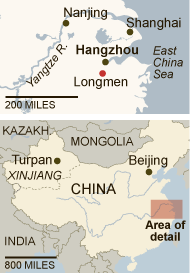
23longmen-map-articleInline

LONGMEN, China — In the shadow of a lush mountain and near a slow-moving river in southeast China sits this village, whose name means Dragon Gate. There are narrow alleys and whitewashed homes and the flesh of sliced bamboo drying on the ground. Its humble appearance, though, belies the fact that it played a role in the famous Three Kingdoms era, when kings leading rival states fought in the third century over the right to succeed the Han empire. The blood-drenched stories were immortalized in a 14th-century classic by Luo Guanzhong, “The Romance of the Three Kingdoms,” which in turn has spawned countless films, television shows and other adaptations. “This village is so important because the people are descended from Sun Quan,” said one resident, Sun Yaxiao, 25, as she walked with visitors one afternoon through the alleys. Sun Quan was one of the three major kings in the early period of the Three Kingdoms, a figure known to most Chinese. Read more of this post

Only Known Iraq Billionaire Hires Women Defying Hussein

Only Known Iraq Billionaire Hires Women Defying Hussein

Faruk Mustafa Rasool first saw a mobile phone in 1998 while he was lying in a London hospital bed recovering from quadruple heart bypass surgery. Ignoring his doctors’ advice to rest, he started figuring out how to bring the device to his native Iraq. Faruk was soon smuggling phones and transmitters over the Turkish border into his hometown of Sulaymaniyah, in Iraq’s semi-autonomous Kurdish region, according to his friend Shwan Taha. He built one of the country’s first wireless networks, something that once could have gotten him thrown in prison. Saddam Hussein banned mobile phones to isolate and better control the citizens of his totalitarian state. Read more of this post

Keeping the family fortune relatively intact; Third and fourth generations are revitalising companies

Last updated: September 22, 2013 3:32 pm

Keeping the family fortune relatively intact

By Jeremy Grant

Family-controlled companies loom large in Asia, many tracing their origins to the 19th-century migration of mercantilist entrepreneurs from China. They account for about half of all publicly listed companies and 32 per cent of total market capitalisation across 10 Asian countries, according to Credit Suisse. Some have come under the spotlight in recent years as they have grappled with awkward and sometimes bruising succession issues. The very public family squabble in 2011 over the assets of Stanley Ho, the 91 year-old Hong Kong-based casino billionaire, was a vivid example. But for each tale of family dysfunction there are others of transition under way to a professionalised younger generation, which is helping run businesses that are among the most profitable in the region. In many cases those younger family members – the third and fourth generation from the founding patriarch – have been educated abroad, at top business schools in the US and Europe. Many also have gained work experience elsewhere before joining the family business. Read more of this post

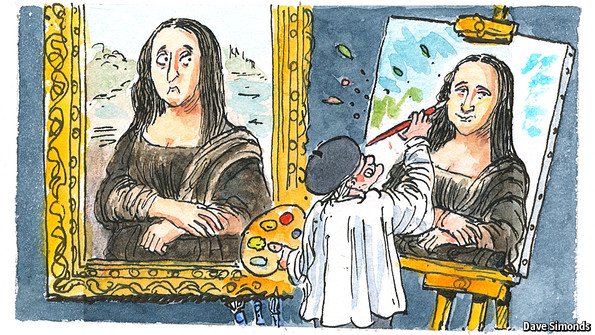
In praise of art forgery: Fakes say some interesting things about the economics of art

In praise of art forgery: Fakes say some interesting things about the economics of art

Sep 21st 2013 |From the print edition

20130921_LDD001_0

WHAT makes an artist great? Brilliant composition, no doubt. Superb draughtsmanship, certainly. Originality of subject or of concept, sometimes. But surely true greatness means that the creator of a painting has brought a certain je ne sais quoi to the work as well. There is, however, a type of person who seems to sait perfectly well what that quoi is, and can turn it out on demand. In 1945, for example, a Dutchman named Han van Meegeren faced execution for selling a national art treasure, in the form of a painting by Vermeer, to Hermann Göring, Hitler’s deputy. His defence was that it was a forgery he had painted himself. When asked to prove it by copying a Vermeer he scorned the offer. Instead he turned out a completely new painting, “Jesus Among the Doctors”, in the style of the master, before the eyes of his incredulous inquisitors. Read more of this post

Moncler, the purveyor of €1,000 down jackets, to list after sales climbed from less than €50m in 2003 to €489m in 2012; “China is very dangerous. I don’t trust that it will be like this for the next 20 years . . . there will be a crash.”

September 23, 2013 11:46 am

Moncler in second attempt to wrap up IPO

By Rachel Sanderson in Milan

Moncler Grenoble Fall 2013 Presentation

My dream is that you collect three, four, five of my jackets in your wardrobe and you choose one for different days, but they last for life – Remo Ruffini, chairman and creative director, Moncler

Moncler, the purveyor of €1,000 down jackets, has a stock market listing in its sights. Remo Ruffini, chairman and creative director of Moncler, said in an interview with the Financial Times that he and the brand’s private equity backers were looking at a winter listing of the Franco-Italian brand in Milan. A successful listing would be second time lucky for Moncler. Private equity group Carlyle pulled a stock market listing in Milan in June 2011. Jittery about volatile markets, Carlyle instead sold 45 per cent of Moncler to French private equity group Eurazeo for €418m. Read more of this post

Druckemiller: “My first mentor and boss used to tell me it takes hundreds of millions of dollars to manipulate a stock up, but the minute this phony buying stop, it can go down on no volume and it can just reprice immediatedly”

Three Investing Billionaires Have Recently Come Out With Cautious Statements On The Stock Market

JOE WEISENTHAL SEP. 22, 2013, 8:59 PM 9,196 10

Here’s an interesting observation from Mike O’Rourke of JonesTrading. In unusual timing, we’ve recently heard from three investing billionaires (Warren Buffett, Carl Icahn, and Stanley Druckenmiller) suggesting that the stock market is getting rich and fully valued. From O’Rourke:

[Buffett]  noted that the equity market was fairly valued and stocks were not overvalued.  Specifically, Buffett said “They were very cheap five years ago, ridiculously cheap,” and “That’s been corrected.”  He also noted, “We’re having a hard time finding things to buy.” One has to take note when the world’s most high profile investor (a long investor), cannot find stocks to buy although he reports his business is improving.  Buffett was not the only Billionaire to weigh in last week.  Carl Icahn responded candidly when asked his view on the market.  “Right now, the market is giving you a false picture.

The market tells you that you are doing well, but I don’t think a lot of companies are doing that well.  They are taking advantage of very low interest rates.  So, obviously, you don’t have to be a financial genius to understand if I can borrow at 3% or 4% and buy assets maybe my own stock that is yielding 9%, 10% or 11%, I am going to make a lot of money. In one sense or another that is what is going on….I do think at 17x that you have to be pretty well hedged.”  These comments come a little more than a week after Stanley Druckenmiller opined that, “But if you tell me QE is going to be removed over nine or 12 months, that’s a big deal because when it’s my belief that QE has subsidized all asset prices.  And you remove that subsidization, the market will go down.

Druckemiller elaborated “My first mentor and boss, Dr. Ellis in Pittsburgh, used to tell me it takes hundreds of millions of dollars to manipulate a stock up, but the minute you have this phony buying stop, it can go down on no volume and it can just reprice immediately. I personally think as long as this game goes on, assets will stay elevated. But when you remove that prop – and let’s face it, the Fed has said they’re targeting those asset prices – those prices can adjust immediately.”

Doug Millett, Former Partner of Kynikos Who Helped Expose Enron and Many Other Frauds, Passes Away

Doug Millett Former Partner of Kynikos Who Helped Expose Enron Dies

by Guest PostSeptember 22, 2013

By Long Short Trader

DougMillett

“In several phone calls Jim Chanos and his chief operating officer Doug Millett, pitched her (Bethany McLean) the Enron story. The company, they said, was nothing more than a hedge fund sitting on top of a pipeline. But despite having the risks of a high-stakes trader, it had the returns on investment of a car company.” – Conspiracy of Fools, a True Story

” ‘I had been in touch with Doug Millett, who worked for James Chanos.’ She (Bethany McLean) reported that Millett suggested she look at Enron’s financial figures.” – The Inside Stories of Modern Political Scandals

“in the memorable words of Doug Millett, Kynikos’ chief operating officer–it simply didn’t make very much money.” – Why Enron Went Bust Start with arrogance. Add greed, deceit, and financial chicanery. What do you get? A company that wasn’t what it was cracked up to be. http://money.cnn.com/magazines/fortune/fortune_archive/2001/12/24/315319/index.htm

I’m told by a gentleman familiar with Doug Millett, that Millett also helped uncover many other frauds, fads and failures, especially of the dot com variety.

Rest in peace. Read more of this post

The Science and Philosophy of Friendship: Lessons from Aristotle on the Art of Connecting; “Friends hold a mirror up to each other; through that mirror they can see each other in ways that would not otherwise be accessible to them, and it is this mirroring that helps them improve themselves as persons.”

The Science and Philosophy of Friendship: Lessons from Aristotle on the Art of Connecting

“Friends hold a mirror up to each other; through that mirror they can see each other in ways that would not otherwise be accessible to them, and it is this mirroring that helps them improve themselves as persons.”

“A principal fruit of friendship,” Francis Bacon wrote in his timeless meditation on the subject, “is the ease and discharge of the fulness and swellings of the heart, which passions of all kinds do cause and induce.” For Thoreau, friendship was one of life’s great rewards. But in today’s cultural landscape of muddled relationships scattered across various platforms for connecting, amidst constant debates about whether our Facebook “friendships” are making us more or less happy, it pays to consider what friendship actually is. That’s precisely what CUNY philosophy professor Massimo Pigliucci explores in Answers for Aristotle: How Science and Philosophy Can Lead Us to A More Meaningful Life (public library), which also gave us this provocative read on the science of what we call “intuition.” Read more of this post

Hong Kong Braces For Worst Storm In 34 Years As Typhoon Usagi Approaches, “Astronomical” Storm Surge Forecast

T8 signal raised in Hong Kong as Typhoon Usagi closes in

Hong Kong Observatory has issued No 8 storm signal for Typhoon Usagi

Sunday, 22 September, 2013 [UPDATED: 6:52PM]

Tanna Chong, Ada Lee and Joanna Chiu

eb54e579c687a9f873e248852252f0fb_0

The Hong Kong Observatory issued the T8 Tropical Cyclone Warning Signal at 6.40pm today. The government advises members of the public with long or difficult journeys home or having to return to outlying islands to begin their journey now. “The water level may rise and cause flooding in the evening,” said Sandy Song Man-kuen, the observatory’s senior scientific officer. The Macau Observatory said the No 8 northwest storm signal would be hoisted before 7pm. The Hong Kong Obsevatory said that Usagi would make landfall to the east of Hong Kong and will skirt the territory at around 100km or less to the north later tonight and early tomorrow morning.  Read more of this post

15 Things Inspiring Leaders Do Differently

15 Things Inspiring Leaders Do Differently

LEE COLANINC. 14 MINUTES AGO 19

Over the past fourteen years, I have worked, coached, trained and studied well over 20,000 leaders. In that time, there are some common practices that I’ve observed from inspiring leaders at any level in any size of organization. Think of this as a to-do list if you aspire to inspire.

Inspiring leaders…

Install a rigorous selection process to ensure they hire only the best and brightest.

Set a clear and compelling vision.

Collaborate with their team to define a plan for realizing that vision.

Keep the plan visible.

Keep score along the way to keep the team energized and accountable.

Look for people doing something right and recognize it.

Eliminate barriers to getting work done.

Address even minor performance issues with proactive coaching.

Listen more than they talk.

Uncompromisingly uphold the team’s values by using them to make big and little decisions.

Give credit for and reward successes.

Get to know the person behind the employee.

Care about their people as much as their people’s performance.

Focus on the organization’s purpose as much as (if not more) than profits.

Consistently and frequently communicate even when they is apparently no news. Read more of this post

The economics of equity research: The old model of stockmarket research is changing

The economics of equity research: The old model of stockmarket research is changing

Sep 21st 2013 |From the print edition

EQUITY research is meant to benefit both providers and recipients. It ought to help investors to allocate money more profitably. And the banks that give their clients free access to research hope that it will help them generate revenues from equity trading. But neither party is much satisfied by the conventional model. Start with the banks. A fall in trading revenues makes the economics of providing research less attractive. Between 2009 and 2013, total equity-trading commissions paid to brokers fell from $13.9 billion to $9.3 billion in America, and from €4.2 billion ($5.6 billion) to €3 billion in Europe, according to Greenwich Associates, a consultancy. The rise of passive investing and the spread of algorithmic trading have both reduced margins and dampened demand for research produced by and for humans. Read more of this post

‘Fee-Only’ Financial Advisers Who Don’t Charge Fees Alone

Sep 20, 2013

THE INTELLIGENT INVESTOR

‘Fee-Only’ Financial Advisers Who Don’t Charge Fees Alone

JASON ZWEIG

BF-AF823A_INVES_G_20130920161621

You might think a “fee only” financial adviser will never charge you commissions or other sales charges that could induce him to favor selling you something that is better for him than for you. Think again. Consider the coveted “certified financial planner” designation, which requires an adviser to complete a thorough course of study and pass a rigorous exam. Investors can search for one on LetsMakeAPlan.org, a website run by the CFP Board, which administers the program. Over the past week, my colleague Rob Barry analyzed the descriptions of 33,949 certified financial planners who were then listed in CFP.net’s public-search area. He found that 8,122, or 24%, described their compensation method as “fee only.” A mere 3% called themselves “commission only,” while 59% said they earn “commission and fee”; 14% didn’t specify how they are paid. Read more of this post

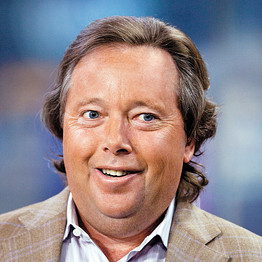
IMAX CEO Richard Gelfond’s Empire

September 20, 2013, 10:59 a.m. ET

EMPIRE BUILDER

IMAX CEO Richard Gelfond’s Empire

His past might not sound like the making of a movie-industry giant, but Richard Gelfond is now the CEO of IMAX, a $1.7 billion empire with a presence in more than 700 theaters

RACHEL LOUISE ENSIGN

OB-YT078_money0_DV_20130901120708

Shoeshine boy. A young sports-paper boss. And a 99-cent dry-cleaner owner. His past might not sound like the making of a movie-industry giant, but Richard Gelfond is now the CEO of IMAX, a $1.7 billion empire with a presence in more than 700 theaters—and part of the movie-going experience for millions of 3D-glasses-wearing film buffs. Now 58 and close with marquee Hollywood figures like director Christopher Nolan, he tells us he made it big because he “was always obsessed by business.”

1. 1963: Launches a shoe-shining business at the age of 8 in a barbershop in his Long Island, N.Y., hometown, using his dad’s shoeshine kit.

2. 1971: Co-founds New York Ball, a newspaper focused on local sports, as a teen. Publication boasts a circulation of 25,000. Uses the experience to land a job at Newsday in college.

3. 1978: As a law student at Northwestern University, he gets an option on a million pounds of coal with a professor in a bid to make money on a local coal-worker strike crimping supply.

4. 1980s: Works at New York law firm Cleary Gottlieb Steen & Hamilton in mergers and acquisitions. Leaves to start a 99-cent dry-cleaning chain, which becomes “a logistical nightmare.”

5. 1988: Joins financial-services firm Drexel Burnham Lambert, where he meets future business partner Brad Wechsler.

6. 1993: Gelfond and Wechsler win a bid on IMAX with an offer of around $100 million. “Fortunately for me, I didn’t understand all of the obstacles,” says Gelfond.

7. 1998: Becomes chair of Stony Brook University’s philanthropic arm. Later donates $1 million so his alma mater can research mercury poisoning after being stricken by the illness himself.

8. 2000: IMAX struggles as many movie-theater chains file for bankruptcy. Its co-owners consider a sale but don’t pursue one. “We had to downsize IMAX dramatically to save it.”

9. 2002: Opens first IMAX venue in China. In a key move, IMAX films later transition from film to digital, reducing the cost of shipping a film from around $30,000 to $150 per theater.

10. 2012: Nolan’s Batman film, “The Dark Knight Rises,” is released with more than one hour of IMAX-shot footage, the most ever for a Hollywood feature. It rakes in about $110 million in IMAX theaters.

Sadness is an emotion we usually try to avoid. So why do we choose to listen to sad music? Aristotle famously suggested the idea of catharsis: that by overwhelming us with an undesirable emotion, music (or drama) somehow purges us of it

September 20, 2013

Why We Like Sad Music

By AI KAWAKAMI

SADNESS is an emotion we usually try to avoid. So why do we choose to listen to sad music? Musicologists and philosophers have wondered about this. Sad music can induce intense emotions, yet the type of sadness evoked by music also seems pleasing in its own way. Why? Aristotle famously suggested the idea of catharsis: that by overwhelming us with an undesirable emotion, music (or drama) somehow purges us of it. But what if, despite their apparent similarity, sadness in the realm of artistic appreciation is not the same thing as sadness in everyday life? Read more of this post

Recognize Intrapreneurs Before They Leave

Recognize Intrapreneurs Before They Leave

by Vijay Govindarajan and Jatin Desai  |   10:00 AM September 20, 2013

Any CEO can tell you that finding ideas is not the always the problem. The real issue is selecting and spreading the best ideas, testing quickly, and executing flawlessly. An “innovation engine” is an organization’s capability to think and invest in long-term opportunities along with the competence to drive continuous innovations for top-line growth each year. To build your innovation engine, your firm must excel at operationalizing ideas from your energized people who are willing to do everything they can to fight off internal resistance without creating chaos. This is your bench of corporate innovators: your intrapreneurs. You already have natural intrapreneurs in your company. Some you know about, but most are hiding. These individuals are not always your top talent or the obvious rebels or mavericks. But theyare unique and certainly the opposite of “organization men.” When you find them and support them correctly, and magic will occur. Read more of this post

Why Swedish People Are So Quiet

Why Swedish People Are So Quiet

LOLA AKINMADE AKERSTRÖMSLATE SEP. 20, 2013, 2:03 PM 5,287 5

Each Friday, Roads & Kingdoms and Slate publish a new dispatch from around the globe. For more foreign correspondence mixed with food, war, travel, and photography, visit their online magazine or follow @roadskingdoms on Twitter.

STOCKHOLM, Sweden—Eight of us—six Swedes, one Finn, and me, the Nigerian-American—are gathered in a modest city-center studio apartment in Stockholm’s eclectic Södermalm district. Next to our dinner table is a small window with a gorgeous view of Stockholm’s history-rich old town, Gamla stan, with its narrow red clay, melon, and burnt-sienna-colored structures. The location alone makes this modest studio as coveted as a New York penthouse with direct views of Central Park. Read more of this post

The Best, Brightest, and Least Productive? In the US, 7.4% of total compensation of employees in 2012 went to people working in the finance and insurance industries; the share is even higher among the most educated and accomplished people, whose activities may be economically useless, if not harmful

The Best, Brightest, and Least Productive?

In the US, 7.4% of total compensation of employees in 2012 went to people working in the finance and insurance industries. Whether or not that percentage is too high, the real issue is that the share is even higher among the most educated and accomplished people, whose activities may be economically useless, if not harmful.

Robert J. Shiller

20 September 2013

NEW HAVEN – Are too many of our most talented people choosing careers in finance – and, more specifically, in trading, speculating, and other allegedly “unproductive” activities? In the United States, 7.4% of total compensation of employees in 2012 went to people working in the finance and insurance industries. Whether or not that percentage is too high, the real issue is that the share is even higher among the most educated and accomplished people, whose activities may be economically and socially useless, if not harmful.

Read more of this post

A Former Goldman Banker Walks His 8-Year-Old Through Her Very First Investment — And It’s Intense

A Former Goldman Banker Walks His 8-Year-Old Through Her Very First Investment — And It’s Intense

MICHAELBANKERS ANONYMOUS SEP. 20, 2013, 4:23 PM 5,508 5

As a father of two daughters, I know I’ll never forget certain special times: their birth, Day 1 of Kindergarten, baby’s first piano recital, menacing the punk who is picking her up to go to the prom, and the police report I’ll file when she quits college to run off with the lead singer of that Norse Death Metal Band.[1] Moments you never forget, like a first stock market investment. As an ex-banker with a daughter, however, other unforgettable milestones also stand out.  Like, for example, when the eldest first beats me at Monopoly, when she makes her first stock market investment, and when she learns how to program Excel to calculate discounted cash-flows.[2] Dear readers, that stock market investment moment has arrived, so I thought I would bring you along with us on this beautiful father-daughter bonding journey. Grab your spreadsheets, and your handkerchiefs. Read more of this post

Creating content that gets everyone talking

Updated: Saturday September 21, 2013 MYT 7:43:54 AM

The viral factor

MALA’S FEED BY MALATI SINIAH

Creating content that gets everyone talking.

“WHAT does the Fox say?” Two minutes into the video and I still don’t know if I should turn it off or keep on watching the grown man in a bird costume going “Cheep Cheep”. Similar to perhaps 90% of today’s Internet users, my decision to click on a video or article link depends on the frequency it appears on my Facebook feed. I do question this decision-making process sometimes, like two weeks ago when the Internet exploded with the music video by two Norwegian brothers called Ylvis. The video showed adults dressed in animal costumes dancing in the forest churping, quacking and mewing. The main question in the video centred around the question “What sound does a fox make?” Read more of this post

A Nation Built for Immigrants: Will the recent surge of newcomers tear the U.S. apart? Not if history is any guide: From the beginning, America was made to unite citizens, even those with deep differences,

September 20, 2013, 7:51 p.m. ET

A Nation Built for Immigrants

Will the recent surge of newcomers tear the U.S. apart? Not if history is any guide: From the beginning, America was made to unite citizens, even those with deep differences.

MICHAEL BARONE

In a single generation, between 1980 and 2007, more than 10 million people migrated, legally or illegally, from Mexico to the U.S. Today there are more than 12 million Mexican-born people in the U.S. and millions of American children who are their offspring—amounting to almost 10% of the nation’s population. That is exponentially larger than in 1970, when there were less than one million Mexican-born people in the country, or 1980, when there were two million. The Mexican migration, and the similarly large migration of others from the rest of Latin America, has in just one generation reshaped the nation. Hispanics have replaced blacks as the largest officially recognized minority group. Read more of this post

Singapore elites: “..class of people who do not understand the problems faced by ordinary Singaporeans, and are only interested to pursue their ‘elite’ interests”

Updated: Saturday September 21, 2013 MYT 8:28:50 AM

Singapore relooks elitist policy

BY SEAH CHIANG NEE

Recent measures show that the government is not aiming to eliminate, only to remake, elitism, which exists everywhere.

AS Lee Kuan Yew celebrated his 90th birthday last week, one of his legacies – an elitist leadership – was given a few hard jolts. Whether the founding leader had intentionally devised it or simply encouraged it through his scholars-as-leaders policy or eugenics theory, a form of elitist environment has taken a grip on Singapore. It created a new breed of highly-paid civil servants, some of whom became dominating and arrogant, who helped to govern a questioning middle-class population – not the best of combinations. A number of them are accused of having lost touch with the common folk because of their high salaries and lavish living. As a result, the class rift has worsened, aggravated by a widening gap between the rich and poor. It has also reduced support for the People’s Action Party (PAP). Read more of this post

Once an $18,000 Home on a Decaying Street, Now a $5 Million Gem

September 16, 2013

Once an $18,000 Home on a Decaying Street, Now a $5 Million Gem

By ELIZABETH A. HARRIS

APPRAISAL1-sub-articleLarge

Jennifer Houlton-Vinyl outside the brownstone on West 94th Street that her parents bought in 1960, when the block was seedy.

“Who plants flowers on this crummy street?” protested Carlos, the hero of a young adult novel called “The Street of the Flower Boxes,” which told of the rejuvenation of a trash-strewed, gang-infested block in Manhattan of the 1960s: West 94th Street between Central Park West and Columbus Avenue. Carlos was fiction, but the events in the book were based on the real-life experience of its author, Peggy Mann Houlton, who bought a brownstone on that street in 1960 with her husband, William Houlton. The couple paid $18,000 for their home and then spent decades meticulously restoring and nurturing the brownstone and the neighborhood. Until one day the house began returning the favor. Read more of this post

The Journey of ‘Taper’ From Old English to the Fed; The economic buzzword of the day is derived from a word meaning wax candle

September 20, 2013, 8:46 p.m. ET

The Journey of ‘Taper’ From Old English to the Fed

The economic buzzword of the day is derived from a word meaning wax candle.

BEN ZIMMER

This week, the word on every financial commentator’s lips was “taper.” For the past year, the Federal Reserve has been buying billions of dollars of bonds each month in its “quantitative easing” program to lower long-term interest rates. Many predicted that the Fed would announce on Wednesday that it would begin “tapering,” or easing up on the bond-buying stimulus. So intense was the speculation over the past few months that many observers started calling the looming announcement “Septaper.” But on Wednesday, Septaper never came. Rather than “tapering,” Fed Chairman Ben Bernanke announced that the bond-buying would continue at its current pace. “Octaper,” anyone? Read more of this post

China’s Fallen Mighty: A Timeline of Toppled Communist Party Leaders, 1976-2013

China’s Fallen Mighty

A Timeline of Toppled Communist Party Leaders, 1976-2013

OUYANG BIN, ZHANG MENGQI, DAVID M. BARREDA, YOUYOU ZHOU

09.19.13

chart_yearschart_Hua_Guofengchart_Hu_Yaobangchart_Zhao_Ziyangchart_years2chart_Wang_Dongxingchart_Hu_Qilichart_years3chart_Wu_Dechart_Chen_Xilianchart_Ji_Dengkuichart_Chen_Yongguichart_Chen_Xitongchart_Chen_Liangyuchart_Bo_Xilaichart_Legend (1)

Political infighting and purges have been hallmarks of the Chinese Communist Party since its earliest days but came to a peak during Mao Zedong’s Cultural Revolution, damaging the country and paralyzing the Party itself. When Mao died in 1976, it was agreed by Party survivors that the constant and ruthless upheaval must end. But the struggles continued, albeit at a slower pace and in a less radical fashion. The timeline below gathers the details of the toppling of the Party’s highest-level leaders from the time of Mao’s death to the trial, in August 2013, of Bo Xilai—the fallen Chongqing Party Secretary whose sentencing for corruption, bribery, and abuse of power is expected to be delivered on September 22.

Read more of this post