‘Get the strategy and the team right’: An interview with the CEO of Henkel; Kasper Rorsted discusses the company’s growth plans, what it takes to hire good people, and how he fosters dialogue with customers and employees

‘Get the strategy and the team right’: An interview with the CEO of Henkel

Kasper Rorsted, head of the global manufacturer since 2008, discusses the company’s growth plans, what it takes to hire good people, and how he fosters dialogue with customers and employees.

February 2014 | byKlaus Behrenbeck

As consumer companies continue to expand their global presence, they face a host of formidable challenges: among them, staying close to the consumer, finding and attracting local talent, and managing an increasingly complex and far-flung organization. These challenges are familiar to Kasper Rorsted, who in April 2008 was named CEO of Henkel, the Düsseldorf-based manufacturer of home- and personal-care products and adhesive technologies. Henkel’s roster of brands includes Persil detergent, Dial soap, Fa deodorant, and Loctite glue. In recent years, the 137-year-old company has fared well—in large part by dramatically boosting its presence in emerging markets, which today account for 45 percent of its global revenues of €16.5 billion. Read more of this post

How to Compete Smarter

Published: February 14, 2014

How to Compete Smarter

Roger Martin, coauthor of Playing to Win: How Strategy Really Works, introduces a lesson on the proper foundation for core competencies from Compete Smarter, Not Harder: A Process for Developing the Right Priorities through Strategic Thinking, by William Putsis. Read more of this post

Harvard’s exit strategy

Harvard’s exit strategy

Feb 21st 2014, 9:58 by R.A. | LONDON

image001-7 image002-3 image007 image010 image012 image018 image020 image021 image023 image003 image004 image005 image006 image008 image009 image011 image013 image001-7 image002-3 image007 image012 image018 image020 image021 image023 image003 image004 image005 image006 image022 image024 image001-11

A RECENT Free exchange column looked at how online education might affect higher education. Elite institutions should be fine, we wrote, because they product they offer is completely different from the standardised, distance education that MOOCs offer. Unless, that is, they begin offering their own course material online at low prices, in the process breaking their business model. What is that model? Stanford economist Caroline Hoxby hasone answer: Read more of this post

The Simple Thing That Makes The Happiest People In The World So Happy

FEBRUARY 26, 2014 by ERIC BARKER

The Simple Thing That Makes The Happiest People In The World So Happy

image001-6

Research has found about 9 zillion things you can do to increase happiness.

Of course, you’re probably not doing any of them. To be fair, most people don’t really do much to deliberately make their lives happier. Read more of this post

The third-largest chocolate maker in the US, Russell Stover Candies, could net the controlling family more than $1 billion if they decide to sell the business

FAMILY BEHIND US CHOCOLATE GIANT CONSIDER SALE

ARTICLE | 25 FEBRUARY, 2014 09:45 AM | BY TESS DE LA MARE

The third-largest chocolate maker in the US, Russell Stover Candies, could net the controlling family more than $1 billion if they decide to sell the business.

The second-generation of the Ward family are mulling giving up the Missouri-based manufacturer of boxed chocolates, and have appointed investment bank Goldman Sachs to assess their options. Read more of this post

How Lego took to anthropology: ‘The Moment of Clarity, Using the human sciences to solve your toughest business problem

February 26, 2014 3:24 pm

How Lego took to anthropology

By Andrew Jack

‘The Moment of Clarity, Using the human sciences to solve your toughest business problems’, by Christian Madsbjerg and Mikkel Rasmussen,Harvard Business Review Press $28; £18.99

A decade ago, Lego’s plastic brick empire was starting to crumble. Half a century after patenting its click-fit system, the Danish toy company reported heavy losses and gave a sign of the depth of its troubles: the grandson of the founder relinquished his place as chief executive to a McKinsey consultant. Read more of this post

Alison Chung’s gift for numbers has helped her build a consulting firm that specializes in computer forensics

FEBRUARY 26, 2014, 7:00 AM  11 Comments

‘I Have Been Told That I’m Different’

By COLLEEN DEBAISE

Alison Chung of Chicago is not wired like most people. This can present challenges socially, but from a business perspective it’s her competitive advantage as the owner of a consulting firm that is essentially a digital detective agency. Read more of this post

Cash crises, political grudge matches, suicide. None of it stopped David Walentas from forging a 10-digit fortune by creating an entire neighbourhood in New York’s underdog borough. And he’s about to do it all again

Brooklyn’s Billionaire Is Betting On The Borough, Again

by Caleb Melby | Feb 27, 2014

Cash crises, political grudge matches, suicide. None of it stopped David Walentas from forging a 10-digit fortune by creating an entire neighbourhood in New York’s underdog borough. And he’s about to do it all again
image001-9

Read more of this post

“Any definition of a successful life must include service to others.” Finding One’s Way on the Entrepreneurial Path

Finding One’s Way on the Entrepreneurial Path

by Michael Freedman | Feb 24, 2014

What are the characteristics of an entrepreneur? What are the risks? H. Irving Grousbeck explains

For nearly 30 years at Stanford, and for several more at Harvard, H. Irving Grousbeck has taught and counseled countless women and men as they moved along the entrepreneurial path. After graduating from Harvard’s MBA program, he cofounded Continental Cablevision (later Media One) in 1964, and has since served on numerous for-profit and not-for-profit boards. He is currently a principal owner of the Boston Celtics. He was founding co-director (with Charles Holloway) of the Center for Entrepreneurial Studies in 1996, and recently stepped down from that position while continuing to teach. Last year, he discussed the traits of successful entrepreneurs, and how they might think about the many challenges that they and others put in front of them.  Read more of this post

How the Option to Do Nothing Can Help You Get Things Done; “To increase persistence, one should directly vet their chosen path against the no-choice option of doing nothing.”

How the Option to Do Nothing Can Help You Get Things Done

Feb 26, 2014

As makers of our own destiny, we like to think that our choices are endless. And if we stay on track, we believe we should accomplish our goals. However, the way we frame our choices can make a huge impact on how persistent we are on our chosen path. Read more of this post

Why Some Innovation Tournaments Succeed and Others Fail

Why Some Innovation Tournaments Succeed and Others Fail

Feb 20, 2014

A few years ago, Penn Medicine — the umbrella group that includes the University of Pennsylvania’s Perelman School of Medicine and the University’s Health System — set out to improve its patient satisfaction rates. Like many health care organizations, Penn Medicine’s senior managers and clinicians were typically in charge of thinking up new ideas. But for this particular challenge, a top-down approach wouldn’t work. The hospital needed fresh thinking from the front lines –including doctors, nurses, clerical staff and transporters, who had an intimate understanding of patients’ experiences. Read more of this post

Overworked nurses linked to higher death rates

Overworked nurses linked to higher death rates

POSTED: 26 Feb 2014 08:09
Investigations in nine European countries have given statistical backing to claims that patients’ lives may be at risk when nurses are overworked

PARIS: Investigations in nine European countries have given statistical backing to claims that patients’ lives may be at risk when nurses are overworked, specialists said on Wednesday. Read more of this post

NASA Scientists Discover 715 New Planets; Data From Kepler Space Telescope Suggests 4 Alien Worlds Have Potential for Life

NASA Scientists Discover 715 New Planets

Data From Kepler Space Telescope Suggests 4 Alien Worlds Have Potential for Life

LEE HOTZ

Feb. 26, 2014 3:57 p.m. ET

NASA’s Kepler mission scientists announces the discovery of 715 new planets around distant stars, including four alien worlds roughly the size of Earth that might be might be potentially suitable for life. Robert Lee Hotz reports on the News Hub. Photo: NASA. Read more of this post

How to thrive in restaurants for 30 years: Alla Wolf-Tasker’s Lake House toughed it out for three decades

How to thrive in restaurants for 30 years

February 26, 2014

Michael Bailey

Alla Wolf-Tasker’s Lake House toughed it out for three decades.

image001-4

Alla Wolf-Tasker spent four years building her restaurant, which celebrates its 30th anniversary this year.

Almost 1500 Victorian restaurants closed in 2012/13, reflecting a nationwide hospitality industry crisis which Alla Wolf-Tasker – celebrating the 30th anniversary of her Lake House fine dining restaurant at Daylesford – partly blames on barriers to entry having become too low. Read more of this post

Breaking through the start-up stall zone: An early rush of revenue growth is necessary-but not sufficient-for long-term survival

Breaking through the start-up stall zone

An early rush of revenue growth is necessary—but not sufficient—for long-term survival.

February 2014 | byTed Callahan, Eric Kutcher, and James Manyika

The rapid pace of creative destruction in today’s global economy makes the ability to launch and grow (or to shut down and move on from) new businesses critical for companies large and small. Competitive dynamics have long been in overdrive in the software and Internet sectors, where we have studied patterns of birth and death for nearly 3,000 companies between 1980 and 2012. Seventy-two percent of them failed to reach the $100 million mark. Only 3 percent made it to $1 billion in sales (exhibit). Read more of this post

El-Erian’s Resignation Memo To PIMCO Employees Had 3 Very Telling Words Bold, Underlined And Italicized

El-Erian’s Resignation Memo To PIMCO Employees Had 3 Very Telling Words Bold, Underlined And Italicized

SAM RO FINANCE  FEB. 25, 2014, 7:38 PM

Last month, PIMCO and its parent company Allianz unexpectedly announced that CEO and Co-CIO Mohamed El-Erian would be resigning.

It was unclear what triggered the decision. Some speculated fatigue. Some speculated political interests. Read more of this post

5 Successful Authors on How They Overcame Creative Blocks to Write Their First Book; “Creating a community reminded me why we write.” “You do the work when you’re not in front of it.” “Sometimes you don’t know what you’re writing until you’ve finis

 5 SUCCESSFUL AUTHORS ON HOW THEY OVERCAME CREATIVE BLOCKS TO WRITE THEIR FIRST BOOK

AGONIZING OVER EVERY SENTENCE, LOSING YEARS OF RESEARCH, RECEIVING REJECTION AFTER REJECTION–WRITING A BOOK ISN’T ALWAYS THE DIVINELY CREATIVE PROCESS IT SEEMS TO BE. FIVE AUTHORS SHARE THEIR STRUGGLE, AND ULTIMATE SUCCESS, IN COMPLETING THEIR FIRST BOOKS.

BY JANE PORTER

The best books seem to have an effortlessness to their writing, as though each word has been set down just where it needs to be. Nowhere on the page is the agonizing, writing, rewriting, not writing of getting it done visible. “Writing a long novel is like survival training,” Haruki Murakami has said. “Physical strength is as necessary as artistic sensitivity.” Read more of this post

For every Fuji Xerox there’s a Sony Ericsson: the pros and pitfalls of merging your business

For every Fuji Xerox there’s a Sony Ericsson: the pros and pitfalls of merging your business

Published 24 February 2014 11:28, Updated 25 February 2014 09:31

Michael McQueen

Wedding bells are ringing. Business marriages seem to be in season. First there were the Microsoft-Nokia nuptials last year and now the blessed union of WhatsApp and Facebook. Even one-time retail rivals Myer and David Jones are flirting with the idea of engaging in consummation rather than competition. Read more of this post

New Spore: GIC employs officers convicted of insider trading

GIC employs officers convicted of insider trading

February 23rd, 2014 |  Author: Editorial

A reader has written in to let TRE know of a case where GIC officers caught for insider trading were allowed to continue to work in GIC.

GIC is among the world’s largest fund management companies. It was established in 1981 to manage Singapore’s foreign reserves. Read more of this post

How Pandora Jewellery grew to become a mega global brand

How Pandora Jewellery grew to become a mega global brand

Mary Teresa Bitti | January 22, 2014 | Last Updated: Feb 24 9:35 AM ET
image001-22

Reg Shah has seen his share of jewellery fads come and go during his decades-long career in the industry. So when Pandora jewellery first entered Canada in 2004, he wasn’t sure how it would be received. Still, when a good friend told him about its long history and success in Europe, he decided to take a chance and sell it at his own store, Michael Anthony Jewellers, in Edmonton. Read more of this post

The Surprising Power of Impulse Control

The Surprising Power of Impulse Control

by H. James Wilson  |   2:00 PM February 25, 2014

Against the backdrop of a declining and temptation-filled Roman Empire, Augustine hesitantly prayed for impulse control: “Grant me chastity and continence, but not yet.”

More recently, against the backdrop of marshmallow tests and America’s “culture of entitlement and instant gratification,” Amy Chua and Jed Rubenfeld reexamine impulse control in a new best-sellingbook and in The New York Times. For them, it’s a success “driver” of better academic performance, higher SAT scores, and upward mobility, and helps explain why certain groups “are doing strikingly better than Americans overall.” Read more of this post

Learn from Google, not from ‘Foxconn’: We must not discount ‘non-cognitive’ skills, or what your mother might call ‘character’

February 25, 2014 7:12 pm

Learn from Google, not from ‘Foxconn’

By John McDermott

We must not discount ‘non-cognitive’ skills, or what your mother might call ‘character’

In January I visited my old school in Edinburgh, where I met four pupils from its gifted and talented programme. When I asked the 12-year-olds what they had been doing that day, one explained they were rewriting fairy tales. Her friend picked up the thread; once upon a time Ariel, from The Little Mermaid, had turned Jasmine, the heroine from Aladdin, into a similarly semi-aquatic character. Jasmine drowned. This ploy was meant to clear the way for Ariel to seduce Aladdin. Unfortunately for the princess, he turned out to be gay. His marriage to Prince Charming was imminent, continued another pupil. The End. Read more of this post

Surviving a Conference Call: How to Stop the Rambling, Multitasking and Zoning Out

Surviving a Conference Call

How to Stop the Rambling, Multitasking and Zoning Out

SUE SHELLENBARGER

Feb. 25, 2014 7:14 p.m. ET

The conference call is one of the most familiar rituals of office life—and one of the most hated.

Abuses are rife. People on the line interrupt others, zone out or multitask, forgetting to hit “mute” while talking to kids or slurping drinks. Read more of this post

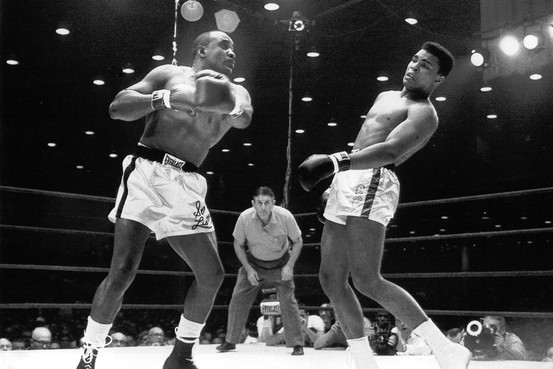
The Fight That Made Muhammad Ali; A Half Century Ago, a Brash Youngster Named Cassius Clay (Muhammad Ali) Beat Sonny Liston and Started His Legend

Clay-Liston: The Fight That Made Muhammad Ali

A Half Century Ago, a Brash Youngster Named Cassius Clay Beat Sonny Liston and Started His Legend

GORDON MARINO

Feb. 24, 2014 11:13 p.m. ET

image001-17

Sonny Liston misfiring against Muhammad Ali, then known as Cassius Clay. The Ring Magazine/Getty Images

Fifty years ago Tuesday, Cassius Clay shocked Sonny Liston to win the heavyweight title.

In the decades afterward, the man later known as Muhammad Ali would politicize sports and transform the art of boxing into theater. He also would beat Liston again in a famously short meeting a year later. But this first fight, the one in Miami Beach, was the one that made it all possible. Read more of this post

Making progress means taking risks and making brilliant blunders

Making progress means taking risks and making brilliant blunders

Thomas Edison is reputed to have said: “I have not failed. I’ve just found 10,000 ways that won’t work.” This statement sums up a fundamental — but often misunderstood — truth about scientific inquiry.

BY MARIO LIVIO –

FEBRUARY 26

Thomas Edison is reputed to have said: “I have not failed. I’ve just found 10,000 ways that won’t work.” This statement sums up a fundamental — but often misunderstood — truth about scientific inquiry. Read more of this post

How to Manufacture More Time in Your Day: Embrace Your Inner Pessimist; Think Like a Chef

HOW TO MANUFACTURE MORE TIME IN YOUR DAY

SOME PEOPLE KNOW HOW TO MAKE THE MOST OF EVERY MINUTE, WHILE THE REST OF US LAMENT THAT THERE’S NOT ENOUGH HOURS IN THE DAY. THE KEY COULD BE AS SIMPLE AS KNOWING WHAT YOU’RE WORKING WITH. HERE’S HOW TO TAKE CONTROL OF THE TIME YOU’RE GIVEN.

BY LAURA VANDERKAM

You know the type: A colleague constantly delivers at work. He exudes a sense of calm, and yet as you get to know him, you find out he’s also coaching soccer, running marathons, and taking a wine-tasting class that he’s never had to skip. Read more of this post

Physics is enjoying a golden age

Physics is enjoying a golden age

By Michael GersonTuesday, February 25, 8:54 AM E-mail the writer

Each of the GPS satellites that allow me to navigate to a new restaurant carries an atomic clock that needs to be accurate in order to triangulate the speed and position of my moving car. But there are a couple of problems. Einstein’s Theory of Special Relativity predicts that clocks hurtling through space at satellite speed will appear to tick more slowly than earthbound clocks by about 7,000 nanoseconds each day (a nanosecond is a billionth of a second). His Theory of General Relativity, on the other hand, predicts that clocks farther from a massive object (the Earth), will advance faster than clocks on the ground, in this case by a little more than 45,000 nanoseconds. Read more of this post

Lincoln’s Boys: John Hay, John Nicolay, and the War for Lincoln’s Image; A timely and intimate look into Abraham Lincoln’s White House through the lives of his two closest aides and confidants

Lincoln’s Boys: John Hay, John Nicolay, and the War for Lincoln’s Image Hardcover

by Joshua Zeitz  (Author)

A timely and intimate look into Abraham Lincoln’s White House through the lives of his two closest aides and confidants
image001-10
Lincoln’s official secretaries John Hay and John Nicolay enjoyed more access, witnessed more history, and knew Lincoln better than anyone outside of the president’s immediate family. Hay and Nicolay were the gatekeepers of the Lincoln legacy. They read poetry and attendeded the theater with the president, commiserated with him over Union army setbacks, and plotted electoral strategy. They were present at every seminal event, from the signing of the Emancipation Proclamation to Lincoln’s delivery of the Gettysburg Address—and they wrote about it after his death. Read more of this post

How Abraham Lincoln’s secretaries helped establish his legacy

How Abraham Lincoln’s secretaries helped establish his legacy

Feb 22nd 2014 | From the print edition

Lincoln’s Boys: John Hay, John Nicolay, and the War for Lincoln’s Image. By Joshua Zeitz. Viking; 390 pages; $29.95. Buy from Amazon.comAmazon.co.uk

AMERICANS crave books about Abraham Lincoln. But finding fresh material on their 16th president is tough. So some writers are turning to his acolytes—the cabinet, the generals, the son. Read more of this post

Governing the high seas: In deep water; Humans are damaging the high seas. Now the oceans are doing harm back

Governing the high seas: In deep water; Humans are damaging the high seas. Now the oceans are doing harm back

Feb 22nd 2014 | From the print edition

ABOUT 3 billion people live within 100 miles (160km) of the sea, a number that could double in the next decade as humans flock to coastal cities like gulls. The oceans produce $3 trillion of goods and services each year and untold value for the Earth’s ecology. Life could not exist without these vast water reserves—and, if anything, they are becoming even more important to humans than before.

Mining is about to begin under the seabed in the high seas—the regions outside the exclusive economic zones administered by coastal and island nations, which stretch 200 nautical miles (370km) offshore. Nineteen exploratory licences have been issued. New summer shipping lanes are opening across the Arctic Ocean. The genetic resources of marine life promise a pharmaceutical bonanza: the number of patents has been rising at 12% a year. One study found that genetic material from the seas is a hundred times more likely to have anti-cancer properties than that from terrestrial life.

But these developments are minor compared with vaster forces reshaping the Earth, both on land and at sea. It has long been clear that people are damaging the oceans—witness the melting of the Arctic ice in summer, the spread of oxygen-starved dead zones and the death of coral reefs. Now, the consequences of that damage are starting to be felt onshore.

Thailand provides a vivid example. In the 1990s it cleared coastal mangrove swamps to set up shrimp farms. Ocean storm surges in 2011, no longer cushioned by the mangroves, rushed in to flood the country’s industrial heartland, causing billions of dollars of damage.
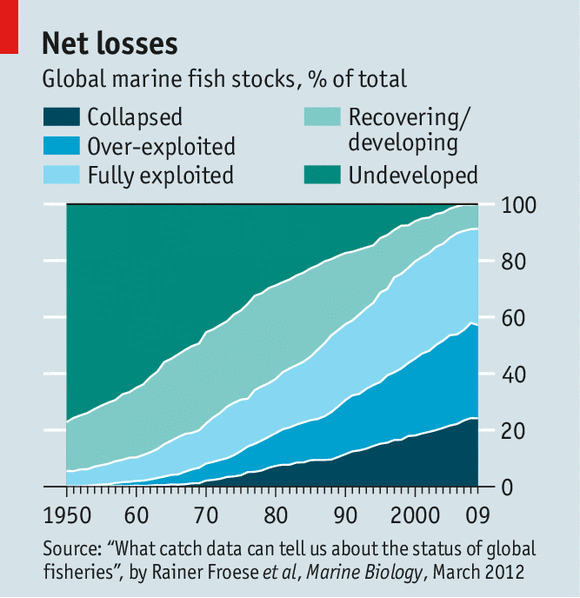
image001-3

More serious is the global mismanagement of fish stocks. About 3 billion people get a fifth of their protein from fish, making it a more important protein source than beef. But a vicious cycle has developed as fish stocks decline and fishermen race to grab what they can of the remainder. According to the Food and Agriculture Organisation (FAO), a third of fish stocks in the oceans are over-exploited; some estimates say the proportion is more than half (see chart). One study suggested that stocks of big predatory species—such as tuna, swordfish and marlin—may have fallen by as much as 90% since the 1950s. People could be eating much better, were fishing stocks properly managed.

The forests are often called the lungs of the Earth, but the description better fits the oceans. They produce half the world’s supply of oxygen, mostly through photosynthesis by aquatic algae and other organisms. But according to a forthcoming report by the Intergovernmental Panel on Climate Change (IPCC; the group of scientists who advise governments on global warming), concentrations of chlorophyll (which helps makes oxygen) have fallen by 9-12% in 1998-2010 in the North Pacific, Indian and North Atlantic Oceans.

Climate change may be the reason. At the moment, the oceans are moderating the impact of global warming—though that may not last (see article). Warm water rises, so an increase in sea temperatures tends to separate cold and warm water into more distinct layers, with shallower mixed layers in between. That seems to lower the quantity of nutrients available for aquatic algae, and to lead to decreased chlorophyll concentrations. Changes in the oceans, therefore, may mean less oxygen will be produced. This cannot be good news, though scientists are still debating the likely consequences. The world is not about to suffocate. But the result could be lower oxygen concentrations in the oceans and changes to the climate because the counterpart of less oxygen is more carbon—adding to the build-up of greenhouse gases. In short, the decades of damage wreaked on the oceans are now damaging the terrestrial environment.

A tragedy foretold

The oceans exemplify the “tragedy of the commons”—the depletion of commonly held property by individual users, who harm their own long-term interests as a result. For decades scientists warned that the European Union’s fishing quotas were too high, and for decades fishing lobbyists persuaded politicians to ignore them. Now what everyone knew would happen has happened: three-quarters of the fish stocks in European waters are over-exploited and some are close to collapse.

The salient feature of such a tragedy is that the full cost of damaging the system is not borne by those doing the damage. This is most obvious in fishing, but goes further. Invasive species of many kinds are moved around the world by human activity—and do an estimated $100 billion of damage to oceans each year. Farmers dump excess fertiliser into rivers, which finds its way to the sea; there cyanobacteria (blue-green algae) feed on the nutrients, proliferate madly and reduce oxygen levels, asphyxiating all sea creatures. In 2008, there were over 400 “dead zones” in the oceans. Polluters pump out carbon dioxide, which dissolves in seawater, producing carbonic acid. That in turn has increased ocean acidity by over a quarter since the start of the Industrial Revolution. In 2012, scientists found pteropods (a kind of sea snail) in the Southern Ocean with partially dissolved shells.

It is sometimes possible to preserve commons by assigning private property rights over them, thus giving users a bigger stake in their long-term health. That is being tried in coastal and island nations’ exclusive economic zones. But it does not apply on the high seas. Under international law, fishing there is open to all and minerals count as “the common heritage of mankind”. Here, a mishmash of international rules and institutions determines the condition of the watery commons.

The high seas are not ungoverned. Almost every country has ratified the UN Convention on the Law of the Sea (UNCLOS), which, in the words of Tommy Koh, president of UNCLOS in the 1980s, is “a constitution for the oceans”. It sets rules for everything from military activities and territorial disputes (like those in the South China Sea) to shipping, deep-sea mining and fishing. Although it came into force only in 1994, it embodies centuries-old customary laws, including the freedom of the seas, which says the high seas are open to all. UNCLOS took decades to negotiate and is sacrosanct. Even America, which refuses to sign it, abides by its provisions.

But UNCLOS has significant faults. It is weak on conservation and the environment, since most of it was negotiated in the 1970s when these topics were barely considered. It has no powers to enforce or punish. America’s refusal to sign makes the problem worse: although it behaves in accordance with UNCLOS, it is reluctant to push others to do likewise.

Alphabet bouillabaisse
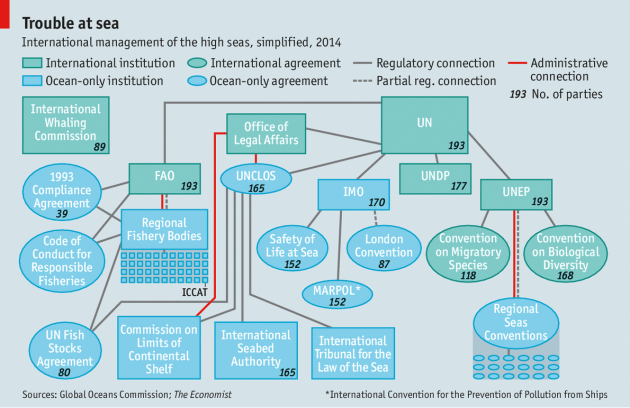
image002A dwindling catch

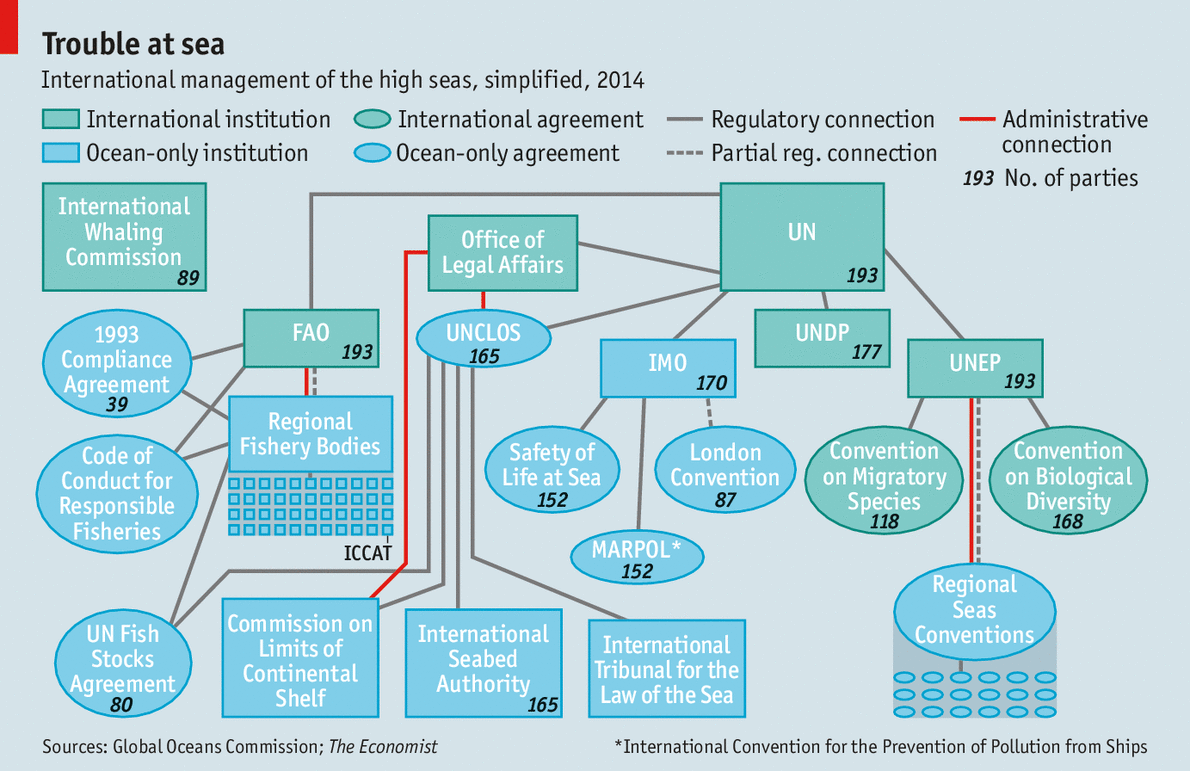
Specialised bodies have been set up to oversee a few parts of the treaty, such as the International Seabed Authority, which regulates mining beneath the high seas. But for the most part UNCLOS relies on member countries and existing organisations for monitoring and enforcement. The result is a baffling tangle of overlapping authorities (see diagram) that is described by the Global Ocean Commission, a new high-level lobby group, as a “co-ordinated catastrophe”.

Individually, some of the institutions work well enough. The International Maritime Organisation, which regulates global shipping, keeps a register of merchant and passenger vessels, which must carry identification numbers. The result is a reasonably law-abiding global industry. It is also responsible for one of the rare success stories of recent decades, the standards applying to routine and accidental discharges of pollution from ships. But even it is flawed. The Institute for Advanced Sustainability Studies, a German think-tank, rates it as the least transparent international organisation. And it is dominated by insiders: contributions, and therefore influence, are weighted by tonnage.

Other institutions look good on paper but are untested. This is the case with the seabed authority, which has drawn up a global regime for deep-sea mining that is more up-to-date than most national mining codes. For once, therefore, countries have settled the rules before an activity gets under way, rather than trying to catch up when the damage starts, as happened with fishing.

The problem here is political rather than regulatory: how should mining revenues be distributed? Deep-sea minerals are supposed to be “the common heritage of mankind”. Does that mean everyone is entitled to a part? And how to share it out?

The biggest failure, though, is in the regulation of fishing. Overfishing does more damage to the oceans than all other human activities there put together. In theory, high-seas fishing is overseen by an array of regional bodies. Some cover individual species, such as the International Commission for the Conservation of Atlantic Tunas (ICCAT, also known as the International Conspiracy to Catch All Tuna). Others cover fishing in a particular area, such as the north-east Atlantic or the South Pacific Oceans. They decide what sort of fishing gear may be used, set limits on the quantity of fish that can be caught and how many ships are allowed in an area, and so on.

Here, too, there have been successes. Stocks of north-east Arctic cod are now the highest of any cod species and the highest they have been since 1945—even though the permitted catch is also at record levels. This proves it is possible to have healthy stocks and a healthy fishing industry. But it is a bilateral, not an international, achievement: only Norway and Russia capture these fish and they jointly follow scientists’ advice about how much to take.

There has also been some progress in controlling the sort of fishing gear that does the most damage. In 1991 the UN banned drift nets longer than 2.5km (these are nets that hang down from the surface; some were 50km long). A series of national and regional restrictions in the 2000s placed limits on “bottom trawling” (hoovering up everything on the seabed)—which most people at the time thought unachievable.

But the overall record is disastrous. Two-thirds of fish stocks on the high seas are over-exploited—twice as much as in parts of oceans under national jurisdiction. Illegal and unreported fishing is worth $10 billion-24 billion a year—about a quarter of the total catch. According to the World Bank, the mismanagement of fisheries costs $50 billion or more a year, meaning that the fishing industry would reap at least that much in efficiency gains if it were properly managed.

Most regional fishery bodies have too little money to combat illegal fishermen. They do not know how many vessels are in their waters because there is no global register of fishing boats. Their rules only bind their members; outsiders can break them with impunity. An expert review of ICCAT, the tuna commission, ordered by the organisation itself concluded that it was “an international disgrace”. A survey by the FAO found that over half the countries reporting on surveillance and enforcement on the high seas said they could not control vessels sailing under their flags. Even if they wanted to, then, it is not clear that regional fishery bodies or individual countries could make much difference.
But it is far from clear that many really want to. Almost all are dominated by fishing interests. The exceptions are the organisation for Antarctica, where scientific researchers are influential, and the International Whaling Commission, which admitted environmentalists early on. Not by coincidence, these are the two that have taken conservation most seriously.

Empty promises

Countries could do more to stop vessels suspected of illegal fishing from docking in their harbours—but they don’t. The FAO’s attempt to set up a voluntary register of high-seas fishing boats has been becalmed for years. The UN has a fish-stocks agreement that imposes stricter demands than regional fishery bodies. It requires signatories to impose tough sanctions on ships that break the rules. But only 80 countries have ratified it, compared with the 165 parties to UNCLOS. One study found that 28 nations, which together account for 40% of the world’s catch, are failing to meet most of the requirements of an FAO code of conduct which they have signed up to.

It is not merely that particular institutions are weak. The system itself is dysfunctional. There are organisations for fishing, mining and shipping, but none for the oceans as a whole. Regional seas organisations, whose main responsibility is to cut pollution, generally do not cover the same areas as regional fishery bodies, and the two rarely work well together. (In the north-east Atlantic, the one case where the boundaries coincide, they have done a lot.) Dozens of organisations play some role in the oceans (including 16 in the UN alone) but the outfit that is supposed to co-ordinate them, called UN-Oceans, is an ad-hoc body without oversight authority. There are no proper arrangements for monitoring, assessing or reporting on how the various organisations are doing—and no one to tell them if they are failing.
Pressure for change is finally building up. According to David Miliband, a former British foreign secretary who is now co-chairman of the Global Ocean Commission, the current mess is a “terrible betrayal” of current and future generations. “We need a new approach to the economics and governance of the high seas,” he says.

That could take different forms. Environmentalists want a moratorium on overfished stocks, which on the high seas would mean most of them. They also want regional bodies to demand impact assessments before issuing fishing licences. The UN Development Programme says rich countries should switch some of the staggering $35 billion a year they spend subsidising fishing on the high seas (through things like cheap fuel and vessel-buy-back programmes) to creating marine reserves—protected areas like national parks.

Others focus on institutional reform. The European Union and 77 developing countries want an “implementing agreement” to strengthen the environmental and conservation provisions of UNCLOS. They had hoped to start what will doubtless be lengthy negotiations at a UN conference in Rio de Janeiro in 2012. But opposition from Russia and America forced a postponement; talks are now supposed to start by August 2015.

Still others say that efforts should be concentrated on improving the regional bodies, by giving them more money, greater enforcement powers and mandates that include the overall health of their bits of the ocean. The German Advisory Council on Global Change, a think-tank set up by the government, argues for an entirely new UN body, a World Oceans Organisation, which it hopes would increase awareness of ocean mismanagement among governments, and simplify and streamline the current organisational tangle.

According to Elinor Ostrom, who won the Nobel prize for economics in 2009, to avoid a tragedy of the commons requires giving everyone entitled to use them a say in running them; setting clear boundaries to keep out those who are not entitled; appointing monitors who are trusted by users; and having straightforward mechanisms to resolve conflicts. At the moment, the governance of the high seas meets none of those criteria.

Changes to high-seas management would still do nothing for two of the worst problems, both caused on land: acidification and pollution. But they are the best and perhaps only hope of improving the condition of half of the Earth’s surface.