The Structure of a Story

The Structure of a Story

February 17, 2014 by Shane Parrish

“Human beings master the basics of storytelling as young children and retain this capability throughout their lives.” — Stephen Denning

When psychologist T. A. Harley researched the academic literature on the structure of stories, he concluded, “There is no agreement on story structure: virtually every story grammatician has proposed a different grammar.” Read more of this post
The Dangers of Planning: Goals Gone Wild

The Dangers of Planning: Goals Gone Wild

February 18, 2014 by Shane Parrish

In 1996 a disaster of historic proportion happened on the peak of Mount Everest. In the entire climbing season of 1996 fifteen climbers died. Eight of those deaths took place  on a single day. Journalist and mountain climber Jon Krakauer captured this story in his breathtaking book Into Thin Air. Krakauer didn’t just uncover the story after the fact, he was on the mountain that day. Read more of this post

Accountability

Accountability

February 21, 2014 by Shane Parrish

“There are always three speeches for every one you actually gave: the one you practiced, the one you gave, and the one you wish you gave.” — Dale Carnegie

I thought I’d post some excerpts from a recent talk I gave to student athletes at Bradley University on accountability. Read more of this post

How Using a Decision Journal can Help you Make Better Decisions

How Using a Decision Journal can Help you Make Better Decisions

February 20, 2014 by Shane Parrish

“Odds are you’re going to discover two things. First, you’re right a lot of the time. Second, it’s often for the wrong reasons.”

We’ve talked quite a bit about decision journals and the one question I get asked more than any other is what should my decision journal look like? Read more of this post

How To Think

How To Think

February 19, 2014 by Shane Parrish

Sebastian Garcia made a mistake but he couldn’t figure it out. At the 2011 National Junior High Chess Championship he was looking strong and heading towards a victory. Then he made a mistake, squandering his advantage. A few moves later the collapse was complete. Sebastian shook hands with the boy who had beaten him and walked back to Union B, the conference room down the hall. Union B was the makeshift home for his chess team from Intermediate School 318 in Brooklyn. Read more of this post

Steven Spielberg got rejected from film school … three times. Oprah Winfrey was told she was “unfit for TV.” Stephen King received 30 rejections for “Carrie.” Walt Disney was told a mouse would never work.

14 people who failed before becoming super successful stars

Aly Weisman, Business Insider | February 22, 2014 7:00 AM ET
More from Business Insider

The names Oprah Winfrey, Walt Disney, and Steven Spielberg aren’t usually associated with failure.

But before these super successful stars made it big in Hollywood, they first failed, were fired, or heard the word “no” countless times. Read more of this post

‘Brands must personify themselves’; In the past, we used to focus on how brands came to life through identity, which is relatively simple. Now, we have brands having conversations with people across digital media, so the brand actually has a voice

2014-02-23 14:15

‘Brands must personify themselves’

By Kim Bo-eun
Korean companies do not dare to voice out opinions on social or political issues for fear of offending the government, businesses or customers.
However, branding consultancy Interbrand’s chief marketing officer (CMO) says more global brands are developing human personalities that voice their stance on various issues, and these personalities can help brands stand out and succeed. Read more of this post

The Curse of Productivity: When ‘Optimization’ Holds You Back

The Curse of Productivity: When ‘Optimization’ Holds You Back

It’s possible to be too productive.

By Shane Parrish 2/21 8:16am

You’re a rational person right? You want to get better at what you do. You want to be a productivity Ninja. You’ve read all the articles you can find online promising productivity tips. You know all 66 personal development habits for smart people. You know how to send emails while on a Skype conference call while texting! In short, you’re basically a productivity machine. And you spend a lot of time, energy, and money becoming more efficient. But for what? Read more of this post

The Powerlessness of Positive Thinking

February 19, 2014

The Powerlessness of Positive Thinking

Posted by Adam Alter

Since publishing “The Secret,” in 2006, the Australian author Rhonda Byrne has been writing self-help manifestos based on the idea that people who think positive thoughts are rewarded with happiness, wealth, influence, wisdom, and success. In November, 2013, she published “Hero,” the fourth book in the series. The book showcases the wisdom of twelve heroes—businesspeople, sports stars, writers, and philanthropists. Byrne’s idea isn’t new—it’s been a mainstay among greeting-card companies, motivational speakers, and school teachers for decades—but she’s become one of its most visible prophets. “The way to change a lack of belief is very simple,” Byrne writes. “Begin thinking the opposite thoughts to what you’ve been thinking about yourself: that you can do it, and that you have everything within you to do it.” Read more of this post

Master of Influence Robert Cialdini Recommends Five Books

Master of Influence Robert Cialdini Recommends Five Books

February 12, 2012 by Shane Parrish

Psychologist Robert Cialdini wrote two of the the most important books on influence: Yes!: 50 Scientifically Proven Ways to be Persuasive and The Psychology of Persuasion.

Now he recommends five books for you: Read more of this post

The art of practical leadership

The art of practical leadership

image001-24

Sunday, February 23, 2014 – 09:00

Han Fook Kwang

Managing Editor

The Straits Times

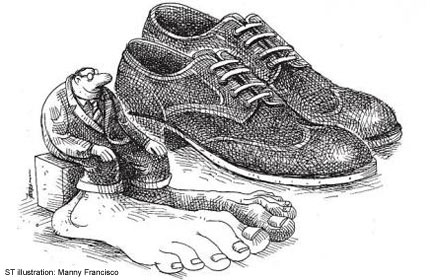
FORMER head of civil service Lim Siong Guan’s new book on leadership contains a passage that made me cast my mind back to my first boss at work.

In The Leader, The Teacher And You, the retired civil servant recounted a conversation he had with then Prime Minister Lee Kuan Yew at their first meeting. Mr Lee had told him: “Always look at the foreigner in his eyes. Never look down. You are dealing with him as a representative of Singapore. Conduct yourself as his equal.” Read more of this post

A world of robber barons: The relationship between business and government is becoming increasingly antagonistic, says Philip Coggan. But the two sides should not overdo it: they need each other

Companies and the state

A world of robber barons: The relationship between business and government is becoming increasingly antagonistic, says Philip Coggan. But the two sides should not overdo it: they need each other

Feb 22nd 2014 | From the print edition

image001-20

IN THE MIDDLE AGES the Rhine was Europe’s most important commercial waterway. Like many modern highways, it was a toll route. Toll points were meant to be approved by the Holy Roman Emperor, but local landowners often charged river traffic for passing through. These “robber barons”, as they became known, were a serious impediment to trade, and imperial forces had to take costly punitive action to remove them. Read more of this post

Plucking the geese: Traditional ways of raising tax do not work well in a globalised world

Plucking the geese: Traditional ways of raising tax do not work well in a globalised world

Feb 22nd 2014 | From the print edition

LOUIS XIV’S FINANCE minister, Jean-Baptiste Colbert, famously declared that “the art of taxation consists in so plucking the goose as to obtain the largest possible amount of feathers with the smallest possible amount of hissing.” When it comes to taxing companies, a modern finance minister might rephrase this as “the largest possible amount of revenue with the smallest possible amount of economic and political damage.” Read more of this post

Entrepreneurs: Delegate now, before it’s too late

Entrepreneurs: Delegate now, before it’s too late

BY SOPHIA SOLANKI 
ON FEBRUARY 22, 2014

A business’s growth is hinged on an entrepreneur’s ability to delegate effectively. You may have the brightest ideas, the best offering in the market — but without getting the work done, these will mean nothing. It’s no secret how the day-to-day management and running of a business soon becomes the only thing you do, and the business growth takes a backseat. The result — stagnation, de-motivation and in the worst scenario, an end to your dreams. Read more of this post

Can God Make It in Hollywood?

Can God Make It in Hollywood?

By MICHAEL CIEPLYFEB. 22, 2014

image001-17

LOS ANGELES — SOME years ago, when I was producing films at Columbia Pictures, I learned up close how hard it was to make Hollywood get religion. It was in the mid-1990s, and a good writer, earlier nominated for an Oscar, had an earnest modern-day Christ story about a damaged man in Los Angeles who might or might not be the Messiah. “The Greatest Story Ever Told” meets “Falling Down,” more or less. Read more of this post

Your Ancestors, Your Fate: Surnames reveal that social mobility is much slower than we think

FEBRUARY 21, 2014, 6:19 AM

Your Ancestors, Your Fate

By GREGORY CLARK

Inequality of income and wealth has risen in America since the 1970s, yet a large-scale research study recently found that social mobility hadn’t changed much during that time. How can that be?

The study, by researchers at Harvard and Berkeley, tells only part of the story. It may be true that mobility hasn’t slowed — but, more to the point, mobility has always been slow. Read more of this post

How to Get a Job at Google; Google attracts so much talent it can afford to look beyond traditional metrics, like G.P.A.

How to Get a Job at Google

FEB. 22, 2014

Thomas L. Friedman

MOUNTAIN VIEW, Calif. — LAST June, in an interview with Adam Bryant of The Times, Laszlo Bock, the senior vice president of people operations for Google — i.e., the guy in charge of hiring for one of the world’s most successful companies — noted that Google had determined that “G.P.A.’s are worthless as a criteria for hiring, and test scores are worthless. … We found that they don’t predict anything.” He also noted that the “proportion of people without any college education at Google has increased over time” — now as high as 14 percent on some teams. At a time when many people are asking, “How’s my kid gonna get a job?” I thought it would be useful to visit Google and hear how Bock would answer. Read more of this post

We are surprisingly terrible at divining what’s going on in someone else’s mind.

Book Review: ‘Mindwise’ by Nicholas Epley

We are surprisingly terrible at divining what’s going on in someone else’s mind.

DANIEL J. LEVITIN

Feb. 21, 2014 3:38 p.m. ET

Socrates said “know thyself.” Sun Tzu said “know your enemy.” Nietzsche asked: “How can man know himself? He is a dark and hidden thing.” If Nietzsche is right, how can we do what Socrates and Sun Tzu advise? How can we possibly know, and trust, one another? Read more of this post

The Benjamin Franklin Effect: The Surprising Psychology of How to Handle Haters

The Benjamin Franklin Effect: The Surprising Psychology of How to Handle Haters

“We are what we pretend to be,” Kurt Vonnegut famously wrote, “so we must be careful about what we pretend to be.” But givenhow much our minds mislead us, what if we don’t realize when we’re pretending – who are we then? That’s precisely what David McRaney explores in You Are Now Less Dumb: How to Conquer Mob Mentality, How to Buy Happiness, and All the Other Ways to Outsmart Yourself (public library) – a “book about self-delusion, but also a celebration of it,” a fascinating and pleasantly uncomfortable-making look at why “self-delusion is as much a part of the human condition as fingers and toes,” and the follow-up to McRaney’s You Are Not So Smart, one of the best psychology books of 2011. McRaney, with his signature fusion of intelligent irreverence and irreverent intelligence, writes in the introduction: Read more of this post

11 Inspiring Quotes From WhatsApp’s Billionaire Co-Founders

11 Inspiring Quotes From WhatsApp’s Billionaire Co-Founders

JILLIAN D’ONFRO TECH  FEB. 22, 2014, 1:49 AM

image001-15

Jan Koum and Brian Acton founded WhatsApp in 2009 and became filthy rich fewer than five years later when they sold the company to Facebook for $19 billionRead more of this post

Mother’s love helped actress overcome war, poverty and bullying to find fame in Japan

Mother’s love helped actress overcome war, poverty and bullying to find fame in Japan

BY MAGDALENA OSUMI

FEB 22, 2014

image001-14Survivor: Rescued from the rubble of a war zone as a young girl in Iran, 28-year-old Sahel Rosa has succeeded in carving out a career in Japan as a model, TV personality and actress.  | YOSHIAKI MIURA

Orphaned at the age of 4, Sahel Rosa celebrates her birthday every Oct. 21 and Oct. 23, although she will never know for sure on what date she came into this world. The sole survivor of an Iraqi air raid that leveled her small town in western Iran in 1989, there are no blood relatives left to ask. Read more of this post

Disney didn’t ignore its animators: here’s why you need to develop the non-manager ‘leaders’ in your business

Disney didn’t ignore its animators: here’s why you need to develop the non-manager ‘leaders’ in your business

Published 20 February 2014 17:18, Updated 21 February 2014 10:24

Jack Zenger

Talented individuals are more inclined to stay with organisations when they feel they are progressing. 

When they hear the word “leader”, most people immediately think of someone with business cards that say “manager”, “director” or another such lofty title. That is, someone who holds a position of stature within a company’s hierarchy, and to whom several other employees report. Read more of this post

What the Netherlands’ complete dominance in speed skating says about success; Success can come from being in the right place at the right time. But it usually takes years spent building a culture, facilitating talent, making investment

What the Netherlands’ complete dominance in speed skating says about success

By Max Nisen @MaxNisen February 21, 2014

Part of the beauty of the Olympics is that despite its size, one country can dominate an entire sport. At Sochi, the biggest winner in that regard has been the Netherlands, a country with less than a fifth as many Olympic athletes as the US, that has won 21 medals (soon to be 22) so far in long track speed skating.

It’s a record for a single country in an Olympics, and a reminder that the greatest success comes from monopolizing on your advantage and putting serious resources behind it. Luck can win a solitary medal, but not 21 of them. Read more of this post

Billionaires invest $29m in plant-based chicken eggs

Billionaires invest $29m in plant-based chicken eggs

Friday, Feb 21, 2014

Hemananthani Sivanandam

Winnie Yeoh

and A. Raman

The Star/Asia News Network

Asia’s richest man Li Ka-Shing and Yahoo co-founder Jerry Yang have invested US$23million (S$29 million) in a California-based company that produces artificial chicken eggs, Sin Chew Daily reported.

The company, Hampton Creek Foods, is producing the artificial eggs using ingredients from 12 types of plants. Read more of this post

Why Rational People Can’t Succeed as Economic Forecasters

Why Rational People Can’t Succeed as Economic Forecasters

by Justin Fox  |   10:35 AM February 21, 2014

We’re all used to economic forecasts. We’re also used to them being wrong. But there was a time when forecasts were new and exciting, and people were genuinely surprised when they didn’t pan out. This was during the first decades of the previous century, an era that Harvard Business School historian Walter Friedman chronicles in his new book Fortune Tellers: The Story of America’s First Economic Forecasters. Read more of this post

To Create Healthy Urgency, Focus on a Big Opportunity

To Create Healthy Urgency, Focus on a Big Opportunity

by John P. Kotter  |   12:00 PM February 21, 2014

There are two basic kinds of energy in organizations. One, triggered by a big opportunity, can create momentum in the right direction and sustain it over time. The other, based on fear or anxiety, might overcome complacency for a time, but it does not build any momentum or maintain it. Instead it can create a panic, with all the obvious negative consequences — stressing people out and eventually draining an organization of the very energy leaders wanted to generate. Read more of this post

Time is money for Malaysia’s copter tycoon Tan Sri Syed Azman Syed Ibrahim; ‘I am no front man… I work for myself’

Updated: Saturday February 22, 2014 MYT 7:08:34 AM

Time is money for copter tycoon

BY B.K. SIDHU

image001-5

Syed Azman believes in saving time by flying.

FOR a man who owns four private jets and a fleet of helicopters, Tan Sri Syed Azman Syed Ibrahim, who will be 54 next month, works out of a spartan office in the middle of Kuala Lumpur.

It is a non-descript office, where the walls of the office are adorned with pictures of him with prominent businessmen and political leaders. Read more of this post

Top 10 Chinese restaurants in Kuala Lumpur

Top 10 Chinese restaurants in Kuala Lumpur

The Star/Asia News Network

Thursday, Feb 20, 2014

1 & 2. Din Tai Fung

Topping the list is the award-winning chain restaurant Din Tai Fung located at Pavilion Kuala Lumpur and The Gardens, Mid Valley City. A TripAdvisor traveller raved, “One of the best Xiao Long Baos (soup dumplings) I have tasted!” Read more of this post

Carl Icahn, obsessive activist investor: His decades-long war on corporate complacency has gone mainstream

February 21, 2014 6:44 pm

Carl Icahn, obsessive activist investor

By Stephen Foley

His decades-long war on corporate complacency has gone mainstream, writes Stephen Foley

image001-31

Steven Goldstone, when he was chief executive of RJR Nabisco, used to call the appearance of Carl Icahn “a rite of spring”. Year after year, the investor would show up to demand RJR split its snacks and tobacco businesses apart; year after year, he would fight to persuade fellow shareholders to approve his representatives for the board; and year after year his defeat would not deter him from trying again. Read more of this post

Why Is It So Difficult to Make Long-Term Predictions?

February 21, 2014, 10:00 AM ET

Why Is It So Difficult to Make Long-Term Predictions?

By Irving Wladawsky-Berger

Guest Contributor

What will the world be like in 2064? Will we be living in a radically different post-singularity world, where machines far surpass humans in intelligence? Or will we continue to co-evolve with and shape our tools, as we have from time immemorial? Will technology advances lead to increased economic inequalities and conflicts, or to major reductions in poverty in a more stable world? Will it be an era of environmental crises and scarce water, food and energy, or will sustainable innovations and worldwide cooperation help us confront global challenges? Read more of this post