What I Learned From Ray Dalio: Lessons from the world’s greatest macro investor.

What I Learned From Ray Dalio: Lessons from the world’s greatest macro investor.

By Samuel Lee | 02-11-14 | 06:00 AM | Email Article

A version of this article was published in the December 2013 issue of Morningstar ETFInvestor. Download a complimentary copy here.

I try to learn from the best. Ray Dalio is one of them. He founded Bridgewater Associates, one of the biggest hedge funds in the world. Many retail investors have not heard of him, probably because his funds are open only to big institutions. It’s a terrible mistake to limit yourself to listening only to the musings of mutual fund managers. Doing so means that you will ignore many of the best investors.

Dalio’s perspective is invaluable. He’s willing to entertain seemingly loony ideas. For example, in 2001 he had his firm develop a depression gauge. In 2003, Nobel Prize-winning economist Robert Lucas declared that the “central problem of depression prevention has been solved, for all practical purposes, and has in fact been solved for many decades.” Five years later, in late 2008, Dalio’s depression gauge went off. Bridgewater was one of the few firms that anticipated and successfully navigated the financial crisis and its aftermath. Unlike many other money managers, Bridgewater predicted low interest rates and low inflation even after the Federal Reserve and other central banks worldwide embarked on rounds of massive and unconventional monetary stimulus.

A great deal of Dalio’s success owes to his admirable willingness to admit error and self-correct. He expects the same of his workers. He says, “At Bridgewater people have to value getting at truth so badly that they are willing to humiliate themselves to get it.”

In many respects, Dalio is the anti-Warren Buffett. Buffett makes big bets on a handful of companies. Dalio makes many small bets on currency pairs, commodities, bonds, and, to a much lesser extent, equities. Buffett grants his subordinates plenty of autonomy and lets them figure out their own way. Dalio imposes a set of principles that his subordinates are to live by and heavily monitors them. Buffett doesn’t give much thought to economic cycles. Dalio’s investing style is based on identifying and navigating them. Buffett doesn’t like gold. Dalio thinks everyone should own a little bit of it.

Because Dalio’s found success in such an unconventional way, his methods are a rich vein to mine for lessons. After all, successful investing requires delinking your perspective from the consensus. Here are some of the most important lessons I learned from Dalio and his colleagues at Bridgewater.

The long- and short-term debt cycles are the biggest reasons the economy deviates from trend-line growth.
According to Dalio, the economy’s behavior can be largely explained by three forces: trend productivity growth, the long-term debt cycle, and the short-term debt cycle. Productivity growth occurs due to technological progress and is the most important force over century-long scales. Exhibit 1 is a chart reproduced from Dalio’s paper, “How the Economic Machine Works.” It shows trend growth of per-capita income has been steady, especially after World War II.
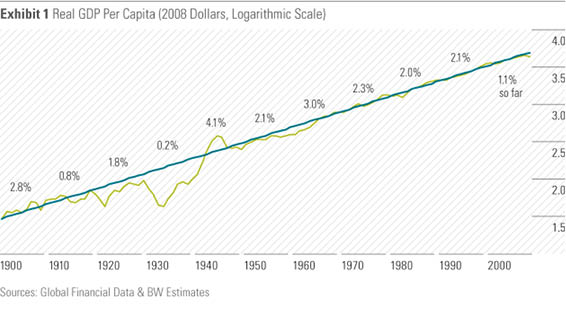
image001-11
 

Over, say, five to seven years, the short-term debt cycle dominates. It occurs when the central bank tightens and loosens credit. It’s also known as the business cycle. When credit and money grow faster than real economic production, inflation rises, spurring the central bank to raise interest rates and tighten credit, leading to a recession. When inflation is under control, the central bank lowers interest rates and loosens credit to spur economic growth. Many investors focus on where they are in the short-term cycle.

So far, Dalio’s model is conventional. His key insight is observing that there’s a long-term debt cycle, which operates over decades. During the leveraging phase of the cycle, debts rise faster than incomes in a self-perpetuating manner. Households and firms borrow money, which they spend. Because someone’s spending is another’s income, overall spending—the economy—grows. Asset prices go up. With greater incomes and more valuable assets, firms and households borrow even more and lenders are eager to lend. And the cycle continues. Part of the growth in incomes and asset prices during this phase is illusory; rising leverage has the effect of pulling forward wealth from the future.

While the process can go on for a long time, debts cannot rise faster than income forever. The process hits a wall when the central bank can no longer stimulate the economy because the short-term interest rate required to restore full employment is below zero.

image002-3
 

According to Dalio, deleveragings are achieved through four channels: 1) debt write-downs; 2) the transfer of wealth from the haves to the have-nots; 3) austerity; and 4) money printing. The first three channels are deflationary. Money printing is inflationary.

How a deleveraging evolves depends on the relative contributions of deflationary and inflationary forces. Because deleveragings occur once a lifetime, policymakers don’t know how to manage them. Guided by conventional wisdom, they usually turn to austerity and debt restructurings to bring down debt levels. The result is an “ugly” deleveraging, during which the economic pain is worsened and the debt/income ratio actually rises because incomes fall faster than debts. Policymakers see that their medicine isn’t working and turn to fiscal stimulus and money printing to ease the burden. This is what occurred in the U.S. in the 1930s and in Europe in the aftermath of the financial crisis.

If authorities balance deflationary interventions with the right amount of money printing, the deleveraging enters a “beautiful” phase. The pain of debt write-downs is spread out. Growth is subdued, as the economy must rely on productivity improvements to grow. The United States is undergoing the most beautiful deleveraging in history, according to Bridgewater. This puts Bridgewater in an unusual camp. Of Ben Bernanke and America’s central bankers, Bridgewater co-president David McCormick has said, “History will look back on them as having responded in a way that was both necessary and heroic.”

Deleveragings take decades to work themselves out. According to this model, we’ve still a long way to go before short-term interest rates rise.

Study distant times and distant places to understand what’s going on today and how events will probably transpire in the future.
Many investors were caught flat-footed by the financial crisis and the way assets behaved in its after-math. They assumed the ghost of the Great Depression or post-bubble Japan would never visit the U.S.

Dalio, on the other hand, studied the great inflation of Weimar Germany, the Great Depression in the U.S., Latin America in the 1980s, post-1990 Japan, and other economic disasters. He seriously considered whether such events could transpire again and what caused them.

Conventional economists and investors on Wall Street focus on post-World War II data for several reasons. First, many believe old data is misleading because the economy has changed so much. Second, many data sets begin only in the 1960s or 1970s. Finally, the possibility of extreme outcomes implied by the historical record and foreign experience is frightening and easy to rationalize as irrelevant.

There’s no such thing as correlation.
Many investors diversify their portfolios based on historical correlations between asset classes. Bridgewater argues that correlation is not a real thing. It is a statistical artifact of the idiosyncratic economic shocks that affected the assets examined in the past.

It makes perfect sense. Different asset classes react in rational, fairly predictable ways to different economic conditions. Assuming a historical correlation will hold going forward is a bet that future economic conditions will, on average, look like the past. This is rarely true, which is why correlations are fairly unpredictable.

Exhibit 3 shows the rolling five-year correlation of the monthly returns of the S&P 500 and the Ibbotson Associates Intermediate Treasury Bond Index. The sign doesn’t switch randomly. There seem to be long-lived regimes.
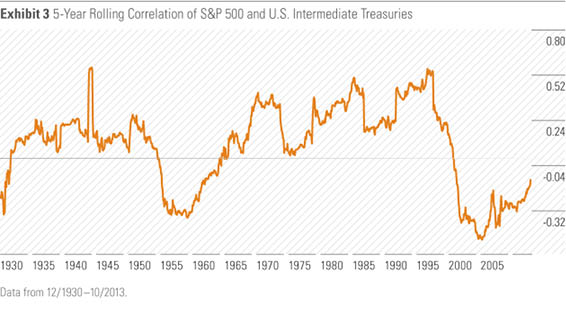
image003-2

According to Dalio, stocks and bonds are both positively correlated when inflation expectations are more volatile than growth expectations, and negatively correlated when they’re not. This makes sense, as inflation uncertainty strongly affects the market’s discount rate. When discount rates rise, both stocks and bonds are hurt, and vice versa.

Bridgewater calls this type of analysis the “structural” approach to correlation. Based on it, Dalio invented the now-famous “risk parity” strategy, which attempts to balance a portfolio’s exposures to rising growth, falling growth, rising inflation, and falling inflation such that it’s not severely hurt when the economic environment changes

 

Business is not a decathlon: why entrepreneurs should concentrate on one thing at a time

Business is not a decathlon: why entrepreneurs should concentrate on one thing at a time

Published 13 February 2014 08:54, Updated 14 February 2014 09:07

Vaughn Richtor

If there’s one thing entrepreneurs tend to excel at, it’s identifying opportunities.

Asking the question “what if . . . ?” and coming up with creative ideas are an entrepreneur’s forte, and the cornerstone on which many great businesses are built. The question is: if so many businesses start with great ideas, then why do so many businesses fail? Read more of this post

How I built Roses Only, why I sold it, and what’s next: founder James Stevens; Roses Only: The $30 million reason Jack Singleton is looking forward to Valentine’s Day

Caitlin Fitzsimmons Online editor

How I built Roses Only, why I sold it, and what’s next: founder James Stevens

Published 13 February 2014 11:56, Updated 14 February 2014 09:07+font-fontprintEmail page

image001-7

RosesOnly founder James Stevens is “bullish about Asia”. Photo: Nic Walker

For James Stevens, the sale of Roses Only in Australia and New Zealand to Jack Singleton’s FlowersCorp is only the end of the beginning.

Stevens retains the right to the Roses Only brand and owns the associated domain name in every market outside Australia and New Zealand and he has big growth plans for Asia. Read more of this post

Turkish next-gens are placing greater importance on corporate governance and professionalisation of their family businesses than preceding generation

TURKISH NEXT-GENS PUSHING FOR PROFESSIONALISATION

ARTICLE | 14 FEBRUARY, 2014 10:35 AM | BY JESSICA TASMAN-JONES

Turkish next-gens are placing greater importance on corporate governance and professionalisation of their family businesses than preceding generations, according to new research released today.

In total only 52% of family businesses in the country have a succession plan for the next generation, and only 23% have an estate plan, according to Turkish wealth builders: Family businesses cultivate economic growth, completed by Campden Wealth in conjunction with UBS. Read more of this post

Ummm, what are we doing this year?: big disconnect between managers and staff; If the boss has a plan, one-third of empoyees don’t know what it is.

Fiona Smith Columnist

Ummm, what are we doing this year?: big disconnect between managers and staff discovered

Published 12 February 2014 12:23, Updated 13 February 2014 08:57

If the boss has a plan, one-third of empoyees don’t know what it is.

A survey taken last week finds that 83 per cent of leaders and managers claim to have a business plan for 2014, but only 66 per cent of employees agree.

The survey was conducted by Leadership Management Australasia and its CEO, Andrew Henderson, says it is concerning that one-third of employees says their organisations have started the new work year without a plan. Read more of this post

Age and Scientific Genius

Age and Scientific Genius

Benjamin Jones, E.J. Reedy, Bruce A. Weinberg

NBER Working Paper No. 19866
Issued in January 2014
Great scientific output typically peaks in middle age. A classic literature has emphasized comparisons across fields in the age of peak performance. More recent work highlights large underlying variation in age and creativity patterns, where the average age of great scientific contributions has risen substantially since the early 20th Century and some scientists make pioneering contributions much earlier or later in their life-cycle than others. We review these literatures and show how the nexus between age and great scientific insight can inform the nature of creativity, the mechanisms of scientific progress, and the design of institutions that support scientists, while providing further insights about the implications of aging populations, education policies, and economic growth.


Why major creative breakthroughs happen in your late thirties; Genius, it seems, happens when a seasoned mind sees a problem with fresh eyes

Why major creative breakthroughs happen in your late thirties

By Olga Khazan, The Atlantic an hour ago

James Murphy, the former frontman of the band LCD Soundsystem, made what he called the biggest mistake of his life at 21, when he turned down a writing job on a sitcom that was about to launch.

The sitcom’s name was Seinfeld. Read more of this post

A self-titled foundation established to leave a legacy in the world used to be the prerogative of the very wealthy, but increasingly philanthropists are abandoning their vanities in favour of high-impact spend-out models for their trusts.

BIG SPENDERS: THE RISE OF THE SPEND-OUT FOUNDATION

ARTICLE | 13 FEBRUARY, 2014 11:20 AM | BY TESS DE LA MARE

The study of philanthropy is an imprecise science and there is no formula that can predict why a wealthy individual would decide to give and to which causes, much less why they would decide it’s time to stop. Read more of this post

Once upon a time, China anointed a ‘King of Japan’

Once upon a time, China anointed a ‘King of Japan’

BY MICHAL HOFFMAN

FEB 15, 2014

In 1401, barely a century after the Mongols’ aborted invasions of Japan, and 600-odd years before Japan and China fell out over the Senkaku islets, a Chinese emperor conferred upon a Japanese shogun the title “King of Japan.” Read more of this post

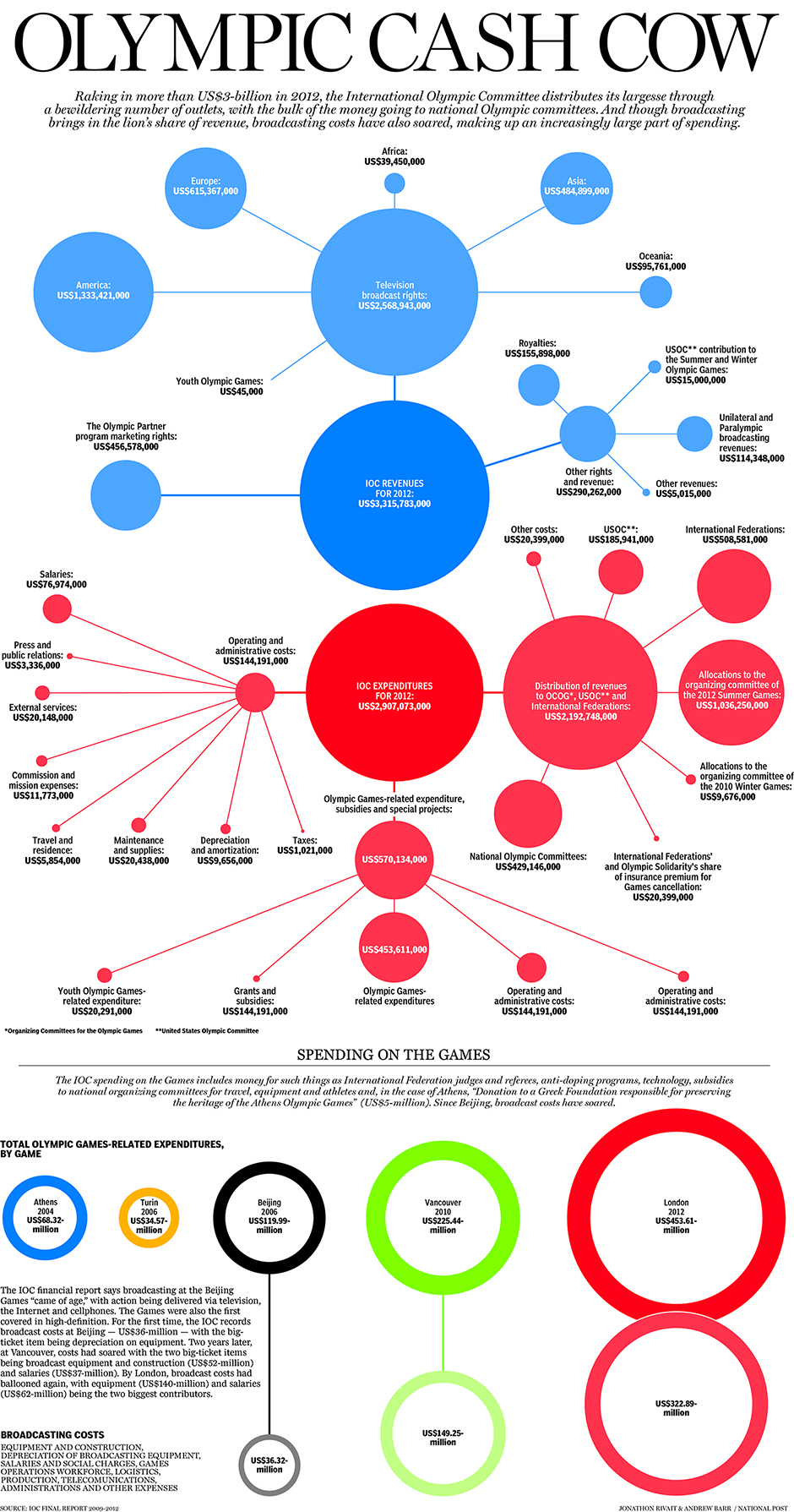
The power behind Olympic glory: IOC soaked in stupendous wealth, mystery and controversy

The power behind Olympic glory: IOC soaked in stupendous wealth, mystery and controversy

Jen Gerson | February 14, 2014 | Last Updated: Feb 14 11:25 PM ET
FO0201_Olympic_Corruption

It’s impossible not to marvel at the spectacle and camaraderie of the Olympics — to be awestruck by athletes who have devoted their lives with monomaniacal intensity to perfecting a sport.

Yet behind the dramas and heartbreak that catch the world’s attention, few wonder how the games are run and funded. Read more of this post

Hooked: A Guide to Building Habit-Forming Products

Hooked: A Guide to Building Habit-Forming Products Paperback

by Nir Eyal  (Author) , Ryan Hoover (Contributor)

image001-3

Why do some products capture our attention, while others flop?
What makes us engage with certain products out of habit?
Is there a pattern underlying how technologies hook us?
This book introduces readers to the “Hook Model,” a four steps process companies use to build customer habits. Through consecutive hook cycles, successful products reach their ultimate goal of bringing users back repeatedly — without depending on costly advertising or aggressive messaging.  Read more of this post

A Family Office for the Superrich, and Lessons for the Less Wealthy

A Family Office for the Superrich, and Lessons for the Less Wealthy

FEB. 14, 2014

Wealth Matters

By PAUL SULLIVAN

STEVEN A. COHEN, the billionaire hedge fund manager, has been in the news for a string of insider trading convictions of current or former portfolio managers at his SAC Capital Advisors. But less attention has been given to his decision to convert his hedge fund into a family office to free himself fromSecurities and Exchange Commission regulations. Read more of this post

The seductive appeal of cultural stereotypes; Is it obvious that Jewish or Chinese Americans have superior willpower? asks Tim Harford

February 14, 2014 4:49 pm

The seductive appeal of cultural stereotypes

By Tim Harford

Is it obvious that Jewish or Chinese Americans have superior willpower? asks Tim Harford

‘It may be taboo to say it, but some cultural groups starkly outperform others.’
Jacket blurb of ‘The Triple Package’ by Amy Chua and Jed Rubenfeld

Which cultural groups are they talking about? I vote for the baby boomers. They run the world and retire early on fat pensions; the rest of us are still listening to their idea of good music. They are outperforming the stuffing out of the rest of us. Read more of this post

Book Review: ‘The Value of the Humanities’ by Helen Small; Professors who were eager to throw over the canon now find it difficult to defend their own jobs

Book Review: ‘The Value of the Humanities’ by Helen Small

Professors who were eager to throw over the canon now find it difficult to defend their own jobs.

BARTON SWAIM

Feb. 14, 2014 5:46 p.m. ET

For centuries—at least since Philip Sidney’s “Apology for Poetry” (1579)—poets and literary critics have felt the need to defend the study of imaginative writing against those who dismiss it as vain and useless. Sidney defended poetry’s utility against Plato’s criticisms in “The Republic”; Matthew Arnold defended the value of “culture” against those who considered it no more than “a smattering of Greek and Latin”; and F.R. Leavis attacked C.P. Snow for (as Leavis thought) demeaning the value of literature. Read more of this post

Lincoln’s Foreign Policy in Today’s World; As a diplomat, Lincoln was a lifelong skeptic of grand foreign adventures

Lincoln’s Foreign Policy in Today’s World

As a diplomat, Lincoln was a lifelong skeptic of grand foreign adventures

KEVIN PERAINO

Feb. 14, 2014 8:13 p.m. ET

When we think about brilliant U.S. foreign-policy minds, we don’t usually think of Abraham Lincoln —and he didn’t either. “I don’t know anything about diplomacy,” he told one foreign envoy at the start of his first term. “I will be very apt to make blunders.” The most ambitious foreign trip he ever took was a jaunt to the Canadian side of Niagara Falls; shortly before his assassination, he had delighted his wife Mary by promising her that they would visit Europe for the first time after his presidency was over. He spoke no foreign languages and couldn’t even read a menu in French, the 19th-century language of diplomacy. “Hold on there,” he once begged a more cosmopolitan waiter in a New York French restaurant. “Beans. I know beans.” Read more of this post

What Would Lincoln Do? Modern-day leaders could learn a lot from the 16th president: Make your case to the public, use humor and embrace unlikely allies.

What Would Lincoln Do?

Modern-day leaders could learn a lot from our 16th president

RICHARD BROOKHISER

Feb. 14, 2014 8:04 p.m. ET

Abraham Lincoln, whose birthday we mark this holiday weekend, had less leadership experience than almost any earlier president. George Washington and Andrew Jackson had been generals, several other presidents had been governors, and all the Southerners had owned plantations. They had run organizations and managed men. President Lincoln, by contrast, was a former state legislator, a one-term congressman and the senior partner of a two-man law firm; he kept his most important papers filed away in his hat. Read more of this post

Why the Office is the Worst Place for Work

WHY THE OFFICE IS THE WORST PLACE FOR WORK

NOT GETTING ANY WORK DONE? GET OUT OF THE OFFICE TO GET IN THE ZONE.

BY LISA EVANS

Despite the fact that many of us spend 40 hours or more a week in offices, it’s likely not the place where you’re most productive.

Jason Fried, author of Remote: Office Not Required says the majority of office workers don’t actually get their work done at the office. “Offices have become places where interruptions happen,” he says. Fried claims offices, and especially those with open floor plans, offer chunks of work time–15 minutes here, a half hour there–between meetings, conference calls and other interruptions, but the real creative work, the type that requires concentration, happens during non-peak times or when employees are away from the office in an interruption-free zone. Read more of this post

Why you should care about your company’s emotional culture

WHY YOU SHOULD CARE ABOUT YOUR COMPANY’S EMOTIONAL CULTURE

DOES YOUR WORKPLACE FEEL DISTANT? ALL YOU NEED IS LOVE–AND THESE FIVE WAYS TO MAKE EVERYONE FEEL APPRECIATED.

BY STEPHANIE VOZZA

We’ve all heard about the importance of corporate culture. How companies like Google and Facebook create environments for their employees that make going to work feel like a day of play. But a recent study at the Wharton School of Business found that keeping employees happy involves more than ping-pong tables and a private chef. Read more of this post

SPANX CEO out after building the mega-brand; Former Coke exec Laurie Ann Goldman was the powerful brand builder behind SPANX founder Sara Blakely’s billion-dollar success.

SPANX CEO out after building the mega-brand

By Colleen Leahey, Reporter February 11, 2014: 12:27 PM ET

Former Coke exec Laurie Ann Goldman was the powerful brand builder behind SPANX founder Sara Blakely’s billion-dollar success.

image001-7

FORTUNE — SPANX announced yesterday that the CEO Laurie Ann Goldman would be leaving the Atlanta-based company. Despite the surprising management change, Goldman’s success with the brand is undeniable. Read more of this post

The GMAT: An exam with greater profit margins than Apple; Sixty years since its birth, the spectacular growth of the admissions exam mirrors the rise in popularity of the MBA degree, arguably the most successful educational product of the post-war

The GMAT: An exam with greater profit margins than Apple

February 11, 2014: 1:51 PM ET

Sixty years since its birth, the spectacular growth of the admissions exam mirrors the rise in popularity of the MBA degree, arguably the most successful educational product of the post-war period. Read more of this post

Family Foundations Let Affluent Leave a Legacy

Family Foundations Let Affluent Leave a Legacy

By KERRY HANNONFEB. 10, 2014

STEPHANIE Cordes, a graduate of the University of California, Santa Barbara, has a present from her father, Ron, that she treasures. It’s a handmade pink scrapbook, titled, “5 Life Lessons From Dad.”

Inside are whimsical photos of her with friends and family alongside typed pages containing his simple guidance. The chapters are: “Seek your passion.” “Do your best.” “Good enough is never good enough.” “No excuses.” “Make a difference.” “Go for it.” Read more of this post

Lego builds on story of its fight to survive to reach new heights

February 14, 2014 10:30 am

Lego builds on story of its fight to survive to reach new heights

By Richard Milne, Nordic Correspondent

The Lego Movie has rich pickings for those seeking metaphors.

In among the millions of brightly coloured bricks in the film that is released globally this weekend, some have seen an anti-business message; others a 100-minute long commercial to the Danish toy company; and yet more see the struggle in life (or Lego) between following instructions and staying creative that is a central part of the plot. Read more of this post

The irresistible appeal of the romantic ideal; Pursue love with less hubris, impatience and intolerance to risk, says Simon May

February 13, 2014 3:53 pm

The irresistible appeal of the romantic ideal

By Simon May

Pursue love with less hubris, impatience and intolerance to risk, says Simon May

Today millions of people celebrate one form of love and one only: romantic love, the love that speaks the language of erotic desire.

As we settle down to our candlelit dinners – or, as singletons or conscientious objectors to Valentine’s day, wander past packed restaurants envying or pitying the serried rows of couples – we might ask: why do we so privilege romance? Read more of this post

The Up Side of Down: Why Failing Well Is the Key to Success

The Up Side of Down: Why Failing Well Is the Key to Success Hardcover

by Megan McArdle  (Author)

image001-3

For readers of Drive, Outliers, and Daring Greatly, a counterintuitive, paradigm-shifting new take on what makes people and companies succeed
Most new products fail. So do most small businesses. And most of us, if we are honest, have experienced a major setback in our personal or professional lives. So what determines who will bounce back and follow up with a home run? If you want to succeed in business and in life, Megan McArdle argues in this hugely thought-provoking book, you have to learn how to harness the power of failure. Read more of this post

How Gandhi Made It to Police Headquarters; The black-and-white portrait of the bespectacled man who led India to freedom from the British in 1947 is perhaps the most striking work in the ongoing street art festival in New Delhi

Feb 13, 2014

How Gandhi Made It to Police Headquarters

ADITI MALHOTRA

image001

A portrait of Gandhi on the Delhi Police headquarters, January 29.

On Jan. 20 Hendrik Beikirch left his house in the German city of Koblenz to travel 90 miles south to Frankfurt. There, he boarded his first flight to New Delhi. A few days later, the 39-year-old began etching the largest ever life-size mural of Mahatma Gandhi in the heart of the Indian capital. Read more of this post

The Presidential Bible Class: Abraham Lincoln’s diligent reading of the Good Book informed the Gettysburg Address.

The Presidential Bible Class

Abraham Lincoln’s diligent reading of the Good Book informed the Gettysburg Address.

TEVI TROY

Feb. 13, 2014 6:13 p.m. ET

image001-1

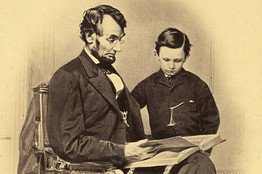
President Lincoln reading the Bible to his son in 1865.Getty Images

If you’re looking for a way to celebrate Presidents Day on Monday, but don’t plan to buy aused car or a new mattress, you could do worse than to spend time reading the Bible. Read more of this post

Seth Klarman Quote On Investing Versus Speculation

Seth Klarman Quote On Investing Versus Speculation

by VW StaffFebruary 12, 2014, 9:58 pm

Investing Versus Speculation From Seth Klarman’s Margin of Safety: Risk-Averse Value Investing Strategies for the Thoughtful Investor

Mark Twain said that there are two times in a man’s life when he should not speculate: when he can’t afford it and when he can. Because this is so, understanding the difference between investment and speculation is the first step in achieving invest-ment success. Read more of this post

Hacking Joins Curriculum as Businesses Seek Cyber Skills: Tech

Hacking Joins Curriculum as Businesses Seek Cyber Skills: Tech

For students of cybersecurity at Switzerland’s 150-year-old ETH university in Zurich, hacking is a legitimate part of the curriculum.

Students learn to infiltrate Internet and mobile networks in classes on “wireless electronic warfare” and “modern malware” designed to prevent computer malfeasance. The number of students enrolled in ETH Zurich’s information security master’s program has more than tripled since 2009, the university said. Read more of this post

Swiss model of vocational education offers lessons for Singapore

Swiss model of vocational education offers lessons for Singapore

ZURICH — Student Mirja Jenzer spends four days a week as an apprentice at a clinic and one day at a vocational school as part ofmedical assistant apprenticeship, instead of plugging away at her studies in a classroom.

BY NG JING YNG –

14 FEBRUARY

ZURICH — Student Mirja Jenzer spends four days a week as an apprentice at a clinic and one day at a vocational school as part of medical assistant apprenticeship, instead of plugging away at her studies in a classroom. Read more of this post

Creativity and hardwork lead to growing empire: The humble beginnings of Cosry Wise (M) Sdn Bhd are truly inspiring, considering the company is currently one of the leading names in Malaysian high fashion.

Updated: Wednesday February 12, 2014 MYT 8:26:48 AM

Creativity and hardwork lead to growing empire

BY ZIEMAN

image003-2

Cosry is owned by Ariff (left) and Putra Aziz, who is the designer

The humble beginnings of Cosry Wise (M) Sdn Bhd are truly inspiring, considering the company is currently one of the leading names in Malaysian high fashion. Read more of this post