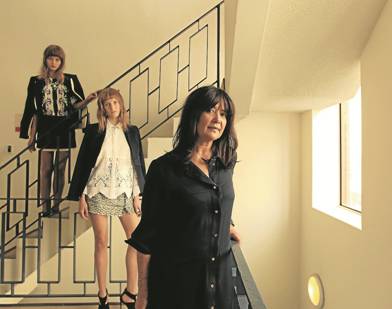
He taught music to actors Ewan McGregor and Daniel Craig in the 1990s and, as director of the Yong Siew Toh Conservatory of Music, is probably the most influential music educator in Singapore today

Led to music by a horse

image003-1

From teaching music to actors such as Daniel Craig, Professor Bernard Lanskey now helps students at the Yong Siew Toh Conservatory of Music pursue their dreams. Read more of this post

Growth Isn’t Over; growth is only being “held back by our inability to process all the new ideas fast enough.”

February 11, 2014, 5:31 PM ET

Growth Isn’t Over

MICHAEL HICKINS

There is a school of thought that economic growth, fueled by innovation, is over. Robert Gordon, a professor at Northwestern University, wrote that “the future of American economic growth is dismal,” in a 2012 article published by The Wall Street Journal. Not everyone is ready to throw in the towel. In a blog post published by TalkingPointsMemo, Professors Erik Brynjolfsson, of the MIT Center for Digital Business, and Andrew McAfee, of the MIT Center for Digital Business, argue that growth is only being “held back by our inability to process all the new ideas fast enough.” Read more of this post

Patience and Thrift by John D. Rockefeller; John D. Rockefeller’s 1941 Speech

Patience and Thrift by John D. Rockefeller

Patience:

All the while, John Rockefeller, with the dogged patience
that would defeat scores of embattled competitors, waited
determinedly in the wings. …

Rockefeller succeeded because he believed in the longterm
prospects of the business and never treated it as a mirage that
would soon fade. Read more of this post

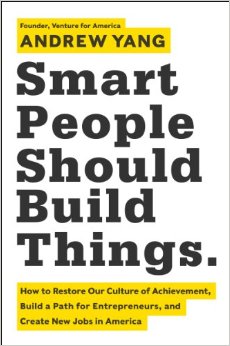
Smart People Should Build Things: How to Restore Our Culture of Achievement, Build a Path for Entrepreneurs, and Create New Jobs in America

Smart People Should Build Things: How to Restore Our Culture of Achievement, Build a Path for Entrepreneurs, and Create New Jobs in America Hardcover

by Andrew Yang  (Author)

image001-6

Andrew Yang, the founder of Venture for America, offers a unique solution to our country’s economic and social problems—our smart people should be building things. Smart People Should Build Thingsoffers a stark picture of the current culture and a revolutionary model that will redirect a generation of ambitious young people to the critical job of innovating and building new businesses. Read more of this post

Beware the Faustian pact of the professions; Doing something with meaning is better for the soul and the economy; But tragically, many intelligent and ambitious young people never pursue such a path in their careers.

February 11, 2014 3:43 pm

Beware the Faustian pact of the professions

By Luke Johnson

I think all humans are born with an innate desire to create. I see the instinct in my children, when they construct miniature worlds with Lego sets. Some of us are lucky enough to exercise such impulses as an adult, either at work or in our hobbies. But tragically, many intelligent and ambitious young people never pursue such a path in their careers. Instead, they enter into a Faustian pact and join one of the well-paid professions such as law, accountancy, banking or management consultancy. For all those bright starters, I suggest they read a new book called Smart People Should Build Things , by ex-corporate attorney Andrew Yang. Read more of this post

The Boss’s Next Demand: Make Lots of Friends

The Boss’s Next Demand: Make Lots of Friends

Companies Harness the Clout of Their Influential Employees

RACHEL FEINTZEIG

Feb. 11, 2014 7:06 p.m. ET

Making friends at the office has never been more rewarding.

Armed with reams of new data, companies including giants Procter & Gamble Co.PG +1.04% and Cisco Systems Inc. CSCO -0.53% are seeking out “influencers,” or those among their employees who are particularly well-connected and trusted by their peers.

Once found, the firms are harnessing these workers’ clout to come up with new products, get workers on board with big changes like mergers, or spread information throughout the organization. Read more of this post

Japanese ‘Beethoven’ Admits Hiring Another Composer to Write Works; Acclaimed composer Mamoru Samuragochi, turns out not to have written some pieces and may not even be deaf.

Japanese ‘Beethoven’ Admits Hiring Another Composer to Write Works

Acclaimed composer Mamoru Samuragochi, turns out not to have written some pieces and may not even be deaf.

ALEXANDER MARTIN

Updated Feb. 6, 2014 4:23 p.m. ET

image001-3

Mamoru Samuragochi was acclaimed for compositions including one being used at a Sochi skating event; Takashi Niigaki says he wrote music for Mr. Samuragochi. Reuters Read more of this post

VCs may have good reason to be biased against Harvard MBAs. And all other MBAs too.

Is Chamath right about HBS entrepreneurs?

By Dan Primack February 10, 2014: 4:13 PM ET

Not too many ‘unicorns’ went to HBS. Or any other business school.

FORTUNE — Venture capitalists are biased against would-be entrepreneurs who went to Harvard Business School.

That was the message imparted top current HBS students at a conference keynote this past weekend by Chamath Palihapitiya, a current venture capitalist and former Facebook (FB) executive. From DealBook: Read more of this post

Bill Gates On Why The World Needs To Be Less Cynical And Start Focusing On Real Problems

Bill Gates On Why The World Needs To Be Less Cynical And Start Focusing On Real Problems

READ THE PHILANTHROPIST’S ANSWERS TO QUESTIONS FROM THE INTERNET ABOUT HIS MYRIAD PROJECTS AROUND THE WORLD–AND IF HE’D BOTHER TO PICK UP A $100 BILL IF HE SAW IT ON THE GROUND.

image001-17

Bill Gates did an informative public Q&A on Reddit yesterday, part of the Internet community’s regular “Ask Me Anything” feature. We learned a lot of quirky tidbits about the world’s biggest philanthropist, including the fact that he hates being called that because many other, less wealthy individuals make much larger personal sacrifices in obscurity. We also learned he’d still pick up a $100 bill if he found one on the street (but he’d donate it), that he considers owning a private airplane his greatest guilty pleasure, and that he won’t try to artificially prolong his life until that’s an option available to most normal people too. He also does the dishes every night. In summary: Bill Gates–a pretty good guy. Read more of this post

Tap Into The 7 Secrets Of Silicon Valley’s Innovation Culture

Tap Into The 7 Secrets Of Silicon Valley’s Innovation Culture

TODAY, COMPANIES CAN CREATE A CULTURE OF VALUE CREATION, NO MATTER WHERE THEY’RE BASED, SOREN KAPLAN WRITES. HERE’S HOW.

WRITTEN BY SOREN KAPLAN

Silicon Valley isn’t just a spot on a map. It’s a brand–a global symbol of enduring innovation.

Mark Zuckerberg moved Facebook from his Harvard dorm room to Silicon Valley. Steve Jobs grew up there. The stereotypical image of theentrepreneurial garage comes from the real one in Palo Alto that housed HP. But what, exactly, makes the Valley tick? And how much of it, if any, can be bottled up and applied outside the area? Read more of this post

In the age of Edmund Burke and Thomas Paine, philosophical arguments could ignite revolutions

Burke and Paine, a rivalry that still reverberates

By Michael Gerson, E-mail the writer

One of the most vivid, outspoken conservatives of our time has the drawback of being a fictional character in a British costume drama, “Downton Abbey.” Here is Lady Violet, dowager countess, sparring with her relentlessly progressive in-law, Isobel Crawley:

Lady Violet: “You are quite wonderful, the way you see room for improvement wherever you look. I never knew such reforming zeal.” Read more of this post

Ugly-Sweater Leadership Moments: Wise leaders actively seek the truth they don’t want to find

Ugly-Sweater Leadership Moments

Posted: February 7, 2014

Susan Cramm, leadership coach, author, and former CFO and CIO, is committed to the principle that the best leaders take care of business by taking care of the people entrusted to their care.

The lead-up to the Olympics brings plenty of opportunities for us all to anticipate, and reflect on, the thrill of victory and the agony of defeat. Life, and leadership, serve them up in large measure. Sometimes, whether we win or lose is out of our hands—but often we play both victim and villain. Read more of this post

Why Is Wrong with Your Business Model?

Why Is Wrong with Your Business Model?

Posted: February 3, 2014

Eric J. McNulty is the director of research at the National Preparedness Leadership Initiative and writes frequently about leadership and resilience.

Do not adjust your computer screen—that’s not a typo in the headline. Your instinct may be to change that why to a what, but why is actually the right question for leaders to ask themselves about their business models. The difference between why and what was nicely articulated by Simon Sinek in a TED Talk a couple of years back and came to mind again recently on the 30th anniversary of the Macintosh computer—Apple is one of the examples Sinek cites of a company that has mastered the why. Read more of this post

Some Key Differences between a Happy Life and a Meaningful Life

Some Key Differences between a Happy Life and a Meaningful Life

Roy Baumeister 

Florida State University – College of Arts & Sciences

Kathleen Vohs 

University of Minnesota, Twin Cities – Carlson School of Management

Jennifer Aaker 

Stanford University – Graduate School of Business

Emily N. Garbinsky 

Independent
October 1, 2012
Stanford Graduate School of Business Research Paper No. 2119

Abstract: 
Being happy and finding life meaningful overlap, but there are important differences. A large survey revealed multiple differing predictors of happiness (controlling for meaning) and meaningfulness (controlling for happiness). Satisfying one’s needs and wants increased happiness but was largely irrelevant to meaningfulness. Happiness was largely present-oriented, whereas meaningfulness involves integrating past, present, and future. For example, thinking about future and past was associated with high meaningfulness but low happiness. Happiness was linked to being a taker rather than a giver, whereas meaningfulness went with being a giver rather than a taker. Higher levels of worry, stress, and anxiety were linked to higher meaningfulness but lower happiness. Concerns with personal identity and expressing the self-contributed to meaning but not happiness. We offer brief composite sketches of the unhappy but meaningful life and of the happy but meaningless life. Read more of this post

Bad is stronger than good.

Bad is stronger than good.

Baumeister, Roy F.; Bratslavsky, Ellen; Finkenauer, Catrin; Vohs, Kathleen D.

Review of General Psychology, Vol 5(4), Dec 2001, 323-370. doi: 10.1037/1089-2680.5.4.323

Abstract

1.       The greater power of bad events over good ones is found in everyday events, major life events (e.g., trauma), close relationship outcomes, social network patterns, interpersonal interactions, and learning processes. Bad emotions, bad parents, and bad feedback have more impact than good ones, and bad information is processed more thoroughly than good. The self is more motivated to avoid bad self-definitions than to pursue good ones. Bad impressions and bad stereotypes are quicker to form and more resistant to disconfirmation than good ones. Various explanations such as diagnosticity and salience help explain some findings, but the greater power of bad events is still found when such variables are controlled. Hardly any exceptions (indicating greater power of good) can be found. Taken together, these findings suggest that bad is stronger than good, as a general principle across a broad range of psychological phenomena.


BILL GATES’ STEVE JOBS MOMENT

BILL GATES’ STEVE JOBS MOMENT

Wednesday, February 5, 2014 — Tweet this article

Steve Jobs and Bill Gates, once pirates, now legends, are forever linked in tech history. You know the lore: both collaborators and competitors in the 80s; Gates dominant in the 90s; Jobs triumphant in the 00s. Their career arcs were different though: Gates went out on top, retiring to a life of philanthropy, while Jobs spent a decade in the wilderness, returning to Apple at its darkest hour and leading it to impossible heights.

It turns out, though, the story may not be over. Read more of this post

Twilight of the Brands; brands have never been more fragile

TWILIGHT OF THE BRANDS

by James SurowieckiFEBRUARY 17, 2014

Twelve months ago, Lululemon Athletica was one of the hottest brands in the world. Sales of its high-priced yoga gear were exploding; the company was expanding into new markets; experts were in awe of its “cultlike following.” As one observer put it, “They’re more than apparel. They’re a life style.” But then customers started complaining about pilling fabrics, bleeding dyes, and, most memorably, yoga pants so thin that they effectively became transparent when you bent over. Lululemon’s founder made things worse by suggesting that some women were too fat to wear the company’s clothes. And that was the end of Lululemon’s charmed existence: the founder stepped down from his management role, and, a few weeks ago, the company said that it had seen sales “decelerate meaningfully.” Read more of this post

Before you can focus your business, you must focus yourself

Before you can focus your business, you must focus yourself

Published 10 February 2014 16:45

New York Times

“On an average day we spend 2.1 hours on distraction,” says Robin Sharma, a best-selling author and personal coach. “We’re distracted by technology every 11 minutes, and it takes us 25 minutes to refocus our minds on the deep, creative work we were doing before we were distracted.” Read more of this post

What 13 highly successful people read before bed

What 13 highly successful people read before bed

Alison Griswold, Business Insider | February 10, 2014 12:09 PM ET
The evening can provide a rare retreat from a jam-packed day for highly successful people.

For many CEOs, execs, and other high achievers, the day begins extremely early and iscrammed with emails, meetings, and events. But the evenings can be a time to unwind. And for those who love to read, there’s no better time to pick up a book or magazine. Read more of this post

Can Mild Electric Current Make People Better at Math? Scientists find mild jolts to the brain may improve performance with numbers

Can Electric Current Make People Better at Math?

Scientists find mild jolts to the brain may improve performance with numbers

SHIRLEY S. WANG

Feb. 10, 2014 8:37 p.m. ET

image001-14

Oxford University research assistant Amar Sarkar wears a cap that provides a type of transcranial electrical stimulation. Frantzesco Kangaris for The Wall Street Journal Read more of this post

Eight Essentials for Scaling Up Without Screwing Up

Eight Essentials for Scaling Up Without Screwing Up

by Robert I. Sutton  |   11:00 AM February 10, 2014

Back in 2006, my colleague Huggy Rao

and I launched an executive education program at Stanford called “Customer-focused Innovation.”  Mornings consisted of lectures and case studies in a traditional classroom in the Stanford Business School; this was the “clean models” part of the program. In the afternoons, we moved the group to the (then) new Hasso Plattner Institute of Design, or “Stanford d.school,” for the “hands on” part. That midday transition could be jarring. The d.school was in a crowded, messy, and rather run-down double-wide trailer in those days. And then there was the fieldwork. That first year, the d.school team (led by Perry Klebahn) sent the executives out to observe and interview customers in BP gas stations. Their assignment was to prototype solutions to problems they heard about, revise them in response to user feedback, and then present them to a demanding group of BP executives. Read more of this post

The brilliance of asking incredibly naïve questions; Most workplace conversations discourage real dialogue — the kind you get when people feel free to challenge plans, ideas, even one another.

The brilliance of asking incredibly naïve questions

February 10, 2014: 12:27 PM ET

Most workplace conversations discourage real dialogue — the kind you get when people feel free to challenge plans, ideas, even one another.

By Megan Hustad

FORTUNE — I was about to get on a conference call and asked the call organizer if he had scheduled a hard stop. No, he said, but he hoped the call would be over in 45 minutes.

The call started, and after 70 minutes I hung up knowing I could always pretend Skype had dropped the call. But no one complained. It seems I wasn’t the only one frustrated. Read more of this post

Use Co-opetition to Build New Lines of Revenue; Examples of high-profile failed business collaborations are everywhere

Use Co-opetition to Build New Lines of Revenue

by Marquis Cabrera  |   1:00 PM February 10, 2014

Examples of high-profile failed business collaborations are everywhere. From the WordPerfect-Novell acquisition that led to bankruptcy, to the misfires of the Target-Neiman holiday experiment, it’s clear that despite the plethora of management literature on how to launch a successful partnership, collaborations often go bust. It turns out, where there is money to be made, self-interest prevails, thus trumping cooperation in the process. Read more of this post

NASA Bets on Private Companies to Exploit Moon’s Resources

NASA Bets on Private Companies to Exploit Moon’s Resources

By Agence France-Presse

 on 4:26 pm February 10, 2014.
NASA — building on successful partnerships with private companies to resupply the International Space Station — is now looking to private entrepreneurs to help exploit resources on the moon. Read more of this post

Woman, 100, still takes care of disabled son, 62

Woman, 100, still takes care of disabled son, 62

image001-11

Tuesday, Feb 11, 2014
The New Paper

She may be 100 years old and weak.

But that has not stopped Madam Meliah Md Diah from looking after her disabled son, 62-year-oldAbdul Rahman Saud. Read more of this post

We were just doing our jobs: Pioneers; Older Singaporeans share about how they got involved in nation building

We were just doing our jobs: Pioneers

Older Singaporeans share about how they got involved in nation building

The Straits Times – February 10, 2014
By: Maryam Mokhtar

MR GOH LYE CHOON: The retired SAF colonel, 73, started the first national service battalion in 1967.

Among the more than 1,000 members of Singapore’s pioneer generation who were at the Istana yesterday morning was an army officer who trained the first SAF regulars and NS men, a hotelier who raised millions for the Community Chest, a teacher, and a prison warden who touched many lives. Read more of this post

I want Zendesk to be truly great. To revolutionise and democratise how customer service is done.

CEO Q&A: Michael Hansen, vice-president and Asia Pacific managing director at Zendesk

Published 10 February 2014 11:04, Updated 10 February 2014 12:09

image003-1

Michael Hansen admires General Sir John Monash as a leader.

What was your first job? Read more of this post

Advice for struggling businesses from Lisa Ho’s administrator

Michael Bailey Deputy editor

Advice for struggling businesses from Lisa Ho’s administrator

Published 07 February 2014 12:24, Updated 08 February 2014 03:44

image001-5

Gray’s Online, which sold Lisa Ho’s last 32 dresses, is also about to sell the fallen fashion empire’s rolls of vintage fabric – including rayon, which is no longer manufactured. Tamara Dean Read more of this post

10 Tips For Raising Happy Kids

10 Tips For Raising Happy Kids

ERIC BARKERBARKING UP THE WRONG TREE
FEB. 9, 2014, 8:53 AM 2,908

When you ask parents what they want for their kids, what’s usually the most common reply? They want their children to be happy.

Via Raising Happiness: 10 Simple Steps for More Joyful Kids and Happier Parents:

the well-being of children is more important to adults than just about anything else–health care, the well-being of seniors, the cost of living, terrorism, and the war in Iraq. More than two-thirds of adults say they are “extremely concerned” about the well-being of children, and this concern cuts across gender, income, ethnicity, age, and political affiliation. Read more of this post

When Linda Farrow founded her eponymous sunglasses brand in 1970 she quickly became one of the hippest names in fashion. Farrow shelved her business in the mid-1980s but since 2003 her son and daughter-in-law have been taking the resurrected label

THE FUTURE’S SO BRIGHT…I GOTTA WEAR SHADES

ARTICLE | 7 FEBRUARY, 2014 11:14 AM | BY TESS DE LA MARE

In their early 20s young couple Simon Jablon (left) and Tracy Sedino had the extraordinary good luck of stumbling across a hoard of vintage glasses – a mixture of Linda Farrow, Jablon’s mother’s former label, and other designer stock. Trainee fashion designer Sedino ditched her plans for further study so she and Jablon could bring the Linda Farrow brand back to life. Read more of this post