Lessons in success from Eton and the Tiger Mother

February 9, 2014 4:17 pm

Lessons in success from Eton and the Tiger Mother

By Lucy Kellaway

Now we know why so many dyslexics and people who lost a parent young make it to the top

Ten days ago my husband went to a reunion at Eton College for the leavers of 1974. About 150 men crowded into the 15th-century chapel to belt out a quick “Praise my Soul the King of Heaven” before settling down to eat, drink and reminisce about schoolboy pranks while quietly trying to work out who had done best in the 40 years since then. Read more of this post

Stop Making Plans: How Goal-Setting Limits Rather Than Begets Our Happiness and Success

Stop Making Plans: How Goal-Setting Limits Rather Than Begets Our Happiness and Success


image002“The job – as well as the plight, and the unexpected joy – of the artist is to embrace uncertainty, to be sharpened and honed by it,”
 Dani Shapiro wrote in her beautiful meditation on the perils of plans. But while embracing uncertainty may be the cure for our epidemic of anxiety and the root of the creative spirit, it remains an art enormously challenging and uneasy-making for the human psyche. Instead, we try to abate the discomfort of uncertainty by making long-term plans and obsessing over everyday to-do lists. Read more of this post

The Psychology of Trust in Life, Learning, and Love

The Psychology of Trust in Life, Learning, and Love

“When you trust people to help you, they often do,” Amanda Palmer asserted in her beautiful meditation onthe art of asking without shame. But what does it really mean to “trust,” and perhaps more importantly, how can we live with the potential heartbreak that lurks in the gap between “often” and “always”? That’s precisely what psychologist David DeSteno, director of Northeastern University’s Social Emotions Lab, explores in The Truth About Trust: How It Determines Success in Life, Love, Learning, and More (public library). Read more of this post

Breakpoint — Bigger is Not Better

Breakpoint — Bigger is Not Better

February 3, 2014 by Shane Parrish

Jeff Stibel

“What is missing—what everyone is missing—is that the unit of measure for progress isn’t size, it’s time.”

Jeff Stibel’s book Breakpoint: Why the Web will Implode, Search will be Obsolete, and Everything Else you Need to Know about Technology is in Your Brain is an interesting read. The book is about “understanding what happens after a breakpoint. Breakpoints can’t and shouldn’t be avoided, but they can be identified.” Read more of this post

Get Some Sleep, and Wake Up the G.D.P.

Get Some Sleep, and Wake Up the G.D.P.

FEB. 1, 2014

image001

By SENDHIL MULLAINATHAN

January is always a good month for behavioral economics: Few things illustrate self-control as vividly as New Year’s resolutions. February is even better, though, because it lets us study why so many of those resolutions are broken. Read more of this post

Shane Parrish’s answer to What are the advantages of reading novels?

Shane Parrish‘s answer to:

Books: What are the advantages of reading novels?

I find many people reading novels like Notebook, P.S. I Love You, Two States, Three Mistakes of my Life etc etc..
What are their advantages that people find out time to read them even in this busy world?
What is the impact on their psychology (incl. brain, memory, IQ etc.) ? Read more of this post

Talent Is Persistence: “I wish the earlier me understood work and practice more. Just the repeated concerted effort to get better at things. I wish I didn’t have the notions of talent and genius I had back then.”

Talent Is Persistence

February 7, 2014 by Shane Parrish

A fantastic interview with filmmaker Kirby Ferguson.

This part hit me.

What would your advice be to the 20-year-old version of you, who’s just starting their career?

I wish I had Everything Is A Remix when I was younger. I wish I knew that you can just start copying other people’s stuff and fiddling with it, and putting stuff into it, and just sort of build from there. It’s okay to be primitive. That’s a perfectly fine way to start making things. Read more of this post

Barry Ritholtz’s motto: ‘Fresh mistakes, every year’

My motto: ‘Fresh mistakes, every year’

By Barry Ritholtz

“More than anything else, what differentiates people who live up to their potential from those who don’t is a willingness to look at themselves and others objectively.”

— Ray Dalio, Bridgewater

Once Again, It Is The Time Of Year When I Look Back At The Various Investing, Trading And Other Mistakes I’ve Made. (Last Year’s Version Is Here; Prior Years Can Be Foundhere). Read more of this post

America, The Startup: How European Settlers Launched The Most Entrepreneurial Economy In The World

America, The Startup: How European Settlers Launched The Most Entrepreneurial Economy In The World

ROB WILE

FEB. 1, 2014, 9:24 AM 10,934 18

EMAIL  MORE

image001-32

Starting a new business is hard.

Building a new industry is even harder. Especially when it’s on the other side of the world.

For nearly a century, exploration of the Americas had been carried out under royal patronage. Whatever spoils were brought back belonged to the crown. Read more of this post

You’d Be Surprised By What Really Motivates Users

You’d Be Surprised By What Really Motivates Users

Posted 22 hours ago by Nir Eyal (@nireyal)

Editor’s note: This article is adapted from Hooked: A Guide to Building Habit-Forming Products, a new book by Nir Eyal and Ryan Hoover.

Earlier this month, Twitter co-founder Biz Stone unveiled his mysterious startup Jelly. The question-and-answer app was met with a mix of criticism and head scratching. Tech-watchers asked if the world really needed another Q&A service. Skeptics questioned how it would compete with existing solutions and pointed to the rocky history of previous products like Mahalo Answers, Formspring, and Aardvark. Read more of this post

Jet Li shares secret to how he won his wife’s heart; “She had many suitors, and I happen to be the least remarkable. Being good at martial arts did not help at all.”

Fri, 07 Feb 2014

Jet Li shares secret to how he won his wife’s heart

image001-30

He may be an accomplished martial artist on the big screen, but in real life, Jet Li struggled for years to perfect the art of courtship.

Recently, the superstar opened up about his marriage and shared the practical promise that won him the hand of his wife, Miss Asia Pageant winner Nina Li, reported Yesky.com via Jaynestars. Read more of this post

Lost in Clinical Translation: What happens when doctors can’t communicate clearly?

FEBRUARY 8, 2014, 2:30 PM  1 Comment

Lost in Clinical Translation

By THERESA BROWN

A classic “Far Side” cartoon shows a man talking forcefully to his dog. The man says: “Okay, Ginger! I’ve had it! You stay out of the garbage!” But the dog hears only: “Blah blah Ginger blah blah blah blah blah blah blah blah Ginger …”

As a nurse, I often worry that patients’ comprehension of doctors and nurses is equally limited — except what the patient hears from us is: “Blah blah blah Heart Attack blah blah blah Cancer.” Read more of this post

Saundra Pelletier, on Embracing ‘Organized Chaos’; “I love organized chaos,” says the C.E.O. of WomanCare Global. “We’re willing to roll and turn and twist and evolve, but some people don’t like that.”

Saundra Pelletier, on Embracing ‘Organized Chaos’

FEB. 8, 2014

Corner Office

By ADAM BRYANT

This interview with Saundra Pelletier, chief executive of WomanCare Global, a nonprofit provider of health care products, was conducted and condensed by Adam Bryant. Ms. Pelletier is also C.E.O. of Evofem Inc., a biotechnology company. Read more of this post

On the Trail of a Scent: A perfumer at International Flavors & Fragrances says it can take from three months to seven years to develop a perfume

On the Trail of a Scent

By PATRICIA R. OLSENFEB. 8, 2014

image001-29

Mr. Gaurin says it can take from three months to seven years to develop a perfume. Michael Nagle for The New York Times

Pascal Gaurin, 44, is a perfumer atInternational Flavors & Fragrances in New York. Read more of this post

How Many Hours Of Minimum Wage Work It Takes To Buy A Beer Around The World

How Many Hours Of Minimum Wage Work It Takes To Buy A Beer Around The World

CHARISMA MADARANGFOODBEAST
FEB. 8, 2014, 8:37 AM 1,373 3

Ever find yourself sitting at your desk, calculating what a day’s work will get you in beers? Of course you have. Gathering data on the average price of a domestic draft beer in different countries and the minimum monthly wage in different parts of the world, Quartz was able to create a comprehensive beer index. Read more of this post

5 Reasons ‘The LEGO Movie’ Is Going To Crush The Box Office This Weekend

5 Reasons ‘The LEGO Movie’ Is Going To Crush The Box Office This Weekend

KIRSTEN ACUNA

FEB. 5, 2014, 12:51 PM 7,151 3

If you have a kid, you’re probably taking them to see “The LEGO Movie” this weekend.

That’s a good bet since the Warner Bros. film based on the brick toys is expected to have a huge opening.

An overwhelming amount of reviews for the film extremely positive. (It currently stands at 96% on Rotten Tomatoes.) Box office estimates are tracking the film to bring in north of $60 million.*  Read more of this post

5 Tough Lessons I Learned At Coding School: You have to possess the ambition to brave the stormy sea, and the patience to sand every splinter off the ship’s deck, only to see those same splinters reappear the next morning

5 Tough Lessons I Learned At Coding School

MICHAEL BRENDAN DOUGHERTYTHE WEEK
FEB. 8, 2014, 10:00 AM 2,135 4

In all likelihood, you shouldn’t learn to code. That is, you should ignore all the tech industry hype-men and silly futurists who say that everyone should learn to create their own software, or that coding is the only way to be free in “the digital age.” Don’t listen when President Obama promotes these fallacies. It’s nonsense. Read more of this post

Search for a Market Niche, and You Might Find a Crowd; For entrepreneurs, an overlooked target market may open broader doors to succ

Search for a Market Niche, and You Might Find a Crowd

By JENNA WORTHAMFEB. 8, 2014

Entrepreneurs have a term for outsized problems they want to tackle or bigger-than-life bets they want to make: “moon shots.” Examples include Google’s driverless cars and Amazon’s delivery-by-drone. Tristan Walker decided that his moon shot would be revolutionizing the skin-care and beauty-product industry for African-Americans. Read more of this post

Two Stanford Professors Have A Fascinating Theory Of Why Businesses Succeed; “Is it more like Catholicism, where the aim is to replicate preordained design beliefs and practices? Or is it more like Buddhism, where an underlying mindset guides why

Two Stanford Professors Have A Fascinating Theory Of Why Businesses Succeed

ALISON GRISWOLD

FEB. 4, 2014, 10:57 AM 22,462 15

In September 2012, Home Depot was in trouble.

The construction and home improvement giant had just announced it would shutter seven big-box outlets in China — the last of the 12 stores it had acquired six years earlier. The company would take an after-tax charge of $160 million and 850 people would lose their jobs. Read more of this post

The founder of Sri Rejeki Isman Textile Group and one of the richest men in Indonesia, H.M. Lukminto, died on Wednesday night, according to family sources in Singapore. He was 67 years old

Sritex Founder Dies of a Heart Attack

By Ari Susanto on 8:58 am February 7, 2014.

Solo. The founder of Sri Rejeki Isman Textile Group and one of the richest men in Indonesia, H.M. Lukminto, died on Wednesday night, according to family sources in Singapore. He was 67 years old. Read more of this post

The mandarin and the teacher: Long-time civil servant Lim Siong Guan talks to Vikram Khanna about Singapore’s generational challenges and the art of leadership

PUBLISHED FEBRUARY 08, 2014

The mandarin and the teacher

Long-time civil servant Lim Siong Guan talks to Vikram Khanna about Singapore’s generational challenges and the art of leadership

image001-24

IT is hard to imagine a career in the Singapore civil service as rich in variety, accomplishment and distinction as that of Lim Siong Guan. In his 37 years in the service, he has held positions at almost all levels. He has been an engineer in the Sewerage Department, started a flying club to groom pilots for the air force, procured tanks and artillery for the military, worked with school teachers and principals to reshape education policy, helped draw up national budgets, promoted innovation in the civil service, pioneered the development of e-services in government and also oversaw Singapore’s investments. Read more of this post

Tan Sri Andrew Sheng: Celebrating Chinese New Ye

Updated: Saturday February 8, 2014 MYT 8:03:43 AM

Celebrating Chinese New Year

BY TAN SRI ANDREW SHENG

image001-23

It is the time for great story-telling

CHINESE New Year is a time for family and friends. The astrologers say the Year of the Horse is supposed to be a sign of activity and surely there will be prosperity for many.

The Chinese zodiac consists of a 12-year cycle with one animal for each year: rat, ox, tiger, rabbit, dragon, snake, horse, goat, monkey, rooster, dog and pig. The CLSA annual tongue-in-cheek Feng Shui Index forecasts that the coming Year of the Wood Horse will be “pure bull from teeth to tail”, with the Hong Kong Hang Seng Index hitting 28,105, compared with the current level of 21,800.

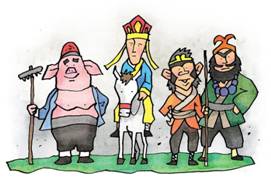
Chinese New Year is basically all about family time, with elders using the occasion to tell stories to the children, with the most popular being those from the Romance of the Three Kingdoms and the Journey to the West. Story telling today is a lost art because children are more entertained by cartoon and movie versions of these stories.

The Journey to the West is one of the most popular classics written in the Ming Dynasty (1368-1644) about the pilgrimage to India of a Chinese monk, Tang Xuanzang (602-664 AD), during the Tang Dynasty (608-907) to learn Buddhism, returning with Buddhist scripts and converting much of China to Buddhism. The novel comprises 100 chapters, which suggests that it is a compilation of episodes told by storytellers who would dramatise the stories with poetry, prose and historical allusions just to create greater appeal to their audience.

The whole journey is shrouded in myth and fantasies, because Xuanzang was accompanied by four disciples, assigned by the diety Guan Yin to protect him during the pilgrimage. The first is the monkey king, Sun Wukong, a clever rascal prone to excesses, against which Guan Yin had to put on him a golden headband, with which Tang could control the monkey if it gets out of hand.

The second disciple is an unfilial dragon transformed into a white horse to serve Tang to atone for the sins of its past life. The third disciple is the greedy pig Zhu Bajie, who is a good fighter, to protect the pilgrims, but spends a lot of time distracted by food and sex. Last is the stalwart Sha Wujing, a sand spirit who is the more serious defender of the monk when Sun Wukong and Zhu Bajie are fooling around elsewhere.

Journey to the West is highly comical, funny and fantastical, enjoyed by children and adults alike. It has been translated into many languages, the most popular in English being the translation by Arthur Waley called Monkey. In his foreword to that translation, the Chinese philosopher Hu Shih claimed it was a book of “profound nonsense”.

Is it such a simple fantasy tale?

I always thought that Journey to the West is a profound, deep allegorical text on the contradictions within the Chinese character, as it melds three key philosophies in China – Buddhism, Confucianism and Taoism.

The appeal of the book lies in the contrast between the monk as a straight, gentle human being, whereas his fantastic and crooked disciples bring out the comic, tragic, sins, virtues, crimes and good deeds – all tests, trials and tribulations that a person seeking enlightenment has to go through.

Life is a journey, with a beginning, middle and an end. But Buddhism and Indian philosophy shares with Taoism and the Book of Change (the earliest Chinese philosophy) the idea of a karmic cycle, that we transcend from one life to another – in other words, an unending journey.

The book begins not with the monk’s journey, but the birth of the monkey, aptly named Wukong, meaning an awakening or enlightenment to the emptiness of mind, when one realises the meaning or meaninglessness of human desire.

At the beginning, the monkey is wild, combative and destructive, wreaking havoc in heaven, but in the end, he realises that he cannot escape Buddha’s hand – the all-reaching compassion of enlightenment and one’s fate.

Like all good stories with good endings, the book ends with Xuanzang and the monkey attaining Buddha status, as well as rewards and recognition for the other pilgrims.

Various experts have pointed out the deep meaning and numerology in various parts of the book. Xuanzang or sometimes called Sanzang (Tripitaka) means the three collections of Buddhist sacred texts that he brought back from India. Zhu Bajie means Eight Sins or forbidden things. Three and Eight are good numbers for Chinese.

In advance of the Third Plenum last October, the Development Research Centre of the Chinese State Council gave an introduction to the reform intentions through what is popularly known as the “383 plan”.

The plan is called 383, because it highlights the key relationships between the state, market and enterprises. There are eight key areas of reform: governance, competition policy, land, finance, public finance, state assets, innovation, and liberalisation of international trade and finance. Finally, there are three correlated goals: reducing external imbalances, building social inclusiveness, and improving governance through tackling inefficiency and corruption.

I wonder whether it is a coincidence that the 383 plan seems like China’s newJourney to the West. If it is anything like the classic, the new journey will be full of drama, twists and turns and never boring.

The Year of the Horse is half-way through the 12-year cycle, marking the beginning of the second half. The first half began with the Year of the Rat (2008), a year of crisis in the West, but one of the fastest growth period for China and indeed many emerging markets, partly the result of quantitative easing in the West.

Will the next six years involve a period of slower growth, less tumultuous and perhaps more stable?

Only time will tell.

The journey of a thousand miles begins with the first step. Every day, every year begins anew with the first step. Gong Xi Fa Cai to all who celebrate Chinese New Year.

Tan Sri Andrew Sheng is president of the Fung Global Institute.


Using data to pick the optimal start-up name? Whatever you do, don’t pick a name that starts with the letter J. Or K. Or Q. Instead, favor names beginning with T, O and A.

Using data to pick the optimal start-up name?

February 7, 2014: 5:04 PM ET

When analyzing data, be careful not to confuse correlation for causation.

By Tomasz Tunguz, contributor

FORTUNE — Naming your startup can be one of the hardest things to do when starting a company. Each founder must agree. The domain must be available to buy. Lastly, and perhaps most importantly, investors need to like it because the first letter of startup’s name has meaningful impact on how easily the company will be able to raise money. Read more of this post

Secrets of the Brain: New technologies are shedding light on biology’s greatest unsolved mystery: how the brain really works.

Published: February 2014

Secrets of the Brain: New technologies are shedding light on biology’s greatest unsolved mystery: how the brain really works.

By Carl Zimmer

Van Wedeen strokes his half-gray beard and leans toward his computer screen, scrolling through a cascade of files. We’re sitting in a windowless library, surrounded by speckled boxes of old letters, curling issues of scientific journals, and an old slide projector that no one has gotten around to throwing out.

“It’ll take me a moment to locate your brain,” he says. Read more of this post

Your Weakness May Be Your Competitive Advantage

Your Weakness May Be Your Competitive Advantage

by Dorie Clark  |   9:00 AM February 5, 2014

Midway through the workshop I was teaching on professional reinvention, I gave participants an assignment: create a narrative citing your professional strengths. After the break, a woman named Alison raised her hand. “This one was difficult for me,” she said. “I thought about what was special about me: I’m a strategic thinker, and I can get things done. But other people can do that, too. I’m not sure how I can really stand out as I’m applying for jobs.” She isn’t alone. For many of us, it’s hard to identify exactly what about us — if anything — is valuable or unique. Read more of this post

The First Strategic Question Every Business Must Ask: What business are you in? It seems like a straightforward question, and one that should take no time to answer

The First Strategic Question Every Business Must Ask

by Anthony K. Tjan  |   8:00 AM February 6, 2014

What business are you in?  It seems like a straightforward question, and one that should take no time to answer.  But the truth is that most company leaders are too narrow in defining their competitive landscape or market space.  They fail to see the potential for “non-traditional” competitors, and therefore often misperceive their basic business definition and future market space. Read more of this post

It’s Time to Put Your Strategy on a Diet

It’s Time to Put Your Strategy on a Diet

by Nick Tasler  |   12:00 PM February 5, 2014

David Packard once famously quipped, “More companies die from overeating than starvation.” As it turns out, recent studies about dieting show that Packard’s clever metaphor might be more instructive than he ever imagined — and they can provide modern leaders with important lessons about planning and strategy. Read more of this post

How Microsoft Avoided the Peter Principle with Nadella

How Microsoft Avoided the Peter Principle with Nadella

by Dennis Carey and Michael Useem  |   9:25 AM February 6, 2014

In one of the most widely scrutinized CEO successions ever, Microsoft directors selected insider Satya Nadella to run the company, only their third CEO pick in the firm’s nearly 40-year history.  His challenges will be enormous. For starters, he will be running a $75 billion+ enterprise with some 100,000 employees, an army of software engineers and many moving parts. For finishers, he will have to change its treads—redirect its strategy—while barreling down a highway with no map for what lies ahead. Read more of this post

Scaling Up is a Problem of Both More and Less

Scaling Up is a Problem of Both More and Less

by Robert I. Sutton  |   8:00 AM February 7, 2014

Huggy Rao and I like to refer to scaling challenges as the “Problem of More” because they always involve getting some existing seed of excellence to take root in more people and more places. The language of “more” pervades discussions of the topic. Ask any group of executives or nonprofit leaders about scaling, run a web search on “scaling” or “taking to scale,” pore over articles, cases, or research on the topic, you’ll find the dominant words and phrases have to do with addition and multiplication: grow, expand, propagate, replicate, amplify, amass, clone, copy, enlarge, magnify, incubate, accelerate, multiply, roll it out to the masses, and so on. Read more of this post

Develop Strategic Thinkers Throughout Your Organization

Develop Strategic Thinkers Throughout Your Organization

by Robert Kabacoff  |   9:00 AM February 7, 2014

In study after study, strategic thinkers are found to be among the most highly effective leaders. And while there is an abundance of courses, books, articles and opinions on the process of strategic planning, the focus is typically on an isolated process that might happen once or twice per year. In contrast, a true strategic leader thinks and acts strategically every day. Read more of this post