New blood
Roger Parloff
@FortuneMagazine
JUNE 12, 2014, 7:37 AM EDT
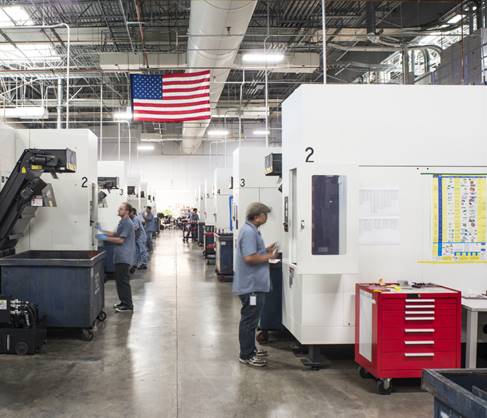
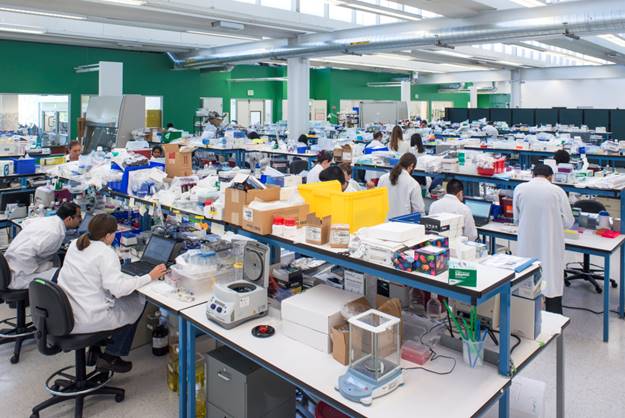
Production in Theranos’s 262,000-square-foot manufacturing facility in Newark, Calif. ; Laboratory scientists perform biochemical experiments in a Theranos R&D lab in Palo Alto.


Elizabeth Holmes founded her revolutionary blood diagnostics company, Theranos, when she was 19. It’s now worth more than $9 billion, and poised to change health care.
In the fall of 2003, Elizabeth Holmes, a 19-year-old sophomore at Stanford, plopped herself down in the office of her chemical engineering professor, Channing Robertson, and said, “Let’s start a company.”
Robertson, who had seen thousands of undergraduates over his 33-year teaching career, had known Holmes just more than a year. “I knew she was different,” Robertson told me in an interview. “The novelty of how she would view a complex technical problem–it was unique in my experience.”
Holmes had then just spent the summer working in a lab at the Genome Institute in Singapore, a post she had been able to fill thanks to having learned Mandarin in her spare hours as a Houston teenager. Upon returning to Palo Alto, she showed Robertson a patent application she had just written. As a freshman, Holmes had taken Robertson’s seminar on advanced drug-delivery devices–things like patches, pills, and even a contact-lens-like film that secreted glaucoma medication–but now she had invented one the likes of which Robertson had never conceived. It was a wearable patch that, in addition to administering a drug, would monitor variables in the patient’s blood to see if the therapy was having the desired effect, and adjust the dosage accordingly.
“I remember her saying, ‘And we could put a cellphone chip on it, and it could telemeter out to the doctor or the patient what was going on,’ ” Robertson recounts. “And I kind of kicked myself. I’d consulted in this area for 30 years, but I’d never said, here we make all these gizmos that measure, and all these systems that deliver, but I never brought the two together.”
Still, he balked at seeing her start a company before finishing her degree. “I said, ‘Why do you want to do this?’ And she said, ‘Because systems like this could completely revolutionize how effective health care is delivered. And this is what I want to do. I don’t want to make an incremental change in some technology in my life. I want to create a whole new technology, and one that is aimed at helping humanity at all levels regardless of geography or ethnicity or age or gender.’ ”
That clinched it for him. “When I finally connected with what Elizabeth fundamentally is,” he says, “I realized that I could have just as well been looking into the eyes of a Steve Jobs or a Bill Gates.”
With Robertson’s blessing, Holmes started her company and, a semester later, dropped out to pursue it full-time. Now she’s 30, and her private, Palo Alto-based corporation, called Theranos–the name is an amalgam of the words “therapy” and “diagnosis”–has 500 employees and has raised more than $400 million from equity sales to investors who have effectively valued the company at more than $9 billion. All these numbers, confirmed to me by an outside director, are being published here for the first time. Though Theranos is largely unknown even in Silicon Valley, that is about to change.
“This is about being able to do good,” Holmes says to me about her company. “And it’s about being able to change the health care system through what we believe this country does so well, which is innovation and creativity and the ability to conceive of technology that can help solve policy challenges.”
At first glance it’s hard to see the connection between the patch that wowed Robertson and what Theranos does now. But as we will see, to Holmes they are simply different “embodiments” of the same core insights.
Theranos today is a potentially highly disruptive upstart in America’s $73 billion diagnostic-lab industry, which performs nearly 10 billion tests a year and is estimated to provide the basis for about 70% of doctors’ medical decisions. Medicare and Medicaid each pay roughly $10 billion annually on reimbursements for these tests.
Theranos runs what’s called a high-complexity laboratory, certified by the federal Centers for Medicare & Medicaid Services (CMS), and it is licensed to operate in nearly every state. It currently offers more than 200–and is ramping up to offer more than 1,000–of the most commonly ordered blood diagnostic tests, all without the need for a syringe.
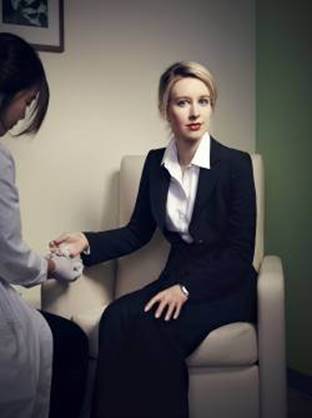
Theranos’s tests can be performed on just a few drops of blood, or about 1/100th to 1/1,000th of the amount that would ordinarily be required–an extraordinary potential boon to frequently tested hospital patients or cancer victims, the elderly, infants, children, the obese, those on anticoagulants, or simply anyone with an aversion to blood draws. Theranos phlebotomists–technicians licensed to take blood–draw it with a finger stick using a patented method that minimizes even the minor discomfort involved with that procedure. (To me, it felt more like a tap than a puncture.)
The Theranos “wellness center” at the Walgreen’s drugstore in downtown Palo Alto. Theranos’s prices for tests are often a half to a quarter of independent lab prices and a quarter to a tenth of hospital lab prices. Photograph by Drew Kelly for Fortune
The company has performed as many as 70 different tests from a single draw of 25 to 50 microliters collected in a tiny vial the size of an electric fuse, which Holmes has dubbed a “nanotainer.” Such a volley of tests with conventional techniques would require numerous tubes of blood, each containing 3,000- to 5,000-microliter samples.
The fact that Theranos’s technology uses such microscopic amounts of blood should eventually allow physicians far greater latitude when ordering so-called reflex tests than they have previously enjoyed. With reflex testing, the physician specifies that if a certain test comes up abnormal, the lab should immediately perform follow-up tests on the same sample to pinpoint the cause of the abnormality. Reflex testing saves patients the time, inconvenience, cost, and pain of return doctor visits and additional blood draws.
The results of Theranos’s tests are available within hours–often matching the speed of emergency “stat” labs today, though stat labs, which are highly inefficient, can usually perform only a limited menu of maybe 40 tests.
Most important, Theranos tests cost less. Its prices are often a half to a quarter of what independent labs charge, and a quarter to a 10th of what hospital labs bill, with still greater savings for expensive procedures. Such pricing represents a potential godsend for the uninsured, the insured with high deductibles, insurers, and taxpayers. The company’s prices are set to never exceed half the Medicare reimbursement rate for each procedure, a fact that, with widespread adoption, could save the nation billions. The company also posts its prices online, a seemingly obvious service to consumers, but one that is revolutionary in the notoriously opaque, arbitrary, and disingenuous world of contemporary health care pricing.
Precisely how Theranos accomplishes all these amazing feats is a trade secret. Holmes will only say–and this is more than she has ever said before–that her company uses “the same fundamental chemical methods” as existing labs do. Its advances relate to “optimizing the chemistry” and “leveraging software” to permit those conventional methods to work with tiny sample volumes.
The scale of Theranos’s operations at the moment is modest. Its phlebotomists currently take physician-ordered blood draws (and saliva, urine, feces, and other samples) at collection centers the company operates at its headquarters in Palo Alto and at 21 Walgreens–one in Palo Alto and the rest in Phoenix. But these are only the advance guard in a gradual national rollout that Walgreens committed to last September; it plans to establish Theranos outposts in a substantial percentage of its 8,200 drugstores in all 50 states. It is the first step in Holmes’s audacious plan to place a Theranos center within five miles of almost every American and within one mile of every city dweller. Walgreens CEO Greg Wasson told me in an interview that he hopes to eventually put them in the pharmacies of the company’s European partner chain, Alliance Boots, as well.
At least as significant, three hospital groups are now working closely with Theranos with the aim of deploying its lab services–UCSF Medical Center in San Francisco, Dignity Health’s 17-state hospital group, and Intermountain Healthcare’s 22-hospital system in Utah and Idaho.
“I just think this is so exciting,” says Mark Laret, the CEO of UCSF Medical Center, about what he’s seen so far. “I mean, here it is. This is the true transformation of health care, right here in front of us.”
“The first time I heard about this, I thought it was snake oil and mirrors,” says David Helfet, the chief of orthopedic trauma at the Hospital for Special Surgery in Manhattan. But after reviewing voluminous validation studies supplied to him by the company, he has become a believer and is urging his hospital to consider adoption.
“It’s real data,” he says. “It’s not their interpretation.” (Theranos has invited Helfet to join its medical advisory board, he says, but he has not yet decided whether to do so.)
Helfet sees an opportunity to enlist Theranos lab services in the identification of so-called hospital-acquired infections–a major scourge in health care today. Conventional methods of identifying germs and figuring out which antibiotics will combat them–growing bacteria on agar in petri dishes–can require three to five days, during which patients languish in hospital beds, take ineffective antibiotics, and incubate antibiotic-resistant bacteria. Using DNA profiling Theranos can, for less than the cost of the conventional tests, identify a bug and its resistance profile within four hours, says Helfet, according to the data he has seen.
“That would be huge,” he says. “That would change the way we practice medicine.” (Though Theranos did not invent DNA testing of this kind, Holmes says, it has found ways to make it cost-efficient.)
Importantly, it’s not just the blood draws that are tiny. It’s also the analytical systems Theranos uses to perform the tests. They take up a small fraction of the footprint required by a conventional lab today.
“It takes at least 10 times–and maybe 100 times–less space for doing the same thing,” says Laret of UCSF Medical Center. That makes it possible to imagine one day placing Holmes’s labs right by the operating rooms in hospitals or in military evacuation helicopters or on ships and submarines or in refugee camps or in tents in the African bush. (The analyzers look like large desktop computer towers. Holmes declines to explain how they work, or even allow them to be photographed, citing the need to protect trade secrets. The company manufactures them at an unmarked facility I toured in a research park across the South Bay from Palo Alto, in Newark, Calif.)
What do incumbent players in the blood-diagnostic space think about all of this? The most frequent criticism is that Theranos is using purportedly breakthrough technology to perform tests that are relied on for life-and-death decisions without having first published any validation studies in peer-review journals. “I don’t know what they’re measuring, how they’re measuring it, and why they think they’re measuring it,” says Richard Bender, an oncologist who is also a medical affairs consultant for Quest Diagnostics, the largest independent diagnostic lab.
Holmes counters that because, as noted, her tests employ “the same fundamental chemical methods” as existing tests, peer-review publication of validation studies is both unnecessary and inappropriate.
The backdrop for this dispute is an unusual regulatory structure that does, in fact, confer upon some–though not all–conventional lab tests an extra layer of validation that Theranos’s do not yet have. Most labs, like Quest and Laboratory Corp. of America, perform many of their routine tests using analyzers they buy from medical-device manufacturers, like Siemens, Olympus, and Beckman Coulter. Before those manufacturers can sell such equipment, they must obtain U.S. Food and Drug Administration approval for the tests those analyzers perform–a process that is in addition to, and more searching than, the audits and proficiency tests required to win CMS certification for the lab itself.
At the same time, for other procedures conventional labs will devise their own lab-developed tests, or LDTs, which they do not have cleared by the FDA. While the FDA takes the position that it could require approval for LDTs, for many years it has said it would forgo that right in the exercise of its “enforcement discretion.”
Theranos, which does not buy any analyzers from third parties, is therefore in a unique position. While it would need FDA approval to sell its own analyzers to other labs, it doesn’t do that. It uses its analyzers only in its own CMS-certified lab. All its tests are therefore LDTs, effectively exempt from FDA oversight.
Holmes sees no basis for criticizing Theranos for acting within this framework, since no other labs seek FDA approval of their own LDTs. “Existing labs use thousands of assays that are neither FDA approved nor peer reviewed,” she says, referring to their LDTs. (In fact, the American Clinical Laboratory Association, the trade group for traditional diagnostic labs, adamantly opposes any effort by the FDA to start requiring approval of LDTs and even takes the position that the FDA lacks legal authority to do so.)
Moreover, Holmes stresses, Theranos is currently seeking FDA clearance for every one of its tests, even though it’s under no legal obligation to do so. (She has submitted many hundreds of pages of validation data in this effort, and has shown much of that data to Fortune.) Theranos may, in fact, be the only lab to have ever sought FDA clearance for LDTs.
Beyond the validation disputes, skeptics also question Theranos’s business model. They doubt its ability to scale up anytime soon to the levels necessary to become a serious competitor, especially since the business has so many unglamorous aspects unrelated to testing–billing, customer service, sorting, regulatory compliance, and the logistics of transporting samples from physicians to labs. Quest, for instance, employs 45,000 people; owns a fleet of 3,000 vehicles and 20 airplanes; and runs eight regional hub labs, 150 satellite labs, and 2,200 patient service centers.
Critics are likewise puzzled by the cosmic vastness of Holmes’s end-to-end business model. If Theranos is making breakthrough analyzers, they wonder, why doesn’t it just sell them to existing labs? To these critics, for Theranos to compete in the lab business itself while making all its own analyzers sounds implausible, if not crazy–like FedEx trying to manufacture all its own airplanes and trucks.
Still, Holmes has convinced a lot of people that she’s onto something. She has assembled what, in terms of public service at least, may be the single most accomplished board in U.S. corporate history. It includes former U.S. Secretary of State, Treasury, and Labor George Shultz; former Secretary of Defense Bill Perry; former Secretary of State and National Security Adviser Henry Kissinger; and former U.S. Senators Sam Nunn and Bill Frist (who is also a heart transplant surgeon), among others.
As a bonus, board meetings are also attended by the company’s de facto legal adviser at large, trial lawyer David Boies. At 73, Boies may be the most eminent living trial lawyer, when one tallies up such cases as his civil antitrust prosecution of Microsoft from 1998 to 2000, his role in the historic Bush v. Gore matter of 2000, and his fight to legalize same-sex marriage.
Because of his admiration for Holmes and what her company is trying to do, Boies says, he agreed to represent Theranos personally in its first challenge from patent holders claiming infringement–something of a coming-of-age ritual for tech startups. In a rare if not unprecedented rout this past March, the patent holders unconditionally surrendered midtrial, stipulating to the invalidity of their own patent. As a kicker they agreed–though the presiding judge would have been powerless to order such a thing himself–to bring no additional patent suits against Theranos for five years.
Though Holmes faces enormous challenges, she seems to consistently attract the service of extraordinary people and to inspire extraordinary fealty in them.
“She really does want to make a dent in the universe–one that is positive,” says retired U.S. Marine Corps Gen. James Mattis, explaining why he signed up last fall as another of Theranos’s strikingly illustrious outside directors. Mattis had stepped down just months earlier as commander of the U.S. Central Command–the chief of U.S. military operations in the Middle East and Central Asia, including Afghanistan–a post he had taken over from David Petraeus in 2010.
“The strength of the leader’s vision in the military is seen as the critical element in that unit’s performance,” Mattis says. “I wanted to be around something again that had that sort of leadership.”
In a conference room at her 140,000-square-foot, open-floor-plan headquarters at the Stanford Research Park–a former home to Facebook and, before that, to the iconic Palo Alto tech firm Hewlett-Packard–Holmes grips a plastic cup of unappetizing green juice. Her first of the day, it is made from spinach, parsley, wheatgrass, and celery. Later she’ll switch to cucumber. A vegan, she long ago dropped coffee in favor of these juices, which, she finds, are better able to propel her through her 16-hour days and seven-day weeks.
She admits–laughing nervously at the eccentricity of it–that after a meal she sometimes examines a drop of her own or others’ blood on a slide, and says she can observe the difference between when someone has eaten something healthy, like broccoli, and when he’s splurged on a cheeseburger. When we dine one night at an Italian place downtown with $14 pastas, the manager knows what she’ll have: a spartan, dressing-less mixed salad and an oil-free spaghetti with tomatoes, prepared from whole-wheat noodles she has provided the restaurant in advance, since it doesn’t stock them. No wine.
During my four days at Theranos, Holmes dressed identically every day: black jacket; black mock turtleneck; black slacks with a wide, pale pinstripe; and black low-heel shoes. Steve Jobs, because of his vision and perfectionism about “great products”–words Holmes punches out with precisely Jobs’ brio–is obviously a hero to her. As an apparent memento mori, she hangs in her office a framed screenshot of his Apple Internet bio, printed out on Aug. 24, 2011, the day he stepped down as CEO because of pancreatic cancer.
From still photos of Holmes herself–young, blond, and blue-eyed–cynics might be excused for thinking, “Oh, I get it. I see why all these geezers are gushing about her company.”
And from small talk with her, one might still wonder what all the fuss was about. She is polite and soft-spoken. She listens. She laughs naturally at other people’s jokes and doesn’t try to trump them. Her voice is lower pitched than you might expect, but that’s about all you notice at first. That, and her youth.
“She looks like 19,” says board member Henry Kissinger, 91.
Asked to assess her as a leader–because he’s seen a few–he responds, “I can’t compare her to anyone else because I haven’t seen anyone with her special attributes. She has iron will, strong determination. But nothing dramatic. There is no performance associated with her. I have seen no sign that financial gain is of any interest to her. She’s like a monk. She isn’t flashy. She wouldn’t walk into a room and take it over. But she would once the subject gets to her field.”
And she does, when she begins explaining to me the “mission.”
“Consumerizing this health care experience is a huge element of our mission,” Holmes says at our first meeting in April, “which is access to actionable information at the time it matters.” In our conversations over the next two months, she comes back to that phrase frequently. It is the theme that unifies what had seemed to me, at first, a succession of diverse, disparate aspects of her vision.
“There’s a lot of ways we’ve focused on access,” she explains, including the use of the minimally invasive finger stick, the affordability, the convenience of a drugstore location. The Walgreens “wellness centers,” as they are called, are open evenings and weekends so that people won’t have to miss work to get their blood test done. Each center is, within its Walgreens, an oasis, playing calming music–vaguely Eastern recorder melodies when I was there–and displaying nature scenes over a high-def LCD monitor (an aquarium video, in my case). The phlebotomist envelops the patient’s finger in a cozy, warming wrap, massages it with a soothing, milking motion, then pulls the trigger on an unusually shallow, narrow-gauge lancet.
“Anywhere from 40% to 60% of people, when they’re given a requisition by a doctor to go get tested, don’t,” asserts Holmes, “because they’re scared of needles or the locations are inconvenient or the cost is too high. And if you’re not even getting tested, how is it possible that we’re going to move toward an era of preventive medicine?”
Preventive medicine–and this relates to the “at the time it matters” portion of her mission statement–is crucial to the mission. She is making diagnostic testing so accessible in all these different ways precisely so that people can eventually do it more often, almost the way they might use a bathroom scale to watch their weight.
Today people might have their blood tested once a year, she explains. They get a snapshot of certain key values and learn whether they are “in range”–that is, statistically normal–or “out of range.” But if they were tested more often, they would begin to see a “movie” of what’s going on inside them. Sudden, rapid changes in some protein concentration–even when technically still in range–could tip off the doctor that something was amiss, and do so before it was too late to address the problem. (Theranos plans soon to display results in a way that maps them against all previous results from tests it has performed for that patient.)
“The movie goal is absolutely core to what we’re working to do,” she says. “When you have that trend, it is a much more meaningful clinical data set for the physician to use.”
She knows that, she says, “because we’ve seen it.” She’s referring to the fact that since 2005 Theranos has been doing work for major pharmaceutical companies, including Pfizer and GlaxoSmithKline, that are conducting clinical drug trials. Early on it was a way for the company, working under confidentiality agreements, to stealthily refine its technology while earning revenue needed to build out infrastructure. Theranos would test drug-trial subjects three times a week–which wouldn’t have been feasible using venipuncture–and catch adverse drug effects quickly, before they became dangerous.
“We’re building an early-detection system,” she explains. “I genuinely don’t believe anything else matters more than when you love someone so much and you have to say goodbye too soon. I deeply believe it has to be a basic human right for everybody to have access to the kind of testing infrastructure that can tell you about these conditions in time for you to do something about it. So that’s what we’re building.”
Holmes was born in February 1984 in Washington, D.C. Her father, Christian Holmes IV, has devoted most of his life to public-minded government service–disaster relief in Africa, international development projects in China, environmental work in this country–and is currently the global water coordinator for the U.S. Agency for International Development. He met Elizabeth’s mother, Noel, on Capitol Hill, where she worked as a congressional committee staffer.
When she was young, Elizabeth read a biography of her great-great-grandfather, the first Christian Holmes, who was a decorated World War I veteran, engineer, inventor, and surgeon after whom a hospital at the University of Cincinnati Medical Center is named. When she was 8, her family took a trip there to see a display about him.
“He ultimately worked himself to death,” Elizabeth tells me–he died at 62–“but he was so passionate in what he did. I wondered, Would I want to be a doctor?”
But she soon discovered she couldn’t handle the sight of blood, even fainting when friends arranged an opportunity for her to watch some surgeries performed. Though her parents remember Elizabeth as a fearless child, the lone exceptions, they say, were getting shots and enduring blood draws.
“The concept of sticking a needle into you and sucking your blood out,” Holmes says, has always been profoundly disturbing to her. As a child, she says, “when I knew I needed to get a test, I would really be focused on that for weeks in advance.” As an adult, she refused to get them. In fact, the last time she endured a venipuncture was in 2007, she says, when her board demanded that she get key-man insurance.
When Elizabeth turned 9, her father took a private sector job with the industrial conglomerate Tenneco. He went to Houston to find a house for the family to move into. He remembers feeling guilty about forcing Elizabeth and her younger brother, Christian Holmes V, to uproot themselves from their happy lives in D.C. So he was profoundly touched when he got a letter from Elizabeth reassuring him that “I love adventures,” that she was looking forward to having “new ones in Texas,” especially since Texas was “big on science.” But the most striking thing about his 9-year-old’s “Dear Daddy” letter was its first sentence: “What I really want out of life is to discover something new, something mankind didn’t know was possible to do,” she wrote.
Elizabeth and her brother–who is now director of product management at Theranos–had both been intrigued by their father’s work in China. So when Elizabeth was about 9, her parents found them both a tutor to teach them Mandarin on Saturdays. Elizabeth then supplemented those lessons with summer language programs at Stanford and, later, at two universities in Beijing. Captivated by computer programming in high school, she was struck by how the Chinese universities’ information technology facilities lagged behind what she was used to. To rectify that situation, she started her first business while still in high school, selling C++ compilers to Chinese universities.
Whether it grew out of her father’s experiences at Tenneco or family lore–they are descendants of a founder of the Fleischmann’s Yeast company–Elizabeth grew up admiring private industry. “At a relatively early age I began to believe that building a business was perhaps the greatest opportunity for making an impact,” she says, “because it’s a tool for making a change in the world.”
Holmes was admitted by early decision to Stanford. As she headed off to college, her father gave her a copy ofMeditations, by the Roman emperor and Stoic philosopher Marcus Aurelius. “I wanted it to reinforce the message of a purposeful life,” her father explained to me. “I think it really affected her.”
Upon admission, Holmes was named one of an elite group of freshmen denominated “president’s scholars,” which meant that Stanford would spot them $3,000 each to use on a research project. While still a freshman, Holmes persuaded her chemical engineering professor, Robertson, to let her use the stipend for a research project in his lab, though it would mean working mainly alongside Ph.D. candidates.
That summer she departed for Singapore to work in the lab at the Genome Institute, which was developing novel systems to detect the SARS virus in blood or nasal swabs. “I had not had much formal biology training,” Holmes recalls, so she had to bring herself up to speed in that respect on her own. At the same time, her engineering and technology background at Stanford led her to believe that “there were much better ways to do” the tests she saw being performed at the institute.
As soon as she got back to the U.S., Holmes started writing a patent application embodying the ideas set in motion by that experience. “I saw her sit down at the computer, and for five to six days she barely got up,” recalls her mother, Noel. “I would bring her food occasionally, and she slept maybe one or two hours a night for five nights.”
The day after Elizabeth finished the draft, Noel started driving her from Houston to Stanford, hoping to enjoy some mother-daughter quality time. But Elizabeth just slept for two days in the car.
Noel and Chris knew then that Elizabeth wanted to start a business, though they didn’t understand the details. It therefore came as no shock the following semester when she told them she needed to suspend college to pursue the company full-time. They let her take the money they’d saved for her education and put it into her business.
“What do you want for your children?” says Noel. “You want them to do something they’re passionate about. To follow their dream. To help people. To change the world. So we said, ‘Of course. Go do this.’”
In what respect, then, does Holmes’s first patent application–the wearable patch that would radio the doctor what is going on in your blood in real time–lead to Theranos, a player in the $73 billion diagnostic lab business?
When one returns to her core mission–making actionable information accessible at the time it matters–one glimpses part of what she means. The patch permitted physicians and patients to see the “movie” of what was going on inside patients’ blood. The original name for her company was Real-Time Cures, though she soon scratched that, after deciding that too many people had a “cynical” reaction to the word “cure.”
“Elizabeth has had a very clear vision of where she wanted to take this since the time I met her,” says Sunny Balwani, who met her in 2002 and has been Theranos’s president since 2009. “The business strategy, the tactics of what to do first, what to offer when–that has changed, but the overall goal and direction has been linear.” Balwani, who founded and sold his own e-commerce company in the 1990s, is an expert in building software products.
For 10 years Holmes patiently raised money and refined her technologies. As much as she needed money, she turned down many offers, she says, because so many investors wanted quick returns.
“Too often the question is, What’s your exit strategy?” she recounts, “before you’re really understanding what your entry strategy is.” She is building a company, she explains, that “30, 40, even 50 years from now will be defining new standards in terms of the way in which people will be able to get access to actionable information.”
Early investors included venture capitalists Draper Fisher Jurvetson (which has funded Tesla and SpaceX), ATA Ventures, Silicon Valley legend Don Lucas Sr. (Oracle, National Semiconductor, Macromedia), and Oracle’s Larry Ellison. She will not identify later investors other than to say they include private equity funds and “strategic partners,” by which she means “entities working with the company as we scale.” Though she has now raised more than $400 million, she says she has retained control over more than 50% of the stock.
All the while, Holmes has continued to invent and to upgrade her earlier inventions. “As she likes to put it,” says board member Shultz, “the best patent is making yourself obsolete. So the person who steals your patent steals yesterday’s technology.”
Today Holmes is a co-inventor on 82 U.S. and 189 foreign patent applications, of which 18 in the U.S. and 66 abroad have been granted. Those are in addition to another 186 applications Theranos has filed worldwide that don’t list Holmes as an inventor, of which 18 have already been granted.
Although I believe Balwani when he says that Holmes’s “overall goal and direction” for the company “has been linear,” I don’t believe that Walgreens wellness centers represent the ultimate target of that vector. There are pieces of the puzzle we haven’t seen yet. In some cases she may be waiting for regulatory approval, while in others she may just be waiting, like Steve Jobs, to finish perfecting her next “great product” before unveiling it with a flourish.
As Holmes relentlessly pursues the next “embodiment” of her vision, her old chemical engineering professor, Robertson, sits about 20 yards from her office, helping her. After years of volunteer service to the company as a director, he became a paid consultant in 2009. Last June he signed up as an employee.
“I gave up two endowed chairs to do this,” he says. “I think that’s a statement.”
Then he adds, “To me, I wish I wasn’t 70 years old. I wish I was her age and could be in on this. Because this is going to be a long, exciting, fascinating, exhilarating ride.”



 Bamboo Innovator