Six Steps To Becoming Hyper-Efficient

Six Steps To Becoming Hyper-Efficient

GWEN MORANENTREPRENEUR
JAN. 14, 2014, 9:19 PM 2,961 1

Being on the road for more than 150 days a year has made Joseph Grenny adept at being efficient on the fly. A popular speaker, author and corporate and leadership trainer, he has developed a number of ways to make himself more efficient whether he’s in his Salt Lake City, Utah, office running VitalSmarts, the training company he co-founded, or on the road. Here, he shares six strategies that can make anyone hyper-efficient. Read more of this post

Why Parents Need To Talk To Their Kids About Math

Why Parents Need To Talk To Their Kids About Math

ANNIE MURPHY PAULTHE BRILLIANT BLOG

JAN. 14, 2014, 9:32 AM 350

Many of us feel completely comfortable talking about letters, words and sentences with our children—reading to them at night, helping them decode their own books, noting messages on street signs and billboards. Read more of this post

Nurturing creative minds

Updated: Wednesday January 15, 2014 MYT 3:16:29 PM

Nurturing creative minds

BY DAVINA GOH

IN early 2012, a teacher and spoken-word artist friend of mine, Elaine, approached me to be part of a drama and poetry teaching project. I felt anxious, having zero experience in teaching. However, I had good working experiences with kids before, and I am a dramatic person by nature, and these instilled Elaine with enough good faith to have me on board. Read more of this post

6 Surprising Leadership Lessons From Climbing Mount Everest

6 Surprising Leadership Lessons From Climbing Mount Everest

JENNA GOUDREAU

56 MINUTES AGO 41

What does it take to stand on the top of the world? Mountaineer Alison Levine, author of new book “On the Edge: The Art of High-Impact Leadership,” knows better than most. The 47-year-old MBA and former Goldman Sachs associate has conquered the highest peak on every continent, skied to both the North and South Poles, and taken on the world’s tallest mountain twice, all with a rare heart condition.  Read more of this post

Australia Warns of Fire Danger as Heatwave Hits

Australia Warns of Fire Danger as Heatwave Hits

By Amy Coopes on 4:45 pm January 14, 2014.

Sydney. Australian authorities warned Tuesday of some of the worst fire danger since a 2009 inferno which killed 173 people, with most of the continent’s southeast sweltering through a major heatwave. Victoria state, where the so-called Black Saturday firestorm flattened entire villages in 2009 and destroyed more than 2,000 homes, was again bracing for extreme fire weather. Read more of this post

Ways to Fall Asleep Faster: Four Methods to Ease Into Bedtime; For some people, the hardest part about getting a good night’s sleep is winding down

Ways to Fall Asleep Faster

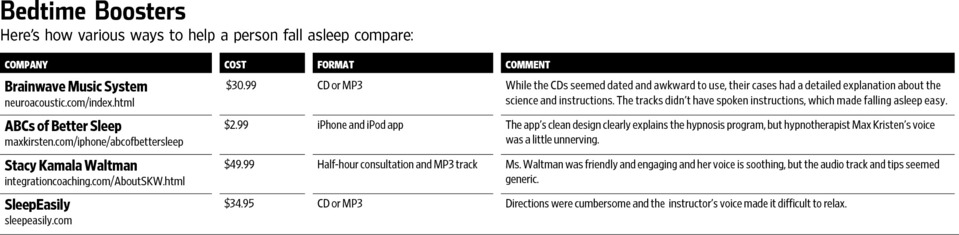
Four Methods to Ease Into Bedtime

JENNIFER ALSEVER

Jan. 13, 2014 7:12 p.m. ET

OG-AA682_Bedbus_G_20140113221807x

For some people, the hardest part about getting a good night’s sleep is winding down.

Plenty of products and services promise to help. Americans spent $32.4 billion in 2012 on sleep-related aids—from noise machines to specialty pillows, according to IMS Health, a marketing analytics firm in Parsippany, N.J. And according to an August study from the Centers for Disease Control and Prevention, 8.6 million people in the U.S. reported taking medication for better sleep in the month before. Read more of this post

Four Points Beginner Risk Managers Should Learn from Jeff Holman’s Mistakes in the Discussion of Antifragile

Four Points Beginner Risk Managers Should Learn from Jeff Holman’s Mistakes in the Discussion of AntifragileNassim Nicholas Taleb 

New York University; Université Paris I Panthéon-Sorbonne – Centre d’Economie de la Sorbonne (CES)
December 16, 2013

Abstract: 
Using Jeff Holman’s comments in Quantitative Finance to illustrate 4 critical errors students should learn to avoid: 1) Mistaking tails (4th moment) for volatility (2nd moment), 2) Missing Jensen’s Inequality, 3) Analyzing the hedging wihout the underlying, 4) The necessity of a numeraire in finance.

Ulrich Hartmann, Who Remade German Energy Market, Dies at 75

Ulrich Hartmann, Who Remade German Energy Market, Dies at 75

Ulrich Hartmann, the chief executive officer who shook up the European energy market when he engineered the merger that turned EON SE into Germany’s largest utility, has died. He was 75. Read more of this post

Private Equity Boss Has A Message To All Those Interns Whining About How Tired They Are

Private Equity Boss Has A Message To All Those Interns Whining About How Tired They Are

LINETTE LOPEZ

54 MINUTES AGO 335

David Rubenstein, founder of one of the most powerful private equity firms in the world, The Carlyle Group, has a message for all the young people on Wall Street concerned about burning out on long hours. Read more of this post

Meet a Ghost Designer; Behind Many Famed Brands: Hired Guns Who Create the Clothes

Meet a Ghost Designer; Behind Many Famed Brands: Hired Guns Who Create the Clothes

CHRISTINA BINKLEY, Jan. 14, 2014 7:27 p.m. ET

Mr. Gottardi prides himself on being pragmatic about creating designs that will sell. W.R.K.

There’s an industry of hired-gun designers behind many of the famous clothing brands we wear. Matteo Gottardi is the unnamed designer behind Rogan and Vince Camuto Men’s among others. He joins Lunch Break.(Photo: Ramsay de Give for The Wall Street Journal) The label says Vince Camuto. But the actual designer of this men’s apparel line is far from a household name. Read more of this post

Legend Holdings co-founder Liu Chuanzhi explains his company’s surprising decision to go into agriculture and controversial comments he made about businessmen and politics

Breaking New Ground

Legend Holdings co-founder Liu Chuanzhi explains his company’s surprising decision to go into agriculture and controversial comments he made about businessmen and politics

By staff reporter Hu Shuli

1389686887280238

(Beijing) — Liu Chuanzhi, co-founded what is now Legend Holdings – owner of Lenovo, the world’s largest PC maker and seller – has dedicated his life to exploring new ground and pushing boundaries. Read more of this post

The Chinese Emperor and His Number Two: Xi-Li Power Shift, What It Means for Value Investors and the Story of Hangzhou Robam

The following article is extracted from the Bamboo Innovator Insight weekly column blog related to the context and thought leadership behind the stock idea generation process of Asian wide-moat businesses that are featured in the monthly entitled The Moat Report Asia. Fellow value investors get to go behind the scene to learn thought-provoking timely insights on key macro and industry trends in Asia, as well as benefit from the occasional discussion of potential red flags, misgovernance or fraud-detection trails ahead of time to enhance the critical-thinking skill about the myriad pitfalls of investing in Asia at the microstructure- and firm-level.

Dear Friends and All,

The Chinese Emperor and His Number Two: Xi-Li Power Shift, What It Means for Value Investors and the Story of Hangzhou Robam

Deng Xiaoping needs the number two man Zhu Rongji in China’s quest for prosperity in the 1990s as “Zhu Laoban” (朱老板, “Zhu the Boss”) pushed through wrenching state-sector reform and terrorized corrupt officials. Singapore’s Lee Kuan Yew has Goh Keng Swee, the economic architect who is said to feel depressed every time he passed by a school at the end of the school day as his thoughts were on how to find gainful employment for the school-leavers every year. The late Indonesian strongman Suharto is aided by Widjojo Nitisastro, the legendary architect of Suharto’s New Order economy. Wal-Mart is unstoppable when Sam Walton has David Glass as the key architect to implement the automated distribution vision at Wal-Mart since 1978 and is since up 1,000-fold to $250 billion in market value. Thailand’s Thaksin had Somkid Jatusripitak but the once-successful Thaksinomics ended with Somkid’s departure in 2006. The importance of a good number two man has been neglected and Thaksin’s parting shot then at the co-founder of the Thai Rak Thai Party has been predictive of his own future downfall: “Whether Somkid is in my next government or not is irrelevant to confidence in my government among business leaders. Nowadays, I am the main person who works. Everybody else in my cabinet is just my helper.”

15-1024x450

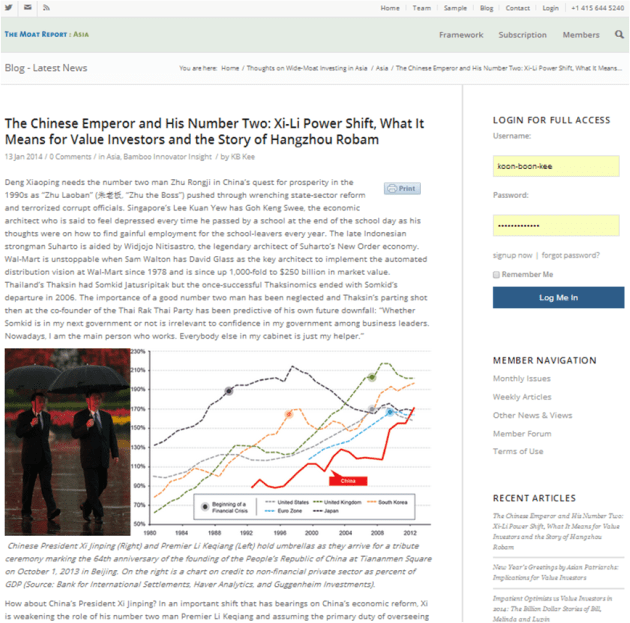
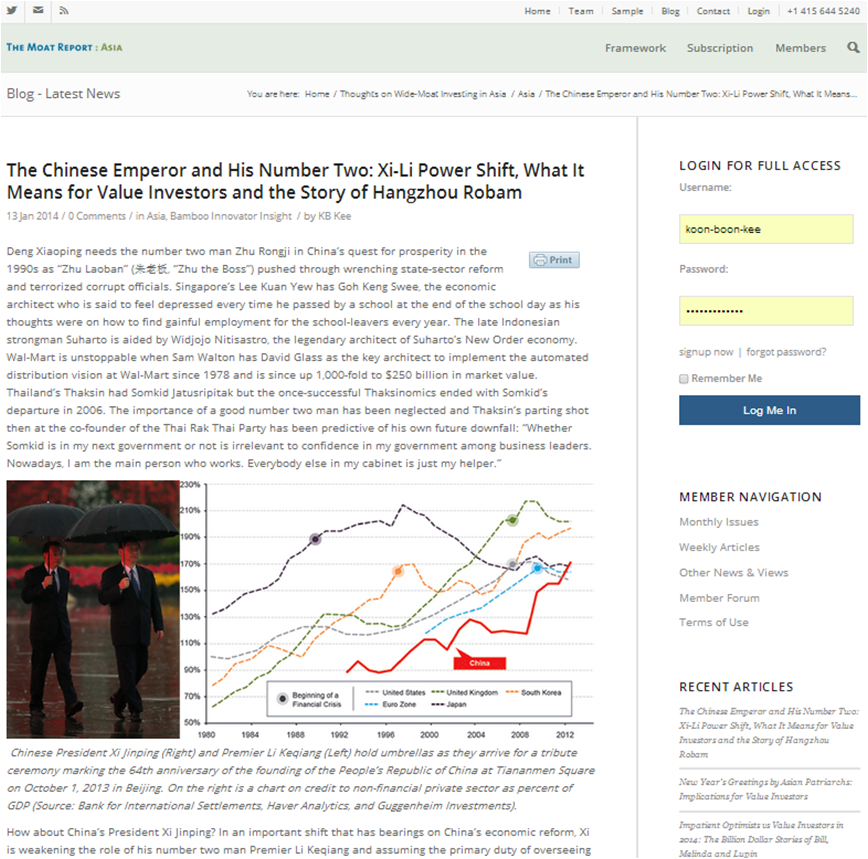
Chinese President Xi Jinping (Right) and Premier Li Keqiang (Left) hold umbrellas as they arrive for a tribute ceremony marking the 64th anniversary of the founding of the People’s Republic of China at Tiananmen Square on October 1, 2013 in Beijing. On the right is a chart on credit to non-financial private sector as percent of GDP (Source: Bank for International Settlements, Haver Analytics, and Guggenheim Investments). 

How about China’s President Xi Jinping? In an important shift that has bearings on China’s economic reform, Xi is weakening the role of his number two man Premier Li Keqiang and assuming the primary duty of overseeing economic reforms, particularly after the Plenum in November 2013. “Likonomics” is replaced by “Jinpingnomics”. Xi had personally led the drafting of the Plenum economic reform plan – the first time a party chief had done so since 2000. Xi is subverting a nearly two-decade-old division of power whereby the president, who is also party chief, handles politics, diplomacy and security, while the premier manages the economy. Xi’s predecessor Hu Jintao had played a negligible role in the economy and shared power evenly with former premier Wen Jiabao who was in charge of the massive RMB4 trillion ($660 billion) stimulus plan to respond to the 2008-09 global financial crisis which led to over RMB20 trillion ($3.3 trillion) of local government debt and concerns by investors such as George Soros who wrote recently what is perceived as a prediction of an economic crash in China: “There is an unresolved self-contradiction in China’s current policies: restarting the furnaces also reignites exponential debt growth, which cannot be sustained for much longer than a couple of years.” After rapidly consolidating power over the party and the military in his first year, Xi is now stepping in on the economy, making him the most individually powerful leader since Deng who launched China’s economic liberalization in 1978. Xi is also said to want to avoid the mistake of Hu who was outshined by Wen during the ten-year Hu-Wen administration from 2002.

Interestingly, in the February and May 2011 monthly editions of On the Ground in Asia, the predecessor of the Bamboo Innovator Insight and the Moat Report Asia, we had highlighted how the weak emperors in China and Asia would attempt to consolidate and take back power from the powerful local warlords:

“Local provinces now have greater autonomy and real power and the local warlords strive to create political dynasties capable of controlling or influencing a wide range of government projects to entrench themselves. A key risk for Asia that has not been particularly publicly highlighted is that the weakened central authority, unhappy at how his power and money base is eroded by so many different local factions, attempts to first attract all the FDI and investment flows into the regions with buzz transformational projects and privatization or PPP plans, and then, after getting a critical pool of funds, “shuts down” the place partially to reallocate power and money back to the central authority. This is a potential macro risk in Asia that investors have to keep in mind.. leverage is flattened, particularly at the LGFVs (local government financing vehicles), so as to weaken the elitist grip in local provinces through controlling the finances, resulting in China taking a “big bath writedown”, contrary to market expectations of a relatively smooth economic condition.. The new (benign elitist) leader Xi Jinping can also start to quickly produce fruits on the burnt-and-fallowed grounds when he takes over to demonstrate his competence and authority.”

The Bamboo Innovator recalled when we wrote about the above opinion in early 2011, we were derided both by some external parties and even internally for being an unnecessary alarmist, especially when Asia had rebounded strongly for almost two years from the bottom in March 2009 and everyone was minting money from property, gold, commodities and so on. The local government debt risk is not something new or unexpected and is already a known risk factored into the markets, some commented. If the information is out there, someone is already worrying about it and the risk will be impounded into the prices, they added. Shanghai Composite index is down 30% since then, Hang Seng index is still slightly down, gold down 11%, while the S&P index is up nearly 40% over the same period. Yes, while the local debt risk is not new, it definitely isn’t weighted enough by the market….

<Article snipped>

… Asian patriarchs and matriarchs add value in ways that do not appear on balance-sheets through their relationship-based deal-making capabilities. These strengths and tacit knowledge are difficult to bequeath or transfer to one’s children, and these specialized and intangible assets cannot be capitalized easily in the markets. This is why some Asian empires struggle to outlive their founders and succession tended to coincide with tremendous destruction of value. Because most Asian companies are “one-man-shop” operations with the founder making all the decisions, one of our favorite due diligence questions for Asian entrepreneurs and managers: the willingness to build a culture of decentralization/ empowerment and invest in a system to cascade decision rights throughout the organization is an important signal that the founder desires and cares to scale up the company in a sustainable manner by not hoarding knowledge.

That is why the Bamboo Innovator likes to see whether the company or country has a David Glass, a Zhu Rongji. Often, in our interaction with the Asian management, we can sense whether the emperor is playing mind games on the people around him or her so as to ascertain the worthiness of the “successor”. True Asian compounders and Bamboo Innovators have no time to waste – they build an idea or a vehicle that is larger than them so that others can be co-creators and involved in the value creation process, rather than having to fight for favors and permission and engaging in time-wasting posturing acts to be perceived in a good light by the emperor. There is a palpable sense of urgency in wanting to get things done, to realize the intangible ideas and Purpose, to keep the flames burning..

To read the exclusive article in full to find out more about the implications of the Xi-Li power shift and the story of Hangzhou Robam, please visit:

  • The Chinese Emperor and His Number Two: Xi-Li Power Shift, What It Means for Value Investors and the Story of Hangzhou Robam, Jan 13, 2014 (Moat Report AsiaBeyondProxy)

Emperor

Individuals can succeed despite family background: PM

Individuals can succeed despite family background: PM

17528456

SINGAPORE — At 11, Ong Yong Jie understands that money is tight at home and has set his mind to work hard in school so he can provide for his family when he grows up.

BY AMANDA LEE –

5 HOURS 19 MIN AGO

SINGAPORE — At 11, Ong Yong Jie understands that money is tight at home and has set his mind to work hard in school so he can provide for his family when he grows up. He makes use of the free time before his co-curricular activities — Art and Taekwondo — to eat a quick meal and do his homework “so I can save time when I reach home and do all my necessary things such as revising homework”. His efforts have paid off. Last year, he won a bronze medal in the National Mathematical Olympiad of Singapore and a silver medal in the National Taekwondo Poomsae Championships. Read more of this post

Sheng Siong CEO ‘thankful’ towards kidnappers for not hurting his mum

Sheng Siong CEO ‘thankful’ towards kidnappers for not hurting his mum

Sunday, January 12, 2014 – 20:58

20140112_shengsiong_zbst_0

Lianhe Wanbao/AsiaOne

SINGAPORE – The CEO of the Sheng Siong supermarket chain, whose mother Ng Lai Poh was kidnapped and freed unhurt last Wednesday, told Lianhe Wanbao that he bears no grudges against the two men suspected to be behind the crime.

Read more of this post

Singapore boss of bankrupt Five Stars Tours asks staff: “Will you hate me?”

Five Stars Tours closure leaves employees, customers in limbo

20140110_fivestarstours-boss_Shinmin(1)

WHAT NEXT? (L) Mr Lim Cheng Chuan, a director of the company. (R) Affected customers at a Five Stars Tours outlet.

By Linette Heng, Koh Hui Theng

The New Paper | Sun, Jan 12 2014

SINGAPORE – “Will you hate me?”

That was what Mr Lim Cheng Chuan, a director of troubled Five Stars Tours, asked his employees as he apologised profusely to them, reported Chinese daily Lianhe Wanbao. The employees, who were apparently moved to tears, described their boss as a man who values his staff and provides them with career opportunities. The company, which had eight outlets islandwide, is believed to have about 200 employees. Read more of this post

Deborah Meaden: ‘I was selling flowers at the age of seven’; Dragons’ Den tycoon Deborah Meaden, 54, started young but hit the big time when she sold the family business for £33m

Deborah Meaden: ‘I was selling flowers at the age of seven’

Fame & Fortune: Dragons’ Den tycoon Deborah Meaden, 54, started young but hit the big time when she sold the family business for £33m

deborah-meaden_2327496b

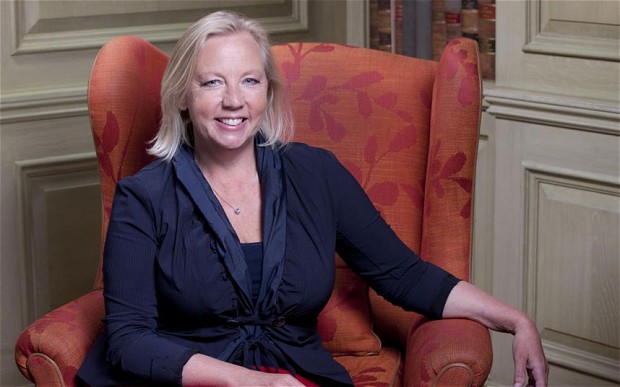
Deborah Meaden: “I don’t believe in luck. You’ve got to put yourself out there” Photo: ANDREW CROWLEY

By Lorraine McBride

8:32AM GMT 12 Jan 2014

How did your childhood influence your attitude to money?

I grew up in a single-parent family and we didn’t have a lot of money. I don’t say that looking for any sympathy, because a child doesn’t notice, except that we naturally assumed our money was spent on food and clothes. Both my parents were hard workers and they had absolutely no choice. It never crossed my mind that I wasn’t going to have to work hard in life, but work was never a grind. Read more of this post

A new vision: How one entrepreneur changed his thinking about the blind

A new vision: How one entrepreneur changed his thinking about the blind

By J.D. Harrison, Published: January 11 | Updated: Monday, January 13, 7:00 PM

It’s a reliable formula for entrepreneurs: Identify a gap in the market, pinpoint your target consumers and build a product tailored specifically for them. Hyungsoo Kim did all three, so he was surprised when his concept — a wristwatch for the blind that featured braille buttons — fell flat. It was then he learned an important lesson about his customers. Read more of this post

The Right Way to Go After Big Clients; Don’t Put All Your Eggs in One Basket

The Right Way to Go After Big Clients

Don’t Put All Your Eggs in One Basket

SARAH E. NEEDLEMAN

Jan. 11, 2014 8:26 p.m. ET

A year after starting a restaurant-technology firm, Rajat Suri got an introduction to what would become by far his biggest client—the casual-dining chain Applebee’s International. Read more of this post

This Funny World Map Shows What Every Country Leads The World In

This Funny World Map Shows What Every Country Leads The World In

MICHAEL KELLEY
JAN. 10, 2014, 7:14 AM 30,063 16

A wonderful map created by William Samari, Ray Yamartino, and Rafaan Anvari of DogHouseDiares illustrates what every country does better than every other country. They collected the information from various sources and sprinkled in some quirkier rankings since many countries led the world in multiple things.

5414

The science of willpower: Kelly McGonigal on why it’s so dang hard to stick to a resolution

The science of willpower: Kelly McGonigal on why it’s so dang hard to stick to a resolution

Posted by: Kate Torgovnick May
January 8, 2014 at 6:07 pm EST

kellymcgonigal_qa

It’s the second week in January and, at about this time, that resolution that seemed so reasonable a week ago — go to the gym every other day, read a book a week, only drink alcohol on weekends — is starting to seem very … hard. As you are teetering on the edge of abandoning it all together, Kelly McGonigal is here to help. This Stanford University psychologist — who shared last year how you can make stress your friend — wants you to know that you’re not having a hard time sticking to a resolution because you are a terrible person. Perhaps you’ve just formulated the wrong resolution. Read more of this post

Goodnight. Sleep Clean. Why do we have to rest? Meet your brain’s janitorial staff

Goodnight. Sleep Clean.

By MARIA KONNIKOVAJAN. 11, 2014

SLEEP seems like a perfectly fine waste of time. Why would our bodies evolve to spend close to one-third of our lives completely out of it, when we could instead be doing something useful or exciting? Something that would, as an added bonus, be less likely to get us killed back when we were sleeping on the savanna? “Sleep is such a dangerous thing to do, when you’re out in the wild,” Maiken Nedergaard, a Danish biologist who has been leading research into sleep function at the University of Rochester’s medical school, told me. “It has to have a basic evolutional function. Otherwise it would have been eliminated.” Read more of this post

How a Hunch Led to Stunning Claim on Buddha Birth Date; Buddha’s birthplace in southern Nepal held secrets that could transform how the world understood the emergence and spread of Buddhism

How a Hunch Led to Stunning Claim on Buddha Birth Date

By Ammu Kannampilly on 4:08 pm January 5, 2014.
Kathmandu. The two archaeologists had a hunch that the Buddha’s birthplace in southern Nepal held secrets that could transform how the world understood the emergence and spread of Buddhism. Their pursuit would eventually see them excavate the sacred site of Lumbini as monks prayed nearby, leading to the stunning claim that the Buddha was born in the sixth century BC, two centuries earlier than thought.

Read more of this post

Ask a Billionaire: James Dyson on His Management Style; Letting people try out their ideas, getting them totally involved, that’s really important. Getting down there, being with people every day, and experiencing what they’re experiencing is also crucial

Ask a Billionaire: James Dyson on His Management Style

January 09, 2014

etc_billionaire03__01__300

James Dyson
Founder and chief engineer, Dyson
Net worth: $4.4 billion

What kind of manager are you?

A pretty dreadful one. The trouble is, I’m just not that interested in it. I’m interested in working with a group of people to make something work. But it’s not conventional management. I just do what I do my way—most of my employees are still here, so it can’t be that wrong! If someone has an offbeat idea which sounds daft, consider it and think about it and try it out. We don’t have technicians, so engineers go and make their own prototypes and rigs. Letting people try out their ideas, getting them totally involved, that’s really important. Getting down there, being with people every day, and experiencing what they’re experiencing is also crucial.

The Little Book of IDEO: Values

The Little Book of IDEO: Values

by Tim Brown, CEO and President at IDEO on Dec 18, 2013

We wrote this to give you a sense of IDEO’s culture—the ties that bind us together as coworkers and as people.

7 Things That Can Make You Wildly Successful

7 Things That Can Make You Wildly Successful

ERIC BARKERBARKING UP THE WRONG TREE
JAN. 9, 2014, 2:24 PM 10,610 4

What does volumes of research say you can learn from wildly successful people? To Build A Better Career, First Build A Better You

It might sound fluffy but research shows how people feel about themselves has a huge effect on success.

Via The 100 Simple Secrets of Successful People:

For most people studied, the first step toward improving their job performance had nothing to do with the job itself but instead with improving how they felt about themselves. In fact, for eight in ten people, self-image matters more in how they rate their job performance than does their actual job performance. – Gribble 2000

What frequently produces creative ideas? It’s not clever tricks — it’s being genuinely interested in your work.  Read more of this post

To Stop Procrastinating, Look to Science of Mood Repair; New Approach Focuses on Helping People Regulate Their Emotions

To Stop Procrastinating, Look to Science of Mood Repair

New Approach Focuses on Helping People Regulate Their Emotions

SUE SHELLENBARGER

Jan. 7, 2014 8:03 p.m. ET

Several new studies help explain what’s happening in the brain when people procrastinate. WSJ’s Sue Shellenbarger unpacks the latest research and software engineer Sean Gilbertson shares his story. Photo: Getty Images.

Procrastinators, take note: If you’ve tried building self-discipline and you’re still putting things off, maybe you need to try something different. One new approach: Check your mood. Read more of this post

Creating a Culture of Unconditional Love

Creating a Culture of Unconditional Love

by Claudio Fernández-Aráoz  |   9:00 AM January 8, 2014

During my first decade working in the Buenos Aires office of Egon Zehnder in the late 1990s, our Argentine executive search practice soared, recording the highest per capita financial performance in the whole firm for five consecutive years. But we all know what happened in 2001. By the end of the year, Argentina’s economy had collapsed.  It was the largest sovereign debt default in world history, and GDP fell by some 30% coupled with a 300% currency devaluation. Over 12 days, five different presidents took control of the country.  One bank lost more money in a few weeks than it had accumulated over the previous century.  There were companies with losses larger than their sales, and one month the number of new cars sold in the country was lower than the number of cars stolen!  As you can imagine, that was not an easy time for me.  No one in their right mind was looking to hire a search consultant. Read more of this post

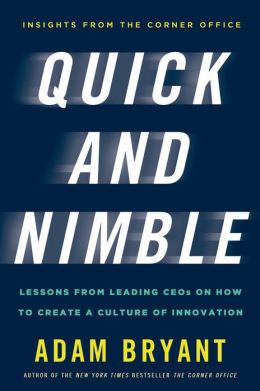
Quick and Nimble: Lessons from Leading CEOs on How to Create a Culture of Innovation

Quick and Nimble: Lessons from Leading CEOs on How to Create a Culture of Innovation Hardcover

by Adam Bryant  (Author)

9780805097016_p0_v1_s260x420

More than two hundred CEOs reveal their candid insights on how to build and foster a corporate culture that encourages innovation and drives results

In Quick and Nimble, Adam Bryant draws on interviews with more than two hundred CEOs to offer business leaders the wisdom and guidance to move an organization faster, to be quick and nimble, and to rekindle the whatever-it-takes collective spark of a start-up, all with the goal of innovating and thriving in a relentlessly challenging global economy. By analyzing the lessons that these leaders have shared in his regular “Corner Office” feature in The New York Times, Bryant has identified the biggest drivers of corporate culture, bringing them to life with real-world examples that reflect this hard-earned wisdom. Read more of this post

Management Be Nimble

Management Be Nimble

By ADAM BRYANTJAN. 4, 2014

Adult Conversations Many managers go out of their way to avoid giving feedback, worried that it will turn into a battle. But the best managers have “adult conversations” right away to clear the air.

“We aspire to be the largest small company in our space.”

When Dominic Orr, the chief executive of Aruba Networks, said those words, he crystallized a goal I had heard many leaders express during the hundreds of interviews I’ve conducted for the Corner Office column: they want to foster a quick and nimble culture, with the enviable qualities of many start-ups, even as their companies grow. Read more of this post

Build a ‘Quick and Nimble’ Culture

Build a ‘Quick and Nimble’ Culture

by Dan McGinn  |   11:00 AM January 7, 2014

Since 2009, Adam Bryant has interviewed hundreds of CEOs for the “Corner Office” feature in The New York Times. This month he’s publishing his second book based on the interviews: “Quick and Nimble: Lessons from Leading CEOs on How to Create a Culture of Innovation.” He talked with HBR about why a company’s culture is more important than its strategy — and some of the innovative tactics that CEOs have used to help create a high-performing culture. Excerpts: Read more of this post