Caterpillars that blow nicotine at their enemy; hornworm, a species that eats tobacco plants without seeming to be bothered by the nicotine in the leaves; scientists wondered if the hornworm might be weaponising nicotine

Caterpillars that blow nicotine at their enemy

Jan 4th 2014 | From the print edition

THE blue caterpillar in “Alice’s Adventures in Wonderland” had a hookah habit and the white rabbit kept looking at his pocket watch. But whereas rabbits are not obsessed about being late, some caterpillars, it seems, really do have a fondness for blowing nicotine at those who annoy them.

The caterpillar in question is the hornworm, a species that eats tobacco plants without seeming to be bothered by the nicotine in the leaves. Since nicotine can work as a natural insecticide, this has led many to wonder what the caterpillars do with the toxins they consume. One clue is that some caterpillars use toxins they collect as weapons—the eastern tent caterpillar is famous for spitting hydrogen cyanide gathered from the plants it eats at its enemies. A team led by Ian Baldwin at the Max Planck Institute for Chemical Ecology in Jena, Germany, wondered if the hornworm might be weaponising nicotine. Read more of this post

Palestinian Tycoon Munib R. Masri Seeking Peace Brings His Fortune Home

Palestinian Tycoon Seeking Peace Brings His Fortune Home

As Munib R. Masri leads visitors around his domed palace, gray-uniformed servants tend the manicured grounds, a Roman-style amphitheater and a glassed-in winter garden perched atop Mount Gerizim, the biblical Mount of Blessings. Read more of this post

Beanie Baby Billionaire Seeks to Avoid Jail for Tax Crime

Beanie Baby Billionaire Seeks to Avoid Jail for Tax Crime

H. Ty Warner, the billionaire creator of Beanie Baby plush toys, asked a judge to give him probation, not prison, for evading taxes on secret Swiss accounts that held as much as $107 million. Read more of this post

Why SAC Capital’s Steven Cohen Isn’t in Jail

Why SAC Capital’s Steven Cohen Isn’t in Jail

By Sheelah Kolhatkar January 02, 2014

Ten thousand dollars an hour worth of lawyers filed into a courtroom in lower Manhattan on the morning of Nov. 8. The legal team represented Steven Cohen’s hedge fund, SAC Capital Advisors, which had agreed to pay $1.2 billion to settle criminal charges that it had engaged in securities fraud. The hearing was the culmination of a long legal struggle between SAC and the government that has dramatically altered what was once one of Wall Street’s most powerful firms. Eight former or current SAC employees have been charged with insider trading. Six of them have pleaded guilty; one, Mathew Martoma, is due to go on trial on Jan. 6, and another, Michael Steinberg, was convicted on Dec. 18 of insider trading in two technology stocks. Separately, Cohen was charged in a civil case with failing to supervise his employees by the Securities and Exchange Commission, which is seeking to bar him from the securities industry. Cohen’s company is transforming itself into a much smaller operation that manages only Cohen’s money. SAC had fostered an unprecedented “culture of corporate corruption,” U.S. Attorney Preet Bharara said when the criminal charges against the company were first unveiled. Read more of this post

Murder and slavery in Brazil: Dr Warne and the cockroaches; How an unsolved murder in 1888 played a part in bringing about the end of slavery

Murder and slavery in Brazil: Dr Warne and the cockroaches; How an unsolved murder in 1888 played a part in bringing about the end of slavery

Dec 21st 2013 | From the print edition

IT WAS half-past three in the morning when the police commissioner heard the crowd approaching. He got out of bed. His wife sent a child out to get help but it was too late. They kicked his door in. He jumped from an upstairs window towards the safety of a neighbouring house but missed his footing and fell. A gang of 200 men in the street below seized him and beat him with clubs while his wife hid inside, cowering in an oven. Read more of this post

Professors picked the four-character Chinese idiom 轉迷開悟 (jeonmigaeoh), meaning one being disillusioned from fallacy and realize truth, as a phrase to characterize 2014.

2013-12-31 17:53

Professors wish 2014 to be year of attaining truth

Nam Hyun-woo

131231_p03_professors

Professors picked the four-character Chinese idiom 轉迷開悟 (jeonmigaeoh), meaning one being disillusioned from fallacy and realize truth, as a phrase to characterize 2014. The phrase is based on the Buddhist teaching of being freed of anguish caused by delusions and reaching nirvana. According to Professors Times, Tuesday, 170 out of 617 surveyed professors at universities in Korea chose the phrase as this year’s one. The professors’ journal picks characterizing phrase of next year in every year-end. Prof. Moon Sung-hoon of Seoul Women’s University, said “I recommended this phrase in a sense to promote people to be freed from falsehoods and move forward in 2014.” Prof. Park Jae-woo at Hankuk University of Foreign Studies said, “The meaning of politics is to correct wrongdoings.” He said he picked the phrase in a wish to “get out of lie-riddled 2013 and march into 2014 in which truth and honesty triumph.” Following the phrase, 激濁揚淸 (gyeoktakyangcheong) was the second most-voted phrase with 147 professors casting their votes. It means letting go muddy water and letting clean water to flow. The journal said, “The phrases reflect professors’ critical view on corrupt and unproductive politicians.”

Ben Horowitz: Can-Do vs. Can’t-Do Culture

Can-Do vs. Can’t-Do Culture

January 1, 2014, 7:53 PM PST

By Ben Horowitz, Co-Founder and Partner, Andreessen Horowitz

“God, body and mind, food for the soul
When you feeding on hate, you empty, my n!*$a, it shows.” — Rick Ross

“The reasonable man adapts himself to the world; the unreasonable one persists in trying to adapt the world to himself. Therefore, all progress depends on the unreasonable man.” – George Bernard Shaw

Lately, it has become in vogue to write articles, comments and tweets about everything that’s wrong with young technology companies. Hardly a day goes by where I don’t find something in my Twitter feed crowing about how a startup that has hit a bump in the road is ”fu&%@d,” or what an “as*h%le” a successful founder is, or what an utterly idiotic idea somebody’s company is. Read more of this post

Get Out of Your Comfort Zone: A Guide for the Terrified

Get Out of Your Comfort Zone: A Guide for the Terrified

by Andy Molinsky  |   11:00 AM December 31, 2013

No one likes to move beyond his or her comfort zone, but that’s really where the magic happens. It’s where we can grow, learn, and develop in a way that expands our horizons beyond what we thought was possible. Also, it’s terrifying. For me, operating beyond my comfort zone was participating in classroom discussions in college. Early in my career, it was public lecturing and participating in departmental meetings. I knew I had things to say, but was very unsure if they were worth saying.

Read more of this post

You Never Make Real Progress Without Pain

You Never Make Real Progress Without Pain

JEFF HADENLINKEDIN

DEC. 31, 2013, 12:38 PM 2,649 2

Without discomfort we never progress. Without stress we never adapt. Without pain we never rebuild. That’s why sometimes the best blessings truly are blessings in disguise. Like:

Disapproval

People criticize only when they care… and while people still care about you or your business you have the opportunity to do something better, to do something differently, to change their minds — or to just meet in the middle. Criticism is no fun… but having no one who cares at all is much, much worse. It’s great that people care enough to want you to do better — so go do better. Read more of this post

The Dangerous Myth of Reinvention

The Dangerous Myth of Reinvention

by Marc Freedman  |   10:00 AM January 1, 2014

Gary Maxworthy spent three decades in business until a personal tragedy prompted him to reexamine his priorities. He left the corporate world behind, set off to find his true calling, and in the process discovered both a new identity and the path to accomplishing his most important work fighting hunger. Read more of this post

The case for putting philosophers into company boardrooms; Businesses must satisfy; philosophy is concerned with what makes a good life

January 1, 2014 5:21 pm

The case for putting philosophers into company boardrooms

By Alain de Botton

Businesses must satisfy; philosophy is concerned with what makes a good life, says Alain de Botton

From a distance, it does not seem as if philosophy and business would have anything to say to one another. Businesses are concerned with meeting strict targets under time pressure, maximising revenue and outwitting competitors. Philosophy is concerned with the largest and most impractical questions about the meaning of life; it sets itself no targets and has no practical outcomes. Read more of this post

The Chinese village with the secret to long life; Tourists paying homage to Bama’s centenarians are bringing in millions. But the Guangxi county’s success may be its undoing

The Chinese village with the secret to long life

Tourists paying homage to Bama’s centenarians are bringing in millions. But the Guangxi county’s success may be its undoing

Tania Branigan in Longevity Village, Guangxi

theguardian.com, Monday 30 December 2013 15.58 GMT

huang-puxin-longevity-village-china

Huang Puxin, who says he is 113, waits for visitors at his home in Longevity Village in Bama, Guangxi. Photograph: Tania Branigan for the Guardian

Her T-shirted charges trailing behind her, the young guide swept into Huang Puxin’s home and flicked her tour flag towards the centenarian, who was waiting on the sofa beneath a giant bas-relief inscribed with the word “longevity”. “The old man is 113,” she mumbled into her headset, turning away. Read more of this post

Want a sure route to a job? Learn to code, says startup co-founder Zach Sims. Codecademy Chief Says Computer Programming Holds the Key

Codecademy Chief Says Computer Programming Holds the Key

Zach Sims’s Startup Offers Free Instruction and Possibly Job Opportunities

MELISSA KORN

Updated Dec. 31, 2013 7:11 p.m. ET

Zach Sims, the CEO of Codecademy, on gaining respect and making good hires.

Want a sure route to a job? Learn to code, says startup co-founder Zach Sims. As chief executive of Codecademy, a two-year-old company that offers free, online instruction in computer programming, Mr. Sims believes that programming skills can be a ticket to upward mobility just as a college degree has been for generations. Read more of this post

Anxious Youth, Then and Now: Today’s millennials face many of the same concerns and challenges of the late 19th century, when the booms and busts of the Industrial Age tore apart the accepted order

December 31, 2013

Anxious Youth, Then and Now

By JON GRINSPAN

FOR years now, we’ve heard the gripes by and about millennials, the offspring of the Great Recession, caught between childhood and adulthood. Their plight seems so very 21st century: the unstable careers, the confusion of technologies, the delayed romance, parenthood and maturity. Read more of this post

Year of self-awakening: Only people who act when needed deserve to feel well-off

2013-12-31 17:03

Year of self-awakening

Only people who act when needed deserve to feel well-off
January 1 is the day to plan for the New Year, hoping it will be better than the Old Year. Unfortunately, we cannot help but wonder how many Koreans are thinking ― instead of hoping ― that 2014 will be better than 2013, after experiencing all that happened on them last year.  Read more of this post

Lessons from 120 years ago in Korea

Lessons from 120 years ago

Jan 03,2014

Humans reflect on history to learn from their past – more specifically, to understand the present through the lessons of the past and brace for the future. That’s why European academics and the press are busy examining the year 1914, when World War I broke out a century ago, and their Korean counterparts are rethinking the meaning of the Gabo Reform in the Joseon Dynasty (1392-1910), initiated 120 years ago after the Donghak Peasant Rebellion.  Read more of this post

Richard Riordan and Eli Broad: Is it a sin to be rich? Not if your resources are used to help others and create jobs. Rather than investing in hedge funds and other forms of financial speculation divorced from the real economy, more of the wealthy

2014-01-02 16:53

Is it a sin to be rich?

By Richard Riordan and Eli Broad
Is it a sin to be rich?
Not if your resources are used to help others and create jobs.
If you listen to most of the discussions of income inequality, it certainly seems like affluence itself is a crime. We hear increasing calls for higher taxes on the wealthy and other policies designed to redistribute income. President Obama summed up that position when he said, “Our country cannot succeed when a shrinking few do very well and a growing many barely make it.” Read more of this post

Impatient Optimists Vs Value Investors in the New Year 2014: The Billion Dollar Stories of Bill-Melinda and Lupin (Bamboo Innovator Insight)

The following article is extracted from the Bamboo Innovator Insight weekly column blog related to the context and thought leadership behind the stock idea generation process of Asian wide-moat businesses that are featured in the monthly entitled The Moat Report Asia. Fellow value investors get to go behind the scene to learn thought-provoking timely insights on key macro and industry trends in Asia, as well as benefit from the occasional discussion of potential red flags, misgovernance or fraud-detection trails ahead of time to enhance the critical-thinking skill about the myriad pitfalls of investing in Asia at the microstructure- and firm-level.

Dear Friends and All,

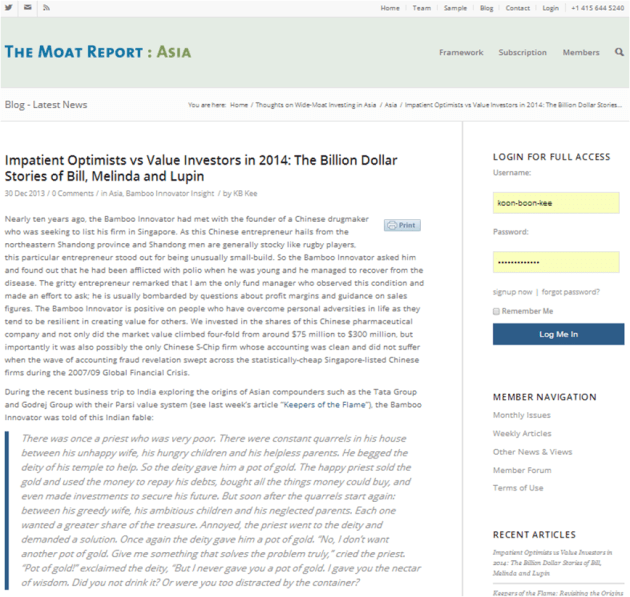
Nearly ten years ago, the Bamboo Innovator had met with the founder of a Chinese drugmaker who was seeking to list his firm in Singapore. As this Chinese entrepreneur hails from the northeastern Shandong province and Shandong men are generally stocky like rugby players, this particular entrepreneur stood out for being unusually small-build. So the Bamboo Innovator asked him and found out that he had been afflicted with polio when he was young and he managed to recover from the disease. The gritty entrepreneur remarked that I am the only fund manager who observed this condition and made an effort to ask; he is usually bombarded by questions about profit margins and guidance on sales figures. The Bamboo Innovator is positive on people who have overcome personal adversities in life as they tend to be resilient in creating value for others. We invested in the shares of this Chinese pharmaceutical company and not only did the market value climbed four-fold from around $75 million to $300 million, but importantly it was also possibly the only Chinese S-Chip firm whose accounting was clean and did not suffer when the wave of accounting fraud revelation swept across the statistically-cheap Singapore-listed Chinese firms during the 2007/09 Global Financial Crisis.

******

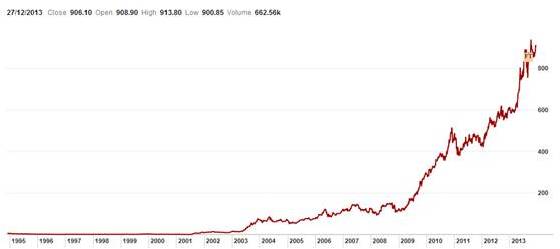
As we step forward into the New Year 2014, the Bamboo Innovator was captivated by a WSJ article “What I Learned in the Fight Against Polio” written by Bill Gates on Nov 10. It talks about how the Bill and Melinda Gates Foundation has helped India stayed polio-free for more than two years and the lessons for solving other human welfare issues worldwide. Impatient Optimists is the name of the blog (www.impatientoptimists.org) of the influential Bill & Melinda Gates Foundation featuring the work and stories of the people working every day to help alleviate suffering, poverty, diseases, promote health, and to help students realize his or her full potential. These are all urgent problems requiring innovative solutions that have long-term investment implications which we will discuss shortly with the story of the Indian compounder Lupin (NSE: Lupin, MV $6.5 billion) and how its focus in the neglected niche of anti-TB drugs transformed the firm into India’s third-most valuable listed pharmaceutical firm, compounding shareholders’ wealth by over 138-fold. Bill Gates wrote in a blog post on Dec 23 about a summary of “Good News You Might Have Missed in 2013” that include how we got smarter and faster at fighting polio and that funding commitment to the Global Fund to fight TB and malaria was renewed. Gates also shared a tweet expressing his excitement on what he is looking forward to seeing in 2014: a new vaccine called pentavalent that can prevent five diseases.

Gates

Lupin

Lupin (NSE: LUPIN) – Stock Price Performance, 1995-2013

To read the exclusive article to find out more about the story of Lupin, of Australia’s CSL which is up 85-fold to $29 billion and how value investors can potentially gaze at the next Lupin/CSL, please visit:

  • Impatient Optimists Vs Value Investors in the New Year 2014: The Billion Dollar Stories of Bill-Melinda and Lupin, Dec 27, 2013 (Moat Report AsiaBeyondProxy)

Impatient Optimists


Founder, manage thyself

Founder, manage thyself

BY JUSTIN YOSHIMURA 
ON DECEMBER 30, 2013

buddha

Ben Horowitz summarizes the hardest job of CEOs as, “managing your own psychology.”  Until recently, I believed that I was pretty good at this. After all, despite not taking more than a few days off since I was 15 — even after I sold my previous companies I would immediately start working on the next thing — I’ve never felt “burnt out.” Read more of this post

How to Worry Less About Money; What Goethe can teach us about cultivating a healthy relationship with our finances

How to Worry Less About Money

by Maria Popova

What Goethe can teach us about cultivating a healthy relationship with our finances.

The question of how people spend and earn money has been a cultural obsession since the dawn of economic history, but the psychology behind it is sometimes surprising and often riddled with various anxieties. In How to Worry Less about Money (public library) — another great installment in The School of Life’s heartening series reclaiming the traditional self-help genre as intelligent, non-self-helpy, yet immensely helpful guides to modern living, which previously gave us Philippa Perry’s How to Stay Sane, Alain de Botton’s How to Think More About Sex, and Roman Krznaric’s How to Find Fulfilling Work — Melbourne Business School philosopher-in-residenceJohn Armstrong guides us to arriving at our own “big views about money and its role in life,” transcending the narrow and often oppressive conceptions of our monoculture. Read more of this post

6 Ways To Create A Culture Of Innovation: Reward employees with time to think, while providing them with the structure they need

6 Ways To Create A Culture Of Innovation

REWARD EMPLOYEES WITH TIME TO THINK, WHILE PROVIDING THEM WITH THE STRUCTURE THEY NEED.

Every organization is designed to get the results it gets. Poor performance comes from a poorly designed organization. Superior results emerge when strategies, business models, structure, processes, technologies, tools, and reward systems fire on all cylinders in symphonic unison.

EDITOR’S NOTE

12/30/13

Happy (almost) New Year! We’re saying good-bye to 2013 by revisiting some of our favorite stories of the year. Enjoy. Savvy leaders shape the culture of their company to drive innovation. They know that it’s culture–the values, norms, unconscious messages, and subtle behaviors of leaders and employees–that often limits performance. These invisible forces are responsible for the fact that 70% of all organizational change efforts fail. The trick? Design the interplay between the company’s explicit strategies with the ways people actually relate to one another and to the organization. Read more of this post

10 Extraordinary People and Their Lessons for Success

10 Extraordinary People and Their Lessons for Success

by Sarah Green  |   9:00 AM December 30, 2013

From presidents to hip-hop producers to poets, the last page of every issue of Harvard Business Review is always an interview with someone who has succeeded outside the traditional corporate world. Here, some of our favorite lessons from the class of 2013:

Justice Sandra Day O’Connor on having long-term colleagues: “Treat people well. Don’t mislead them. Don’t be prickly. Don’t say things that are aggravating. Try to be as agreeable as you can be. Try to be helpful rather than harmful. Try to cooperate.”

Cartoonist Scott Adams on using his MBA: ”When the comic strip first came out, it showed Dilbert in a variety of settings—not just the office. I didn’t really know what was working, because I had no direct contact with readers… So way back at the dawn of the internet, I started putting my e-mail address in the margin of the strip… I found out that there was a common theme: People loved it when Dilbert was in the office, and they liked it a lot less when he was at home or just hanging around. So Dilbert became an office-based comic, and that change made it all work.”

Chef Nobu Matsuhisa on starting as an apprentice: “I was 18 and didn’t know anything about fish. My mentor taught me the basics. For the first three years, I didn’t make sushi; I washed dishes and cleaned the fish. But if I asked questions, he always answered. I learned a lot of patience.”

Saturday Night Live producer Lorne Michaels on hiring: “I wouldn’t choose anyone whose side I didn’t want to be on. It isn’t like we hire 12 and figure six will work. We don’t bring in anybody we’re not rooting for. Sometimes they succeed in week five, but for most people it’s two, three, four years before they become who they’re going to be. You have to allow for that growth.”


Hip-hop mogul Russell Simmons on meditating twice a day: “Every creative idea, every second of happiness, is from stillness…. But the way you move around the world has nothing to do with the stillness in your heart. Moving meditation—that’s what we have to practice. It doesn’t mean you have to move slow; you just have to see the world in slow motion.”

Golfer Arnold Palmer on learning humility: “One time at Augusta, I was going into the last hole with a one-shot lead to win the Masters, and a friend from the gallery hollered at me, so I walked over and accepted congratulations. And then I proceeded to make six on the hole and lose. My father had warned me about that. I was told all my life not to accept congratulations until it’s over.”

Poet Maya Angelou on courage: “One isn’t born with courage. One develops it by doing small courageous things—in the way that if one sets out to pick up a 100-pound bag of rice, one would be advised to start with a five-pound bag, then 10 pounds, then 20 pounds, and so forth, until one builds up enough muscle to lift the 100-pound bag. It’s the same way with courage. You do small courageous things that require some mental and spiritual exertion.”

Designer Philippe Starck on persuading clients: “I’m very good at explaining. I don’t work like a diva. I don’t say, “Oh my God, that must be pink,” and refuse to discuss it… I am cuckoo, yes. I am the king of intuition. But I am also a serious guy. I explain in a clear way. And then, even if it’s something that looks completely different than expected, something completely against mainstream thinking, clients understand. I explain that it might look strange but why, given the two to five years it will take for development, it will for so many reasons be exactly the right thing to do… And then the clients agree, always, 100%.”

President Mary Robinson on being frank: “At every stage, it’s [a] passion for human rights that has prompted me to speak truth to power, to stand up to bullies, to be prepared to criticize even the United States after 9/11. People told me it wouldn’t help my career as high commissioner, but it seemed much more important to do the job than to try to keep the job.”

Historian David McCullough on hard work: “When the founders wrote about life, liberty, and the pursuit of happiness, they didn’t mean longer vacations and more comfortable hammocks. They meant the pursuit of learning. The love of learning. The pursuit of improvement and excellence. I keep telling students, ‘Find work you love. Don’t concern yourself overly about how much money is involved or whether you’re ever going to be famous.’ …In hard work is happiness.”

How to Find Fulfilling Work: On the art-science of “allowing the various petals of our identity to fully unfold.”

How to Find Fulfilling Work

by Maria Popova

On the art-science of “allowing the various petals of our identity to fully unfold.”

“If one wanted to crush and destroy a man entirely, to mete out to him the most terrible punishment,” wrote Dostoevsky“all one would have to do would be to make him do work that was completely and utterly devoid of usefulness and meaning.” Indeed, the quest to avoid work andmake a living of doing what you love is a constant conundrum of modern life. In How to Find Fulfilling Work (public library) — the latest installment in The School of Life’s wonderful series reclaiming the traditional self-help genre as intelligent, non-self-helpy, yet immensely helpful guides to modern living, which previously gave us Philippa Perry’s How to Stay Sane and Alain de Botton’s How to Think More About Sex — philosopher Roman Krznaric (remember him?)explores the roots of this contemporary quandary and guides us to its fruitful resolution: Read more of this post

7 Things I Learned in 7 Years of Reading, Writing, and Living

7 Things I Learned in 7 Years of Reading, Writing, and Living

by Maria Popova

Reflections on how to keep the center solid as you continue to evolve.

On October 23, 2006, I sent a short email to a few friends at work — one of the four jobs I held while paying my way through college — with the subject line “brain pickings,” announcing my intention to start a weekly digest featuring five stimulating things to learn about each week, from a breakthrough in neuroscience to a timeless piece of poetry. “It should take no more than 4 minutes (hopefully much less) to read,” I promised. This was the inception of Brain Pickings. At the time, I neither planned nor anticipated that this tiny experiment would one day be included in the Library of Congress digital archive of “materials of historical importance” and the few friends would become millions of monthly readers all over the world, ranging from the Dutch high school student who wrote to me this morning to my 77-year-old grandmother in Bulgaria to the person in Wisconsin who mailed me strudel last week. (Thank you!) Above all, I had no idea that in the seven years to follow, this labor of love would become my greatest joy and most profound source of personal growth, my life and my living, my sense of purpose, my center. (For the curious, more on the origin story here.) Read more of this post

“Work as hard as you can, Imagine immensities, don’t compromise, and don’t waste time.”; Fail Safe: Debbie Millman’s Advice on Courage and the Creative Life

Fail Safe: Debbie Millman’s Advice on Courage and the Creative Life

by Maria Popova

Work as hard as you can, Imagine immensities, don’t compromise, and don’t waste time.”

The seasonal trope of the commencement address is upon us as wisdom on life is being dispensed from graduation podiums around the world. After Greil Marcus’s meditation on the essence of art and Neil Gaiman’s counsel on the creative life, here comes a heartening speech by artiststrategist, and interviewer extraordinaire Debbie Millman, delivered to the graduating class at San Jose State University. The talk is based on an essay titled“Fail Safe” from her fantastic 2009 anthology Look Both Ways: Illustrated Essays on the Intersection of Life and Design (public library) and which has previously appeared onLiterary Jukebox. The essay, which explores such existential skills as living with uncertaintyembracing the unfamiliar,allowing for not knowing, and cultivating what John Keats has famously termed“negative capability,” is reproduced below with the artist’s permission. If you imagine less, less will be what you undoubtedly deserve. Do what you love, and don’t stop until you get what you love. Work as hard as you can, imagine immensities, don’t compromise, and don’t waste time. Start now. Not 20 years from now, not two weeks from now. Now. Look Both Ways: Illustrated Essays on the Intersection of Life and Design is an absolute treasure in its entirety, the kind of read you revisit again and again, only to discover new meaning and new access to yourself each time. It was preceded by How to Think Like a Great Graphic Designer and followed by the recent Brand Thinking and Other Noble Pursuits, both excellent in very different but invariably stimulating ways.

What Is Love? Famous Definitions from 400 Years of Literary History; “Love has nothing to do with what you are expecting to get — only with what you are expecting to give — which is everything.”

What Is Love? Famous Definitions from 400 Years of Literary History

by Maria Popova

“Love has nothing to do with what you are expecting to get — only with what you are expecting to give — which is everything.”

After those collections of notable definitions of artscience, and philosophy, what better way to start a new year than with a selection of poetic definitions of a peculiar phenomenon that is at once more amorphous than art, more single-minded than science, and more philosophical than philosophy itself? Gathered here are some of the most memorable and timeless insights on love, culled from several hundred years of literary history — enjoy. Read more of this post

Interview with Calvin & Hobbes Creator Bill Watterson; coming at a new work requires a certain amount of patience and energy, and there’s always the risk of disappointment.

Mental Floss Exclusive: Our Interview with Bill Watterson!

For the December issue of mental_floss magazine, Jake Rossen managed to do something we thought was impossible—he snagged an interview with the legendary Bill Watterson! Since we’re guessing there are a few Calvin and Hobbes enthusiasts in the audience, we thought we’d provide a glimpse of the e-mail exchange. For our full story on the comic strip, be sure to pick up the print magazine. Read more of this post

Redistribute wealth? No, redistribute respect.

Friday, December 27, 2013

Redistribute wealth? No, redistribute respect.

Author: Noah Smith

“It is said that heaven does not create one man above or below another man.”
– Yukichi Fukuzawa
I’ve always been a communist revolutionary at heart. Inequalities between human beings have always annoyed me, and I have the strong desire to see them eliminated. In American society, we generally discuss three kinds of “equality”: 1) “equality of outcome”, usually meaning equality of wealth or income, 2) “equality of opportunity”, and 3) “equal rights” under the law. The first is typically supported by true communists and socialists, and some liberals; the second by centrist liberals; and the third by libertarians and conservatives. The arguments between proponents of the three types of equality are voluminous and endless. And I think all three are important. Read more of this post

Dynamic Duos: 5 Brilliant Business Lessons From Warby Parker’s CEOs; Launched in 2010, eyewear retailer Warby Parker has transformed the way many consumers think about glasses, selling ultra-stylish specs–online–for less than $100

Dynamic Duos: 5 Brilliant Business Lessons From Warby Parker’s CEOs

LAUNCHED IN 2010, EYEWEAR RETAILER WARBY PARKER HAS TRANSFORMED THE WAY MANY CONSUMERS THINK ABOUT GLASSES, SELLING ULTRA-STYLISH SPECS–ONLINE–FOR LESS THAN $100.

Neil Blumenthal and David GilboaCofounders and CEOs

Warby Parker started with a casual conversation among friends. Four Wharton MBA students were hanging out one morning on campus, and one of them, Dave Gilboa, happened to mention how annoyed he was with the high price of eyeglasses. They talked over the problem a bit, wondering if glasses might somehow work as an online business. “I remember going home and just constantly thinking about this idea, having trouble going to sleep that night,” recalls Neil Blumenthal, who, along with Gilboa and the other two friends, founded the transformative web retailer in 2010. Read more of this post

The Year Mao Met the Smartphone; As Technology Points to the Future, the Political Climate Goes Retro

The Year Mao Met the Smartphone

As Technology Points to the Future, the Political Climate Goes Retro

ANDREW BROWNE

Dec. 30, 2013 8:02 a.m. ET

BEIJING—Elsewhere in the world, people wake up and check the weather forecast. In China, they now open a smartphone app to find out how bad the air is. That, in itself, represents a big advance in the past year, as the government bowed to public pressure to increase transparency about the true extent of air pollution choking Beijing and other cities and to take steps to clean it up. Read more of this post