Why Time Slows Down When We’re Afraid, Speeds Up as We Age, and Gets Warped on Vacation

Why Time Slows Down When We’re Afraid, Speeds Up as We Age, and Gets Warped on Vacation

by Maria Popova

“Time perception matters because it is the experience of time that roots us in our mental reality.”

Given my soft spot for famous diaries, it should come as no surprise that I keep one myself. Perhaps the greatest gift of the practice has been the daily habit of reading what I had written on that day a year earlier; not only is it a remarkable tool of introspection and self-awareness, but it also illustrates that our memory “is never a precise duplicate of the original [but] a continuing act of creation” and how flawed our perception of time is — almost everything that occurred a year ago appears as having taken place either significantly further in the past (“a different lifetime,” I’d often marvel at this time-illusion) or significantly more recently (“this feels like just last month!”). Rather than a personal deficiency of those of us befallen by this tendency, however, it turns out to be a defining feature of how the human mind works, the science of which is at first unsettling, then strangely comforting, and altogether intensely interesting. Read more of this post

More Rational Resolutions: To Reach Goals, Be More Logical and Take a Scientific View of Your Emotions

More Rational Resolutions

To Reach Goals, Be More Logical and Take a Scientific View of Your Emotions

ANGELA CHEN

Dec. 30, 2013 7:09 p.m. ET

OG-AA570_Ration_G_20131230204516

Can “goal factoring” help you keep your New Year’s resolution to hit the gym every day in 2014? “Goal factoring,” a method of designing better plans, is one of the techniques taught by the Center for Applied Rationality, which hosts three-day workshops that teach attendees how to use science-based approaches to achieve goals. A November workshop in Ossining, N.Y., instructed 23 participants on how thinking about one’s future self as a different person can help goal-setting and why building up an “emotional library” of associations can reduce procrastination. Read more of this post

Raised to start a business; Offspring from family-run firms explain how parents can help

December 30, 2013 5:24 pm

Raised to start a business

By Jonathan Moules

Jack Barber was born into a family of food entrepreneurs. Barber Foods, a frozen-poultry company, was started by his grandfather in 1955 shortly after arriving in the US from Armenia. Read more of this post

Triathlons, exams and the allure of tough pursuits

December 30, 2013 5:07 pm

Triathlons, exams and the allure of tough pursuits

By Lisa Pollack

For some, climbing the corporate ladder simply is not enough. They have to have a sideline in being GI Jane (or Joe). Pulling a Clark Kent on their way through the office doors, they trade business garb for Lycra and Neoprene to train for marathons and Ironman triathlons. Presumably owing to poor memories of how much certain activities hurt, more and more people are signing up for events such as these every year. But life-affirming self-torture need not be so violent. After all, there are always professional exams. Read more of this post

For people at high risk of depression because of a family history, spirituality may offer some protection for the brain; Parts of the brain’s outer layer, the cortex, were thicker in high-risk study participants who said religion or spirituality was more important

Study Shows How Spirituality Could Help Your Brain

ANDREW M. SEAMANREUTERS
DEC. 30, 2013, 6:03 PM 1,466 4

NEW YORK (Reuters Health) – For people at high risk of depression because of a family history, spirituality may offer some protection for the brain, a new study hints. Parts of the brain’s outer layer, the cortex, were thicker in high-risk study participants who said religion or spirituality was “important” to them versus those who cared less about religion. Read more of this post

One-third of Americans reject evolution, survey

Updated: Tuesday December 31, 2013 MYT 10:30:25 AM

One-third of Americans reject evolution, survey

NEW YORK: One-third of Americans reject the idea of evolution and Republicans have grown more sceptical about it, according to a poll released on Monday. Sixty percent of Americans say that “humans and other living things have evolved over time,” the telephone survey by the Pew Research Center’s Religion and Public Life Project showed (Click http://www.pewforum.org/2013/12/30/publics-views-on-human-evolution/ for the full survey). Read more of this post

In the Human Brain, Size Really Isn’t Everything; the human brain is so advanced not simply because it is large, but because its rapid growth caused neurons to develop new connections and circuits

December 26, 2013

In the Human Brain, Size Really Isn’t Everything

By CARL ZIMMER

There are many things that make humans a unique species, but a couple stand out. One is our mind, the other our brain. The human mind can carry out cognitive tasks that other animals cannot, like using language, envisioning the distant future and inferring what other people are thinking. Read more of this post

Egypt Turmoil Turns Tourist Hub Luxor Into Ghost Town

Egypt Turmoil Turns Tourist Hub Luxor Into Ghost Town

By Sarah Benhaida on 12:37 pm December 31, 2013.
Luxor, Egypt. Tourists once flocked to Luxor for its ancient treasures, but as Egypt witnesses sweeping political upheavals, the visitors have simply vanished from this famed temple city. Christmas used to be particularly busy, as tens of thousands of visitors thronged Luxor’s famous temples, but fresh unrest that followed the army’s ouster of Islamist president Mohamed Morsi in July has virtually stopped tourist arrivals. Read more of this post

Zappos is going holacratic: no job titles, no managers, no hierarchy

Zappos is going holacratic: no job titles, no managers, no hierarchy

By Aimee Groth December 30, 2013

Zappos is known for its zany corporate culture. The company’s Q4 “All Hands” meeting in November was aptly-themed “Gone Wild”: one female employee voluntarily climbed into a case filled with tarantulas to win a $250 gift card. The event opened with a Lion King performance put on by employees at the Smith Center in downtown Las Vegas and closed with an after party at the museum next door. Focusing on company culture and customer service is how CEO Tony Hsieh built Zappos into a billion-dollar online retailer. While he’s not getting rid of those priorities, Hsieh is laying the groundwork for a major reorganization. Read more of this post

Solving Problems for Real World, Using Design

December 29, 2013

Solving Problems for Real World, Using Design

By NICOLE PERLROTH

PALO ALTO — Akshay Kothari’s first assignment at the D.school  — formally known as the Hasso Plattner Institute of Design at Stanford University — was to rethink how people eat ramen noodles. His last D.school assignment led to a news-reading app that was bought by LinkedIn for $90 million. Read more of this post

Why Some People Respond to Stress by Falling Asleep

Why Some People Respond to Stress by Falling Asleep

By Elijah Wolfson

Last month, my wife and I found ourselves in a disagreement about whether or not our apartment was clean enough for guests—the type of medium-sized disagreement that likely plagues all close relationships. In the midst of it, there was a lull and, feeling exhausted all of a sudden, I got up and left the living room. In the bedroom, I immediately fell face down into the sheets. The next thing I knew it was 20 minutes later and my wife was shaking me awake. I hadn’t meant to fall asleep; I just felt so fatigued in that moment that there was nothing else I could do. Read more of this post

Christopher Chabris explains how we can be oblivious to things that later seem obvious — and why people who think they’re funny have the worst sense of humor

Q&A: Christopher Chabris, psychology professor, on everyday illusions

Chabris explains how we can be oblivious to things that later seem obvious — and why people who think they’re funny have the worst sense of humor.

When a politician tells a personal story that turns out to be false, does that make him a liar? When an employee exudes confidence, does that make her the smartest person in the room? Depite our intuition about the way our minds work, the answers might turn out to be no, according to Christopher Chabris, a psychology professor at Union College. (To see why, watch the video at bottom to test your own mind before you finish the rest of this story.) Read more of this post

In future, there may be people who – despite being fit to work – have no economic value

December 27, 2013 4:05 pm

The robots are coming and will terminate your jobs

By Tim Harford

In future, there may be people who – despite being fit to work – have no economic value

Nao robots are among those set to be deployed in public spaces to test human-robot interaction

On August 29 1997, Skynet – a computer system controlling the US nuclear arsenal – became self-aware. Panicking operators tried to deactivate it. Skynet, perceiving the threat, launched its arsenal, killed most of humanity, and ushered in a world in which the robots ruled. So went the backstory of the 1984 movie The Terminator. But computers did not become self-aware in 1997 – the closest they managed was when Deep Blue, a B-list supercomputer, beat Garry Kasparov, the world chess champion. Despite decades of hand-wringing about robots taking over, the robots never quite seem to rise. Read more of this post

This Sad And Hilarious Flow Chart Will Convince You Not To Go To Law School

This Sad And Hilarious Flow Chart Will Convince You Not To Go To Law School

ERIN FUCHS

OCT. 7, 2013, 2:22 PM 66,831 23

A Connecticut lawyer named Samuel Browning has created a massive flow chart listing all of the terrible reasons people want to go to law school these days. That chart was based on the book “Don’t Go To Law School (Unless)” by Paul Campos, which outlines the very few good reasons for getting a J.D. in the current market. Matt Leichter published the flow chart on his Law School Tuition Bubble blog, and he and Browning have given us permission to republish it here. As you can see, Browning’s chart could deter the lion’s share of lawyer hopefuls from even taking the LSAT.

flow chart

The lesson from Sarofim’s five decades in the investment business: Buy quality stocks; hold them forever

SATURDAY, DECEMBER 28, 2013

A Lion in Winter

By ANDREW BARY | MORE ARTICLES BY AUTHOR

The lesson from Sarofim’s five decades in the investment business: Buy quality stocks; hold them forever.

BA-BD735_Sarofi_DV_20131226232024

After more than five decades in the investment business, Fayez Sarofim remains bullish on U.S. stocks, particularly brand behemoths like Coca-Cola and Philip Morris International that he has owned for decades. Sarofim has long favored well-regarded industry leaders over smaller upstarts. Read more of this post

Chinese leader Xi Jinping has been spotted buying steamed buns in Beijing, causing the internet to go into meltdown with photos of the president carrying the buns and paying for them himself

Hot off the press: Xi Jinping buys his own steamed buns

Staff Reporter

2013-12-28

20131228xibaozi-165210_copy1

Chinese leader Xi Jinping has been spotted buying steamed buns in Beijing, causing the internet to go into meltdown with photos of the president carrying the buns and paying for them himself, according to state-run Chinese News Service. A Chinese internet user going by the name “Four Seas Micro Broadcasting” posted a message on Sina Weibo at Saturday noon saying: “Dear netizens, I cannot believe what I saw?! President Xi came to Qingfeng to grab a steam bun! Uploading picture immediately.” The post came with a picture of the rpesident. The netizen posted another message at 1:21 pm saying: “President Xi queued in person and paid for his buns. He also took a plate himself to collect the purchased bun. Qingfeng should launch a set meal for President Xi.” The posts have been reposted by state media including People’s Daily, Xinhua and China National Television. Four Seas Micro Broadcasting’s personal profile showed the netizen is a senior internet worker and has been certified as a news commentator by Sina Weibo. The store where Xi bought his buns, Qingfeng Steamed Dumpling Shop, was founded in 1948. It began focusing on steamed buns since 1956 and established a well-known brand. It is a subsidiary of state-run Huatian Foods and Drink Group.

The Best Financial Advice I Ever Got (or Gave): Wisdom from 22 successful investors

The Best Financial Advice I Ever Got (or Gave)

Wisdom from 22 successful investors.

LIZ MOYER, JASON ZWEIG, RYAN WALLERSON, LIAM PLEVEN, LESLIE SCISM, KIRSTEN GRIND And DAVID BENOIT

Dec. 27, 2013 6:10 p.m. ETThe holidays are a time for relaxing, helping the less fortunate, showering family and friends with love and attention—and, sometimes, for smiling and nodding through unsolicited stock tips from an overbearing relative who has been sampling the eggnog. But good advice can make careers and forever change lives for the better. So The Wall Street Journal asked an array of prominent people who manage, invest, study and write about money to share the single best piece of financial advice they ever received—or gave. The respondents included investors who collectively have earned billions of dollars for clients and themselves; founders and owners of businesses that are household names; and Nobel laureates who shaped the world’s understanding of the forces that drive the stock market. A leading federal judge who has presided over cases related to the financial crisis shared his thoughts, as did an agent who has negotiated some of the most lucrative contracts in the history of sports and an adviser who helps clients recover financially after a divorce.

In most cases, the recommendations are easy to follow today. Some reflect conventional wisdom, while some fly in its face. Not every tidbit is consistent with all the others. The responses, some of which were edited for clarity, appear below. But first, a word of caution: Like all advice, it should be weighed soberly—ideally, at a good distance from the eggnog. Read more of this post

The Best Financial Advice I Ever Got (or Gave): Wisdom from 22 successful investors.

The Best Financial Advice I Ever Got (or Gave)

Wisdom from 22 successful investors.

LIZ MOYER, JASON ZWEIG, RYAN WALLERSON, LIAM PLEVEN, LESLIE SCISM, KIRSTEN GRIND And DAVID BENOIT

Dec. 27, 2013 6:10 p.m. ET

The holidays are a time for relaxing, helping the less fortunate, showering family and friends with love and attention—and, sometimes, for smiling and nodding through unsolicited stock tips from an overbearing relative who has been sampling the eggnog. But good advice can make careers and forever change lives for the better. So The Wall Street Journal asked an array of prominent people who manage, invest, study and write about money to share the single best piece of financial advice they ever received—or gave. The respondents included investors who collectively have earned billions of dollars for clients and themselves; founders and owners of businesses that are household names; and Nobel laureates who shaped the world’s understanding of the forces that drive the stock market. A leading federal judge who has presided over cases related to the financial crisis shared his thoughts, as did an agent who has negotiated some of the most lucrative contracts in the history of sports and an adviser who helps clients recover financially after a divorce. In most cases, the recommendations are easy to follow today. Some reflect conventional wisdom, while some fly in its face. Not every tidbit is consistent with all the others. The responses, some of which were edited for clarity, appear below. But first, a word of caution: Like all advice, it should be weighed soberly—ideally, at a good distance from the eggnog. Read more of this post

The Merchant of Just Be Happy: Martha Beck has built a multimillion-dollar business as a life coach, or, as she sometimes calls herself, a wayfinder

December 28, 2013

The Merchant of Just Be Happy

By TAFFY BRODESSER-AKNER

29-BECK-JP1-articleLarge

Martha Beck, at her North Star Ranch, has built a multimillion-dollar business as a life coach, or, as she sometimes calls herself, a wayfinder.

On a cool mid-September afternoon at the California horse ranch of the life coach Martha Beck, two blindfolded, crouching men came to an impasse. The men had been told to think of themselves as animals and to use only their sense of hearing to try to locate and tag each other — all in an effort to awaken the senses and instincts presumably deadened by desk jobs and smartphones. Read more of this post

Why Programmers Work At Night

Why Programmers Work At Night

SWIZEC TELLERA GEEK WITH A HAT 

JAN. 14, 2013, 8:05 PM 579,107 213

ballmer_peak2

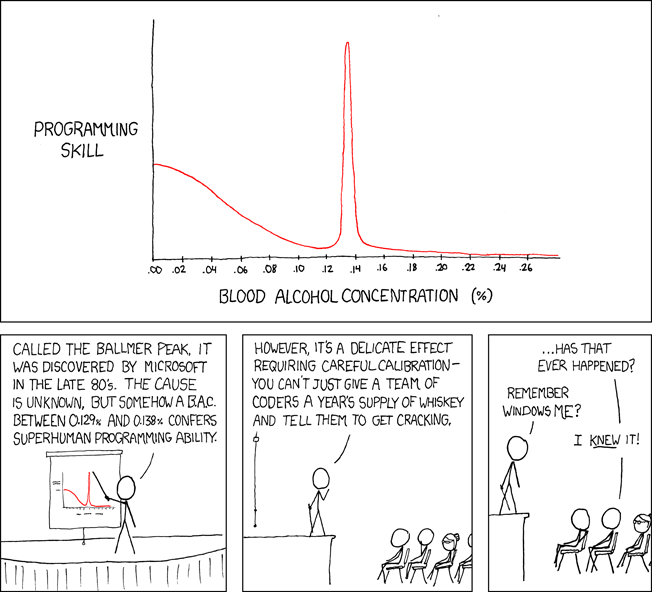
A popular saying goes that programmers are machines that turn caffeine into code. And sure enough, ask a random programmer when they do their best work and there’s a high chance they will admit to a lot of late nights. Some earlier, some later. A popular trend is to get up at 4am and get some work done before the day’s craziness begins. Others like going to bed at 4am. At the gist of all this is avoiding distractions. But you could just lock the door, what’s so special about the night? I think it boils down to three things: the maker’s schedule, the sleepy brain and bright computer screens. Read more of this post

Why the cult of hard work is counter-productive

Why the cult of hard work is counter-productive

From footballers’ work rates to the world of Big Data, the cult of “productivity” seems all-pervasive – but doing nothing might be the best thing for your well-being and your brain.

By Steven Poole [1] Published 11 December 2013 11:53

From footballers’ work rates to the world of Big Data, the cult of “productivity” seems all-pervasive – but doing nothing might be the best thing for your well-being and your brain. Recently, I saw a man on the Tube wearing a Nike T-shirt with a slogan that read, in its entirety, “I’m doing work”. The idea that playing sport or doing exercise needs to be justified by calling it a species of work illustrates the colonisation of everyday life by the devotion to toil: an ideology that argues cunningly in favour of itself in the phrase “work ethic”. Read more of this post

Heart and soul resolutions; Something simple and meaningful can make a real difference in somebody’s life.

Updated: Sunday December 29, 2013 MYT 7:20:50 AM

Heart and soul resolutions

BY SOO EWE JIN

Something simple and meaningful can make a real difference in somebody’s life.

OKAY. It’s that time of the year when columnists like us are granted the licence to offer some New Year resolutions to others. We can be serious, or we can be funny. But the reality is that few people will take our suggestions seriously unless they strike a chord within us. In the spirit of this column, which draws on many real-life experiences I go through myself, I would like to offer 10 resolutions that are up to us, as individuals, to fulfil. They do not depend on others doing their part first. The power, as we say, rests solely in our hands. Read more of this post

Famous Writers’ Sleep Habits vs. Literary Productivity, Visualized

http://www.brainpickings.org/wp-content/uploads/2013/11/sleepproductivitywriters_1500_1.jpg

Famous Writers’ Sleep Habits vs. Literary Productivity, Visualized

“In both writing and sleeping,” Stephen King observed in his excellent meditation on the art of “creative sleep” and wakeful dreaming, “we learn to be physically still at the same time we are encouraging our minds to unlock from the humdrum rational thinking of our daytime lives.”

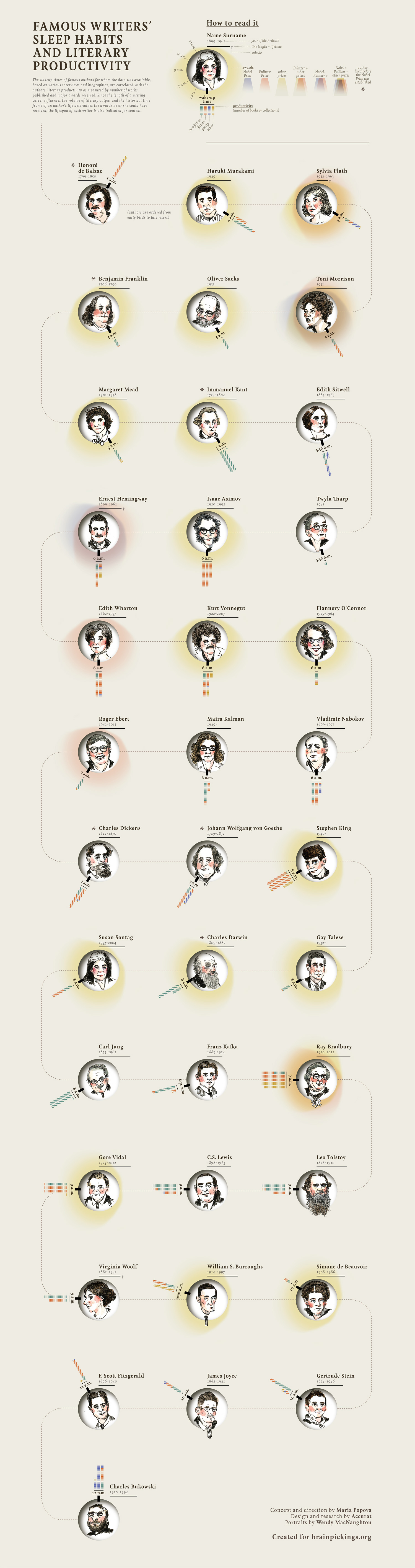
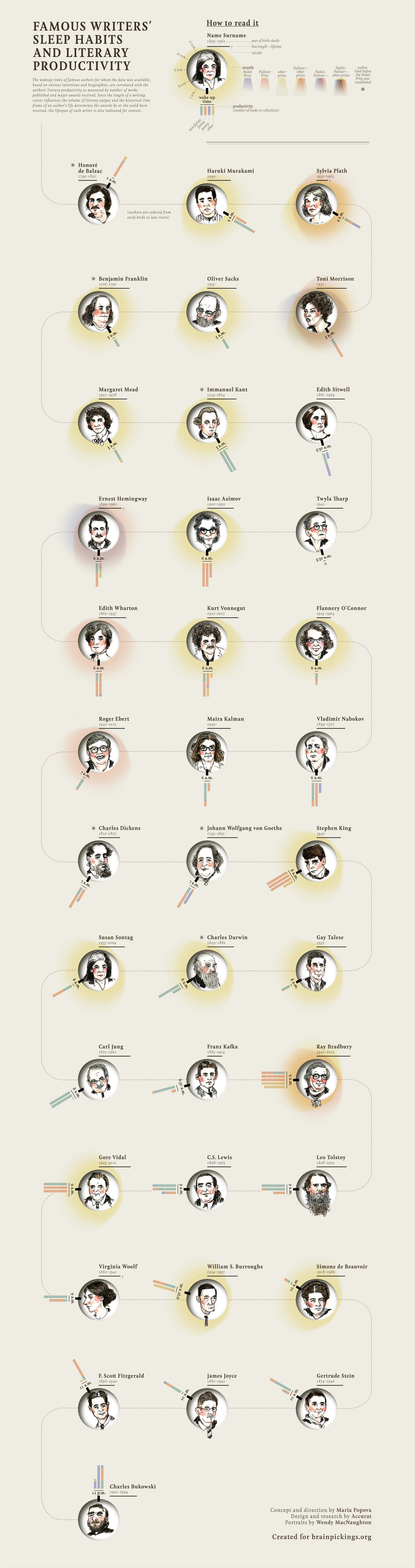
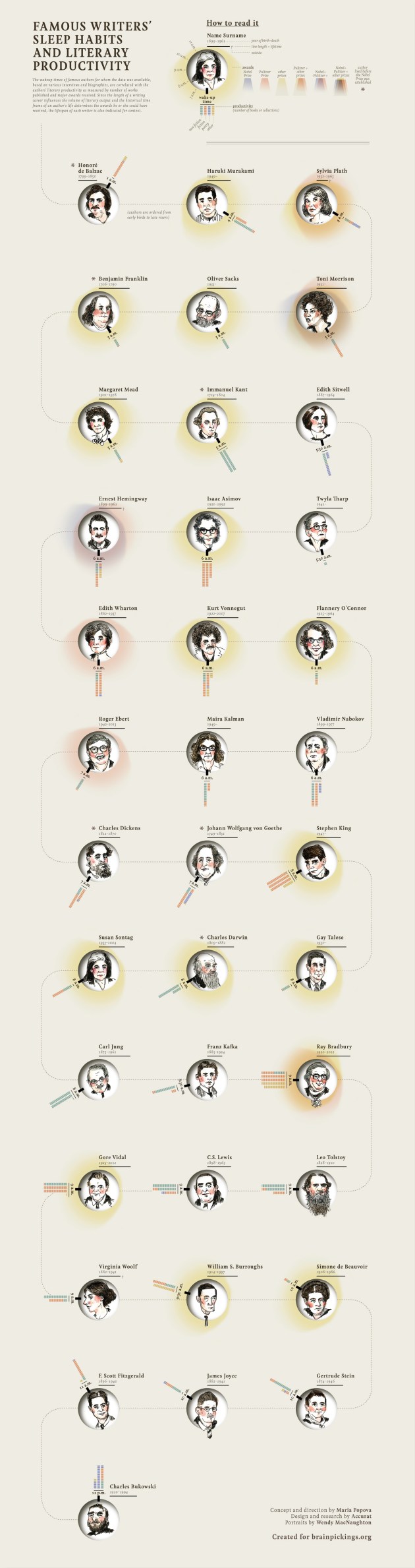
Over the years, in my endless fascination with daily routines, I found myself especially intrigued by successful writers’ sleep habits – after all, it’s been argued that “sleep is the best (and easiest) creative aphrodisiac” and science tells us that it impacts everything from our moods to our brain development to our every waking moment. I found myself wondering whether there might be a correlation between sleep habits and literary productivity. The challenge, of course, is that data on each of these variables is hard to find, hard to quantify, or both. So I turned to Italian information designer Giorgia Lupi and her team at Accurat – who make masterful visualizations of cultural phenomena seemingly impossible to quantify – and, together, we set out to explore whether it might be possible to visualize such a correlation.

First, I handed them my notes on writers’ wake-up times, amassed over years of reading biographies, interviews, journals, and other materials. Many came from two books – Daily Rituals: How Artists Work by Mason Currey and Odd Type Writers: From Joyce and Dickens to Wharton and Welty, the Obsessive Habits and Quirky Techniques of Great Authors by Celia Blue Johnson – as well as from the Paris Review interviews and various collections of diaries and letters. We ended up with a roster of thirty-seven writers for whom wake-up times were available – this became the base data set, around which we set out to quantify, then visualize, the literary productivity of each author. One important caveat is that there is an enormous degree of subjectivity in assessing a literary – or any creative – career, but since all information visualization is an exercise in subjective editorial judgment rather than a record of Objective Truth, we settled on a set of quantifiable criteria to measure “productivity”: number of published works and major awards received. Given that both the duration and the era of an author’s life affect literary output – longer lives offer more time to write, and some authors lived before the major awards were established – those variables were also indicated for context. Lastly, I reached out to Wendy MacNaughtonillustrator extraordinaire and very frequent collaborator – and asked her to contribute an illustrated portrait for each of the authors. The end result – a labor of love months in the making – is this magnificent visualization of the correlation between writers’ wake-up times, displayed in clock-like fashion around each portrait, and their literary productivity, depicted as different-colored “auras” for each of the major awards and stack-bars for number of works published, color-coded for genre. The writers are ordered according to a “timeline” of earliest to latest wake-up times, beginning with Balzac’s insomniac 1 A.M. and ending with Bukowski’s bohemian noon. The most important caveat of all, of course, is that there are countless factors that shape a writer’s creative output, of which sleep is only one – so this isn’t meant to indicate any direction of causation, only to highlight some interesting correlations: for instance, the fact that (with the exception of outliers who are both highly prolific and award-winning, such as like Bradbury and King) late risers seem to produce more works but win fewer awards than early birds.

sleepproductivitywriters_1500_1

Texas Man Arrested For Not Returning A Library Book

Texas Man Arrested For Not Returning A Library Book

WILL WEISSERTASSOCIATED PRESS
DEC. 27, 2013, 7:19 PM 4,220 23

Have an overdue library book? It could get you fined — even jailed — in Texas, other states

AUSTIN, Texas (AP) — Call it throwing the book at the bookworms. A Texas man who was arrested for failing to return an overdue library book ignited an online flurry of snarky comments and headlines about the Lone Star State extending its tough-on-crime bravado to books. But such cases aren’t unheard of, and many communities faced with shrinking budgets and rising costs have ordinances calling for fines or even arrest warrants when library property isn’t returned. In Texas alone, the issue has cost libraries an estimated $18 million. Read more of this post

Next-gens might feel that the older generation aren’t doing enough to help them develop a good relationship with the family firm. But they can take matters into their own hands.

LOVE THE FAMILY BUSINESS

ARTICLE | 27 DECEMBER, 2013 09:30 AM | BY SARAH MICHAELS

Next-gens might feel that the older generation aren’t doing enough to help them develop a good relationship with the family firm. But they can take matters into their own hands. CampdenFB takes a look.

There is more to successfully taking over a family business than being given a big office and a few shares. Successions only work if the next generation feel a strong bond with the business. Such a bond doesn’t just happen, but can only be the result of concerted efforts and detailed plans, which have to be worked at for many years. So say two academics from Barcelona’s IESE business school, Josep Tapies and Lucia Cela, who asked next-gens how they felt about their family businesses, and wrote a paper about the results, titled A Model of Psychological Ownership in Next-Generation Members of Family-owned Firms. Read more of this post

To Optimize Talent Management, Question Everything

To Optimize Talent Management, Question Everything

by John Boudreau, Ravin Jesuthasan and David Creelman  |   11:00 AM December 27, 2013

Should you hire as if your workforce will stay a month, a year, or their entire career?  The answer makes a big difference in the qualifications you set, how well candidates must “fit” with the job, the team or the organizational culture, and the “deal” you offer.  A traditional employment model may work for some, while a model based on short-term employment may work for others.  At the extreme, it may be best never to “hire” your workers at all, or to “fire” and “hire” them several times.  Leaders need solid principles to build talent strategies that fit the situation, with an optimization approach.  Too often the necessary principles for optimization are lost in the chorus of divergent views and pithy examples.  This chorus can also obscure the need to question long-held assumptions.  Letting go of those assumptions may be the key to seeing new options that make optimization possible. Read more of this post

“I think the most important thing I learned from my time there is the importance of being compassionate, patient and tolerant to other people regardless of how different or weird they may seem.” An Ultra-Exclusive High School In California Is Producing Some Of Today’s Top Startup Founders

An Ultra-Exclusive High School In California Is Producing Some Of Today’s Top Startup Founders

ALYSON SHONTELL

DEC. 27, 2013, 9:48 AM 7,668 4

Mark Suster, a venture capitalist who lives in Southern California, is helping his child apply to local high schools. One of his top choices is a private school called Crossroads, which costs tens of thousands per academic year. His child will have to compete for one of 48 slots; most openings are given to children of the school’s 3,000+ alumni. Read more of this post

Anita Mui: Remembering a Cantopop Star; “Anita also had to work very hard in order to earn a living when she was very young. Both of us didn’t have a childhood or adolescence at all, which meant we had to be perfect at our jobs.”

December 27, 2013, 8:03 AM

Anita Mui: Remembering a Cantopop Star

By Joyu Wang

BN-AW687_1224an_G_20131224002246

When Cantopop star Anita Mui Yim-fong died from cancer a decade ago, her obituary dominated headlines in Hong Kong. Now, a series of events are commemorating the singer, who sold millions of records and performed tirelessly until her death at the age of 40. Embodying her home city’s philosophy of working hard to build a career from scratch, Ms. Mui first shot to fame in 1982 after winning a singing award for new talent in Hong Kong. She went on to make more than 30 albums and give a total of 292 live concerts in her career – still a record for a Chinese female singer. Read more of this post

The Ultimate Cheat Sheet For Selling Anything: Be the sun and you will become abundance. The sun shines no matter what. It doesn’t care which flower blossoms. The sun is always there providing value every second of the day

The Ultimate Cheat Sheet For Selling Anything

Posted Dec 21, 2013 by James Altucher, Contributor

Editor’s note: James Altucher is an investor, programmer, author, and several-times entrepreneur. His latest book is “Choose Yourself!” (foreword by Dick Costolo, CEO of Twitter). Follow James on Twitter @jaltucher.

I’ve never read a book on sales. They seemed corny. Like many people, I always looked down on the concept of “selling.” It seemed like something lower than me. To some extent, selling appears manipulative. You have a product where you give the perception it has more value than it has in reality. So you need to manipulate people to buy it. This seems sad, as in “Death of a Salesman” sort of sad. Read more of this post

How Thoughts of Money Lead Us Astray: Experiments show that cash on the brain suppresses reflection

How Thoughts of Money Lead Us Astray

Experiments show that cash on the brain suppresses reflection

Dec. 27, 2013 7:48 p.m. ET

The New Year makes many of us think about time passing, and research shows that such thoughts often spur us to act more ethically. If we were to brood instead about the cash we’re likely to blow on Dec. 31, our actions might be less upright. Read more of this post