Gospel from 20th Century Investment King, Sir John Templeton

Gospel from 20th Century Investment King, Sir John Templeton

by Investing CaffeineDecember 25, 2013

Exceptional returns are not achieved by following the herd, and Sir John Templeton, the man Money magazine called the greatest global stock investor of the 20th century, followed this philosophy to an extreme. This contrarian, value legend put his money where his mouth was early on in his career. After graduating from Yale and becoming a Rhodes Scholar at Oxford, Templeton moved onto Wall Street. At the ripe young age of 26, and in the midst of World War II tensions, Templeton borrowed $10,000 (a lot of dough back in 1939) to purchase 100 shares in more than 100 stocks trading at less than $1 per share (34 of the companies were in bankruptcy). When all was said and done, only four of the investments became worthless and Templeton made a boatload of money. This wouldn’t be the end of Templeton’s success, but rather the beginning to a very long, prosperous career -Templeton ended up living a full life to age 95 (1912 – 2008). Read more of this post


The Secret to Delighting Customers: Give people purpose, not rules

The Secret to Delighting Customers

by Dilip Bhattacharjee, Bruce Jones and Francisco C. Ortega  |   10:00 AM December 27, 2013

What motivates employees to go above and beyond the call of duty to provide a great customer experience? Disney tells a story about a little girl visiting a theme park who dropped her favorite doll over a fence. When staff retrieved the doll, she was covered in mud, so they made her a new outfit, gave her a bath and a hairdo, and even took photos of her with other Disney dolls before reuniting her with her owner that evening. The girl’s mother described the doll’s return as “pure magic.” Read more of this post

The Secret to a Happy Marriage: Scrabble; For 30 years, one couple has stayed together by using their words

The Secret to a Happy Marriage: Scrabble

For 30 years, one couple has stayed together by using their words.

SHIRA DICKER and ARI L. GOLDMAN

Dec. 27, 2013 7:44 p.m. ET

When we get invited to an engagement party—something happening more now that we have children in their late 20s—we always give a Scrabble set. Invariably, we wrap it up, attach a bow and include a note with a promise: “Here is one of the secrets of a happy marriage.” Read more of this post

A Fund That Invests Like Buffett

A Fund That Invests Like Buffett

“Put all of your eggs in one basket and then watch that basket,” Warren Buffett says. In other words, if you want to beat the market, focus your efforts on a concentrated portfolio of stocks whose businesses have been analyzed as thoroughly as possible to screen out any chance of a blowup. Read more of this post

The fall guy: Bad emperors get all the credit for crumbling dynasties. What of the incompetent functionaries who do all the work?

The fall guy: Bad emperors get all the credit for crumbling dynasties. What of the incompetent functionaries who do all the work?

Dec 21st 2013 | From the print edition

20131221_CDP007_0

IT WAS the summer of 1880. In China’s rugged north-west, Russian soldiers were skirmishing with Chinese forces. In the seas to the east, the tsar’s navy was approaching Chinese waters. Thousands of Chinese troops were dispatched to Tianjin, near the capital, Beijing, where an army was mobilising for a war the Qing empire did not wish to fight. Considering that China and Russia had just negotiated a treaty, things were not going terribly well.

Read more of this post

Pulpit Bullies: Why Dominating Leaders Kill Teams

Pulpit Bullies: Why Dominating Leaders Kill Teams

by Michael Blanding | Dec 27, 2013

Power interrupts, and absolute power interrupts absolutely. Francesca Gino and colleagues discover that a high-powered boss can lead a team into poor performance

When Harvard Business School Associate Professor Francesca Gino invites high-powered business leaders to address her class, she often observes an interesting phenomenon. The guest speakers announce that they are just as interested in learning from the students as teaching them, and encourage them to ask questions and make comments. In reality, however, the speakers often do the opposite—dominating the time and not allowing for much discussion at all. Read more of this post

Loyal Subscribers Keep Hobby Magazines Afloat

December 27, 2013

Loyal Subscribers Keep Hobby Magazines Afloat

By CHRISTINE HAUGHNEY

Lance Prucnal’s family, like others in the digital age, has canceled most of its newspaper and magazine subscriptions. Mr. Prucnal’s wife dumped Family Circle, Taste of Home and Better Homes & Gardens because she no longer found enough interesting recipes. His daughter said goodbye to Glamour. And he didn’t renew Newsweek and The Dallas Morning News because the family was getting their general-interest news from television. Read more of this post

The Indie Innovator of Champagne Country: Anselme Selosse, the reclusive French vintner who helped uncork a bubbling movement

The Indie Innovator of Champagne Country

Jay McInerney tracks down Anselme Selosse, the reclusive French vintner who helped uncork a bubbling movement

JAY MCINERNEY

Updated Dec. 27, 2013 5:31 p.m. ET

OD-BA304_WINE_G_20131224172613

GROWER SPIRIT | Anselme Selosse, who runs Jacques Selosse, at his winery Michel Joly for The Wall Street Journal

CHAMPAGNE LOVERS should be grateful to Anselme Selosse, who has inspired a new generation of grape growers to produce their own bubbly rather than sell their grapes to the big, brand-name houses. The proliferation of small grower-made Champagnes, especially from Côte des Blancs, the area of France best suited to Chardonnay grapes, has been the most exciting recent development in Champagne. Grower Champagnes are the indie bands of the world’s most famous sparkling-wine region—not necessarily better, but quirkier and more distinctive than the products of the big houses. Read more of this post

When Franklin D. Roosevelt was stricken with polio at 39, it was reasonable to assume that his only future was retirement as an invalid. Alonzo Hamby reviews James Tobin’s “The Man He Became.”

Book Review: ‘The Man He Became’ by James Tobin

When Franklin D. Roosevelt was stricken with polio at 39, it was reasonable to assume that his only future was retirement as an invalid.

Alonzo L. Hamby

Dec. 27, 2013 4:38 p.m. ET

Visitors to the District of Columbia’s greatest theme park, the Franklin D. Roosevelt Memorial, are greeted at the entrance by a life-size statue of FDR in a wheelchair. Not in the original plan, it was added in 2001 after sustained advocacy by groups representing the handicapped. Roosevelt, despite his own championing of polio victims, would surely have preferred to see himself depicted without a wheelchair. He avoided such images during his lifetime, carefully constructing instead the persona of a leader who had grappled with the dread disease and prevailed over it. In “The Man He Became,” James Tobin describes, with a crisp narrative sweep, the difficult physical battle that culminated in FDR’s election to the presidency in 1932. Read more of this post

What Children Really Think About Magic; research shows little kids’ surprisingly sophisticated concepts of fantasy and reality

What Children Really Think About Magic

Dec. 27, 2013 7:29 p.m. ET

This week we will counter the cold and dark with the warmth and light of fantasy, fiction and magic—from Santa to Scrooge, from Old Father Time and Baby New Year to the Three Kings of Epiphany. Children will listen to tales of dwarves and elves and magic rings in front of an old-fashioned fire or watch them on a new-fashioned screen. Read more of this post

The Words That Popped in 2013: As a Busy Year Rushed By, a Spray of Newly Coined Terms Burst Forth Around Us

The Words That Popped in 2013

As a Busy Year Rushed By, a Spray of Newly Coined Terms Burst Forth Around Us

BEN ZIMMER

Dec. 27, 2013 7:26 p.m. ET

BN-AX482_wordss_G_20131227173437

Casting an eye back on 2013 through the lens of language can feel like looking at a series of bubbles: words that momentarily caught our fancy, often tied to passing trends or breaking-news stories. But those bubbles in the language almost always go “pop!” before too long, as new ones rise to take their place. Read more of this post

Trip Tips: Perception versus reality on the reconstructed Silk Road

Trip Tips: Perception versus reality on the reconstructed Silk Road

Thu, Dec 26 2013

By Peter Ward

SAMARKAND (Reuters) – I had a smile on my face as I strode across the tarmac of Samarkand airport, for I had arrived at last in the city I had toiled for four years to recreate as a novelist. Read more of this post

Thatcher, Mandela, Chavez Are Among Notable Deaths in 2013

Thatcher, Mandela, Chavez Are Among Notable Deaths in 2013

The first female prime minister of the U.K., the first black president of South Africa and the first woman to buy a seat on the New York Stock Exchange were among the notable deaths of 2013. Margaret Thatcher, 87, died in April; Nelson Mandela, 95, died this month; and Muriel Siebert, 84, died in August. The year also included the deaths of politicians Edward Koch, 88, in February and Hugo Chavez, 58, in March; musicians Marian McPartland, 95, in August and Lou Reed, 71, in October; and athletes Stan Musial, 92, in January, and Ken Norton, 70, in September. The world of business, finance and investing lost Fred Turner, 80, the former McDonald’s Corp. chief executive officer who introduced Chicken McNuggets, Egg McMuffins and Happy Meals, in January; Martin Zweig, 70, who predicted the 1987 stock-market crash, in February; and Alfred Feld, 98, whose 80 years at Goldman Sachs Group Inc. made him the firm’s longest-serving employee, in November. Here are the year’s notable deaths, with each name linked to a previously published obituary. A cause of death is provided when known. Read more of this post

Where There’s a Why, There’s a Way; Disruption is, by its very nature, discovery-driven. You can’t see the end from the beginning when you play where no one else is playing — so you simply start

Where There’s a Why, There’s a Way

by Whitney Johnson  |   12:00 PM December 26, 2013

At least once a week, I hear my son, a junior in high school, say, “What is the point of school? I am never going to use [insert subject] again.”  He may or may not, depending on his chosen profession.  My counter-argument tends to be, “You may not use all of it.  Some of it you will.  Regardless, good grades get you into college, and knowing how to work gets you into a happy life.”  On days when I’m desperate, or just exasperated, I huff (and I puff): “Do it because I said to.”  At which point I lament aloud, “Why doesn’t he have a vision for what his future might hold?” Read more of this post

Love of others is like quilting

2013-12-26 17:05

Love of others is like quilting

Lee Eung-tae
I believe others make us better people by sharing pieces of their personalities, their hobbies and their emotions with us.
Undoubtedly, their sweet fragrance is more than enough to warm our hearts. And the world will turn out to be a better place when we feel that hospitable atmosphere around us. I feel strong bonds whenever I am reminded of those people. A happy life is the process of building the bonds which change us into someone new.
We teachers go through many changes every March. Some teachers transfer to other schools, while others stay at the same school but assume different jobs.
So we come to meet new colleagues every year. And keeping a good relationship with people sitting around us is vital for a happy office life because we have to be together for a year. Read more of this post

Great Leaders Treat Integrity As A Habit

Great Leaders Treat Integrity As A Habit

ALISON GRISWOLD

DEC. 26, 2013, 6:23 PM 905 5

Building trust doesn’t happen in a day, but rather over weeks, months, and years. Trustworthy leaders spend the better part of their careers establishing their reputation and character, writes Joel Peterson, chairman of JetBlue Airways, in a recent post on LinkedIn. Because of that, they treat integrity as a habit and extend it to all aspects of their life. “No matter a leader’s competence, charisma, or authority, she’s either trustworthy or she’s not,” Peterson asserts. “Trustworthy people are trustworthy when it comes to family, friends, or colleagues. Obligations to show respect, to consider the welfare of others, and to keep your word don’t end when you leave the office.” Part of upholding those obligations means being constantly open to feedback, Peterson adds. The most trustworthy leaders are always ready to fix things about themselves and learn from their mistakes. “In the same way a mechanic keeps a car in top running condition, high-trust individuals monitor and tune their behavior, always striving to do better by team members and customers alike,” he says.

Jet Li has hyperthyroidism: “Like you, I have brilliant days when I am at my best … as well as days when I question whether I can still continue working. I can be in pain, but I cannot cry, and must face it head on.”

Jet Li has hyperthyroidism

POSTED: 26 Dec 2013 17:00
Action star Jet Li revealed Tuesday during a recording session for a Chinese television show that he suffers from hyperthyroidism.

TAICANG, China: Action star Jet Li revealed during a recording session for a Chinese televised talent show on Tuesday that he is suffering from hyperthyroidism, reported Chinese media. Read more of this post

How to bust through barriers to business growth; Most businesses fail to scale up. Here are three obstacles you need to blast through if you want your business to grow

How to bust through barriers to business growth

December 26, 2013: 10:01 AM ET

Most businesses fail to scale up. Here are three obstacles you need to blast through if you want your business to grow.

By Verne Harnish

FORTUNE — Most businesses fail to grow — with a vast majority remaining tiny, one- or two-person shops. I’d like to see more reach their potential. Even if a business isn’t destined to be the next Google, Amazon, or Facebook, it can still become a thriving, mid-market company. Here are three barriers to growth you need to blast through if you want your business to scale up. Read more of this post

Here’s The Reason Why Startups Crash And Burn, According To Silicon Valley Investor Paul Graham; they’re just not energetic enough. Part of what you have to be energetic enough about is going out and making users real, real happy

Here’s The Reason Why Startups Crash And Burn, According To Silicon Valley Investor Paul Graham

MEGAN ROSE DICKEY

DEC. 26, 2013, 4:32 PM 3,045 3

Startups fail all of the time, but what’s the reason for that? Prolific investor Paul Graham recently shed some light on that in The Information, Jessica Lessin’s new tech news site. His theory? Companies spend too much time making products people don’t want. Here’s the full quote:  Probably the biggest cause of failure is not making something people want. The biggest reason people do that is that they don’t pay enough attention to users. For example, they have some theory in their heads about what they need to build. They don’t go out there and talk to users and say “What do you want?” They just build this thing and then it turns out users don’t want it. It happens time and time again. Another reason might be that they’re just not energetic enough. Part of what you have to be energetic enough about is going out and making users real, real happy. They just do a half ass job of it. Maybe they’re pointing along the right vector but they only go half as far as they need to. Users look at it and they say, “Ah, it’s pretty good.” A million pretty goods, and you’re dead.

How Beer Created Civilization; What led early humans to begin cultivating grain some 10,000 years ago? It was beer — not bread

How Beer Created Civilization

DINA SPECTOR

DEC. 26, 2013, 6:15 PM 1,121 3

What led early humans to begin cultivating grain some 10,000 years ago? It was beer — not bread — a growing body of research shows.  Archaeologists have long hinted that Neolithic, or Stone Age, people first began growing and storing grain, like wheat and barley, to turn it into alcohol instead of flour for making bread. The hypothesis was recently revisited by writer Gloria Dawson in the science magazine NautilusRead more of this post

BILL GATES: 2013 Was A Huge Year For The Things That Really Matter

BILL GATES: 2013 Was A Huge Year For The Things That Really Matter

JULIE BORT

DEC. 26, 2013, 1:54 PM 13,417 28

Bill Gates is proud of how the world improved in 2013. “You’re probably seeing a lot of people’s year-end lists right now, going through the best movies, books, YouTube clips, grumpy cat memes, etc. I thought I would share a different kind of list: some of the good news you might have missed,” he wrote in a blog post. Here’s a summary of Gates’ 2013 Good News List, and we have to admit, this stuff is REALLY good

“We got smarter and faster at fighting polio.” An outbreak in the Horn of Africa was controlled in four month and that India hasn’t reported a case of polio in nearly three years.

“Child mortality went down—again.” Half as many children died in 2012 as in 1990. (A cup half-full way of looking at an awful problem.)

“The worldwide poverty rate went down—again.” The poverty rate has dropped by half since 1990, the Economist reported in June. Gates adds, “I never miss an issue of the Economist, and this might be the best piece they ran this year.”

“Rich countries re-committed to saving lives.” Gates points out renewed funding commitments to the Global Fund to fight AIDS, TB, and malaria.

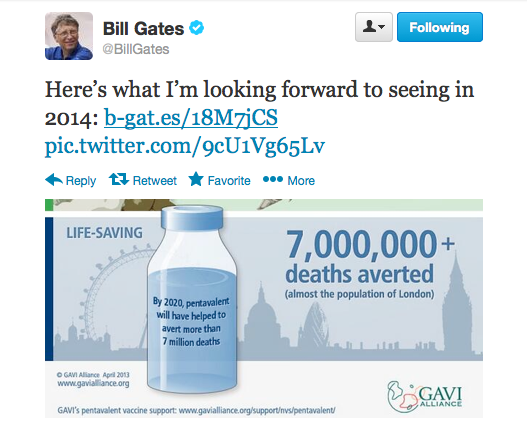
And next year, all of the world’s poorest countries will have access to a new vaccine called pentavalent. Gates is pretty excited about that, too. It’s called pentavalent “because it prevents five diseases,” Gates explained: Next year it will be available in South Sudan, the last of the 73 poorest countries to introduce it. India just announced that they’ll start giving it to every child in the nation in 2014. If other countries follow India’s example, pentavalent could prevent 7 million deaths by 2020. That’s 7 million more children protected from common, preventable childhood illnesses, in addition to the 440 million that an organization called GAVI has immunized since 2000, he says. The idea caused Gates to send this jubilant tweet:

bill-gates-tweet-deaths

Twitter/@BillGates

With so much bad news bombarding us daily, it’s nice to see how things improved, too.

Next year will be the year of “Gabo,” according to East Asia’s traditional 60-year lunar calendar. The previous Gabo years, 60 and 120 years ago, saw many turbulent events and became turning points for Korea

2013-12-26 17:02

‘Gabo’ years have many historic moments

By Lee Chang-sup
Next year will be the year of “Gabo,” according to East Asia’s traditional 60-year lunar calendar. The previous Gabo years, 60 and 120 years ago, saw many turbulent events and became turning points for the country. Reviewing what happened in these previous Gabo years will help us learn from our mistakes and help us move forward. Read more of this post

DocuSign’s CEO on getting in over your head (and succeeding): Programmer by day, thrill-seeker by night: We talk to Keith Krach about what makes him tick.

DocuSign’s CEO on getting in over your head (and succeeding)

December 26, 2013: 8:22 AM ET

Programmer by day, thrill-seeker by night: We talk to Keith Krach about what makes him tick.

By Chanelle Bessette, reporter

keith-krach-headshot-crop-620x348

FORTUNE — As the youngest-ever vice president and general manager of GMF Robotics, the industrial robotics division of automaker General Motors, Keith Krach used his early momentum in tech business to help found Rasna (which was sold in 1995 to Parametric Technologies for $500 million) and Ariba. He continued his entrepreneurial path by joining DocuSign — an electronic signature company that facilitates legal, contractual, and tax documents online — and becoming the company’s chairman and CEO. Krach holds a BS in industrial engineering from Purdue University and an MBA from Harvard, and he sits on several boards, including Angie’s List and Purdue University’s board of trustees. We asked him about his early days in business and what he considers to be his biggest achievements, as well as the thrill-seeking he does in his free time. Read more of this post

Cattle look good on gift cards, but look like poor investments; If one analysis is correct, the continued existence of cows disproves the main tenets of capitalism

December 26, 2013 7:30 pm

Cattle look good on gift cards, but look like poor investments

By Samuel Brittan

If one analysis is correct, the continued existence of cows disproves the main tenets of capitalism

Are there any central tenets of capitalism? If so, they are better provided by academic observers than by business people, who are too busy trying to earn a penny or two – not the least over the season just past – to know. So I turn to a slightly offbeat application of economics. I refer to Paper No. 9639 of the Centre for Economic Policy Research by S Anagol, A Etang and DS Karlan, portentously entitled “Continued Existence of Cows Disprove the Central Tenets of Capitalism?” Read more of this post

The first to fly: The true story of two eccentric 18th century inventors

The first to fly: The true story of two eccentric 18th century inventors

BY ADAM L. PENENBERG 
ON DECEMBER 26, 2013

The story of the first humans to fly involves two eccentric French brothers, lots of taffeta, a race against the French Academy of Science, King Louis XVI, Marie Antoinette, Benjamin Franklin, a scheming scientist, a nobleman, a rooster, duck, and a sheep. Read more of this post

Temples of delight: Museums the world over are doing amazingly well, says Fiammetta Rocco. But can they keep the visitors coming?

Temples of delight: Museums the world over are doing amazingly well, says Fiammetta Rocco. But can they keep the visitors coming?

Dec 21st 2013 | From the print edition

20131221_SRC114 (1) 20131221_SRC115 (1) 20131221_SRC756_0

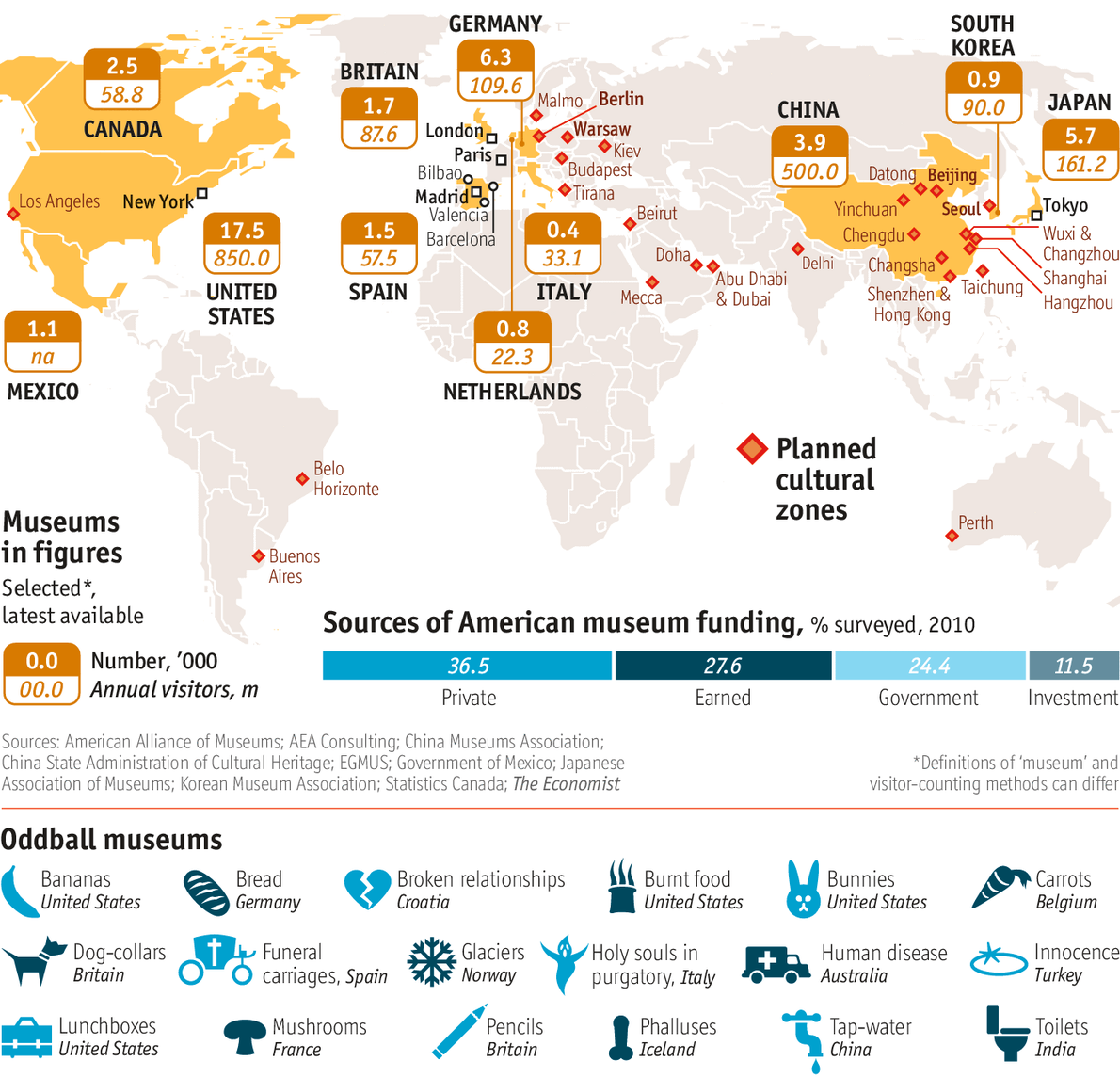
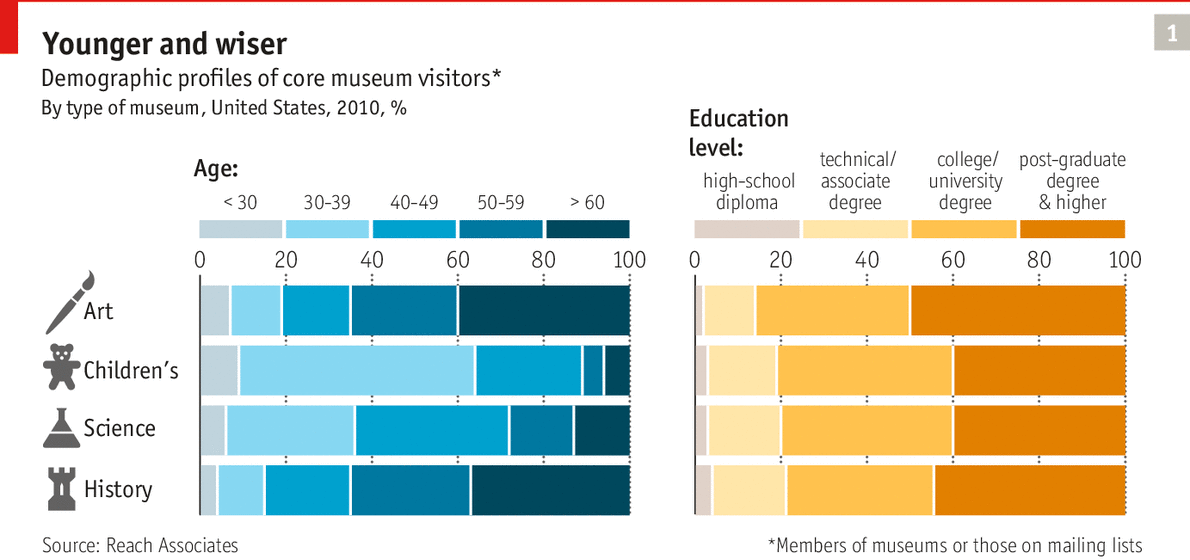
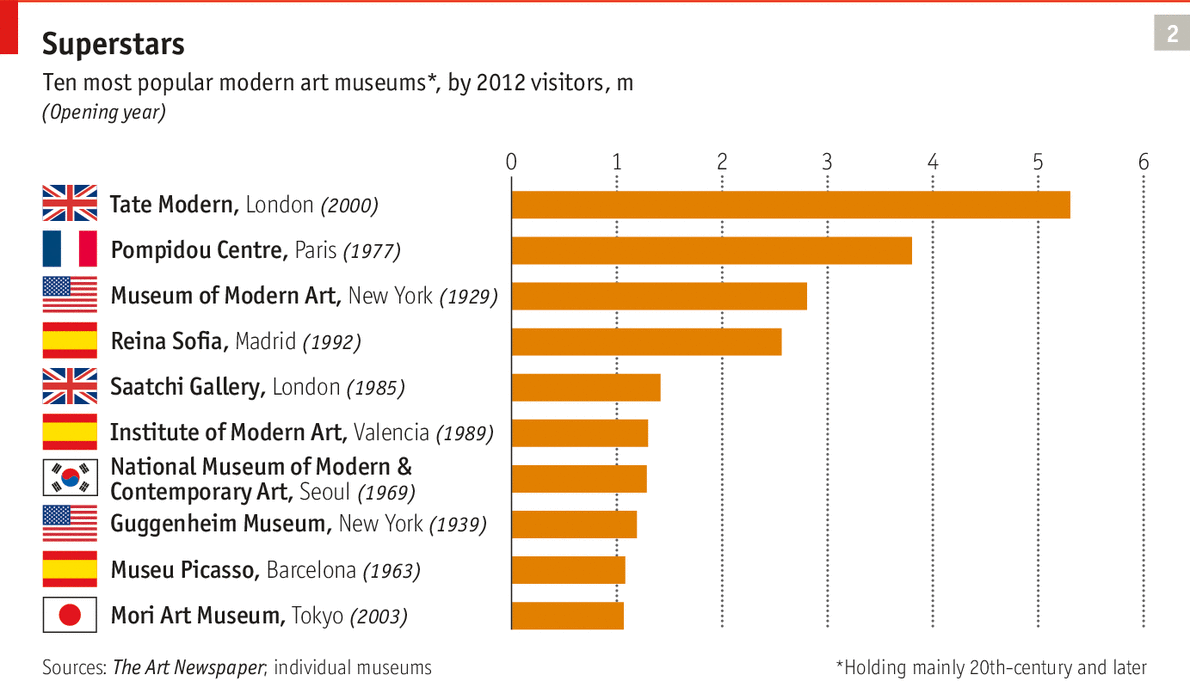
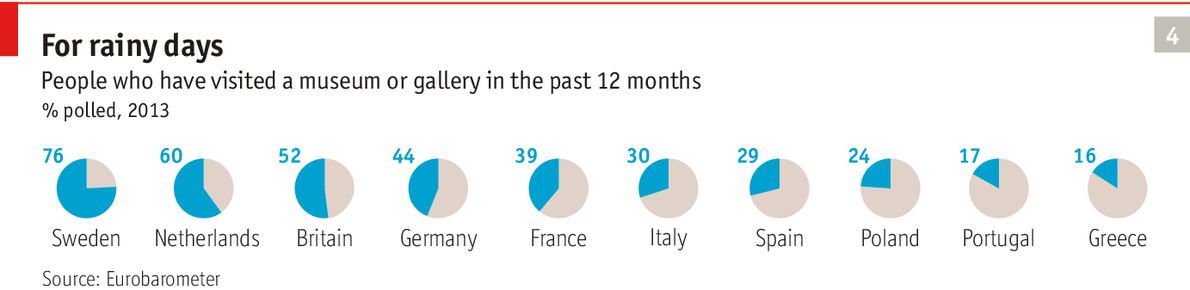
MUSEUMS USED TO stand for something old, dusty, boring and barely relevant to real life. Those kinds of places still exist, but there are far fewer of them, and the more successful ones have changed out of all recognition. The range they cover has broadened spectacularly and now goes well beyond traditional subjects such as art and artefacts, science and history (for a sample of oddball specialities, see chart). One of the biggest draws is contemporary art. Read more of this post

Feeding the culture-vultures: What museums must do to satisfy an increasingly demanding public

Feeding the culture-vultures: What museums must do to satisfy an increasingly demanding public

Dec 21st 2013 | From the print edition

20131221_SRC793_0

MUSEUMS ARE MEANT to preserve and safeguard the collections entrusted to them, which makes them naturally conservative. Yet with public funds likely to remain tight for the foreseeable future, and private money free to back institutions that are seen as winners, they will have to do some innovative thinking over the next 20 years, both to deal with unavoidable change and to seize new opportunities. Read more of this post

“Day To Night” – 24 Hours Captured In A Single Frame: The Photo Gallery

“Day To Night” – 24 Hours Captured In A Single Frame: The Photo Gallery

Tyler Durden on 12/25/2013 11:17 -0500

“I wanted to take something that everybody had an idea of — ‘I’ve been there, I’ve seen the statue of liberty’ — but I wanted to show it to you in a way that you could never see it”

– Stephen Wilkes

With markets closed around the world (and since 2008 some would say), here is something different. Below is a sampling of some of the most iconic Day to Night photos by Stephen Wilkes, each of which captures the passage of an entire day in a single frame and which, as Wired states, takes an “absurd amount of time and effort to produce” including up to 15 hours to shoot and weeks to edit. “Wilkes says he is “maniacal” in his attention to detail when making these his information-dense, hyper-curated and highly polished accounts of a single day in some of the world’s most iconic locations. Every inch of his photos, some as big as 10 feet wide, are meant to tell a story. He says telling that story is an all-consuming process.” More on this distinctly unique creative processThe amount of work that goes into these photos is insane. After intensively scouting a location and planning the shoot, Wilkes spends as long as 15 hours behind the camera, often on a crane high above the scene. He’ll shoot more than 1,000 frames between sunrise and sunset, trying to capture the shifting light and activity throughout his field of view. Through it all he remains as still as possible for fear the slightest move will shift the camera even a fraction of a degree. He and his assistant pore over the photos for weeks, creating dozens of digital collages that typically comprise 50 images. He uses a complex grid system to arrange the most interesting parts of each shot into a strong composition while staying true to the time of day that they were taken. The attention to detail reveals itself when you’re right next to the massive prints, which when seen up close stretch well beyond natural peripheral vision. The smallest oversight, like a slightly shifted shadow, can shatter the illusion by betraying the fact the epic image is in fact a collage of smaller images shot at different times of day. But when everything comes together perfectly, the viewer can step back or get nose-deep in the image without losing the sense of cohesion. Another important aspect of the work is how Wilkes teases visual narratives out of seemingly chaotic public spaces. A few hundred tourists snapping selfies in front of the Sacre Coeur or an arrest on the Santa Monica Pier become nodes of intrigue in a network connecting individual frames that form the final collage. Wilkes says finding ways to connect the countless moments held within the image and the sweep of time it captures is one of the most exciting parts of the process. “It’s as if I’m a writer and I’ve been given this incredible thesaurus, so I have all these new words to write with,” he says.

And the photos:

America Cup_0 Read more of this post

33 Ways To Be Happier

33 Ways To Be Happier

DINA SPECTOR

Humans have remarkable control over their own happiness. In her book, “The How of Happiness: A New Approach to Getting the Life You Want,” psychology professor Sonja Lyubomirsky says a person’s happiness is 50% due to genetics, 10% due to circumstances, and the remaining 40% is “within our power to change.” Happiness is different for each person, which is why we’ve compiled dozens of different methods to help you find your inner sunshine.

Find your “flow.”

Mihaly Csikszentmihalyi, a professor at Claremont Graduate University, says that the secret to happiness is finding your “flow” — the creative moment when a person achieves an “effortless state of concentration and enjoyment.” These exceptional moments are unqiue to each person, and generally occur when a person is doing his or her favorite activity — cooking, singing, or playing chess, for example. Writing in Psychology Today, Cikszentmihaly provides the example of someone who experiences “flow” while skiing: Imaging that you are skiing down a slope and your full attention is focused on the movements of your body and your full attention is focused on the movements of your body, the position of the skis, the air whistling past your face, and the snow-shrouded trees running by. There is no room in your awareness for conflicts or contradictions; you know that a distracting thought or emotion might get you buried face down in the snow. The run is so perfect that you want it to last forever. We engage in these activities for our own sake, and “the happiness that follows flow is of our own making,” Cikszentmihaly says.

Focus on what you’re doing right now.

Are you thinking about something other than what you’re currently doing? If the answer is “yes” then you are less happy than people who don’t have a wandering mind, according to research from Harvard University. About 46% of people spend their waking hours thinking about something other than what they’re doing, say Harvard psychologists Matthew Killingsworth and Daniel Gilbert. “The ability to think about what is not happening is a cognitive achievement that comes at an emotional cost,” the study, published in the journal Science, concluded.  Read more of this post

Want to build a brand? Make one great product; “Money runs out faster than opportunities.” Make one thing great. Get one thing right.

Want to build a brand? Make one great product

BY ANDY DUNN 
ON DECEMBER 25, 2013

one

A lot of brands don’t make it, because in the process of trying to get many things right, they don’t get anything right. Why are they in such a hurry? A great brand is a privilege, and it’s a privilege best earned through an item, not through a collection. Designers and merchants and founders think about collections. Consumers think about items. Designers and merchants and founders think about one-stop shops. That kind of thinking may lead you to a no-stop shop. Read more of this post