In Japan, no escape from The Eye’s perpetual policing glare

In Japan, no escape from The Eye’s perpetual policing glare

BY DEBITO ARUDOU

DEC 4, 2013

Hey, all you residents heading abroad for the holidays, here’s a little experiment to try on yourself: When you return to Japan, take note of an interesting phenomenon that starts just as you deplane and plug back into Japanese society. You’ll feel a palpable and intractable pressure — a pressure to conform to The Order, that standardized way of doing things in Japan. You can use it to get what you want, or you can defy it and feel the burn of its stare. Read more of this post

A life without empathy for others is truly unrewarding

Updated: Wednesday December 4, 2013 MYT 11:17:27 AM

No Compromise on Compassion

BY DAVINA GOH

A life without empathy for others is truly unrewarding.

IF there is any more memorable way that I have reconnected with old friends, I can’t imagine one more relevant than with my good friend Ashaari. Ashaari and I had only known each other previously from a theatre production a year before. I was an actor and he, a friend of the director’s, was a front-of-house volunteer. Over a year later, I randomly responded to a mass Facebook message Ashaari had sent out, regarding a video project for an international initiative called the Charter of Compassion. He was looking for people to be filmed answering the question: What does the word ‘compassion’ mean to you? Read more of this post

12 Successful Entrepreneurs Share The Best Advice They Ever Got

12 Successful Entrepreneurs Share The Best Advice They Ever Got

MAX NISEN AND JENNA GOUDREAU DEC. 3, 2013, 2:27 PM 160,867 1

This is part of the “Moving Forward” series offering advice to small business owners on technology, mentorship, productivity, and growth. “Moving Forward” is sponsored by Ink from Chase®. 

Being a successful entrepreneur frequently involves a series of missteps and mistakes before finally nailing the right idea or business. The difference, for many, between giving up and persisting through the toughest times can be getting advice from people who have done it before — and being smart enough to listen. From investor Mark Cuban’s dad telling him that there are no shortcuts to Lululemon founder Chip Wilson’s realization that people actually enjoy helping others, we asked 12 successful entrepreneurs to share the best advice they ever got, discovering the lessons that stick with them to this day.  Read more of this post

Hidden U-Haul Billionaire Emerges With Storage Empire

Hidden U-Haul Billionaire Emerges With Storage Empire

download (34)

Mark V. Shoen had to endure his father’s suicide, a sister-in-law’s murder and an internecine battle on his way to becoming the largest shareholder of Amerco, the parent of truck rental company U-Haul, North America’s biggest moving and storage business. Becoming a self-storage baron required additional drama, if only in the courtroom. Shoen’s storage empire was the center of a decade-long shareholder suit that splintered his family and left the 62-year-old in control of a business that made him a billionaire. Read more of this post

Malcolm Gladwell on the Advantages of Disadvantages

Malcolm Gladwell on the Advantages of Disadvantages

Dec 03, 2013 Books Podcasts Video North America

In his new bestseller, David and Goliath: Underdogs, Misfits, and the Art of Battling Giants, Malcolm Gladwell looks at what happens when ordinary people confront powerful opponents. He starts the book by dissecting the classic tale of David and Goliath, challenging our beliefs about what the story tells us regarding underdogs and giants, and ultimately, our fundamental assumptions about power. Wharton management professor Adam M. Grant recently interviewed Gladwell about his new book when he visited campusas a guest lecturer in the Authors@Wharton series. Gladwell shared why he never roots for the underdog, where he comes up with the ideas for his books and sets the record straight on the biggest misunderstandings about his work. An edited transcript of the conversation follows.

Adam Grant: Let’s start talking about your latest blockbuster: David and Goliath. What’s the core message and idea?

Malcolm Gladwell: It’s an examination of the idea of advantage and, particularly, it looks at asymmetrical conflicts – conflicts between one very large and one not-so-large party. How do we account for the unusual number of successes that underdogs have in those situations? The book takes off from there to try and figure out whether our assumptions about what makes for an advantage are accurate. Read more of this post

U.S. Students Get Stuck in Middle of the Pack on OECD Test

U.S. Students Get Stuck in Middle of the Pack on OECD Test

U.S. teenagers showed little progress on an international test of math, science and reading, which was again led by students in Shanghai and Singapore, bolstering support for tougher standards in U.S. schools. The U.S. placed below average in math and about average in reading and science among the 34 countries in the Organization for Economic Cooperation and Development, the Paris-based agency that released results today of the 2012 Programme for International Student Assessment. There was little change from the last test three years ago, the OECD said. Read more of this post

Game Theory Sparks Terrorism Risk Modeling; There isn’t enough historical data to help companies keep pace with intelligent adversaries.

December 02, 2013

Game Theory Sparks Terrorism Risk Modeling

There isn’t enough historical data to help companies keep pace with intelligent adversaries.

David M. Katz

This is one of three articles in a special report on new uses of risk analytics and risk modeling. The report takes in an-depth look at how Big Data can provide CFOs with new weapons they can use to combat the risk they fear the most: the unexpected.

By factoring in the Economic Cost of Risk, CFOs can capture the ups and downs of their companies’ perils. Traditional metrics can help CFO get a firmer grasp of past or frequent events. But for future perils, risk modeling may be the way to go. Read more of this post

The need to rein in perfectionism; Demanding flawless performance is itself a management fault

December 4, 2013 5:56 pm

The need to rein in perfectionism

By Naomi Shragai

In psychotherapy we have a useful concept to take the pressure off parents who feel they need to be perfect. We say they need only to be “good enough”, and that an important way of achieving that is to create the right environment for their children to thrive. Read more of this post

Harvard Median Grade of A- Gets F in Responsibility From Teacher

Harvard Median Grade of A- Gets F in Responsibility From Teacher

Harvard University undergraduates are more likely to get an A than any other grade, a measure of academic largesse that hurts the college’s students in the long run, a professor said.

A university official revealed in a faculty meeting that A’s are the most frequently given mark from Harvard College teachers, and A- is the median grade, the Harvard Crimson student newspaper reported yesterday.

“They’re debasing the value of an A,” said Harvey Mansfield, a government professor who has long decried grade inflation at the school in Cambridge, Massachusetts. “They’re ignoring their responsibility to maintain our standards.”

Jay Harris, Harvard’s dean of undergraduate education, revealed the data on grades to answer a question from Mansfield at a monthly faculty meeting, the Crimson reported. Jeff Neal, a university spokesman, confirmed the accuracy of the information in an e-mailed statement today.

“We believe that learning is the most important thing that happens in our classrooms and throughout our system of residential education,” Neal said. “The faculty are focused on creating positive and lasting learning outcomes for our undergraduates. We watch and review trends in grading across Harvard College, but we are most interested in helping our students learn and learn well.”

The school formed an Initiative on Teaching and Learning in 2011.

Cheating Scandal

Harvard, the oldest and richest U.S. university, had its scholarly reputation rocked last year by a final-exam cheating scandal that resulted in suspensions for dozens of students. The scandal was discovered when teachers noticed evidence of students collaborating inappropriately on a take-home exam.

The college’s students expect high grades, whether or not they perform outstanding work, Mansfield said.

“The scandal took place in an atmosphere where easy, good grades are expected,” he said in a telephone interview. “People aren’t serious about working for grades.”

Mansfield said that many teachers give A’s because they want to maintain good relationships with students, who need high marks to get jobs and places in graduate and professional schools. He called the high-grade glut a kind of pollution, where each person thinks their contribution is harmless.

“Students are living in a bubble,” he said. “When they get out, they’re surprised that people don’t get A’s for doing no work and being dumb.”

Established in 1636, Harvard has an endowment of $32.7 billion, the biggest educational fund in the world. The school said in September that it plans to raise $6.5 billion in donations by 2018, a record goal for U.S. universities.

— Editors: Chris Staiti, Lisa Wolfson

To contact the reporter on this story: John Lauerman in Boston at jlauerman@bloomberg.net

Trust-based payment system not working out well for restaurant

Trust-based payment system not working out well for restaurant

Wednesday, December 4, 2013 – 09:24

China Daily/Asia News Network

The owner of a self-service restaurant in Fujian province that trusts diners to pay what they want says he is running up a huge financial loss – as many people opt to pay nothing at all. Five Loaves and Two Fish was opened in downtown Fuzhou in August, offering coffee, cakes and hot dishes. It has five round tables and six workers to cook and clean.  Read more of this post

December 4, 2013

Baffling 400,000-Year-Old Clue to Human Origins

By CARL ZIMMER

Scientists have found the oldest DNA evidence yet of humans’ biological history. But instead of neatly clarifying human evolution, the finding is adding new mysteries. In a paper in the journal Nature, scientists reported Wednesday that they had retrieved ancient human DNA from a fossil dating back about 400,000 years, shattering the previous record of 100,000 years. Read more of this post

The Three Habits of Highly Effective Demotivators

Posted: November 22, 2013

Sally Helgesen is an author, speaker, and leadership development consultant, whose most recent book is The Female Vision: Women’s Real Power at Work(with Julie Johnson; Berrett-Koehler, 2010).

The Three Habits of Highly Effective Demotivators

Jake, a young marketing whiz, thought he’d found his perfect match in a well-funded technology startup in the academic sector. (It’s a real company, but I’ve changed all names.) For the first few months, Jake was in heaven: smart colleagues, plenty of autonomy, an open field of savvy customers looking for solutions in a hot sector, behind-the-curve competitors, and a terrific product he could sell with his heart. Read more of this post

The President, the Pope and the People: The idea that honest work should pay an honest wage is part of the American social contract – and one that is in danger of disintegrating

December 4, 2013

The President, the Pope and the People

By CHARLES M. BLOW

On Wednesday, while delivering a speech largely about income inequality and economic mobility, a populist president invoked a populist pope. After rattling off a laundry list of dire statistics, President Obama cited Pope Francis: Read more of this post

Serious innovation requires serious state support; Growth requires the kind of committed finance behind Silicon Valley

December 4, 2013 5:16 pm

Serious innovation requires serious state support

By Mariana Mazzucato

Growth requires the kind of committed finance behind Silicon Valley, writes Mariana Mazzucato

Economics ministers around the developed world say that they want to “rebalance” away from speculative finance and build up a more productive “real economy”. Yet this plan overlooks just how sick the real economy has become. It also ignores that we need high-quality finance – not just large quantities of it – in order to regenerate it. Read more of this post

16 Gifts Every Investor Would Love

16 Gifts Every Investor Would Love

STEVEN PERLBERG AND SAM RO NOV. 29, 2013, 1:33 PM 101,944 1

This editorial feature, “16 Gifts Every Investor Would Love,” is sponsored by Rosetta Stone. For many, the actual act of holiday shopping is the scourge of an otherwise cheerful season. A good gift is hard to find for anyone, but if you’ve got an investor in your life, it can prove especially difficult. Not to fear, because we’ve got a bunch of great options for you. Whether it’s a desktop essential, a must-have book, or a premium item, we have you covered this year. Prices may vary, but these are sure to keep any investor risk-on for 2014.  Read more of this post

Goldman Sachs Sued by Singapore Client Oei Over $34.3 Million Loss on Brazilian real-yen options trades

Goldman Sachs Sued by Singapore Client Oei Over Loss

Goldman Sachs Group Inc. (GS) was sued by Singaporean wealth-management client Oei Hong Leong over a $34.3 million loss on Brazilian real-yen options trades he said it misled him into making. Oei accused the New York-based bank of fraudulent misrepresentation, breach of fiduciary duty, fraudulent inducement and unjust enrichment in papers filed today in New York state court. Read more of this post

Idea Velocity: What I Learned From SAC; do you really have a discipline in place to come up with at least one, highly researched, well-thought out, high conviction idea per week?

TUESDAY, NOVEMBER 26, 2013

IDEA VELOCITY. What I learned from SAC.
POSTED BY DASAN AT 9:25 AM

SAC, the infamous hedge fund led by mercurial, secretive, super art collector Stevie Cohen is legendary. They have recently been accused of insider trading and it sure looks like they are guilty.  But there are a lot of very smart people that worked there that had nothing to do with this scandal. PMs and analysts in Hedgistan dream of toiling there and making obscene riches.  As an unabashed trading addict and player of The Game, I was like a moth to the flame.  I had to check this place out.  I did.  Although by dumb luck and a well-calibrated BS detector, I was able to avoid joining them, I did meet with them over a dozen times.  I learned some principles that have changed my way of trading forever.  For the good.  Out of a spirit of equanimity and gratitude, I will share them with you. Read more of this post

How to Live In a Grey World with Black-and-White Values? Musings on the Indian Accounting Standards 18, “Willful Defaulters”, Frugal Innovations and Avalokiteśvara

The following article is extracted from the Bamboo Innovator Insight weekly column blog related to the context and thought leadership behind the stock idea generation process of Asian wide-moat businesses that are featured in the monthly entitled The Moat Report Asia. Fellow value investors get to go behind the scene to learn thought-provoking timely insights on key macro and industry trends in Asia, as well as benefit from the occasional discussion of potential red flags, misgovernance or fraud-detection trails ahead of time to enhance the critical-thinking skill about the myriad pitfalls of investing in Asia at the microstructure- and firm-level.

The weekly Bamboo Innovator Insight series brings to you:

  • How to Live In a Grey World with Black-and-White Values? Musings on the Indian Accounting Standards 18, “Willful Defaulters”, Frugal Innovations and Avalokiteśvara, Dec 2, 2013 (Moat Report AsiaBeyondProxy)

Grey World

How to Live In a Grey World with Black-and-White Values? Musings on the Indian Accounting Standards 18, “Willful Defaulters”, Frugal Innovations and Avalokiteśvara

“Mr Murthy, if we have black-and-white values like yourself, how can we live in the real world that is grey?” This brilliant question to Infosys Chairman Narayana Murthy was posed by Hemant Amin, the Singapore-based value investor who compounded his investment in Infosys by 60-folds, amongst his other concentrated portfolio holdings in his multi-million single family office. Last Thursday was the second time that the Bamboo Innovator has met over lunch with Hemant, also the head of the BRKets (www.brkets.com), after our rendezvous at the Singapore Cricket Club on 7 Nov. We also wanted to catch up before the Bamboo Innovator flies over to India on a work trip from 7 to 17 December.

The Bamboo Innovator is grateful to have the experience to have met with people from all walks of life during the past decade plus in the Asian capital jungles. They range from competent pioneering intra-preneurs such as Tong Chong Heong who nurtured Singapore’s Keppel FELS (KEP SP, MV $16.3B); gritty entrepreneurs such as Lim Hock Chee who built Singapore’s supermarket chain Sheng Siong (SSG SP, MV $672M) against the odds of competing with the Davids of state-owned FairPrice and giant Jardine Group’s Dairy Farm, China’s natural gas pipeline and equipment baron Wang Yusuo of ENN Energy (2688 HK, $7.6B) and spinoff Enric (3899 HK, MV $3.2B) and many more; kind and wise professors from the School of Accounting at Singapore Management University; to exposing the accounting frauds of billionaire imposters such as Eddy Groves of Australia’s ABC Learning and the “extractor” CEOs of S-chips and P-chips. Perhaps the Bamboo has acquired some sensitivity in differentiating between the “Compounders” and the “Extractors” in a harsh and cruel world over the years. Hence, we are always excited to meet with a super value investor or/and outstanding entrepreneur with upright values and Hemant is amongst them.

The answer by Narayana Murthy was equally brilliant and profound. “You have to be able to live with the consequences of your values system. You have to be comfortable under your own skin.” An example would be how Murthy would rather acquire plots of land to expand his business at three times the price than he would otherwise pay for if he had gone through the “grey market” of middlemen who would most probably bully and rape the rural poor residents and force them into “illegal” eviction.

Besides Infosys, another concentrated compounding bets that returned multiple-fold for Hemant include HDFC (HDFC IN, MV $20.6B) and its subsidiary spinoff GRUH Finance (GRHF IN, MV $671M). As Asia slows down, many tycoons have been considering spinoffs as part of their corporate restructuring efforts to battle sluggishness and improve managerial efficiency. As explained in our earlier articles, not all spinoffs are value-creating opportunities. Heavily-indebted firms are in deleveraging mode to dispose highly-geared businesses to investors in spinoffs. The upcoming spinoff events in Asia need to be examined carefully for their business fundamentals (whether they have a wide moat and a unique scalable business model) and their motivation. In India, one of the more useful accounting clues to separate the Compounders vs the Extractors in India has been the Indian Accounting Standards 18 (IAS 18), which we will elaborate after understanding the (hidden) debt problem in India and Asia.

Despite the entrenched problems in India, both Hemant and the Bamboo Innovator share the same investment insight that India is a unique vibrant and versatile hub for “frugal innovations”: cost-effective and affordable solutions of various varieties that cater to price-sensitive consumers. Like the three sources of wide-moat in Bamboo Innovators to separate the resilient compounders vs the extractors, India’s Frugal Innovators are those with the:

1)       Indestructible intangible know-how in proprietary know-how in the system to scale up or know-how in unique products or trust and support in the community of customers and suppliers, such as Tata Consultancy Services TCS; NBFCs such as HDFC and its subsidiary GRUH with their accumulated knowledge base in assessing the credit quality of its borrowers which cultivates and snowballs trust and support from its customer base; the “unique” products of Bosch India, Pidilite Industries, Britannia, Jyothy, Eicher, Emami;

2)       Core-periphery network with the strong touch-points and periphery network eg Asian Paints, Godrej Consumer, Mahindra & Mahindra;

3)       Open innovation in co-creating value with external partners, such as the MNCs Nestle India etc, Amara Raja vs Exide, Hero Motocorp.

One prominent Buddhist story according to Mahāyāna doctrine tells of Avalokiteśvara (Sanskrit: अवलोकितेश्वर lit. “Lord who looks down”), the bodhisattva vowing never to rest until he had freed all sentient beings from samsara. Despite strenuous effort, he realizes that still many unhappy beings were yet to be saved. After struggling to comprehend the needs of so many, his head splits into eleven pieces. Amitabha Buddha, seeing his plight, gives him eleven heads with which to hear the cries of the suffering. Upon hearing these cries and comprehending them, Avalokiteśvara attempts to reach out to all those who needed aid, but found that his two arms shattered into pieces. Once more, Amitabha Buddha comes to his aid and invests him with a thousand arms with which to aid the suffering multitudes. The Chinese name of Avalokiteśvara is Guanyin (观音菩萨), which means “Observing the Sounds or Cries of the World”. The Goddess of Mercy goes all out to hear and see the pains and sorrows and negative things to help with her thousand hands and eyes (“即发誓言,若我当来堪能利益安乐一切众生者,令我即时身千手千眼具足.” 《千手千眼观世音菩萨广大圆满无碍大悲心陀罗尼经》). In their own ways, Frugal Innovators attempt to design cost-effective, “good enough” solutions that can reach out to meet the aspirations and solve the problems of millions of consumers with the indestructible intangible asset in the form of their first-hand knowledge of the ground situation of targeted customer group. Seeking to hear and see the negative things and acknowledging sadness and failures is perhaps the first step to becoming a Bamboo Innovator and resilient compounder.

The Bamboo Innovator will be away to India on a work trip from 7 to 17 December and will resume the weekly Bamboo Innovator Insight article in the last week of December. We are grateful for your support and understanding all this while.

Hands-On Bavarian Count Presides Over a Pencil-Making Empire

December 3, 2013

Hands-On Bavarian Count Presides Over a Pencil-Making Empire

By JACK EWING

STEIN, Germany — Count Anton-Wolfgang von Faber-Castell has been known to hurl wooden pencils from the tower of his castle to the stone courtyard below. It is not a petty fit of pique by a mad Bavarian aristocrat. The 72-year-old count, the eighth in a long line of pencil makers, just wants to prove how durable the pencils that carry his family name are. The Faber-Castell family has been making wooden pencils by the hundreds of millions here in a storybook setting, bisected by the swift Rednitz River, which was once the main source of power here. A torrent of brightly colored pencils flows from clattering machines in a century-old factory with a tile roof and windows framed in pastel hues. Faber-Castell is the largest maker of wood-encased pencils in the world and also makes a broad range of pens, crayons and art and drawing supplies as well as accessories like erasers and sharpeners. About half the company’s German production is exported, mostly to other countries in the euro zone. That means that Faber-Castell contributes, at least in a small way, to Germany’s large and controversial trade surplus — which now rivals China’s for the world’s largest. Read more of this post

Marriages can survive the start-up pressures; Being married to an entrepreneur is not easy. Most are egotistical and obsessed by their company; very few winning entrepreneurs are unattached permanently. Like all of us, they benefit from the emotional support a soul mate can bring

December 3, 2013 4:20 pm

Marriages can survive the start-up pressures

By Luke Johnson

Being married to an entrepreneur is not easy. Most are egotistical and obsessed by their company

Virtually all entrepreneurial successes are forged by a partnership. But frequently one of the partners is a background figure, who few in the business world will know. That is because they are the spouse of the entrepreneur. Yet their importance is usually enormous. Read more of this post

Is a Peanut Butter Pop-Tart Innovation? Kellogg’s CEO Calls It That, but Is He Right?

Is a Peanut Butter Pop-Tart Innovation?

Kellogg’s CEO Calls It That, but Is He Right?

DENNIS K. BERMAN

Dec. 3, 2013 8:22 p.m. ET

It measures nearly three inches by five inches, and it’s made from enriched flour, corn syrup and creamy peanut butter. This is Kellogg‘s K +0.89% Gone Nutty! peanut butter Pop-Tart. If you agree with Kellogg CEO John Bryant, it’s one of the cereal company’s important products of 2013. He went so far as to call it an innovation. Listen to the chiefs of America’s biggest companies, and you’ll find the Gone Nutty! Pop-Tart has plenty of company. Most CEOs now spray the word “innovation” as if it were an air freshener. A little spritz can’t hurt. A little spritz can’t hurt. Read more of this post

The One Thing That Truly Motivates Creative Talent–And How To Foster It

THE ONE THING THAT TRULY MOTIVATES CREATIVE TALENT–AND HOW TO FOSTER IT

BY DEBORAH MORRISON

Educator and author Deborah Morrison talks inner mojo and the simple, yet critical stuff of wanting to be good. Talent. It’s the subject line of many an inbox message these days. All of us who belong to the great ecosystem of new talent development–universities, portfolio programs, thinktanks, agencies–and agency leaders, mentors, recruiters and talent managers, offer opinions about who we need now and how we train them. Even better, the discussion has evolved to the nurturing of talent over the long ride of a career. Read more of this post

(Bad) strategy is everything, in innovating

(Bad) strategy is everything, in innovating

“Business as usual” is no longer a luxury a company can afford. More and more, companies are seeing that their revenue growth cannot outpace the increase in cost, resulting in decreasing profitability year-on-year.

BY JANSON YAP –

4 HOURS 54 MIN AGO

“Business as usual” is no longer a luxury a company can afford. More and more, companies are seeing that their revenue growth cannot outpace the increase in cost, resulting in decreasing profitability year-on-year. With the fast-changing competitive ecosystem, brought about in part by technology and knowledge advancement, business leaders are recognising the urgent need to revisit their strategy. Innovation is a critical piece of that strategy — but many times, normally rational business people allow themselves to be blinded by the notion that innovation is unlike any other aspect of business and, therefore, does not follow the normal rules of corporate strategy. Read more of this post

The Secrets Inside Us: The human body is less well understood than we think

December 3, 2013

The Secrets Inside Us

By BILL HAYES

WHEN the news broke recently that a team of Belgian scientists had “discovered” a new body part — a ligament located just outside the knee — the first place my mind went was to Padua. Padua is the small city in northern Italy where the 16th-century Brussels-born scientist Andreas Vesalius taught anatomy and created his history-making masterpiece, “De Humani Corporis Fabrica” (“On the Fabric of the Human Body”), published in 1543. The old man would have been delighted by the news, I couldn’t help thinking. Read more of this post

The Science of Great Ideas – How to Train Your Creative Brain

THE SCIENCE OF GREAT IDEAS–HOW TO TRAIN YOUR CREATIVE BRAIN

CREATIVITY IS A MYSTERY RIGHT? MAYBE NOT. HERE’S A LOOK AT THE SCIENCE OF THE CREATIVE PROCESS AND HOW TO HARNESS YOUR BRAIN’S POWER TO COME UP WITH MORE GREAT IDEAS.

BY BELLE BETH COOPER

Ah, ideas. Who doesn’t want more great ideas? I know I do. I usually think about ideas as being magical and hard to produce. I expect them to just show up without me cultivating them, and I often get frustrated when they don’t show up when I need them. The good news is that it turns out cultivating ideas is a process, and one that we can practice to produce more (and hopefully better) ideas. On the other hand, often timesgreat ideas can also just come to us whilst in the shower or in another relaxing environment. Read more of this post

The Reinvention of an Industrial Titan: DuPont is again remaking itself, with a shifting R&D strategy and a pile of acquisitions and divestitures. The CFO gives his take on the transformation.

November 22, 2013

The Reinvention of an Industrial Titan

DuPont is again remaking itself, with a shifting R&D strategy and a pile of acquisitions and divestitures. The CFO gives his take on the transformation.

David McCann

The quaintly named E.I. du Pont de Nemours and Company was founded in 1802 as a gunpowder manufacturer. That remained its main product until late in that century, when it delved into dynamite and nitroglycerin. (The company later upped the explosive ante considerably by helping along The Manhattan Project and production of the first atomic bombs.) For most of the past century, DuPont remained a U.S. industrial titan even while entering and exiting a dizzying array of businesses. It’s arguable that no major American company has reinvented itself as many times as DuPont has. Read more of this post

Paul Crouch dies at 79; founder of the Trinity Broadcasting Network, the world’s largest Christian television system.

Paul Crouch dies at 79; founder of the Trinity Broadcasting Network

By Elaine Woo, Tuesday, December 3, 9:02 AM

In the mid-1970s, a vision came to Paul Crouch, but it wasn’t what a man of the cloth might have expected. A map of North America appeared on his ceiling, glowing with pencil-thin beams of light that shot in every direction. “Lord,” asked Mr. Crouch, a Pentecostal minister, “what does this mean?” God, according to Mr. Crouch, had one word for him: “Satellite.” Read more of this post

Buffett-Munger: Temperament is more important than IQ

Temperament is more important than IQ

by SHANE PARRISH on NOVEMBER 25, 2013

Munger

During a recent interview Warren Buffett and Charlie Munger had some interesting comments on how to outsmart people who are smarter than you.

Munger: We’ve learned how to outsmart people who are clearly smarter [than we are.]

Buffett: Temperament is more important than IQ. You need reasonable intelligence, but you absolutely have to have the right temperament. Otherwise, something will snap you.

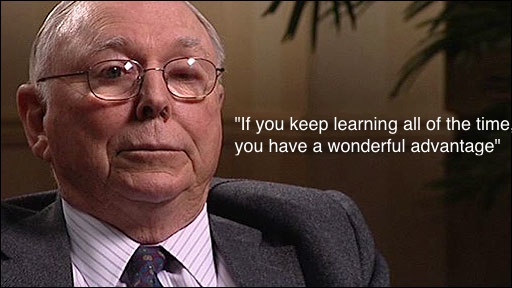
Munger: The other big secret is that we’re good at lifelong learning. Warren is better in his 70s and 80s, in many ways, than he was when he was younger. If you keep learning all the time, you have a wonderful advantage.

Buffett: And we have a wonderful group of friends, from whom we can learn a lot. Read more of this post

When the undefeated samurai Miyamoto Musashi retreated to a cave in 1643 and wrote The Book of Five Rings, he created one of the most perceptive and incisive texts on strategic thinking ever to come from Asia

The Book of Five Rings Hardcover

by Miyamoto Musashi  (Author) , Shiro Tsujimura

(Illustrator) , William Scott Wilson (Translator)

When the undefeated samurai Miyamoto Musashi retreated to a cave in 1643 and wrote The Book of Five Rings, a manifesto on swordsmanship, strategy, and winning for his students and generations of samurai to come, he created one of the most perceptive and incisive texts on strategic thinking ever to come from Asia.
Musashi gives timeless advice on defeating an adversary, throwing an opponent off-guard, creating confusion, and other techniques for overpowering an assailant that will resonate with both martial artists and everyone else interested in skillfully dealing with conflict. For Musashi, the way of the martial arts was a mastery of the mind rather than simply technical prowess—and it is this path to mastery that is the core teaching in The Book of Five Rings.
William Scott Wilson’s translation is faithful to the original seventeenth-century Japanese text while being wonderfully clear and readable. His scholarship and insight into the deep meaning of this classic are evident in his introduction and notes to the text. This edition also includes a translation of one of Musashi’s earlier writings, “The Way of Walking Alone,” and calligraphy by Japanese artist Shiro Tsujimura.   Read more of this post

How successful people make themselves luckier

How successful people make themselves luckier

By Craig Forman November 30, 2013

The two most important days in your life are the day you are born, and the day you know why. Unfortunately for some people, that second day never occurs. For lucky people, though, the second day—the day you know why—is often described as a personal epiphany. The most successful people have a clear idea of who they are, and a conviction about where they want to end up. They then work backwards to develop the milestones they need to hit along the way. Read more of this post