End of the imperial corporate leader; CEOs have to trust staff to get on with the job

November 18, 2013 4:26 pm

End of the imperial corporate leader

By Andrew Hill

CEOs have to trust staff to get on with the job

Not much unites Franz-Joseph I of Austria-Hungary and a flock of starlings. But when Don Tapscott, the business thinker, used film of murmurations of flocking starlings  to conclude a presentation about managing complexity in Vienna last week, the mesmerising images unfolded alongside the forbidding presence of the old emperor, staring down from a gilt-framed portrait. The coincidence underlined Prof Tapscott’s point. Starlings, somehow organising themselves en masse to see off predators, are at the opposite end of the leadership spectrum from the all-powerful arch-bureaucrat, imposing his system on a highly complex empire. Read more of this post

Rich make same investment errors as rest; Study shows only super rich are ahead of the game

November 20, 2013 8:36 am

Rich make same investment errors as rest

By John Authers

When investing, it often hurts to think of what might be possible if only you started with even more money. Those already wealthy have far more opportunities to use investment to make themselves wealthier. They can afford to take more risk, they can tie up money in more illiquid products, they can afford the high minimum investments for alternative asset classes, and they can even afford to pay for the best advisers. Read more of this post

Caring for Aging Parents: Adult children who have overseen their parents’ care say that besides physical and emotional strains, there are financial effects that can include a loss of job mobility

November 19, 2013

Caring for Aging Parents, Even From a Distance

By PAUL SULLIVAN

THROUGH the 1990s, Patrick Quirke’s career was sailing along. Every few years, he would be promoted at the transportation company where he worked and move to another city. He said he had every reason to believe that he would be promoted to the company’s headquarters in a few more moves. Then, his parents’ health started to decline. First he moved them to Indiana, where he was living, from California, where they had retired to help his sister, who had been injured in an accident. He said they did well in the independent-living facility he found, but then his mother’s dementia grew worse and his father started to decline physically. Read more of this post

Richard Branson: make the dream of running your own business a reality

Richard Branson Contributor

Richard Branson: make the dream of running your own business a reality

Published 20 November 2013 10:12, Updated 20 November 2013 10:13

e7700b5c-4d9f-11e3-8870-2da23437d4d0_syd-6a3xcmq60qw1fzvbwd5n_original--646x363

Richard Branson: “If you have confidence in your business, sooner or later you’ll have to give it a go full-time.” Photo: Josh Robenstone

Almost everyone has some entrepreneurial spirit and, with it, the potential to run their own business. But an entrepreneur’s life isn’t for everyone. Many people decide instead to put their talents to work at somebody else’s company, innovating as “intrapreneurs”. For others, working for someone else is never an option, and so they start launching their own ventures early on. If you have confidence in your business, sooner or later you’ll have to give it a go full-time. If you don’t, you’ll spend the rest of your life wondering what might have been. Read more of this post

As our lawyers increasingly suffer from financial hardships due to the economic slowdown, corruption is becoming more rampant among that socially respected class

More shady lawyers

Nov 20,2013

As our lawyers increasingly suffer from financial hardships due to the economic slowdown, corruption is becoming more rampant among that socially respected class. In sharp contrast with the past, lawyers are actively committing fraudulent practices rather than being passively engaged in them as enablers. It is time for the government to come up with measures to help preserve the integrity of that exclusive club and avert potential damage for their clients.  Read more of this post

Julian Richer started selling hi-fi equipment as a schoolboy with something to prove

November 19, 2013 4:02 pm

Good vibrations on the high street

By Jonathan Moules

Julian Richer is fretting about catching a train. “I have to be in a taxi at 10,” says his email, explaining that he has an economy ticket for the journey home to York, which means he can travel only on the 10.30am from Kings Cross. He will have to leave our meeting at The George, his Mayfair club, prompt­ly. He usually forswears taxis too, he later adds. He is making an ex­ception today because he is squeezing the meeting in between a visit to one of his shops and hosting a Bible study group at his Georgian mansion in the Yorkshire countryside. Mr Richer is one of the UK’s most successful retailers, although a lack of overseas outlets makes him little known beyond the Channel. Read more of this post

Shiller vs. Fama vs. the Skeptics

NOVEMBER 19, 2013, 7:32 PM

Shiller vs. Fama vs. the Skeptics

By BINYAMIN APPELBAUM

Robert Shiller and Eugene Fama, sharing a stage for the first time since it was announced last month that they would share the 2013 Nobel Memorial Prize in Economic Science, sparred with languorous familiarity Tuesday about the efficiency of financial markets. The electricity, somewhat surprisingly, came from some of the chemists and biologists who joined the two men on a stage at the House of Sweden in Washington for a discussion featuring all nine of the nation’s 2013 crop of Nobel laureates. Read more of this post

Harvard’s top entrepreneurship professor reveals MBA’s biggest misconceptions and why bad ideas and fantastical thinking can be an asset

Why entrepreneurs need to be a little delusional

November 19, 2013: 1:36 PM ET

Harvard’s top entrepreneurship professor reveals MBA’s biggest misconceptions and why bad ideas and fantastical thinking can be an asset.

Interview by Taylor Ellis

(Poets&Quants) — Ask any of the founders behind Harvard Business School’s most successful startup — from clothing swap service thredUP to website optimizer CloudFlare — and they’ll all point to a single key to getting a business off the ground: Tom Eisenmann, Harvard’s veteran entrepreneurship professor, whose legendary Launching Technology Ventures course has helped legions of budding entrepreneurs find their focus and bring their ideas to fruition. Eisenmann co-chairs HBS’ Rock Center for Entrepreneurship, the campus’ nucleus for new ventures, and leads trips to Silicon Valley and New York for students eager to experience America’s innovation epicenters firsthand. Read more of this post

The Co-operative Group said that its chairman had resigned after the former head of its banking arm – which prides itself on ethical investments – was filmed allegedly planning to buy illegal drugs

Co-op says chairman quits over bank scandal

The chairman of Britain's Co-operative Group, Len Wardle, is seen in this undated photograph received via the The Co-operative Banking Group, in London

Tuesday, November 19, 2013 – 20:16

AFP

LONDON – The Co-operative Group said on Tuesday that its chairman had resigned after the former head of its banking arm – which prides itself on ethical investments – was filmed allegedly planning to buy illegal drugs. Len Wardle, chairman of the supermarket-to-banking business, said he was standing aside after former Co-operative Bank chairman Paul Flowers – a 63-year-old church minister – was linked to allegations involving crack cocaine, crystal meth and ketamine. Read more of this post

Start-Up Founders Look Beyond the Usual Options of Selling or Going Public

NOVEMBER 19, 2013, 1:01 PM

Start-Up Founders Look Beyond the Usual Options of Selling or Going Public

By THE NEW YORK TIMES STAFF

Successful tech entrepreneurs eventually face a choice, known in Silicon Valley as an exit: either sell their start-ups to bigger companies or take them public. As we wrote on Monday, that decision can be painful and personal. And like Snapchat’s rejection  of Facebook’s billion-dollar offer, it is often a high-stakes bet. But some entrepreneurs are seeking other options beyond the traditional two, inspired partly by the stories of start-ups that rebuffed buyout offers or regretted taking them. Below are entrepreneurs’ experiences, in their own words, as told to Nick Wingfield, Jenna Wortham, Brian X. Chen, Nick Bilton and Claire Cain Miller. Read more of this post

Step Inside Africa’s First Underwater Hotel Room

Step Inside Africa’s First Underwater Hotel Room

PAIGE COOPERSTEIN NOV. 19, 2013, 4:43 PM 8,693

Sleeping with the fishes just became a good thing. Africa opened its first underwater hotel room this month, making it the second in the world.  The room, at the Manta Resort on the Zanzibari island of Pemba, was designed by Swedish artist Mikael Genberg, who also built the first underwater hotel room in a lake in Sweden. The Manta Resort room sits 4 meters beneath the surface (that’s just over 13 feet, three feet deeper than the room in the Swedish lake). The three-tiered suite includes a roof deck, a landing deck at sea level with a lounge and bathroom, and of course the underwater bedroom surrounded by windows that afford a nearly 360-degree view of a nearby coral reef and dozens of species of fish. Anchor wires tether the structure to the sea floor. A stay in the underwater hotel room goes for $900 a night as a single or $1,500 a night as a couple. The room sits just over thirteen feet deep in the Indian Ocean off the coast of Tanzania. Here’s the view from inside the underwater bedroom. The windows are under-lit to offer a good view of the ocean at all times.

underwater-hotel 131012-154837-9581-redigera-1-1 993753_558347257547936_1673996459_n

The worst practice in advertising is far too common (and expensive)

The worst practice in advertising is far too common (and expensive)

BY JEFF ZWELLING 
ON NOVEMBER 19, 2013

Brands have become increasingly persistent about the ways in which they follow individual consumers around the Web. When I look at a pair of shoes online on a Saturday but don’t buy them, chances are good that I will see those very same shoes pop up in ad banners on unrelated websites by Monday. On Tuesday, they’ll be in the ad feed of my favorite social networking site and Wednesday I might find a discount coupon in my email inbox to buy the shoes at a reduced price. By Thursday, I could feel like cornered prey, with those shoes popping up everywhere I turn online. Read more of this post

Investing Is Still More Art Than Science

Investing Is Still More Art Than Science

By Morgan Housel | More Articles
November 18, 2013 | Comments (10)

I was in Orlando this weekend at the American Association of Individual Investors annual conference. Investor James O’Shaughnessy, who I greatly admire, gave a wonderful talk called “What works on Wall Street.” It got me thinking about something important. It’s actually one of the things that drives me crazy about finance. O’Shaughnessy began noting that in Benjamin Graham’s day, the first half of the 20th century, good financial data was extremely hard to come by, and good historical data going back more than a few years was nonexistent. This made studying finance close to impossible. Graham (Warren Buffett’s early mentor) once said that until more data was available, investors couldn’t dare call their trade a profession. It was an art, but not a profession. Read more of this post

“They come to visit certain companies. They see them, they leave. But their eyes remain fixated on what they came to see.”

Michael Bleby Reporter

Meet the fund manager who runs $500m – from $10-a-night hotels

Published 19 November 2013 11:52, Updated 19 November 2013 13:03

If you meet a middle-aged American staying in a $10-a-night room in the central Java city of Yogyakarta, don’t assume he’s just another backpacker. If his name is Robert Levitt, he is a fund manager working out how to use his $US500 million in funds under management. Right now, the traffic congestion in Yogyakarta is what occupies Levitt’s mind. Traffic congestion has long been a thing in the capital city of Jakarta, with its 9 million people, but seeing the rapid growth of small-car ownership and consequent gridlock in this regional city of 400,000, tells Levitt there is an opportunity. Read more of this post

Mao-era art fetching high prices at auction

Mao-era art fetching high prices at auction

2013-11-18 01:24:13 GMT2013-11-18 09:24:13(Beijing Time)  SINA.com

A screen grab from chinanews.com shows the photo of Lushan Mountain taken by Jiang Qing. A calligraphic album of 37 poems by Mao Zedong with sound provenance fetched 14.26 million yuan ($2.34 million) at an auction in Beijing on Saturday night. The calligraphic works were painted in running script (xing shu) by Guo Moruo (1892-1978), a government official and leading author and scholar of 20th-century China. Read more of this post

G. Moffett Cochran, Silvercrest Asset Management CEO, Dies at 63

G. Moffett Cochran, Silvercrest Asset Management CEO, Dies at 63

G. Moffett Cochran, co-founder and chief executive officer of Silvercrest Asset Management Group Inc., a New York-based firm catering to wealthy families, which went public in June, has died. He was 63. He died yesterday at Stamford Hospital in Connecticut, near his home in New Canaan, said his daughter, Lee Cochran. She said he survived 10 years with a neuroendocrine tumor on his pancreas, then his liver, because of experimental treatments with Robert L. Fine, a doctor at the Herbert Irving Comprehensive Cancer Center at New York Presbyterian Hospital-Columbia University Medical Center. Read more of this post

Management itself needs innovation

Management itself needs innovation

When I say the word “innovation”, what pops into your mind? Great products like the iPhone or iPad? Breakthroughs in scientific drug research? Social-media platforms like Twitter or Facebook? Maybe others.

BY NATALIE TURNER –

4 HOURS 27 MIN AGO

When I say the word “innovation”, what pops into your mind? Great products like the iPhone or iPad? Breakthroughs in scientific drug research? Social-media platforms like Twitter or Facebook? Maybe others. But I doubt the eight-hour workday, popularised by Henry Ford in 1914, or the Management by Objectives concept, coined by Peter Drucker in the mid-1950s, comes to mind. They have been around so long that we take them for granted. Read more of this post

Tales of the Greatest Investors: Alfred Lee Loomis

Tales of the Greatest Investors: Alfred Lee Loomis

by ValueWalk StaffNovember 19, 2013

Alfred Lee Loomis was accomplished in many areas, including science, philanthropy, law and investment banking. His laboratory in Tuxedo Park, New York was responsible for the development of enormously prolific scientific contributions, especially to the U.S. defense in World War II. He is not to be understated as a scientist; however, this discussion is not focused on Loomis the scientist, but on Loomis the investor. Originally, he was an attorney. Later he became an investment banker who made a lot of money in the 1920s in utilities. He and his partner, Landon K. Thorne, took over a nearly bankrupt investment bank known as Bonbright. Between 1924 and 1929 Bonbright underwrote 15% of not merely utility securities, a field in which Loomis specialized, but of all the securities issued in the U.S. Read more of this post

Are You Crafty Enough? Yellen’s Non-Bubble, Henry Ford’s Art Book Present and Korea’s Com2Us-Gamevil (Bamboo Innovator Insight)

The following article is extracted from the Bamboo Innovator Insight weekly column blog related to the context and thought leadership behind the stock idea generation process of Asian wide-moat businesses that are featured in the monthly entitled The Moat Report Asia. Fellow value investors get to go behind the scene to learn thought-provoking timely insights on key macro and industry trends in Asia, as well as benefit from the occasional discussion of potential red flags, misgovernance or fraud-detection trails ahead of time to enhance the critical-thinking skill about the myriad pitfalls of investing in Asia at the microstructure- and firm-level.

The weekly Bamboo Innovator Insight series brings to you:

  • Are You Crafty Enough? Yellen’s Non-Bubble, Henry Ford’s Art Book Present and Korea’s Com2Us-Gamevil, Nov 18, 2013 (Moat Report AsiaBeyondProxy)

Bubble

Dear Friends and All,

Are You Crafty Enough? Yellen’s Non-Bubble, Henry Ford’s Art Book Present and Korea’s Com2Us-Gamevil

“Mirror, mirror on the wall, who’s the bubble of them all?”

Checking the various Fed quant valuation models that attempt to mirror the actual world’s fundamentals and prospects, Fed chair Janet Yellen replied at her confirmation hearing before the Senate Banking Committee on Thursday 14 Nov asking about bubbles: “Stock prices have risen pretty robustly, but I think that if you look at traditional valuation measures, you would not see stock prices in territory that suggests bubble-like conditions.” Yet, the very action of artificially driving down interest rates is what’s making stocks look cheap. When pressed further by the senators, Yellen reassured them that she does not see the era of low interest rates and quantitative easing continuing indefinitely. “This program cannot continue forever,” Yellen said. The FOMC “is focused on a variety of risks and recognizes that the longer this program continues, the more we will need to worry about those risks,” she said.

Yellen’s non-bubble proclamation reminded me of a closed-door presentation two-plus years ago that the Bamboo Innovator did to the CEO and top management team of an Asean-listed tech company that had a market value of over S$500 million then. I deliberately asked rhetorically a difficult question that would embarrass myself in front of the group of tech veterans: “Is there a bubble in tech stocks? What’s the difference between now and the Internet bubble that burst in 2000/01?”

Legs shuffle, some murmurings, people look uncomfortably at one another before settling their piercing eyes on me, waiting to shred apart my comments since everyone knows firmly that no one has the clear answer to this question. Before I made my remarks, the word regret did flash quickly through my brain but I believe in asking the authentic and uncomfortable questions to bring forth a meaningful dialogue, even if it makes me look painfully stupid. “Do you observe that this time round, there’re more large sophisticated giant buyers such as the likes of Tencent, Baidu, Alibaba holding sway the valuation – and overvaluation – of the off-market new assets created whose present fundamentals may still be awkward? In the previous round, it’s the mom-and-pop retail investors and fund managers driving the craze in the public market. Now, there’s an active private market for trade sellers with spillovers to the public market. These mega trade buyers believe they can integrate these smaller companies into their own business model as an offensive strategy to create bigger value for their customers. The mom-and-pop and fund managers hold paper; the trade buyers wring value – hopefully.” This is an important but less-visible fringe activity around the visible “bubble” that they have also observed but did not articulate it out to one another. The palpable tension in the room eased and positive energy ensued in our interesting discussion on wide-moat business models in Asia’s tech sector.

Observing the less-visible fringe activities that are not and cannot be captured in the traditional valuation measures has yielded interesting insights on the evolution of bubbles. Now, (too) many smaller private investors seek access to the party, lured by the explosion of VCs, PEs and dealmakers promising multibaggers. They want to be part of the thrill and become the conversational life of the party: “Oh, I have invested in that Unicorn”. Partly blinded by the “social returns” of investing in promising growth companies, the blasé attitude of private investors to the investment risks, believing that they are clever and crafty enough to discern the right VC, PE and dealmaker and right investments reminds me of the thought-provoking story of Henry Ford’s art book present and Joseph Duveen:

The year of 1920 had been a particularly bad one for American art dealers. Big buyers – the robber-baron generation of the previous century – were getting to an age where they were dying off like flies, and no new millionaires had emerged to take their place. Things were so bad that a number of the major dealers decided to pool their resources, an unheard-of-event, since art dealers usually get along like cats and dogs.

Joseph Duveen, art dealer to the richest tycoons of America, was suffering more than the others that year, so he decided to go along with this alliance. The group now consisted of the five biggest dealers in the country. Looking around for a new client, they decided that their last best hope was Henry Ford, then the wealthiest man in America. Ford had yet to venture into the art market, and he was such a big target that it made sense for them to work together.

The dealers decided to assemble a list, “The 100 Greatest Paintings in the World” (all of which they happened to have in stock), and to offer the lot of them to Ford. With one purchase, he could make himself the world’s greatest collector. The consortium worked for weeks to produce a magnificent object: a three-volume set of books containing beautiful reproductions of the paintings, as well as scholarly texts accompanying each picture. Next they made a personal visit to Ford at his home in Dearborn, Michigan. There they were surprised by the simplicity of his house: Mr Ford was obviously an extremely unaffected man.

Ford received them in his study. Looking through the book, he expressed astonishment and delight. The excited dealers began imaging the millions of dollars that would shortly flow into their coffers. Finally, however, Ford looked up from the book and said, “Gentlemen, beautiful books like these, with beautiful coloured pictures like these, must cost an awful lot!” “But Mr Ford!” exclaimed Duveen, “we don’t expect you to buy these books. We got them up especially for you, to show you the pictures. These books are a present to you.” Ford seemed puzzled. “Gentlemen,” he said, “it is extremely nice of you, but I really don’t see how I can accept a beautiful, expensive present like this from strangers.” Duveen explained that the reproductions in the books showed paintings they had hoped to sell to him. Ford finally understood. “But gentlemen,” he exclaimed, “what would I want with the original pictures when the ones right here in these books are so beautiful?”

Duveen prided himself on studying his victims and clients in advance, figuring out their weaknesses and the peculiarities of their tastes before he ever met them. He was driven by desperation to drop this tactic just once, in his assault on Henry Ford. It took him months to recover from his misjudgement, both mentally and monetarily. Ford was the unassuming, plain-man type who just isn’t worth the bother. He was the incarnation of those literal-minded folks who do not possess enough imagination to be deceived. From then on, Duveen saved his energies for the Mellons and Morgans of the world – men crafty enough for him to entrap in his snares.

The tone of the fringe activities in the past two-plus years in Asia has changed from one of healthy doubt to that of “craftiness”. Most of every private investors and high-net-worth entrepreneurs these days believe that they are “crafty enough” to invest in the right “art piece”, the right lottery-like multibagger company and exit at the right time and avoid losses during this evolution of the muddle-through bubble period. After all, the negative news and expectations are supposed to be already all out there in the market and prices have already impounded these informational content. In some sense, they resemble the sophisticated investors whom art dealer Joseph Duveen – the VCs, PEs, dealmakers – sought to court: “the Mellons and Morgans of the world – men crafty enough for him to entrap in his snares.” Sometimes, we ourselves determine the kind of people whom we attract and value investors who are lifelong learners are never crafty enough – we are simple-minded folks who appreciate the value of having a authentic dialogue with a group of like-minded people who genuinely care about one another.

Also, what are the implications of the recent merger of Korea’s top mobile gaming operators Com2Us and Gamevil? What are the 4 key Bamboo Innovator takeaways?

Why Monk Mode Is The Secret To Insane Productivity

WHY MONK MODE IS THE SECRET TO INSANE PRODUCTIVITY

IF YOU HAVE A GIGANTIC PROJECT AND A TON OF PEOPLE WANTING YOUR TIME, HOW DO YOU SATISFY BOTH? BY SLIPPING INTO MONK MODE.

BY DRAKE BAER

The most productive people structure solitude into their working lives: Marie Curie experimenting deep into Parisian nightsFriedrich Nietzsche tramping around Alpine lakesHenry Thoreau camping and contemplating in a Massachusetts forest. That was back in the day. But can you make that same headspace in our hyper-busy, hypertextual world? Business writer Greg McKeown couldn’t. He was fortunate to have a monster of a project on his hands–his first solo book–but he was kept awake at night with authorly anxiety. And quite ironically, the book was about the pursuit of less. “Being stressed out for a year while I wrote it simply was not an option,” he says on LinkedIn. But he had a hunch. If there was more time and space to really concentrate, then his levels of stress would go down–and the quality of work would go up. The proposal: monk mode. Read more of this post

The mindfulness business: Western capitalism is looking for inspiration in eastern mysticism

The mindfulness business: Western capitalism is looking for inspiration in eastern mysticism

Nov 16th 2013 |From the print edition

20131116_WBD000_1

IN HIS 1905 book, “The Protestant Ethic and the Spirit of Capitalism”, Max Weber credited the Protestant ethic with giving rise to capitalism. Now it sometimes seems as if it is the Buddhist ethic that is keeping capitalism going. The Protestants stressed rational calculation and self-restraint. The Buddhists stress the importance of “mindfulness”—taking time out from the hurly-burly of daily activities to relax and meditate. In today’s corporate world you are more likely to hear about mindfulness than self-restraint. Read more of this post

The Art Of Doing Everything: Our complete guide to maximizing your productivity in an increasingly distracting world

THE ART OF DOING EVERYTHING

OUR COMPLETE GUIDE TO MAXIMIZING YOUR PRODUCTIVITY IN AN INCREASINGLY DISTRACTING WORLD.

BY DRAKE BAER

SECRETS OF THE MOST PRODUCTIVE PEOPLE

3021699-inline-i-2-caro-archtypes 3021699-inline-i-1-caro-archtypes 3021699-inline-i-8-caro-archtypes 3021699-inline-i-7-caro-archtypes 3021699-inline-i-3-caro-archtypes 3021699-inline-i-6-caro-archtypes 3021699-inline-i-5-caro-archtypes 3021699-inline-i-4-caro-archtypes

When it comes to being productive, we are a nation obsessed. Look no further than the launch last February of email-management app Mailbox, which allows users to put off dealing with certain emails until a later date while prioritizing others. Email–that great productivity destroyer–was transformed into a productivity enhancer. Almost immediately, nearly 1 million people joined a waiting list to receive the app, and on March 15, before it was even available to the public, Dropbox acquired Mailbox for a reported $100 million. Read more of this post

Motivating workers: Ranked and yanked; Firms that keep grading their staff ruthlessly may not get the best from them

Motivating workers: Ranked and yanked; Firms that keep grading their staff ruthlessly may not get the best from them

Nov 16th 2013 | NEW YORK |From the print edition

IT IS a brutal management technique in which bosses grade their employees’ performance along a “vitality curve” and sack those who fall into the lowest category. Known as “ranking and yanking”, it had its heyday in the 1980s and 1990s. In America its popularity faded somewhat after it was seen to have contributed to the fall of Enron. Now it is back in the headlines. Read more of this post

The Luck Factor in Great Decisions

The Luck Factor in Great Decisions

by Michael Wheeler  |   9:00 AM November 18, 2013

Bill Gates made a bad decision early in his career. In fact, if it weren’t for the fact that some other people made even worse mistakes, we might not ever have heard of him. Yes, Gates was and is brilliant, and he worked hard. Malcolm Gladwell, author of Outliers, attributes his success to the 10,000 hours he spent mastering computer programming at an early age. Like star athletes and musical prodigies, Gates invested serious time and effort to deepen his knowledge and hone his skills. Gladwell also acknowledges that Gates had the benefit of good education. He went to a private school with a computer lab long before such facilities were commonplace. Read more of this post

Start-Up Leaders Recall Choice to Cash In or Stay Independent

Published: November 17, 2013

Start-Up Leaders Recall Choice to Cash In or Stay Independent

18startups-lead-image-custom1

Clockwise from top left, Peter DaSilva and Jennifer S. Altman for The New York Times, Greg Cohen, Richard Drew/Associated Press

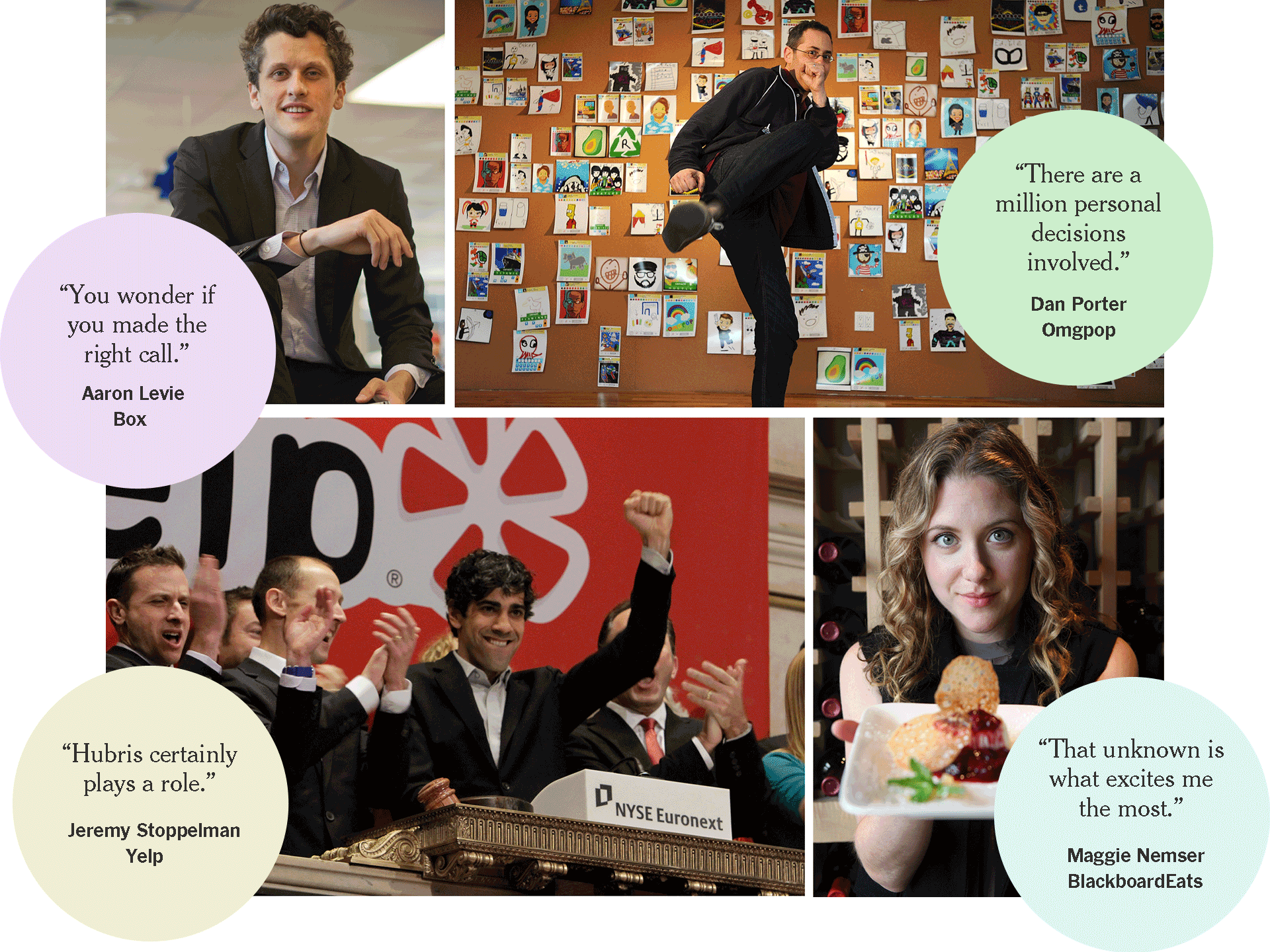
The reactions last week flowed like those to a Rorschach test. Were the young founders of Snapchat, a mobile-messaging start-up, delusional for turning down a multibillion-dollar buyout offer? Greedy to think they might get more later? Or courageous to chase their dreams? The decision they faced — to cash out or remain independent — is one that all successful technology entrepreneurs eventually confront. The founders face cold business considerations: pressure from investors and workers who want liquidity, and complex calculations about timing in a dynamic industry. But the choices also involve ambition and exhaustion, competition and loyalty, dreams and reality. Read more of this post

Jim Chanos on Taking Risks Early

Jim Chanos on Taking Risks Early

Joshua M Brown

November 17th, 2013

I took the biggest risk of my life at age 33 and I was terrified.

With a wife and two kids, a mortgage and almost nothing in the bank, I left my management position at a broker-dealer and dropped my Series 7. I essentially bolted from the business I had been in for a decade, giving up my license and my livelihood on a bet that I could be doing better for my clients as their advisor and make a lot more money once I was happy and the pit in my stomach dissolved. Read more of this post

Where does success come from?

Where does success come from?

by Kate Matsudaira, Founder, CTO at PopForms on Oct 25, 2013

You go to meetings. You process your inbox. You might make a presentation here and there. You certainly seem busy. But I bet if I asked your team what it is you do all day long, most of them would say, “I have no idea”. And come to think of it, do you know how exactly they spend every day?
In today’s new generation of tech company, leadership and responsibility is more distributed than ever before. People are expected to get the job done, without someone watching or directing every move all along the way. Teams are focused on results, not roles.
So as leaders in increasingly flat organizations without the traditional hierarchy and process of the past, how can we make sure we are still leading effectively? What’s the balance between too hands-on and too hands-off?
Your job as a leader is to let your team do what they’re good at, but you can only give over autonomy once you’ve given them the tools they need and trust that they can execute without you watching over their shoulder. The talk will cover strategies to help you build trust with your team and set up the right guard rails to loosen your grip on the steering wheel and give people what they want in a leader.

Toy Story: America is still the birthplace of inventions. But for how long?

November 17, 2013

Toy Story

By BILL KELLER

MY model American entrepreneur of the moment is Cheong Choon Ng. He has not attracted a $3 billion bid from Facebook, like the young inventors of the photo-sharing service Snapchat. Wall Street is not cooking up an I.P.O. But Ng is a star in my household. He is the creator of the Rainbow Loom, which in the middle-schooler market is the hottest device not called iSomething. If you have noticed that half the children in America — and a fair number of adults — seem to be sporting bracelets that are braids of brightly colored rubber bands, then you have seen the fruits of the Rainbow Loom. Read more of this post

The Bully Pulpit: Theodore Roosevelt and the Golden Age of Journalism; America’s first muckrakers: A president who saw the benefits of co-operating with the press

America’s first muckrakers: A president who saw the benefits of co-operating with the press

Nov 16th 2013 |From the print edition

The Bully Pulpit: Theodore Roosevelt and the Golden Age of Journalism. By Doris Kearns Goodwin. Simon & Schuster; 928 pages; $40; Viking; £20. Buy fromAmazon.comAmazon.co.uk

THE dance between politicians and the press can appear awkward, largely because both sides want to be the ones who are leading. Doris Kearns Goodwin, a popular scholar of American politics, traces the early days of this fraught negotiation in “The Bully Pulpit”. Here she tells the story of Theodore Roosevelt, America’s 26th president, who at the turn of the 20th century became the first to install a press room in the White House. Savvy and larger than life, he understood the benefits of co-operating with the press. Yet it was the very “muckraking” of these newly powerful journalists that exacerbated tensions within his Republican Party. Read more of this post

Taking Over from an Incompetent Team Leader

Taking Over from an Incompetent Team Leader

by Roger Schwarz  |   2:00 PM November 18, 2013

Becoming the leader of an existing team can be challenging, but taking over from an incompetent leader is more difficult. Incompetent leaders are not only ineffective at achieving the team’s goals. They think and act in ways that detract from and undermine the team’s performance, working relationships, and well-being. Consequently, in addition to forging agreement on the normal issues of mission, goals, and roles, incoming leaders often find their new team in disarray, dealing with conflict and stress. Building a stronger team means addressing these emotionally-laden issues. There are several steps leaders facing this situation can take: Read more of this post