How to build a $100 million business; It took these entrepreneurs just three years to go from zero to seriously wealthy

How to build a $100 million business

October 28, 2013

Kate Jones

It took these entrepreneurs just three years to go from zero to seriously wealthy.

photo-4-620x349

Zero to heroes: Philip Weinman and Clive Sher

It’s the question every business owner wishes they had the answer to. How to build a $100 million business? Business veterans Philip Weinman and Dr Clive Sher have years of entrepreneurial know-how. Weinman has spent 30 years building and selling businesses, specialising in IT and travel companies. And Sher has developed numerous healthcare companies in the past 25 years. Between them, the pair has made a fortune from building successful businesses. Their latest company, Plan B, was launched in 2010 as a way of streamlining the expensive and complicated business of corporate travel. The turnover in its first year was $1 million, which jumped to $28 million the following year. Proving to be one of Australia’s fastest growing companies, Plan B is on track for a turnover of more than $100 million this financial year. The company initially started as an in-house corporate travel solution for Weinman’s management company, Deasil, before word-of-mouth launched it into a much broader market. Read more of this post

Stuck in the comfort zone; We like to say it is better to be with the devil we know than the angel we don’t when we do not want to fight for change

Updated: Sunday October 27, 2013 MYT 7:24:01 AM

Stuck in the comfort zone

BY SOO EWE JIN – SUNDAY STARTERS

We like to say it is better to be with the devil we know than the angel we don’t when we do not want to fight for change.

IF only I could. How often have we heard this phrase uttered when we are together with friends and loved ones? Someone struggling with work issues talks about giving it all up, moving to a job that pays less, but without the stress, and then finishes up the conversation with this phrase, “If only I could.” We may complain about being stuck in a two-hour traffic jam on the way to work from Petaling Jaya to Kuala Lumpur but we are unlikely to give it all up to work in a small town in Sarawak where it may take just five minutes to walk from our huge rented bungalow to the office nearby. Read more of this post

Where Does Leadership Live? As we develop new ways of doing business, we must also develop new ways of looking at, and assigning, leadership

Where Does Leadership Live?

October 25, 2013

Eric J. McNulty is the director of research at the National Preparedness Leadership Initiative and writes frequently about leadership and resilience.

For all the business community talks about leadership, there is little exploration of the basic assumptions we make about it—what constitutes leadership, who we should call leaders, and what qualities a leader should demonstrate. Yet those assumptions are exactly what we (and our organizations) base so much of our thinking and actions on. Perhaps this is why there is still not a generally accepted definition of leadership in business literature and why it can be so difficult to gauge the impact of leadership development programs. The most foundational question we must ask is: Where does leadership live? Read more of this post

Life with a narcissistic manager

October 28, 2013 3:39 pm

Life with a narcissistic manager

By Naomi Shragai

Narcissism has received a bad business press over the years. The self-obsessed chief executive with a volatile temper who both charms and intimidates staff, takes all the credit for success while shifting the blame for failure on to others, has been a recurring character in corporate dramas. Compelling, charismatic, colourful, such people can initially draw people under their spell until difficulties and discord arise, when their deeper, darker personality begins to emerge. Read more of this post

Going where no brand has gone; Providing samples is a relatively simple affair for many products. For toilet paper brands, however, getting consumers to try the product on the spot is decidedly more complicated

Going where no brand has gone

16771635

NEW YORK — Providing samples is a relatively simple affair for many products, whether it is fragrance brand representatives spritzing consumers in department stores or snack brand representatives handing out tortilla chips in supermarkets. For toilet paper brands, however, getting consumers to try the product on the spot is decidedly more complicated.

THE NEW YORK TIMES

NEW YORK — Providing samples is a relatively simple affair for many products, whether it is fragrance brand representatives spritzing consumers in department stores or snack brand representatives handing out tortilla chips in supermarkets. For toilet paper brands, however, getting consumers to try the product on the spot is decidedly more complicated. Read more of this post

Leaving behind exam-oriented system

Updated: Tuesday October 29, 2013 MYT 6:49:51 AM

Leaving behind exam-oriented system

BY DR MOHD FARID MOHD SHAHRAN

Under the new education blueprint the approach will focus more on comprehensive assessment based on the banding system, where all students will be tutored to achieve the highest band which is Band 6.

AMONG the aims of the Malaysia Education Blueprint 2013-2025 launched by the Deputy Prime Minister recently is to end the exam-oriented system that has been in place for a long time. The revised approach will focus more on the comprehensive assessment which will be based on the banding system ranging from Band 1 to Band 6. According to this system, all students will be tutored properly by the teachers to achieve the highest band which is Band 6. Read more of this post

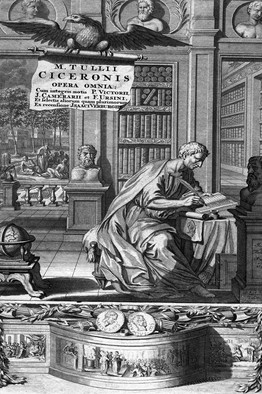
@Cicero Would Have Loved Twitter: In many ways, Facebook and Twitter are a throwback to ancient modes of sharing news.

@Cicero Would Have Loved Twitter: In many ways, Facebook and Twitter are a throwback to ancient modes of sharing news.

L. GORDON CROVITZ

Oct. 27, 2013 5:40 p.m. ET

ED-AR423_crovit_DV_20131027173157

‘You cannot get to the end of the Internet,” said author Tom Standage when asked what role is left for traditional news publishers. He said there is an element of “finishability” in newspapers and magazines, whether in print or online, that many people value in an era of information overload. Otherwise, Mr. Standage, a leading student of the history of technology and its portents for the future, had little good news to offer the news business during a discussion last week about his latest book. Read more of this post

How Dr. Martens boots used counter-culture to defy the punishing fashion cycle

How Dr. Martens boots used counter-culture to defy the punishing fashion cycle

By John McDuling @jmcduling 8 hours ago

European private equity house Permira—which paid $485 million to snap up the iconic British bootmaker Dr. Martens last week—isn’t the first firm with deep pockets and a global reach to try and make money out of classic shoes. But if apparel giant Nike’s resurrection of the once-bankrupt Converse label was surprising, then the Dr. Martens story is truly remarkable, mainly due to its humble boots’ long-running appeal. Read more of this post

It’s not the workload that’s making people hate their jobs—it’s the boss, according to Danish researchers

It’s not the workload that’s making people hate their jobs—it’s the boss

By Lauren Davidson @laurendavidson 9 hours ago

Overwork is one of the most common complaints of the modern professional. But it’s less likely to be a cause of workplace depression than being treated unfairly in the office is, according to new Danish research. “Our study shows that the workload actually has no effect on workplace depression,” Matias Brødsgaard Grynderup, PhD, a psychologist at Aarhus University and one of the researchers behind the study, told ScienceNordic.com. Read more of this post

The New Testament is silent about the resurrection. Nowhere do the gospels describe the central feature of Christianity

Review: ‘Silence’ by Diarmaid MacCulloch

The New Testament is silent about the resurrection. Nowhere do the gospels describe the central feature of Christianity.

D.G. HART

Oct. 27, 2013 5:42 p.m. ET

Silence wouldn’t appear to be a topic that could sustain a book. Yes, you want a quiet room for reading, but it is the presence of qualities—words or actions—that drive a book’s narrative or spin its arguments. Silence usually raises more questions than it answers. Consider the husband who is nervous about his wife’s silence or the parents who wonder why the kids in the basement are suddenly so quiet. Once the wife explains her thoughts or parents discover the kids’ activities, silence ends. Read more of this post

‘Chief disruption officer’: Standing room only as c-suite gets crowded

Leo D’Angelo Fisher Columnist

‘Chief disruption officer’: Standing room only as c-suite gets crowded

Published 25 October 2013 11:25, Updated 28 October 2013 07:32

Life insurance company TAL has created the new position of Chief Innovation and Disruption Officer. It seems there’s always room for one more “C” in the C-suite. Chief Innovation and Disruption Officer is a mouthful of a title, and CIDO doesn’t exactly roll off the tongue either. It’s certainly not as elegant and instantly recognisable as CEO or CFO. All in all, it doesn’t sound a natural fit in the once rarified C-suite. To that extent alone, the new CIDO will be living up to at least half of his job title from day one. Read more of this post

Taking count of the sufficiency of Japanese suffixes

Taking count of the sufficiency of Japanese suffixes

BY MARK SCHREIBER

SPECIAL TO THE JAPAN TIMES

OCT 27, 2013

One of the first things new learners of Japanese must struggle with is the amazing variety of classifiers for numbers. When counting books, for instance, the number is followed by 冊 (satsu, volumes, as in issatsunisatsuetc.); for thin, elongated objects such as pencils it’s 本 (hon, as in ipponnihon,sanbon, etc.); for pieces of paper like tickets it’s 枚 (mai); for à la carte orders of sushi it’s 貫 (kan); for pairs of shoes it’s 足 (soku); and so on. Read more of this post

Samsung chairman owns most lavish home among tycoons

2013-10-28 10:38

Samsung chairman owns most lavish home among tycoons

Lee Kun-hee, chairman of the world’s top maker of smartphones Samsung Electronics Co., owns the most expensive houses out of the country’s top 30 business leaders, data showed Monday. The combined declared value of houses held by the 30 business tycoons reached 157.7 billion won (US$148.4 million) at end-June, up 9.6 percent from a year earlier, according to the data by market researcher Chaebul.com. Read more of this post

Koreans ranked second among 150 countries in terms of per capita working hours in 2012

Koreans take No. 2 for working hours

Oct 28,2013

BY SONG SU-HYUN [ssh@joongang.co.kr]

Korea may be a highly advanced country in manufacturing, but in the labor and social sectors, it still resembles a developing nation, a government report said yesterday. The Korea International Trade Association (KITA) announced the fourth-largest Asian economy ranked second among 150 countries in terms of per capita working hours in 2012, according to statistics complied by the Organization for Economic Cooperation and Development. Mexicans were the only people to work more. Read more of this post

Bankrupt NY City Opera May Be Revived on Purchase Campus

Bankrupt NY City Opera May Be Revived on Purchase Campus

Three weeks into the bankruptcy of New York City Opera, there’s discussion in opera circles about how to reconstitute it under a different management to provide the country’s most populous city with an alternative to the Metropolitan Opera. “Many people are talking about the need for a second company, with a similar role New York City Opera had,” Gail Kruvand, chairwoman of City Opera’s orchestra committee, said in an interview on Saturday. “We continue to hope that will arise.” Read more of this post

Better Than a Tweet? In Four Characters, a New World of Meaning

OCTOBER 27, 2013, 6:22 PM

Better Than a Tweet? In Four Characters, a New World of Meaning

By AMY QIN

There is a Chinese idiom that might be used to describe the place of idioms in Chinese literary tradition: jianding buyi (坚定不移), meaning “firm and unchanging.” The use of such expressions, especially the classical set phrases known as chengyu (成语), has long been seen as a mark of erudition in China. Most chengyu consist of only four characters, but they don’t follow the grammar and syntax of modern Chinese, and as many frustrated Mandarin students can tell you, they are often indecipherable without some knowledge of their origins, usually in ancient Chinese literature dating to the centuries before and after the birth of Christ. Some of the most popular Chinese idioms in use today, though, are of a more modern provenance, having been forged in what is currently the hottest space for linguistic innovation in China — the Internet. These sayings retain the four-character format of the classic idioms but are distinguished by their ironic, contemporary, and sometimes political themes. Popular among Chinese youth, the new idioms may not be considered highbrow, but they offer a window into the humor, culture and concerns of China’s millennial generation. Read more of this post

The F in CFO stands for future

The F in CFO stands for future

BY SHYAM MAMIDI –

4 HOURS 21 MIN AGO

CFO stands for Chief Financial Officer. But increasingly, this role is becoming of greater significance. At top-performing companies, the “F” has taken on the meaning of “Future”. The CFO is the person, in most organisations, who is in the best position to harness the ever-expanding deluge of data that can inform and drive corporate strategy. CFOs cannot only be scorekeepers. They are heavily focused on integrating the information across the enterprise and need to help their firm score big, which is to say, discover new revenue growth opportunities. Read more of this post

Smart cities? The truly great have soul

Smart cities? The truly great have soul

When I was a child, I admired James Bond very much because, whenever he was in enemy territory facing imminent danger, he intuitively knew which switches to press to get the desired results.

BY ASIT K BISWAS –

4 HOURS 37 MIN AGO

When I was a child, I admired James Bond very much because, whenever he was in enemy territory facing imminent danger, he intuitively knew which switches to press to get the desired results. When we consider smart and resilient cities, I have no idea which switches to press to get the desired outcomes. Sadly, no one else really knows either. In fact, we do not even know if the right switches are on the switchboard for us to press. Read more of this post

Emphasise various assessments, not just national exams: Expert

Emphasise various assessments, not just national exams: Expert

SINGAPORE — As Singapore prepares to take part in a global study measuring skills acquired by citizens during their schooling journey, one expert feels that the education system here could place greater emphasis on a variety of assessments, instead of relying solely on high-stakes national exams.

BY NG JING YNG –

4 HOURS 39 MIN AGO

SINGAPORE — As Singapore prepares to take part in a global study measuring skills acquired by citizens during their schooling journey, one expert feels that the education system here could place greater emphasis on a variety of assessments, instead of relying solely on high-stakes national exams. This could involve a “multi-layer framework”, where a student receives daily verbal feedback on his strengths and weaknesses, is assessed regularly at the class and school level, and then evaluated in national exams, said Mr Andreas Schleicher, who is Deputy Director for Education and Skills at the Organisation for Economic Co-operation and Development (OECD). Read more of this post

The invisible poor in Singapore: There are 105,000 households earning below $1,500 a momth. 10% of Singapore’s resident households earn an average of $1,644. This figure is all the more surprising given that Singapore has one of the world’s highest annual incomes per head, of $65,000.

The invisible poor

Monday, October 28, 2013 – 07:30

Robin Chan

Radha Basu

The Straits Times

While attending university in the United States, Singaporean Kevin Seah remembers being struck by the snaking lines outside soup kitchens and homeless shelters. “That was my impression of poverty. Begging, homelessness. But in Singapore you don’t see all that,” said Mr Seah, 27, a former Anglo-Chinese School (Independent) boy who admitted his life until then had been quite sheltered. So he was surprised to find some startling statistics about the poor here, when he first started working on a marketing campaign to raise awareness of poverty in Singapore when he returned after graduating from Buffalo University in upstate New York. “There are 105,000 households earning below $1,500 a month. I knew there are some issues which we are facing. But it’s quite hidden,” he said. Hidden they may be, but they are certainly there. According to latest official data, 10 per cent of Singapore’s resident households, comprising an average of 3.5 members and with at least one working person, earn an average of $1,644. This figure is all the more surprising given that Singapore has one of the world’s highest annual incomes per head, of $65,000. Read more of this post

The former chief executive of crisis company Boart Longyear has spoken for the first time since his sacking, and expressed his sadness at the mining services company’s recent struggles.

Boart’s demise ‘hard to watch’, says former CEO

October 28, 2013

Peter Ker

The former chief executive of crisis company Boart Longyear has spoken for the first time since his sacking, and expressed his sadness at the mining services company’s recent struggles. Craig Kipp, who led Boart to both record revenues and profits in June 2012 before being sacked three months later, said Boart remained a ”great business” that had been hit by two monumental downturns over the past five years. ”It has been hard to watch, I am trying to help as many former employees as I can. I am pulling for them and for Boart,” he said. ”The impact on the investors, employees and suppliers has been devastating.” Read more of this post

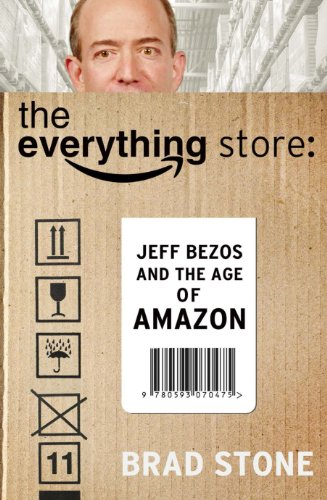
It’s Harder to be Kind than Clever: 10 Things I Learned Reading Brad Stone’s — The Everything Store: Jeff Bezos and the Age of Amazon

10 Things I Learned Reading Brad Stone’s — The Everything Store: Jeff Bezos and the Age of Amazon

by SHANE PARRISH on OCTOBER 24, 2013

510tRCeCMCL

I really enjoyed Brad Stone’s The Everything Store: Jeff Bezos and the Age of Amazon. Anyone who wants to better understand the dynamics of disruption or just gain a better understanding of the website we’ve come to love, must read this book. Here are ten things I found interesting. Read more of this post

The writing life requires courage, patience, persistence, empathy, openness, and the ability to deal with rejection. To look at the world without blinders on. To observe and withstand what one sees. To be disciplined and take risks

Dani Shapiro on the Pleasures and Perils of Writing and the Creative Life

“At its best, the sensation of writing is that of any unmerited grace,” Annie Dillard famously observed, adding the quintessential caveat, “It is handed to you, but only if you look for it. You search, you break your heart, your back, your brain, and then – and only then – it is handed to you.” And yet, Zadie Smith admonished in her 10 rules of writing, it’s perilous to romanticize the “vocation of writing”: “There is no ‘writer’s lifestyle.’ All that matters is what you leave on the page.”

Still, surely there must be more to it than that – whole worlds rise and fall, entire universes blossom and die daily in that enchanted space between the writer’s sensation of writing and the word’s destiny of being written on a page. For all that’s been mulled about the writing life and its perpetual osmosis of everyday triumphs and tragedies, its existential feats and failures, at its heart remains an immutable mystery – how can a calling be at once so transcendent and so soul-crushing, and what is it that enthralls so many souls into its paradoxical grip, into feeling compelled to write “not because they can but because they have to”? That, and oh so much more, is what Dani Shapiro explores in Still Writing: The Pleasures and Perils of a Creative Life (public library) – her magnificent memoir of the writing life, at once disarmingly personal and brimming with widely resonant wisdom on the most universal challenges and joys of writing. Read more of this post

Emotional Agility: How effective leaders manage their negative thoughts and feelings

Emotional Agility

by Susan David and Christina Congleton

R1311L_A

Sixteen thousand—that’s how many words we speak, on average, each day. So imagine how many unspoken ones course through our minds. Most of them are not facts but evaluations and judgments entwined with emotions—some positive and helpful (I’ve worked hard and I can ace this presentation; This issue is worth speaking up about; The new VP seems approachable), others negative and less so (He’s purposely ignoring me; I’m going to make a fool of myself; I’m a fake).

The prevailing wisdom says that difficult thoughts and feelings have no place at the office: Executives, and particularly leaders, should be either stoic or cheerful; they must project confidence and damp down any negativity bubbling up inside them. But that goes against basic biology. All healthy human beings have an inner stream of thoughts and feelings that include criticism, doubt, and fear. That’s just our minds doing the job they were designed to do: trying to anticipate and solve problems and avoid potential pitfalls. Read more of this post

You Can’t Be a Wimp—Make the Tough Calls; To make timely, high-quality decisions, you need to develop three key traits

You Can’t Be a Wimp—Make the Tough Calls

An Interview with Ram Charan by Melinda Merino

As one of the world’s preeminent advisers to CEOs and boards, Ram Charan has spent the past 35 years on the road, watching hundreds of executives deal with their toughest challenges. He regularly shares the insights from his experiences in speeches and the classroom and is the author of several best-selling books. (His latest books are Boards That Lead, which he cowrote with Dennis Carey and Michael Useem, and Global Tilt.) He has also published many popular articles, including the HBR classic“Conquering a Culture of Indecision” (April 2001), in which he addresses the problem of organizational paralysis. In this edited interview with HBR senior editor Melinda Merino, he returns to the topic of decisions and talks about what he’s learned in three decades of helping executives make them. Read more of this post

Make the Most of a Polarizing Brand; Having a group of customers who hate your brand can be a good thing

Make the Most of a Polarizing Brand

by Xueming Luo, Michael Wiles, and Sascha Raithel

F1311A_A

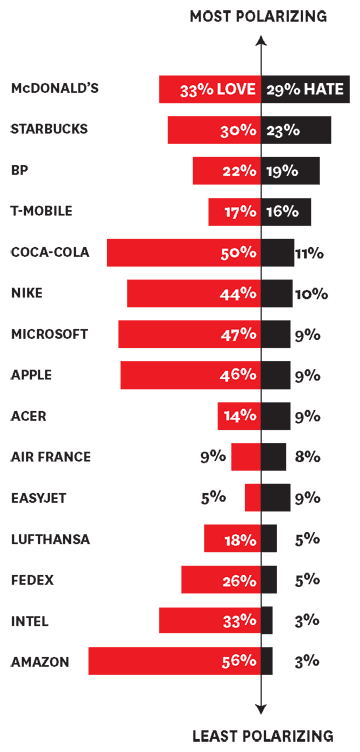
As conversation starters go, “What do you think of Miracle Whip?” probably seems unlikely—you wouldn’t think many people have strong opinions about the slightly-sweeter-than-mayonnaise sandwich spread. But when marketers at Kraft began researching shoppers’ attitudes toward the dressing, they found surprisingly deep emotions. It turns out that a substantial number of people love Miracle Whip, and many others detest it. In 2011 Kraft launched ads that sought to make a virtue of the schism. The campaign used love-’em-or-hate-’em celebrities, including Pauly D from Jersey Shore and the political pundit James Carville. Some people in the ads praised Miracle Whip’s yumminess, but one character said he’d break up with his girlfriend if he learned that she liked the dressing. Another said, “I’d rather lick your shoe” than try it. “Miracle Whip is a polarizing product,” the brand director, Sara Braun, explained at the time. “We’re trying to own up to this fact.” The strategy worked: During the campaign Miracle Whip experienced a 631% surge in social media postings and a 14% increase in sales. Read more of this post

Leaving a legacy: ‘You only die when you are forgotten’; Canadian billionaire Seymour Schulich has given away $350-million in his lifetime, partly, he acknowledges, to keep his memory alive

Leaving a legacy: ‘You only die when you are forgotten’

Garry Marr | 25/10/13 | Last Updated: 26/10/13 3:24 PM ET

 How We Die Now: “Death renders all equal,” wrote Claudian. How each one of us relates to death, however, is individual, and always changing — as we mature; as we contemplate life, and death, around us; and as society changes. In this special series in the National Post, we present stories and columns looking at the different ways we see, and prepare for, the Great Equalizer. To read the complete series, click here.

1024schulich

Seymour Schulich: I have two major objectives now. Number one is to be counted among the greatest Canadian philanthropists of my era and two to encourage other wealthy folks to step up He may have given away more money than anybody else in Canada, so Seymour Schulich probably has some insight into what drives the desire to have your name live on. “There are people out there who think their legacy is their company. Your company is not your legacy. Companies have a mortality rate,” says Mr. Schulich, 73, a billionaire who made his money in the gold sector. “Business is a means to an end. I don’t need to get any richer, thank you. I have two major objectives now. Number one is to be counted among the greatest Canadian philanthropists of my era and two to encourage other wealthy folks to step up.” Read more of this post

The bright side of sadness: Bad moods can have unappreciated mental upsides

The bright side of sadness: Bad moods can have unappreciated mental upsides

BY BRUCE BOWER

1:45PM, OCTOBER 18, 2013

sad_moodlist

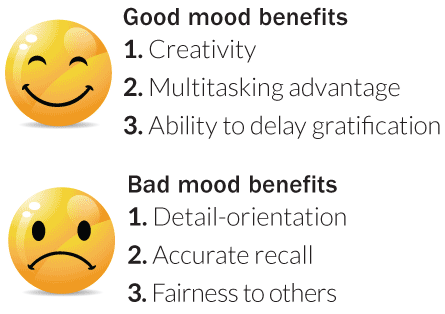
Thomas Jefferson defended the right to pursue happiness in the Declaration of Independence. But that’s so 237 years ago. Many modern societies champion everyone’s right to be happy pretty much all the time. Good luck with that, says psychologist Joseph Forgas of the University of New South Wales in Sydney. A lack of close friends, unfulfilled financial dreams and other harsh realities leave many people feeling lonely and forlorn a lot of the time. But there’s a mental and social upside to occasional downers that often goes unappreciated. “Bad moods are seen in our happiness-focused culture as representing a problem, but we need to be aware that temporary, mild negative feelings have important benefits,” Forgas says. Read more of this post

Rakuten’s CEO on Humanizing E-Commerce

Rakuten’s CEO on Humanizing E-Commerce

by Hiroshi Mikitani

R1311A_BR1311A_A

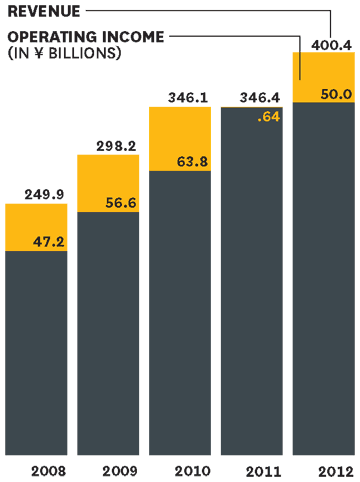
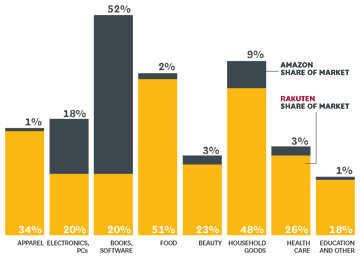
The Idea: Mikitani believes that human beings need communication and connection. So instead of emphasizing efficiency and convenience, Rakuten tries to create a personalized, bazaarlike shopping experience. I can still remember the first time I made an online purchase: It was in October 1996. I bought Japanese noodles from a small shop in Shikoku. The checkout process was primitive, but my order arrived in the mail, and it was as good as everyone had said it would be. I realized immediately that online shopping would be commonplace someday. At the time, I was already planning to launch Rakuten. Our website went live about six months later, in May 1997. My goal was simple: We would offer small and midsize merchants an opportunity to set up shop on the internet very easily. We would charge them a set monthly fee, and they could pay extra for advertisements and promotions. Read more of this post

The Decline of Wikipedia Due to Bureaucracy

The Decline of Wikipedia

By Tom Simonite on October 22, 2013

wiki.tablex519

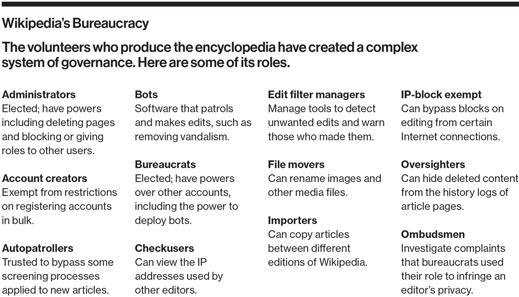
The sixth most widely used website in the world is not run anything like the others in the top 10. It is not operated by a sophisticated corporation but by a leaderless collection of volunteers who generally work under pseudonyms and habitually bicker with each other. It rarely tries new things in the hope of luring visitors; in fact, it has changed little in a decade. And yet every month 10 billion pages are viewed on the English version of Wikipedia alone. When a major news event takes place, such as the Boston Marathon bombings, complex, widely sourced entries spring up within hours and evolve by the minute. Because there is no other free information source like it, many online services rely on Wikipedia. Look something up on Google or ask Siri a question on your iPhone, and you’ll often get back tidbits of information pulled from the encyclopedia and delivered as straight-up facts. Read more of this post