The fraud detective: Jim Chanos saw through Enron, Tyco, and the subprime mortgage mess. And made money on them

The fraud detective

Jim Chanos saw through Enron, Tyco, and the subprime mortgage mess. And made money on them.

By Richard Conniff | Sep/Oct 2013

On a muggy Thursday in the dog days of August 2011, the news broke that the American technology giant Hewlett-Packard was about to acquire British software maker Autonomy Corp. The offer price represented a 64 percent premium on the previous day’s close. At his office in mid-Manhattan, hedge fund manager Jim Chanos ’80 did not rejoice. Only a few weeks earlier, his firm, Kynikos Associates, had put together a report on Autonomy, calling its chief operating officer unqualified, its customers unenthusiastic, its market share and growth numbers questionable, its financial disclosures “very poor,” and its margin profile “suspiciously high.” Read more of this post
World’s greatest GIF-maker works 100 hours a week in job that goes on and on and on

World’s greatest GIF-maker works 100 hours a week in job that goes on and on and on

October 23, 2013 – 1:14PM

Sarah Lyall

art-gif2-620x349

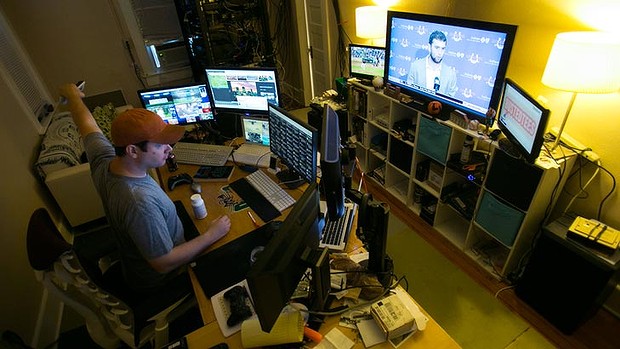
“I’m very committed to this, but also I’m always in the house … I am not able to do many other things”: Tim Burke can record from 28 sources at once. Photo: Will Vragovic/The New York Times

At 2:44 pm on a recent Sunday, Tim Burke took a moment from monitoring several NFL games for the sports website Deadspin to post something that had nothing to do with football: a smidgen of a clip from an English rugby match he also happened to be following. He stitched together still-frame images captured from the broadcast into a short, continuous loop that showed a player built like a cement mixer strong-arming an opponent to the ground by the unfortunate man’s throat. The GIF, or Graphics Interchange Format, showed a vivid moment, the kind that has become standard currency for online sports journalism. That Burke had time to produce a GIF reflects the vacuum-cleaner-like way he approaches his job. The sports editor over at the website Buzzfeed, Ben Mathis-Lilley, could only observe in awe. Read more of this post

The Shanghai Secret: How these schools in China made it to No. 1 in the world

October 22, 2013

The Shanghai Secret

By THOMAS L. FRIEDMAN

SHANGHAI — Whenever I visit China, I am struck by the sharply divergent predictions of its future one hears. Lately, a number of global investors have been “shorting” China, betting that someday soon its powerful economic engine will sputter, as the real estate boom here turns to a bust. Frankly, if I were shorting China today, it would not be because of the real estate bubble, but because of the pollution bubble that is increasingly enveloping some of its biggest cities. Optimists take another view: that, buckle in, China is just getting started, and that what we’re now about to see is the payoff from China’s 30 years of investment in infrastructure and education. I’m not a gambler, so I’ll just watch this from the sidelines. But if you’re looking for evidence as to why the optimistic bet isn’t totally crazy, you might want to visit a Shanghai elementary school. Read more of this post

Breaking up the bamboo ceiling: Making Asian-background Australians less invisible in business

Fiona Smith Columnist

Breaking up the bamboo ceiling: Making Asian-background Australians less invisible in business

Published 23 October 2013 07:15, Updated 23 October 2013 08:39

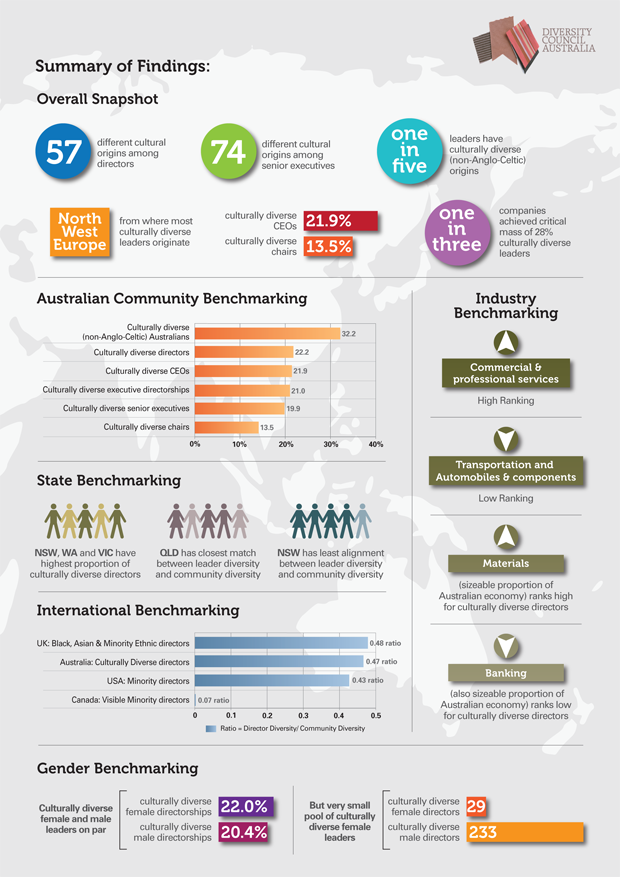
The director of a household-name company was pleased with himself as he expanded on the promotion of business leaders with an Asian background. “We’ve got one banana and three eggs on our board,” he informed BRW. What he meant was that there is one director with Asian heritage, who has spent much of their career working for Western organisations, and three Anglo-Australians accustomed to dealing with Asian businesses and state-owned enterprises. Despite the lack of political correctness in the delivery, at least this director was conscious of the benefits of capitalising on the talents and experience of Asian-Australians. The CEO of Diversity Council Australia (DCA), Nareen Young, says employers are starting to have conversations about the “bamboo ceiling” – the Asian equivalent of the invisible glass ceiling that has kept women out of positions of power for so long.

6da1435a-3b56-11e3-85ad-f423b978d243_DCA Capitalising on Culture Summary HR Read more of this post

Buffett Sees Zero Chance of Gates Returning as Microsoft CEO

Buffett Sees Zero Chance of Gates Returning as Microsoft CEO

Warren Buffett, the billionaire chairman of Berkshire Hathaway Inc., said Bill Gates’s focus on philanthropy makes it impossible that the Microsoft Corp. co-founder will return to the company as chief executive officer. “The chances of that are zero,” Buffett told Bloomberg Television’s Betty Liu in an interview today. “He is doing exactly what he wants to do in life, and he’s doing it well and it takes his full-time energy.” Microsoft is searching for a new CEO after Steve Ballmer said he would step down from the world’s largest software maker. Gates, 57, is chairman of Microsoft and serves on the board of Berkshire. In 2006, Buffett committed a majority of his wealth to the foundation run by Gates and his wife, Melinda. Gates is “flying around the world a very significant percentage of the time, and he is engaging governments in his efforts,” said Buffett, 83. “He has got more than a full-time job at the Gates Foundation, and obviously cares about Microsoft, but he’s not going back.” Buffett appeared today alongside his son and grandson, both named Howard, to promote a new book, “40 Chances: Finding Hope in a Hungry World.” The text describes lessons the billionaire’s son learned from his years working to improve food security around the world. The elder Buffett has also given funds to foundations overseen by his three children.

To contact the reporters on this story: Noah Buhayar in New York at nbuhayar@bloomberg.net; Zachary Tracer in New York at ztracer1@bloomberg.net

Howard Buffett Finds 40 Chances to Get Philanthropy Right

Howard Buffett Finds 40 Chances to Get Philanthropy Right

Howard G. Buffett has photographed an African warlord at close range and witnessed 50 children bound in shackles in Senegal. In Barranquilla, Colombia, he sat next to the pop star Shakira in an SUV as kids banged on the windows until their idol emerged to sign autographs. Buffett, son of the second-richest person in the U.S., could have written a vanity book to chronicle his philanthropic work battling world hunger. Instead, he offers insight, self-deprecation, solutions and heart in “Forty Chances: Finding Hope in a Hungry World.” Warren Buffett and his late first wife, Susan, gave and pledged billions to each of their three children to fund charitable foundations. Howard, an Illinois farmer, picked global hunger as his target. In the book’s foreword, the elder Buffett describes “Forty Chances” as a “guidebook for intelligent philanthropy.” It’s more than that. Howard Buffett has figured out a way to tell 40 stories about hunger, farming, poverty and war, while delivering a readable account of a formidable challenge. Philanthropists will take much from “Forty Chances,” and the layperson will benefit, too, coming away wiser about the powerful forces that keep poverty and hunger alive — and ways to fight those forces. Read more of this post

How a Radical New Teaching Method Could Unleash a Generation of Geniuses

How a Radical New Teaching Method Could Unleash a Generation of Geniuses

BY JOSHUA DAVIS

10.15.13

José Urbina López Primary School sits next to a dump just across the US border in Mexico. The school serves residents of Matamoros, a dusty, sunbaked city of 489,000 that is a flash point in the war on drugs. There are regular shoot-outs, and it’s not uncommon for locals to find bodies scattered in the street in the morning. To get to the school, students walk along a white dirt road that parallels a fetid canal. On a recent morning there was a 1940s-era tractor, a decaying boat in a ditch, and a herd of goats nibbling gray strands of grass. A cinder-block barrier separates the school from a wasteland—the far end of which is a mound of trash that grew so big, it was finally closed down. On most days, a rotten smell drifts through the cement-walled classrooms. Some people here call the school un lugar de castigo—“a place of punishment.” Read more of this post
How Our Brains Betray Us

How Our Brains Betray Us

In the wake of the financial crisis, parents, educators and even students have argued for more financial literacy courses in schools. Problem is, many studies show that financial education doesn’t make a difference because people don’t change their behavior – even if they know better. David Laibson, an economics professor at Harvard University, says understanding this anomaly could help us take charge of our financial lives.

Most Americans know they should save for retirement and pay off their debts. Yet they often don’t do those things. Why?

Our brains are responsible for good intentions not being translated into action. There’s a little tug-of-war going on in our minds. One region of the brain tells us that the right thing to do is to execute. Another brain region says to go for instant gratification. The presence of the dopamine reward system make us biased to do things we can do now. To make things that are not pleasant happen, we have to learn how to exert self-control. Read more of this post

Starbucks vs Starbung in Bangkok

Starbucks vs Starbung

starbungcks2

Tuesday, October 22, 2013 – 09:20

The New Paper

BANGKOK – On one side is a billion-dollar global coffee chain. On the other is a Bangkok street vendor, selling coffee from his cart. Starbucks, which had an annual net profit of US$1.38 billion (S$1.7 billion) last year, is suing Mr Damrong Maslae for 300,000 baht (S$12,000) for copying its famous green logo on his Starbung cart, the Bangkok Post reported. Mr Damrong sells coffee for 20-30 baht each in the Thai capital. Starbucks is also demanding a monthly payment of 30,000 baht plus legal fees, according to its Trademark Act violation complaint. Read more of this post

The Global Innovation 1000: Navigating the Digital Future

October 22, 2013

The Global Innovation 1000: Navigating the Digital Future

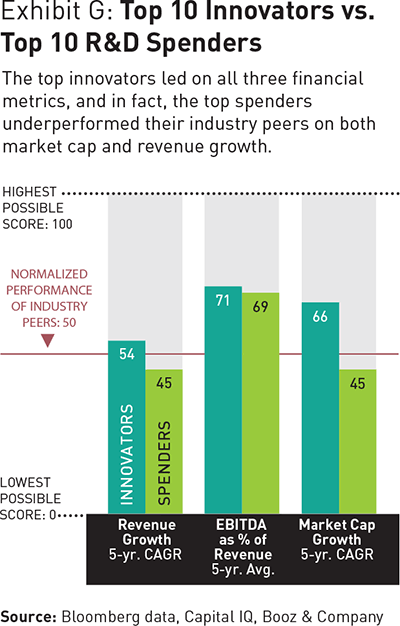
Booz & Company’s annual study of R&D spending reveals the tools that are transforming innovation—from customer insight to product launch.

by Barry Jaruzelski, John Loehr, and Richard Holman

At Catalent, a U.S.-based producer of pharmaceutical products and provider of advanced drug delivery technologies and services, digital tools often support the practices of the company’s 18 research and development sites around the world. Data pours in from R&D, sales and marketing, operations, quality assurance, and regulatory affairs, as well as customers. Evjatar Cohen, vice president for global innovation and portfolio management, and his team make sense of it all with a slate of new market and customer insight enablers. “Collecting the data is just part of what we do,” he says. “It’s really about using that input to come up with market uptake estimates for each potential product and an understanding of its business value. That aids us greatly in deciding where to focus our day-to-day activities as well as planning our long-term strategy.”

00221_ex01b00221_ex0200221_exfb00221_exgb Read more of this post

“An entrepreneur has to tell a story that’s a prophecy that we feel will definitely come true.” How Screenwriting Guru Robert McKee Teaches Brands To Tell Better Stories; If you want everyone from customers to colleagues to believe in your mission, you need to tell them a story, not make an argument.

HOW SCREENWRITING GURU ROBERT MCKEE TEACHES BRANDS TO TELL BETTER STORIES

IF YOU WANT EVERYONE FROM CUSTOMERS TO COLLEAGUES TO BELIEVE IN YOUR MISSION, YOU NEED TO TELL THEM A STORY, NOT MAKE AN ARGUMENT.

BY: ROBERT MCKEE AS TOLD TO DRAKE BAER

It’s hard not to refer to Robert McKee as a “guru.” And why not? McKee, who has been teaching a seminar on screenwriting for 30 years and has written the field’s holy text, has become a foundational necessity to making it in movies, with alumnae including Peter Jackson, Julia Roberts, and John Cleese, and with 50-some Academy Award winners and 170 Emmy Award winners. McKee, who’s worked with brands likeMicrosoft, Nike, and HP to craft their stories, is now also teaching a Story-in-Business seminar. I had lunch with McKee and his wife, Mia, in Manhattan last week to talk about why brands need narratives. Here, we present an edited portion of our conversation.

To me, “story” is a fundamental. When people say story or whatever, they immediately begin to think of Hollywood and/or maybe the theater and novels, history, biography, autobiography. To me, they think about those big narrative forms and they call it the story, or they think in those terms. To me, the heart of it is a story, a mode of thought in direct opposition to other modes of thought that business tends to favor. Read more of this post

The highly unusual company behind Sriracha, the world’s coolest hot sauce; Tran’s dream is “to make enough fresh chili sauce so that everyone who wants Huy Fong can have it. Nothing more.”

The highly unusual company behind Sriracha, the world’s coolest hot sauce

By Roberto A. Ferdman @robferdman October 21, 2013

images (38)130611_sriracha_2

If David Tran were a more conventional CEO, he would be a fixture at conferences, a darling of magazine profiles, and a subject of case studies in the Harvard Business Review. Sriracha hot sauce, made by Huy Fong Foods, which Tran founded 33 years ago in Los Angeles, is one of the coolest brands in town. There are entire cookbookswritten to celebrate Sriracha’s versatility; memorabilia ranging from iPhone covers to t-shirts and all sorts of other swaga documentary in the works to chronicle its rise; and innumerable imitators. Sriracha sales last year reached some 20 million bottles to the tune of $60 million dollars, percentage sales growth is in the double digits each year, and it does all this without spending a cent on advertising. Yet Tran shuns publicity, professes not to care about profits, hardly knows where his sauces are sold, and probably leaves millions of dollars on the table every year. His dream, Tran tells Quartz, “was never to become a billionaire.” It is “to make enough fresh chili sauce so that everyone who wants Huy Fong can have it. Nothing more.” Read more of this post

Prince Charles royal ruckus for fund managers saying that short-term thinking was making their brand of capitalism increasingly “unfit for purpose”

Last updated: October 18, 2013 2:03 pm

A right royal ruckus for fund managers

By Neil Collins

Prince Charles’ criticism likely to be shrugged off

The Prince of Wales may know as much about finance as the average fund manager knows about the royal family but sometimes he’s uncomfortably close to the truth. This week he told the National Association of Pension Funds that short-term thinking was making their brand of capitalism increasingly “unfit for purpose”. This irritating, overworked phrase aside, there’s a serious problem here, although short-termism is a symptom rather than the cause. The malaise in this industry can be easily summarised: too many coins are sticking to the shovels of the managers and the brokers. Since they designed the model, this is hardly surprising: they get paid whatever happens to the fund being managed. There is the nuclear threat of losing the mandate but generally only prolonged poor performance allied with no convincing case for improvement causes the bomb to be dropped. Running a fund is so lucrative that there are four pages of them in your weekday FT and little more than a single page of the underlying stocks that the funds trade. Describing this problem is easy; breaking the model is much harder. The Kay report recommended scrapping quarterly reports and greater engagement by fund managers with companies. It singled out Neil Woodford as the model manager. Unfortunately, Mr Woodford has now left the big fund he ran and the response of the average manager to the royal criticism is likely to be: why should I bother?

Start-Up Reinvents the Bicycle Wheel; “The Copenhagen Wheel” transforms a normal bicycles into a hybrid e-bike

OCTOBER 21, 2013, 8:59 PM

Start-Up Reinvents the Bicycle Wheel

By NICK BILTON

bits-wheel-tmagArticle

“The Copenhagen Wheel” transforms a normal bicycles into a hybrid e-bike.

It’s rare that a company comes along and reinvents the wheel, but it looks like that is about to happen. Superpedestrian, a start-up in Boston, announced on Monday that it has received $2.1 million in financing to help build a wheel that transforms some standard bicycles into hybrid e-bikes. The product, the Copenhagen Wheel, is a design from the Massachusetts Institute of Technology SENSEable City Laboratory. The original goal of the wheel was to entice more people to more bicycles in large cities in lieu of cars by giving them help from a motor. Read more of this post

Why is pivot such a dirty word?

Why is pivot such a dirty word?

BY CARMEL DEAMICIS 
ON OCTOBER 21, 2013

If I had a dollar every time someone explained to me why their company’s shift in priorities wasn’t a pivot, well, I might not be a millionaire, but I’d probably have enough to treat everyone at the bar that night. “I wouldn’t say it’s a pivot so much as…” An iteration. A new feature. A shift in priorities. No company that pivots thinks it’s pivoting. Or at least, no company that pivots wants to admit it to a member of the press. The word pivot’s use in startup land comes from the book The Lean Startup, where author Eric Ries defines it as, “Structured course correction designed to test a new fundamental hypothesis about the product, strategy, and engine of growth.” Despite his clear definition, the term has subjective meanings that color it. It’s associated with failure. Read more of this post

Mapping China’s Surnames 制图 “老百姓”

Mapping China’s Surnames 制图 “老百姓”

by ASTOKOLS27 on Oct 20, 2013 • 9:56 pmNo Comments

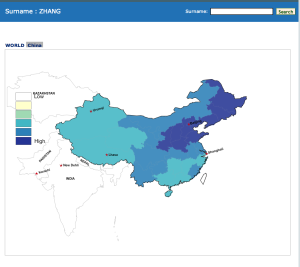
Li-300x270 wang--300x258 zhang-300x267 C-hen-300x256 guo-300x255 ma-300x210

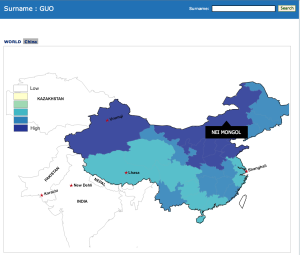
Using this cool new website that maps global surnames according to geographic origin, I was able to map a few of the most common Chinese surnames.  The map shows data at the sub-national level, enabling a province-level map of China’s surnames.  China presents a unique context in which to study the origin of surnames due to the continuity and prevalence of recorded Chinese characters associated with each surname, and the relatively low number of total surnames.  There are, by some estimates, 4,100 surnames in China, while in the US that number is around 6.2 million total. The geographic spread of names in China could be explained in many ways: from population and migration patterns over history, the geographic divisions between north and south, and watersheds.  Historian William Skinner’s came up with the concept of  “macro-regions”  that defined patterns of trade, commerce, language, and culture in China. With China’s massive internal migration today, one might think that the importance of geographic divisions such as the macro-regions, would fade.  As these maps show, that is clearly not the case. Here’s are maps for some of the most common surnames*: Purple indicates a high density of surnames in that province. Read more of this post
Leaders need trust more than Twitter; Running a business raises many questions to which ‘social media’ is not the answer

October 21, 2013 3:32 pm

Leaders need trust more than Twitter

By Andrew Hill

Running a business raises many questions to which ‘social media’ is not the answer

Irecently spent time sifting strategic plans for seven non-profit organisations, drawn up by teams of MBA students for an FT competition, the winner of which will be announced this week. It was a rare insight into how bright young executives are thinking and I am sure their efforts will benefit the non-profits themselves. But one thing stood out: the number of entrants that believed that, whatever the problem, social media would help solve it. Raising money? Go to Twitter. Building local, national and international support? TryFacebook. Read more of this post

Economic Theory, via YouTube and Cartoon; Ray Dalio, the founder of the largest hedge fund, offers a 30-minute lecture in how the economy works. No tuition necessary, just a connection to YouTube

OCTOBER 21, 2013, 8:53 PM

Economic Theory, via YouTube and Cartoon

By ANDREW ROSS SORKIN

Forget Econ 101. Take a look at the lessons in Dalio 101. Ray Dalio, the 64-year-old founder of Bridgewater Associates, the largest hedge fund in the world with some $150 billion under management, has quietly begun teaching his investment secrets on YouTube. Mr. Dalio, who is said to be worth some $13 billion, was one of the few investors to see the financial crisis of 2008 developing, and perhaps just as important, the rebound. He’s made his money by predicting big macroeconomic cycles. His economic theories, up until now, have been known only to a small group of investors and those willing to pay his firm 2 percent management fees and 20 percent of the investment profits.

Read more of this post

The Inefficient Market Hypothesis

OCTOBER 21, 2013, 12:01 AM

The Inefficient Market Hypothesis

By NANCY FOLBRE

Nancy Folbre is professor emerita of economics at the University of Massachusetts, Amherst.

Either it was a partisan compromise, or the Nobel Memorial Prize in Economic Science committee simply hedged its bets, bestowing its annual prize on three economists, two of whom represent divergent views. One Financial Times blogger compared it to a joint celebration of Milton Friedman and John Maynard Keynes. John Kay, also writing in The Financial Times, put it more sharply, as “awarding the physics prize jointly to Ptolemy for his theory that the Earth is the center of the universe and to Copernicus for showing it is not.” Read more of this post

What happens when retailer Sears is supposedly valuable for its tangible property assets and the business is managed by a dealmaker? 18 Depressing Photos That Show Why Nobody Wants To Shop At Sears

18 Depressing Photos That Show Why Nobody Wants To Shop At Sears

ASHLEY LUTZ OCT. 21, 2013, 8:26 AM 71,887 57

Sears, once America’s golden retailer, is a company in crisis.  The company has shuttered hundreds of stores in recent years. The embattled company has been selling some its most profitable stores to raise money. Brian Sozzi, chief equities strategist at Belus Capital Advisors, took poignant photos inside of New Jersey  and New York Sears locations. “To understand why Sears is in a ‘sell stores mode’ one must look no further than the stores themselves, where the truth is to be found,” Sozzi writes. His photos show the sad reality of what Sears is today.

Sears’ mannequins are outdated in comparison with competitors like Macy’s, Lord & Taylor, and JCPenney, Sozzi says. “If you are living darn near paycheck to paycheck, does this presentation excite you about making a purchase with a couple saved up electronic dollars?”

shld-mann-e1382137232438

Sozzi points out that this display is confusing. “Huh? A random football themed carpet with no promotion around it?” he says.

football-carpet1-e1382137446920 Read more of this post

Why Transformation Needs a Second Chapter: Lean, but Not Yet Mean

Why Transformation Needs a Second Chapter: Lean, but Not Yet Mean

by Martin Reeves, Kaelin Goulet, Gideon Walter, and Michael Shanahan

OCTOBER 21, 2013

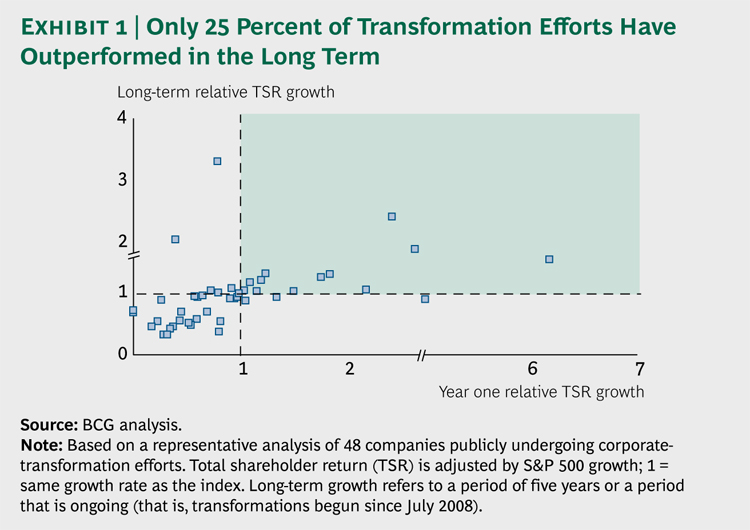
LeanNotMean_Ex1_lg_tcm80-146756 LeanNotMean_Ex2_lg_tcm80-146760

It’s a well-known mantra in business: “You can’t cut your way to greatness.” Nonetheless, painful cost cutting and other defensive measures are a familiar strategy for staying afloat. They are quick and obvious and deliver tangible results, but they are not in themselves a recipe for success. What does a CEO driving a turnaround do after these “easy” measures have been exhausted? Read more of this post

Wang Fengying, China’s only female motor industry CEO

Wang Fengying, China’s only female motor industry CEO

Staff Reporter

2013-10-21

CFP420550083-103435_copy1

Wang Fengying at a Great Wall Motor product launch in Tianjin in August 2011. (Photo/CFP)

Wang Fengying, general manager and CEO of Great Wall Motor Company, is the only female CEO in China’s massive motor industry. Born in October 1970 in the city of Baoding in north China’s Hebei province, Wang obtained her bachelor’s degree from the Tianjin Institute of Finance and began working for Great Wall Motor in 1991. She later returned to her alma mater and completed a master’s degree in economics in 1999. Wang, who turns 43 this month, as spent her entire career at Great Wall Motor. After working at the company for 13 years, predominantly in sales and marketing, she was promoted to general manager and CEO, making her the first — and to date only — female chief executive of a motor vehicle manufacturer in China. Read more of this post

The father of G-Shock, Kikuo Ibe, revolutionised the world of digital watches

Shock value

15758911_0

Monday, Oct 21, 2013

Dylan Tan

The Business Times

KIKUO Ibe, inventor of the iconic Casio range of G-Shock timpieces, looks amused when told his biggest fan in Singapore has about 600 different models and variations of the digital watch in his collection. He has every reason to because there’s really no need to own more than one. The groundbreaking watch he created 30 years ago is virtually indestructible – it’s water-resistant; can resist drops, vibrations and G-forces; and depending on use, has been known to run for as long as 10 years without a battery change. The “G” in its name refers to “gravity” which Mr Ibe wanted to counter when he was creating the break-proof watch. Its design consists of several layers of bumpers which protect the timepiece from damage even when used in the most extreme of conditions. Read more of this post

Poor Sleep Linked to Alzheimer’s in Study of Brain Scans

Poor Sleep Linked to Alzheimer’s in Study of Brain Scans

Sleeping poorly or not getting enough rest may result in a type of brain abnormality associated with Alzheimer’s disease, a study showed. Brain images of adults with an average age of 76 found that those who said they slept less or poorly had increased build-up of beta-amyloid plaques, one of the hallmarks of Alzheimer’s, according to research published today in JAMA Neurology. None of those in the study had been diagnosed with the disease. Read more of this post

NASA Says Ban on Chinese Nationals Was a Mistake

Oct 21, 2013

NASA Says Ban on Chinese Nationals Was a Mistake

JACOB GERSHMAN

NASA says it mistakenly banned Chinese scientists from attending a science conference next month, blaming the mix-up on a “misinterpretation of the agency’s policy.” It was reported earlier this month that NASA had decided to exclude Chinese nationals from the Kepler Science Conference taking place at the Ames research center in California next month. The ban provoked outrage from U.S. scientists and an angry letter from a U.S. congressman who said Congress had never authorized such a policy. Read more of this post

More Botox for Baby Boomer Men; In a Tough Job Market, Guys Seek a Little Facial Work

More Botox for Baby Boomer Men

In a Tough Job Market, Guys Seek a Little Facial Work

ELIZABETH O’BRIEN

Oct. 16, 2013 6:19 p.m. ET

101713lunchbotox_640x360

However stealthily, men are having a little work done in increasing numbers these days. Elizabeth O’Brien and dermatologist Dr. David McDaniel explain on Lunch Break. Photo: Shutterstock. David McDaniel, a dermatologist in Virginia Beach, Va., recalls an awkward scene in which a husband bumped into his wife at Dr. McDaniel’s office. Both were there for Botox, but the husband hadn’t told his wife he was getting treated. The man quickly threw his arm around Dr. McDaniel, pretending the doctor was an old buddy he had stopped by to visit. Read more of this post

Lawrence Klein, Nobel Winner for Econometric Models, Dies at 93; Economist Applied Forecasting Models to the Real World

Nobel-Winning Economist Applied Forecasting Models to the Real World

BRENDA CRONIN

Updated Oct. 21, 2013 8:13 p.m. ET

Lawrence R. Klein was the father of modern economic forecasting, which melds economics with statistics in an attempt to predict the future. Mr. Klein, who died Sunday at age 93, was the recipient of the 1980 Nobel Prize in economics for his pioneering work on econometric models. He ushered forecasting from academia into the realm of business, said Nariman Behravesh, chief economist of IHS Global Insight, the firm that ultimately evolved from the groundbreaking forecasting operation founded by Mr. Klein. Read more of this post

Stress of Childhood Poverty May Have Long Effect on Brain

Stress of Childhood Poverty May Have Long Effect on Brain

Children raised in poverty or in orphanages experience chronic stress early in life that can have long-lasting effects on the brain, setting them up for future mental and physical ailments as adults, two studies found. The stress of poverty may affect regions in a child’s brain that control emotion, according to research published today in the journal Proceedings of the National Academy of Sciences. A second study found that children who had lived in an orphanage were more anxious than those who hadn’t. Read more of this post

Latest China smog emergency shuts city of 11 million people in Heilongjiang’s Harbin

Latest China smog emergency shuts city of 11 million people

20131020_smog3 20131020_smog5 20131020_smog6_0

1:38pm IST

BEIJING (Reuters) – Choking smog all but shut down one of northeastern China’s largest cities on Monday, forcing schools to suspend classes, snarling traffic and closing the airport in the country’s first major air pollution crisis of the winter. An index measuring PM2.5, or particulate matter with a diameter of 2.5 micrometers (PM2.5), reached a reading of 1,000 in some parts of Harbin, the gritty capital of northeastern Heilongjiang province and home to some 11 million people. A level above 300 is considered hazardous, while the World Health Organisation recommends a daily level of no more than 20. Read more of this post

Infecting an Audience: Why Great Stories Spread

INFECTING AN AUDIENCE: WHY GREAT STORIES SPREAD

BY: JONATHAN GOTTSCHALL

In the second of a two-part series, Jonathan Gottschall discusses the unique power stories have to change minds, and the key to their effectiveness.

In his 1897 book What is Art? the great Russian novelist Leo Tolstoy defined art as “an infection.” Good art, Tolstoy wrote, infects the audience with the storyteller’s emotion and ideas. The better the art, the stronger the infection–the more stealthily it works around whatever immunities we possess and plants the virus. Tolstoy reached this conclusion through artistic intuition, not science, but more than a century after Tolstoy’s death this is exactly what psychologists are finding in the lab. When we enter into a story, we enter into an altered mental state–a state of high suggestibility. Read more of this post