Glimpses of Shiller, Through the Years

OCTOBER 15, 2013, 6:00 AM

Glimpses of Shiller, Through the Years

By DAVID LEONHARDT

Robert Shiller struggled mightily to choose a major when he was a college student at the University of Michigan in the 1960s. He took so many long walks around Ann Arbor trying to decide among the academic fields that intrigued him – economics, journalism, law and others – that he eventually injured his foot and had to see a doctor. Almost 50 years later, with Mr. Shiller among the three Nobel laureates in economics announced Monday, his wandering academic eye helps to explain his success. Far more than most economists, he has borrowed from other fields, especially history and psychology, to do research with obvious relevance for everyday life. Read more of this post

The Nobel committee is muddled on the nature of economics; The term ‘rationality’ lacks relevance in a world characterised by imperfect information

October 15, 2013 1:40 pm

The Nobel committee is muddled on the nature of economics

By John Kay

The term ‘rationality’ lacks relevance in a world characterised by imperfect information

The Royal Swedish Academy of Sciences continues to astonish the public when awarding the Nobel Memorial Prize in Economics. In 2011 it celebrated the success of recent research in promoting macroeconomic stability. This year it pays tribute to the capacity of economists to predict the long-run movement of asset prices. Read more of this post

Raise your glasses to the craft brewers; Thousands of young breweries – as well as established family concerns – are fighting back

October 15, 2013 5:05 pm

Raise your glasses to the craft brewers

By Luke Johnson

Thousands of young breweries – as well as established family concerns – are fighting back

Ifrequently meet worried participants in the media industry, and thank my lucky stars I mostly make my living from food and drink. The stability of the sector – compared with the turmoil in newspapers, thanks to digital upheaval – is a great comfort. Indeed certain industries, such as the brewing trade, appear to be coming full circle and reverting to a structure that prevailed at the start of industrial capitalism. For this, entrepreneurs must be grateful: it enables us to compete against the multinationals, and resist the relentless trend towards consolidation and oligopolies. Read more of this post

Indonesia businessmen of troubled London-listed miner Bumi links buy 70% stake in Inter Milan for €300m

October 15, 2013 4:54 pm

Indonesia businessmen buy 70% stake in Inter Milan

By Rachel Sanderson in Milan and John Aglionby in London

A majority stake in Italian football club Inter Milan has been sold to a trio of Indonesian businessmen led by media tycoon Erick Thohir, becoming the latest well-known Italian brand to cede to foreign control. The long-trailed deal sees Mr Thohir and Indonesian businessman Rosan Roeslani and Handy Soetedjo take a 70 per cent stake in Inter Milan through a capital increase of an undisclosed amount. Read more of this post

New York Times: The Opulence of Singapore

December 16, 1984

THE OPULENCE OF SINGAPORE

Barbara Crossette is chief of The New York Times’s bureau in Bangkok. By Barbara Crossette YOU KNOW,” SAYS FRAN cis Siah Ooi Choe, smiling, ”we still get Americans over here thinking we live under mosquito nets and ill-treat the workers.” At his new plant in Singapore’s Kallang Bahru industrial complex, Mr. Siah controls what has become a multimillion-dollar empire built on plastic bags. On the rooftop of the plant are a swimming pool, squash courts, sauna, massage rooms, game rooms, bar and cafeteria – all at the disposal of Mr. Siah’s factory workers. Read more of this post

The Fallacy of Success

The Fallacy of Success  OCT 10 2013

KOTTKE.ORG

In a book called All Things Considered published in 1915, G.K. Chesterton deftly skewers the glut of books by gurus, articles linked to from Hacker News, and conference talks by entrepreneurs about how to be successful.

That a thing is successful merely means that it is; a millionaire is successful in being a millionaire and a donkey in being a donkey. Any live man has succeeded in living; any dead man may have succeeded in committing suicide. But, passing over the bad logic and bad philosophy in the phrase, we may take it, as these writers do, in the ordinary sense of success in obtaining money or worldly position. These writers profess to tell the ordinary man how he may succeed in his trade or speculation-how, if he is a builder, he may succeed as a builder; how, if he is a stockbroker, he may succeed as a stockbroker. They profess to show him how, if he is a grocer, he may become a sporting yachtsman; how, if he is a tenth-rate journalist, he may become a peer; and how, if he is a German Jew, he may become an Anglo-Saxon. This is a definite and business-like proposal, and I really think that the people who buy these books (if any people do buy them) have a moral, if not a legal, right to ask for their money back. Nobody would dare to publish a book about electricity which literally told one nothing about electricity; no one would dare publish an article on botany which showed that the writer did not know which end of a plant grew in the earth. Yet our modern world is full of books about Success and successful people which literally contain no kind of idea, and scarcely any kind of verbal sense. Read more of this post

Yet Another Way to Mock China’s New Rich: tuhao jin (土豪金), which in modern-day parlance might be translated as “the gold of the uncouth and wealthy.”

OCTOBER 15, 2013, 7:05 PM

Yet Another Way to Mock China’s New Rich

By AMY QIN

When Apple introduced the iPhone 5s in China last month, demand was predictably overwhelming. Less predictable, however, was the online reaction when the gold-colored version of the phone sold out almost instantly. Chinese on the Internet gleefully described the gold phone, by far the most popular of the three colors available, as tuhao jin (土豪金), which in modern-day parlance might be translated as “the gold of the uncouth and wealthy.” Used to connote derision for the garish and excessive tastes of China’s new rich, the term tuhao has since gone viral, yielding more than 24.2 million search results on Sina Weibo, China’s popular microblog platform, as of Tuesday afternoon. Read more of this post

Homely lessons from a Tiger Mum; A growing number of Chinese parents are shunning the gruelling school system

October 15, 2013 3:11 pm

Homely lessons from a Tiger Mum

By Patti Waldmeir in Shanghai

A growing number of Chinese parents are shunning the gruelling school system, says Patti Waldmeir

Cao Qing is home-schooling her 13-year-old son because, among other things, “he doesn’t like homework”. In the land of the midnight homework project, the average teenager’s distaste for homework would not normally give Tiger Mum pause. Most Chinese children learn early to sacrifice playtime and sleeptime on the altar of schoolwork: kids who do not excel in primary school fail to get into the middle school that gets them into the high school that guarantees the right university entrance scores. School is a serious business in China, right from the beginning. Read more of this post

Hans Riegel, Billionaire Maker of Gummy Bears, Dies at 90; The Man Who Turned Warren Buffet Away; “Money was never my motivation. I don’t even know when I made my first million.”

Hans Riegel, Billionaire Maker of Gummy Bears, Dies at 90

Haribo

Hans Riegel, the German billionaire owner of Haribo GmbH, the maker of Gummy Bear candy, has died. He was 90. Riegel died today of heart failure in Bonn, the company said in an e-mailed statement. He had undergone successful surgery this year to remove a benign brain tumor and was “on the way to recovery,” Haribo said. Riegel had a net worth of $4.2 billion, according to the Bloomberg Billionaires Index. “With his pioneering spirit, he created an internationally incomparable company and brand,” Bonn-based Haribo said. Read more of this post

Cancer Survivor Shows Obamacare Unleashing Startups

Cancer Survivor Shows Obamacare Unleashing Startups: Economy

Maksim Tsvetovat and Tatyana Kanzaveli say they doubt they could have started their data-collection company, Open Cancer Network, without Obamacare. Tsvetovat, 37 and the father of a four-year-old boy, said he was hesitant to quit his job as chief technology officer at a consulting firm and lose his health coverage. Even more crucially, Kanzaveli, 50, was diagnosed with colon cancer in January, less than two months after her contract job with an investment company ended. Her condition left her unable to purchase new medical insurance. Read more of this post

An ‘epic fail’ for network resilience in Singapore

An ‘epic fail’ for network resilience

I think we just failed an end-of-year exam on network resilience, Singapore.

BY LIM MAY-ANN –

3 HOURS 22 MIN AGO

I think we just failed an end-of-year exam on network resilience, Singapore. My friend was returning home in a taxi last week when she texted me saying the driver had started the ride telling her that she could not pay by NETS (Network for Electronic Transfers) because there was “something wrong with the network”. He proceeded to recount how he had spent the day at his company’s overcrowded service centre because he thought his taxi information update system was not working, only to be told after hours of waiting that there was “something wrong with the network”. Read more of this post

Homer the Sloth Gnaws at Bankrupt Detroit as Zoo Becomes Burden; “Unlike a museum, our assets are liabilities. They require feeding every day, and they die.”

Homer the Sloth Gnaws at Bankrupt Detroit as Zoo Becomes Burden

Bubbles the chimp and Boo the grizzly are marquee attractions at the Detroit Zoo, furry cultural assets and financial liabilities in a municipal bankruptcy where still life is worth more than animal life. As appraisers value city-owned Picassos and Van Goghs in the Detroit Institute of Arts, the zoo is under pressure to make expensive additions to draw more visitors, even as support from the insolvent city may disappear. And the 3,300 animals in Michigan’s biggest paid tourist attraction are not as valuable in an $18 billion bankruptcy as their fame suggests. Read more of this post

Can Asia Produce a Precision Castparts (PCP), a 1,000X Compounder? (Bamboo Innovator Insight)

The following article is extracted from the Bamboo Innovator Insight weekly column blog related to the context and thought leadership behind the stock idea generation process of Asian wide-moat businesses that are featured in the monthly entitled The Moat Report Asia. Fellow value investors get to go behind the scene to learn thought-provoking timely insights on key macro and industry trends in Asia, as well as benefit from the occasional discussion of potential red flags, misgovernance or fraud-detection trails ahead of time to enhance the critical-thinking skill about the myriad pitfalls of investing in Asia at the microstructure- and firm-level.

Asia PCPDear Friends and All,

Can Asia produce a Precision Castparts Corp (PCP)? PCP grew from a small metal casting workshop to become one of the best compounders in American capital history, up over 1,700x in three decades plus to a global giant with a market cap of $34.7 billion. In other words, an initial investment of $100,000 compounds to over $170 million.

This is one of the questions that I asked rhetorically in our recent Members’ Forum dialogue with one of our thoughtful Institutional Subscribers, who come from various continents spanning from North America, the Nordic, Europe and Asia, including professional value investors with over $20 billion in asset under management. This is not a trivial question since the median market cap of Asian companies is below $100 million, which is PCP’s market value before 1980. Even Buffett’s Berkshire Hathaway was attracted to the wide moat of PCP and initiated the purchase of 1.248 million shares in 3Q2012, a stake subsequently increased to 1.977 million shares that’s now worth over $450 million in its latest 13F filing; the astute capital allocators also overcome this major psychological barrier faced by many value investors: buying a stock that has already gone up multiple-folds. It is common for value investors to run screens for “cyclically cheap” stocks trading at 52-weeks low or 3-5 years low and “overlook” stocks like PCP or Fastenal who are long-term industry consolidators with their business models overcoming short-term cyclicality.

In the Forum, our institutional subscriber was initially asking about how the net cash position of a steel and aluminum stockist-cum-fabricator family business listed in Southeast Asia can be nearly two-third of its market cap which is below $100 million. The stock appears cheap, trading at a price-to-book of 0.68x. So a natural counter question: Could the high net cash be misleading and the stock is a value trap? How about tunneling opportunities of the cash via related party transactions? Is the listed company a front to act as a loan guarantor for its unlisted companies in the business group so that the high net cash mask the massive hidden off-balance-sheet debt at the group level? All these are prevalent situations in Asia that value investors using quant screens neglect to investigate, especially when share prices and volume of the illiquid stocks are manipulated.

And what similarities do PCP and the below chart of a Northeast Asian-listed stock, a family business which has 25% domestic market share in a relatively stable-demand product and run by the Seul family for 58 years, appear to have in common? What are the important differences that resulted in PCP becoming a resilient Bamboo Innovator but not the Asian company below?

Taihan Electric Wire Co. Ltd. (001440.KS) – Stock Price Performance, 1983-2013

BII_Oct2013_841

The Moat Report Asia Members’ Forum has been getting penetrating quality dialogues from our existing institutional subscribers from North America, the Nordic, Europe and Asia. Questions range from:

  • The nuances of internal dealings in Asia, including the case discussion of the recent deal in which HK billionaire’s Lee Shau-kee Henderson Land acquiring Towngas or Hong Kong & China Gas (3 HK) from his family holdings, seemingly déjà vu from the early Oct 2007 transaction when the market peak.
  • The case of F&N Singapore spinning out its property unit FCL Trust and getting “free” special dividend-in-specie and the potential risk in asset swap restructuring to deleverage the hidden debt in the entire Group balance sheet.
  • Discussion of the wise and thoughtful 107-year-old Irving Kahn’s investment into a US-listed but Hong Kong-based electronics company with development property project in Shenzhen’s Qianhai zone and the possible corporate governance risks that could be underestimated or overlooked, as well as their history of listing some assets in HK in 2004.. This is also a case study of “buy one get one free” in John’s highly-acclaimed book The Manual of Ideas in which the “free” property is lumped together with the (eroding) core business to make the combined entity look cheap and undervalued. What are the potential areas that value investors need to watch out for when adapting the SOTP (sum-of-the-parts) method in Asia?
  • And many more intriguing questions.

Do find out more in how you can benefit from authentic and candid on-the-ground insights that sell-side analysts and brokers, with their inherent conflict-of-interests, inevitable focus on conventional stock coverage and different clientele priorities, are unwilling or unable to share. Think of this as pressing the Bloomberg “Help Help” button to navigate the Asian capital jungle. Institutional subscribers also get access to the Bamboo Innovator Index of 200+ companies and Watchlist of 500+ companies in Asia and the Database has eliminated companies with a higher probability of accounting frauds and  misgovernance as well as the alluring value traps.

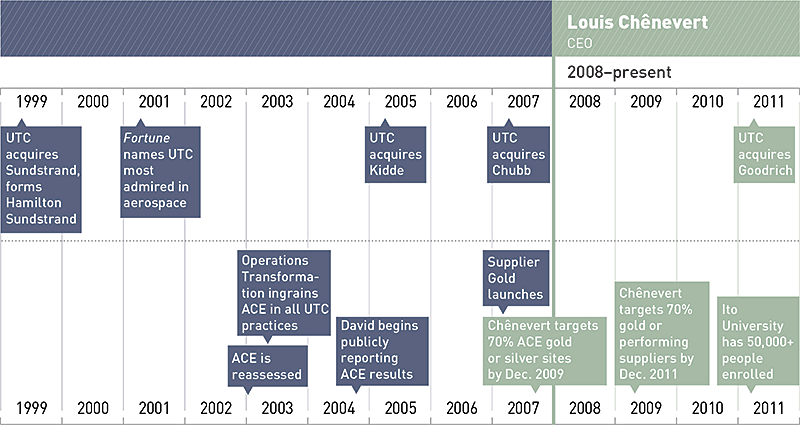
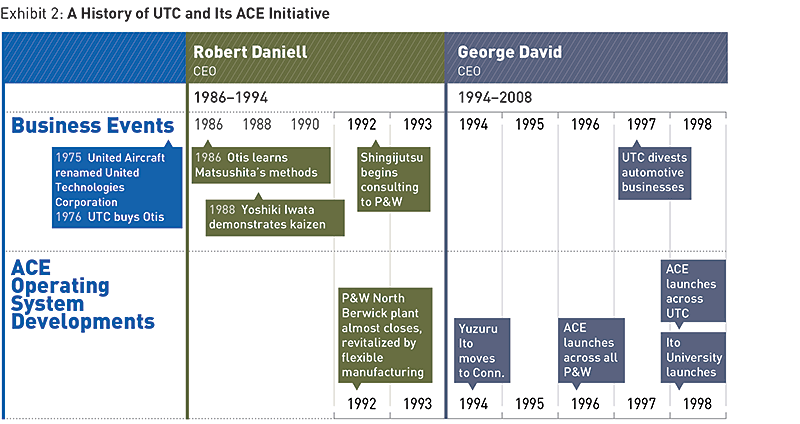
An Uncommonly Cohesive Conglomerate: How United Technologies Corporation—owner of Pratt & Whitney, Otis Elevator, and a wide range of other businesses—became one of the major corporate success stories of the past two decades.

Published: August 27, 2013

An Uncommonly Cohesive Conglomerate

How United Technologies Corporation—owner of Pratt & Whitney, Otis Elevator, and a wide range of other businesses—became one of the major corporate success stories of the past two decades.See also The Story of UTCʼs Success—In Pictures.

by George L. Roth

00209_ex01 00209_ex02bb 00209_ex02ab

Right from the start, the service call was unusual. In a business-to-business manufacturing company like Otis Elevator—or its corporate parent, the United Technologies Corporation (UTC)—field engineers are supposed to be heroes. They swoop in when there’s a technical problem too complex for anyone else to solve. But when two of Otis’s best field engineers were dispatched from their U.S. headquarters near Hartford, Conn., to Osaka, Japan, to fix a pair of malfunctioning elevators at Matsushita Electric, they weren’t brought to the problem site. Instead, they were ushered into a conference room where their customers, Matsushita’s corporate leadership, sat stone-faced around a table. Read more of this post

14 Jeff Bezos Quotes That Show Why Amazon’s Boss Is A Total Genius; On haters: “If you never want to be criticized, for goodness’ sake don’t do anything new.”

14 Jeff Bezos Quotes That Show Why Amazon’s Boss Is A Total Genius

JILLIAN D’ONFRO OCT. 13, 2013, 12:38 PM 222,527 21

on-pricing-there-are-two-kinds-of-companies-those-that-work-to-try-to-charge-more-and-those-that-work-to-charge-less-we-will-be-the-second

Jeff Bezos, founder and CEO of Amazon, is a billionaire who’s had an amazing life and career: He’s building a mysterious 10,000-year clock in a West Texas cave. Earlier this year, he bought the Washington Post for $250 million. You wouldn’t want to get on his bad side. Bezos achieved so much success by being incredibly smart and business savvy, and so we rounded up some quotes that show his genius.

On complacency: “A company shouldn’t get addicted to being shiny, because shiny doesn’t last.”

On innovation: “I think frugality drives innovation, just like other constraints do. One of the only ways to get out of a tight box is to invent your way out.”

On progress: “If you’re competitor-focused, you have to wait until there is a competitor doing something. Being customer-focused allows you to be more pioneering.”

On developing company culture: “Part of company culture is path-dependent—it’s the lessons you learn along the way.”

On new ideas: “There’ll always be serendipity involved in discovery.”

On haters: “If you never want to be criticized, for goodness’ sake don’t do anything new.”

On motivation: “I strongly believe that missionaries make better products. They care more. For a missionary, it’s not just about the business. There has to be a business, and the business has to make sense, but that’s not why you do it. You do it because you have something meaningful that motivates you.”

On choosing friends: “Life’s too short to hang out with people who aren’t resourceful.”

On morals: “The one thing that offends me the most is when I walk by a bank and see ads trying to convince people to take out second mortgages on their home so they can go on vacation. That’s approaching evil.”

One strategy: “We’ve had three big ideas at Amazon that we’ve stuck with for 18 years, and they’re the reason we’re successful: Put the customer first. Invent. And be patient.”

On growth: “All businesses need to be young forever. If your customer base ages with you, you’re Woolworth’s.”

On pivoting: “If you’re not stubborn, you’ll give up on experiments too soon. And if you’re not flexible, you’ll pound your head against the wall and you won’t see a different solution to a problem you’re trying to solve.”

On marketing: “In the old world, you devoted 30% of your time to building a great service and 70% of your time to shouting about it. In the new world, that inverts.”

On pricing: “There are two kinds of companies, those that work to try to charge more and those that work to charge less. We will be the second.”

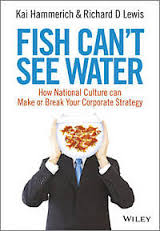
Fish Can’t See Water: How National Culture Can Make or Break Your Corporate Strategy

Fish Can’t See Water: How National Culture Can Make or Break Your Corporate Strategy Hardcover

by Kai Hammerich  (Author) , Richard D. Lewis (Author)

How national culture impacts organizational culture—and business success

Fish Can't See Water

Using extensive case studies of successful global corporations, this book explores the impact of national culture on the corporate strategy and its execution, and through this ultimately business success—or failure. It does not argue that different cultures lead to different business results, but that all cultures impact organizations in ways both positive and negative, depending on the business cycle, the particular business, and the particular strategies being pursued. Depending on all of these factors, cultural dynamics can either enable or derail performance. But recognizing those cultural factors is difficult for business leaders; like everyone else, they too can be blind to the culture of which they are a part. The book offers managers and leaders eight recommendations for recognizing those cultural factors that negatively impact performance, as well as those that can be harnessed to encourage superior performance. With real case studies from companies in Asia, Europe, and the United States, this book offers a truly global approach to organizational culture. Offers a fresh approach to the effects of national culture on organizational culture that is applicable to any country in any region

Based on case studies of such companies as Toyota, Samsung, General Motors, Nokia, Walmart, Kone and British Leyland

It describes the origins and nature of the most common corporate crisis and how culture impacts the response to such a crisis

Ideal for managers, business leaders, and board members, as well as business school students

A welcome response to the flat-Earth fad that argues we’re all alike, this book offers a nuanced and practical view of cultural differentiators and how they can enable or derail business performance. Read more of this post

Why the efficient markets hypothesis merited a Nobel

October 14, 2013 1:35 pm

Why the efficient markets hypothesis merited a Nobel

By Tim Harford

Any follower of Fama would have smelled a rat before the subprime crisis, says Tim Harford

Few Nobel-watchers will be surprised at the award of a Nobel Memorial Prize in Economics to Robert Shiller, the man who told us that markets could be irrationally exuberant. He has long been a favourite. More of a surprise is that Eugene Fama is one of the two men – with Lars Peter Hansen – sharing the prize with Professor Shiller. The old joke about the economics Nobel was that it had been shared by two men who disagreed with each other: Friedrich von Hayek and Gunnar Myrdal. Profs Fama and Shiller, at first glance, are another example: Prof Fama showed that markets were efficient; Prof Shiller showed that they were not. Read more of this post

Pilgrimages are a big business—and getting bigger; The haj, which all Muslims aspire to do at least once in their lifetimes, now brings in $16.5 billion, around 3% of Saudi GDP

Pilgrimages are a big business—and getting bigger

Oct 12th 2013 | BEIRUT AND CAIRO |From the print edition

MECCANS say they do not need agriculture, for God has given them the pilgrimage as their annual crop. Millions of Muslims are now setting out to take part in this year’s haj, a trek to Islam’s holiest site, in Saudi Arabia. The haj, which all Muslims aspire to do at least once in their lifetimes, now brings in $16.5 billion, around 3% of Saudi GDP. Jerusalem, a holy city for all three Abrahamic religions, also draws crowds of pilgrims, and huge numbers of Shia Muslims visit shrines in Iraq. The UN’s World Tourism Organisation estimates that over 300m people go on pilgrimages each year. Countless others visit shrines or sacred places. Read more of this post

The Economics Nobel Highlights a Big Unanswered Question: We still don’t know nearly enough about why the prices of stocks, bonds and other assets move the way they do

The Economics Nobel Highlights a Big Unanswered Question

The awarding of a Nobel Prize to three economists with divergent views on the working of markets highlights a troubling truth about the state of the discipline: We still don’t know nearly enough about why the prices of stocks, bonds and other assets move the way they do. If the economics profession wants to help the world avert – – or at least better survive — financial crises, it will have to be more open to new ways of looking at this question. Read more of this post

Nobel Prize Shows Both Wisdom and Madness of Crowds

Nobel Prize Shows Both Wisdom and Madness of Crowds

Financial markets provide a useful reminder of just how humble we economists should be about our understanding of the world. The three winners of the 2013 Nobel Memorial Prize in Economic Sciences neatly capture this tension. Eugene Fama is the intellectual godfather of the view that financial markets are efficient, while no one has done more than Robert Shiller to highlight their inefficiencies. Lars Peter Hansen developed statistical techniques that both sides have used to help resolve their differences. Read more of this post

Fama’s Nobel Work Shows Active Managers Fated to Lose

Fama’s Nobel Work Shows Active Managers Fated to Lose

The work that earned Eugene Fama the Nobel Prize in economics provided the intellectual foundation for index-tracking funds, which have upended stock picking as investors abandon active money managers. Fama, 74, has argued that financial markets are efficient and that stock-price movements are unpredictable, making it impossible for even professional money managers to gain an advantage. His conclusion that investors would be better off in low-cost funds that track the market’s performance helps explain the success of Vanguard Group Inc., the biggest U.S. mutual-fund company, as well as the rise of passive investments, which had more than $2.6 trillion in U.S. assets between exchange-traded funds and mutual funds at the end of 2012. Read more of this post

When The New-York Daily Times began publication in 1851, China was ruled by a weak and stagnating Qing dynasty

OCTOBER 14, 2013, 10:31 AM

“Interesting From China.”

By AUSTIN RAMZY and PHILIP P. PAN

When The New-York Daily Times began publication in 1851, China was ruled by a weak and stagnating Qing dynasty. Hong Kong was a young British colony, ceded to Queen Victoria at the end of the first Opium War only nine years earlier. And the devastating Taiping Rebellion, which would leave at least 20 million dead, more than almost any other military conflict in history, had just begun in a corner of what is now the southern region of Guangxi. Read more of this post

Nobels and National Greatness; Anyone who thinks America’s best days are behind it should take a close look at the latest Nobel haul

October 14, 2013, 7:35 p.m. ET

Stephens: Nobels and National Greatness

Anyone who thinks America’s best days are behind it should take a close look at the latest Nobel haul.

BRET STEPHENS

In its proud and storied history, Hungary has produced a dozen winners of the Nobel Prize: four for chemistry; three for physics; three for medicine; one for economics; and one for literature. Not bad for a little country of not quite 10 million people. But one curious fact: All of Hungary’s laureates ultimately left, or fled, the country. If you are brilliant, ambitious and Hungarian, better get out while you can. Read more of this post

Blood found in 46-million-year-old mosquito

Blood found in 46-million-year-old mosquito

October 15, 2013 – 9:48AM

Nicky Phillips

Mozzies have been annoying humans for centuries, but they’ve been sucking blood from other creatures for far longer, close to 50 million years, say scientists, who have ancient blood to prove it. Researchers have found components of red blood cells in a 46-million-year-old fossilised mosquito. While the discovery sounds like the plot of the popular sci-fi novel Jurassic Park – where scientists use DNA extracted from an amber-encased mosquito to revive dinosaurs – the female specimen represents the world’s first fossil of a blood-engorged mosquito. Read more of this post

The Long, Slow Process of IKEA Design: Company’s Commitment to Shaving Costs Makes Designing a Kitchen a Five-Year Task

The Long, Slow Process of IKEA Design

Company’s Commitment to Shaving Costs Makes Designing a Kitchen a Five-Year Task

JENS HANSEGARD

Updated Oct. 14, 2013 11:57 a.m. ET

While some car companies can design a new sedan in about three years and smartphone makers can churn out a new handset in six months, it takes IKEA half a decade to create a new kitchen. Ellen Jervell finds out why.

ÄLMHULT, Sweden—It takes car companies about three years to design a sedan, and handset makers can churn out a new smartphone in six months. But an IKEA kitchen takes half a decade to create. The Swedish company uses a painstaking development process to produce cheap and sensible home-design items, all of which have quirky names and many of which must be assembled at home from kits. IKEA’s dogged pursuit of engineering products to bring down the price is helping fuel growth in emerging markets such as China and Russia. Read more of this post

Tadamitsu Matsui, the man behind Muji’s turnaround; Employees can raise any problems they encounter, come up with solutions and tweak their copy of Mujigram. These updates are synced across all stores.

Simply Muji

st_muji_0

Sunday, Oct 13, 2013

Natasha Ann Zachariah

The Straits Times

Lifestyle brand Muji might not put its name or logo on any of its products, but it is happy to shout about their quality. During an interview with Life!, Mr Tadamitsu Matsui, chairman of Japanese retail company Ryohin Keikaku, Muji’s parent company, emphasises no fewer than 10 times that Muji is synonymous not just with minimalist design, but also well-made products. The 64-year-old, who was in town last week for the opening of the seventh Muji store here in 313@Somerset, is not just paying lip service. When he took over as president and representative director of Ryohin Keikaku in 2001, Muji was in a steep decline. It had chalked up a deficit of 3.8 billion yen the year before and was closing stores worldwide. Its stock price plunged to just one-sixth of its original price. Read more of this post

Buffett Turns to Deputies to Help Find Successors for Unit CEOs

Buffett Turns to Deputies to Help Find Successors for Unit CEOs

Warren Buffett isn’t the only chief executive officer that Berkshire Hathaway Inc. (BRK/A) shareholders have to worry about replacing. Managing CEO turnover has become more demanding with the company’s expansion. Last week the Benjamin Moore paint unit named its third chief in two years, bringing in an executive who worked before with Ted Weschler, 52, one of Buffett’s investing deputies. Read more of this post

Ray Kelvin, the founder and chief executive of Ted Baker, on how a Glasgow shirt shop has been transformed into a global fashion brand over the last 25 years

Ted Baker chief Ray Kelvin is as unique as his brand

Ray Kelvin, the founder and chief executive of Ted Baker, on how a Glasgow shirt shop has been transformed into a global fashion brand over the last 25 years.

bloomted_2226898bray-kelvin_2701232c

Ray Kelvin never shows his face in public – “I’m an ugly bugger,” he says. Ray Kelvin’s quirkiness, passion and rebellious style runs through everything that Ted Baker does Photo: Martin Pope

By Graham Ruddick

6:00AM BST 14 Oct 2013

Before you meet Ray Kelvin, the founder and chief executive of Ted Baker, you already know that he is not your average FTSE boss. A bit of reading on the history of the company tells you that he never shows his face in public, he makes people who are late to meeting do press-ups, and he loves to hug people. A lot.  But after a couple of hours in his company, here are a few more things that stand out about Kelvin – he beat Andy Murray at table tennis three days after the sportsman won Wimbledon, he spends his evenings “in front of the TV farting”, and he constantly plays matchmaker in the office. Read more of this post

Entrepreneurship and sacrifice go hand in hand

Entrepreneurship and sacrifice go hand in hand

Published: 2013/10/14

THE closing ceremony of the Global Entrepreneurship Summit 2013 (GES 2013) in Kuala Lumpur literally finished with a big bang! We hosted 4,700 delegates, we showcased exemplary young entrepreneurs, we deliberated on the many challenges faced by entrepreneurs worldwide and we announced a new initiative named “MaGIC”! The audience also witnessed the passing of the baton from Malaysia to Morocco, who will host GES 2014. As I reflect on the achievements of Malaysia as the host this year, I can’t help but try to understand the true intention of President Barack Obama when he first conceptualised the GES four years ago in Cairo. He did so because he understood that freedom of opportunity is humanity’s most powerful motivator.  Read more of this post

Liam Casey has never read a book on China and does not speak Chinese. But the Irish entrepreneur has earned the nickname “Mr China” by creating a 5,000-employee company in Shenzhen whose customers include Apple and Beats Electronics. “There is no such thing as a ‘Mr China’ because nobody knows China,” says Mr Casey.

October 13, 2013 4:48 pm

Liam Casey: From County Cork to ‘Mr China’

By Demetri Sevastopulo

©Berton Chang

Express delivery: Liam Casey says his group can ship a Chinese product to ‘anywhere in the world in a couple of days’

Liam Casey has never read a book on China and does not speak Chinese. But the Irish entrepreneur has earned the nickname “Mr China” by creating a 5,000-employee company in Shenzhen whose customers include Apple and Beats Electronics. Sitting in his glass-walled office, the chief executive of PCH International laughs off the sobriquet given to him by the journalist James Fallows in The Atlantic magazine. “There is no such thing as a ‘Mr China’ because nobody knows China,” says Mr Casey. Read more of this post