China’s Achilles’ heel: Growing foreign oil and gas dependency

China’s Achilles’ heel: Growing foreign oil and gas dependency

Tim Daiss

2013-12-21

Amid news of China’s GDP growth for the third quarter, still stellar at 7.8% compared to the rest of the world, its impressive US$3.66 trillion in foreign currency reserves — the largest in the world — and even its recent successful unmanned moon mission, China has an Achilles’ heel, a weakness that is mounting and posed to worsen in coming years: its dependency on foreign oil and natural gas. Read more of this post

China’s financial system is in crisis mode again, and the central bank’s billions aren’t helping

China’s financial system is in crisis mode again, and the central bank’s billions aren’t helping

By Gwynn Guilford @sinoceros December 20, 2013

On Dec. 20, as China’s overnight money-market rate surged to 10%—the level reached during the country’s cash crunch last June—the People’s Bank of China (PBOC) pumped a reported 200 billion yuan into the system. That brought rates down to 7%.

But it wasn’t enough. Rates neared 10% once again today. And the PBOC’s floodgates swung open, again. In total, it injected 300 billion yuan in the last three days via its short-term liquidity operation (SLO), the PBOC said over Sina Weibo (link in Chinese; registration required). Here’s a look at the 7-day rate, viaBloomberg’s Tom Orlik: Read more of this post

China to Open More of Government Market to Foreign Firms

China to Open More of Government Market to Foreign Firms

Wants to Join Global Pact on Government Purchases

BOB DAVIS

Updated Dec. 20, 2013 10:33 a.m. ET

BEIJING—China said it would agree to open more of its vast government market to foreign firms as part of a decadelong bid to join a global pact on government purchases, which could ultimately benefit Chinese companies too. Read more of this post

China companies try new measures to keep staff from fleeing

China companies try new measures to keep staff from fleeing

Friday, Dec 20, 2013

Qiu Quanlin

China Daily/Asia News Network

Chen Zhongwei has had to shift some of his processing business to factories in inland areas due to a shortage of workers in his company, located in the traditional manufacturing hub of Dongguan. Read more of this post

Australia’s slowing economy needs its floating exchange rate more than ever

Australia’s slowing economy needs its floating exchange rate more than ever

Dec 14th 2013 | From the print edition

THIRTY years ago this week, Australia took a big economic gamble. On December 12th 1983 Paul Keating, then treasurer (finance minister), decided to float the Australian dollar.

20131214_FNC025 (1)

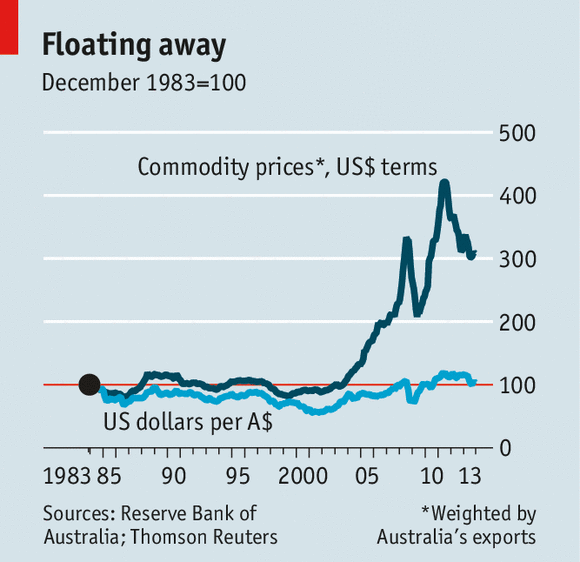
Ordinary Australians have lived with the highs and the lows of this decision ever since. In its first 20 years afloat, the dollar’s value closely followed the prices of the commodities Australia exports (see chart). But around 2003 they suddenly diverged. Over the next eight years commodity prices quadrupled; the dollar rose by much less. It no longer “has any day-to-day relationship to commodity prices”, according to Ric Deverell of Credit Suisse, a bank. Read more of this post

Hyosung chairman grilled over the group’s alleged tax evasion, embezzlement and creation of a slush fund

2013-12-10 16:48

Hyosung chairman grilled over slush fund creation

Nam Hyun-woo

Hyosung Group Chairman Cho Suk-rae appeared before the prosecution Tuesday to be questioned over the group’s alleged tax evasion, embezzlement and creation of a slush fund. The 78-year-old tycoon appeared at the Seoul Central District Prosecutors’ Office at around 10 a.m.  Read more of this post

Korea’s State firm CEOs pressured to cut debts; combined debt owed by public firms totaled 565.8 trillion won ($538 billion), higher than the government’s debt of 446 trillion won

2013-12-10 17:40

State firm CEOs pressured to cut debts

By Na Jeong-ju
Strategy and Finance Minister Hyun Oh-seok vowed Tuesday to conduct “rigorous” debt restructuring programs at public firms, saying their CEOs will be held responsible if they fail to meet government standards.
“We will implement stricter performance evaluation standards for all CEOs at public firms,” Hyun said during a forum on public sector reform in Seoul. “If they fail to reduce debts, they will be kicked out immediately. We won’t consider their given terms.” Read more of this post

Thai Opposition Decision on Election Participation Risks Crisis

Thai Opposition Decision on Election Participation Risks Crisis

Thailand’s main opposition Democrat Party will decide today whether to boycott a snap election called for Feb. 2, a move that may deepen the nation’s political crisis after months of street protests. Senior party officials including former lawmakers, who will meet in Bangkok, have been urged to skip the polls by protesters calling for parliament to be replaced by an unelected council. The protesters are seeking to erase the political influence of Prime Minister Yingluck Shinawatra’s family. Read more of this post

Taking voting rights away from poor and uneducated not the answer: Thailand’s election commissioner

Taking voting rights away from poor and uneducated not the answer: Thailand’s election commissioner

Saturday, December 21, 2013 – 12:59

Pravit Rojanaphruk

The Nation/Asia News Network

THAILAND – Talk among the educated middle class and the elite about taking away people’s right to vote is unacceptable, Election Commission member Somchai Srisuthiyakorn said, adding that this went against the fundamental values of equality. Read more of this post

By Sci-Fi Standards, Newest Robots May Disappoint

December 20, 2013

By Sci-Fi Standards, Newest Robots May Disappoint

By JOHN MARKOFF

HOMESTEAD, Fla. — The robot gently grabbed the door handle and pulled it open. But before it could shuffle through the frame, it lost its grip and the spring-loaded door slammed shut. Read more of this post

BlackBerry’s Foxconn Deal Spurs Evolution Into Services Company

BlackBerry’s Foxconn Deal Spurs Evolution Into Services Company

BlackBerry Ltd. (BBRY)’s five-year deal to outsource smartphone production to Foxconn Group is jump-starting its transformation into a services provider, pleasing investors who were looking for a smaller, nimbler company. BlackBerry announced plans yesterday for Foxconn to make its phones at plants in Indonesia and Mexico, sending the shares up 16 percent, the biggest one-day gain in more than four years. The move will help the struggling company cut production spending and avoid the kind of inventory gluts that contributed to a $4.6 billion writedown last quarter. Read more of this post

Bracing for tough times

Updated: Saturday December 21, 2013 MYT 8:25:43 AM

Bracing for tough times

BY CECILIA KOK

HARD times beckon as Malaysians usher in a year of price hikes in less than two weeks.

Undoubtedly, we will all feel a tad poorer, as our discretionary spending power gets squeezed by the increase in prices of some basic items such as fuel, sugar, electricity, and possibly, highway toll rates. Although we have been told that some of us, in particular those who belong to the low-income group, would be spared from the direct impact of the price hikes, it is unlikely that anyone could escape the spill-over effects of higher costs of basic items. Read more of this post

Your FX year that was

Your FX year that was

David Keohane

| Dec 16 10:28 | Comment | Share

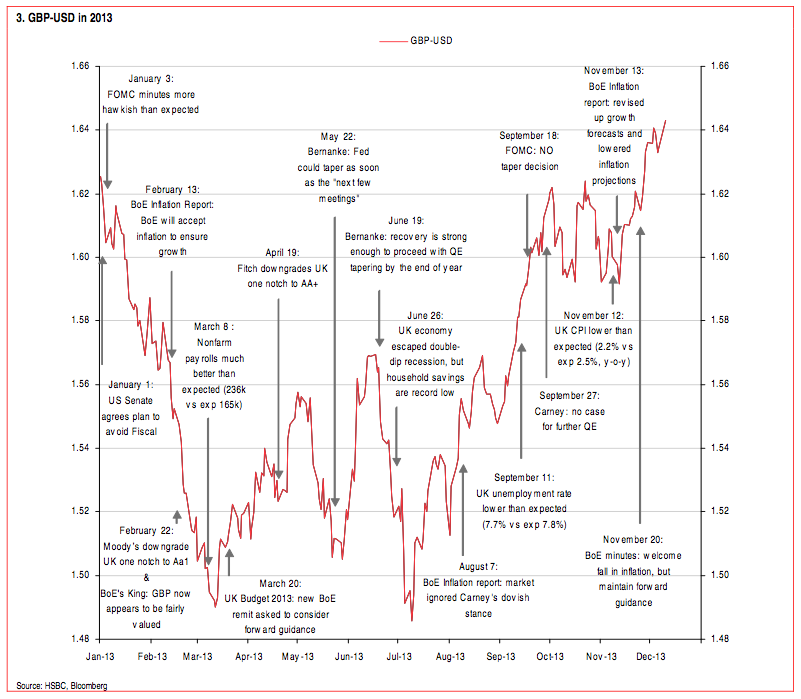
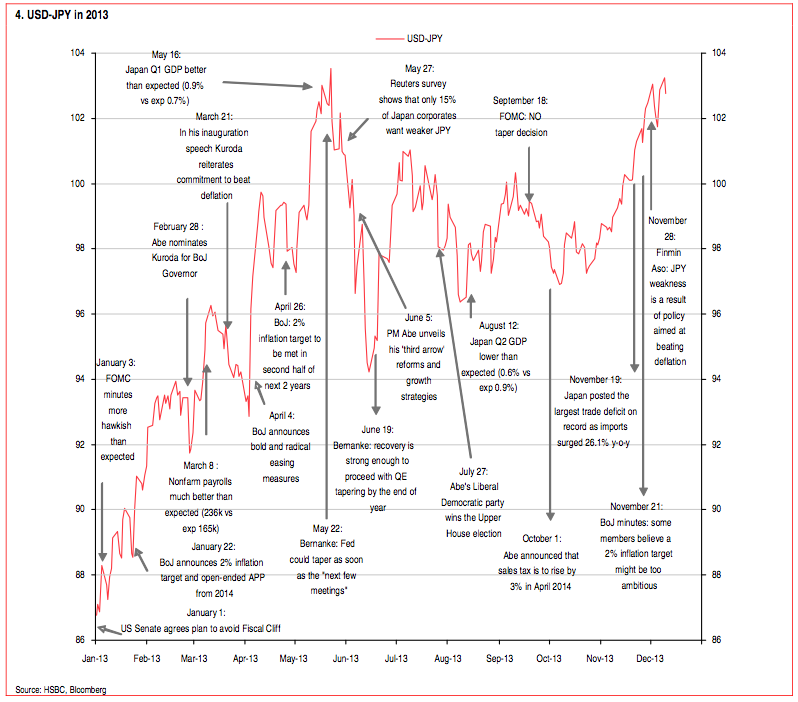
At least for the majors. Just some annotated charts courtesy of HSBC, click to enlarge: More in the usual place for those that want it.

Screen-Shot-2013-12-16-at-15.43.23 Screen-Shot-2013-12-16-at-15.44.44 Screen-Shot-2013-12-16-at-15.45.20


What’s Wrong With REITs, Anyway? REITs outperformed stocks between 2009 and 2012. But this year, they have fallen far behind. What’s an investor to do?

Dec 20, 2013

What’s Wrong With REITs, Anyway?

JASON ZWEIG

Taper your expectations, real-estate investors. That’s one of the clearest lessons from the Federal Reserve’s decision this Wednesday to scale back, or “taper,” its bond-buying program to $75 billion from $85 billion per month. Read more of this post

What the Rest Really Should Learn From the West in Order to Catch Up

What the Rest Really Should Learn From the West in Order to Catch Up

By Pankaj Mishra on 5:20 pm December 17, 2013.

In “Free to Choose,” Milton and Rose Friedman first posed the binary of private markets versus state intervention, which would come to underpin World Bank and International Monetary Fund reports, policies and prescriptions for the next two decades. According to the Friedmans, places such as Japan, South Korea, Taiwan, Hong Kong and Singapore had succeeded due to their reliance on “private markets.” India, China and Indonesia had stagnated after “relying heavily on central planning.” Read more of this post

Wealth managers are paying for clients’ sins, even if they were unaware of them

Wealth managers are paying for clients’ sins, even if they were unaware of them

Dec 14th 2013 | NEW YORK | From the print edition

20131214_FNC036 (1)

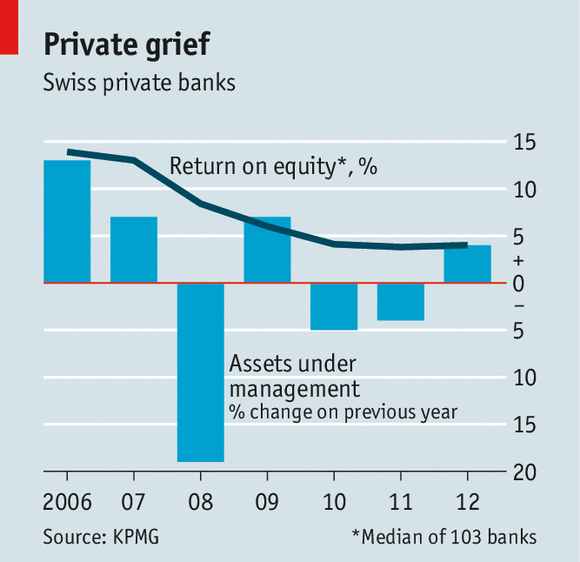
AMERICANS never made up a large portion of Swiss private banks’ international client base, but the price to be paid for allowing some of them to evade tax is proving to be steep—and could be ruinous for some smaller wealth managers. By December 9th most of Switzerland’s 300 or so banks were required to tell their regulator whether they would participate in a voluntary-disclosure programme crafted by the Department of Justice, under which those that have handled untaxed accounts for American clients can wipe the slate clean in exchange for fines. Swiss authorities have urged banks to sign up to avoid the fate of Wegelin, a venerable private bank that closed after being indicted in New York for aiding tax dodgers. Read more of this post

U.S. Law School Enrollments Fall; Lack of Jobs Has Students Steering Away From Legal Career

U.S. Law School Enrollments Fall

Lack of Jobs Has Students Steering Away From Legal Career

JENNIFER SMITH 

Dec. 17, 2013 7:41 p.m. ET

MK-CI666A_LAWSC_NS_20131217182103

First-year enrollment at U.S. law schools plunged this year to levels not seen since the 1970s as students steered away from a career that has left many recent graduates loaded with debt and struggling to find work. Read more of this post

Three things long/short hedge funds cannot do (well)

Three things long/short hedge funds cannot do (well)

Dan McCrum

| Dec 18 11:17 | 16 comments | Share

ScreenShot031-590x262 ScreenShot032

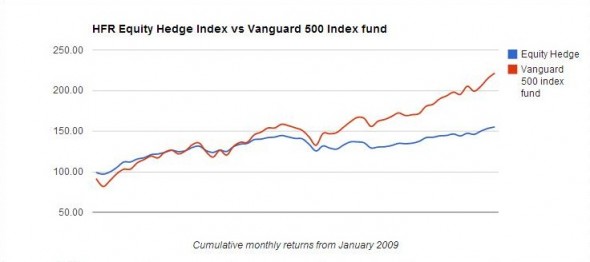
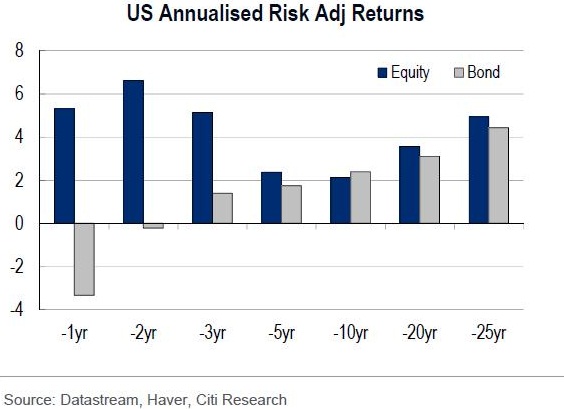
We have mentioned the five-year problem before. However, we suspect that theranks of the zombies will be swelling again soon, because of the simple fact that the five-year track record of stock-trading hedge funds is horrible.

Your $100 would be worth $220 if you lodged it with Vanguard — while the Long-Short industrial complex would have turned it into $155 (after taking at least $25 in fees).

This matters because, having worked to justify hedge funds as a separate asset class, the sector is effectively competing with stocks. And as Jonathan Stubbs at Citi has been pointing out, asset-class returns for equities now look pretty good for almost every period you choose to consider, a fact which tends to be followed by higher allocations of capital.

But we are looking for reasons to explain the enormous gap between the performance of stocks and highly-paid stock traders. In particular, we think there are three fundamental things that Long/Short funds should be able to do, but clearly cannot:

1. Manage risk.

We don’t mean risk in the month-to-month trading exposure sense. We mean in the deciding when to go big and when to stay at home sense.

It may be that the desire of big institutions for monthly reporting, tight risk limits and safety has become counterproductive – that in trying to build something of “institutional quality” you destroy the nimbleness the institutions are after in the first place.

But equity hedge funds have not done a good job of managing risk. A case in point: with hindsight it is clear that the biggest risk to portfolios at the start of the year was having too little market exposure.

See also the whole of 2011.

2. Short stocks on a systematic basis

Want to go long the market? There are a host of strategies you can use – value, quality, earnings momentum, monkey darts.

To go short though, not so easy. There is no inherent return, and over the long term you are fighting the market. For the long-short model to work, hedge funds must constantly have short positions in place, and to do that well is hard to the point of impossibility for most.

One thought also for discussion. We suspect there is a temptation to use low-beta stocks for shorts as the lack of volatility makes such positions cheaper. But low beta stocks have also proved to be good performers a lot of the time.

3. Stop trading.

Friction is a killer, as those trading commissions and little losses add up. For the individual investment experts who were nimble and rose to the top in the early days, making the industry’s reputation, this was not a problem.

Scale up to thousands of funds and more than a trillion dollars in capital at work, however, and the friction will start to tell at the industry level. You might also classify this as the prime broker’s cut from the use of our imaginary investor’s $100…

The Volcker rule: More questions than answers; A push to make America’s banks safer creates new uncertainties

The Volcker rule: More questions than answers; A push to make America’s banks safer creates new uncertainties

Dec 14th 2013 | NEW YORK | From the print edition

THE 37 words inserted into the 848-page Dodd-Frank law overhauling the regulation of America’s financial institutions seemed innocent enough. Lawmakers wanted regulators to come up with strictures that would prevent banks from gambling with deposits insured by the federal government. The resulting rule, named after a prominent proponent, Paul Volcker, a former head of the Federal Reserve, prohibits banks from “proprietary trading”, meaning transactions conducted purely for their own gain, rather than to serve clients. On December 10th five different regulatory agencies approved the Volcker rule; it will come into force, awkwardly enough, on April 1st. Read more of this post

The politics of low pay: Raising the floor; America’s minimum-wage debate has rolled round again

The politics of low pay: Raising the floor; America’s minimum-wage debate has rolled round again

Dec 14th 2013 | BALDWIN PARK, CALIFORNIA, AND NEW YORK | From the print edition

HE LIKES the work; but at $9.60 an hour, stacking the shelves at a Walmart in east Los Angeles does not pay Anthony Goytia enough to cover the bills for his family of five, he says. He supplements his fortnightly pay of $560-600 with the odd catering job, by subjecting himself to clinical trials of a treatment for his psoriasis, and with federal and state assistance. He was recently approved for food stamps; that should make Christmas a little jollier.
20131214_USC023 (1) 20131214_USM944

America is going through one of its periodic fits of agony over the minimum wage. In recent weeks several states and municipalities have approved rate rises; most dramatically in SeaTac, a suburb of Seattle consisting of a large airport, where voters raised the hourly figure to $15. On December 4th Barack Obama called for a higher federal minimum wage. He has previously suggested that it rise from $7.25 to $10.10. It has lost 5.8% of its purchasing power since it was last raised, in 2009.

Between 1979 and 2007 the incomes of the top 1% of American earners rose by 275%, according to the Congressional Budget Office. Those of the bottom 20% rose by 18%. Had the federal minimum wage kept up with productivity gains since 1968 it would have reached $21.72 last year, estimates the Centre for Economic and Policy Research (CEPR), a leftish think-tank. Campaigners gripe that the government should not have to top up the pay of workers like Mr Goytia (who agrees); this “hidden subsidy” amounts to $7 billion in the fast-food industry alone, according to one study.

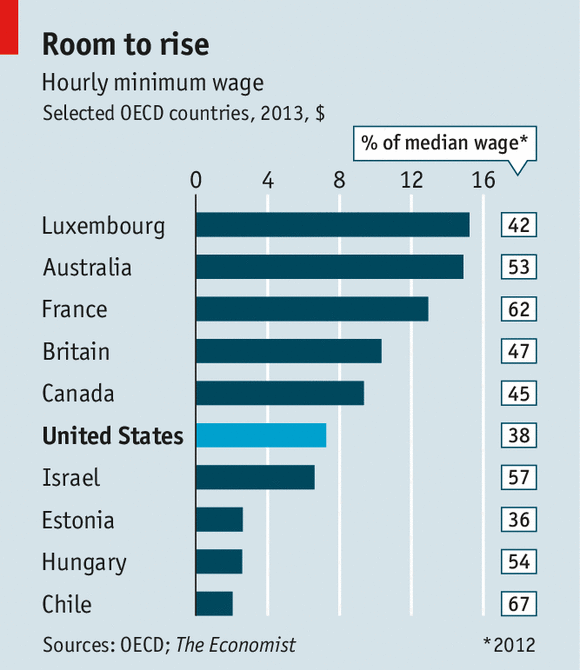
There is no consensus among economists about the extent to which minimum wages kill jobs. But recent research suggests that relatively low rates (America’s is 38% of the median wage) are not harmful, and that small increases can be beneficial. They not only lift workers’ purchasing power; they also make them more loyal, and so reduce the amount companies must spend recruiting new people.

Mr Obama will not convince Republicans in the House of Representatives to vote for an increase. But by raising the idea he may help Democrats in next year’s midterm elections, particularly in red states where local minimum-wage rises are on the ballot. Republican voters do not recoil at the prospect; 58% told Gallup in November that they would support a rise to $9 an hour; overall, 78% of Americans agree.

Advocates for a higher federal minimum wage point out that, in real terms, it is well below its peak in 1968. That is true, but misleading. First, the big drop came in the 1970s and early 1980s, not recently. Second, as David Neumark of the University of California, Irvine, has pointed out, the earned-income tax credit, a federal subsidy for low-wage workers, makes up for a lot of the losses.

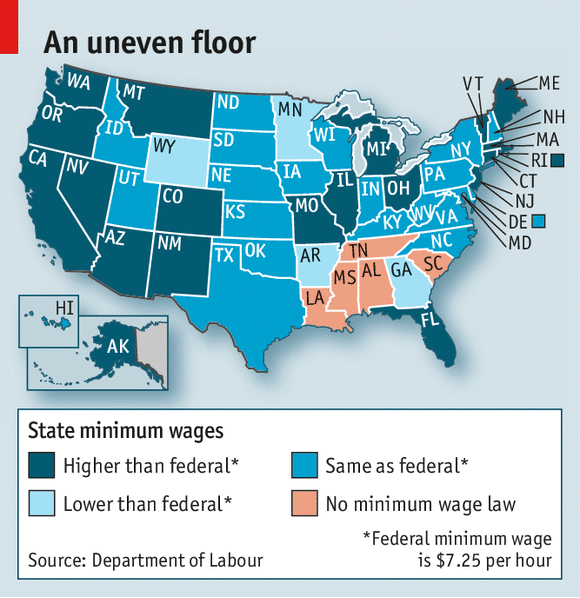
Moreover, the proliferation of state and municipal minimum wages means that the federal rate covers far fewer people than it once did. In 1979 7.9% of workers toiled at or below the federal minimum wage; last year 2.8% did. From January 1st 21 states will have a minimum wage higher than the federal one (see map). More may introduce one next year; others will raise theirs further.


Variable minimum wages make sense for a large country with variable costs of living. But they can have unexpected consequences. The campaign in SeaTac became a big issue during the concurrent mayoral race in Seattle; there, both candidates backed a $15 rate. John Burbank of the Seattle-based Economic Opportunity Institute now reckons the city will approve a $15 rate next year. Washington, DC and two neighbouring counties recently co-ordinated huge rate rises to stop firms playing them off against each other.

Such quirks are inevitable when politicians are left in charge. Most countries with a minimum wage outsource rate-setting to independent technocrats. Eleven American states and several cities index their rates to inflation; this can be awkwardly inflexible when economies stumble, but it does mean firms and workers avoid nasty shocks. Elsewhere, and at the federal level, minimum wages are subject to the fancies of politicians and voters.

Some agitators for higher pay focus on specific industries or companies, such as McDonald’s. Last week hundreds of union-backed workers went on the latest of a series of nationally co-ordinated strikes calling for a $15 wage. That figure, according to a recent business-backed survey, would lead to “personnel decisions” (management-speak for cutting jobs or hours) at 86% of fast-food and other franchises. Ron Shaich, the boss of Panera, a chain of 1,800 eateries, is an exception in the industry; he backs an increase in the minimum wage so long as it applies to everyone.

Other business leaders feel differently. The solution to the “wage problem” said Jim McNerney, the boss of Boeing, this week, is not a minimum wage but “an economy that’s growing”. But John Schmitt of the CEPR says the demand for a $15 wage is best understood as a broader push for collective-bargaining rights. Perhaps some employers can be convinced to pay higher wages as part of a strategy to reduce job churn, he suggests.

This happened with caretakers (janitors) in the late 1990s, after a decade of campaigns. An industry once staffed by ill-paid part-timers now pays workers in unionised cities $15 or more an hour.
The Hubble bubble theory of the continuous expansion of the financial universe

The Hubble bubble theory of the continuous expansion of the financial universe

Izabella Kaminska | Dec 06 19:28 | 29 comments | Share

Part of the BITCOINMANIA SERIES

Or something like it. We’re not, after all, physicists. Though, feel free to read about the Hubble Bubble theory here. What we probably should be referring to is Hubble’s flow, the rate at which expansion of the universe occurs. Read more of this post

The Hedge Fund Way: Pay More, to Get Less, and Be Unable to Access Your Money

The Hedge Fund Way: Pay More, to Get Less, and Be Unable to Access Your Money

By Nick Summers December 06, 2013

Another month, another marker that hedge funds are having an annus horribilis: With returns of 7.1 percent so far this year, the industry is badly trailing the broader market, where the Standard & Poor’s 500-stock index has gained 29.1 percent. If the pace continues, 2013 will be the worst year for the asset class, compared with stocks, in nearly a decade. Hedge fund manager Stanley Druckenmiller called the results a “tragedy” on Bloomberg TV on Nov. 22. Read more of this post

The future of the Paris Bourse: France fights for its stock exchange

The future of the Paris Bourse: France fights for its stock exchange

Dec 7th 2013 | PARIS | From the print edition

FRENCH moneymen were in Beijing in November talking up their financial wares to the people who have the cash these days. Whether the Chinese will snap up French stocks, bonds and asset management as readily as they do Hermès scarves remains to be seen. In fact, Paris’s very future as a financial centre is in doubt. Read more of this post

The first world war: A century on, there are uncomfortable parallels with the era that led to the outbreak of the first world war

The first world war: A century on, there are uncomfortable parallels with the era that led to the outbreak of the first world war

Dec 21st 2013 | From the print edition

AS NEW YEAR approached a century ago, most people in the West looked forward to 1914 with optimism. The hundred years since the Battle of Waterloo had not been entirely free of disaster—there had been a horrific civil war in America, some regional scraps in Asia, the Franco-Prussian war and the occasional colonial calamity. But continental peace had prevailed. Globalisation and new technology—the telephone, the steamship, the train—had knitted the world together. John Maynard Keynes has a wonderful image of a Londoner of the time, “sipping his morning tea in bed” and ordering “the various products of the whole earth” to his door, much as he might today from Amazon—and regarding this state of affairs as “normal, certain and permanent, except in the direction of further improvement”. The Londoner might well have had by his bedside table a copy of Norman Angell’s “The Great Illusion”, which laid out the argument that Europe’s economies were so integrated that war was futile. Read more of this post

The Federal Reserve at 100: Age shall not weary her; America’s central bank has become ever more powerful over the past century

The Federal Reserve at 100: Age shall not weary her; America’s central bank has become ever more powerful over the past century

Dec 21st 2013 | From the print edition

AS THE holiday season of 1913 drew near, only one thing stood between Woodrow Wilson and a long-awaited vacation on the Gulf of Mexico. Congress was still fighting over a bill to create the Federal Reserve, and Wilson had threatened to keep it in session over Christmas until the bill was ready for his signature. Read more of this post

The Economist’s country of the year: Resilient Ireland, booming South Sudan, tumultuous Turkey: our country of the year is…

The Economist’s country of the year: Resilient Ireland, booming South Sudan, tumultuous Turkey: our country of the year is…

Dec 21st 2013 | From the print edition

HUMAN life isn’t all bad, but it sometimes feels that way. Good news is no news: the headlines mostly tell of strife and bail-outs, failure and folly.

Yet, like every year, 2013 has witnessed glory as well as calamity. When the time comes for year-end accountings, both the accomplishments and the cock-ups tend to be judged the offspring of lone egomaniacs or saints, rather than the joint efforts that characterise most human endeavour. To redress the balance from the individual to the collective, and from gloom to cheer, The Economist has decided, for the first time, to nominate a country of the year. Read more of this post

Smart beta-blocking; The ugly truth about smart beta

Smart beta-blocking

Dan McCrum

| Dec 06 13:57 | 4 comments | Share

ScreenShot0141-590x337

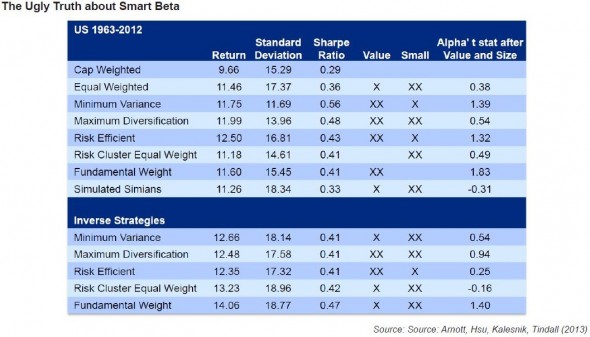
We are big fans of index tracking, particularly for those cash strapped and socially sensitive large pension funds, and we are far from alone: passive is massive for a reason. But where there’s a fee there’s a way. As alternative investments suffer the slowzombification of poor performance, active managers have been trying to find a way into this passive game, prompting some elegant demolition. Read more of this post

Risks of QE are in the descent; Too slow a removal of stimulus could generate risky asset bubbles

December 20, 2013 8:32 am

Do not get wrongfooted on descent from QE

John Authers

Too slow a removal of stimulus could generate risky asset bubbles

The expected Christmas rally in the stock market finally arrived this week. US stock markets hit yet another all-time high, after sagging for several weeks. Read more of this post

Path to a stronger financial system still strewn with dangers

Path to a stronger financial system still strewn with dangers

Fri, Dec 20 2013

By Huw Jones

LONDON (Reuters) – “What a week”, tweeted European Union financial services chief Michel Barnier on Thursday after securing an agreement on how to wind up failed banks without making the region’s taxpayers foot the bill. Read more of this post

Bond Sales Slump to 2002 Low in Europe as Banks Cut Debt Piles

Bond Sales Slump to 2002 Low in Europe as Banks Cut Debt Piles

Bond sales dropped to the least since 2002 in Europe this year, with financial institutions curbing issuance as they cut debt to meet capital demands from regulators. Read more of this post