Ikea Wolf Toy Gets Renamed in China After Old One Deemed Vulgar

Ikea Wolf Toy Gets Renamed in China After Old One Deemed Vulgar

Ikea changed the Chinese name of its stuffed wolf toy because the earlier version sounded like a vulgarity in Cantonese, after the toy became a symbol of government opposition in Hong Kong. The new name of the plush toy wolf from the Little Red Riding Hood fairy tale contains the Chinese character for “good fortune.” The earlier name sounded like a vulgar anatomical reference in the Cantonese dialect which uses the same characters as Mandarin but pronounces them differently. Read more of this post
New Delhi Voters Jolt Old Order

New Delhi Voters Jolt Old Order

Thrilling new energies are coursing through Indian democracy. On Sunday, a rude jolt was delivered both to the governing party in the capital, New Delhi, and to the very nature of political power as commonly understood and often cynically exercised. Assembly elections in Delhi, India’s only city-state, resulted in the ruling Congress party — which has headed India’s coalition government since 2004 — being booted out of power after three consecutive terms in office. It won only eight of the 70 seats on offer. Ordinarily, such an unambiguous expression of voter discontent would have meant a huge swing toward some other long-established party: in this case, the Bharatiya Janata Party, the main opposition group both in Delhi and on the national level. But while this was the case in three other states that also had elections — Madhya Pradesh, Rajasthan and Chhatisgarh, all of which voted or returned the BJP to power — in Delhi the story was far more surprising. Read more of this post

Rupee Aids Bajaj Overseas as Honda Grabs Share: Corporate India

Rupee Aids Bajaj Overseas as Honda Grabs Share: Corporate India

Bajaj Auto Ltd. (BJAUT), which lost its ranking as India’s second-largest two-wheeler maker to Honda Motor Co. this year, is banking on the rupee’s longest losing streak in 12 years to boost exports as sales drop at home. Motorcycle deliveries by Pune, India-based Bajaj have fallen 14 percent this year, the most among India’s nine producers of the vehicle, compared with a 30 percent jump in Honda’s local two-wheeler sales, which includes scooters. Bajaj’s exports have grown for four straight months since August, the Society for Indian Automobile Manufacturers said. Read more of this post

Indonesia’s president to weigh into mineral export confusion

Indonesia’s president to weigh into mineral export confusion

Wednesday, Dec 11, 2013

Reuters

JAKARTA, Dec 11 (Reuters) – Indonesia’s president will make the final decision in a furious debate over next month’s scheduled ban on the export of unprocessed metal ore, an issue that pits nationalist-minded lawmakers against officials desperate not to lose revenue. Read more of this post

Many Indonesians think vote-buying ‘acceptable’: Poll

Many Indonesians think vote-buying ‘acceptable’: Poll

Friday, December 13, 2013 – 18:18

AFP

JAKARTA – More than 40 percent of Indonesian voters consider politicians seeking to buy support at elections acceptable, a survey showed Friday, months before national polls in the graft-ridden country. In what it described as an “alarming” survey, Jakarta-based pollster Indikator found that 41.5 percent of 15,600 people interviewed did not have a problem accepting cash or a gift from would-be lawmakers. Read more of this post

Japan Passes U.S. as Top App Spender as Smartphone Use Rises

Japan Passes U.S. as Top App Spender as Smartphone Use Rises

Japan surpassed the U.S. as the top-grossing market for apps in October as smartphone use surged and wireless carriers started billing customers directly for downloads from Google Inc. (GOOG)’s online store. App revenue in Japan more than tripled from a year earlier as the rising popularity of games including GungHo Online Entertainment Inc.’s “Puzzle & Dragons” helped Google Play close the gap with Apple Inc. (AAPL)’s store, defying the trend elsewhere, according to a Dec. 11 report by researcher App Annie. Downloads also increased after NTT Docomo Inc. (9437), the country’s largest mobile-phone operator, started offering the iPhone in September. Read more of this post

Osaka Seeks to Lure Biggest Pension Fund to Airport Concessions

Osaka Seeks to Lure Biggest Pension Fund to Airport Concessions

New Kansai International Airport Co. is seeking to attract Japan’s state-run retirement fund to a sale of two airport concessions that could raise as much as 1.2 trillion yen ($12 billion). Read more of this post

McKinsey Return to BOE Spurs 1960s Memory of Unfinished Business

McKinsey Return to BOE Spurs 1960s Memory of Unfinished Business

McKinsey & Co. consultants working at the Bank of England are competing with the ghosts of their predecessors.

Governor Mark Carney is giving the U.S. firm another shot at transforming the three-century-old institution, more than four decades after the BOE first hired it to conduct a full-scale examination of operations. The impact of the original review was “limited,” according to former BOE official Guy de Moubray, who participated in the study. Read more of this post

The 2014 Contrarian Investment Tour, From Rupees to Copper

The 2014 Contrarian Investment Tour, From Rupees to Copper

Don’t try to catch a falling knife. It’s one of the oldest saws on Wall Street. But to make a lot of money, sometimes you have to get a little bloody.

So say contrarians like Brian Singer. The risk is great, “but the return is of such an astounding magnitude, you’re willing to do it,” says Singer, manager of the William Blair Macro Allocation Fund (WMCNX). Read more of this post

How Ireland Charmed the Germans to Lead Nation Out of Bailout Wilderness

How Ireland Charmed the Germans to Lead Nation Out of Bailout Wilderness

As a cold day last February turned to early evening twilight, Alan Dukes strode through the lobby of Dublin’s Merrion Hotel when a familiar figure lurking in the shadows stopped him.

Sean Kinsella, private secretary to Finance Minister Michael Noonan, told the banker that his boss wanted to see him. The pair scurried across the road to Noonan’s office. There, Dukes learned for the first time of the plan to close the bank he led, the former Anglo Irish Bank Corp., emblem of the financial boom and bust that had crippled Ireland. Read more of this post

Haircut Deficit: Kids Living in Basements a Drag on U.S. Services Spending

Haircut Deficit: Kids Living in Basements a Drag on U.S. Services Spending

The U.S. economy is suffering a service interruption.

Consumer spending on services — everything from rents and water bills to health care and haircuts — is a laggard as the economy has recovered from the worst recession since the Great Depression. Such expenditures adjusted for inflation have risen 6.3 percent since mid-2009, compared with a 34 percent surge in outlays on durable goods such as automobiles and appliances, according to data from the Commerce Department in Washington. Read more of this post

With a hole in its heart, South Africa buries Mandela

With a hole in its heart, South Africa buries Mandela

8:27pm EST

By Ed Cropley

QUNU, South Africa (Reuters) – South Africa buries Nelson Mandela on Sunday, closing one momentous chapter in its tortured history and opening another in which the multi-racial democracy he founded will have to discover if it can thrive without its central pillar. Read more of this post

Are Bitcoins the Criminal’s Best Friend?

Are Bitcoins the Criminal’s Best Friend?

Until very recently, the virtual currency known as bitcoins could be mistaken for just another Internet fad (the Winkelvoss twins of Facebook fame even had a role). But when federal law enforcement closed the “Silk Road,” the wildly popular online illegal-drug emporium that used Bitcoin as a medium of exchange, politicians and policy makers took notice. Criminals, it turns out, really like bitcoins, which can be exchanged for nefarious purposes on the “Dark Web,” with complete anonymity and, it seems, impunity. Read more of this post

Most Americans Don’t Know Bitcoin While Some Guess Xbox

Most Americans Don’t Know Bitcoin While Some Guess Xbox

Some Americans think Bitcoin is an Xbox game. Others think it might be an iPhone app. The majority have no idea it’s a virtual currency they can use to buy everything from T-shirts to Tesla Motors sedans, according to a Bloomberg National Poll. Only 42 percent of Americans who responded to the Dec. 6-9 telephone survey correctly identified Bitcoin, which has gained more than 80-fold in value this year as its popularity expands. Read more of this post

Bitcoins Fail Currency Test in Scandinavia’s Richest Nation

Bitcoins Fail Currency Test in Scandinavia’s Richest Nation

Bitcoins were dealt a blow in Norway as the government of Scandinavia’s richest nation said the virtual currency doesn’t qualify as real money.

“Bitcoins don’t fall under the usual definition of money or currency,” Hans Christian Holte, director general of taxation in Norway, said in an interview. “We’ve done some assessments on what’s the right and sound way to handle this in the tax system.” Read more of this post

Emerging-Market Investing: It’s Not About the Growth; Most investors get burned—over and over—in emerging markets

Emerging-Market Investing: It’s Not About the Growth

Most investors get burned—over and over—in emerging markets

BRETT ARENDS

Dec. 13, 2013 11:32 a.m. ET

IN 2012 THE ARGENTINE STOCK market plunged by 40 percent in U.S. dollar terms. Meanwhile, the stock market of Colombia rose by 30 percent. The Egyptian market rose more than 40 percent, while that of nearby Qatar ended the year in the red. Kenya’s rose 55 percent, while the Ukraine’s was halved. It may be all up and down, but this, not growth, is the prime attraction of investing part of your portfolio in stocks in developing countries. Done right, such so-called emerging- and frontier-market investing can actually reduce the risk in a portfolio, thereby increasing risk-adjusted returns. But, naturally enough, it is rarely done right. On the contrary, almost everything investors hear from the Wall Street marketing machine about investing in developing countries is wrong. As a result, when they do allocate funds to these countries, most investors typically do it for the wrong reasons, at the wrong times and in the wrong way. Read more of this post

China’s Debts Keep On Rolling

China’s Debts Keep On Rolling

ALEX FRANGOS

Dec. 11, 2013 9:24 a.m. ET

China’s economy needs change. What it’s getting for now is more debt.

AM-BB430_CHINAH_NS_20131211121503

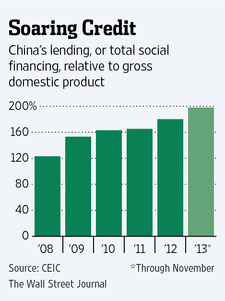
Beijing’s broadest measure of credit, total social financing, has expanded by 19% in the past 12 months through November. November’s monthly numbers were stronger than expected and lending as a percentage of the economy is close to 200%, up from 123% five years ago. Read more of this post

Some Stunning Perspective: China Money Creation Blows US And Japan Out Of The Water

Some Stunning Perspective: China Money Creation Blows US And Japan Out Of The Water

Tyler Durden on 12/11/2013 09:47 -0500

November Credit Creation_2_0

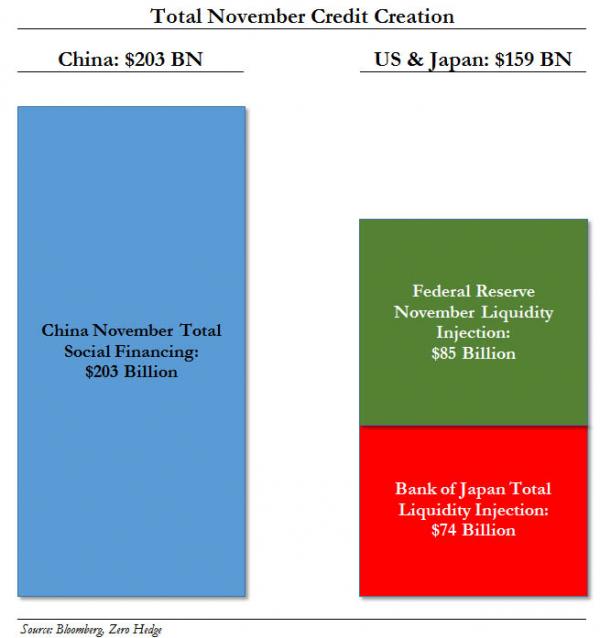
With private sector loan creation in the US and Japan virtually unchanged since Lehman levels (and the US in danger of posting a negative comp in a very months) and Europe loan creation contracting at a record pace, it falls upon the Fed and Bank of Japan (and possibly the ECB soon) to inject the much needed credit-money liquidity into the system. And, as everyone knows, month after month the Fed and the BOJ diligently create $85 billion and $75 billion in new outside money out of thin air (that this “credit” ends up in the stock market is a different topic). Read more of this post

Tata Steel’s Rise Isn’t Iron Clad

Tata Steel’s Rise Isn’t Iron Clad

Europe Is Reeling From Too Much Steel Capacity

ABHEEK BHATTACHARYA

Updated Dec. 13, 2013 3:59 a.m. ET

AI-CF439_TATAHE_NS_20131213035412

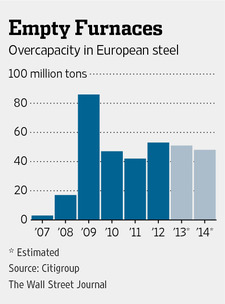
Green shoots of economic revival in Europe and India are making Tata Steel500470.BY +0.20% investors euphoric. They may have gotten ahead of themselves. The Mumbai-listed steelmaker has become a play on the industrial sectors in both parts of the world. After Tata bought Britain’s Corus Steel in 2007, about 60% of its revenue comes from Europe, and most of the rest from India. Read more of this post

Lessons From a Hot Market: Stocks are booming. But don’t get smug. Here’s what you can learn from this year’s rally

Lessons From a Hot Market

Stocks are booming. But don’t get smug. Here’s what you can learn from this year’s rally.

LIAM PLEVEN

Dec. 13, 2013 6:56 p.m. ET

BF-AG389A_LESSO_G_20131213163917BF-AG369_LESSON_NS_20131213173603

The stock market is teaching investors some valuable lessons in 2013. But in order to make the most of them, you should first acknowledge that this year’s outsize gains don’t necessarily make you a genius. It is easy to feel smart during a broad, sustained rally. Major U.S. stock indexes are up at least 20% to 30% in 2013, on top of double-digit increases last year. Foreign markets are mixed, but Japan and Germany are among those that have risen sharply. Read more of this post

In Japan, traditionally a land of subtle smells, Scented Fabric Softeners Wrinkle Some Noses

In Japan, Scented Fabric Softeners Wrinkle Some Noses

Boom in Strong Fragrances Has Raised a Stink

MAYUMI NEGISHI and PHRED DVORAK

Updated Dec. 13, 2013 5:15 a.m. ET

TOKYO—Japan’s environment ministry came up with a novel suggestion earlier this year for women sweating out the summer in hot, energy-scrimping offices. “Combat body odor,” the ministry suggested in a tip-filled Web page touting its turn-up-the-thermostat campaign, “by using scented fabric softener.” In the fragrance-happy U.S., that would have been just so much background scent, but in Japan—traditionally a land of subtle smells—it raised quite a stink. Call it the war of the noses. Read more of this post

Abe Breaks Micro-Farms to End Japan Agriculture Slide: Economy

Abe Breaks Micro-Farms to End Japan Agriculture Slide: Economy

Takashi Nakajima earns $100,000 a year growing lettuces, employs Chinese laborers to harvest them, and has four months off in winter to indulge his passion for speed skating. He’s the result of a protected farming system that Japanese Prime Minister Shinzo Abe is about to dismantle. Read more of this post

Reimagining India: Google’s executive chairman expresses optimism about India’s technology sector but urges companies to prioritize domestic excellence over global dominance

Reimagining India: A conversation with Eric Schmidt

Google’s executive chairman expresses optimism about India’s technology sector but urges companies to prioritize domestic excellence over global dominance.

December 2013

Google openedInterview transcript its first office in India almost a decade ago, and executive chairman Eric Schmidt has since watched the country’s technology sector expand rapidly. In this video interview, Schmidt is optimistic about the role technology can continue to play in India’s development but warns that the regulatory environment must keep improving. This interview was conducted by James Manyika, a director in McKinsey’s San Francisco office, and what follows is an edited transcript of Eric Schmidt’s remarks. Read more of this post

Reimagining India: The global CEO of Ogilvy Public Relations Worldwide discusses the difficulties in simultaneously promoting India as exotic and amazing to tourists, while assuring foreign investors of the country’s stability and potential

Reimagining India: A conversation with Christopher Graves

The global CEO of Ogilvy Public Relations Worldwide discusses the difficulties in simultaneously promoting India as exotic and amazing to tourists, while assuring foreign investors of the country’s stability and potential.

December 2013

Launched in 2002, Ogilvy & Mather’s “Incredible !ndia” marketing campaign—with its now-iconic exclamation mark—increased the size of the country’s tourism industry more than fivefold in barely a decade. Yet as Ogilvy Public Relations Worldwide global CEO Christopher Graves explains in this video interview, foreign and portfolio investors aren’t looking for “incredible”; they want a stable and reliable investment climate. What follows is an edited transcript of Graves’s remarks. Read more of this post

Reimagining India: MIT Sloan School of Management professor Yasheng Huang warns of the dangers of India’s reliance on the IT sector for economic growth, calling for regulatory reforms and greater investment in basic services

Reimagining India: A conversation with Yasheng Huang

MIT Sloan School of Management professor Yasheng Huang warns of the dangers of India’s reliance on the IT sector for economic growth, calling for regulatory reforms and greater investment in basic services.

November 2013

Needed reforms

Leapfrogging wisely

India is known globally for the rise of its information-technology and software industry. Yet in this video interview, Yasheng Huang, a professor of global economics and management at MIT’s Sloan School of Management and essayist from Reimagining India: Unlocking the Potential of Asia’s Next Superpower(Simon & Schuster, November 2013), warns the country against becoming too dependent on those sectors. He argues India’s potential will only be realized if the country develops its manufacturing and services sectors, which requires labor-market reforms and significant investments in both education and social services. Without those, India will not only face growing social inequality but could also jeopardize its pipeline of college-ready students critical to the high-tech industry. What follows is an edited transcript of his remarks. Read more of this post

Rajan Faces India Rate Quandary as CPI Tops 11% Amid Growth Woes

Rajan Faces India Rate Quandary as CPI Tops 11% Amid Growth Woes

India’s consumer-price inflation exceeded 11 percent last month, adding pressure on central bank Governor Raghuram Rajan to raise interest rates again next week even as industrial output slid more than expected. Consumer prices rose a more-than-estimated 11.24 percent in November from a year earlier, official data yesterday showed. Most economists in a Bloomberg News survey predict Rajan will hold the benchmark interest rate at 7.75 percent in a policy decision due Dec. 18, after raising it 50 basis points since he took over the Reserve Bank of India in September. Read more of this post

Narendra Modi could be India’s Shinzo Abe

Narendra Modi could be India’s Shinzo Abe

Tue, Dec 10 2013

(The author is a Reuters Breakingviews columnist. The opinions expressed are his own)

By Andy Mukherjee

SINGAPORE, Dec 10 (Reuters Breakingviews) – Narendra Modi could be India’s Shinzo Abe. If the recent state polls are any indicator of the electorate’s mood, the opposition politician will be prime minister of the world’s largest democracy by May next year. Just like his Japanese counterpart, Modi would oversee higher asset prices and revive growth, but struggle with structural reforms. Read more of this post

India toughens insider trading rules

India toughens insider trading rules

Wed, Dec 11 2013

By Himank Sharma

MUMBAI (Reuters) – India’s financial market regulator unveiled new proposals on Wednesday, broadening the scope of who can be held liable for insider trading violations, as it steps up its fight against securities fraud. The Securities and Exchange Board of India (SEBI) plans to include company employees, directors and their immediate relatives and other stakeholders such as founders, handling market sensitive information under its purview. Read more of this post

India Readies Big Move Into Solar Energy

India Readies Big Move Into Solar Energy

Proposed 4,000-Megawatt Plant in Rajasthan Would Power Homes in the Northwest

BIMAN MUKHERJI

Dec. 13, 2013 9:03 p.m. ET

SAMBHAR, India—Here on the shores of a salt-water lake in the desert state of Rajasthan, India hopes to build a solar-power station that eventually will dwarf the world’s largest such plants under construction today. Read more of this post

‘An Uncertain Glory’ by Jean Drèze and Amartya Sen | ‘Transforming India’ by Sumantra Bose

‘An Uncertain Glory’ by Jean Drèze and Amartya Sen | ‘Transforming India’ by Sumantra Bose

Indian reformers did not sell their liberal reforms to the people, who concluded the free market helps the rich alone.

GURCHARAN DAS

Dec. 13, 2013 5:44 p.m. ET

Two and a half years ago India was the envy of the world. It had survived the global financial crisis, and its economy was growing at a rate of 9% a year, creating masses of jobs and lifting millions out of poverty. This happy situation was the reward of free-market reforms that began in 1991. As government reduced the regulatory shackles on business, dozens of innovative firms emerged that competed brutally at home and began to succeed on the global stage. India’s governments after 1991 kept reforming, if slowly. Even slow reforms added up to make India the world’s second fastest-growing economy. Read more of this post