Why Do China’s Reforms All Fail? Throughout history, Chinese reformers have fallen short and met grisly ends. Why did they always fail?

Why Do China’s Reforms All Fail?

Throughout history, Chinese reformers have fallen short and met grisly ends. Why did they always fail?

By Yang Hengjun

May 30, 2014

Compared with the “revolutions” (peasant uprisings, armed rebellions, palace coups, etc.) that toppled dynasties in Chinese history, the goal of “reform” has been the exact opposite: to perpetuate the dynasty. Ordinary people have roughly the same impression of “revolution” and “reform” as instruments of “change.” But actually, in the 2000-year history of China, there has been one purpose for reform: avoiding change. Reform is used to keep the existing system in place. In Chinese history, “reform” and “revolution” alternated over time. Revolutions often succeeded, and so China became the country with the most peasant uprisings and dynastic changes in the world. But few reforms were successful. Read more of this post
Arresting China’s slowdown: the search for sustainable growth

Yukon Huang

June 3, 2014

Arresting China’s slowdown: the search for sustainable growth

There are no signs that China’s slowdown has bottomed out. A turnround would require some combination of a pickup in investment, exports or consumption in the midst of current efforts to deleverage and this is unlikely to happen soon. More than a decade ago during the Asian financial crisis, China was able to revive growth despite a similarly severe debt problem by tapping buoyant global markets facilitated by its accession to the World Trade Organisation. Read more of this post

Why Chinese Booze Costs More Than Fine Wine at Auction

Jun 3, 2014

Why Chinese Booze Costs More Than Fine Wine at Auction

With its strong flavor and fiery aftertaste, Kweichow Moutai isn’t for everyone. With prices for vintage bottles of the liquor spiraling upwards, it’s now for even fewer people.

On Sunday, at an auction hosted by Chinese auction house Beijing Googut Auction Co., 540 milliliter bottles of Moutai produced in the 1980s sold for between 60,000 yuan ($9,700) and 70,000 yuan ($11,300). That was up from between 50,000 and 60,000 yuan last year, and around 30,000 yuan at the end of 2012. Read more of this post

China’s economic boom leaves a trail of ghost cities

China’s economic boom leaves a trail of ghost cities

by Rob Schmitz

Monday, June 2, 2014 – 16:09

Nearly a year ago, I visited a replica of New York City under construction outside the Northern Chinese city of Tianjin. Workers were constructing dozens of skyscrapers on a piece of swampland inside a bend in the river, giving it an uncanny resemblance to the island of Manhattan. There were plans for a Lincoln Center, a Rockefeller center, and much more. Read more of this post

Chinese port stops metal shipments due to probe – trade sources

Chinese port stops metal shipments due to probe – trade sources

Mon, Jun 2 2014

By Melanie Burton

SYDNEY, June 2 (Reuters) – China’s northeastern port of Qingdao has halted shipments of aluminium and copper due to an investigation by authorities, causing concern among bankers and trade houses financing the metals, trading and warehousing sources said on Monday. Read more of this post

Election fever hits Indonesia as candidates polarize netizens

Election fever hits Indonesia as candidates polarize netizens

Tuesday, June 3, 2014 – 10:08

The Jakarta Post/Asia News Network

INDONESIA – For those Indonesians uninterested in politics, logging in to Facebook or Twitter is a frustrating experience these days.

“I’ve limited my newsfeed to close friends,” Ira Hairida, a blogger from Palembang, South Sumatra, wrote on her Facebook wall. She said she was tired of people posting political statuses and verbally attacking the presidential contenders. Read more of this post

The fear factor: Why Asian firms need to take on the world

The fear factor: Why Asian firms need to take on the world

May 31st 2014 | From the print edition

image001-4 image002-4


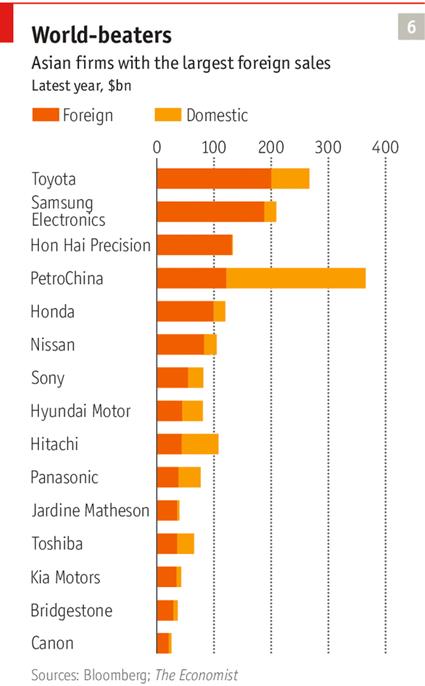
FUJIO MITARAI KNOWS more than most people about building a multinational. He is the 78-year-old boss of Canon, one of Japan’s biggest firms. Worth $43 billion, it makes everything from scanners to lenses for Hollywood. It first opened a New York office back in 1955, but breaking into America took 20 years of hard slog and an Apple-style innovation. In 1976 the company launched a cheap, automatic single-lens-reflex camera on the back of a massive advertising campaign. Mr Mitarai was in charge and the memory still makes him smile. “Our competitors thought I’d gone crazy.” Canon became America’s biggest camera firm. Today it faces competition from smartphones and low-cost rivals. Mr Mitarai insists innovation will keep the firm ahead of the pack. It is developing a raft of new products, from surveillance cameras to virtual-reality design studios and 3D printing materials. Read more of this post

Hutchison Whampoa: Now for the fat-cow years; Lessons in survival from an Asian corporate legend

Hutchison Whampoa: Now for the fat-cow years; Lessons in survival from an Asian corporate legend

May 31st 2014 | From the print edition

IF YOU WANT to hear some plain talk on the relative merits of family-controlled conglomerates, listen to Canning Fok, managing director of Hutchison Whampoa, one of the region’s biggest specimens with a value of $60 billion and a worldwide empire of ports, energy, property, telecoms and retail. “There’s a school of thought in America that widely held companies have better governance,” he says. “But if you look over the last ten years that has not happened. Just look at the big banks and all the chief executives going crazy.” Read more of this post

Get up and dance: China Mobile, a state-owned giant, is having to reinvent itself

Get up and dance: China Mobile, a state-owned giant, is having to reinvent itself

May 31st 2014 | From the print edition

THROUGH THE SMOG in Beijing’s Financial Street you can see the glass-and-steel headquarters of many of China’s giant state-owned-enterprises (SOEs). The flash buildings are a statement of might, but inside them the mood is more of anxious self-reinvention. Most SOEs are in fast-changing industries, and since last year China’s government has made clear that it wants them to become more market-orientated and more competitive. As a result, some of these organisations now face the largest transformation in corporate history. Read more of this post

Governance: Avoiding the dinosaur trap; State firms and family conglomerates are Asia’s favourite kinds of companies. Both must change

Governance: Avoiding the dinosaur trap; State firms and family conglomerates are Asia’s favourite kinds of companies. Both must change

May 31st 2014 | From the print edition

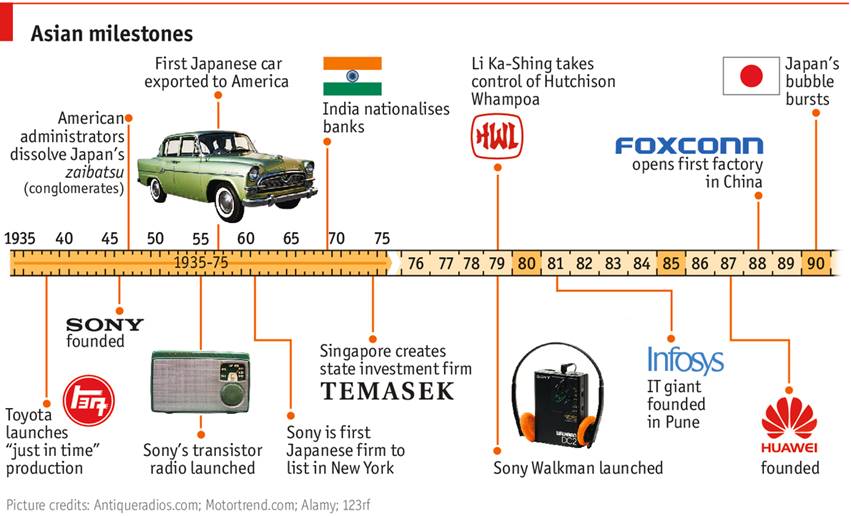
ASIA IS A land never conquered by institutional shareholders. Only 28% of the region’s stockmarket consists of firms with diverse owners (see chart 4). Most of these are in Japan, where businesses are controlled by managers and employees who by long-established protocol politely listen to and then ignore what fund managers say. State-run firms make up 40% of Asia’s total and family-run firms, often conglomerates or “business houses”, account for 27%. The proportions vary from country to country (see chart 5). In China state-run firms dominate, whereas in South Korea and India business houses are prominent. All this has been true for a long time and it is tempting to think it will never change. That would be a mistake.

image001-2 image002-2 Read more of this post

How to keep roaring: Over the past two decades Asia’s companies have enjoyed huge success. But now they need to reform to become brainier, nimbler and more global

How to keep roaring: Over the past two decades Asia’s companies have enjoyed huge success. But now they need to reform to become brainier, nimbler and more global, says Patrick Foulis

May 31st 2014 | From the print edition

image001 Read more of this post

Convergence: Asian and Western business will become more alike

Convergence: Asian and Western business will become more alike

May 31st 2014 | From the print edition

ASIA PROSPERED OVER the past two decades by following a different economic model from the West’s. But if it wants to continue to do well over the next 20 years, it will have to reform. What that involves will vary from place to place. Myanmar, a big country with a difficult past, is beginning to pull itself out of the mire. India and Indonesia, two chaotic democracies, have to create enough order to attract factories and industrial jobs. In China the government needs to ease its grip on the economy. Japan is embarking on the world’s biggest experiment to see whether a society can shrink and still remain prosperous. Read more of this post

Megatrends Q & Asia: A handful of Asian conundrums the world’s boardrooms should chew over

Megatrends Q & Asia: A handful of Asian conundrums the world’s boardrooms should chew over

May 31st 2014 | From the print edition

OVER THE PAST decade innumerable PowerPoint presentations have condensed Asia into two bullet points. One is its rise as a vast consumer market. About 30% of the world’s middle-class spending is done by Asians, up from 20% in 2000, according to the Brookings Institution, a think-tank, which defines the middle class as those earning $10-100 a day at purchasing-power parity. The other is Asia as a production hub: 47% of world manufacturing is now in the region. But the world’s boardrooms have started to grapple with a much broader set of questions about Asia. The most immediate ones are higher labour costs and ageing populations, growing consumer expectations and the way the internet will affect business there. A rising risk of hostilities in the region is adding further complexity. And in the background looms the broader issue of whether, and if so how much, Asian companies need to globalise (which will be dealt with later in this special report). Read more of this post

High-dividend-paying stocks tend to outperform all other equities during long time horizons, but they are the worst performers when interest rates increase

Dividends Great for Long Term, but Beware Rising Rates

High-dividend-paying stocks tend to outperform all other equities during long time horizons, but they are the worst performers when interest rates increase.

By Timothy Strauts | 05-29-2014 10:00 AM

Tim Strauts: Today we’re going to look at how dividend stocks have performed in different interest-rate periods. In this chart, you can see we’ve broken up the equity universe into four buckets. The highest 30% bucket is the 30% of stocks with the highest dividend yield, going all the way down to the no-dividend bucket of companies that pay no dividends. Read more of this post

Indonesia: A True Tiger?

Indonesia: A True Tiger?

CONTRIBUTOR YOUR SAY  JUN. 3, 2014, 10:40 AM

The complexity of Indonesia’s culture is perhaps only outmatched by its economic and political workings.  This is a country and people with a history of battling colonialism, erupting in constant turmoil and political unrest.  Its democracy is a fairly young 15 years.  While Indonesia portrays itself to have a stable democracy, the tenseness surrounding the presidential elections this year tells a widely different story.  Political and economic “games” erupt, for which corruption is the most common explanation.  Corruption almost seems to be a way of life here in Jakarta, as it is acknowledged constantly in conflicts, with heads nodding in understanding and then dismissal, as “that is just the way it is.” Read more of this post

Forget artisan bread and A2 Milk: Woolworths’ latest assault on ¬Australia’s wealthiest shoppers includes walk-in cheese rooms, a ¬gourmet pizza bar and resident chefs ready to dole out tips on their favourite recipes

Samantha Hutchinson Reporter

Woolworths Double Bay: it’s Woolies for the Prada set

Published 02 June 2014 10:03, Updated 03 June 2014 09:26

image001-3

Woolworths state manager Danny Baldwin at the new Double Bay store. Photo: Louise Kennerley

Forget artisan bread and A2 Milk: Woolworths’ latest assault on ­Australia’s wealthiest shoppers includes walk-in cheese rooms, a ­gourmet pizza bar and resident chefs ready to dole out tips on their favourite recipes. Read more of this post

Jump in shareholder activism to hit Australian companies

Jump in shareholder activism to hit Australian companies

Published 29 May 2014 14:49, Updated 30 May 2014 11:17

Joyce Moullakis

Australian boards should brace for an uptick in shareholder activism, as lawyers and bankers urge preparedness and engagement with activists and proxy firms to navigate a typically disruptive process. Read more of this post

Internet minnows struggle in China’s cramped smartphone market

Internet minnows struggle in China’s cramped smartphone market

Staff Reporter

2014-06-03

Encouraged by the extraordinary success of Chinese budget smartphone maker Xiaomi, a number of internet firms in the country muscled into the market in the first half this year only to find themselves stuck without room to grow, reports Guanzgzhou’s 21st Century Business Herald. Read more of this post

Realty brokers in China may step up promotions amid slump

Realty brokers in China may step up promotions amid slump

Staff Reporter

2014-06-03

The prices of newly built houses in 100 Chinese cities averaged 10,978 yuan (US$1,757) per square meter in May this year, according to a report published by the China Index Academy, a major property research institute in China.

The figure represented a drop of 0.32% from the previous month, and the first drop in 23 months after June 2012. The report also indicated that among the 100 cities, prices in 37 rose from the previous month, while they dropped in 62. The prices only remained stable in one city. Read more of this post

Why do China’s biggest internet firms go public in the US? In the VIE structure, if the company goes bankrupt foreign investors can’t access the company’s assets in China

Why do China’s biggest internet firms go public in the US?

Staff Reporter

2014-06-03

Shopping website Jingdong Mall (JD.com) has become China’s third-largest internet firm to do go public on the Nasdaq in the United States after Tencent Holdings and Baidu amid a wave of listings by Chinese internet companies in the US, the People’s Daily Overseas Edition reports. Read more of this post

Asustek unveils world’s first 5-in-1 laptop at Taipei Computex

Asustek unveils world’s first 5-in-1 laptop at Taipei Computex

CNA and Staff Reporter

image001-1

2014-06-03

Taiwan-based PC maker Asustek unveiled Monday a line of new products at this year’s Computex Taipei computer trade show, with a converged notebook that enables five modes across the Windows and Android platforms given pride of place.

The Transformer Book V is a 12.5-inch tablet combined with a detachable keyboard dock and a 5-inch smartphone. Based on different usage scenarios, the device, which supports dual operating systems, can transform into a Windows laptop, a Windows tablet, an Android laptop, an Android tablet, or an Android smartphone. Read more of this post

Samsung’s ownership transfer to speed up with IPO

Samsung’s ownership transfer to speed up with IPO

SEOUL, June 3 (Xinhua) — Ownership transfer of Samsung Group, South Korea’s largest conglomerate, is expected to speed up as plans to list its de facto holding company will help the heir apparent secure funds to take control of the group’s affiliates.

Samsung Everland, the group’s de facto holding company, held a board of directors’ meeting Tuesday, deciding to make the amusement park operator go public by the first quarter of next year. Read more of this post

China grappling with garbage woes; urban trash now encloses more than two-thirds of the nation’s cities, with a quarter of them having exhausted space for refuse landfills and dumping grounds

China grappling with garbage woes

Li Shu-liang and Staff Reporter

2014-06-03

With accelerating urbanization in China, urban trash now encloses more than two-thirds of the nation’s cities, with a quarter of them having exhausted space for refuse landfills and dumping grounds, reports the China News Service.

At present, a total of 500 million square meters of urban land in China is occupied by dumps, which results in an economic loss of 30 billion yuan (US$4.76 billion) a year. Read more of this post

Urgent need for reforming Taobao’s judicial sales; The land use rights for a piece of national land in Kunshan has gone up for a starting price of 325 million yuan (US$52 million)

Urgent need for reforming Taobao’s judicial sales

Staff Reporter

2014-06-03

On May 23, the most expensive item on Taobao — Alibaba’s biggest website for online shopping — made its debut. The land use rights for a piece of national land in Kunshan, Jiangsu province, has gone up for a starting price of 325 million yuan (US$52 million). Read more of this post

China’s top express delivery service SF Express has stirred up the e-commerce market by setting up a chain of stores, where customers can place online orders or pick up the items they purchase online

SF Express chain stores stir up China’s e-commerce market

Li Tao-cheng and Staff Reporter

image001

2014-06-03

China’s top express delivery service SF Express has stirred up the e-commerce market by setting up a chain of stores, where customers can place online orders or pick up the items they purchase online.

Following the launch of its first Heike store in May, the chain has already opened a total of 18 outlets in Shanghai, with a target to increase the number to 400 by the end of this year. Read more of this post

China will replace Google’s Android and Apple’s iOS with its own localized smartphone operating system within the next three to five years?

China to develop localized smartphone OS in 3-5 years: academic

Staff Reporter

2014-06-02

China will replace Google’s Android and Apple’s iOS with its own localized smartphone operating system within the next three to five years, says a Chinese academic. Read more of this post

For Chinese Online Giants, All the Web’s a Stage: Baidu, Alibaba and Tencent have set sights on the entertainment industry as the Internet’s next frontier

06.02.2014 11:44

For Online Giants, All the Web’s a Stage

Baidu, Alibaba and Tencent have set sights on the entertainment industry as the Internet’s next frontier

By staff reporters Liu Ran and Qu Yunxu

When Tencent Holdings signed a contract with novelist and Nobel laureate Mo Yan in 2013, the Internet and messaging services provider raised the stakes in a race to dominate China’s online entertainment market. Read more of this post

Surviving Tiananmen: On the 25th anniversary of the Tiananmen Square massacre, two questions stand out: How has the CCP survived the last quarter-century, and can it endure for another

MINXIN PEI

Minxin Pei is Professor of Government at Claremont McKenna College and a non-resident senior fellow at the German Marshall Fund of the United States.

MAY 26, 2014

Surviving Tiananmen

HONG KONG – It may be hard to imagine, but 25 years ago, the Chinese Communist Party (CCP) was nearly toppled by a nationwide pro-democracy movement. It was the late paramount leader Deng Xiaoping’s steely nerves and the tanks of the People’s Liberation Army – dispatched to enforce martial law and suppress the protests in Beijing’s Tiananmen Square – that enabled the regime, at the cost of several hundred civilian lives, to avoid collapse. Read more of this post

Navigating a Post-Samsung Era; What would happen to South Korea’s economy if its largest conglomerate were to fail?

Navigating a Post-Samsung Era

JUNE 2, 2014

Young-Ha Kim

SEOUL, South Korea — On May 10, the chairman of the Samsung Group, Lee Kun-hee, had a heart attack and stopped breathing. He was resuscitated at the hospital but remained in a coma for more than two weeks. As the country waited for information about his condition, rumors ran rampant. One of the most widely circulated was that Mr. Lee, 72, had already died and Samsung was covering it up. Read more of this post

Grisly Murders Highlight Social Strains in Modi’s India

Grisly Murders Highlight Social Strains in Modi’s India

By Sruthi Gottipati on 02:42 pm Jun 02, 2014

Katra Shahadatganj, India. When a farm laborer in this hardscrabble village in northern India went to the police last week to report that his daughter and her cousin had gone missing, a constable slapped him in the face and sent him away.

Hours later he found the two girls, hanging by their necks from a mango tree. A post-mortem found they had been raped. Read more of this post