Higher Swiss Leverage Ratio Could Mean End of Universal Bank

Higher Swiss Leverage Ratio Could Mean End of Universal Bank

Swiss Finance Minister Eveline Widmer-Schlumpf said lenders including UBS AG (UBSN) and Credit Suisse Group AG (CSGN) may have to pull out of investment banking as she called for their leverage ratios to be raised. “Banks would have to consider whether to carry on with investment banking or focus even more on asset management,” Widmer-Schlumpf was quoted as saying in an interview with Schweiz am Sonntag. Banks “must be organized in such a way that the state isn’t ultimately held liable.” Read more of this post
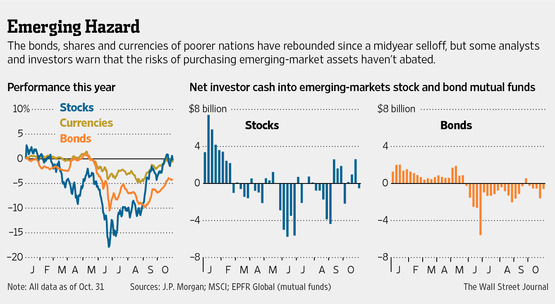
Emerging-Stock Rally Raises Concern; Some Analysts Expect a Volatile Time; Avoiding the ‘Fragile Five’: India, Brazil, Turkey, Indonesia and South Africa

Emerging-Stock Rally Raises Concern

Some Analysts Expect a Volatile Time; Avoiding the ‘Fragile Five’

E.S. BROWNING

Nov. 3, 2013 3:20 p.m. ET

MI-BZ445_ABREAS_G_20131103171504

Investors have rediscovered developing countries, sending their stocks up 16%, as a group, since late June. A growing number of analysts who follow these countries, known in the trade as emerging markets, find that troubling. Their message: Proceed at your own risk. Emerging markets are exciting to investors because for much of the past decade, EM stocks and bonds delivered the big gains. Many investors still are nervous about U.S. stocks, even though many major U.S. indexes are in or near record territory. Read more of this post

Dutch government is planning to sell all $12 billion of the US mortgage bonds acquired during the 2009 bailout of ING as prices of the securities soared, more than doubling in some cases from lows that year

Dutch Gamble on U.S. Housing Debt After Patience Wins

The Dutch government’s decision to hold onto U.S. mortgage debt acquired during the 2009 bailout of ING Groep NV (INGA) has paid off so far as prices of the securities soared, more than doubling in some cases from lows that year. The nation now is planning to sell all $12 billion of the bonds, many of which are tied to borrowers who were deemed more risky after failing to document their incomes or taking on mortgages with growing balances. ING, the Netherlands’ biggest financial-services company, said last week the current market value of the bonds is about 71 percent of the face amount. The government may see a gain of almost 800 million euros ($1.1 billion), Finance Minister Jeroen Dijsselbloem told Parliament. Read more of this post

Big finance is a problem, not an industry to be nurtured; To bring down our debt levels, we cannot avoid shrinking the financial sector

November 3, 2013 5:23 pm

Big finance is a problem, not an industry to be nurtured

By Dirk Bezemer

To bring down our debt levels, we cannot avoid shrinking the financial sector, says Dirk Bezemer

Many western economies have both large financial sectors and exorbitant private debt-to-output ratios. This is no coincidence. Each loan is a debt, so a large financial sector implies high debt levels. For example, in the mid-1980s, loans by UK banks to UK companies and households were less than a quarter of gross domestic product; today they amount to 130 per cent. Add non-bank borrowing to that, and total private debt today stands at well over twice UK GDP. Read more of this post

Stratospheric Views, and Prices; Hard as it may be to believe, the price per square foot for luxury apartments in New York City is considerably less than it is for luxury elsewhere in the world

November 3, 2013

Stratospheric Views, and Prices

By JULIE CRESWELL

Walking slowly to the windows facing the meadow of green that is Central Park, Gary Barnett slips into salesman mode as he spreads his arms wide, embracing the sweeping bird’s-eye view he has from the 87th floor of his shimmering skyscraper in Midtown Manhattan. Noting a visitor’s gasp at the stunning vista, he smiles. “That’s what we want. We want the ‘Oh, wow,’ ” he says. Read more of this post

Shopping Mall Giant Westfield Group Focuses on U.S., U.K., Cautious on China

Westfield Group’s Retail Therapy

Shopping Mall Operator Focuses on U.S., U.K., Cautious on China

ROSS KELLY

Nov. 3, 2013 8:29 p.m. ET

Westfield GroupWDC.AU +0.46% one of the world’s largest shopping mall operators by revenue, is all about attracting big spenders. From Prada and Gucci to high-end restaurants, its malls cater to customers who are willing to pay for prized goods. So it may be surprising that Peter Lowy, the company’s joint chief executive, takes a cautious approach to investment. Despite a balance sheet bolstered by more than $6 billion from asset sales since the start of 2012, Westfield has resisted risky expansions into emerging markets like China. For now, it has no plans to join the rush of luxury brands and main-street retailers vying for the favor of Asia’s increasingly affluent middle classes. Read more of this post

The Fed is locked in a QE prison of its own making; US policymakers are caught in a trap – a seemingly inescapable dilemma that stems directly from the massive scale of QE

The Fed is locked in a QE prison of its own making

US policymakers are caught in a trap – a seemingly inescapable dilemma that stems directly from the massive scale of QE

Last Wednesday, at its monthly meeting, the Fed’s monetary committee voted to keep QE going – ordering the purchase of another $40bn of mortgage-backed securities and another $45bn of Treasuries, so $85bn in total. Photo: AP

By Liam Halligan, Economic Agenda

6:30PM GMT 02 Nov 2013

Back in the spring, Ben Bernanke told the world that “tapering” would start “later this year”. The Federal Reserve Chairman was indicating, in other words, that America’s central bank would start to wind-down its $85bn-a-month money-printing habit by the end of 2013. Such an outcome now looks increasingly unlikely. My view, in fact, is that the Fed, could soon unleash more, not less, quantitative easing – ramping up the policy rather than tapering. Such an outcome, were it to happen, would be incredibly risky. Speeding up monetary stimulation, rather than slowing it down, could spook financial markets – and even cause a panic. Yet in recent weeks, I’ve heard several well-placed economists and policymakers, especially in the US, start to contemplate such action. Read more of this post

How China Profits From Our Junk

How China Profits From Our Junk

By Adam Minter

China’s reputation as the “world’s factory” is well-established. But what happens to everything the world throws away? Since 2002, the Shanghai-based journalist Adam Minter has sought to find out. The son and grandson of scrap metalists, Minter traveled throughout the world to investigate how what we discard—and reuse—helps drive the global economy. Minter, who has written for a variety of publications (including both the print and digital versions ofThe Atlantic), now writes a weekly column on China for Bloomberg. In this excerpt from his forthcoming book Junkyard Planet, which will be published by Bloomsbury Press on November 12,  Minter travels to the epicenter of the global scrape trade: southern China. Read more of this post

Less sin, more shrek in Macau as China takes aim in corruption fight

Updated: Monday November 4, 2013 MYT 7:39:41 AM

Less sin, more shrek in Macau as China takes aim in corruption fight

MACAU: The media scrum surrounding the politically connected chairman of a Chinese financial services company was interested in one particular unpaid loan. The amount – $1.3 million (816,224 pounds) – was nothing extraordinary. But the story behind it was. Xie Xiaoqing, chairman of Rongzhong Group, was sued in January for failing to repay the money to Sands China Ltd, U.S. billionaire Sheldon Adelson’s Macau gambling unit. Xie has said he wasn’t gambling and the money was for a friend. A spokesman for his company said Xie was not available to comment. Read more of this post

Xi Borrows From Mao Playbook in Power Play Ahead of China Plenum

Xi Borrows From Mao Playbook in Power Play Ahead of China Plenum

The mission for the near-dozen Communists sitting round a table at a Beijing ministry was explicit: criticize their boss, who was present. Party cadres carefully recorded their comments as they spoke, in an echo of sessions held decades ago under Chairman Mao Zedong’s direction. “Every party member, every division chief, each department head and the ministers have to go through it,” said 31-year-old Tang, who participated in the September gathering and asked to withhold his full name and work unit because he isn’t authorized to talk to reporters. “There are clear instructions that criticism must be genuine. For instance, you can’t say ‘Oh, you have worked too hard and should take more breaks.’” Read more of this post

Hong Kong luxury home buyers queue amid talk of last hurrah

Hong Kong luxury home buyers queue amid talk of last hurrah

4:04pm EST

By Yimou Lee and Alice Woodhouse

HONG KONG (Reuters) – In a shopping mall in one of Hong Kong’s prime retail districts, more than 100 people wait patiently to take a lift to the sales floors – not to buy luxury bags or clothes, but high-end apartments with price tags of up to $4.4 million. Foster Lee, a 30-year-old banker, was among the lucky ones who won the chance to buy a unit after a ballot in which more than 1,600 people signed up for just 80 luxury units on offer. Read more of this post

Could fracking boom peter out sooner than DOE expects?

Could fracking boom peter out sooner than DOE expects?

Wendy Koch, USA TODAY10:46 a.m. EST November 3, 2013

The future of the U.S. fossil fuel industry rests largely on fracking, which has brought a surge in oil and gas production. Energy experts disagree, though, on how long this boom will last.

STORY HIGHLIGHTS

Fracking has led to a surge in U.S. oil and gas production

Yet energy experts disagree about how long this shale boom will last

The U.S. government cites uncertainties in its own mixed forecast

Surging oil and gas production is nudging the nation closer to energy independence. But new research suggests the boom could peter out long before the United States reaches this decades-old goal. Many wells behind the energy gush are quickly losing productivity, and some areas could hit peak levels sooner than the U.S. government expects, according to analyses presented last week at a Geological Society of America meeting in Denver. Read more of this post

Big Oil’s Tricky Mix of Shale and Scale

Big Oil’s Tricky Mix of Shale and Scale–Heard on the Street

Size Isn’t an Advantage in the Shale Patch

LIAM DENNING

Nov. 3, 2013 3:32 p.m. ET

MI-BZ455_SHALEH_NS_20131103172704

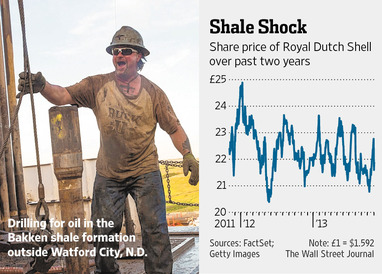
If you are going to be big, you have to make it work for you. The problem for Big Oil is that one of the world’s biggest opportunities, shale, doesn’t necessarily reward bigness. Royal Dutch Shell‘s RDSB.LN +1.39% partial retreat from U.S. shale this year suggests it overreached as it scooped up assets there. Latecomers always risk getting the crumbs after first-movers have picked up the choice cuts. But there also is a structural problem confronting Big Oil. Read more of this post

India throws rings of protection around divisive candidate Modi

India throws rings of protection around divisive candidate Modi

4:10pm EST

By Sanjeev Miglani

NEW DELHI (Reuters) – – Indian security forces are preparing for one of their most challenging assignments in decades, protecting prime ministerial candidate Narendra Modi in a country with a grim history of political assassinations. A series of small bombs killed six people at a rally the Hindu nationalist leader held in the city of Patna on October 20. Read more of this post

Apollo Tyre says problems reaching a deal with Cooper’s U.S. labor union and a lack of information about a Cooper JV in China have made it impossible to raise the more than $2 billion in debt it needs to close the deal

Cooper Tire, Apollo Tyre Head to Court

With Deal in Limbo, Debate is Over Problems Reaching Labor Contract

LIZ HOFFMAN

Updated Nov. 3, 2013 7:15 p.m. ET

A $2.2 billion takeover of Cooper Tire & Rubber Co. CTB -0.31% is on the skids. Whether it closes—and at what price—may hinge on a judge’s interpretation of one of the fuzziest deal terms around. India’s Apollo Tyre Ltd. agreed in June to buy Cooper Tire for $35 a share. Cooper’s shareholders approved the deal in September, teeing up an Oct. 4 closing date. But Apollo didn’t show up to close. Read more of this post

“Please bring back the old Tanah Abang”; SE Asia’s Top Textile Market Seeks to Clean Up Its Act

SE Asia’s Top Textile Market Seeks to Clean Up Its Act

By Agence France-Presse on 10:30 am November 3, 2013.
After years of being overrun by a racketeering mafia, drug addicts and prostitutes, Southeast Asia’s biggest textile market is cleaning up its act in an effort to win back droves of shoppers. Spread across several blocks in the Indonesian capital Jakarta, Tanah Abang market is a colourful whirl of activity that has attracted shoppers from across the region for centuries. While glittering skyscrapers have shot up around the city centre trading hub, the market itself, which was founded in 1735 by a Dutch businessman, is a series of modest buildings in an area of traditional, red-tiled houses. Read more of this post

Singapore exchange mulls giving rebates to high-frequency traders after investing $250 million in HFT infrastructure

Some Indexers Grouse About ‘Smart Beta’ Approaches

Talk of improved index strategies riles some classic index investors

KAREN DAMATO and ARI I. WEINBERG

Nov. 3, 2013 4:16 p.m. ET

If you’re not “smart,” does that mean you’re “dumb?” That’s the question proponents of classic index investing are asking these days. Index funds aim to provide exposure to the performance—or beta—of any market. But now, new mutual and exchange-traded funds are billing themselves as “smart beta” funds, and some investors and advisers are upset. Their gripe: The term “smart beta” implies that older indexing varieties are, well, not so intelligent. Read more of this post

Universal Life Policies Hurt by Low-Rate Era

Universal Life Policies Hurt by Low-Rate Era

LESLIE SCISM

Nov. 3, 2013 6:38 p.m. ET

MI-BZ456_LIFE_NS_20131103161203

CEDAR RAPIDS, Iowa—About 20 years ago, Steven and Joanne Carfrae, then-owners of a meat-packing plant here, took out a “universal life” insurance policy, naming local charities to receive the future $2 million in proceeds. To their dismay, the couple recently faced a stark choice: put up tens of thousands of dollars to keep the policy alive at its existing face value or reduce the death benefit sharply. They went the latter route and now have a $658,000 policy—meaning their favorite causes will receive $1.3 million less than planned. Read more of this post

Great Investors’ Best Ideas Conference Notes 2013; Notes From Excellence in Investing San Francisco 2013

Thursday, October 31, 2013

Great Investors’ Best Ideas Conference Notes 2013: Price, Akre, Gabelli, Pickens, Russo & More

Below are some brief notes from the 7th annual Great Investors’ Best Ideas Conference in Dallas benefiting the Michael J. Fox Foundation for Parkinson’s Research and the Vickery Meadow Youth Development Foundation.
Notes From Great Investors’ Best Ideas Conference
Michael Price (MFP Investors): He pitched three ideas:  long Hospira (HSP), long Songbird Estates (SBD.LN) and long Dolby Labs (DLB).  HSP has seen value guys buying it, transitioning away from growth investors as the investor base changes.  The company has good free cash flow and he thinks the stock can hit $60.  His thesis on Songbird is a discount to NAV story (around 30%).  Dolby (DLB) has a ton of cash and no debt with huge royalty streams (80% of revenue).  As tablets and PCs continue to grow, they’ll make money. Read more of this post

Test Your Emerging-Markets IQ; Before taking the leap, fund investors should know the territory

Test Your Emerging-Markets IQ

Before taking the leap, fund investors should know the territory

CHANA R. SCHOENBERGER

Nov. 3, 2013 4:16 p.m. ET

As the world’s most advanced economies continue to sputter, investors looking for a brighter picture continue to turn to emerging markets, which are growing faster. How much do you know about emerging markets? Find out by taking this emerging-markets quiz. Investing in these countries can carry significant risks. Political turmoil, uncertain legal systems that may not favor foreign investors, and currency risk are all possible pitfalls. The payoff is a potential for higher returns as these economies expand. Many of these countries have a growing middle class that is clamoring increasingly for consumer goods. Some are also benefiting from high rates of infrastructure spending and from natural resources. Read more of this post

In China’s Xinjiang, poverty, exclusion are greater threat than Islam

In China’s Xinjiang, poverty, exclusion are greater threat than Islam

4:16pm EST

By Michael Martina

URUMQI, China (Reuters) – In the dirty backstreets of the Uighur old quarter of Xinjiang’s capital Urumqi in China’s far west, Abuduwahapu frowns when asked what he thinks is the root cause of the region’s festering problem with violence and unrest. “The Han Chinese don’t have faith, and the Uighurs do. So they don’t really understand each other,” he said, referring to the Muslim religion the Turkic-speaking Uighur people follow, in contrast to the official atheism of the ruling Communist Party. Read more of this post

Emerging Markets Come to Growth Pivot Point; Whether the growth slowdown in emerging markets is cyclical or structural, one thing is certain: Deeper overhauls are a must if a prolonged downturn is to be avoided at all

Emerging Markets Come to Growth Pivot Point

Slump in Developing Nations’ Economies Could Be Cyclical or Due to Structural Problems

TOM WRIGHT

Updated Nov. 3, 2013 7:53 p.m. ET

Is the slowing growth in emerging markets from China to Turkey to Brazil a temporary blip or a harbinger of worse to come? For much of the past decade, these emerging economies expanded swiftly as people shifted from farms to more-productive urban jobs. They bounced back strongly after the global recession as large monetary and fiscal stimulus spending by China and other developing nations helped offset a drop in U.S. demand. The Federal Reserve further bolstered their growth story when it poured cheap credit into these markets by printing money to boost the U.S. economy. Read more of this post

If you’re not “smart,” does that mean you’re “dumb?” Some Indexers Grouse About ‘Smart Beta’ Approaches; Talk of improved index strategies riles some classic index investors

Some Indexers Grouse About ‘Smart Beta’ Approaches

Talk of improved index strategies riles some classic index investors

KAREN DAMATO and ARI I. WEINBERG

Nov. 3, 2013 4:16 p.m. ET

If you’re not “smart,” does that mean you’re “dumb?” That’s the question proponents of classic index investing are asking these days. Index funds aim to provide exposure to the performance—or beta—of any market. But now, new mutual and exchange-traded funds are billing themselves as “smart beta” funds, and some investors and advisers are upset. Their gripe: The term “smart beta” implies that older indexing varieties are, well, not so intelligent. Read more of this post

Fed Gives Banks New Dire Scenarios for 2014 Stress Tests

Fed Gives Banks New Dire Scenarios for 2014 Stress Tests

Lenders including JPMorgan Chase & Co. (JPM) and Citigroup Inc. (C) will have to show they can survive the demise of a trading partner or a plunge in value of high-risk business loans in the 2014 version of U.S. stress tests. The scenarios for the annual tests, outlined by the Federal Reserve in a statement yesterday, reflect some of the most pressing threats seen by regulators as they gauge the ability of the U.S. financial system to withstand economic shocks. Bankers will have to show what would happen to the value of leveraged loans they hold, the impact of another housing bust and how they’d fare if a firm that owes them substantial sums collapses. Read more of this post

Dirty Money: Will Singapore Clean Up Its Act? Singapore has become an increasingly popular haven for money laundering and tax evasion. Can it be both a home for fortune hunters and a bastion of integrity?

11/01/2013 06:59 PM

Dirty Money: Will Singapore Clean Up Its Act?

By Martin Hesse

Singapore has become an increasingly popular haven for money laundering and tax evasion. But now it faces calls for reform and a difficult dilemma: Can it be both a home for fortune hunters and a bastion of integrity?

A yellowish-brown fog has settled in the urban canyons of Singapore’s financial district. From a skyscraper high above the harbor, you can hardly make out the endless rows of containers in the port terminals. A cloud of smog locally referred to as the “haze” — caused by the slash-and-burn farming methods of the palm oil barons in neighboring Indonesia — regularly darkens the skies of the wealthy city-state of Singapore, at the southern tip of the Malaysian Peninsula. But the air has never been as bad as it is now. Read more of this post

Sears’ CEO and billionaire hedge fund manager Eddie Lampert: “I’d like to go faster. I’d like to go bigger. We’re just not making money, which makes it much, much harder to fund the transformation.”

November 2, 2013

At Sears, Those Big Losses Get in the Way

By GRETCHEN MORGENSON

“I’d like to go faster. I’d like to go bigger. We’re just not making money, which makes it much, much harder to fund the transformation.” That’s Edward S. Lampert, the chairman and chief executive of Sears Holdings, speaking last Friday about what lies ahead for this embattled retailing giant, which he put together in 2005 and now oversees. Earlier in the week, the company had announced a possible spin-off of a prized asset — the trusted online retailer Lands’ End. Together with another spin-off, of Sears Auto Centers, the company could “accelerate our transformation into a leading integrated retailer,” it said. Read more of this post

Veteran investor Donald A. Yacktman finds much to like in Coke, Pepsi, and P&G which he views as bargains

SATURDAY, NOVEMBER 2, 2013

Why Three Big Stocks Look Like Bargains

By LAWRENCE C. STRAUSS | MORE ARTICLES BY AUTHOR

Veteran investor Donald A. Yacktman finds much to like in Coke, Pepsi, and P&G which he views as bargains.

Donald A. Yacktman is regarded as an insightful investor with a keen analytical mind, as his long-term results attest. The Yacktman Fund (ticker: YACKX) has a 15-year annual return of 10.62%, besting 99% of its peers in Morningstar’s large-cap blend category. Yacktman and his team hew to a buy-and-hold approach, content to hold stocks for years. Annual turnover averages about 20%. The fund’s top 10 holdings account for about 50% of assets. Yacktman, 72, who is president of Yacktman Asset Management in Austin, Texas, oversees nearly $30 billion of assets. To find out about a few of his holdings and his sense of where the markets stand, Barron’s caught up with him recently by telephone. Read more of this post

The Dangers of a Stock Market Melt-Up; Though a steadfast market bull, a strategist worries about investors’ nonchalant attitude toward ever-rising stocks

November 2, 2013

The Dangers of a Stock Market Melt-Up

By JEFF SOMMER

Investors aren’t worrying much about the stock market, and that worries Edward Yardeni.

It’s not that Mr. Yardeni, an independent economist and strategist, has a gloomy outlook on the market himself. To the contrary, he’s been generally optimistic about the prospects for stocks for about five years, and he remains so. “We’re in a bull market, and I think it can continue for the next few years,” he said in an interview last week. But what’s striking about his perspective is that while he remains a steadfast market bull, he finds himself increasingly preoccupied by a cloud on the horizon: the growing complacency of his fellow investors. Read more of this post

From food coupons to Taobao: China through Arab eyes

From food coupons to Taobao: China through Arab eyes

BEIJING, Nov. 2 (Xinhua) — Before Mustapha Al-Saphariny left Palestine to come to China, he had heard that “China has many people, so many that you could barely walk on the street.” Now the venerable gentleman is over sixty, and occupies an enviable 350sq. meter duplex near the Olympic Park in Beijing. “When I first came to China, I never dreamed of owning such a beautiful apartment as this,” he said. “Reform and opening-up after 1978 brought earth-shaking changes.”

Read more of this post

China’s smoggy days at 52-year high

China’s smoggy days at 52-year high

2013-11-02 00:59:32 GMT2013-11-02 08:59:32(Beijing Time)  Xinhua English

eca86bd9d54313dde9e508

A pupil goes to school wearing a mask amid smog in Jinan, East China’s Shandong province, Oct 29

The 31 provincial-level regions on China’s mainland have reported 4.7 smoggy days on average so far this year, the highest number since 1961, a meteorologist with the China Meteorological Administration (CMA) said on Friday. Chen Zhenlin, head of the Department of Emergency Response, Disaster Mitigation and Public Services under the CMA, told reporters that the number was 2.3 days higher than that of the same period in ordinary years. Read more of this post