MSCI Puts ISS on Block amid Proxy Firm Headwinds

October 31, 2013, 6:09 PM ET

MSCI Puts ISS on Block amid Proxy Firm Headwinds

CFO Report Editor, WSJ Pro

This article was originally posted on our sister blog, Risk & Compliance Journal.

By Gregory J. Millman

MSCI Inc. announced in its third quarter earnings release that it was exploring strategic alternatives for its influential proxy advisor and governance-services provider ISS. The announcement comes as the proxy advisory business is facing regulatory scrutiny, market headwinds, and questions about the validity of its analytical models. The announcement quoted Henry A Fernandez, chairman and chief executive of MSCI, saying of ISS that,  “Over the past three years, MSCI has worked hard to return that business to a growth track.” Mr. Fernandez further said, “the Governance business reported organic revenue growth of 7% and Adjusted [earnings before interest, tax, depreciation and amortization] growth of 12%. We believe the time is right to explore our strategic alternatives.” A spokesman for ISS declined to comment beyond the release.


FedEx and UPS have turned Memphis and Louisville into “aerotropolises”

FedEx and UPS have turned Memphis and Louisville into “aerotropolises”

Nov 2nd 2013 | MEMPHIS |From the print edition

AFTER most Memphians have gone to bed and before they switch on their coffee-makers, around 150 jets land at Memphis International Airport and take off again. They have no passengers—just stuff. A Boeing 777 jet may feel cramped to those sardined in coach class, but with all the seats and compartments stripped out it is immense—able to carry 225,000 pounds (102 tonnes) of cargo non-stop from Tennessee to Shanghai. Read more of this post

Fed’s Bubble Alarm Stuck on Snooze

Fed’s Bubble Alarm Stuck on Snooze

By Jonathan Weil  Oct 31, 2013

The Federal Reserve’s policy of unrestrained quantitative easing has worked like rocket fuel for U.S. stocks this year. Case in point:Rocket Fuel Inc. It’s the sort of company that probably couldn’t have done an initial public offering absent a raging bull market. Rocket Fuel says its business is “big data” and “artificial intelligence” (as opposed to real intelligence). Mainly, it helps advertising agencies place orders for online ad campaigns. Read more of this post

Chinese investors sour on Brazil

Updated: Friday November 1, 2013 MYT 3:03:00 PM

Chinese investors sour on Brazil

SAO PAULO: For Chinese investors, Brazil is no longer the promised land. After making a big push into the South American giant in search of raw materials such as iron ore, as well as a promising market for their consumer goods, Chinese executives have grown frustrated with stagnant economic growth, heavy costs and what they see as a political and popular backlash against their presence. As a result, Chinese investment is falling. As much as two-thirds of the roughly US$70bil in projects announced since 2007 is either on hold or has been cancelled, according to interviews with Chinese and Brazilian officials.

Read more of this post

Britain’s plans for a high-speed railway are deeply flawed. Spend the money on boring stuff instead

Britain’s plans for a high-speed railway are deeply flawed. Spend the money on boring stuff instead

Nov 2nd 2013 |From the print edition

THE Victorians did Britain a favour by building such a terrific railway network. A map of the country’s lines resembles a dense tangle of blood vessels, clotted around London, the West Midlands and the urban north-west. France’s, by contrast, looks like a lazy spider’s web. But the Victorians also bequeathed to their successors a powerful sense of inferiority. Surely the nation ought to be able to build like that again? Read more of this post

Britain runs towards nuclear energy as other countries flee

Britain runs towards nuclear energy as other countries flee

Oct 26th 2013 |From the print edition

20131026_BRC618

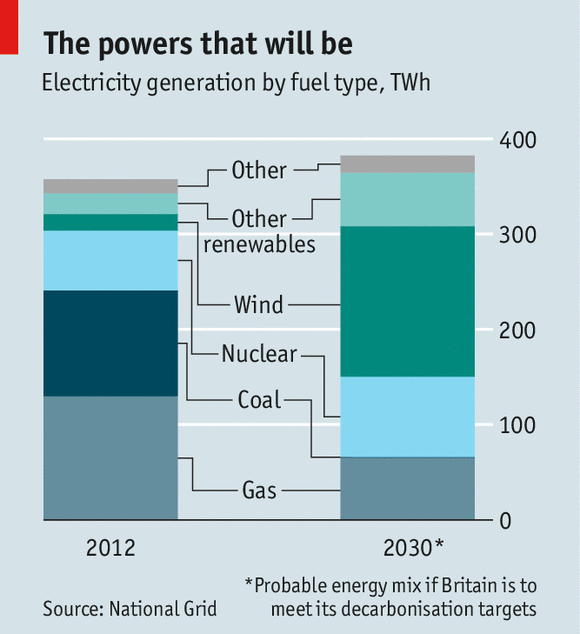
TOURING the muddy, unfinished site of Calder Hall, Britain’s first nuclear power station, in 1955, The Economist’s correspondent detected an “infectious, irresistible sense of excitement”. Some fear the flattened earth at Hinkley Point in Somerset, soon to host Britain’s first new reactors since 1995, will give way to a money pit. On October 21st the government said that a consortium led by EDF, a state-controlled French firm, has committed to building Hinkley C. To secure the £16 billion ($26 billion) construction costs, the government has promised EDF a price of £92.50 per megawatt hour for the power it generates—about twice the current wholesale price of electricity. Read more of this post

Hybrid corporate bonds: The rating game; The latest fashion in corporate borrowing has a familiar air

Hybrid corporate bonds: The rating game; The latest fashion in corporate borrowing has a familiar air

Nov 2nd 2013 |From the print edition

AS CORPORATE-BOND issuance has swelled in recent years, so have its more exotic offshoots. None is more exotic than “hybrid” bonds, of which €23 billion-worth ($32 billion) have been issued in Europe this year, according to Royal Bank of Scotland, more than doubling the size of the market. Banks have been issuing instruments called hybrid bonds for a while, most recently as part of the effort to strengthen their balance-sheets after the financial crisis. Investors in such issues will be “bailed in” (their debt converted into equity) if the bank gets into trouble. But corporate hybrid bonds are different—indeed they are rather odd creatures. Their main appeal is that they are treated by rating agencies as part-bond, part-equity; most recent issues have been classified as half-and-half. Read more of this post

Greek survivors of the crisis are those that move fast and think creatively

Survivors of the crisis are those that move fast and think creatively

Nov 2nd 2013 |From the print edition
APOSTOLOS KAISIDIS is thankful that in 2008, after nearly half a century dealing in cars, his family firm moved out of Thessaloniki, Greece’s second-largest city, to a cheaper place 50km away, and started repairing vehicles as well as selling them. If it hadn’t, “we would probably be bankrupt now,” he says. In crisis-ridden Greece, companies have had to adapt to survive. Read more of this post

Buffett’s $40 Billion Cash Pile Provides Acquisition Fuel

Buffett’s $40 Billion Cash Pile Provides Acquisition Fuel

Warren Buffett, who aims to have $20 billion in cash at his Berkshire Hathaway Inc. (BRK/A), isn’t investing fast enough to keep money from piling up. Berkshire will post a $4.3 billion third-quarter profit, according to an estimate from Barclays Plc, adding to a cash hoard of $35.7 billion at the end of June. Buffett also got back $4.4 billion this month that was lent to help Mars Inc. buy Wm. Wrigley Jr. Co. in 2008. Read more of this post

David Teoh: Untangling the start-up web of TPG’s reclusive billionaire and his family

Ben Hurley Reporter

David Teoh: Untangling the start-up web of TPG’s reclusive billionaire and his family

Published 30 October 2013 15:36, Updated 31 October 2013 01:27

4b5ed6e8-3d1f-11e3-ab36-6925a5387f6d_777013947--646x363

Evasive: David Teoh ducks the lens of BRW’s photographer. Photo: Nic Walker

He’s a self-made billionaire. He heads what could soon become the second-biggest privately-owned fixed line network in the country, and compete with the National Broadband Network. More recently his wife and four sons have pumped tens of millions of dollars into a vision to own disruptive start-up companies and incubators in every major capital city. And yet, hardly anybody in the start-up world seems to know Malaysian businessman David Teoh – the executive chairman of TPG Telecom – his Taiwan-born wife Vicky, and their four sons Shane, Jack, John and Bob. Read more of this post

Money mirage exposes emerging markets; The real problem for EM assets is illusion of abundant liquidity

October 31, 2013 8:45 am

Money mirage exposes emerging markets

By Gillian Tett

The real problem for EM assets is illusion of abundant liquidity

If a shock was to hit Brazil, India, Indonesia – or any other emerging market country – tomorrow, how would investors react? Would asset values adjust smoothly, amid an explosion of trading flows? Or would markets instead freeze up, as liquidity evaporated? It is not an academic question. Earlier this year, when investors started to speculate about an American “taper” – or wind-down from quantitative easing – this mere conjecture was enough to spark a dramatic gyration in the value of some emerging market assets, such as Indian or Brazilian equities. Read more of this post

Asia’s Rising Debt Brings Back Memories of 2007

October 31, 2013, 3:17 AM

Asia’s Rising Debt Brings Back Memories of 2007

NATASHA BRERETON-FUKUI

With debt levels rising across Asia in an era of easy money, many observers have asked if the region is facing a repeat of the 1997 Asian financial crisis. Perhaps a more relevant question is whether it’s 2007 all over again. A report this week by Standard & Poor’s Ratings Services notes similarities between Asia’s rising household debt – fueled by waves of cash unleashed by quantitative easing in the developed world — and the excessive private-sector borrowing that helped trigger the U.S. subprime mortgage crisis and a global recession. Read more of this post

Are China’s Banks Next?

Are China’s Banks Next?

Simon Johnson, a former chief economist of the IMF, is a professor at MIT Sloan, a senior fellow at the Peterson Institute for International Economics, and co-founder of a leading economics blog, The Baseline Scenario. He is the co-author, with James Kwak, ofWhite House Burning: The Founding Fathers, Our National Debt, and Why It Matters to You.

30 October 2013

WASHINGTON, DC – America’s recent bout of dysfunctional politics and the eurozone’s on-again, off-again crisis should, on the face of it, present a golden opportunity to China. To be sure, the malaise in the United States and Europe is likely to hurt Chinese exports; but, over the long term, China wants to reorient its economy toward domestic consumption. With the Tea Party wing of America’s Republican Party scaring investors out of the dollar, interest in the Chinese renminbi’s potential as an international reserve currency can only increase. Read more of this post

China GDP figures wrong by US$610bil: report

Updated: Wednesday October 30, 2013 MYT 5:51:58 PM

China GDP figures wrong by US$610bil: report

BEIJING: China’s economy would be at least 3.7 trillion yuan (US$610bil) bigger than Beijing thinks if the country’s local government statistics were to be believed, state media reported Wednesday. The Economic Information Daily tallied up gross domestic product (GDP) data from 28 of mainland China’s 31 provincial-level authorities, and arrived at 42.4 trillion yuan for the first nine months of the year. But the figure for the whole country, already announced by Beijing, is 3.7 trillion yuan lower. The discrepancy – which has been in place for more than two decades – has been widening rapidly in recent years, the Economic Information Daily said. Read more of this post

A different approach in design and marketing in the past decades has catapulted Pernod Ricard to its current leading position in the world’s liquor market

2013-10-30 16:44

Pernod Ricard rises on unique marketing

By Choi Kyong-ae

A different approach in design and marketing in the past decades has catapulted Pernod Ricard to its current leading position in the world’s liquor market.
Back in the 1980s, most advertisements took a similar form as they were manufactured based on customers’ daily lives but the French liquor company decided not to join the mainstream to sell its products. Read more of this post

Why you shouldn’t buy shares in Legoland owner Merlin Entertainment

Why you shouldn’t buy shares in Legoland owner Merlin Entertainment

Questor editor John Ficenec says investors should avoid buying shares in Merlin Entertainment when it floats

By John Ficenec, Questor editor

1:03PM GMT 30 Oct 2013

Merlin Entertainments, the owner of Alton Towers and Madame Tussauds, is launching its £3bn IPO. Will this be another Royal Mail and rocket on day one or will it fall as flat as Facebook? Will Merlin conjure up Royal Mail style gains? First up, the theme park owner is a very different animal from Royal Mail. Spending on trips to theme parks is discretionary and dependent on consumer confidence and therefore more cyclical. Questor thinks Merlin revenue and profitability is therefore exposed to a downturn. Read more of this post

Teenager Kieran Bailey takes on top UK economist in ‘Brexit’ battle

Teenager Kieran Bailey takes on top UK economist in ‘Brexit’ battle

A 15-year-old boy is taking on Nomura’s chief UK economist and politicians with his plan for a British exit from the European Union

By Szu Ping Chan

3:44PM GMT 31 Oct 2013

Fifteen-year-old Kieran Bailey’s plan for a British exit from the European Union has been shortlisted for a prestigious €100,000 prize, but his entry was only made possible because illness forced him to take a day off school. Kieran was among 149 candidates who submitted entries to win the six-figure “Brexit” prize, which asked entrants to devise a blueprint for Britain outside the EU. The competition was launched this summer by the Insititute of Economic Affairs, and a shortlist of 17 names was unveiled on Thursday. The teenager, who describes himself as a “eurosceptic”, only learned about the competition while watching a popular morning politics show one weekday while off from school in Bristol. Read more of this post

Gyrating undergarments , snake oil remedies and life-changing watches may be seeing less airtime, as China’s television watchdog puts new limits on infomercials

October 31, 2013, 6:22 PM

Bye Bye Vibrating Bras: China Limits Infomercials

Gyrating undergarments , snake oil remedies and life-changing watches may be seeing less airtime, as China’s television watchdog puts new limits on infomercials. The country’s satellite TV stations will be allowed to air infomercials for a maximum of three minutes per hour, under new rules issued this week by the State General Administration of Press, Publication, Radio, Film and Television. Read more of this post

Chinese carmakers narrow quality gap with global brands

Chinese carmakers narrow quality gap with global brands

11:53am EDT

By Samuel Shen and Norihiko Shirouzu

SHANGHAI (Reuters) – China’s state-owned GAC Motor scored above average in a closely watched quality survey, as home-grown brands narrowed the gap with the foreign marques that dominate the world’s biggest car market. GAC Motor, which sells cars under its own brand Trumpchi, had 97 problems per 100 newly sold vehicles in a survey published on Thursday by market-research firm JD Power & Associates. Read more of this post

China Debt Solution Seen Aided by Selling Listed Shares: Economy

China Debt Solution Seen Aided by Selling Listed Shares: Economy

China’s swelling local-government debt is spurring speculation that authorities could sell some of their holdings of listed shares, estimated by UBS AG to total at least 5 trillion yuan ($820 billion), to make repayments. Partial divestment of governments’ stakes in state-owned companies is one option to address the debt issue, said Yao Wei, China economist at Societe Generale SA in Hong Kong. Local governments have already made some sales over the past two years and repayment pressures mean that more are likely, said Chen Li, a Shanghai-based analyst at UBS. Read more of this post

China’s Zoomlion and Sany Heavy suffer third-quarter profit hits

October 30, 2013 1:25 pm

China’s Zoomlion and Sany Heavy suffer third-quarter profit hits

By Paul J Davies in Hong Kong

Zoomlion, the diggers and pumps company whose finances have been at the centre of a Chinese media scandal, said third-quarter profits dropped by more than one-third as its bitter local rival Sany Heavy reported profits down by half. On Saturday a Chinese reporter confessed to taking bribes to write damaging stories about the company after being arrested by police from Zoomlion’s home city of Changsha in the latest set of accusations against the group. Read more of this post

China securitization plan expanded to include foreign banks

Exclusive: China securitization plan expanded to include foreign banks – sources

8:33am EDT

By Hongmei Zhao

HONG KONG (Reuters) – Chinese regulators have expanded a pilot plan allowing banks to package loans into tradable securities to include foreign banks, sources said. Chinese policymakers see securitization as a tool to shift risk away from the banking system to reduce the chances of a financial crisis as economic growth slows and bad loans rise. Securitization would also help satisfy voracious investor demand for alternatives to the chronically weak stock market and frothy property sector. Read more of this post

Air Pollution Drives 50% Drop in Visitors to Beijing

October 31, 2013, 6:29 PM

Air Pollution Drives 50% Drop in Visitors to Beijing

Beijing residents aren’t the only ones turned off by how smoggy their skies get. According to a state media report, the city’s notorious pollution is also deterring tourists. Visitors to China’s capital declined by roughly 50% in the first three quarters of the year compared to a year earlier, according to a report in Beijing Youth Daily based on a survey of domestic travel agents (in Chinese). Read more of this post

Regulatory curbs ‘squeezing Asian property developers’: S&P

Regulatory curbs ‘squeezing Asian developers’: S&P

THE NATION October 31, 2013 1:00 am

STRINGENT regulations will continue to restrain Asian real-estate developers including those in mainland China, Hong Kong and Singapore, Standard & Poor’s Ratings Services said in a new report titled “Asia-Pacific Credit Trends 2014: Real Estate Developers Wrestle with Regulatory Curbs; REITs Hunt for M&As”. S&P expects the credit outlooks for the real estate investment trust (REIT) and property development sectors in the Asia-Pacific region to be largely stable in 2014. Some markets in the real-estate development sector are likely to perform worse than this year, though. Read more of this post

Australia’s Biggest Banks May Face Tougher Capital Requirement

Australia’s Biggest Banks May Face Tougher Capital Requirement

Part of Global Efforts to Avert Another Banking Crisis

ROBB M. STEWART

Oct. 31, 2013 3:42 a.m. ET

MELBOURNE, Australia—Australia’s biggest banks may be required to deepen their capital reserves against future stresses, potentially raising costs for their customers and reducing the scope for dividend increases that have historically lured investors. The nation’s banking regulator said it was considering requiring the country’s largest lenders to create a bigger capital cushion as part of global efforts to avert another banking crisis. A bigger cushion would leave less room for Australia’s banks—which remained healthy throughout the global financial crisis—to return money to shareholders. Read more of this post

FARMING FOLLY: How One PRC Investor Lost 90% On Agriculture Picks

FARMING FOLLY: How One PRC Investor Lost 90% On Agriculture Picks

Andrew Vanburen (China Correspondent)

Thursday, 31 October 2013 07:00

A CHINESE WOMAN lost nearly all of her investment in just one month betting on spot agricultural commodities.
In China’s agricultural heartland of Hubei Province in the city of Wuhan, Ms. Liu managed to lose around 90% of her original 260,000 yuan capital while trying to make a few bucks on the commodities exchange. And around 100 people in the investing group on chat forum QQ that she frequents also claim to have suffered “major losses” playing the exchange. So how did Ms. Liu’s catastrophic crop failure come about? She was lured early on by small initial gains which ended up draining her life savings in the blink of an eye. Read more of this post

Thais’ household debt jolts S&P

Thais’ household debt jolts S&P

THE NATION October 31, 2013 1:00 am

AS THE LEVEL of household debt increased to 77 per cent of gross domestic product in 2012 from 55 per cent in 2008, Thais are now more vulnerable to rising interest rates, unemployment, and economic slowdowns, said a rating agency. In Standard & Poor’s Ratings Services’ analysis “Rising Household Debt Could Weigh Down Asia’s Banks”, Thailand’s household-debt-to-GDP ratio is second only to Malaysia’s, which in 2012 was 80.5 per cent against 60.4 per cent in 2008.

Read more of this post

Singapore Challenged as LNG Hub by Trading Delay; Singapore to lift moratorium on gas imports via pipeline

Singapore Challenged as LNG Hub by Trading Delay: Southeast Asia

Singapore’s drive to become an Asian hub for buying and selling liquefied natural gas will be constrained by stagnant volumes in the spot market, which traders say may not expand anytime soon. The city-state, which opened its first LNG terminal in May, plans to award import licenses to as many as two suppliers and almost triple the amount of gas it can receive over the next three years, the government said yesterday. While it has the infrastructure and supply options needed for a market to develop, a lack of liquidity may prevent that from happening for at least four years, according to Wood Mackenzie Ltd. Read more of this post

More investors shun penny stocks; The former executive director of local building solutions company Natural Cool has been fined $150,000 for carrying out purchases to create a false or misleading appearance with respect to the price

More investors shun penny stocks

By Yvonne Chan
POSTED: 31 Oct 2013 22:31
Analysts said investors are shunning this particular market segment after the recent fiasco involving penny stocks.

SINGAPORE: Investor confidence in penny stocks has taken quite a beating. The Singapore Exchange (SGX) junior board, the Catalist Index, has fallen 17.5 per cent since September following the sharp drop in the share prices of some penny stocks. In comparison, the market’s benchmark Straits Times Index (STI) has gained six per cent over the same period. Analysts said investors are shunning this particular market segment after the recent fiasco involving penny stocks. Three penny stocks Asiasons, Blumont and LionGold were suspended by the SGX on October 4 after sharp declines in their stock prices erased S$8.6 billion in market value over three days. They were later allowed to resume trading as “designated securities”. However, when shares of Sky One Holdings plunged as much as 91 per cent on October 28, SGX did not confer the same ruling on Sky One Holdings. Analysts said investors are likely to remain jittery until SGX releases information about its investigation into the previously suspended stocks. “Even though SGX came up with certain explanations, there’s no exact description as to what is called fair orderly transparent trade,” said Ng Kian Teck, analyst at Voyage Research. Daryl Liew, head of Portfolio Management at Reyl Singapore, said SGX faces a delicate balancing act. “On one hand, the SGX has a duty to let the free markets move. On the other hand, there’s an expectation that they need to protect investors as well,” he explained. As for measures to reduce speculation in penny stocks, Mr Ng argued that making it mandatory for small cap companies to increase their free float wouldn’t work. He said: “You cannot ask a company to issue shares for the sake of issuing shares because if the company doesn’t need the money, it defeats the purpose. “It’s an intervention and it would not be as fair, and to the owners, they might not really want to divest in the first place. You’d be forcing them and this would deter people from coming to the exchange.”And as to whether penny stocks would be sullied with a reputation similar to the S-chips saga in the past, Mr Liew thought otherwise. He said: “While there have always been cases of suspicious behaviour or trading pertaining to penny stocks, my sense is that it won’t follow in the footsteps of S-chips. “If you look at the trading habits of investors in penny stocks, they just like the speculative nature. You can’t curb them over the long term.” Analysts said there will still be room for penny stocks among retail investors and speculators.

Singapore company director fined $150,000 by MAS

Thursday, Oct 31, 2013

AsiaOne

SINGAPORE – The former executive director of local building solutions company Natural Cool Holdings has been fined $150,000 by the Monetary Authority of Singapore (MAS) for contravening the Securities and Futures Act (SFA). Read more of this post

In Singapore, Building Businesses for the Next Billion

OCTOBER 30, 2013, 8:30 AM

In Singapore, Building Businesses for the Next Billion

By QUENTIN HARDY

SINGAPORE — Years back, my first serious job began in a warehouse in a jungly part of this island nation. I returned there last week. The same building, somewhat refurbished, is now five stories of start-ups, accelerators and venture capital offices, surrounded by modern high rises. That is not shocking. Living in modern Asia is about embracing contradiction and change. A deeper look at what’s now happening inside this old factory building, though, showed how much today’s cheap, portable technology is affecting virtually all societies around the world. Read more of this post