Here are the signs that China’s Lehman moment is inevitable

Here are the signs that China’s Lehman moment is inevitable

By Gwynn Guilford @sinoceros October 27, 2013
quasi-money-in-china-s-financial-system_chartbuilder

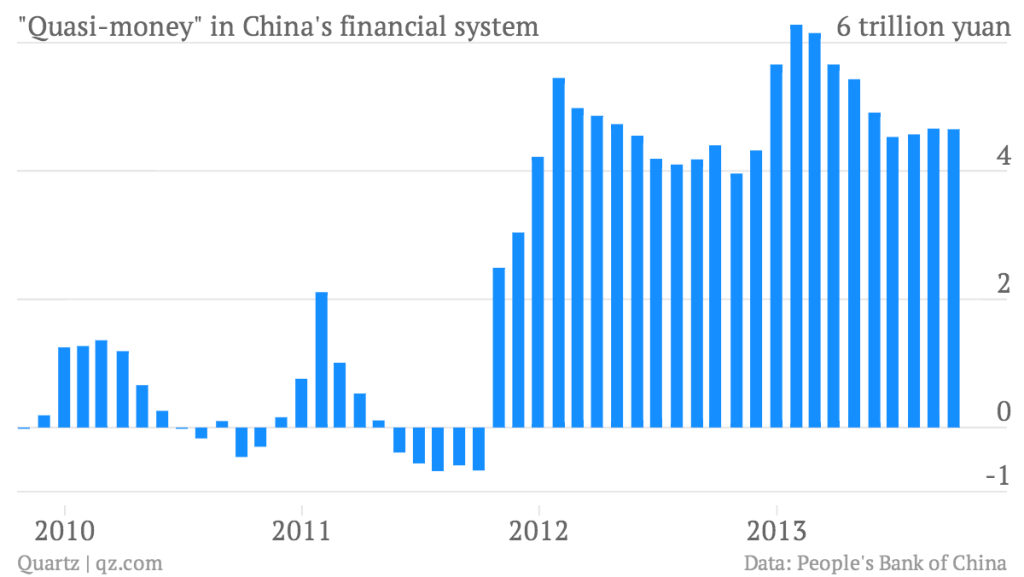
Money market rates in China climbed again last week, prompting more worries of a deja vu of June’s cash crunch that spooked global markets. That was when the Shibor—the Shanghai interbank offering rate, which tracks the interest rates banks charge each other—soared, reminding many of the Libor leap that happened just before Lehman’s demise in 2008. The likely cause is that the People’s Bank of China (PBOC) declined to inject funds into the interbank market for a third time in a row Friday. Cash will get even scarcer this week, when banks move cash back onto their balance sheets to meet reserve ratio requirements. For that reason, the PBOC will likely open its tills on Tuesday, soothing the Shibor once again. Read more of this post

China’s new law hits tourism industry

2013-10-20 15:48

China’s new law hits tourism industry

By Kim Bo-eun

23-02(5)
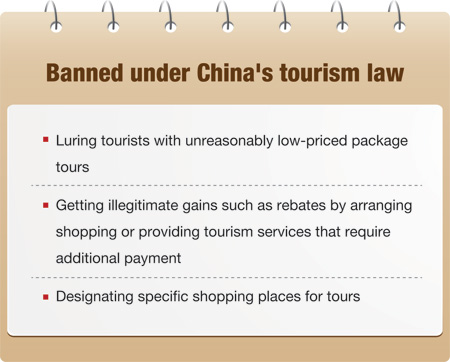
A new Chinese law is taking its toll on Korea’s tourism industry. From Oct. 1, Chinese travel agents are banned from selling cheap travel packages that include stops to overseas shopping centers, including those in Korea. The law is feared to create a kink in Korea’s plan to attract 12.5 million foreign tourists this year, a 12 percent increase from 2012.
It is designed to protect its own citizens traveling abroad, but could significantly decrease the amount of tourists and money spent in Korea. Read more of this post

China May Revamp Rural-Land Rights as Part of Reforms

China May Revamp Rural-Land Rights as Part of Reforms: Economy

China Politburo member Yu Zhengsheng said the Communist Party would consider “unprecedented” economic reforms next month, as a top research agency proposed changes to rural land ownership rules and social security. The Development Research Center under the State Council, or cabinet, has also proposed adding “outside investors” to boost competition, China News Service reported Oct. 26, citing a publicly released plan. Yu’s comments in the southern city of Nanning were reported by the official Xinhua News Agency on Oct. 26. Read more of this post

Two of Australia’s best-known investors will go head to head after Mark Carnegie launched a $1 billion proposal to break up one of the last remaining cross-shareholding arrangements on the ASX between Brickworks and Pattinson

James Thomson Editor

BRW Rich List veteran Robert Millner facing attack on Brickworks-Soul Patts tie-up

Published 24 October 2013 08:46, Updated 25 October 2013 07:04

e1e47c02-3c2b-11e3-b283-dd988051129c_A66C3431-483--646x363

Robert Millner is unlikely to give in to pressure from Mark Carnegie and Matt Williams to break up the cross shareholding between Soul Patts and Brickworks. Photo: Rob Homer

Two of Australia’s best-known investors will go head to head in the coming months after Mark Carnegie launched a $1 billion proposal to break up one of the last remaining cross-shareholding arrangements on the ASX between Washington H Soul Pattinson and Brickworks. The proposal will see Carnegie and his brother in arms in this fight, Perpetual fund manager Matt Williams, take on a man who is investment royalty in Australia, Robert Millner. Read more of this post

Treasury Wine faces class action over US disclosure

Treasury Wine faces class action over US disclosure

October 28, 2013 – 11:48AM

Eli Greenblat

Wine glut … Treasury Wine Estates booked $35 million to destroy stocks. Photo: Ron Chapple

Litigation funder IMF is calling for aggrieved shareholders to sign up for a possible court action against Treasury Wine Estates, the owner of a portfolio of leading and iconic wine brands such as Penfolds, Wolf Blass and Lindemans, claiming ‘‘deceptive and misleading conduct’’ over disclosures around its troubled US business. Treasury Wine Estates, the world’s largest pure-play winemaker, shocked markets and investors in July when it admitted an oversupply of poor and unwanted wine in the US would trigger a $160 million write-down and include a $35 million charge to destroy past-its-date wine stocks. Read more of this post

Belt Tightening Spurs Malaysia, Indonesia Currencies

Oct 28, 2013

Belt Tightening Spurs Malaysia, Indonesia Currencies

By Ewen Chew

Budgets that emphasize spending cuts to curb current-account deficits announced in Indonesia and Malaysia ahead of the weekend are already paying off with stronger currencies. Both the rupiah and the ringgit fell sharply this summer on fears that their growing current-account deficits would trigger credit-rating downgrades. Since May 1, the Indonesian currency had fallen by as much as 16%, while Malaysia’s currency fell as much as 8.8%, though the Malaysian currency had clawed back some losses: it was down 3.7% since May 1 as of Thursday. Read more of this post

From Big Foot to Bluto, Gulf of Mexico set for record oil supply surge

From Big Foot to Bluto, Gulf of Mexico set for record oil supply surge

Sun, Oct 27 2013

By Kristen Hays and Terry Wade

CORPUS CHRISTI, Texas (Reuters) – The Gulf of Mexico, stung by the worst offshore oil spill in U.S. history in 2010 and then overshadowed by the onshore fracking boom, is on the verge of its biggest supply surge ever, adding to the American oil renaissance. Over the next three years, the Gulf is poised to deliver a slug of more than 700,000 barrels per day of new crude, reversing a decline in production and potentially rivaling shale hot spots like Texas’s Eagle Ford formation in terms of growth. Read more of this post

US Dollar Notes Still Highly Coveted in Indonesia

US Dollar Notes Still Highly Coveted in Indonesia

By Dion Bisara on 10:01 am October 28, 2013.
The US Federal Reserve reiterated its commitment to meet demand for US dollar notes in Indonesia, currency that many Indonesians still highly regard as an instrumental of storing value. “Our role in the Federal Reserve is simply to meet the demand. It does not matter if it comes from domestic or abroad,” Michael J. Lambert, the Fed’s associate director for reserve bank operations and payment systems division, told the Jakarta Globe in an interview last week. Read more of this post

Yakuza Bosses Whacked by Regulators Freezing AmEx Cards

Yakuza Bosses Whacked by Regulators Freezing AmEx Cards

By Terje Langeland & Takahiko Hyuga on 9:37 am October 27, 2013.
Tokyo. The yakuza, Japan’s organized-crime syndicates that have reaped billions from activities ranging from extortion to human trafficking, are finding their ranks decimated by authorities employing methods similar to those used to jail Al Capone: going after their money. Japan’s Financial Services Agency delivered the latest blow, last month ordering Mizuho Financial Group to improve compliance and then demanding that top executives report by Oct. 28 what they knew and when about a consumer-credit affiliate found making loans to crime groups. Read more of this post

Samsung chairman owns most lavish home among tycoons

2013-10-28 10:38

Samsung chairman owns most lavish home among tycoons

Lee Kun-hee, chairman of the world’s top maker of smartphones Samsung Electronics Co., owns the most expensive houses out of the country’s top 30 business leaders, data showed Monday. The combined declared value of houses held by the 30 business tycoons reached 157.7 billion won (US$148.4 million) at end-June, up 9.6 percent from a year earlier, according to the data by market researcher Chaebul.com. Read more of this post

‘Focus on core business and compete globally’

2013-10-27 14:10

‘Focus on core business and compete globally’

IE Business School professor warns chaebol of risks in diversification
By Choo Sung-ho

The country’s three recently-failed conglomerates — Woongjin, STX and Tongyang — appear to have collapsed under mainly snowballing debt. But at the root of their demise are a series of bad managerial decisions by group chairmen. Rather than focus on core businesses, they expanded into other areas, largely construction, shipbuilding and other old industries. To finance their “reckless” expansion, they borrowed the excessive amounts of money from financial institutions and issued corporate bonds. But their businesses suffered greatly amid the prolonged global economic downturn and became unable to service debts. Read more of this post

Koreans ranked second among 150 countries in terms of per capita working hours in 2012

Koreans take No. 2 for working hours

Oct 28,2013

BY SONG SU-HYUN [ssh@joongang.co.kr]

Korea may be a highly advanced country in manufacturing, but in the labor and social sectors, it still resembles a developing nation, a government report said yesterday. The Korea International Trade Association (KITA) announced the fourth-largest Asian economy ranked second among 150 countries in terms of per capita working hours in 2012, according to statistics complied by the Organization for Economic Cooperation and Development. Mexicans were the only people to work more. Read more of this post

Reagan Revolution Misses Tax Fiefdoms Flourishing in U.S.

Reagan Revolution Misses Tax Fiefdoms Flourishing in U.S.

Nothing thrives in Illinois like local government — almost 7,000 units that tax, spend and drive up debt in a state struggling to pay off vendors and cover almost $100 billion of unfunded pension liabilities. More than any other state, Illinois illustrates how local taxing bodies flourish across the U.S., whether urban or rural, Republican or Democrat. The governments duplicate services and burn tax dollars at the same time states slash money for education and Washington cuts discretionary spending. Read more of this post

Small-Caps Double Dow in Signal Economy Is Gaining Speed

Small-Caps Double Dow in Signal Economy Is Gaining Speed

The smallest stocks are rallying almost twice as fast as bigger companies in the U.S., a bullish economic signal from businesses whose profits are most dependent on domestic demand. Shares of companies from Rite Aid Corp. to Teledyne Technologies Inc. in the Russell 2000 Index (RTY) have advanced 32 percent in 2013, compared with 19 percent for the Dow Jones Industrial Average. The spread is the widest for any year since 2003, according to data compiled by Bloomberg. Three of the last four times small-caps outperformed by this much, the economy grew faster the next year and stocks stayed in a bull market for another year or more. Read more of this post

Hong Kong Home Prices to Drop 30% as Barclays Joins UBS, Merrill

Hong Kong Home Prices to Drop 30% as Barclays Joins UBS, Merrill

Barclays Plc joined UBS AG and Bank of America Corp. in forecasting a Hong Kong property slump, predicting home prices will fall at least 30 percent by the end of 2015 as income growth stalls and supply increases. A “downward spiral of home prices is likely” as developers and homeowners adjust expectations, analysts Paul Louie and Zita Qin wrote in a report today. They assigned a “negative” rating to the Hong Kong property sector and said office prices will drop 20 percent. Read more of this post

Danone-Backed Project Provides Water at Cost to Cambodia

Danone-Backed Project Provides Water at Cost to Cambodia

When Francois Jaquenoud knocked on Danone’s door seven years ago seeking clean-water funds for Cambodians, the maker of Evian turned him down. Two years later, Danone reversed course. Just how did the Paris-based company that’s the biggest yogurt maker get involved half a world away in Cambodia? Credit dates to when the founder of “1001 Fontaines pour demain,” French for “1,001 Fountains for tomorrow,” crafted a business plan to provide 2 liters (a half-gallon) of safe water a day to each Cambodian. From not a drop in 2004, the former Accenture Plc (ACN) consultant’s enterprise now sells water to 100,000 Cambodians at cost: less than a euro cent (1.38 U.S. cents) a liter. Read more of this post

BIS sees risk of 1998-style Asian crisis as Chinese dollar debt soars; The world’s banking watchdog warns that foreign loans to companies and banks in China has tripled over the last five years and may be large enough to set off financial tremors in the West

BIS sees risk of 1998-style Asian crisis as Chinese dollar debt soars

The world’s banking watchdog warns that foreign loans to companies and banks in China has tripled over the last five years and may be large enough to set off financial tremors in the West

By Ambrose Evans-Pritchard

9:30PM GMT 27 Oct 2013

chart-23_2715252c chart-10_2715250c chart-11_2715248c

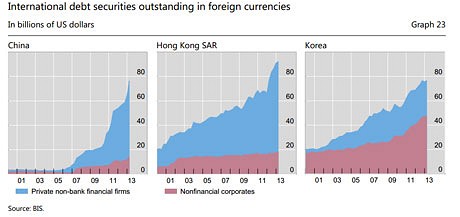
Foreign loans to companies and banks in China have tripled over the last five years to almost $900bn and may now be large enough to set off financial tremors in the West, and above all Britain, the world’s banking watchdog has warned. “Dollar and foreign currency loans have been growing very rapidly,” said the Bank for International Settlements in a new report. “They have more than tripled in four years, rising from $270 billion to a conservatively estimated $880 billion in March 2013. Foreign currency credit may give rise to substantial financial stability risks associated with dollar funding,” it said. China’s reserve body SAFE said 81pc of foreign debt under its supervision is in dollars, 6pc in euros, and 6pc in yen. Read more of this post

Wikipedia China Becomes Front Line for Views on Language and Culture

October 27, 2013

Wikipedia China Becomes Front Line for Views on Language and Culture

By GRACE TSOI

HONG KONG — The Chinese-language version of Wikipedia has become more than an online encyclopedia: it is a battlefield for editors from ChinaTaiwan and Hong Kong in a region charged with political, ideological and cultural differences. Wikipedia editors, all volunteers, present opposing views on politics, history and traditional Chinese culture — in essence, different versions of China. Compounding the issue are language differences: Mandarin is the official language in mainland China and Taiwan, while the majority in Hong Kong speak Cantonese. But mainland China uses simplified characters, while Taiwan and Hong Kong use traditional script. Read more of this post

Army of Chinese fast food firms challenge McDonald’s, KFC and other foreigners in China

Updated: Monday October 28, 2013 MYT 8:22:21 AM

Army of Chinese fast food firms challenge McDonald’s, KFC and other foreigners in China

SHANGHAI: Bearing rice burgers and lotus roots, an army of Chinese fast food firms is cooking up a challenge to McDonald’s Corp and Yum Brands Inc, tempting cost-conscious diners with healthy, homegrown fare and causing a drag on growth for the U.S. chains in the country’s $174 billion fast food market. McDonald’s said last week it was thinking of slowing expansion in China as diners are tempted by local rivals. KFC-parent Yum warned this month economic weakness in China would drag on a recovery in sales dented by a food safety scare at the end of last year. Read more of this post

Forging an Art Market in China; In China’s growing art market, now the second largest in the world, outsize auction results often overshadow false sales data and forged art

Forging an Art Market in China

By David Barboza, Graham Bowley and Amanda CoxAdditional Reporting by Jo Craven McGintyBEIJING, October 28, 2013

点击查看本文中文版 | Read in Chinese »

When the hammer came down at an evening auction during China Guardian’s spring sale in May 2011, “Eagle Standing on a Pine Tree,” a 1946 ink painting by Qi Baishi, one of China’s 20th-century masters, had drawn a startling price: $65.4 million. No Chinese painting had ever fetched so much at auction, and, by the end of the year, the sale appeared to have global implications, helping China surpass the United States as the world’s biggest art and auction market. But two years after the auction, Qi Baishi’s masterpiece is still languishing in a warehouse in Beijing. The winning bidder has refused to pay for the piece since doubts were raised about its authenticity. Read more of this post

China Won’t Lose Its ‘Voice’ Despite New TV Restrictions

October 25, 2013, 10:22 AM

China Won’t Lose Its ‘Voice’ Despite New TV Restrictions

Fans of ”The Voice of China,” have no fear. The show is staying put.

Broadcaster Zhejiang Satellite TV has confirmed it will continue airing the hit show despite new regulations that take aim at broadcasts based on formats developed abroad, and said it is tweaking other shows to make sure they conform with the new restrictions. “The Voice of China” is based on a Dutch show, “The Voice of Holland,” that has done well in its international iterations, including as “The Voice” in the U.S. Read more of this post

Debt: A deceptive calm: Investors are wary that the tranquility in eurozone bond markets could breed complacency

October 27, 2013 7:55 pm

Debt: A deceptive calm

By Ralph Atkins in London

Investors are wary that the tranquility in eurozone bond markets could breed complacency

James Carville, an adviser to former US President Bill Clinton, wanted to be reincarnated as the bond market, complaining that it was more powerful than presidents or popes. “You can intimidate everybody,” he moaned. He should have moved to Rome. This year, Italy has had an inconclusive election, a government often on the brink of collapse and an economy struggling to leave a deep recession. But the bond markets have been noticeably quiescent. Rather than Rome’s borrowing costs rising as investors worried about the security of Italy’s public debt, the difference – or “spread” – between the yield on 10-year Italian and German government bonds has fallen to levels unseen since the eurozone crisis hit the country more than two years ago. Read more of this post

Beijing’s caution on reforms: China does not have the luxury of deferring all changes until conditions suit, says Eswar Prasad

October 27, 2013 6:57 pm

Beijing’s caution on reforms makes sense – for now

By Eswar Prasad

But China does not have the luxury of deferring all changes until conditions suit, says Eswar Prasad

Cataloguing China’s economic risks has become a popular parlour game. In the past decade, a steady drumbeat of warnings has predicted imminent collapse. Rising state and local government debt, a weak financial system and multiplying inefficiencies in the economy certainly pose big risks. The reforms needed to maintain growth and improve its quality have been painfully slow. Read more of this post

Forget China: Growth is ‘driven by knowledge – at the level of society, not the individual’

October 27, 2013 2:57 pm

Forget China and switch to Zimbabwe, Mexico or Egypt

By John Authers

Growth is ‘driven by knowledge – at the level of society, not the individual’

Where does growth come from? Why do some countries “emerge” and take on “developed” status, while others flounder before reaching that stage? Some once highly unlikely candidates have emerged as powerful economies. South Korea, for example, grew in two generations from a peasant economy devastated by war, to a fully paid-up member of the developed world. Others once far better placed have stumbled. Read more of this post

Regulators have growing concerns about the mortgage vehicles amid concerns that a rapid rise in interest rates could trigger a sell-off

October 27, 2013 6:07 pm

Fed probes banks’ exposure to mortgage vehicles

By Tracy Alloway, Arash Massoudi and Michael Mackenzie in New York

Regulators at the New York Fed have been probing banks’ exposure to a type of mortgage investment vehicle that has proliferated since the financial crisis amid concerns that a rapid rise in interest rates could trigger a sell-off. The private discussions, described by one person as a “deep dive” into the topic, underscore regulators’ growing concerns about the rapid expansion of mortgage real estate investment trusts. MReits finance their purchases of long-term mortgages with short-term borrowings, known as repo, secured from dealer banks. Read more of this post

Wave of private equity money flows into shipping

October 27, 2013 2:23 pm

Wave of private equity money flows into shipping

By Mark Odell and Ajay Makan

The shipping industry has endured its worst crisis in 25 years. But there are some signs it may be navigating its way out of choppy waters – not least a surge in the amount of“smart” money from private equity flowing into the sector. The record influx of funds so far this year is seen by many as a watershed after five years of weathering the storm that caused several ship operators and owners to collapse during the economic downturn. Read more of this post

Markets’ animal spirits need taming; QE froth is great for asset prices, less so for the real world

October 25, 2013 11:51 am

Markets’ animal spirits need taming before a hard fall

By Michael Mackenzie in New York

QE froth is great for asset prices, less so for the real world

History may not repeat itself but will it rhyme with a messy denouement for risky assets? In the final quarter of 1999, a surfeit of central bank liquidity thanks to concerns over Y2K pumped up the technology bubble before the bottom fell out of the market the following year. Fast forward to 2014 and there is no getting away from massive central bank stimulus propelling asset prices and allowing investors to downplay fundamental factors. Read more of this post

Singapore’s penny stock mystery increases pressure on exchange

Singapore’s penny stock mystery increases pressure on exchange

5:05pm EDT

By Rachel Armstrong and Anshuman Daga

SINGAPORE (Reuters) – Singapore Exchange Ltd (SGXL.SI: QuoteProfileResearchStock Buzz)’s role as the city-state’s equity market regulator is coming under increasing scrutiny in the fall-out from a penny stock crash earlier this month. The sudden implosion of Blumont Group Ltd (BLUM.SI: QuoteProfileResearchStock Buzz), LionGold Corp (LION.SI: QuoteProfileResearchStock Buzz), and Asiasons Capital Ltd (ASNS.SI: QuoteProfile,ResearchStock Buzz) – after huge run-ups in their share price earlier in the year had turned them briefly into billion dollar companies – left many in the market mystified and raised question marks over whether the exchange missed red flags and was too slow to act. Read more of this post

China Seen Losing Sheen for IBM to Nike as Hurdles Mount

China Seen Losing Sheen for IBM to Nike as Hurdles Mount

Companies from IBM to Starbucks are struggling with new obstacles in China as Communist Party officials tussle over the direction and depth of economic reforms. China’s state-controlled media last week accused Starbucks Corp. (SBUX) with charging too much for coffee and said Samsung Electronics Co.’s smartphones don’t work properly. International Business Machines Corp. (IBM) IBM’s China revenue slipped 22 percent in the third quarter, contributing to the first-ever sales decline in the company’s growth-markets division, as state-owned companies started delaying orders, including mainframes and servers. Read more of this post

The invisible poor in Singapore: There are 105,000 households earning below $1,500 a momth. 10% of Singapore’s resident households earn an average of $1,644. This figure is all the more surprising given that Singapore has one of the world’s highest annual incomes per head, of $65,000.

The invisible poor

Monday, October 28, 2013 – 07:30

Robin Chan

Radha Basu

The Straits Times

While attending university in the United States, Singaporean Kevin Seah remembers being struck by the snaking lines outside soup kitchens and homeless shelters. “That was my impression of poverty. Begging, homelessness. But in Singapore you don’t see all that,” said Mr Seah, 27, a former Anglo-Chinese School (Independent) boy who admitted his life until then had been quite sheltered. So he was surprised to find some startling statistics about the poor here, when he first started working on a marketing campaign to raise awareness of poverty in Singapore when he returned after graduating from Buffalo University in upstate New York. “There are 105,000 households earning below $1,500 a month. I knew there are some issues which we are facing. But it’s quite hidden,” he said. Hidden they may be, but they are certainly there. According to latest official data, 10 per cent of Singapore’s resident households, comprising an average of 3.5 members and with at least one working person, earn an average of $1,644. This figure is all the more surprising given that Singapore has one of the world’s highest annual incomes per head, of $65,000. Read more of this post