Japan’s Meiji to Stop Baby Formula Sales in China on Competition

Japan’s Meiji to Stop Baby Formula Sales in China on Competition

Meiji Co., the Japanese confectioner and dairy products maker, said it will stop selling baby formula in China due to rising material costs and intensified competition in the world’s most populous nation. “There are so many players in the market,” Junji Ohashi, a spokesman for parent Meiji Holdings Co. (2269), said by phone today. “Our sales fell to one third of the peak in 2009.” Read more of this post

Hong Kong to Raise Subsidies to Replace Polluting Vehicles

Hong Kong to Raise Subsidies to Replace Polluting Vehicles

Hong Kong will offer HK$12 billion ($1.5 billion) in subsidies to replace old diesel vehicles, a 20 percent increase from an initial proposal, to clean up its smoggy streets. The increase from HK$10 billion for vehicle owners was made after consultation with the industry, Christine Loh, the city’s undersecretary for environment, said today. The money will be used to “clean up the dirtiest vehicles,” she said. Read more of this post

Australian government facing challenges on financial planning reforms

Australian government facing challenges on financial planning reforms

by Samuel Poon

CANBERRA, Oct. 24 (Xinhua) — The Australian government is facing intense challenge from banks and financial service providers to act on reforms of the financial advisers sector as crafted by the previous Labor government, collectively known as the Future of Financial Advice (FoFA). The new government has recently asked Treasury and the Australian Securities and Investment Commission(ASIC) for advice on whether the Labor Law designed to minimize financial planners’ conflict of interests should be watered down more than promised during the election. Assistant Treasurer Arthur Sinodinos, who has an obligation to deliver the changes the Coalition promised during the campaign, will stand for the government to respond to the industry pressure. The changes were designed to stop remuneration arrangements for financial advisers, which for many years created a conflict between the interests of clients and maximizing advisers’income. Read more of this post

With many companies nearing the first-to-second generation transfer phase, Asian family businesses have been forced to learn the art of succession planning quickly

MASS SUCCESSION

ARTICLE | 23 OCTOBER, 2013 04:55 PM | BY RASHMI KUMAR

With many companies nearing the first-to-second generation transfer phase, Asian family businesses have been forced to learn the art of succession planning quickly.  When Chu Meng Yee, owner of billion-dollar Chinese real estate developer Hopson Development, named his daughter as its deputy chairman in July, it created ripples across the world of family businesses in Asia. Family business experts were overwhelmed with excitement – not only had Chu appointed a woman to take over the company, but he had taken a big step forward in moving the company from the first to the second-generation. Read more of this post

Watchdog asleep on Australia’s sub-prime scandal

Watchdog asleep on Australia’s sub-prime scandal

October 24, 2013 – 2:25PM

A leading consumer activist claims the corporate regulator has not only failed to investigate hundreds of cases of loan fraud put before it but, as a consequence, has covered up a systemic banking failure. As the deadline for submissions for the Senate Inquiry into the Performance of the Australian Securities & Investments Commission (ASIC) closed this week, veteran consumer rights activist Denise Brailey filed a brutal assessment of ASIC’s failure to investigate the cases of loan fraud. Read more of this post

Woolworths rekindles pharmacies in supermarkets battle with new trademark application

Woolworths rekindles pharmacies in supermarkets battle with new trademark application

Published 24 October 2013 10:34, Updated 24 October 2013 10:57

Sue Mitchell

Woolworths has lodged a new application with IP Australia to register the trademark “Pharmacy-in-Supermarket”. Photo: Glenn Hunt

Woolworths has not given up on its ambitions to enter the $16 billion pharmacy market, despite federal government policy that has locked out major retailers since 1990. The retailer has lodged a new application with IP Australia to register the trademark “Pharmacy-in-Supermarket”. A previous application lapsed. The trademark covers six classes of goods and services, including the sale of pharmaceutical and medical products provided by pharmacists. Australia’s largest retailer has wanted to sell pharmaceuticals and prescription medicines since 2003, when it first registered the Pharmacy-in-Supermarket trademark and outlined plans to sell drugs, medicines, toiletries and tissue products from pharmacies within its stores. Under the federal government’s Community Pharmacy agreement, which has been in place since 1990, pharmacies must be owned by pharmacists. Woolworths believes consumers are paying too much for prescription and over-the-counter medicines because of the inefficiencies of independent pharmacies. In 2004, then Woolworths chief executive Roger Corbett called the pharmacy industry “the biggest anti-competitive gerrymander in Australia”.

Beijing to promote industrialization of GM crops

Beijing to promote industrialization of GM crops

Staff Reporter

2013-10-24

Sixty-one scholars recently called for the industrialization of genetically modified (GM) rice in China, which has once again raised the public’s attention on the controversial technology, reports the Chinese-language Beijing News. The country’s Ministry of Agriculture plans to promote the industrialization of GM foods and technology, and accelerate the passing of amendments for related regulations, the paper said. Beijing has also approved GM cotton, rice, corn and papaya to be grown, but a researcher at the Chinese Academy of Agricultural Science added that only cotton and papaya have been allowed for commercial production. Read more of this post

China’s scandal-rocked dairy industry is changing, but the government’s goals remain uncertain

10.23.2013 17:57

China’s Dairy Market Policies Clear as Milk

The scandal-rocked dairy industry is changing, but the government’s goals remain uncertain

By staff reporters Qu Yunxu and He Chunmei, and intern reporter Huo Bingyi

Dairy operators pouring over the Chinese government’s latest industry-support policies and what speculators have been saying about future policy changes want to know whether the cup is full, half-empty or nonexistent. Clear answers are hard to find because mixed signals have been trickling out of the Ministry of Industry and Information Technology (MIIT), Ministry of Agriculture (MOA) and other policymaking agencies since last spring. Read more of this post

Chinese Auto Tie-Ups Losing That New-Car Smell

October 24, 2013, 11:16 AM

Chinese Auto Tie-Ups Losing That New-Car Smell

Global auto companies reap big sales in China from their partnerships with Chinese brethren. Might they someday be allowed to go it alone? Under current regulations, global auto makers can only own as much as half of their joint ventures in China. Most foreign car companies such as General Motors Co.GM -1.02% and Ford Motor Co.F -0.45% hold 50% shares. One notable exception isVolkswagen AGVOW3.XE -0.59%’s joint venture with FAW Group, the German automaker holds 40%. Read more of this post

Chinese Filmgoers Journey Away From the West; home-grown films take six of the top 10 spots. China’s box office gross $2.7 billion, up 35% from a year earlier. The growth in sales for Chinese films: a whopping 94%

October 24, 2013, 2:02 PM

Chinese Filmgoers Journey Away From the West

MK-CH277_CFILM_G_20131023174808

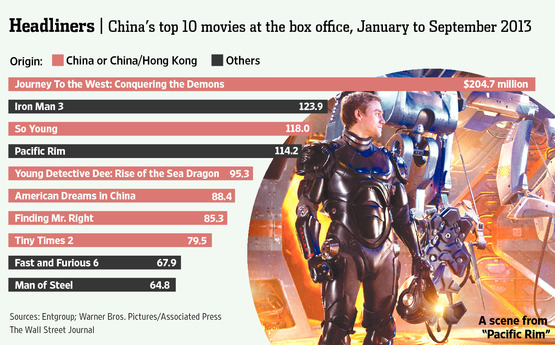
In the surprising battle for China’s box office so far this year, the Monkey King gave Iron Man an improbable beat down and a gaggle of Chinese college kids managed to hold their own against a group of tower-sized monster-destroying robots. If you want to be mega-successful in the movie business these days, you have to win the hearts of Chinese filmgoers. For years, Hollywood has raked in the lions share of China’s film spoils despite import restrictions designed to protect domestic movies. But as WSJ’s Wayne Ma and Laurie Burkitt report, that tide appears to have turned in 2013, with home-grown films taking six of the top 10 spots so far this year: Read more of this post

Wal-Mart to open up to 110 new China stores by 2016

Wal-Mart to open up to 110 new China stores by 2016

12:43am EDT

By Matthew Miller

BEIJING (Reuters) – Wal-Mart Stores Inc (WMT.N: Quote,ProfileResearchStock Buzz), the world’s biggest retailer, is expanding its China business as it seeks to raise profitability in a slowing retail sector. Wal-Mart will open up to 110 facilities in China between 2014 and 2016, in addition to the 30 it has already opened this year, it said at a press event in Beijing on Thursday. Read more of this post

Lu Guanqiu, chairman of one of China’s leading auto parts makers, will finally achieve his longstanding dream of extending his business to making cars.

Wanxiang poised to enter auto manufacturing

Staff Reporter

2013-10-24

Barring opposition, Lu Guanqiu, chairman of one of China’s leading auto parts makers, will finally achieve his longstanding dream of extending his business to making cars. On Oct. 22, the Ministry of Industry and Information Technology (MIIT) publicized a list of new auto manufacturing enterprises, which include Wanxiang EV, an electric car subsidiary of Wanxiang Group. Read more of this post

Japan edges closer to lifting casino ban

October 24, 2013 4:50 am

Japan edges closer to lifting casino ban

By Jonathan Soble in Tokyo

A long-debated proposal to lift Japan’s ban on casino gambling could finally come to fruition this year after a multi-party group of lawmakers agreed to submit a legalisation bill to the current session of parliament. Iwaya Tsutomu, a member of the ruling Liberal Democratic party who is part of the pro-casino group, said Tokyo’s selection last month as host of the 2020 Olympic games had given fresh impetus to its push for legalisation. Read more of this post

FDI in Indonesia has fallen for the first time in two years as southeast Asia’s biggest economy faces growing challenges from a widening current account deficit to rising economic nationalism ahead of next year’s elections

October 23, 2013 11:49 am

Foreign direct investment falters in Indonesia

By Ben Bland in Jakarta

Foreign direct investment in Indonesia has fallen in US dollar terms for the first time in two years as southeast Asia’s biggest economy faces growing challenges from a widening current account deficit to rising economic nationalism ahead of next year’s elections. The government’s investment co-ordinating body (BKPM) said on Wednesday that realised FDI fell from $7.2bn in the second quarter to $7bn in the third quarter, the first quarter-on-quarter decline since 2011. That still represented a rise of more than 18 per cent compared with the third quarter of last year. Read more of this post

Electronic Retailer Courts Asia Breaks Ground for Its Megastore in Bekasi

Electronic Retailer Courts Asia Breaks Ground for Its Megastore in Bekasi

By Johan Mulyadi on 11:00 pm October 23, 2013.
Bekasi. Singapore-based Courts Asia, an electronics retailer, is hoping to tap the Indonesian market with its first store in Bekasi, West Java, on the outskirts of Jakarta. The ground-breaking ceremony at the site took place on Wednesday. The company plans to spend $20 million on the Bekasi megastore, expected to be operational by the second half of 2014. The store, to be located in Kota Harapan Indah, Bekasi, will occupy 13,000 square meters. It will stock a wide range of products from computer products and electronics, to home furnishings. “Big-box stores have lower rental cost per square meter and this should compensate for the lower shopping traffic as compared to shopping malls. A big-box store can also earn rent from food and beverage vendors located on the premises,” Courts Asia chief executive Terence Donald O’Connor said during the ceremony. Besides the Bekasi store, the company also plans to open another in Bumi Serpong Damai in Tangerang, Banten. It is expected to open some time in 2015. Courts Asia plans to open an additional 10 stores in Indonesia in the next five years, O’Connor said. The company raised S$44 million ($36 million) from an initial public offering early this month. It will use the bulk of the proceeds to finance its Indonesian expansion, which according to its website, will amount to about S$40 million. “Indonesia’s growth is driven by a burgeoning consumer market that is still under-penetrated. It is highly attractive. We plan to launch stores in urban areas to capture our target customers — the rising middle-class,” O’Connor said. Read more of this post

Failed malls in India point to soured retail boom

Failed malls in India point to soured retail boom

Agence France-Presse | Updated On: October 23, 2013 09:51 (IST)

Mumbai: The Centre One shopping mall on the outskirts of Mumbai is gloomy and bereft of customers, even during India’s annual festive and wedding season when retailers traditionally cash in. “Business is dull, usually weak,” said one bored-looking fashion salesman. The shopping centre’s empty look is no exception. In the past decade, supermarkets and malls have spread across India’s large cities and towns, fuelled by fast economic growth and excitement about middle-class buying power. Read more of this post

Oil traders hunger for lost years of volatility; “As long as oil remains rangebound, it’s like free money to write puts and calls, so a lot of people are coming into the market to do it. The problem is that if oil does move, you lose a money”

October 23, 2013 10:35 am

Oil traders hunger for lost years of volatility

By Gregory Meyer in New York and Ajay Makan in London

Clive Capital has thrown in the towel. Deep into its third year of losses, what was onceone of the world’s largest commodity hedge funds shut down late last month. The closure is symptomatic of a broader trend – or more accurately, the lack of one. Hedge funds once feasted on wild action in oil. Now, volatility has fallen to historic lows. Plodding prices have forced traders to experiment with new ways to make money. Read more of this post

S. Korea fashion industry reshaping under way

S. Korea fashion industry reshaping under way

Kim Ji-mi

2013.10.23 17:52:37

South Korea’s fashion industry dynamics are changing. For start, Cheil Industries, a leading player in the industry since 1970s, agreed to sell its fashion unit to Samsung Everland.
Cheil Industries, LG Fashion and Kolon Industries had dominated the fashion market, but their grip has dismantled since 2010. Now, Kolon Industries’ fashion operations generate 1.3 trillion won ($1.2 billion) in sales, only one third of the company’s total sales of over four trillion won. The fashion operations are no longer a flagship business of Kolon Industries. In contrast, E-Land has launched low and mid-priced brands and sold them in standalone stores and earned two trillion won in sales last year, surpassing Cheil Industries to take the top position. The sales figure excludes another two trillion won it brought in from abroad. Cheil Industries garnered 1.5 trillion won in sales in the local fashion market. The dominance of the three fashion conglomerates is giving way to an emergence of multiple companies, as large retailers including Lotte Department Store, Shinsegae Group and Hyundai Department Store are aggressively pushing into the industry. Shinsegae Group’s fashion arm Shinsegae International imports and sells luxurious brands such as Armani, Marni, and Dolce & Gabbana. Shinsegae International is also promoting domestic brands including Vov, G-Cut and Vidivici. Lotte Department Store’s global fashion business division has unveiled Niceclaup, Thyren, J-Press and Furla. Hyundai Department Store Group’s affiliate Hyundai Home Shopping, meanwhile, acquired local women’s clothes company Handsome, and opened new brand Iro.
Using tech playbook, oil drillers shower employees with stock

Using tech playbook, oil drillers shower employees with stock

1:24am EDT

By Ernest Scheyder

NEW YORK (Reuters) – U.S. energy exploration companies leading a domestic oil boom increasingly are using stock options to find and maintain employees, evoking comparisons to the dot-com bubble of the late 1990s. Some compensation experts and investment analysts worry that employees of small- and medium-sized firms that are still searching for sizeable profits could be lulled by a false sense of financial security. Read more of this post

A combination of an influx of people from overseas and persistent land and building shortages has pushed rates for prime office space in Myanmar/Yangon towards $100 per square metre – significantly higher than costs than in much more developed countries in the region such as Singapore

October 23, 2013 4:26 pm

Myanmar property prices surge as country opens up to investment

By Michael Peel in Yangon

Myanmar’s emergence as one of the world’s great new commercial frontiers has sent property values soaring and triggered fears that all but the largest investors could be priced out of the market. A combination of an influx of people from overseas and persistent land and building shortages has pushed rates for prime office space towards $100 per square metre – significantly higher than costs than in much more developed countries in the region such as Singapore, business people and others say. Read more of this post

Pullback of funds from emerging markets likely to begin in earnest next year

Updated: Thursday October 24, 2013 MYT 9:36:51 AM

Pullback of funds from emerging markets likely to begin in earnest next year

KUALA LUMPUR: A fund manager based in the United States said he sees “headwinds” for emerging markets as the Federal Reserve unwinds its five-year-old monetary stimulus, amid a slow but sure recovery in the world’s largest economy. Grant Bowers, portfolio manager of Franklin Templeton Investments’ US Opportunities Fund, told newsmen in a briefing that what had been dubbed the “great rotation” of funds out of emerging markets was “still playing out”, triggered by the planned tapering of the Federal Reserve’s US$85bil a month bond-buying programme and easy money policies. Read more of this post

Heineken’s profit warning: all about EM

Heineken’s profit warning: all about EM

Oct 23, 2013 10:28am by Jonathan Wheatley

Is Russia the world’s toughest beer market? It’s beginning to look that way, after Heineken said on Tuesday it would see a 10 per cent decline in volumes sales in the country this year. That’s even worse than a recent gloomy assessment by Carlsberg, which said volume had slumped by 7 per cent in the first half. “Russia is a very, very difficult market,” René Hooft Graafland, Heineken’s chief financial officer, said on a conference call, warning that profits were likely to fall this year “in the low single digits”, sending the brewer’s shares down 5 per cent by mid morning in Amsterdam. Read more of this post

Europe’s Flawed Growth Strategy; Reliance on Exports Isn’t a Sustainable Approach

Europe’s Flawed Growth Strategy

Reliance on Exports Isn’t a Sustainable Approach

DAVID WESSEL

Updated Oct. 23, 2013 1:40 p.m. ET

NA-BY577_CAPITA_G_20131023133604 NA-BY578_CAPITA_NS_20131023133609

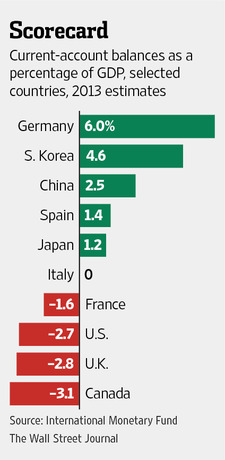
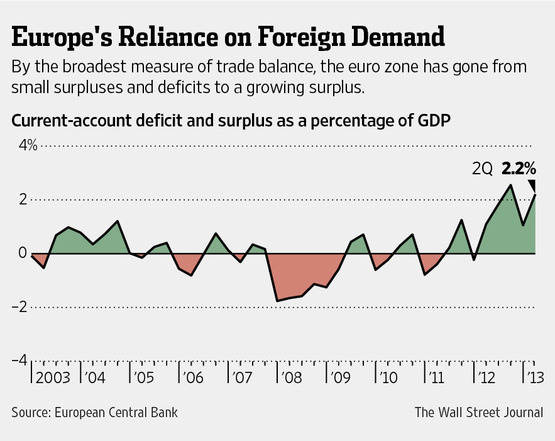
Now that Washington has reopened the government and averted potential default, the global spotlight will shift back to the euro zone. Europe has a way of making the U.S. economy look good. In the U.S., the unemployment rate is a still-high 7.2%. In the 17 countries that share the euro, it’s 12%, ranging from 5.2% in Germany to 26.2% in Spain. Neither the U.S. nor Europe has a compelling strategy to boost the slow pace of economic growth. But Europe in particular has stumbled onto a short-term approach that can’t last: Make the rest of Europe more like frugal Germany, relying heavily on exports rather than on domestic consumer spending and business investment. Read more of this post

Crime in Mexico: Out of sight, not out of mind; Having decided to play down the fight against drug kingpins, Enrique Peña Nieto has yet to come up with a serious alternative

Crime in Mexico: Out of sight, not out of mind; Having decided to play down the fight against drug kingpins, Enrique Peña Nieto has yet to come up with a serious alternative

Oct 19th 2013 | TIJUANA |From the print edition

20131019_AMD001_0

A HUMAN hellhole lies under the noses of American tourists driving from California into Mexico. Below the bridge leading into Tijuana is a dry canal strewn with heroin syringes that is home to countless migrants and vagrants, most of them thrown out of the United States for not having the right papers. Jesús Alberto Capella, Tijuana’s chief of police, says their numbers have included about 10,000 ex-convicts turfed out of American jails this year. They live under tarpaulins and in foxholes dug into the side of the canal. The place is a cauldron of violence. It is also a focal point for President Enrique Peña Nieto’s strategy of applying what officials call “social acupuncture” to some of the most dangerous parts of Mexico. Read more of this post

Active assault on low-volatility trackers

October 21, 2013 12:26 pm

Active assault on low-volatility trackers

By Jackie Noblett

Several firms are looking to take a slice of the growth of assets that have flooded into low-volatility index exchange traded funds by rolling out actively managed funds. While prevalent among institutions for years, these retail funds are increasingly going head-to-head with the popular index-based ETFs in the market. Fund executives and analysts say the decision to go active versus passive is a matter of philosophy and intent rather than of one being better than the other. Read more of this post

Sotheby’s Investor Marcato Pushes to Sell New York, London Properties; Hedge Fund Believes Moves Could Free Up $1.3 Billion in Cash

Sotheby’s Investor Marcato Pushes to Sell New York, London Properties

Hedge Fund Believes Moves Could Free Up $1.3 Billion in Cash

DAVID BENOIT

CONNECT

Updated Oct. 23, 2013 8:59 p.m. ET

Sotheby’s BID +0.21% doesn’t just have an activist problem. It has a two-activists problem. The auction house faces one hedge fund manager— Daniel Loeb of Third Point LLC—loudly banging down the doors over its performance. Meanwhile, another hedge fund is working behind the doors to get the company to sell its physical home. That second hedge fund, Marcato Capital Management LLC, spelled out its arguments for the first time in a presentation to investors Wednesday evening. According to the presentation, reviewed by The Wall Street Journal, Marcato wants Sotheby’s to sell its New York and London properties and unlock the capital it uses in its smaller art financing and art dealing operations. Read more of this post

Xi Praises Group of Global Business Leaders; “Many of you are renowned entrepreneurs and business leaders in the world today and you all have profound insight on the global economy. Your suggestions are a very important source of inspiration for the Chinese government.”

Xi Praises Group of Global Business Leaders

China’s Leader Seeks Advice From Global Business Chiefs at Beijing Gathering

LAURIE BURKITT

Updated Oct. 23, 2013 7:33 p.m. ET

MK-CH282_XI_G_20131023190315

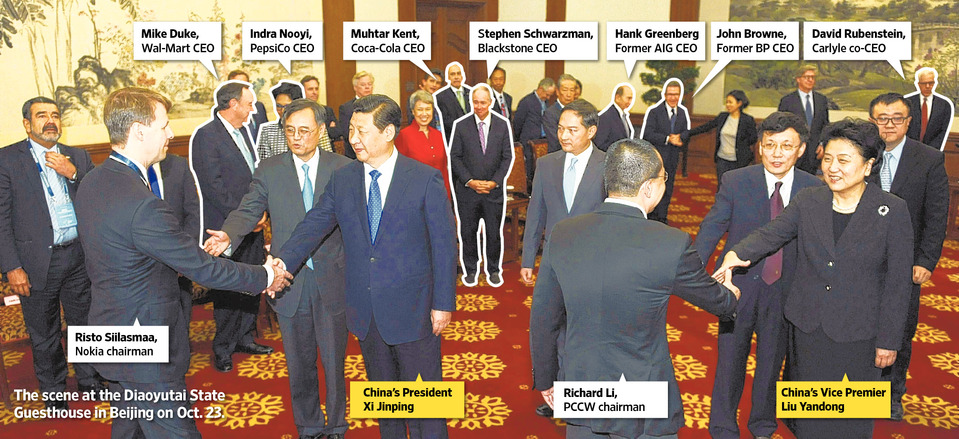
BEIJING—China has spent the past year telling foreign companies to clean up their acts. Names ranging from Apple Inc. AAPL +0.98% to Starbucks Corp. SBUX -1.05% toVolkswagen AG VOW3.XE -0.59% have come under intense scrutiny from government-controlled media for the ways they treat Chinese customers. So executives at some of the world’s biggest multinational companies could perhaps be forgiven if they felt a sense of whiplash on Wednesday, when the country’s top Communist Party official publicly sought their advice. “Many of you are renowned entrepreneurs and business leaders in the world today and you all have profound insight on the global economy, so that is why we attach great importance to the suggestions you offer,” Chinese President Xi Jinping told a group of nearly two dozen top foreign executives gathered in a building where Beijing entertains its most exalted guests. “Your suggestions are a very important source of inspiration for the Chinese government.” Read more of this post

The Trademark of China’s Progress; Beijing is finally embracing better brand protections for domestic and foreign firms

The Trademark of China’s Progress

Beijing is finally embracing better brand protections for domestic and foreign firms.

LOKEKHOON TAN AND DAVID WU

Oct. 23, 2013 12:46 p.m. ET

Some observers have speculated for years that Beijing would start taking intellectual property rights seriously once the economy had developed to a point where Chinese companies themselves had valuable intellectual property to protect. That appears to be the case. Witness a set of amendments to the trademark law, approved in August and set to take effect in May, which come as Beijing is eager for domestic firms to move further up the value chain. Read more of this post

Starbucks Is Expensive in China. Who Cares? “Everyone has his own opinion. However, when does a TV station have the right to interfere in a company’s pricing policies?”

Starbucks Is Expensive in China. Who Cares?

What did Starbucks Corp. ever do to the Chinese Communist Party? That’s the question China’s latte-sipping set is asking in the wake of a now-notorious investigation, first aired on national television Sunday, that revealed — among other examples of allegedly shameless profiteering — that a tall latte costs about 45 cents more at a Starbucks in Beijing than it does at one in London, and that Starbucks’s profit margins in the Asia-Pacific region exceed those of any other in which the company operates. The story has dominated China, with major international news media outlets subsequently picking up on it. The global interest is understandable: Starbucks claims to have more than 1,000 stores in China, and the company’s chief executive officer expects China to one day be Starbucks’s second-largest market. Read more of this post

China’s Stocks Slump as Small Companies Tumble on Money Rates

China’s Stocks Slump as Small Companies Tumble on Money Rates

China’s stocks fell, with the benchmark index for smaller companies capping the biggest two-day loss in 18 months, after money-market rates surged. Leshi Internet Information & Technology (Beijing) Co. (300104), the operator of online-video portal LeTV.com, plunged by the 10 percent daily limit for a second day. Inner Mongolia Yili Industrial Group Co. (600887), China’s biggest dairy producer by sales, declined by the most in five months. Huaneng Power International Inc., the listed unit of China’s largest power group, slumped 5.8 percent after third-quarter earnings missed estimates. Read more of this post