Influx of cheap foreign beer costing Malaysia over US$78m in lost taxes

Influx of cheap foreign beer costing Malaysia over US$78m in lost taxes

Shaun Ho and Christina Chin, The Star/ANN, Petaling Jaya | Business | Fri, October 18 2013, 11:15 AM

There is an influx of cheap foreign beer in the Malaysian market and it may be costing the country up to 250 million ringgit (US$78 million) in lost taxes annually. Industry sources claim that beer with high alcohol content from Thailand, the Philippines, China and Europe have flooded the market and are being sold at almost half the price of locally-produced beer at coffeeshops, convenience stores, medical halls and even some established supermarkets here. Read more of this post

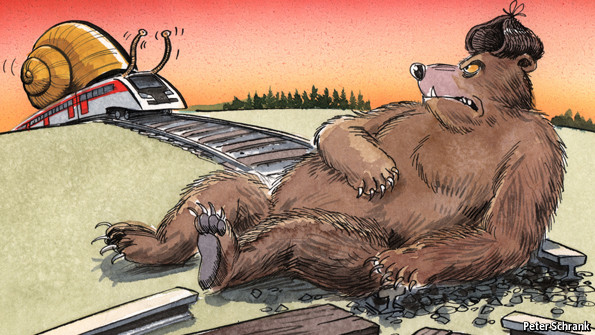
On the Baltic slow train: The geopolitics of the EU’s flagship railway project

On the Baltic slow train: The geopolitics of the EU’s flagship railway project

Oct 19th 2013 |From the print edition

20131019_EUD000_0

THE 600km-long human chain that stretched from Vilnius via Riga to Tallinn in August 1989 came to be the emblem of the Baltic states’ struggle for freedom from the Soviet Union. But more than two decades after they regained independence, their three capitals have no direct passenger train service linking them to each other, let alone to the rest of the European Union. In terms of infrastructure the Baltics are still “captive nations”: the railways run east to Moscow and St Petersburg; the electricity grids are synchronised with Russia’s; and they are largely dependent on Russia for gas. Read more of this post

How not to rescue an airline: The Italian government is pumping even more cash into its ailing carrier

How not to rescue an airline: The Italian government is pumping even more cash into its ailing carrier

Oct 19th 2013 | ROME |From the print edition

ONLY the most gullible or optimistic Italians ever believed that the Phoenix Project launched with great fanfare five years ago would allow Alitalia, Italy’s bankrupt flag-carrier, to soar to profitability. Half-year results approved on September 26th showed a net loss of €294m ($386m), taking total losses since the end of 2008 to well over €1 billion. Its share capital eroded, bleeding cash, with only €128m left, including unused credit lines, Alitalia has run into near-terminal turbulence. Read more of this post

The Economist explains: Why are no-frills airlines so cheap? Ryanair boss promises it will stop being quite so horrible to customers

The Economist explains: Why are no-frills airlines so cheap?

Oct 17th 2013, 23:50 by C.R.

IN THE 1950s flying was a privilege enjoyed by only the wealthiest. The costs of flying were simply too high for most ordinary folk. In 1952 a London-to-Scotland return flight would set the average Englishman back a week’s wages; a trip to New York might require saving up for five months. But in 2013 flying is a mass market, due in no small part to the growth of “no-frills” airlines offering flights at very low prices. Ryanair, an Ireland-based no-frills airline, has even been known to give tickets away for free. How can no-frills airlines be so cheap? Read more of this post

High-yield bonds: An appetite for junk; Companies have taken advantage of investors’ growing willingness to buy speculative bonds

High-yield bonds: An appetite for junk; Companies have taken advantage of investors’ growing willingness to buy speculative bonds

Oct 19th 2013 |From the print edition

20131019_FND010

WHEN cash deposits pay virtually zero, investors have an incentive to take risks in search of higher returns. That has been good news for the high-yield, or junk, bond market, where companies with poor credit ratings (below the investment-grade threshold of BBB) turn for finance. Many companies can now borrow at rates that governments would have been pleased to achieve two decades ago. Indeed, so low have borrowing costs fallen that some wags have dubbed the market “the asset class formerly known as high-yield”. Read more of this post

IBM’s China-driven slump sparks executive shakeup

IBM’s China-driven slump sparks executive shakeup

4:40pm EDT

By Soham Chatterjee and Edwin Chan

(Reuters) – IBM Corp has reassigned the head of its growth markets unit, a source with knowledge of the move said, after a surprisingly steep drop in quarterly hardware sales in China prompted a 7 percent share slide on Thursday. James Bramante’s reassignment was first flagged during the company’s conference call on Wednesday, when Chief Financial Officer Mark Loughridge said sales chief Bruno Di Leo would be taking over at the unit, which oversees growth markets for the company. Read more of this post

Family-owned Dr. Martens footwear and clothing brand nears deal to sell for $484 million

OCTOBER 17, 2013, 11:49 AM

Dr. Martens Nears a Deal

By CHAD BRAY

LONDON – The private equity firm Permira is in “advanced negotiations” to possibly acquire the family-owned Dr. Martens footwear and clothing brand, according to a person familiar with the discussions. The R. Griggs Group, the family business that owns Dr. Martens, is in talks for a deal that could be worth roughly £300 million, or $484 million, the person said. It is unclear whether the deal will result in the family selling the brand or just a license for the name. Read more of this post

The Tequila Curse; the Mexican tequilla industry produces 300 million liters of tequila per year, earning revenue of 21 billion pesos ($1.6 billion) in 2012

The Tequila Curse

By Ted Genoways October 17, 2013

feature_tequila43__630inline

Every year on the Day of the Dead, Guillermo Erickson Sauza invites family and friends to join him at the graves of his great-great-grandfather, Don Cenobio Sauza, and great-grandfather, Don Eladio Sauza, in the Panteón de Mezquitán in Guadalajara. The streets outside are packed with vendors selling skull candles, skeleton dolls, and loaves of bread baked into the shape of crossbones. Visitors throng at the wrought iron gates, so Erickson Sauza sprinkles a trail of marigold petals for his guests to follow and drapes his ancestors’ crypts with bright-orange garlands and wreaths arranged to read “Familia Sauza.” Read more of this post

Russia Roofing Billionaires Seen Among Country’s Youngest; “We earned two degrees, one in physics and one in roofing”

Russia Roofing Billionaires Seen Among Country’s Youngest

Sergey Kolesnikov and Igor Rybakov spent their summers in the early 1990s fixing rooftops around Moscow, a job that paid them about $500 a month. The work gave the aspiring scientists, who were roommates at the Moscow Institute of Physics and Technology, Russia’s top research university, a chance to become entrepreneurs after the fall of the Soviet Union. “We earned two degrees, one in physics and one in roofing,” Kolesnikov said in an interview at his central Moscow office. Read more of this post

How China May Lose a Chance for Reform; The top monopolies run by state enterprises may have cost China $311 billion in lost growth since 2010. An overhaul of state companies looks less and less likely

How China May Lose a Chance for Reform

By Dexter Roberts October 11, 2013

In the runup to November’s big Communist Party confab, known officially as the Third Plenary Session of the 18th CPC Central Committee, expectations among reform advocates are high. At the third plenum in 1978, paramount leader Deng Xiaoping announced gaige kaifang, or reform and opening-up, ending the self-imposed isolation of the Cultural Revolution and exposing China’s economy to market forces. “Thirty-five years after the Communist Party of China lifted the country out of 10 years of chaos and started economic reform and opening up, analysts say the Third Plenary Session of the 18th Central Committee of the CPC has the potential to be a landmark event,” China’s official news agency, Xinhua, wrote on Oct. 9. Read more of this post

Hey China, Stop Laughing at the U.S.; Schadenfreude is easy. Maneuvering and handling the internal politics of reform is hard

Hey China, Stop Laughing at the U.S.

By most accounts, the past few weeks have exposed a drastic maturity gap between the U.S. and Chinese governments. The purported icon of democracy watched its system descend into chaos and petty political gamesmanship, coming within hours of a default that would have sparked global economic disorder. Publicly, Chinese leaders remained statesmanlike and above the fray, withholding comments on the circus in Washington. At the same time, and unsurprisingly, surrogates in the Chinese news media and commentators in the intelligentsia were less restrained. They gleefully piled on with op-ed articles arguing for “de-Americanizing” the world and rapidly reducing China’s purchase of U.S. Treasuries. It is notable that some of these commentaries only appeared in the English-language press, both within China and globally: They were clearly aimed at a Western audience. So was the showy downgrade of U.S. sovereign debt by China’s Dagong Global Credit Rating Co. — a feature of the last debt-ceiling crisis, too. Read more of this post

China set to announce reforms of creaking pension system

China set to announce reforms of creaking pension system: sources

5:13pm EDT

By Natalie Thomas

BEIJING (Reuters) – China is close to announcing long-awaited reforms to its pension system, whose assets are estimated to have already fallen $3 trillion behind projected future payouts, as it seeks to create a sustainable safety net for a rapidly ageing population. The reforms, which may be announced as early as this month, could include merging separate state and private sector employee pension schemes, increasing coverage and broadening the range of assets pension funds are invested in to boost returns and improve efficiency, said sources with knowledge of the discussions. Read more of this post

China Companies Rank Lowest in Survey of Transparency Reporting

China Companies Rank Lowest in Survey of Transparency Reporting

Chinese companies ranked the lowest in a survey of public reporting practices in emerging markets, underscoring concern that the government’s anti-corruption campaign may not take root in the corporate sector. The 33 Chinese multinationals surveyed averaged a score of 2 out of 10 points in Berlin-based Transparency International’s “Transparency in Corporate Reporting” survey, released today. Chery Automobile Co., the closely held carmaker based in Wuhu, China, joined one other company among the 100 surveyed with a score of zero across the three categories measured. Read more of this post

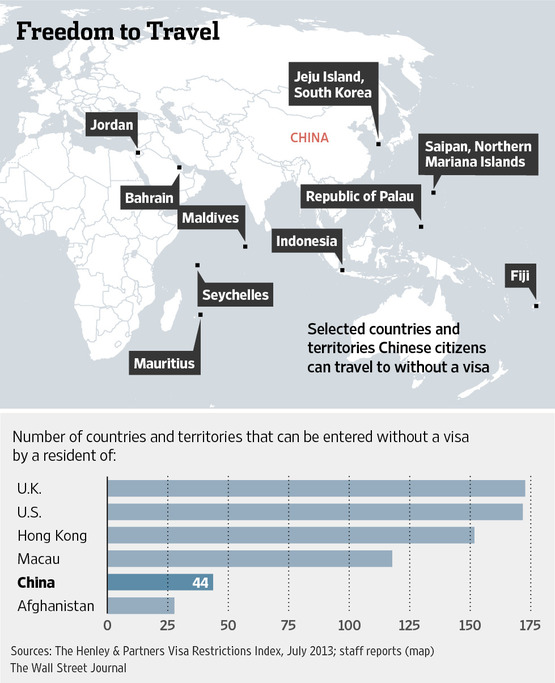
Chasing the Chinese Tourist Yuan; Countries Including the U.S. and U.K. Look to Ease Visa Headaches for Travelers From China

October 17, 2013, 10:51 a.m. ET

Chasing the Chinese Tourist Yuan

Countries Including the U.S. and U.K. Look to Ease Visa Headaches for Travelers From China

WEI GU

AM-BA734_WEICOL_G_20131017054505

The U.K. is the latest country to relax visa rules for visitors from China. The WSJ’s Wei Gu speaks fund manager Jim Rogers about why investors should look beyond the U.S. debt deal and focus on the opportunity offered by Chinese travelers.

Money trumps politics. That rule is being proved again as more Chinese venture abroad—and countries seek to capture that tourist spending by making the visa process easier. So for China’s richest man, Wang Jianlin, the formalities ahead of a trip to the U.K. earlier this year didn’t include lining up at the U.K. Embassy in Beijing. Instead, the U.K. visa service went to him with the equipment to take his application, fingerprints and photograph. The visa service’s efforts paid off: Mr. Wang, the chairman of China’s largest commercial property developer, Dalian Wanda Group, went on a shopping spree. He bought British yacht builder Sunseeker for £300 million ($478 million), and plowed another £700 million into a London site to build Western Europe’s tallest residential tower. Read more of this post

Can Wuhan Become the Detroit of China?

October 17, 2013, 5:02 PM

Can Wuhan Become the Detroit of China?

Colum Murphy for The Wall Street Journal

Wuhan is a city with attitude, known for its hot weather and hot-and-dry noodles. It’s also famous as the birthplace of modern China. The 1911 Xinhai Revolution that brought an end to the Qing Dynasty and led to the establishment of the Republic of China took place here. Today Wuhan, the capital of Hubei province, harbors another aspiration for greatness: It wants to become the Detroit of China (minus the bankruptcy, of course). Read more of this post

StanChart’s Private Bank Assets Stagnate in Wealthier Asian Hunt

StanChart’s Private Bank Assets Stagnate in Wealthier Asian Hunt

Standard Chartered Plc (STAN)’s Asian private-bank asset growth has stagnated this year as the lender focused on wealthier clients and investment returns were curtailed by volatility in regional financial markets. Assets managed in Asia excluding the Indian sub-continent and the Middle East have stayed at about $35 billion, the same as at the end of 2012, said Rajesh Malkani, the private bank’s head of Northeast and Southeast Asia. Globally, Standard Chartered started increasing from late last year the investment threshold for private-bank clients to $2 million, double the previous level, he said. Read more of this post

Toys ‘R’ Us is heading into the holidays with a new leader who has little experience with the U.S. market, owners who don’t always see eye to eye and a debt burden that tops $5 billion

No Joy in Toys ‘R’ Us Land

Management Void Is Finally Filled, but Debt and Ownership Structure Burden Retailer

SUZANNE KAPNER and JOANN S. LUBLIN

Updated Oct. 17, 2013 5:29 p.m. ET

MK-CH142_TOYS_G_20131017180429MK-CH140_TOYS_G_20131017183306

Toys ‘R’ Us hired an insider to be its CEO after external candidates turned down the job. Above, the retailer’s Times Square store in New York. Keith Bedford for The Wall Street Journal

With the holidays approaching, this should be the happiest time of year for a toy company. But Toys “R” Us Inc. is facing a season of uncertainty. The company that helped create the “category killer” retail model is headed into the crucial shopping period with a new leader who has little experience with the hyper-competitive U.S. market. Meanwhile, the company’s longer-term strategy is in flux, and people close to the company say it is hamstrung by owners who don’t always see eye to eye and a debt burden that tops $5 billion. Read more of this post

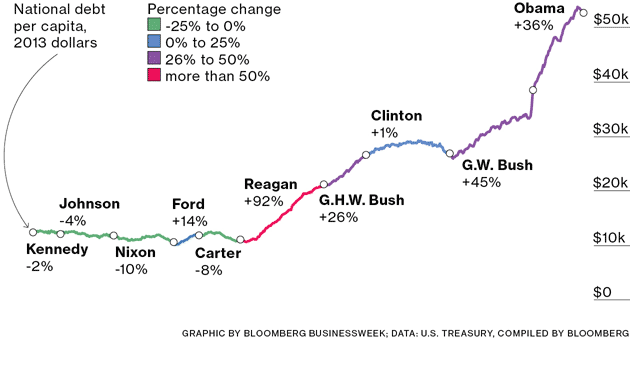
How U.S. Debt Per Capita Has Changed Under Every President Since JFK

How U.S. Debt Per Capita Has Changed Under Every President Since JFK

By Giovanni Salzano October 17, 2013

The national debt has not always been the hot-button issue it is today. In the Kennedy, Johnson, Nixon, and Carter administrations, inflation-adjusted debt per capita dropped.

econ_debtchart43_630

Deep Divide Lingers After Impasse Ends; Pessimism Greets Lawmakers as They Start Negotiations on Broad Budget Deal

Deep Divide Lingers After Impasse Ends

Pessimism Greets Lawmakers as They Start Negotiations on Broad Budget Deal

DAMIAN PALETTA

Updated Oct. 17, 2013 8:01 p.m. ET

P1-BN587B_DEBT__G_20131016211807

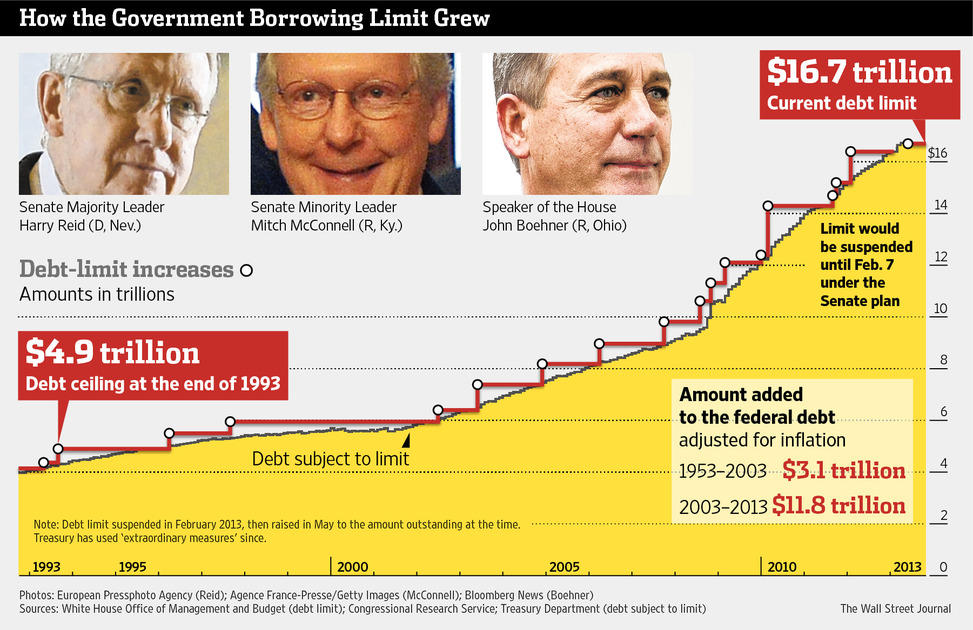
WASHINGTON—Eight hours after President Barack Obama signed a bill to reopen the federal government, top congressional budget leaders from both parties gathered over breakfast to try to find common ground in coming weeks. But differences between the two sides remain stark, and a number of congressional aides said the chances of devising a budget that both parties can live with are low. The conference committee the lawmakers head faces a Dec. 13 deadline under the package Congress approved late Wednesday. Read more of this post

Shutdown Hit Boehner’s Favorite Diner as $24 Billion Lost; money lost during shutdown can’t be easily recovered, creating a long-term ripple effect that will be difficult to forget

Shutdown Hit Boehner’s Favorite Diner as $24 Billion Lost

Gum Tong owns a diner in Washington, D.C., and Matt Bellinger charters fishing boats in the Florida Everglades. They have this in common: The shutdown of the U.S. government cost them money they will never get back. Pete’s Diner & Carryout, a 50-year-old Capitol Hill eatery frequented by House Speaker John Boehner, lost about 80 percent of its usual business, said Tong, surrounded by empty seats and Halloween decorations. Bellinger missed out on $1,000 a day in canceled charters because Everglades National Park was closed. Read more of this post

Restarting U.S. Government Seen as Harder Than Shutdown

Restarting U.S. Government Seen as Harder Than Shutdown

Starting up the government will be harder than it was to shut it. The legislation passed by Congress last night to raise the debt ceiling and fund the government into 2014 will bring hundreds of thousands of federal workers back to their jobs and reopen national parks and museums. Yet it may be weeks or even months before the government resumes issuing loans, payments and contracts at a normal pace. Read more of this post

Ikea Keeps Lid on Billy Prices in Europe as Inflation Weakens; The Billy index calculates the cost across 43 countries of Ikea’s white bookcase

Ikea Keeps Lid on Billy Prices in Europe as Inflation Weakens

Ikea will keep a lid on prices of its Billy bookshelves in most euro-area countries next year, underscoring a lack of inflation in the 17-member currency bloc. The signature bookcase remains cheapest in Europe, according to the 2014 catalog on the website of the world’s biggest home-furnishings retailer, compiled in Bloomberg’s annual global index. The shelves are least expensive in Slovakia and the Netherlands, with a price of 34.95 euros ($46.48). Read more of this post

Fed’s Fisher warns of potential U.S. housing bubble, MBS buys

Fed’s Fisher warns of potential U.S. housing bubble, MBS buys

11:14am EDT

By Jonathan Spicer

NEW YORK (Reuters) – A top Federal Reserve official said on Thursday he is seeing fresh signs of a U.S. “housing bubble” and warned about the central bank’s ongoing purchases of mortgage-based bonds. “I’m beginning to see signs not just in my district but across the country that we are entering, once again, a housing bubble,” Dallas Fed President Richard Fisher told reporters after a speech in New York. “So that leads me … to be very cautious about our mortgage-backed securities purchase program.” Read more of this post

EBay, Ellison Embrace Microgrids in Threat to Utilities

EBay, Ellison Embrace Microgrids in Threat to Utilities

Oracle Corp. Chief Executive Officer Larry Ellison plans to build one to power the Hawaiian island he bought last year. EBay Inc. (EBAY) has one to run a data center. The University of California at San Diego and the federal government have invested tens of millions of dollars in the technology.

Microgrids are emerging as a credible threat to the dominance of America’s 100-year-old-plus utility monopoly. The small-scale versions of centralized power systems, once just used against blackouts, are now gaining thousands of customers as homeowners in states with high power costs turn to them as a way to manage rooftop solar systems, cut electricity bills and, in some cases, say goodbye to their power companies.

The systems use computer software and remote measuring devices to control energy sources such as rooftop solar panels and natural gas-fueled power generators. They allow a home or business owner, a college systems engineer or a farmer on a mountainside to generate, distribute and regulate their locally produced power with an ease and sophistication that only utilities had a few years ago.

Not much of a factor a decade ago, microgrids are expected to explode into a $40 billion-a-year global business by 2020, according to Navigant Research, a clean-technology data and consulting company. In the U.S., about 6 gigawatts of electricity — enough to power as many as 4.8 million homes — will flow through microgrids by 2020, Navigant said.

Utility Leapfrog

“Microgrids are going from evolutionary to revolutionary,” said Jon Creyts, a program director at the Rocky Mountain Institute, a nonprofit energy and environmental think tank. While microgrids control a sliver of generation in relation to the overall grid, they are being built with a speed and projected scale that is cause for utilities to worry, according to Creyts.

In the developing world, they may leapfrog the need for conventional utilities — the same way mobile phones leapfrogged the need for landlines — and bring power almost half of the 1.3 billion people on Earth who don’t have it.

While the earliest microgrids controlled simple generator backup systems, they have evolved into sophisticated smart grids. Operators can remain tethered to the larger grid and switch seamlessly between the electricity they generate and utility power, whichever is cheaper. They can even sell surplus electricity back to the utilities through a process known as net metering.

If the main grid goes down, a flip of a switch or automated computer program deploys their mix of green energy, backup generators and storage batteries to keep the lights on.

Eating Revenue

Microgrids have the potential to radically change the U.S. electricity paradigm as they proliferate and begin to eat into the utility revenue stream. For example, U.C. San Diego saves an estimated $850,000 a month on its electricity bill by self-generating and using its microgrid to fine-tune campus power consumption.

The 3,200 U.S. utilities are already facing what NRG Energy Inc. CEO David Crane calls a “mortal threat” to the industry. Forces including deregulation, green politics and an explosion of rooftop solar and other homemade energy — known as distributed generation — mean a reduction in the fossil-fuel electricity utilities sell.

Microgrids may be the mechanism through which this revolution in clean distributed generation will be carried out – – a portal for leaving the traditional power grid.

Mixed Reaction

For utilities, which sell $400 billion worth of electricity a year delivered by 2.7 million miles (4.3 million kilometers) of power lines, the reaction is mixed.

In California, epicenter of the rooftop solar revolution, utility executives have begun to complain to regulators that microgrid operators who remain tied to power lines should shoulder some of the costs of keeping the grid stable, perhaps through connection fees. Sempra Energy (SRE) and American Electric Power Co. are considering microgrid investments as a way to hedge the threat.

While only about 30 commercial-scale systems like those used by EBay and the U.S. Food and Drug Administration exist now, that number is projected to climb to 300 in just two years, said Steve Pullins, chief strategic officer for Green Energy Corp., a Tennessee-based builder of commercial-scale microgrids.

His company estimates that 24,000 U.S. commercial and industrial sites are ripe for large-scale microgrid conversions. Globally, about 400 additional big microgrid projects are under way. Lockheed Martin Corp. completed in May the U.S. Army’s first domestic microgrid at Fort Bliss in Texas. The military is already using them at sites in other countries to reduce fuel consumption.

Requests Increase

“We are seeing requests for proposals going up significantly, 30 to 40 percent higher than last year,” said Paul Orzeske, president of the Honeywell International Inc. unit that designs and builds commercial-scale microgrids. Honeywell built a $71 million microgrid for an FDA research center in Maryland and the agency is in the midst of a $213 million addition that will be online early next year. On the consumer level, San Francisco-based Gen110, which installs leased microgrid systems with no out-of-pocket costs to homeowners, is attracting utility customers put off by tiered pricing that penalizes them when their use exceeds a certain level. Read more of this post
Brazilian Drugstore Billionaire Open to CVS Partnership; “The Brazilian market requires knowledge of the complexity of the tax regime — that’s the main barrier.”

Drugstore Billionaire Open to CVS Partnership: Corporate Brazil

Empreendimentos Pague Menos SA, Brazil’s second-biggest drugstore company, would consider U.S. partners such as CVS Caremark Corp. and Walgreen Co. to expand amid heightened competition, its chief executive officer said. “We’ve been approached by some companies, but we would only do it with a strategic partner,” Francisco Deusmar de Queiros, 66, the billionaire CEO of the closely held chain, said in an interview at Bloomberg’s Sao Paulo office without naming any prospects. “The right partner has yet to appear — the right partner that enchants us to go to the ball and dance.” Read more of this post

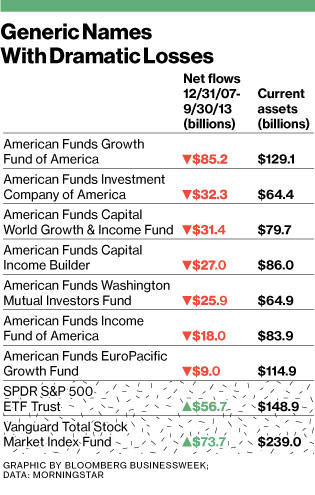
American Funds Defends Active Investing After Massive Investor Retreat

American Funds Defends Active Investing After Massive Investor Retreat

By Christopher Condon October 17, 2013

mf_active43table_315inline

On the eve of the financial crisis, Capital Group was king of the mutual fund business—even though most investors had never heard of it. The Los Angeles-based company’s American Funds unit ran seven of the nation’s 10 biggest funds, including the largest of all, the $193 billion Growth Fund of America. Eagerly sold by brokerages such as Merrill Lynch (BAC) and Edward Jones, the funds had no need for mass marketing to attract investors and even less for media attention. Capital Group has issued only three press releases in its 82-year history and politely declines most requests for comment. The idea was that the blandly named funds’ outstanding returns spoke for themselves. Read more of this post

HKMA has proposed that Chinese authorities remove a 20,000 yuan ($3,280) daily currency conversion limit on the city’s permanent residents

Hong Kong Proposes Removing Yuan-Conversion Limit on Locals

The Hong Kong Monetary Authority has proposed that Chinese authorities remove a 20,000 yuan ($3,280) daily currency conversion limit on the city’s permanent residents, according to Chief Executive Norman Chan. “The People’s Bank of China said this is feasible and it will pro-actively consider it,” Chan told reporters in Beijing today. “That’ll make it easier for banks to sell wealth-management products denominated in yuan.” Read more of this post

Brewing U.S. ethanol legal battle hinges on meaning of ‘supply’

Brewing U.S. ethanol legal battle hinges on meaning of ‘supply’

9:34pm EDT

By Cezary Podkul

CHICAGO (Reuters) – The fate of a landmark U.S. requirement to blend increasing amounts of biofuels into the nation’s gasoline pool rests on the meaning of three words tucked into a mammoth law: unless there is “inadequate domestic supply.” But “supply” of what? The law does not say. As a years-long battle over the future of the U.S. fuel supply begins to shift to the courts, the two fierce foes – the biofuel industry and oil refiners – are debating a definition that lawyers say leaves much room for interpretation. Read more of this post

40 Years After Embargo, OPEC Is Over a Barrel

40 Years After Embargo, OPEC Is Over a Barrel

Today marks the 40th anniversary of the Organization of the Petroleum Exporting Countries embargo against the U.S. and states that supported Israel after Egypt and Syria initiated simultaneous offensives against it on Yom Kippur in 1973. While it’s not an anniversary that many will celebrate, it’s a good opportunity to reflect on how much more secure our energy situation is, despite our continued heavy reliance on fossil fuels. Read more of this post

Dynasties Reinforced as Mahathir Son in UMNO Bid: Southeast Asia

Dynasties Reinforced as Mahathir Son in UMNO Bid: Southeast Asia

Mukhriz Mahathir, the 48-year-old son of Malaysia’s longest-serving prime minister, will tomorrow contest the vice presidency of the nation’s biggest political party, staking his claim as a potential future national leader. The United Malays National Organisation, or UMNO, which has led coalitions to govern Southeast Asia’s third-biggest economy since independence from Britain in 1957, will elect party leaders who typically hold their posts for three years. As UMNO seeks to shore up its base after a May general vote that saw the government returned by its smallest margin, the meeting will provide an insight into policy priorities and leadership style ahead of the next election due in 2018. Read more of this post