Aussies the world’s richest people by the median wealth measure: Credit Suisse

Aussies the world’s richest people: Credit Suisse

October 9, 2013 – 1:20PM

Australians remain the richest people in the world, by one measure at least. The median wealth of adult Australians stands at $US219,505 ($233,504) – the highest level in the world, according to the Credit Suisse 2013 Global Wealth Report, released on Wednesday. Median wealth is the midpoint between richest and poorest, meaning that 50 per cent of the population has more than $233,504, and 50 per cent less than that. By the measure of average wealth, Australians fall back to second with $US402,578 per person, ranking behind the Swiss who were the world’s richest on $US513,000. Read more of this post

In Indonesia, a New Breed of Politician Is on the Rise

Updated October 8, 2013, 10:15 p.m. ET

In Indonesia, a New Breed of Politician Is on the Rise

‘What We’re Seeing Is Extraordinary”

BEN OTTO And ANDREAS ISMAR

Fifteen years after the overthrow of strongman Suharto, and less than a year before Indonesia’s first transition between two directly elected presidents, leaders that bear little resemblance to their predecessors are emerging in this young democracy of more than 240 million people. They are mayors, governors and technocrats with a reputation for clean hands in a country dogged by corruption. Many have risen with little money and few connections in a political system where leaders traditionally hail from the military or dynastic families. Read more of this post

50% of Jakarta Public Transport Drivers Don’t Have Licenses

50% of Jakarta Public Transport Drivers Don’t Have Licenses

By Suara Pembaruan on 4:46 pm October 8, 2013.
Category Law & OrderNews
Almost half of Jakarta’s 28,000 public transport drivers are either not in possession of a motor vehicle license or are too young to be behind the wheel, according to an official with the city’s transportation council. “Around 50 percent of public transport drivers in Jakarta don’t have a driver’s license,” Azas Tigor Nainggolan, chairman of Jakarta Transportation Council told BeritaSatu on Tuesday. “Our field observations show that, mainly at night, many of the drivers are in fact minors. Sometimes, they’re even driving drunk.” Read more of this post

We Have Made India The Tech Capital Of Biometrics: Nandan Nilekani

We Have Made India The Tech Capital Of Biometrics: Nandan Nilekani

by Rohin Dharmakumar, Seema Singh, N.S. Ramnath | Oct 8, 2013

Nandan Nilekani on the Aadhaar project’s scope, its vulnerabilities and its future

Q. How long does the UIDAI hold transaction data and what steps has it taken to ensure that the privacy of users’ data—demographic & transactional—will be safeguarded from any third party?
We are in the process of finalising the policy for that. UIDAI only gets the location, time and the device from which the authentication request came from. It is a federated database with in-built optimal ignorance among various players. At the design level itself, we don’t have transactional data, except that we had an authentication request. When we do authentication, if we get a claim that it is a ‘false accept’, we, in turn, have to investigate and that’ll decide how long we retain the data. We have to strike a balance between privacy issues and liability issues, looking at practices of banks and switching companies. But let me tell you that we take great care to safeguard the data. We encrypt at source; we anonymise data when we send it for verification; the database itself is encrypted; we have layers and layers of security. In fact, as far as biometrics is concerned, once we have extracted the minutiae, we put it offline.   Read more of this post

Taiwan Warns That China Could Mount Successful Invasion by 2020

Taiwan Warns That China Could Mount Successful Invasion by 2020

By Debra Mao and Argin Chang  Oct 8, 2013

China may be able to successfully invade Taiwan by 2020 as it develops technology to prevent allies such as the U.S. from coming to the island’s aid, the Taiwanese defense ministry said. A military modernization campaign has seen China’s People’s Liberation Army enhance its ability to make long-range precision strikes and develop so-called area-denial technology, the ministry said in its 2013 National Defense Report. Read more of this post

Taiwan saw a 30-percent drop in Chinese tour group travelers in the first week of October — a long holiday in mainland China — compared to the same period last year due to a new law restricting low cost tours

Fewer Chinese tours to Taiwan after new law

CNA
October 9, 2013, 12:07 am TWN

TAIPEI — Taiwan saw a 30-percent drop in Chinese tour group travelers in the first week of October — a long holiday in mainland China — compared to the same period last year, a phenomenon the Tourism Bureau attributed yesterday to a new law restricting low cost tours. Only 19,698 Chinese visitors entered Taiwan between the holiday break of Oct. 1-7 due to mainland China’s new Tourism Law, which bans operators from offering low-priced or free tours and making up the profits through additional charges or commissions from particular shops, Taiwan’s Tourism Bureau said. Read more of this post

Thailand’s one tablet per child program rocked by claims of 30% broken tablets

Thailand’s one tablet per child program rocked by claims of 30% broken tablets

October 8, 2013

by Saiyai Sakawee

One Tablet Per Child is a policy launched last year by the Thai government in an attempt to improve education and address issues of inequality. Basically, the government gives away tablets to first graders, hoping that being able to connect to the internet and work online together will help improve the quality of their education. However, an audit – as spotted by the Bangkok Post – claims that many of the tablets have flaws. The Office of the Auditor-General (OAG) says that about 30 percent of the 860,000 tablets distributed to students last year are reported as being broken or needing repair. Read more of this post

Millions of poor people during Brazil’s decadelong boom took out loans to speed their rise to the middle class. Now comes the less glamorous side of a consumer’s life: paying off debt

Updated October 8, 2013, 11:18 p.m. ET

Bill Comes Due for Brazil’s Middle Class

Debt Woes Help Explain Why the Country’s Once-Dazzling Growth Has Fizzled

LORETTA CHAO and JOHN LYONS

P1-BN457_BCREDI_NS_20131008181504 P1-BN458_BCREDI_G_20131008184207

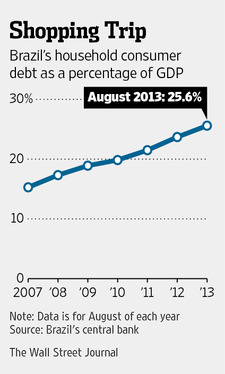
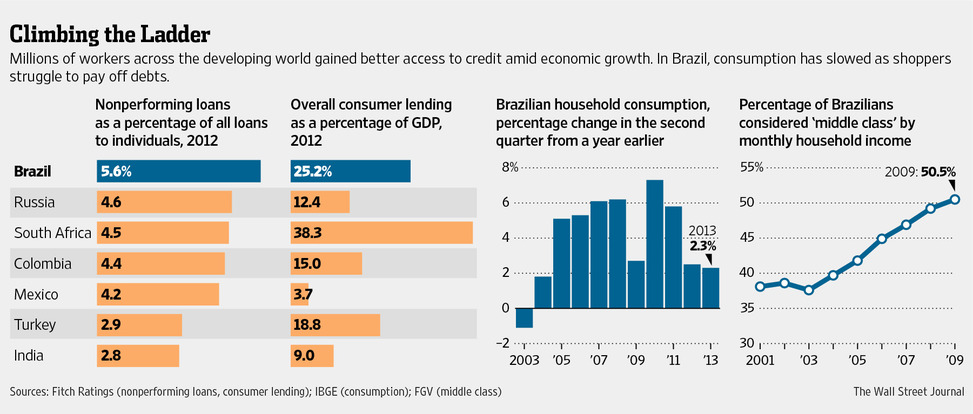
SÃO PAULO, Brazil—Like millions of poor people during Brazil’s decadelong boom, Odete Meira da Silva took out loans to speed her rise to the middle class. The single mom bought a computer, a flat-screen TV and started building a concrete home on the rough southern edge of this sprawling city. Now, her spending spree is over. The 56-year-old small-business owner is today concerned with a less glamorous side of middle-class life: paying off debt. After her ballooning credit-card bills exceeded what she could afford, she cut back on everything and stopped home construction. On a recent day, a bare concrete staircase rose from her living room to an unfinished second floor. It is a reminder of her own halfway climb up Brazil’s economic ladder. Read more of this post

Brazil’s next major export: literature

Brazil’s next major export: literature

By Lily Kuo @lilkuo 9 hours ago

Troubled by high inflation and poor infrastructure, Brazil is looking to literature to boost its economy. Tomorrow, 70 Brazilian writers and over 100 publishers will descend on the world’s largest book fair when it opens in Frankfurt with Brazil as its guest of honor. There, they’ll promote the country’s literary wares in a 2,500 sq. meter pavilion (8,200 sq. feet.) via video installations and art. Read more of this post

Putting a Speed Limit on the Stock Market

October 8, 2013

Putting a Speed Limit on the Stock Market

By JACOB GOLDSTEIN

When Brad Katsuyama was running the U.S. trading desk for the Royal Bank of Canada, his clients would send in orders every day, but every day, when Katsuyama went to buy or sell, something would go wrong. When he wanted to buy, offers to sell shares would suddenly vanish, and the price of the stock would shoot up. When he wanted to sell, the same thing would happen in reverse. “I started to realize that, day in and day out, I was getting screwed,” Katsuyama told me recently. Read more of this post

Singapore Girl is facing a bumpy ride; Competition between low-cost carriers has driven down fares

October 8, 2013 5:25 pm

Singapore Girl is facing a bumpy ride

By Jeremy Grant

Competition between low-cost carriers has driven down fares

Singapore Girl is flying into turbulence.

For years the advertising icon of Singapore Airlines – a stewardess dressed in a sarong designed by a Parisian couturier – has projected an image of unimpeachable reliability and graceful Asian hospitality. That has helped to create one of the most recognisable and trusted brands in the global airline business. It has also helped to underpin one of its most financially successful. Singapore Airlines (SIA) has never in its 28 years as a listed company recorded a loss in any full financial year – a feat virtually unheard of in an industry that has bled red ink ever since commercial jet flight began in the 1950s. But the winds of change are blowing in the Asian airline industry as low-cost carriers such as AirAsia, owned by Malaysian entrepreneur Tony Fernandes, have steadily eaten away at the market share of established carriers such as SIA and Cathay Pacific. Read more of this post

Fidelity Billionaire Johnson Taps ETFs as Profits for Funds Fade

Fidelity Billionaire Johnson Taps ETFs as Profits for Funds Fade

When Abigail Johnson began her apprenticeship at Fidelity Investments 25 years ago, the Boston-based firm founded by her grandfather was the nation’s biggest mutual-fund company and star manager Peter Lynch was enjoying a performance streak at the Magellan Fund — a 29 percent average return over 13 years — that ranks among the best in the industry’s history. A year ago, Johnson, now 51, was named president of a very different Fidelity. Under her father, Edward C. Johnson III, known as Ned, Fidelity has surrendered its leadership and much of its iconic status as a money manager, Bloomberg Markets magazine will report in its November issue. Fees for investing client money in its own funds now produce less than half of Fidelity’s revenue, and rivals BlackRock (BLK) Inc., Pacific Investment Management Co. and Vanguard Group Inc. have shot past Fidelity in assets managed in the course of the past five years. Read more of this post

China sacks official over lavish, three-day wedding

China sacks official over lavish, three-day wedding

6:48am EDT

BEIJING (Reuters) – China sacked an official for “extravagant waste” after he spent an estimated 1.6 million yuan ($260,000) on a lavish, three-day wedding for his son, state media said on Tuesday, the latest move in a crackdown on profligate lifestyles and graft. Ma Linxiang, a deputy village chief from the Beijing suburb of Qingheying, hosted the estimated 250-table wedding at a convention center that was part of the main 2008 Beijing Olympics venue during the week-long National Day holiday last week, newspapers reported. Read more of this post

Chocolate Tempts India’s Sweet Tooth

October 8, 2013, 5:12 p.m. ET

Chocolate Tempts India’s Sweet Tooth

NEENA RAI And DEBIPRASAD NAYAK

When Deepti Ranjan was a child, a box of Cadbury’s candy-coated chocolate Gems or a caramel-chocolate 5-Star bar was a luxury. Now Ms. Ranjan, a 32-year-old software developer from Bangalore, is a chocoholic. She says she tries two or three chocolate varieties a month. Among her favorites are honey-sweet Swiss Toblerone and Cadbury’s Bournville, a dark-chocolate bar marketed with the tagline “You don’t buy a Bournville, you earn it.” “With my earnings,” says Ms. Ranjan, “I am discovering my secret passion.” India’s vast, growing middle class has the world’s chocolate purveyors on a sugar high. Rising demand in Asia is a important reason that cocoa futures have been the best-performing commodity so far this year—up 19%, even as other agricultural commodities have slumped. Read more of this post

The Strategy Behind China’s Aid Expansion; Between 2001 and 2011, China’s pledged foreign aid was $671 billion

October 8, 2013, 7:13 p.m. ET

The Strategy Behind China’s Aid Expansion

Between 2001 and 2011, China’s pledged foreign aid was $671 billion.

CHARLES WOLF JR.

In 2001, China spent roughly $1.7 billion on foreign aid. By 2011, the annual foreign-aid figure had risen to $189.3 billion. Part of the increase reflects the growth in China’s economy. But this is an increase with a purpose, and China’s foreign-aid programs are as different from aid programs conducted by the U.S. and other Organization for Economic Cooperation and Development countries as East is from West. Read more of this post

Lululemon’s next challenge: overseas growth

Lululemon’s next challenge: overseas growth

5:25pm EDT

By Solarina Ho

TORONTO (Reuters) – In a narrow, bustling street in Hong Kong’s trendy Soho district, a small Lululemon Athletica Inc (LULU.O: QuoteProfileResearchStock Buzz) test boutique is helping to lay the groundwork for what the premium yogawear maker sees as a promising avenue for growth. The Canadian retailer is casting an eye on international markets even as it grapples with the demands of finding a new chief executive, mending a tarnished image after an embarrassing recall of overly sheer pants and pursuing expansion in the United States. It’s a tricky move even in the best of times. While the rewards are alluring, such global markets can be fickle, complicated and risky. Read more of this post

Singapore Circuit Breakers Sought After Losses: Southeast Asia

Singapore Circuit Breakers Sought After Losses: Southeast Asia

Singapore Exchange Ltd. (SGX), Southeast Asia’s biggest bourse, faces calls from investors to add circuit breakers after a plunge in shares of three commodity companies erased $6.9 billion in value over three days. The bourse operator imposed unprecedented trading restrictions on Blumont Group Ltd. (BLUM), Asiasons Capital Ltd. and LionGold (LIGO) Corp. after their stock prices plunged. Trading caps to prevent sharp gains or losses will give investors time to assess their holdings, according to Liquidnet Holdings Inc. and the Securities Investors Association of Singapore. Read more of this post

Sri Lanka Targets Wealthy Asians in Singapore-Style Casino Push

Sri Lanka Targets Wealthy Asians in Singapore-Style Casino Push

Louise Fernandez has visited Sri Lanka about five times in the past decade, drawn by its white sandy beaches, tea plantations and historic temples. The South Asian island is about to give her more reasons to return. The Sri Lankan parliament is due to approve today a tax amnesty for the island’s first foreign casino venture, a $350 million investment backed by Australian James Packer’s Crown Ltd. The 400-room waterfront project will join a growing lineup of luxury Colombo hotels, including a $400 million beachfront Shangri-La, the Taj group’s upgraded five-star Samudra Colombo, and a John Keells Holdings Plc. gaming resort. Read more of this post

Default risk a ‘giant Taser’, says Alcoa chief

October 8, 2013 11:14 pm

Default risk a ‘giant Taser’, says Alcoa chief

By Ed Crooks in New York

The threat that the US might refuse to raise the debt ceiling is a “giant Taser” freezing confidence in the world economy, Klaus Kleinfeld, chief executive of Alcoa,the US aluminium group, has warned. Speaking as Alcoa reported strong growth in earnings for the third quarter, Mr Kleinfeld said the disputes in Washington were hurting confidence not just in the US but globally. Read more of this post

Buyout debt returns to pre-crisis levels in US

October 8, 2013 6:38 pm

Buyout debt returns to pre-crisis levels in US

By Anne-Sylvaine Chassany, Private Equity Correspondent

The amount of debt in US leveraged buyouts has increased to levels reminiscent of the boom years before the financial crisis, as private equity groups tap buoyant credit markets. Private equity investors aim to boost their returns by using more bank debt or bonds than their own cash to fund takeovers. By the end of September, the debt component in US deals, which is serviced by the profits of the purchased companies, equalled 5.3 times the companies’ earnings before interest, taxes, depreciation and amortisation (ebitda), according to S&P Capital IQ. This is the highest ratio since 2007, when the average debt portion reached a peak of 6 times ebitda, and surpasses the 2006 level of 5.1 times. Read more of this post

While Norway’s election handed power to a coalition led by women, Scandinavia’s richest economy is reserving its top corporate jobs and biggest pay checks for men

Sex Gap Alive and Kicking in Norway as Women Rule in Politics

While Norway’s election handed power to a coalition led by women, Scandinavia’s richest economy is reserving its top corporate jobs and biggest pay checks for men. Norway is set to get its first female prime minister in 17 years as Conservative Party leader Erna Solberg, 52, takes over on Oct 18. Her coalition partner, the Progress Party, is led by 44-year-old Siv Jensen. Women also head Norway’s largest labor union and its biggest employers group. Read more of this post

Chengdu mall has everything but crowds

Chengdu mall has everything but crowds

20131007_escalators_chengdu_st

Tuesday, October 8, 2013 – 03:00

Esther Teo

The Sunday Times

CHINA – With its undulating silhouette and hulking size, the New Century Global Centre – the world’s biggest building – is impossible to miss among the tall skyscrapers of Chengdu. The massive glass and steel structure sits snugly like a heavy metal box placed on the earth by the gods in this south-western Chinese city of 14 million. The centre officially opened on Sept 1 in Tianfu New District in Chengdu’s south – a new business area that aims to accelerate the city’s development. It is 100m tall, 500m long and 400m wide, offering 1.7 million sq m of floor space – or 12 times that of Singapore’s largest mall, VivoCity. Put another way, it could fit 20 Sydney Opera Houses. If that does not begin to hint at its massive scale, consider what’s inside: a university campus, two hotels, a shopping mall, an Imax cinema, offices, a convention centre and a seaside resort with water lapping on a fake beach, an Olympic- size ice rink and Mediterranean- themed shopping village. Clearly, if anyone needs a definition of excess, this is it. When I stepped through the revolving doors of the all-in-one shopping mall, vast khaki-toned marbled halls lined with palm trees greeted me. The cavernous central atrium compelled me to gaze upwards to figure out just how high the glass ceiling went. Natural sunlight filtered in through the wave-like roof structure as winding escalators – some golden in colour and with bright blue LED panels on the sides – criss-crossed one another, giving a sense of opulence. Read more of this post

Does 6,000 Percent Interest Make You a Loan Shark? The recession in the U.K. has produced an explosion of payday lenders, with much of the action online. Britons now take out more than 8 million short-term loans worth more than 2 billion pounds a year

Does 6,000 Percent Interest Make You a Loan Shark?

The recession in the U.K. has produced an explosion of payday lenders, with much of the action online. Britons now take out more than 8 million short-term loans worth more than 2 billion pounds a year, at least double the amount in 2008, at theoretical annualized interest rates of 5,853 percent or more. These “legal loan sharks” have become a big issue. According to the U.K. consumer group Which?, 38 percent of those who take out short-term loans use them to pay for essentials, such as food and fuel; a quarter repay other loans. Read more of this post

Panic: 1 Month Bill Yield Explodes, Prices At 0.35% Highest Since Lehman

Panic: 1 Month Bill Yield Explodes, Prices At 0.35% Highest Since Lehman

Tyler Durden on 10/08/2013 11:39 -0400

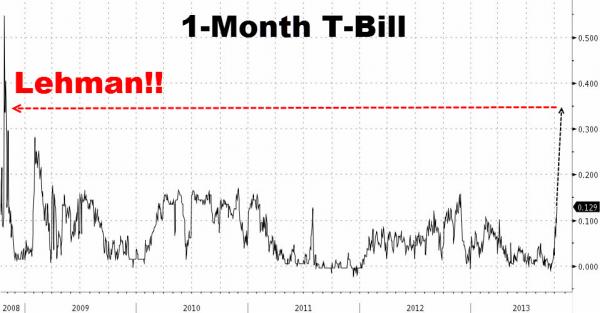
Moments ago, the just concluded 4 week Bill, with a Cusip which appropriately enough was BK, priced at a stunning 0.35%, blowing through the 0.295% When Issued, the highest yield since October 2009, the lowest Bid to Cover since March 2009, and the largest tail since March 25, 2008. The bond market panic is palpable, and just as we predicted would happen in a market gripped by sheer “Bernanke will kiss and make it all better” complacency.
20131008_1m_0

Updated October 8, 2013, 12:42 p.m. ET

Default Worry Hammers Short-Term U.S. Debt

T-bill Yields Climb to Highest Since October 2008

CAROLYN CUI And KATY BURNE

Short-term U.S. debt prices tumbled again Tuesday amid rising investor concern about the prospect of a government-debt default, sending the yield on one-month U.S. Treasury bills to its highest level since the financial crisis.

With little sign that Republicans and Democrats will hammer out a compromise on the partial government shutdown, many in the financial markets are starting to worry about the prospect of a default.

Treasury bills maturing on Oct. 31—a date many market participants predict for the Treasury to run out of cash to pay its bills—sold off sharply Tuesday, driving their yields up to 0.35%, the highest level since October 2008.

Concern about the stalemate in Washington was also evident in Tuesday’s auction of new bills. The Treasury Department sold $30 billion worth of four-week bills maturing on Nov. 7 at a rate of 0.350%, the highest rate the government paid on such short-dated debt in five years.

Money-market funds and banks are typically the biggest buyers of Treasury bills, where they park their idle cash for a short time. But they shied away from the auction Tuesday. The bid-to-cover ratio, a gauge of investor demand, was 2.76, the lowest since July 2009 for four-week bills, according to Nomura Securities.

“It was an awful auction,” said Priya Misra, head of U.S. rates strategy research at Bank of America Merrill Lynch.

In another sign of weak demand, the “tail,” or the difference between the highest yield on the securities during the auction and the expected high yield when the auction starts, was as wide as 0.05 percentage points, the largest since March 25, 2008, according to Bank of America.

In the market for derivatives known as credit-default swaps, which some traders use to bet that a debt issuer will default, investors now are pricing in a 3% probability the U.S. won’t pay its obligations in timely fashion. Traders were asking Tuesday for €58,800 ($79,856) to insure €10 million of U.S. debt for a year, up 9.7% from Monday and up tenfold from Sept. 20 levels. U.S. credit-default swaps trade in euros to help users hedge the risk of a depreciating dollar in the event of a default.

The U.S. Treasury has said it will run out of emergency borrowing capacity around Oct. 17. By Oct. 31, the government could deplete all its available funds and face the risk of a default on bills or bonds that are due around month’s end, according to J.P. Morgan Securities LLC. Prices for bills maturing between mid-October and early November fell the most.

Some money managers said they sold these maturities to avoid potential losses or the operational difficulties of dealing with defaulted securities.

For now, investor concerns appear to be limited to these short-term securities. The yields of longer-term bills, those maturing in three, six and 12 months, remain near zero, and the yield on the 10-year note has been holding steady, settling at 2.634%.

U.S.-listed money-market funds saw a small outflow of $3.679 billion in the week ended Oct. 2, according to EPFR Global, a fund data provider.

“We’re still not seeing a great deal of concern among retail investors of the probability of a debt-ceiling incidence,” said Jake Lowery, portfolio manager with ING U.S. Investment Management. “While managers are trying to minimize their exposure to Treasury bills that are most likely to be impacted by any default, investors still believe T-bills are a safe-haven asset.”

The repurchase market, known as repo, where banks and other financial institutions get billions of dollars of short-term funding by borrowing and lending securities—often short-term Treasury debt—is beginning to show some stress.

It cost 0.09% to borrow cash overnight against short-term Treasury debt Tuesday, up from 0.05% in late September, according to the Depository Trust & Clearing Corporation.

Traders and banks are concerned that a Treasury default on its debt could mean they are pushed to pay a much higher rate to borrow against short-term Treasury securities, or they may simply refuse to lend cash against such securities, analysts say. U.S. government securities amount to about one-third of all the securities used to back up loans obtained in the repo market.

In 2008, concerns about borrowers’ ability to repay their debts froze the repo market as investors shied away from trading with certain financial institutions. This time around, the repo market is dealing with a more fundamental question: What’s the credit quality of the Treasury securities backing the loans?

Declines in the value of T-bills, considered one of the most risk-free assets in the world, will have a knock-on effect on other assets used to back loans in the repo market, Ms. Misra said.

“In the run-up to a default or following a default, there could be significant changes in pricing of equities, corporate bond and other securities,” said Alex Roever, head of U.S. rates strategy at J.P. Morgan Chase.
South Korea’s Celltrion CEO to Be Probed in Stocks Trading Case

South Korea’s Celltrion CEO to Be Probed in Stocks Trading Case

South Korea’s financial regulator plans to ask prosecutors to investigate the chief executive officer of Celltrion Inc. over alleged stock price manipulation, the drug manufacturer said today. The Financial Services Commission is asking prosecutors to probe the actions of Celltrion’s largest shareholder, the company said in an e-mailed statement. Celltrion disagrees with the FSC’s decision and plans to cooperate with prosecutors, the company said. Celltrion’s largest shareholder is CEO Seo Jung Jin, spokesman Kim Joon Seok confirmed by phone. Read more of this post

How Investors Lose 89 Percent of Gains from Futures Funds

How Investors Lose 89 Percent of Gains from Futures Funds

The pitch was enticing. At a time when the Standard & Poor’s 500 Index had suffered a decline of 41 percent in the previous three years, Morgan Stanley (MS) was offering its clients the possibility of some relief. In a prospectus, the New York securities firm invited its customers to put their money into a little-known area of alternative investing called managed futures. “If you’ve never diversified your portfolio beyond stocks and bonds, you should know about the powerful argument for managed futures,” the bank wrote. “Managed futures may potentially profit at times when traditional markets are experiencing losses.” Read more of this post

Packed China Tourist Sites May Spur Paid-Leave Reform, CCTV Says

Packed China Tourist Sites May Spur Paid-Leave Reform, CCTV Says

China’s overcrowded trains, roads and tourist sites during the week-long National Day holiday may spur the country of more than 1.3 billion people to speed up reforms that ensure paid leave for workers, state television reported. Chinese companies rarely grant requests for vacation time, which combined with growing tourism demand in the world’s second-largest economy, has led to surges in travel during the so-called “Golden Week” holiday Oct. 1-7, China Central Television reported. That’s added impetus to more quickly implement rules that guarantee paid leave, the broadcaster reported yesterday, citing “experts” it didn’t identify. Read more of this post

A Lonely Housing Bear Predicts a Big Tumble

A Lonely Housing Bear Predicts a Big Tumble

Talk to Mark Hanson about the housing market for five minutes and you may find yourself wanting to sell your home and park the cash in a suitcase. The Menlo Park, California, real estate analyst, blogger and founder of consultancy Hanson Advisers predicts a decline of 20 percent in housing prices in the next 12 months. Half the gains since the latest housing bottom in 2011 could be erased in the hot areas — Florida, California, Nevada, Arizona and Georgia — by rising interest rates and a thinner herd of speculative private-equity buyers, he says. Read more of this post

Emerging storm reveals ebbing central bank autonomy

Emerging storm reveals ebbing central bank autonomy

9:25am EDT

By Sujata Rao

LONDON (Reuters) – After a stormy year for global emerging markets, one long-term casualty may be the decade-long push for central banking free from politics and the inflation-busting kudos that earned. Investors see governments once more intent on pumping up economic growth via low interest rates even at the risk of inflation and currency volatility. The trend is effectively rolling back more than 10 years of growing consensus on the benefits of inflation targeting and greater rate-setting autonomy across emerging markets. Read more of this post

Steak No More in Yeats Country Depicting Scant Recovery: Economy

Steak No More in Yeats Country Depicting Scant Recovery: Economy

On Ireland’s emptiest major shopping street, butcher Keith Clarke is mourning a loss of business. “The fillet steak died a death,” said Clarke, 57, who runs a store on Grattan Street in the town of Sligo on the country’s west coast. His sales have dropped 40 percent since the economy imploded in 2008 and have further to fall, he said. “They’re buying the cheapest cuts now.” Read more of this post