The 77 Year-Old Grandmother With Faith in Indian Stocks; “Patience is key to stock market investments”

August 1, 2013, 1:14 PM

The Grandmother With Faith in Indian Stocks

By Ashutosh Joshi

OB-YJ833_istock_G_20130801034224

At a time when individuals in India are disenchanted with the stock market, Mumbai resident Ashalata Maheshwari, 77 years old, is a rare champion for stocks. Ms. Maheshwari has been investing in Indian companies for five decades, and though many have gone bust over the years, shares in others have gained enough value to give her confidence that equities are the best investments over the long term. “Stocks have given me the best returns because I have rarely sold them,” Ms. Maheshwari told The Wall Street Journal in an interview at her Mumbai home. “Patience is key to stock market investments,” she said. Read more of this post

The Gaping Hole in China’s Corruption Fight

August 1, 2013, 3:03 PM

The Gaping Hole in China’s Corruption Fight

Top of Form

By Stanley Lubman

The ongoing campaign against corruption that forms the backbone of new Chinese president Xi Jinping’s reform platform is not nearly robust as Communist Party media would have us believe. It is directed more at symptoms than causes and is limited in scope due to fears of citizen agitation on broader issues such as press freedom and transparency. It also suffers from a glaring and an important omission: The judicial system, although it should be the appropriate institution for exposure and punishment of offenders, is itself infected by corruption that up to now has gone unmentioned. Read more of this post

New Zealand Pushes Technology to Head Off Mislabeling of Meat; Producers Work to ‘Fingerprint’ Products as Mislabeled and Tainted Food Eat Into Customer Confidence

July 31, 2013, 11:01 p.m. ET

New Zealand Pushes Technology to Head Off Mislabeling of Meat

Producers Work to ‘Fingerprint’ Products as Mislabeled and Tainted Food Eat Into Customer Confidence

LUCY CRAYMER

AI-CC640_NZMEAT_G_20130801040306

WELLINGTON, New Zealand—Beef and lamb producers are at the forefront of a global push to try to verify scientifically the provenance of the meat that people buy, as a series of scandals over mislabeled and tainted food eat into consumer confidence. Farm groups from the highlands of Scotland to the pastures of New Zealand are investing in technology that tries to “fingerprint” meat by looking for chemical traces of the soil, grass, water and air where the animals once roamed. The move shows how economies dependent on farm income are battling to retain their reputation for high quality—and their premium prices—in an increasingly complex and opaque global food chain. Read more of this post

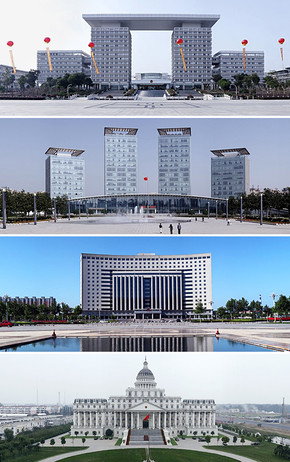
Gated, gilded and gaudy, they have sprung up all over China: overwrought government buildings erected at vast public expense, and in stark contrast to the shoddy state of so many homes and schools

Architectural bombast

Jul 27th 2013 |From the print edition

20130727_cnp010

GATED, gilded and gaudy, they have sprung up all over China: overwrought government buildings erected at vast public expense, and in stark contrast to the shoddy state of so many homes and schools. In style they range from modernist brutalism to Versailles kitsch. In function, they are less lofty. The four towers in the second picture are the government headquarters of Changxing, a county in Zhejiang with a population of just 620,000. In a sign the central government understands public frustration with the waste, and the whiff of corruption, associated with these projects, it has ordered a five-year “across-the-board halt” to official building projects. The ban also covers government hotels and training centres. Announcing the ban, the government acknowledged that “glitzy structures” have “tainted the image” of the Communist Party and “stirred vehement public disapproval”

Many Malaysians looking to bulletproof their vehicles following shooting incidents; can bulletproof the windows from $300

Many looking to bulletproof their vehicles

20130801_bulletproof_reuters

Thursday, August 1, 2013 – 09:35

The Star/Asia News Network

PETALING JAYA – Malaysians, who are known for pimping their ride, are now looking to bulletproof their vehicles. There have also been enquiries on making the windows of their houses bullet proof. A check showed that one can bulletproof the windows of a Perodua Kancil windows from around RM1,000 (S$389) but it can be more expensive for other models. A source from a German car company revealed that one of their flagship models, which is a fully bulletproof version, would cost around RM5mil. Meanwhile, STEC Laminates director James Thomas said enquiries for security protec-tion of cars have increased during the last week. “Our main market is not in Malaysia. We export our materials to 30 other countries. “Since the shooting incidents, enquiries have increased and we have received five calls in one week,” said Thomas. Read more of this post

Vietnam bans bloggers and social media users from sharing stories

Vietnam bans bloggers and social media users from sharing stories

Thursday, August 1, 2013 – 16:19

AFP

HANOI- Communist Vietnam is to ban bloggers and social media users from sharing news stories online, under a new decree seen as a further crackdown on online freedom. Blogs or social media sites like Facebook and Twitter — which have become hugely popular over the last few years in the heavily-censored country — should only be used “to provide and exchange personal information”, according to the decree. The document, signed by Prime Minister Nguyen Tan Dung and made public late Wednesday, stipulates that internet users should not use social networks to share or exchange information on current events. Read more of this post

Three quarters of China’s solar-grade polysilicon producers face closure as solar panel piles up and Beijing looks to overhaul a bloated and inefficient industry

As solar panels pile up, China takes axe to polysilicon producers

Wed, Jul 31 2013

By Charlie Zhu

HONG KONG (Reuters) – Three quarters of China’s solar-grade polysilicon producers face closure as Beijing looks to overhaul a bloated and inefficient industry, resulting in fewer but better companies to compete against Germany’s Wacker Chemie AG and South Korea’s OCI Co Ltd. The polysilicon sector, which has around 40 companies employing 30,000 people and has received investment of 100 billion yuan ($16 billion), suffers from low quality and chronic over-capacity as local governments poured in money to feed a fast-growing solar panel industry, for which polysilicon is a key feedstock. Read more of this post

Mortgage bond sell-offs hit U.S. banks with big losses

Mortgage bond sell-offs hit U.S. banks with big losses

12:06am EDT

By Peter Rudegeair, Carrick Mollenkamp and Cezary Podkul

(Reuters) – U.S. banks, who had little choice in recent years but to use deposits to buy super safe mortgage bonds, are now getting an unpleasant taste of the risks. On Wednesday, Tulsa, Oklahoma-based BOK Financial (BOKF.O: Quote, Profile, Research, Stock Buzz), which had nearly a third of its $27.5 billion in assets invested in mortgage bonds earlier this year, saw paper profits from the portfolio drop. It said net unrealized gains on agency mortgage bonds fell 66 percent to $70 million in the second quarter compared to the previous three month period. A BOK spokeswoman wasn’t immediately available to comment further. Read more of this post

China’s equity market has become “dysfunctional” after the regulator halted share sales and investors shifted to wealth-management products, said Anthony Neoh, a former government adviser who helped the nation open up to foreign money managers a decade ago.

China Stock Market Dysfunctional Amid IPO Freeze, Neoh Says

China’s equity market has become “dysfunctional” after the regulator halted share sales and investors shifted to wealth-management products, said Anthony Neoh, a former government adviser who helped the nation open up to foreign money managers a decade ago.

Smaller companies are losing access to capital as the China Securities Regulatory Commission extends a more than nine-month halt on initial public offerings and government-controlled banks focus on lending to state-owned enterprises, said Neoh, who helped start the Qualified Foreign Institutional Investor program as the CSRC’s chief adviser from 1999 to 2004. Many investors assume wealth-management products are guaranteed by the government, creating “tremendous moral hazard,” Neoh said. Read more of this post

India’s Financial Technologies, which controls the nation’s biggest commodity exchange, tumbled 42 percent after a subsidiary suspended trading in some contracts.

Financial Technologies Plunges Most in 15 Years: Mumbai Mover

Financial Technologies (India) Ltd. (FTECH), which controls the nation’s biggest commodity exchange, sank the most in more than 15 years after a subsidiary suspended trading in some contracts.

Financial Technologies tumbled 42 percent to 313.95 rupees at 9:57 a.m. in Mumbai, its biggest decline since December 1997. Unit National Spot Exchange Ltd. halted trading in some contracts, merged the delivery and settlement of all others and deferred them for a period of 15 days, it said in statement yesterday. Trading in its dematerialized contracts will continue, the company said. Read more of this post

Australia to increase tobacco tax by 60 pct over four years

Australia to increase tobacco tax by 60 pct over four years

Thursday, August 1, 2013 – 12:54

Reuters

SYDNEY – The Australian government said on Thursday it will increase tobacco taxes by 60 per cent over the next four years as it seeks to return the budget to a surplus in 2016/17, dealing another blow to cigarette manufacturers. The move, which the government said is also aimed at battling high rates of smoking-related cancer, follows the introduction in Australia last year of the world’s toughest cigarette plain packaging laws. Read more of this post

Europe’s plan to cut card fees will hurt banks but may not help consumers; Retailers battling banks over debit-card transaction costs may benefit from lower fees after winning a court ruling on claims they were overcharged billions of dollars under an unlawful rate set by the Fed

Europe’s plan to cut card fees will hurt banks but may not help consumers

Jul 27th 2013 |From the print edition

TO POLITICIANS, banks are both incompetent behemoths waiting for public bail-outs and conniving profiteers pulling a fast one on their customers. Just as one arm of the European Commission has been finalising new rules that will force banks to have much more capital on their balance-sheets in order to make them safer, another arm has been writing rules to stop the “unjustifiably high” fees charged whenever a credit or debit card is used. Read more of this post

Prosperous Guangzhou Nears Debt Red Line, on the verge of falling short of meeting scheduled debt repayment

07.31.2013 17:56

Guangzhou Nears Debt Red Line, Its Figures Show

Prosperous southern city’s payment obligations for year approach 20 percent of revenue, raising more worries about local government finances

By staff reporter Wang Jing

(Beijing) – One of the most affluent cities in the country has published figures that indicate it is on the verge of falling short of meeting scheduled debt repayment. This comes amid mounting concern that local governments may have trouble paying off the debts they racked up in recent years amid spending intended to stimulate the economy. Guangzhou, the capital of Guangdong Province with a GDP that ranked third last year among all Chinese cities, said on July 30 that it needs to pay loans worth almost 26.1 billion yuan this year. That is 19.37 percent of the city government’s projected income for this year. The internationally accepted red line for this ratio is 20 percent. Read more of this post

Which Chinese City Will Become the Next Detroit?

Which Chinese City Will Become the Next Detroit?

Where is China’s Detroit? A few weeks ago, the answer to that question would have been an optimistic shortlist of towns with thriving automobile industries. But since Detroit filed for bankruptcy on July 18, the question has become this: Which Chinese city will be the poster child for the country’s growing multitrillion-dollar local-government-debt problem?

In 2010, China’s National Audit Office announced that local governments had amassed a debt of $1.73 trillion, driven largely by borrowing for construction, infrastructure and debt service. Easy credit meant to avert the worst of the global financial crisis only served to worsen the problem: Local debt will grow to $2.63 trillion by the end of the year, equal to 29 percent of gross domestic product, according to Huatai Securities Co. Ltd. A 2012 audit of 36 local governments found $624.6 billion in debt — suggesting there are at least a few Chinese cities with debt equal to, or in excess of, the $18 billion that sunk Detroit. Read more of this post

Walgreen gets a modern makeover; CEO Greg Wasson is expanding the retailer’s mission and taking it global.

Walgreen gets a modern makeover

By Geoff Colvin, senior editor-at-large  @FortuneMagazine July 31, 2013: 12:24 PM ET

greg-wasson-ceo-of-walgreens-poses-in-a-newly-opened-duane-reade-store-in-new-york-february-17-2010

Greg Wasson wants Walgreen to offer more — and better — services.

As the digital revolution remakes retailing and the Affordable Care Act transforms health care, drugstores need fresh thinking.Walgreen (WAG, Fortune 500) CEO Greg Wasson, 54, is bringing it to America’s largest retail pharmacy chain, with some 8,300 locations (as Walgreens, Duane Reade, and a few other names regionally). Last summer he bought 45% of the U.K.’s Alliance Boots, becoming the first U.S. drug chain to expand abroad, and in March he signed a distribution deal with AmerisourceBergen, a drug wholesaler. He’s also reimagining his stores. Sushi bars? Beauty consultants? He’s trying them out. Wasson spoke recently with Geoff Colvin about turning drugstores into primary-care providers, serving more economically strapped customers, selling groceries, and much else. Edited excerpts: Read more of this post

India’s Poor Drain ‘Impure’ Blood to Cure Ills

India’s Poor Drain ‘Impure’ Blood to Cure Ills

By Rupam Nair on 1:30 pm July 31, 2013.
New Delhi. Mother-of-three Lilavati Devi stands perfectly still in the hot sun in Old Delhi as a practitioner and his assistants check the veins in her hands. Then, armed with razor blades, the practitioner slices neatly into her skin and lets the “impure blood” drain out. Devi suffers from chronic arthritis and firmly believes that her elderly “doctor” or practitioner, Mohammed Gyas, has the skills to cure her and others through the ancient treatment of bloodletting. “Science and modern medicine have failed,” Devi tells AFP, as an assistant pours cold water on her bleeding hands and sprinkles them with a grey-colored herbal powder. The 82-year-old Muslim man’s treatment “has been the only way to end the severe joint pain,” she says. Read more of this post

For nuns and analysts alike, bank commodity earnings are a mystery; Goldman relents in metals warehousing row

For nuns and analysts alike, bank commodity earnings are a mystery

1:43am EDT

By Cezary Podkul

NEW YORK (Reuters) – When the Reverend Seamus Finn got an email from Goldman Sachs last week, the giant Wall Street bank was addressing an issue that was already on his mind. “We were getting ready to go back to them and talk to them about commodities anyway,” said Finn, who heads up faith-consistent investing for the Missionary Oblates, a Washington DC-based Catholic group that owns Goldman shares. Read more of this post

Hong Kong watchdog cracks down on China Metal Recycling, a $1.43 billion company that describes itself as China’s largest recycler of scrap metal

Hong Kong watchdog cracks down on China Metal Recycling; bankers wary

5:00pm EDT

By Rachel Armstrong

SINGAPORE, Aug 1 (Reuters) – Hong Kong’s securities regulator has taken one of its most draconian actions ever and asked the courts to liquidate a listed company, a move that could be the first of several as the watchdog hardens its stance against alleged market misconduct. The Securities and Futures Commission (SFC) says it has evidence that China Metal Recycling, a $1.43 billion company that describes itself as China’s largest recycler of scrap metal, exaggerated its financial position when it listed in Hong Kong in 2009. The case, which comes up for its next hearing in Hong Kong on Friday, underscores the SFC’s resolve to restore investor confidence to what was the world’s busiest IPO market at a time when offerings have dried up due to volatile trading conditions, China’s waning economic growth and regulatory concerns. Read more of this post

China banks could see bad loans rise in 2013 due in part to delinquency risks from industries plagued by overcapacity

Updated: Wednesday July 31, 2013 MYT 5:01:18 PM

China banks could see bad loans rise in 2013-industry body

BEIJING (Reuters): Bad loans at Chinese banks could rise by between 70 billion yuan and 100 billion yuan ($11 billion and $16 billion) in 2013 due in part to delinquency risks from industries plagued by overcapacity, the China Banking Association said in an annual report on the industry. The report comes several days after Beijing began a new campaign to reduce overcapacity in several industries, a step seen as key to eventually rebalancing China’s economic structure. It warned that steel, photovoltaic and shipping sectors may be at the forefront of a new crop of bad loans. “Such industries facing excessive capacity could lift non-performing loans and require highest attention from banks in their short-term risk control,” the industry body said in the report, published on its website late on Tuesday. Read more of this post

China’s Cadres Balk at Showing the Money; For All the Corruption-Campaign Fanfare, Efforts to Get More Insight Into Officials’ Assets Appear to Suffer a Backlash

July 31, 2013, 7:41 p.m. ET

China’s Cadres Balk at Showing the Money

For All the Corruption-Campaign Fanfare, Efforts to Get More Insight Into Officials’ Assets Appear to Suffer a Backlash

JAMES T. AREDDY

WO-AO797A_CASSE_NS_20130731183317

SHANGHAI—Chinese President Xi Jinping stripped away some traditional privileges of government service when he took office. But even as his administration frowns on banqueting and fancy cars, it is defending a fundamental entitlement of Chinese public service: concealed wealth. Almost no Chinese official tallies his investments and net worth in ways that make the information accessible to the public. Now, there are indications that Mr. Xi’s government is stepping up efforts to keep it that way. In addition to the apparent resealing of once-available data, Chinese authorities also appear to be cracking down on transparency advocates as political dissidents. Read more of this post

Bond Slump Saddles Big Banks; Large Banks Can’t Avoid Trouble When Interest Rates Rise

July 31, 2013, 3:22 p.m. ET

Bond Slump Saddles Big Banks

Large Banks Can’t Avoid Trouble When Interest Rates Rise

DAN FITZPATRICK and SHAYNDI RAICE

The recent market turmoil exposed a new weakness in the balance sheets of large banks: they hold so many bonds that they can’t avoid trouble when interest rates rise. When long-term rates jumped by a full percentage point in May and June amid worries the Federal Reserve would taper its bond-buying stimulus program, bank investments in mortgage-backed securities and Treasuries got slammed. J.P. Morgan ChaseJPM +0.72% & Co., Bank of America Corp., BAC +0.55% Citigroup Inc. C +0.70%and Wells Fargo WFC +0.55% & Co. saw a measure of the paper value of these holdings fall by more than $13 billion during the second quarter. Read more of this post

Angry and powerless in China

Angry and powerless in China

Thursday, August 1, 2013 – 10:21

New Straits Times

According to the Chinese Constitution, “the People’s Republic of China is a socialist state … led by the working class and based on the alliance of workers and peasants”. Taken literally, that should mean that people such as farmers and migrant workers are the masters of the country. But, as events show, such is not the case; in fact, quite the contrary.

On July 20, Ji Zhongxing, originally a farmer from Shandong province but now paralysed from the waist down and unemployable, detonated a home-made bomb at the Capital International Airport in Beijing, losing his left hand in the process. However, after six frustrating years, he has finally succeeded in getting the attention of officialdom. Read more of this post

US failures could teach China’s automakers how to succeed

US failures could teach China’s automakers how to succeed

Wednesday, July 31, 2013

In early 20th-century China, personal transportation didn’t get much better than a rickshaw. On the other side of the world, automakers like Winton Motor Carriage Company in Cleveland, Ohio were bringing automobiles to the masses. By 1924, however, Winton was out of business. An inability to produce enough cars to meet national demand helped bankrupt the company as the major US automakers grew stronger. Nearly 100 years later, as China’s car market experiences an auto boom similar to that of the US, small mainland automakers may find themselves in a similar position as they struggle to serve the growing needs and requirements of today’s Chinese car buyers. China now has more than 170 automakers. That’s roughly comparable to the more than 250 car manufacturers in the US just after the turn of the century. Like Winton, many of the Chinese firms are small, local ventures with production capacities that pale in comparison to the major automakers. Read more of this post

Alarm bells for crowdfunding as bubble pops for soap start-up

July 31, 2013 6:16 pm

Alarm bells for crowdfunding as bubble pops for soap start-up

By Lucy Warwick-Ching, Tanya Powley and Elaine Moore

One of the first companies to raise money via crowdfunding in the UK has ceased trading, sounding alarm bells for investors in what has become one of the fastest growing investment areas in the country. Bubble & Balm, a fair trade soap manufacturer, was the first start-up to raise money via equity crowdfunding platform Crowdcube, in 2011. It raised £75,000 in return for 15 per cent of the company’s equity from 82 investors, who contributed between £10 and £7,500 each. As part of the deal investors were also in line to receive free soap and discounted products. Read more of this post

Korean accounting firms poised for seismic changes next year

Accounting firms poised for seismic changes next year

By Park Seung-cheol/ Lee Ga-yoon

2013.07.31

South Korea’s accounting industry is fussing over the largest-ever seismic changes slated for next year. Critical changes will all come next year: international audit standards will become effective; the period for audit firm rotation will approach on the annulment of the rule, under which businesses must replace an audit firm with another in six years; and an independent auditing committee will be given rights to pick audit firms.  Large accounting firms including Samil PwC, Deloitte Anjin, Samjong KPMG Advisory and Ernst & Young Korea are already in the cutthroat competition, believing the next year’s accounting firm selection will be the event that will reshape the market landscape. An official at Ernst & Young Korea noted, “accounting firms had enjoyed extra demand for consulting services with the introduction of the international financial reporting standards, but now failed to seek new breakthroughs to be in the doldrums over the last few years,” adding “the next year will be the cornerstone for accounting firms to get out of the hardships.”  The international audit standards call for a parent company’s auditor to hold responsibility for the audit results of its consolidated subsidiaries. Accounting firms project that the introduction of international audit standards will eventually make parent company and its subsidiaries have the same audit firm. In addition, it has been three years since Korea scrapped the rule, by which businesses are obliged to rotate their auditors every six years, in 2009. This is acting as another catalyst for fueling competition among accounting firms.

The benefits and perils of riding China’s coat-tails; Many Latin American nations have bet the mine on an economy that is now slowing

July 31, 2013 4:18 pm

The benefits and perils of riding China’s coat-tails

By David Pilling

Many Latin American nations have bet the mine on an economy that is now slowing

Few parts of the world have benefited as much from China’s rise as Latin America. In 1990, China was a lowly 17th on the list of destinations for Latin American exports. By 2011, it had become the number one export market for Brazil, Chile and Peru and number two for Argentina, Cuba, Uruguay, Colombia and Venezuela. Over that time, annual trade rose from an unremarkable $8bn to an irreplaceable $230bn. Chinese leaders predict it will reach $400bn by 2017. Read more of this post

Ex-courier lifts lid on theft and fraud in China’s logistics industry

Ex-courier lifts lid on theft and fraud in China’s logistics industry

Staff Reporter

2013-08-01

A retired courier said that it has become the norm for employees in China’s delivery services industry to steal or tamper with items trusted to them to sort and deliver, while couriers work with contacts to scam the recipients out of money, reports the Guangzhou Daily. The former courier, who recently retired from his position at the Guangzhou branch of Shanghai YTO Express (Logistics) — a leading player in the delivery services industry — said that many couriers steal parts of a parcel if its packaging is broken. He added that many would open and steal from parcels if they knew that the contents were items such as moon cakes, teas or fruit. He said that many in the industry would also take high-end electronic products such as iPhones if they had the chance, which they then would replace with a counterfeit item, repackaging the parcel before delivering it to the recipient. Read more of this post

Money Merry-Go-Round in North Korea

Money Merry-Go-Round in North Korea

Good luck finding a North Korean won in Pyongyang

By Giles Hewitt on 1:10 pm July 31, 2013.
Pyongyang. Chinese yuan, US dollars, euros and tea bags. Money can come in many forms in North Korea, but as a foreign visitor you’ll probably never even see a local banknote, let alone use one. Pretty much any hard currency is welcome in a country with anemic foreign reserves. Tourists, although few in number, represent a valuable cash source. For those who do choose to visit, every transaction — no matter how small — must be made in foreign exchange, further narrowing options in what is already among the most restrictive countries in the world. There are not many places to spend money in the capital Pyongyang. As a foreigner, the choice is reduced further by the need to find somewhere that takes foreign currency and — importantly — is capable of giving change. Read more of this post

China Owes Hollywood Millions After Halting Payment for Films; lack of profit has not deterred US studios from sending their films to China,

China Owes Hollywood Millions After Halting Payment for Films

By Agence France-Presse on 1:48 pm July 31, 2013.
Los Angeles. China has stopped paying Hollywood studios for its films in a dispute over a Chinese tax on movie profits, Hollywood trade papers reported Tuesday. Tens of millions of dollars in box office revenues are owed in arrears to the likes of Disney, Warner, Universal, Paramount, Fox and Sony, according to The Hollywood Reporter. The magazine said China’s state-owned movie distributor, China Film Group, owes more than $31 million to Warner for “Man of Steel,” $23 million to Sony for “Skyfall” and $23 million to Fox for “Life of Pi.” China stopped payment at the beginning of the year, when American studios took issue with a two percent value-added tax that the world’s most populous nation was levying on US films. Chinese authorities want the studios to pax them the tax, but the studios argue it violates a World Trade Organization agreement governing the film trade between the two countries. In the accord last year, heralded as historic by the United States, the two countries agreed that China could import 34 US blockbusters a year (up from 20) and studios’ revenue share from China was fixed at 25 percent (up from 13 to 17 percent). The Motion Picture Association of America (MPAA), which acts on behalf of studios’ interests, is negotiating with Chinese authorities, to resolve the tax dispute. In the meantime, lack of profit has not deterred US studios from sending their films to China, which currently has the world’s most dynamic movie market, in the aim of cementing a long-term foothold.

Overcapacity sends China’s steel sector into loss

Overcapacity sends China’s steel sector into loss

English.news.cn   2013-07-31

BEIJING, July 31 (Xinhua) — China’s iron and steel industry reported a loss of 699 million yuan (about 113 million U.S. dollars) in June, the first monthly deficit that the overcapacity-troubled industry has seen this year. For the first half, the profits of members of the China Iron and Steel Association (CISA) hit 2.27 billion yuan, with an average profit margin of 0.13 percent, the lowest among all industries, said the CISA on Wednesday. Steel prices have been dropping since February. At the end of June, the price of steel products fell 6.45 percent compared with the beginning of this year, and down 14.7 percent year on year, according to the CISA. Read more of this post