China Resources Power fell the most in more than four years after Xinhua media said the power generator and the chairman of its state-owned parent intentionally overpaid for a 2010 acquisition

China Resources Power Falls After Report of Deal Overpayment

China Resources Power Holdings Co. (836) fell the most in more than four years after the official Xinhua News Agency posted a letter on its website by one its reporters that said the power generator and the chairman of its state-owned parent intentionally overpaid for a 2010 acquisition.

The company’s shares fell as much as 11.8 percent, the biggest drop since Nov. 6, 2008, and were trading down 10.4 percent as of 2:20 p.m. in Hong Kong. The city’s benchmark Hang Seng Index was little changed. Read more of this post

China’s Richest Man Considers IPO for Department Store Business

China’s Richest Man Considers IPO for Department Store Business

Zong Qinghou, China’s richest man who is worth an estimated $11.3 billion, is considering an initial public offering of his department store businesses.

There is no specific timeframe for the share sale, Zong said at a press conference in Beijing today. The billionaire controls food and beverage conglomerate Hangzhou Wahaha Group Co., which plans to have 100 malls in China in the next three to five years, according to a statement from the closely held company today. Read more of this post

Chaebol under fire amid South Korean scandals

July 16, 2013 6:28 am

Chaebol under fire amid South Korean scandals

By Song Jung-a in Seoul

The audio file is uncomfortable listening. Uploaded on YouTube, it captured a young salesman at Namyang Dairy Products, one of South Korea’s leading dairy companies, bullying a representative of one of the group’s distributors. At one stage he threatens to kill the distributor unless he buys more of the company’s products. The threat comes after a series of verbal insults are hurled at the buyer, who pleads that he does not have the space to store any more stock. The poisonous exchange, which has rocketed around South Korea’s vibrant social media forums since May, has become a lightning rod for mounting discontent over the dominance of the chaebol – the country’s big family-run conglomerates – which are accused of choking the development of small and medium-sized companies. The recording provided an extreme example of something many people believed had been happening up and down the country – lifting a veil on decades of abuse meted out by the chaebol. Read more of this post

Shattering the myth of the ‘Startup Nation’

Shattering the myth of the ‘Startup Nation’

This lofty title has long served as a cover for the low productivity that plagues the Israeli economy.

By Amir Teig | Jul. 16, 2013 | 2:14 PM

Legend has it that a treasure trove of economic reforms is hidden deep down in the confines of the Finance Ministry’s budget department – dozens of important reforms formulated over the years just waiting for the day when the right politician will come along and pluck them out of the files. The department’s capable economists and senior bureaucrats cover all their bases by running everything through committees and past experts. Usually they identify clearly, and in real time, the numerous problems and challenges threatening the Israeli economy, and even formulate solutions. But this work usually goes no further than the filing cabinet: Barring the sense that there is a terrible crisis or a fire that needs to be put out, no politician will commit to risky long-term reforms. And yet, without them, Israel will always be behind. Read more of this post

Asia After the Money Flood; It’s time to prepare for the end of U.S. quantitative easing

Updated July 16, 2013, 6:59 p.m. ET

Asia After the Money Flood

It’s time to prepare for the end of U.S. quantitative easing.

Investors have awakened to the implications for Asia of a gradual unwinding of easy money policies in the West. Witness last month’s cash exodus and stock-market declines as investors re-evaluate their appetite for risk. Higher yields in America are expected to draw portfolio investment back from emerging markets.

The upshot is that Asian leaders accustomed to reaping the growth rewards of plentiful foreign capital are in for a shock. The investors who remain committed to the region will look for those countries that offer the most attractive mix of risk and return. It’s time to revisit economic reforms that will keep them hooked. Read more of this post

A very clear explanation of China’s economic woes; Are there good examples of boondoggles that have been created through this investment boom?

A very clear explanation of China’s economic woes

By Brad Plumer, Updated: July 16, 2013

One of the biggest economic stories in the world right now is the sharp slowdown in China’s economy. On Monday, the country reported that it had grown just 7.5 percent in the second quarter of 2013, a worrisome drop from previous quarters. To get a clearer sense of why China is in such economic turmoil — and whether it could drag the rest of the world down with it — I called up Patrick Chovanec, a longtime China watcher who is currently chief strategist at Silvercrest Asset Management and was formerly an associate professor at Tsinghua University’s School of Economics and Management in Beijing. A transcript of our talk follows.

Brad Plumer: Let’s assume I know nothing whatsoever about China. How would you explain why the country is suddenly facing all these economic problems and making headlines? It seemed like China was booming. Read more of this post

Unorthodox injections sustain China’s healthcare system

July 16, 2013 4:10 pm

Unorthodox injections sustain China’s healthcare system

By Leslie Hook in Beijing

New protesters arrive every couple of minutes at the unmarked gates of the Ministry of Health in Beijing, coming in the faint hope that the national authorities will be able to help where their local hospitals and clinics have failed. One young mother carries a tattered notebook full of medical records, baby ultrasounds and official letters. She says she is trying to get treatment for her son, now aged eight, who has organ damage after drinking toxic infant formula as a baby. Another young woman unfurls graphic pictures of her injuries after a violent beating by police, and says she is here to protest against a local hospital that refused to treat her.

Read more of this post

For Global Drug Manufacturers, China Becomes a Perilous Market

July 16, 2013

For Global Drug Manufacturers, China Becomes a Perilous Market

By KATIE THOMAS

ChinaHealthcare

Multinational drug companies now employ more sales agents in China than they do in the United States, their largest market. Several, including Merck and GlaxoSmithKline, are making huge scientific investments in the country, including building research and development centers. Within the next few years, China is poised to surpass Japan as the world’s second-largest pharmaceutical market. The booming Chinese demand for drugs could not come at a better time for Western manufacturers, whose sales have been slumping because of patent expirations in the United States and stringent price controls in Europe. Read more of this post

Myanmar aims to set up its first stock exchange by 2013; many industry players said they are skeptical on whether a stock exchange can actually be operational so soon.

Myanmar aims to set up its first stock exchange by 2013

By May Wong
POSTED: 16 Jul 2013 11:57 PM
Myanmar government is pushing hard to set up its first stock exchange in order to build up their capital markets.

YANGON: Myanmar hopes to set up its first ever stock exchange before the end of this year. It expects Parliament to pass the Security Exchange Law within this month during the current session. Myanmar wants to model its stock exchange after the Japan and Singapore stock exchanges. It feels that both exchanges bear many similarities and meet the needs as well as objectives of Myanmar. Read more of this post

China Slowdown Endangers Southeast Asia: ADB; Singapore Exports Fall 8.8% in Longest Slump Since Global Crisis

China Slowdown Endangers Southeast Asia: ADB

By Dion Bisara on 9:03 am July 17, 2013.
China’s cooling economy threatens to impact growth in Southeast Asia, including Indonesia, the Asian Development Bank said in its outlook update on Tuesday. The Manila-based lender trimmed the region’s economic growth forecast to 5.2 percent this year and 5.6 percent next year in the update to its Asian Development Outlook publication. Originally, the outlook published in April forecast growth to be 5.4 percent in 2013 and 5.7 percent in 2014. “Southeast Asia’s strong start to the year is being tempered by slower growth in the People’s Republic of China and continued weak demand from advanced economies for exports,” the bank said. Read more of this post

Federal regulators have launched an antitrust investigation into the merger of the two largest funeral services companies in the US, probing the industry as it prepares for a surge in business from a generation of baby boomers. “It’s a distress purchase, and people spend more when their thinking is clouded because someone has died.”

July 16, 2013 7:09 pm

Consumer groups push for funeral deal to be put six feet under

By April Dembosky

Federal regulators have launched an antitrust investigation into the merger of the two largest funeral services companies in the US, probing the industry as it prepares for a surge in business from a generation of baby boomers. The Federal Trade Commission will examine the market impact of the $1.4bn purchase by Service Corporation International(SCI), the largest chain of funeral homes and cemeteries in the US by sales, ofStewart Enterprises, the second-largest company in the field, several people familiar with the matter said. The FTC declined to comment. Read more of this post

French dreams of a start-up renaissance

July 16, 2013 3:55 pm

French dreams of a start-up renaissance

By Hugh Carnegy

On a Friday morning in a modest office block in eastern Paris, Bastien Cazenave is huddled with colleagues behind a computer screen. They are putting the finishing touches to the latest episode in his young company’s online murder-mystery game.

There is an air of quiet intensity as Pretty Simple Games releases its weekly instalment of Criminal Case, a sleuthing game that has rocketed up the social gaming charts this year. It is now the second most-played game on Facebook after King.com’s Candy Crush, overtaking those of Zynga, the biggest maker of Facebook games. Read more of this post

Bad loans cast long shadow over Indian banks

July 16, 2013 3:01 pm

Bad loans cast long shadow over Indian banks

By James Crabtree

System is left vulnerable to setbacks such as this week’s liquidity tightening

Growing concerns about bank asset quality, hidden bad loans and a general lack of transparency, all set against the backdrop of an economic slowdown. This may sound like a description of worries about China’s shadow banking system. But it could equally apply to the increasingly parlous situation in India too. Politicians in Asia’s second-largest emerging economy often talk with pride about their banks, which are typically cautious and well capitalised. Most made it through the global financial crisis with little difficulty. But signs of stress have become unmistakable over the past year, in particular among the same supposedly reliable state-backed institutions that control about three-quarters of banking assets. And they are getting worse. Tuesday’s sudden moves by the Reserve Bank of India to tighten liquidity, designed to stem recent falls in the rupee, only deepened the problem. Read more of this post

Top fund managers were blindsided by U.S. bond market carnage

Top fund managers were blindsided by U.S. bond market carnage

8:32pm EDT

By Jennifer Ablan and Katya Wachtel and Tim McLaughlin

(Reuters) – The plunge in the U.S. Treasuries market in the past couple of months may well have been one of the most well-telegraphed reversals in financial market history. Top money managers and investment strategists had warned the U.S. Federal Reserve was likely to soon begin paring back its bond-buying stimulus if U.S. economic data remained robust. Bill Gross, who is known on Wall Street as “the Bond King,” said on May 10 he believed “the 30-yr secular bull market in bonds” had likely ended at the end of April. Other leading Wall Street figures told the New York Fed they were concerned about the exposure of mom-and-pop investors in the event of a bonds slump. Read more of this post

Is the Singapore soil fertile for creativity?

Is the Singapore soil fertile for creativity?

Singapore’s drive for productivity has focused attention on a key component to boosting organisational performance — innovation. While companies espouse the importance of innovation, the truth of the matter is that many companies have, consciously or unconsciously, put up barriers to innovation.

4 HOURS 43 MIN AGO

Singapore’s drive for productivity has focused attention on a key component to boosting organisational performance — innovation. While companies espouse the importance of innovation, the truth of the matter is that many companies have, consciously or unconsciously, put up barriers to innovation. Barriers to innovation could exist within the structure of the organisation, the mindset of its leaders and managers or within the culture itself. The starting point for any company that wishes to foster innovation and creativity should be to recognise these barriers. Read more of this post

Nike’s Lost Year in China Serves as Cautionary Tale

Nike’s Lost Year in China Serves as Cautionary Tale

Not long ago, Nike Inc. (NKE) could simply open stores in China and wait for newly minted middle-class shoppers to show up. No longer. Though it has been in China for 30 years, the world’s largest sporting-goods maker is losing customers to Adidas AG (ADS)’s more fashionable street wear and Hennes & Mauritz AB (HMB)’s cheap, hip clothing. Making matters worse, Nike is knee-deep in unsold merchandise after a projected post-Olympics sales bump didn’t materialize. Eighteen months ago, Nike was so bullish on China it predicted sales there would double to $4 billion in four years. Now it says China sales will probably fall for the next two quarters, which would make it five in a row. Read more of this post

‘Invisible’ Man Steers China’s Reserves; Zhu Changhong, a former physicist, plays a key role in the allocation of China’s trillions of dollars of foreign reserves, but little is known about him

July 16, 2013, 2:53 p.m. ET

China’s Zhu Changhong Helps Steer Nation’s Currency Reserves

Nation’s Media Call Former Physicist ‘Invisible’

By LINGLING WEI and BOB DAVIS

MI-BX255_ZHU_NS_20130716181803

BEIJING—At an official Chinese New Year’s party earlier this year, a former bond trader named Zhu Changhong was hailed for the smart choices he made investing the world’s largest stash of cash: China’s $3.5 trillion in foreign reserves. Tweaking the lyrics of a famous revolutionary song that extolled Mao Zedong, Mr. Zhu’s colleagues jocularly lauded him: “The east is red, the sun rises. From China arises Zhu Changhong…he is SAFE’s savior,” people with knowledge of the event say. SAFE is China’s State Administration of Foreign Exchange, the division of the central bank that manages China’s currency reserves and is one of the most powerful investors in the world.

Read more of this post

India makes risky bet with rupee defense

India makes risky bet with rupee defense

12:22pm EDT

By Rafael Nam and Subhadip Sircar

MUMBAI (Reuters) – India’s boldest attempt yet to prevent a rout in the rupee delivered only a modest lift in the currency but shares slumped and bond yields jumped as investors worried that policymakers might overplay their hand and damage economic growth. The government said on Tuesday the moves were an attempt to stabilise the currency, which hit a record low last week and is down nearly 10 percent since the start of May. Analysts say longer-term economic reforms are what India really needs.

Read more of this post

Unease as property fuels rise in Singapore household debt

Unease as property fuels rise in household debt

Tuesday, Jul 16, 2013

Goh Eng Yeow

The Straits Times

SINGAPORE – During the global financial crisis five years ago, one local bank boss quipped that his management went through so many stress tests on the loans book that they were stressed out themselves. Well, stressful times are back. You can’t blame analysts for going into overdrive trying to suss out the various economic scenarios that could emerge here after the United States central bank flagged a possible tightening of its monetary policy. Read more of this post

Musicals, the stalwart of the Korean performing arts market, have hit a slump; Interpark accounts for more than 70 percent of ticket sales in the country

2013-07-16 16:47

Musicals sing summer blues

By Baek Byung-yeul

Musicals, the stalwart of the Korean performing arts market, have hit a slump despite efforts to bolster summer ticket sales. As people tend to travel, summer is generally considered the offseason for musical companies. But in a market where some 400 productions are staged in a year, even the sticky months are seen as a time to promote musicals. The trend was validated last year, when the smash hit musical “Wicked” drew in more than 200,000 during the summer and early fall. Not so this summer. Read more of this post

Intel to IBM Feel Putin Pinch as Medvedev Loses Hold on Tech Hub

Intel to IBM Feel Putin Pinch as Medvedev Loses Hold on Tech Hub

When Russian agents stormed the downtown offices of the Skolkovo technology hub being built near Moscow on April 18, a startled Intel Corp (INTC). executive got caught up in the raid.

Dusty Robbins, head of global programs for the world’s largest chipmaker, was forced to surrender his mobile phone and was only allowed to leave the building escorted by officers after Skolkovo officials appealed to investigators, two people familiar with the matter said. Robbins flew back to the U.S. without holding a planned meeting with Skolkovo’s billionaire president, Viktor Vekselberg, said the people, who asked not to be identified because the information is confidential. Read more of this post

Women and China’s property market: Married to the mortgage; Are high house prices hurting women more than men?

Women and the property market: Married to the mortgage; Are high house prices hurting women more than men?

Jul 13th 2013 | BEIJING |From the print edition

20130713_CNC060

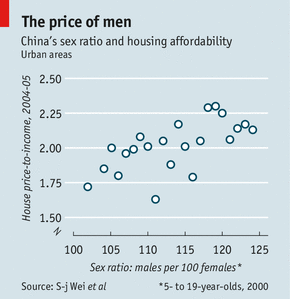
CHINA’s communists attacked many bourgeois institutions after taking power in 1949. But marriage was not one of them. On the contrary, they enacted a marriage law in 1950, four years before they introduced a constitution. The pressure to marry remains heavy in today’s China, where almost 80% of adults have tied the knot at some point, compared with only 68% in America. But today, in contrast to the 1950s, marriage is bound up with another bourgeois institution: property. In China mortgages often precede marriages. According to popular belief, if a man and his family cannot buy property he will struggle to find a bride. In choosing a husband, three-quarters of women consider his ability to provide a home, according to a recent survey of young people in China’s coastal cities by Horizon China, a Beijing-based market-research firm. Even if a woman herself dismisses this criterion, her family and friends, not to mention the country’s estate agents, will not let her forget it.

Read more of this post

Xi’s campaign to boost the Chinese party’s image fails to inspire

Masses of meetings: A campaign to boost the party’s image fails to inspire

Jul 13th 2013 | BEIJING |From the print edition

20130713_CND001_0

ON JULY 9th the Communist Party issued a new directive on President Xi Jinping’s campaign to clean up its act. Among the orders: “Avoid going through the motions”. Despite a blizzard of instructions in recent weeks calling on officials to get “closer to the masses”, the response has been perfunctory. Even one of the party’s own newspapers has hinted that Mr Xi’s efforts are on the wrong track.

The campaign “to study the mass line” revives a Maoist notion that the party should learn from the people (while ignoring any demands for a different party to lead them). It was announced in April and formally launched in June with a speech by Mr Xi to the Politburo calling for a “thorough clean-up” of the party to rid it of “formalism, bureaucratism, hedonism and extravagance”. It is supposed to carry on until mid-2014. This month 45 teams of officials were despatched by the party leadership to make sure that provincial leaders, university principals and the managers of state-owned enterprises were paying proper attention. Mr Xi has ordered his generals to make sure the army (a bastion of privilege) listens too. Read more of this post

Europe’s zombie banks: Europe’s financial system is in a terrible state, and nothing much is being done about it

Europe’s zombie banks: Europe’s financial system is in a terrible state, and nothing much is being done about it

Jul 13th 2013 |From the print edition

“PROBABLY the most successful monetary-policy measure undertaken in recent times.” That is Mario Draghi’s self-effacing judgment on the outright monetary transactions (OMT) programme, the promise made by the European Central Bank (ECB) last summer to buy the bonds of struggling euro-area governments. The ECB’s president deserves credit for bringing calm to bond markets. But in reality the situation is still awful, and Europe’s banks are at the heart of the problem.

The euro-zone economy has contracted for six consecutive quarters. The IMF this week revised its 2013 forecast down again: it expects the euro zone to shrink by 0.6% this year. (Just to rub things in, the fund adjusted its forecasts for Britain upwards.) The outlook in the core euro-zone economies has worsened, thanks in part to a slowdown in China: in May German exports suffered their sharpest fall for two years. But the brunt of the pain is being borne by the peripheral economies. Read more of this post

Brazil struggles to shake off shackles of high interest rates

Brazil struggles to shake off shackles of high interest rates

8:02am EDT

By Alonso Soto

BRASILIA (Reuters) – When Brazilian interest rates nose-dived to record lows last year, President Dilma Rousseff and many economists here boasted that the days of sky-high borrowing costs were over. They may have been wrong. Heavy public spending, a sharp depreciation of the local currency and an expected normalization of monetary conditions in the United States could force Brazilian policymakers to eventually lift the benchmark Selic rate back to double digits. Read more of this post

Low rates pledge buys time but builds risk for fragile banks

Low rates pledge buys time but builds risk for fragile banks

11:33am EDT

By Laura Noonan

LONDON (Reuters) – A determination by Europe’s most powerful central bankers to keep interest rates low might save the continent’s fragile banking system from short-term pain but undermines long-term profitability and encourages excessive risk-taking.

The Bank of England’s new governor Mark Carney raised eyebrows on July 4 when he said market expectations of higher interest rates were “not warranted”, a policy departure for a central bank that traditionally plays its cards close to its chest until monthly rate decisions are taken. Read more of this post

China Museum Shut Down After Exhibits Revealed to Be Forgeries

China Museum Shut Down After Exhibits Revealed to Be Forgeries

Chinese authorities forced the closing of a museum curated by a local Communist Party boss in northern China after determining that almost all of the items in its 50 million-yuan ($8.1 million) collection were fake.

Forgeries at the museum in Hebei province included an item billed as a five-color porcelain vase from the Tang Dynasty, even though the artistic technique wasn’t invented until hundreds of years later, the Shanghai Daily said in a story today. Another item was purportedly signed in simplified Chinese by an emperor said to have lived more than 3,000 years before the writing system was invented. Read more of this post

IKEA becomes largest foreign landowner in China

IKEA becomes largest foreign landowner in China

Staff Reporter 2013-07-16

In line with the belief that retail outlets built on its own land is integral for the complete materialization of its business concept, IKEA China has insisted on operating only on property it wholly owns since it entered the country 15 years ago. It is now one of the largest landowners in the nation.

Over the past 15 years, IKEA has changed the interior tastes of Chinese people with its simple yet trendy products. The property ownership of IKEA China actually complies with the consistent global practices of the company. INGKA Holding BV, the parent firm of IKEA group, boasted assets of €44.74 billion (US$58.5 billion) in 2012, of which fixed assets — including property, factory buildings, and equipment — accounted for 45%. Read more of this post

Singapore’s PMET (Professionals, Managers, Executives, Technicians) = Pampered, Mediocre, Expensive, Timid

Are Singaporean workers… expensive & entitled?

These are the charges some employers have levelled against locals in a recent debate over wages and skills. Robin Chan investigates. 

7x1rDcT

A YOUNG university graduate walks into his first job interview at a shipping firm waving a salary survey his school provided for him and demands a starting salary above $4,000. But that is what a more senior employee gets only after three to four years on the job. Another, applying for an analyst position at an investment bank, asks if he will have his own office and secretary. There are others: Singaporean professionals turning down overseas postings, job-hopping with a vengeance or wanting more benefits and less work. These stories of professionals behaving badly have emerged in the wake of a Sunday Times commentary last month in which a multinational corporation (MNC) boss asked: “Do Singaporeans deserve the salaries they are paid?” They lack the skills, and the hunger, he observed. Read more of this post

Four Drugmakers Face China Probes as Glaxo Woes Widen; GSK is test case in China’s rules laboratory

Four Drugmakers Face China Probes as Glaxo Woes Widen

GSK

China is investigating at least four multinational drugmakers as it widens its probe of GlaxoSmithKline Plc (GSK), according to a lawyer in Hong Kong whose firm advises companies on cross-border anti-corruption.

The investigations point to an increased targeting of the pharmaceutical industry in corruption probes as the world’s most populous country faces rising health-care costs and seeks to lower drug prices. While the drugmakers are being examined by local regulators, the results may draw added questions from officials in Beijing and scrutiny by the U.S. government under the Foreign Corrupt Practices Act. Read more of this post