What do Korean superstars like singer Psy, U.S. Ladies Professional Golf Association sensation Park In-bee and Los Angeles Dodgers starting pitcher Ryu Hyun-jin have in common?

2013-07-11 18:30

Psy, Park In-bee and Ryu Hyun-jin

Lee Chang-sup
A diplomat in Seoul asked me: What do Korean superstars like  singer Psy, U.S. Ladies Professional Golf Association sensation Park In-bee and Los Angeles Dodgers starting pitcher Ryu Hyun-jin have in common? I scratched my head over this difficult question. The diplomat joked all of three are chubby. He later revealed the correct answer is that these three personalities are currently some of the most famous Koreans in the world.  Apart from being famous, the three South Korean superstars mentioned above have many other traits in common. For one, they were born during boom periods in Korea. Psy was born in 1977 when Korea’s economy was just taking off; Ryu was born in 1987, just one year before the Seoul Summer Olympics; and Park was born in 1988, merely months before the said Olympics. Read more of this post

Why do tech-savvy Israelis remain e-commerce Luddites? Don’t blame shoppers: Business simply hasn’t invested in online selling

Why do tech-savvy Israelis remain e-commerce Luddites

Don’t blame shoppers: Business simply hasn’t invested in online selling.

By Eyal Rosen | Jul.15, 2013 | 5:57 AM

Considering the widespread use of the Internet in Israel, it is quite surprising to discover that just a half percent of gross domestic product, only NIS 5 billion, can be attributed to online transactions for goods and services. This is a considerably lower proportion than in other developed economies. In Europe, for instance, electronic commerce accounts for roughly 1.5% of GDP, three times the rate in Israel. Purchases over the web have grown 120% a year since 2003 in China and from $1.6 billion to $43 billion annually over the past decade in Latin America. The breakthrough hasn’t yet occurred in Israel even though the volume of commerce in the country resulting from online searches reached NIS 20 billion a year, or about 2% of GDP, according to a study performed by McKinsey & Co. in 2009. Read more of this post

Accounting Scandal Hooks Spanish Frozen Fish Giant; “It’s Enron, Spanish style. There was a tangle of subsidiaries set up solely and uniquely to hide the debt.”

Accounting Scandal Hooks Spanish Frozen Fish Giant

By Katell Abiven on 2:45 pm July 14, 2013.

A Pescanova’s store is pictured in Vigo, northwestern Spain, on June 26, 2013. The head of Spanish frozen fish giant Pescanova admitted on July 11, 2013 he may have made bad decisions after an auditor’s report said the group deliberately fabricated deals and financial results to disguise a 3.28-billion-euro ($4.3 billion) debt. (AFP Photo/Miguel Riopa)

Madrid. It boasts a fleet of 100 ships and 10,000 employees worldwide but suspected fraud at frozen seafood giant Pescanova is causing an embarrassing stink in export-hungry Spain. After years of posting growing sales, amounting to 1.7 billion euros ($2.2 billion) in 2011, the group that was among the world industry’s leaders and the pride of the northern region of Galicia has plunged into scandal. One evening in February, Pescanova was forced to reveal that it could not publish its 2012 accounts. Two months later, on April 25, it filed for bankruptcy. “That was a surprise,” said Francisco Vilar, regional secretary of the food-processing federation of the main union at Pescanova, the Workers’ Commissions (CCOO).  People who work here have been here for 30, 40 years, with good management. So it was an enormous surprise.” Pescanova is accused of false billing, hiding a debt of 3.3 billion euros that was more than double the declared figure, and its top managers of selling shares just before the scandal broke. “It’s Enron, Spanish style,” said one banking source, referring to the giant US energy group that collapsed in the 2000s in one of the biggest financial scandals in US corporate history. Read more of this post

China Slump Ripples Globally; Slowed Growth Realigns Industries and Economies as Beijing Switches Strategies

Updated July 14, 2013, 9:34 p.m. ET

China Slump Ripples Globally

Slowed Growth Realigns Industries and Economies as Beijing Switches Strategies

P1-BM276_CWorld_G_20130714172105

ALEX FRANGOS in Hong Kong and ERIC BELLMAN in Jakarta

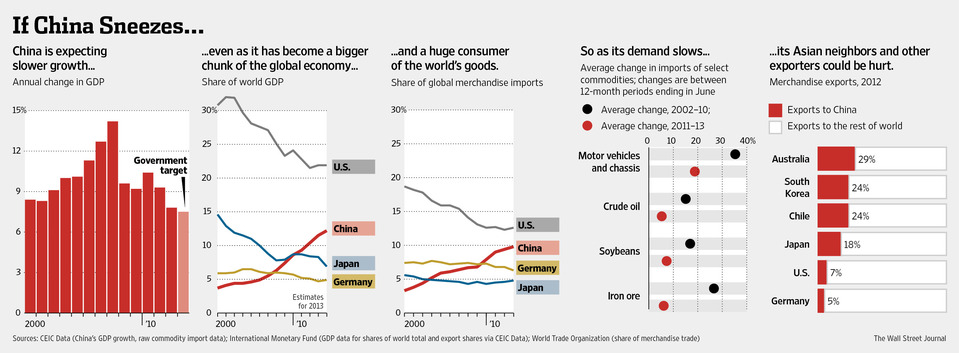
As the numbers pile up showing China’s sizzling growth cooling down, industries world-wide—from German paper-cutter makers to Indonesian palm-oil exporters—are confronting an altered landscape of winners and losers. The ones that benefited the most from China’s rise are now being hurt. Others, aiming at China’s 1.3 billion consumers, are faring better. Growth in China, the world’s second-biggest economy after the U.S., has been slowing since 2007’s peak, but that slowdown has accelerated recently. China’s second-quarter gross domestic product released early Monday showed the economy expanded 7.5% from the year earlier, slower than the 7.7% growth in the first quarter. That matches the government’s full-year growth target of 7.5%, a rate that would make this year the slowest since 1990. Some economists figure China will grow even slower than that.

Read more of this post

Altor to buy French ski maker Rossignol; Private equity group looks to revive and expand historic brand

July 15, 2013 2:09 pm

Altor to buy French ski maker Rossignol

By Anne-Sylvaine Chassany, Private Equity Correspondent

Bruno_Cercley,_CEO_of_Rossignol

Ski maker Rossignol has brought production back to France

Rossignol, the world’s second largest ski manufacturer by sales, is to be sold to Swedish private equity house Altor Equity Partners, after a plan to recover from near bankruptcy involved repatriating 10 per cent of its production back to France from Taiwan. The move away from a country with lower labour costs has helped the century-old French company return to profit five years after California surf gear maker Quiksilver sold it to a group led by Macquarie of Australia. Altor now plans to diversify into outdoor clothing, with the aim of doubling the company’s €207m sales to counter a contracting ski market. The value of the deal was not disclosed. Read more of this post

From $177 Million to $2.6 Billion: Once teetering on the edge of bankruptcy, Restoration Hardware is turning into a bonanza for its private-equity owners.

Updated July 14, 2013, 7:58 p.m. ET

Restoration Hardware’s Renovation Is Private-Equity Boon

Restoration Hardware Holdings Inc. is turning into a bonanza for its private-equity owners.

By RYAN DEZEMBER and MATT JARZEMSKY

MI-BX181_HARDWA_NS_20130714184203 MI-BX185_HARDWA_G_20130714184208

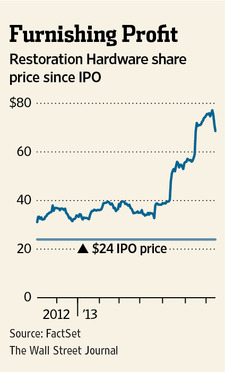
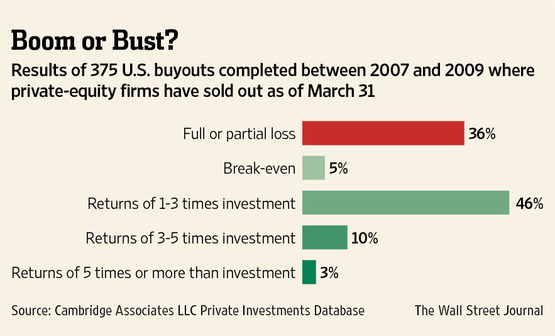
RH +1.01% Once teetering on the edge of bankruptcy and subject of a buyout bidding war during which offers shrank, Restoration Hardware Holdings Inc. RH +1.01% is turning into a bonanza for its private-equity owners. The firms that bought the luxury-home-furnishings retailer in 2008 are on track to make about eight times their initial investment, when including their remaining stock holdings in the company, according to a Wall Street Journal analysis of securities filings. This is a huge return among deals struck in the years leading up to and during the financial crisis. Five years ago, as the housing crash crimped the company’s profits, a group led by Connecticut private-equity firms Catterton Partners and Tower Three Partners LLC and the retailer’s chief executive took the company private for about $177 million. Restoration still doesn’t turn out consistent profits. But today the retailer, which returned to public ownership in a November initial public offering, has a stock-market value of about $2.7 billion. Read more of this post

Caution: Huge home supply in Singapore; Investment homes face declining rental yield

Caution: Huge home supply

Monday, Jul 15, 2013

Christine Li

My Paper

SINGAPORE – Three weekends ago, eager buyers snapped up all of the 738 units (498 condo units and 240 Soho-inspired units) of the J Gateway condominium in the west within 24 hours. The remarkable performance surprised market watchers, including many developers, because the last time a sizeable project was fully sold within such a short span of time was in 2009, with Optima@Tanah Merah. One question that figures is: “Why are people still buying when prices are at a record high?” Read more of this post

JPMorgan, Goldman eye sales of metal warehouse business; An upcoming dehoarding effect in metals?

JPMorgan, Goldman eye sales of metal warehouse business: FT

5:54pm EDT

(Reuters) – JPMorgan Chase & Co (JPM.N: Quote, Profile, Research, Stock Buzz) is following a move by rival Goldman Sachs Group Inc (GS.N: Quote, Profile, Research, Stock Buzz) to explore sales of its metal warehouse business, the Financial Times said on Sunday. Citing people familiar with the matter, the newspaper said on its website on Sunday that both U.S. banks have in recent months informally started to seek potential buying interest for their warehouse units. A Goldman spokesman said the firm has no comment. A spokeswoman at JPMorgan did not immediately return calls for comment. In April, Reuters first reported Goldman has explored a sale of its metals warehousing business Metro International LLC, just three years after the investment bank bought the firm for $550 million. A proposed rule change by the London Metal Exchange (LME) to relieve bottlenecks that slow metal delivery out of warehouses could cut into profits for the metal warehouse industry, the FT said. Sources told the FT that JPMorgan has recently started a sales process for its warehousing unit, Henry Bath, although the discussions began before the LME’s rule change proposal. JPMorgan has also discussed sales of some of its physical metal trading book, although there is no direct connection between the two deals, the FT said. Several U.S. banks including Goldman are locked in discussions with the Federal Reserve over their right to keep owning and operating physical commodity assets like warehouses, oil storage tanks, and pipelines following their conversion to bank holding companies during the financial crisis. Under U.S. banking regulations, banks are usually barred from owning physical commodity assets that they operate.

An upcoming dehoarding effect in metals?

Izabella Kaminska

| Jul 15 13:54 | 15 comments | Share

An interesting bit of news, by way of the FT’s Jack Farchy and Daniel Schäfer this week:

JPMorgan Chase and Goldman Sachs are seeking to sell their metal warehousing units just three years after their controversial entry to the industry, even as a proposed rule change by the London Metal Exchange is likely to reduce the attractiveness of the business. Read more of this post

Smuggling rice to Thailand – like coals to Newcastle; “No one can differentiate which one is Thai rice and which one is Cambodian rice. That makes it easy to smuggle rice in and make a profit by selling it to the government”

Smuggling rice to Thailand – like coals to Newcastle

5:25pm EDT

By Apornrath Phoonphongphiphat and Naveen Thukral

SA KAEO, Thailand/SINGAPORE (Reuters) – Hidden in 18-wheeler trucks, carts and pick-up vans, hundreds of thousands of tonnes of rice are being smuggled from Cambodia and Myanmar into Thailand, although the country holds enough stocks to meet half the world’s annual trade in the commodity. A populist program to support prices has led to the Thai government paying its farmers almost double prevailing prices in Cambodia and Myanmar. Farmers and traders in the neighboring countries are trying to take advantage, sending their grain across the border to be sold into the Thai intervention scheme. The equivalent of 750,000 tonnes of milled rice is being smuggled into Thailand a year, mainly from Cambodia and Myanmar, according to estimates of analysts and traders who have studied the illicit shipments. “No one can differentiate which one is Thai rice and which one is Cambodian rice. That makes it easy to smuggle rice in and make a profit by selling it to the government,” said Kiattisak Kalayasirivat, managing director at Thai trader Novel Agritrade. Read more of this post

Hong Kong Horse Bets Exceed Las Vegas Casinos’: Chart of the Day

Hong Kong Horse Bets Exceed Las Vegas Casinos’: Chart of the Day

iZW5Hir5tiuA

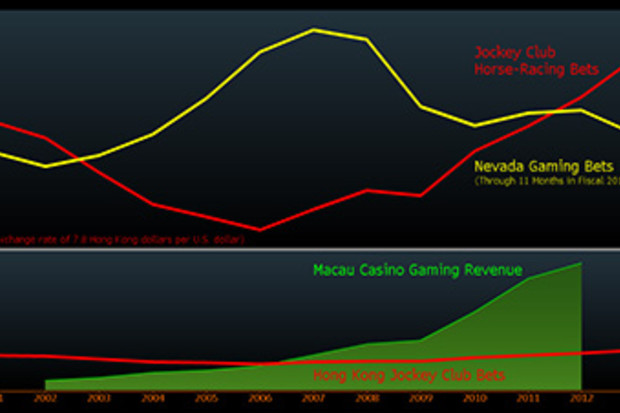
Bets on horse races in Hong Kong are poised to exceed wagers at Nevada’s casinos for a second straight year, with the city’s sole legal outlet for gambling seeking to lure punters from neighboring Macau.

The CHART OF THE DAY compares the Hong Kong Jockey Club’s annual betting totals with gaming revenue from Nevada’s casinos. Wagers of HK$93.8 billion ($12 billion) from 83 horse-race meetings in the fiscal year to June 30 were 19 percent more than Nevada’s combined take in the 11 months through May. Bets at the club, set up in 1884 when Hong Kong was under British rule, exceeded those in the U.S. gambling hub in fiscal 2012 for the first time in about a decade, according to data compiled from the club and Nevada regulators. Read more of this post

Arguments about whether China will grow at 7% or 7.5% are “pointless” because the economy is already in a financial crisis which may only worsen if the government doesn’t address the country’s crippling debt problem

SUNDAY, JULY 14, 2013 – 16:30

China Govt Advisor Says Economy In Crisis As Debt Costs Spiral

BEIJING (MNI) – Arguments about whether China will grow at 7% or 7.5% are “pointless” because the economy is already in a financial crisis which may only worsen if the government doesn’t address the country’s crippling debt problem, a senior government researcher has warned.

Xia Bin, an economist with the State Council’s Development Research Center and government advisor, said Beijing needs to stop using bland rhetoric about “stabilizing the economy” and focus on tackling a debt burden whose interest payments alone tally nearly CNY6 trillion a year. Read more of this post

Once known as “Atomic Town” in China, Xihai has been transformed into a heaven for cyclists from home and abroad

Atomic Town” now heaven for cyclists

English.news.cn   2013-07-13

XINING, July 13 (Xinhua) — Once known as “Atomic Town” in China, Xihai has been transformed into a heaven for cyclists from home and abroad. Xihai Town, where the country’s first atomic and hydrogen bombs were created in the 1960s, sits along the northern bank of the Qinghai Lake in northwest China’s Qinghai Province. The once-forbidden mysterious town has witnessed cyclists swarming to attend the Tour de Qinghai Lake, an international road cycling race since 2002. “They have come here every year for the past 12 years,” said Gyumtsho, a 77-year-old woman, who was sitting in the shade watching cyclists pass the finishing line of the fifth section of this year’s race, which kicked off on Sunday. Read more of this post

Experts skeptical of Old Summer Palace repairs

Xinhua Insight: Experts skeptical of Old Summer Palace repairs

by Xinhua writers Ji Shaoting, Dai Ying and Yue Ruifang

English.news.cn   2013-07-13

BEIJING, July 13 (Xinhua) — The Old Summer Palace, an ancient royal garden that was nearly destroyed by British and French troops 150 years ago, is experiencing yet another change. The core area of the Old Summer Palace, or “Yuanmingyuan” in Chinese, is undergoing renovations and repairs. However, experts from the Society of Yuanmingyuan believe the repair project is doing more harm than good. The ruins of the palace are among 150 sites designated to be protected and repaired under a plan issued by the State Administration of Cultural Heritage on July 3. Read more of this post

China Protest Forcing Nuclear Retreat Shows People Power; China currently has 17 nuclear power-generating units in operation and 28 under construction

China Protest Forcing Nuclear Retreat Shows People Power

Protests in a southern Chinese city last week that forced local authorities to abandon plans for a uranium-processing facility highlight the growing willingness of ordinary people to challenge the state on environmental issues.

The proposed Longwan Industrial Park project won’t be approved “in order to fully respect the opinion of the masses,” the government of Heshan, Guangdong province, said in a statement on its website on July 13. A “social-stability risk assessment” of the proposal that was released for public awareness generated “much opposition,” it said. Read more of this post

Milk Price War Pits California Dairy Farms Against Cheesemakers

Milk Price War Pits California Dairy Farms Against Cheesemakers

Ray Souza’s voice cracks a bit when he says it, when he tells how his family’s Turlock, California, dairy farm is struggling to pay the bills.

“We go from black to red month by month,” the 66-year-old said. “For us, it’s break even at best.”

Souza is like many other dairy farmers in the state who say the price they’re paid for milk from cheese producers isn’t enough to cover the soaring cost of feeding cows. Those economics have caused a fifth of California’s dairies to shutter since 2007, according to state agricultural figures. Read more of this post

Granny’s Gold Bars Are Key to Vietnam Push to Boost Dong

Granny’s Gold Bars Are Key to Vietnam Push to Boost Dong

The target of Vietnam’s campaign to stabilize its currency is in the locked bedroom wardrobe of retired civil servant Vu Thi Huong: gold bars.

“It’s been my habit for ages, buying gold whenever I can save up some money,” said Huong, 57, who watches the financial news every day to monitor the price of the precious metal. “With gold, I can save my fortune and later on have something valuable to pass down to my children and grandchildren.”

Huong is among millions of Vietnamese who hold an estimated 300 tons to 400 tons of bullion to store their wealth — valued at as much as $19 billion at domestic prices and equal to official U.K. holdings — a legacy of more than a century of war, revolution and economic turbulence. The central bank wants to convert the hoard, much of it smuggled in, into dong deposits to strengthen the currency, which has slid 21 percent against the dollar in five years. Read more of this post

Stella International Takes on LVMH to Expand in Paris

Stella International Takes on LVMH to Expand in Paris

Stella International Holdings Ltd. (1836), the Asian shoemaker that manufactures for companies such as Prada SpA (1913), plans to expand its own brands in Paris, turning into a lower priced competitor to luxury clients there.

The contract manufacturer plans to add two shops in Paris by end of this year and expand into other locations in Europe, Stephen Chi, chief executive officer of the company’s women’s footwear and retail business division, said in a July 10 phone interview. The company, which was founded in Taiwan and trades on the Hong Kong stock exchange, already has one Paris store. Read more of this post

China Wealth Eluding Foreigners as Equities Earn 1% for 20 Years

China Wealth Eluding Foreigners as Equities Earn 1% for 20 Years

China’s 20-year economic boom has boosted the wealth of its 1.3 billion citizens at the fastest pace worldwide and spawned some of the biggest companies in history. Foreigners earned less than 1 percent a year investing in Chinese stocks, a sixth of what they would have made owning U.S. Treasury bills.

The MSCI China Index has gained about 14 percent, including dividends, since Tsingtao Brewery Co. (168) became the first mainland company to sell H shares to international investors in Hong Kong in July 1993. That compares with a 452 percent return in the Standard & Poor’s 500 Index, 322 percent in the MSCI Emerging Markets Index and 86 percent from Treasuries. Only the MSCI Japan Index had a weaker performance among the 10 largest markets, losing about 1 percent. Read more of this post

Serendipity and Samples Can Save Barnes & Noble

Serendipity and Samples Can Save Barnes & Noble

Turmoil at Barnes & Noble Inc. (BKS), where Chief Executive Officer William Lynch resigned last week after the company posted an unexpectedly large loss in the quarter ended April 30, has people in the publishing industry worried. “We’re all forced to ask: What would the book discovery environment look like without Barnes & Noble?” writes Rich Fahle, a former Borders executive who runs a marketing agency for authors.

The question zeroes in on a growing problem for the U.S. book industry. Although readers increasingly purchase books online, they still rely on physical bookstores to discover what to buy. In-store displays are the most common way, after personal recommendations, that frequent buyers find new books, accounting for about 20 percent of purchases, according to a survey by the Codex Group. Yet brick-and-mortar stores are disappearing, as customers defect to the convenience and, in many cases, lower prices of Amazon.com Inc. Read more of this post

Dymocks: out of the ashes; The reports of the iconic bookshop’s demise have been greatly exaggerated

Dymocks: out of the ashes

July 15, 2013

Belinda Williams

The reports of the iconic bookshop’s demise have been greatly exaggerated. There are many lessons to be learnt from a notoriously gloomy prediction made two years ago that online shopping would see the end of Australian bookstores. “In five years, other than a few specialist booksellers in capital cities, we will not see a bookstore; they will cease to exist,” then federal small business minister Nick Sherry stated at the time while launching a program to encourage small businesses to expand online. Today, Dymocks bookstores are still standing. In fact, the iconic bookstore claims to have sold more books last year than ever before. But customers’ reading appetites cannot be solely credited for the 130-year-old bookseller’s endurance. The collapse of REDgroup (parent of Borders and Angus & Robertson chains) saw the abrupt departure of Dymocks’ sidewalk competition. Read more of this post

Young professionals in Malaysia struggle to own property

Young professionals in Malaysia struggle to own property

Now with rising house prices and a shorter home loan repayment period, some say it has become an impossible struggle. -The Star/ANN
Christina Chin
Sun, Jul 14, 2013
The Star/Asia News Network

Chua pondering the possibility of ever owning his first apartment in Penang. Malaysia – Wanting and actually being able to afford your own place are two very different things. With the oversupply of high-end condominiums shadowing the property market, fresh graduates and young professionals may have to either send out an SOS to their parents for cash or live at home because having “my own space” just got a little tougher. Fresh graduate K.T.S. Chua, 23, who recently took out a RM30,000 personal loan to start a hotdog business, is relieved at narrowly missing the July new personal loan cap ruling but the shorter home loan repayment period has dampened the budding entrepreneur’s plan for a bachelor pad. He currently lives at home with his parents and two brothers. “I was looking to get a place of my own; unfortunately, the new ruling will gravely affect my plans to purchase a home. Without the new cap, it is already so hard for me to buy property and I will have to put it on hold. Read more of this post

The hidden costs of investing

July 12, 2013 5:43 pm

The hidden costs of investing

By Lucy Warwick-Ching

Hidden Costs

Picture the scene. You’ve splashed out on the latest Aston Martin. But as you climb into the driver’s seat you’re asked to pay a fee for the key to the car and another charge for its manual. Then, just as you’re about to drive off the dealer’s forecourt you’re hit with yet more charges – an exit fee for leaving the garage, followed by separate charges for the leather seats and passenger door. Most of us wouldn’t keep silent if this scenario happened in real life, so why do so few investors complain about the percentage of their money that goes on charges? “Confusion about charges on investment funds and pensions has left most investors in the dark about how much they are paying,” says Gina Miller of SCM Private, a wealth manager, who is spearheading a“True & Fair Campaign” to encourage better disclosure of investing costs. Read more of this post

The New Wave of IPOs: Initial public offerings are back in vogue. Here’s why investors should be wary

July 12, 2013, 5:57 p.m. ET

The New Wave of IPOs: Initial public offerings are back in vogue. Here’s why investors should be wary.

TELIS DEMOS and JOE LIGHT

BF-AF338_13WIws_G_20130712182714

There are lots of IPOs to pick from. But that doesn’t mean you should. The U.S. initial-public-offering market is on track this year to produce the most deals since 2007. In the second quarter, 80 companies publicly began the process of registering for an IPO in the U.S., more than double the number that did so in the same period a year ago, according to accounting firm PricewaterhouseCoopers. The publicly available IPO pipeline includes 140 companies seeking to raise a total of $30.5 billion, the firm said. That is on the top of the 95 companies that already have debuted this year, which have raised $23 billion, according to market-data firm Dealogic. Some of the best-performing IPOs this year have been those of familiar companies, such as SeaWorld Entertainment, SEAS -1.54% whose shares are up 42% since its April debut; restaurant chain Noodles & Co.,NDLS -1.72% which has jumped 139% from its June IPO; and Norwegian Cruise Line Holdings, NCLH +0.32% up 66% from its January deal. By comparison, the Standard & Poor’s 500-stock index is up 18% so far this year. There have been duds, too. Gogo, GOGO +6.88% which provides Internet services on airplanes, and online ad network Tremor Video TRMR -0.38% are down 18% and 20%, respectively, since their June debuts. Read more of this post

Deutsche Bank Opaque Loans From Brazil to Italy Hide Risk

Deutsche Bank Opaque Loans From Brazil to Italy Hide Risk

By Elisa Martinuzzi and Vernon Silver – Jul 10, 2013

Deutsche Bank AG (DBK), perennially among the top three in global credit markets, made billions of dollars of loans to banks worldwide since 2008 and accounted for them in a way that obscured their continuing risk to investors.

Germany’s largest bank managed to lend to firms from Brazil to Italy while making the transactions disappear from its balance sheet, even though it still is owed the money, according to four people with knowledge of the practice and internal documents provided to Bloomberg News. Read more of this post

China’s banking regulator has taken further steps to tighten its oversight of wealth management products by asking banks to register these products before selling them to the public

July 12, 2013, 7:42 a.m. ET

China Orders Banks to Register Wealth Management Products

China’s banking regulator tightens supervision over fast-growing segment

BEIJING—China’s banking regulator has taken further steps to tighten its oversight of wealth management products by asking banks to register these products before selling them to the public, according to a document seen by The Wall Street Journal on Friday.

The new rule would give the regulator increased information on these high-yield products, though it could slow the speed at which they come to market, a local banker who received the document said. Read more of this post

‘Diaosi’ become mainstream consumer force in China; “Diaosi” is originally a derogatory term referring to unattractive, poor, hopeless young people who stay at home playing online games

‘Diaosi’ become mainstream consumer force in China

Staff Reporter

2013-07-11

“Diaosi,” originally a derogatory term referring to unattractive, poor, hopeless young people who stay at home playing online games, has gained widespread use as a mainstream social group. The term is especially favored by programmers and those in the media, aged between 30-39.

Shi Yuzhu, owner of a major e-commerce firm, likes to call himself a diaosi, as he found that those people are major patrons of his website. Read more of this post

China’s Fund Management Firms Seek to Emulate Alibaba’s Yu E Bao’s Success

07.12.2013 14:48

Fund Management Firms Seek to Emulate Yu E Bao’s Success

Manulife Teda starts recruiting service personnel as other firms mull an e-investment presence on Taobao

By staff reporter Cao Wenjiao

(Beijing) – Fund management companies are hurrying to establish their presence on Alibaba’s Internet platforms, after online shoppers showed great interest in Yu E Bao, a money market fund the e-commerce giant recently launched.

Beijing-based Manulife Teda Fund Management Co. has started recruiting client service personnel for its planned virtual store on Taobao, Alibaba’s e-commerce website. Read more of this post

Banks jolted as regulators seek to crack down on leverage

Banks jolted as regulators seek to crack down on leverage

10:21am EDT

By Steve Slater

LONDON (Reuters) – New demands from regulators to force banks to keep a lid on risk-taking after the financial crisis has re-ignited a debate over how best to strengthen the industry without stifling lending or alienating investors.

Bank regulators in the United States this week set out plans to impose a leverage ratio on banks that caps their lending based on a simple assessment of their equity. Britain and Switzerland have also demanded their banks “gold-plate” a global rule for this leverage cap or ratio. Read more of this post

ETF Simplicity Betrayed by Volatility in Market Selloff

ETF Simplicity Betrayed by Volatility in Market Selloff

Emerging-market stocks can be volatile to begin with. Investing in them through exchange-traded funds can add another layer of price swings for investors, especially in times of market stress.

Share prices for the 10 largest diversified emerging-market ETFs on average were 42.6 percent more volatile than their underlying indexes from May 22 to June 24, when comments by Federal Reserve Chairman Ben S. Bernanke triggered a selloff that sent emerging-market stocks to a one-year low, according to data compiled by Bloomberg. The group included ETFs from BlackRock Inc. (BLK), State Street Corp. and Vanguard Group Inc., the largest managers of the products. The five biggest emerging-market index mutual funds, by contrast, were 4.8 percent more volatile than their indexes. Read more of this post

A Peek at Trucking Data, and Then the Stock Surged; Glimpses of Key Figures Can Aid Investors in Truck Stocks, Soybeans, Bed Makers and Others

July 11, 2013, 11:34 p.m. ET

A Peek at Trucking Data, and Then the Stock Surged

Glimpses of Key Figures Can Aid Investors in Truck Stocks, Soybeans, Bed Makers and Others

MICHAEL ROTHFELD, JOHN CARREYROU and BRODY MULLINS

OB-YE026_2INDIC_G_20130711233009

Just before the stock market closed March 4, an industry-research firm emailed a monthly report on commercial-truck orders to hedge funds and other subscribers that pay the group $1,700 a year for the exclusive service. The early peek was worth the expense. The next day, after the bullish truck numbers were reported in the media, shares in truck makers surged, generating a tidy profit for investors who traded on the report in the late moments of the previous session. Even as federal, state and congressional investigators examine the preferential release to investors of broad economic data—such as the University of Michigan consumer-sentiment survey—some investors tap numerous other more narrowly focused and less well-known industry indicators ahead of the rest of the investing public. Read more of this post