China’s top auditor: US$943m embezzled from China’s affordable housing project
June 29, 2013 Leave a comment
$943m embezzled from China’s affordable housing project
Updated: 2013-06-28 14:46
( Xinhua) Read more of this post
R.E.S.-ilience in Value Creation 《竹经:经商经世离不得立根创新》
June 29, 2013 Leave a comment
$943m embezzled from China’s affordable housing project
Updated: 2013-06-28 14:46
( Xinhua) Read more of this post
June 29, 2013 Leave a comment
The Days Of The Super-Powered Chinese Economy Are Over
06/28/2013 20:36 -0400
Authored by Michael Pettis, originally posted at Foreign Policy,
In the months leading up to last week’s liquidity crunch, in which the cost of short-term loans in China spiked and roiled global markets, most financial institutions had been lowering their growth forecasts for China. In mid-June, the World Bank revised its 2013 Chinese growth forecast from 8.4 percent to 7.7 percent; HSBC, Credit Suisse, and Goldman Sachs, among others, have also downgraded their Chinese growth forecasts several times over the last two years, as quarterly data have kept revealing lower-than-expected economic growth and higher-than-expected credit growth. Many banks now estimate around 7 percent to be the new normal. Read more of this post
June 29, 2013 Leave a comment
Saturday June 29, 2013
Highlighting the rich and evasive
By ERROL OH
IN CASE you’ve missed it, we’re in the midst of a “global crackdown on tax evasion”. So far this month, Bloomberg, Los Angeles Times, Reuters,The Guardian and The New York Times have used this phrase in articles about recent measures to step up international cooperation in nabbing tax dodgers.
The most significant of these was the outcome of the two-day G8 Summit at Lough Erne, Northern Ireland, last week. Tax was clearly high on the agenda in this meeting of leaders from Canada, France, Germany, Italy, Japan, Russia, the United States and Britain. Read more of this post
June 29, 2013 Leave a comment
Saturday June 29, 2013
M&As worldwide at four-year low
NEW YORK: Mergers and acquisitions (M&A) around the world slowed to their most sluggish pace since 2009 in the first half of 2013, Thomson Reuters data show, as recession-hit European companies put the brakes on transactions and their healthier US counterparts took a cautious approach amid market uncertainty.
Some US companies took advantage of cheap financing and abundant cash to strike big deals early this year. More chief executive officers have recently taken a pause, though, partly because of worries that they might find themselves overpaying for assets if interest rates rise, which would likely pull stock markets lower. Read more of this post
June 29, 2013 Leave a comment
June 28, 2013, 6:52 p.m. ET
In Search of Safety
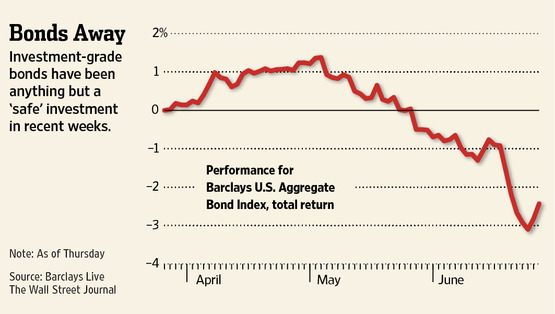
It is time for investors to rethink safety.
Until May 22, when Federal Reserve Chairman Ben Bernanke told Congress that the central bank might start scaling back its massive bond-buying program this year, investors could find shelter from market drops via bonds or stocks that pay high dividends and are less volatile. But since then, it is these same “safe” investments that are being punished the most. The beauty of assets traditionally perceived as “safe”—or, more correctly, defensive—was that, while they didn’t gain as much as risky assets in boom periods, they offered investors some protection in times of turmoil. This past month’s roller-coaster ride has offered a preview of how the next few years might be different. Read more of this post
June 29, 2013 Leave a comment
June 27, 2013 7:01 pm
Prosperity fuels protest in the new age of unrest
By Philip Stephens
The leaders most likely to survive are those who will act on corruption and inequality
In Istanbul, the protesters want green space and the right to enjoy a glass of wine. In São Paulo, the demand on the streets is for decent public transport and a crackdown on police corruption. The placards may be different, but the forces at work in these recent disturbances have been much the same. Politics in the rising world has been left behind by the tumultuous pace of economic and social change. The stresses are not about to go away any time soon. Welcome to the age of unrest.
June 29, 2013 Leave a comment
Why the world’s biggest democracy still fails too many of its people
Jun 29th 2013 | DELHI |From the print edition
An Uncertain Glory: India and its Contradictions. By Amartya Sen and Jean Drèze. Allen Lane; 434 pages; £20. To be published in America in August by Princeton University Press; $29.95. Buy from Amazon.com, Amazon.co.uk
AS A conundrum it could hardly be bigger. Six decades of laudably fair elections, a free press, rule of law and much else should have delivered rulers who are responsive to the ruled. India’s development record, however, is worse than poor. It is host to some of the world’s worst failures in health and education. If democracy works there, why are so many Indian lives still so wretched? Read more of this post
June 29, 2013 Leave a comment
Spooked by shale: The shale-gas revolution unnerves Russian state capitalism
Jun 29th 2013 |From the print edition

A SPECTRE is haunting Russia: the spectre of shale gas. It is seeping into the salons of power, discomfiting Russia’s leaders and their bizniz cronies. Energy companies account for half of the value of the Russian stockmarket, and a single, state-backed firm, Gazprom, produces 10% of the country’s exports. Russian politics are also built on conventional oil and gas: Vladimir Putin is in essence the CEO of Russian Energy Inc. The revolution in unconventional gas production from shale beds, which began in the United States and is now spreading around the world, is shaking Russian state capitalism to its foundations. Read more of this post
June 29, 2013 Leave a comment
For Third Point Manager, It’s Not Easy Being Short
MARKETS, BANKS, FINANCIALS, INVESTING, WALL STREET, INVESTMENT STRATEGY, TESLA MOTORS INC, GREEN MOUNTAIN COFFEE ROASTERS INC, BUSINESS NEWS
CNBC.com | Monday, 24 Jun 2013 | 2:17 PM ET
The $12 billion hedge fund Third Point has been on a tear this year, with trades like a long Nikkei position and shares of Yahoo contributing to overall returns of 15 percent in its offshore fund through May. One area that has been working less well: a specialized short book that relies on heavy research to take bearish positions on stocks. Amid a 10 percent Standard & Poor’s rally this year, some of Third Point’s short holdings have held it back, as even the most beaten-down companies have staged remarkable comebacks.
June 29, 2013 Leave a comment
Singapore Tightens Rules for Home Loans in Latest Curbs
Singapore unveiled new rules governing how financial institutions grant property loans to individuals, extending efforts to curb speculation as prices in Asia’s second-most expensive housing market continue to rise.
Starting today, a new framework requires that lenders take a borrower’s debt into consideration when granting property loans, the Monetary Authority of Singapore said in a statement yesterday. Home loans should not exceed a total debt servicing ratio of 60 percent and those that do will be considered “imprudent,” it said. Read more of this post
June 29, 2013 Leave a comment
It’s Official: Student Loan Rates Will Double Monday
SHELBY BREMER , CREDIT.COM 26 MINUTES AGO 3
More than 7 million students will see interest rates on their student loans double from 3.4 to 6.8 percent on Monday, after the failure of Congress to pass legislation to prevent the automatic rate hike that they successfully deferred for a year last summer.
Despite the introduction of several bills to serve as a solution, lawmakers will leave for the week-long July 4 recess without implementing any of them, letting the July 1 deadline pass. Any students taking or renewing federal subsidized Stafford loans after that deadline can expect to pay, for example, an additional $3,000 on a $23,000 loan paid off over 10 years. Read more of this post
June 29, 2013 Leave a comment
Entrepreneurs need not apply: Companies shun the self employed
By Vickie Elmer 8 hours ago
Recession prompted millions of laid off workers and new graduates to jump into self-employment—some with enthusiasm and others with reluctance because they couldn’t find anything better. Now, according to new research, it seems they aren’t wanted back.
That’s only ironic because company executives and human resources say they want self starters, innovative hires, a certain entrepreneurial spirit. Read more of this post
June 29, 2013 Leave a comment
Japan Is Counting on Friendly Robots to Save Its Economy
By Lily Kuo

Japan’s space agency announced today that it will be sending a small robot named “Kirobo” into outer space (paywall) to keep Japanese astronauts company. Engineers fashioned the pint-sized robot to be cute, attentive (it will recognize people by their faces), and responsive to questions. A sister robot (“Mirata”) will stay in Japan as backup crew to analyze Kirobo’s performance. The latest automated venture is another sign of the country’s robot obsession. Here are a few examples of how robots are infiltrating everyday life in Japan: Read more of this post
June 29, 2013 Leave a comment
The myth of the all-weather portfolio
September 24th, 2009
For quite some time now financial advisers of all stripes have been in search of the elusive “all-weather portfolio.” That is, an asset allocation that serves to protect investors in bad times (bear markets) and performs well in good times (bull markets). Does an all-weather portfolio really exist?
Prior to the economic crisis many would have answered in the affirmative and would have pointed to the large university endowment funds as examples of investors who had achieved this goal. However the aftermath of the credit crisis and ensuing bear market indicate these funds have failed to achieve this goal. Read more of this post
June 29, 2013 Leave a comment
China, the devaluation possibility
| Jun 28 13:31 | 7 comments | Share
A couple of points from Deutsche Bank’s GEM Equity strategy team on Friday to file under the “it’s China, not the Fed, that’s driving everything at the moment” meme:
…‘we believe that the improvement in the Chinese economic and corporate data, which has become evident since the end of August, is not sustainable’ and that ‘the Chinese growth story is starting to unravel’. As regular readers will know, our negative structural view derives from an examination of the relationship between the corporate sector and the state, especially at a local level, which we have documented in two longer research reports (China’s corporate sector; a messy transition’, 15 May 2012, and ‘China; no quick fix for the Beijing model’, 30 August 2012). Read more of this post
June 29, 2013 Leave a comment
Beijing Residents Told to Stay In as Smog Exceeds Exposure Limit
Beijing told its 20 million residents to avoid outdoor activities as a U.S. Embassy pollution monitor showed levels of smog surpassing hazardous levels in the Chinese capital.
Concentrations of PM2.5, fine air particulates that pose the greatest health risk, rose to 520 micrograms per cubic meter at 3 p.m. near Tiananmen Square from an average of 260 in the past 24 hours, according to the Beijing Municipal Environmental Monitoring Center. That reading was more than 20 times higher than the World Health Organization recommendations of no higher than 25 for day-long exposure. Read more of this post
June 29, 2013 Leave a comment
Updated June 28, 2013, 12:32 p.m. ET
Low-Key Politician to Take Helm of China’s $500 Billion Fund
Ding Xuedong Is Set to Be Named Head of China Investment Corp.

BEIJING—A relatively obscure senior politician with little international experience is taking the reins of China’s $500 billion sovereign-wealth fund, an appointment that comes as it tries to adapt to a quickly changing global landscape. Ding Xuedong, 53 years old, is set to be named chairman of China Investment Corp., according to people with direct knowledge of the matter. His appointment would end months of speculation over the position sparked by China’s once-a-decade leadership change. Read more of this post
June 29, 2013 Leave a comment
Henry Paulson Sees Volatility, Pain as Fed Programs Phased Out
Phasing out the Federal Reserve’s stimulus and monetary accommodation will cause some market volatility and pain, said former U.S. Treasury Secretary Henry Paulson.
The Fed (FED) has been making $85 billion in monthly bond purchases and holding the key interest-rate target near zero to spur job growth and faster U.S. economic expansion. The central bank will probably taper its asset purchases later in 2013 and stop them around mid-2014 as long as the economy performs in line with its projections, Chairman Ben S. Bernanke said June 19. Read more of this post
June 29, 2013 Leave a comment
Bonds Tied to Mortgages Poised for the Biggest Losses Since 1994
Government-backed U.S. mortgage bonds declined after a two-day rally, extending quarterly losses that are on track to be the worst in almost two decades.
Fannie Mae’s 3 percent, 30-year securities fell about 0.2 cent today to 97.6 cents on the dollar as of 11:19 a.m. in New York, down from about 103 cents on March 28, according to data compiled by Bloomberg. A Bank of America Merrill Lynch index tracking the more than $5 trillion market lost 2 percent this quarter through yesterday, the most since the start of 1994. Read more of this post
June 29, 2013 Leave a comment
Lula Default Scare Echoed in Brazil’s Worst Bond Sell-Off
Brazilian government bonds are suffering the biggest quarterly losses since the run-up to former President Luiz Inacio Lula da Silva’s election in 2002 led to speculation that the nation would default.
Dollar-denominated bonds from Brazil, Latin America’s biggest nation, plunged 7.55 percent since the end of March, the biggest slide since a 16 percent drop in the third quarter of 2002 before Lula’s October election that year. The loss this quarter exceeds a decline of 6.15 percent for countries with triple-B ratings, according to Bank of America Corp. Read more of this post
June 29, 2013 Leave a comment
June 28, 2013, 6:27 a.m. ET
This Time Is Different: Gold’s Plunge Doesn’t Lure Retail Buyers
Unlike after April selloff, Chinese and Indian consumers hold back
CLEMENTINE WALLOP And BIMAN MUKHERJI
When gold prices tumbled in the spring, the world’s biggest buyers took advantage of the lower prices to snap up coins, bars and jewelry. In the current selloff, consumers in China and India are holding back.
That has worsened gold’s decline. It has now fallen 39% from its peak in 2011, and it dropped below $1,200 an ounce in U.S. trading Thursday for the first time in nearly three years. Read more of this post
June 28, 2013 Leave a comment
China Bad-Loan Alarm Sounded by Record Bank Spread Jump
Borrowing costs for Chinese banks have surged the most in at least six years this month as rating companies say a cash crunch threatens to swell bad loans.
The yield spread for one-year AAA bank bonds over similar-maturity sovereign notes jumped 56 basis points so far this month to 163 basis points, the most in ChinaBond records going back to 2007. The similar AA gap widened 59 basis points to 188. Even as China Construction Bank Corp. (939) President Zhang Jianguo said yesterday cash conditions have normalized, the benchmark seven-day repurchase rate was fixed at 6.85 percent, almost twice the 3.84 percent average for this year. Read more of this post
June 28, 2013 Leave a comment
Pot Bellies Transform $2,000 Suits With India Expanding
A few months ago, Corneliani SpA, an Italian maker of svelte $2,000 suits, noticed it was losing some business in India. Then it realized why: It wasn’t catering to overweight customers, especially those with pot bellies.
So, in April, it began a made-to-measure service that includes options for shoppers seeking “odd”-sized suits, overcoats or trousers, said Prem Dewan, who oversees Indian retail operations. Businessmen, celebrities and politicians have come calling. Read more of this post
June 28, 2013 Leave a comment
REIT Rout Seen Curtailing Deals as Rising Rates Cut Share Sales
Property purchases by U.S. real estate investment trusts are likely to be curtailed after almost $36 billion of deals this year as a tumble in share prices makes a key source of capital costlier.
The Bloomberg REIT Index has dropped 11 percent from an almost six-year high in May as the yield on 10-year Treasury notes surged amid speculation the Federal Reserve would reduce bond purchases, which have kept borrowing costs low. The decline was three times the slump in the Standard & Poor’s 500 Index. Read more of this post
June 28, 2013 Leave a comment
June 27, 2013, 12:54 p.m. ET
India’s Last Maharaja
The 38th successive ruler of an ancient Indian clan, Gaj Singh II harbors deep connections to the past, but his innovative approach to protecting his family’s historical treasures is providing his country with a model for the future.



BLUE HEAVEN | Built in the 15th century by Rao Jodha, the walls of the fortress of Mehrangarh are 70 feet thick. Many of the houses of Jodhpur are painted blue to deflect the sunlight, and, according to folklore to repel insects.
FIT FOR A KING | The steps of Umaid Bhawan Palace, from which Mehrangarh is visible. Now partly a Taj hotel, revenues are up 80 percent thanks to a boost in domestic tourism.
FAMILY AFFAIR | Gaj Singh II, known to some of his staff as the ‘Jazz Age maharaja’ for his love of jazz, in front of a portrait of his ancestor, Takhat Singh
EACH SPRING, Maharaja Gaj Singh II hosts a Sufi music festival inside his family’s vast desert fort in the Indian city of Jodhpur. From a distance, this monumental sandstone fortress, called Mehrangarh, looms over the city’s chalky blue buildings, evoking the country’s ancient and otherworldly history. And yet people fly in from across the globe because the festival—and the maharaja who hosts it—blends old India so deftly with new. Read more of this post
June 28, 2013 Leave a comment
INVESTMENT OUTLOOK
July 2013
The Tipping Point
I’ve spun a few yarns in recent years about my days as a naval officer; not, thank goodness, tales told by dead men, but certainly echoes from the depths of Davy Jones’ Locker. A few years ago I wrote about the time that our ship (on my watch) was almost cut in half by an auto-piloted tanker at midnight, but never have I divulged the day that the USS Diachenko came within one degree of heeling over during a typhoon in the South China Sea. “Engage emergency ballast,” the Captain roared at yours truly – the one and only chief engineer. Little did he know that Ensign Gross had slept through his classes at Philadelphia’s damage control school and had no idea what he was talking about. I could hardly find the oil dipstick on my car back in San Diego, let alone conceive of emergency ballast procedures in 50 foot seas. And so…the ship rolled to starboard, the ship rolled to port, the ship heeled at the extreme to 36 degrees (within 1 degree, as I later read in the ship’s manual, of the ultimate tipping point). One hundred sailors at risk, because of one twenty-three-year-old mechanically challenged officer, and a Captain who should have known better than to trust him. Read more of this post
June 28, 2013 Leave a comment
June 27, 2013, 8:44 p.m. ET
Fashionable ‘Risk Parity’ Funds Hit Hard
Strategy, Using Leverage to Boost Returns, Hurt by Market Tumult
MICHAEL CORKERY, CAROLYN CUI and KIRSTEN GRIND
Investors who piled into “risk parity” funds, which follow a popular strategy that promises to make money in most environments, are being hit hard by the current market turmoil. The losses are touching a broad swath of investors, ranging from hedge-fund firms Bridgewater Associates LP and AQR Capital Management LLC, to mutual funds and local pension funds. Risk-parity funds use leverage to try to increase returns on bond investments so they more closely resemble returns of stocks. The basic idea of the strategy is that by equally distributing risks among stocks, bonds and commodities, the portfolio can weather huge price swings without sacrificing returns. Read more of this post
June 28, 2013 3 Comments
Here’s the Real Crisis in Australia
By William Pesek – Jun 27, 2013
Australia (AUNAGDPC) has been called many things: Oz; the land Down Under; the lucky country. But the equivalent of a collateralized-debt obligation?
Canberra can’t be happy to hear its AAA-rated economy likened to one of the reviled investment vehicles that blew up amid the 2008 global crisis. Yet the comparison is being made by some economists, who see the asset underlying Australia — demand from China — beginning to evaporate. No country is more vulnerable to the much-dreaded slowdown in China than resource-rich Australia. The mining boom that fueled nearly all of its recent growth is nearing a cliff of economic risk. “Australia is a leveraged time bomb waiting to blow,” says Albert Edwards, Societe Generale SA’s London-based global strategist. “It is not just a CDO, but a CDO squared. All we have in Australia is, at its simplest, a credit bubble built upon a commodity boom dependent for its sustenance on an even greater credit bubble in China.” Read more of this post
June 28, 2013 Leave a comment
Last updated: June 27, 2013 1:42 pm
ETFs under scrutiny in market turbulence
By Tracy Alloway and Arash Massoudi in New York
Like a tremor that rattles the girders of a gleaming skyscraper, a market sell-off can be the moment that exposes flaws in the plumbing of Wall Street’s favourite products.
For exchange traded funds, a $2tn industry that has boomed in recent years, last week’s tumble in asset prices has unearthed possible cracks in the pipework. Commentators are probing beneath the surface to look at how ETFs, which allow “mom and pop” investors instant access to a multitude of assets, hold up when faced with market turbulence. Read more of this post
June 28, 2013 Leave a comment
06.27.2013 19:10
No Easy Answers for Clean-up of Milk Powder Industry
The government wants domestic companies to consolidate and increase their market share, but this is easier said than done
By staff reporters Qu Yunxu and He Chunmei
(Beijing) – Premier Li Keqiang said in late May at a State Council meeting that the government would supervise the quality of infant milk powder using the same standards as those used for drugs.
Then, on June 4, the Ministry of Industry and Information Technology (MIIT) said that from June 1 to August 31 it would launch a safety inspection of milk powder production in an aim to improve quality and boost consumer confidence. Read more of this post

咬定青山不放松,立根原在破岩中。 千磨万击还坚劲,任尔东西南北风。

